
Original Life Forms:
- Mammal: Star-nosed Mole
- Reptile: Chameleon
- Amphibian: Poison Dart Frog
- Arachnid: Trapdoor Spider
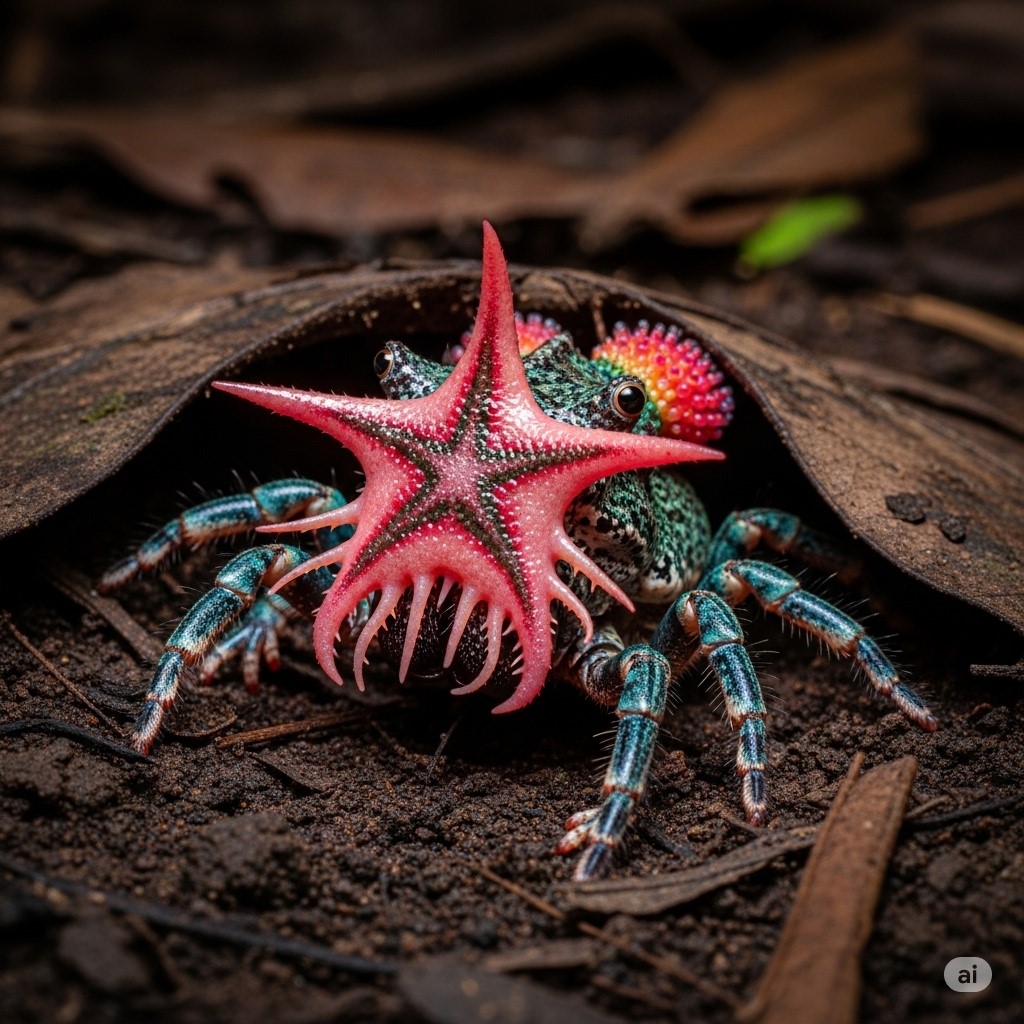
Appearance: This creature is a grotesque, low-slung predator with a body plan that defies simple categorization. It possesses eight powerful, multi-jointed legs like a spider, but they are thick and equipped with heavy, mole-like claws designed for rapid excavation. Its body is covered in a smooth, rubbery skin that is constantly moist, capable of shifting its color and pattern with startling speed to perfectly match the surrounding earth, leaf litter, or stone. The creature’s back secretes a vibrant, toxic mucus, often displaying vivid, shifting patterns of bright orange, electric blue, and deep black as a warning. Its head lacks a conventional face; instead, it is dominated by a grotesque, fleshy, pinkish star composed of twenty-two sensitive, constantly writhing tentacles arranged in a radial pattern. Protruding from just above this nasal star are two independently swiveling, cone-shaped eyes, allowing it to look in two different directions at once. It has no visible mouth until it attacks, at which point a set of powerful chelicerae and fangs unfold from beneath the nasal star.
Size: The Starnose Chameleofrog Spider is a compact creature, roughly the size of a large badger or a medium-sized dog. It typically measures 2 to 3 feet in length and stands about 1.5 feet high, though its low-slung posture often makes it appear smaller. It weighs between 40 and 60 pounds.
Speed: On the surface, it moves with a slow, deliberate crawl at a speed of 20 feet. Its true proficiency is in movement through soil and loose earth, where it has a burrowing speed of 30 feet, using its powerful legs to tear through dirt with incredible efficiency.
Stat Modifiers:
- Strength: -1
- Dexterity: +4
- Constitution: +3
- Intelligence: -4
- Wisdom: +5
- Charisma: -5
Skills:
- Stealth: It is a master of concealment, both through its natural camouflage and its ability to remain perfectly motionless for hours.
- Perception: Its primary sense is touch, using its nasal star to detect the faintest vibrations in the ground, allowing it to pinpoint the location, size, and movement of nearby creatures with extreme accuracy. Its panoramic vision is excellent for spotting aerial threats.
- Athletics: It is an exceptional burrower and can climb rough surfaces with ease thanks to its eight legs and sharp claws.
Behavior: This creature is the epitome of a solitary ambush predator. It spends the vast majority of its life underground in a complex burrow it excavates. The entrance to its lair is sealed with a meticulously constructed trapdoor made of silk, soil, and saliva, which is camouflaged so perfectly as to be nearly invisible. The creature will wait just below this door, its star-like appendage pressed against the inner surface, sensing the world above through vibrations. When suitable prey—a small animal, a large insect, or an adventurer’s foot—steps or lands near the trapdoor, the creature explodes from its hiding place with blinding speed. It attempts to deliver a single, venomous bite before dragging its paralyzed victim down into the darkness of its burrow to be consumed. It is not actively aggressive and will not hunt far from its lair, relying entirely on prey to come to it. If its burrow is discovered or compromised, it will defend the entrance fiercely before attempting to flee by digging a new escape tunnel.
Diet: The creature is an opportunistic carnivore. Its diet consists of anything it can overpower and drag into its lair. This includes giant beetles, rodents, snakes, lizards, ground-nesting birds, and any other small creature unwary enough to trigger its trap. It is extremely efficient, consuming its prey entirely and leaving no waste.
Emotions: The emotional capacity of this creature is virtually nonexistent. It operates on a cold, calculating instinct honed for a single purpose: ambush. Its most dominant state is one of infinite patience, capable of waiting unmoving for days for a potential meal. When it attacks, it is not with anger or malice, but with a pure, predatory efficiency. The only other state it displays is a reactive, defensive panic if its burrow is breached.
Environment Where Found: The Starnose Chameleofrog Spider is found in environments with deep, soft, loamy soil. It thrives in the damp earth of temperate rainforests, humid jungles, and murky swampland floors. It avoids rocky, sandy, or shallow soil where it cannot construct its extensive burrows. Its presence can sometimes be inferred by a patch of ground that seems unnaturally silent and devoid of the usual insect and animal life.
Tags: Aberration, Ambusher, Amphibious, Burrower, Camouflage, Feral, Poisonous, Solitary, Subterranean, Trap-builder, Vibration Sense, Paralytic Venom, Forest, Swamp, Patient Hunter, Multi-limbed, Territorial, Secretive
Age The natural lifespan of a Starnose Chameleofrog Spider can be surprisingly long for a creature of its size, ranging from 25 to 40 years if left undisturbed in a stable environment. They reproduce asexually, once every five to six years after reaching maturity. The creature lays a single, silken egg sac, roughly the size of a fist, which is buried in a specially prepared chamber deep within its burrow. There is no parental care; upon hatching, dozens of tiny offspring, no larger than a thumb, must immediately disperse and dig their own miniature burrows. The mortality rate for these hatchlings is extraordinarily high, as they are vulnerable to predation and environmental hazards. Those that survive the first year enter a juvenile stage for another two to three years, subsisting on insects and worms while they grow. Upon reaching adulthood at around age four, they seek out a permanent territory to construct the large, complex burrow in which they will likely spend the remainder of their lives.
Height This creature maintains a very low profile. Its typical standing height is approximately 1.5 feet from the ground to the top of its back. From the tip of its nasal star to its posterior, it measures between 2 and 3 feet in length. Its body is highly compressible, and its multi-jointed legs allow it to flatten itself against the ground to become almost perfectly flush with the surface when hiding. This flexibility also allows it to navigate tunnels that are significantly narrower than its body width would suggest.
Weight An adult specimen weighs between 40 and 60 pounds. This weight is deceptive, as the creature carries very little body fat. The vast majority of its mass is composed of dense, powerful muscle tissue, particularly in its eight legs and torso, all evolved for the purpose of powerful and sustained excavation.
Speed The creature’s modes of movement are highly specialized. On the surface, it is slow and somewhat awkward, moving with a shuffling, low-slung crawl at a speed of around 20 feet. It avoids surface travel and will only leave its burrow to attack, relocate, or if its home is destroyed. Its true mastery of movement is displayed underground. It has a burrowing speed of 30 feet, which is not a magical phase through earth but an act of rapid, physical excavation. It tears through soil and roots with the powerful claws of its forelimbs while simultaneously shoveling the loose dirt behind it with its rear limbs, creating a tunnel almost as fast as it can move.
Other Interesting Information The Starnose Chameleofrog Spider utilizes two distinct forms of poison. Its bite injects a potent, fast-acting neurotoxin that does not kill but induces rapid paralysis, completely immobilizing prey within seconds. This allows the creature to safely drag its victim into its lair without a struggle. The second poison is a passive defense, a brightly colored mucus secreted from the skin on its back. This toxin is not venomous but is highly poisonous if ingested, causing violent sickness and death to any predator that might try to eat it. The creature can “flare” the colors of this mucus as a vibrant warning display.
Its lair is an impressive piece of natural engineering. The primary entrance is a vertical shaft descending 10 to 15 feet below the surface. This shaft ends in a larger living chamber where the creature rests and consumes its prey. The most critical feature is the trapdoor at the surface, a perfectly circular plug of soil, silk, and dried mucus, hinged on one side with a thick, flexible strand of its unique silk. It is counter-balanced to be easily thrown open but heavy enough to fall securely back into place. The camouflage is so meticulous that it is often entirely indistinguishable from the surrounding ground.
The creature’s primary sensory organ, the fleshy nasal star, is a marvel of sensitivity. Its 22 tentacles are covered in thousands of microscopic sensory nodes, forming a complex tactile array. By pressing this star to its trapdoor, it can build a detailed “image” of the world above. It can distinguish the light, skittering steps of a beetle from the heavier tread of a mammal, the slithering of a snake from the probing of a bird’s beak, and can even sense the change in ground pressure from an impending rainstorm.
The silk it produces is not used for webs to catch prey. It is a thick, leathery, and waterproof substance used for construction. Its only applications are for creating the hinge and seal for its trapdoor and for weaving the tough, protective casing of its egg sac. It does not wrap its prey, preferring to consume it immediately once inside its lair.
A party of adventurers would have numerous compelling reasons to either deliberately hunt a Starnose Chameleofrog Spider or to stumble upon one, with motivations ranging from alchemy and high-stakes espionage to grim investigations into unexplained disappearances. The creature’s unique biology and perfectly concealed lair make any encounter a specialized and dangerous affair.
One of the most common reasons for a deliberate search would be the harvesting of its unique biological agents. The creature possesses two distinct and highly potent poisons, making it a living treasure trove for alchemists, apothecaries, and assassins. Its bite delivers a fast-acting paralytic neurotoxin, a substance of immense value. A city’s guard captain might commission a party to acquire the venom gland to develop non-lethal subdual agents, while a spymaster from one of the great political houses might pay a fortune for the same gland to create tools for silent kidnapping. Conversely, the vibrant mucus secreted from its back is a powerful ingested poison, but alchemical theory suggests that such a potent toxin could be the key to formulating a universal antidote or a powerful antitoxin. A desperate noble whose child has been poisoned by a rare substance might hire adventurers to procure the skin secretion as the last hope for a cure.
Beyond its poisons, other parts of the creature are highly sought after by the world’s artisans and mages. The chromic skin, capable of instantaneous and perfect camouflage, would be invaluable to a master leatherworker. A cloak or suit of armor crafted from this hide could grant its wearer unparalleled stealth capabilities, making it a legendary item for any scout or infiltrator. Furthermore, the creature’s star-nosed sensory organ is a biological marvel. An artificer specializing in sensory equipment or a mage researching divination magic would be fascinated by its ability to perceive the world through vibration. A commission might be posted to acquire the organ intact, with the goal of studying its structure to create items that grant tremorsense, or perhaps even to build sophisticated seismic detectors for predicting magical earth tremors or locating underground resource veins.
Encounters are often the result of grim necessity rather than a planned hunt. Due to its hunting method, the creature creates a “zone of silence” around its lair. People or livestock from a newly founded settlement on the edge of a jungle or swamp might begin to disappear without a trace. There would be no tracks, no blood, no sounds of a struggle—an individual simply vanishes from the world. A concerned village elder or a corporate foreman from a logging company might hire a party to solve the mystery. The investigation would be a tense affair of eliminating possibilities until the adventurers realize the threat is coming from beneath their feet, forcing them to find a way to detect the invisible trapdoor before another person is lost.
An accidental encounter with a Starnose Chameleofrog Spider would be a matter of terrible luck. Because the creature does not roam, adventurers would not simply cross its path. Instead, they would have to trigger its trap. A party fleeing from another monster or from hostile forces might run blindly through the woods, and in the chaos, a member might fall, placing their hand directly upon the creature’s hidden lid. In another scenario, adventurers exploring a collapsed ruin might find that an underground chamber now opens to the forest floor above. The creature could have made its lair in this opening, its camouflaged trapdoor appearing as just another section of the forest floor amidst the rubble. The first person to step on it would be violently dragged into the darkness below, turning an expedition for treasure into a desperate rescue mission.
From the corpse of a Starnose Chameleofrog Spider, a skilled harvester with knowledge of alchemy and anatomy can extract several rare and valuable ingredients. Each component has unique properties, making the creature a prized, if exceedingly dangerous, target for well-equipped adventurers.
Paralytic Venom Gland Located in delicate sacs connected to the creature’s fangs, this gland contains the potent neurotoxin responsible for incapacitating its prey. The venom is clear, viscous, and loses its potency quickly if exposed to air, making swift and careful extraction paramount. Its primary use is in advanced alchemy and medicine. When properly diluted and stabilized by a skilled apothecary, the venom serves as the active ingredient in powerful local anesthetics, allowing for complex magical surgery without causing pain to the patient. In a less diluted form, it can be applied to darts, blades, or bolts to create non-lethal subdual weapons favored by city guards and bounty hunters who need to capture targets alive and without a struggle.
Weaver Who Wore the World
There was a man who lived by himself. His house was a room with a loom. The man was a weaver. The threads he used were of many colors, the colors of the sky-fire at morning and the deep water at night. He wove pictures of forests and pictures of kings. People came from far places to buy his cloth. It was so. But the man, he was a man of one color. His skin was the color of dust. His eyes were the color of a wet stone. His hair was the color of ash. When people looked at his beautiful cloth, they did not look at him. He was a plain man.
The weaver was not happy. He looked at his hands, which were plain. He looked at his face in a still water pool, and it was plain. He thought, “I make all the colors, but I have no color myself. I wish to be a color. I wish to be seen.” Or, he thought, “I wish to be no color. I wish to be not seen at all.” His heart did not know which one it wanted.
One day a traveler came, a man who sold salt. The salt-seller saw the weaver’s cloth and he saw the weaver’s plain face. He said, “You make colors. But have you heard of the skin that is all colors? There is a creature in the wet-lands. It is the ground that breathes. It wears the skin of the world. One moment, it is the color of a brown leaf. The next moment, the color of a green moss. It has no true color, so it has every true color.”
The weaver’s heart heard this. He stopped his work. The loom became quiet. He thought, “This skin is for me. I will take this skin. I will wear it and become a color. Or I will wear it and become nothing.” He left his house of threads. He walked to the wet-lands.
The wet-lands were a place of soft earth and many flies. The weaver was not a hunter. He did not have a spear. He had only his eyes. He sat by the mud. He looked at the ground. He looked for a long time. He learned to see the colors of the place. He saw the brown mud and the grey stone and the black water. He watched and waited for the ground to tell him a lie. For many days, the ground told him the truth. And then, one morning, he saw it. A patch of mud was not mud. A patch of moss was not moss. It moved when the wind did not move. He had found the creature’s hidden door.
He did not break the door. He sat and he watched. He was a patient man, like his loom. The door opened. The creature came out. It was a thing of many legs, with a strange flower for a face. It snatched a lizard and was gone. The weaver saw its skin. It was the color of the lizard, and then the color of the mud, and then it was gone again. The weaver’s heart was full of wanting.
He did not have a spear, but he had his threads. He went away and came back. He had a new thing he had woven. It was a fly, but a fly made of the most beautiful threads. Its wings were the color of sunlight on water. Its body was the color of a deep jewel. It was a beautiful lie made of thread. He tied this beautiful lie to a thin string and he dangled it over the hidden door.
The creature came out. It looked at the thread-fly. Its flower-face touched the shining wings. The creature was not hungry for this fly. It knew the lie of the thread. But the beauty was true. The creature had never seen such a color. The story says the creature was pleased. It looked at the weaver. It trembled, and its old skin, its outer skin, fell off like a loose shirt. A shimmering sheet of many colors lay on the mud. The creature, in its new, brighter skin, went back into its dark hole.
The weaver took the skin. It was a gift. Or maybe it was a theft. His heart did not know. He ran from the wet-lands and returned to his quiet room. He took the skin and he sewed it. He made a cloak with a hood. He put on the cloak. He stood before a hanging picture of a forest he had made. The cloak became the color of the woven trees and the woven leaves. The weaver was gone. He stood before a stone wall. The cloak became the color of the stones. He laughed. It was the first time he had laughed in many years.
He wore his cloak to the town. He walked in the crowd, and his cloak became the colors of the crowd. No one saw him. He was invisible. He was more alone than before. This was not what he wanted. So he went to the king’s court. He stood before the throne. He made his cloak become the color of the sunset. Bright orange and red and gold. The people were amazed. They said, “Look at the beautiful cloak! Look at the magical colors!” They did not say, “Look at the beautiful man.” They did not see the man inside the colors.
The weaver went home. He sat in his room. He took off the cloak. He looked at his own plain skin. It was the skin of a stranger. He had worn the world for so long, he had forgotten his own shape. He had become all colors, and so he had no color of his own. The stories say that he put the cloak on one last time. He stood before his greatest tapestry, a picture of a deep and endless forest. He walked toward it. The cloak took the colors of the woven trees, the woven moss, the woven shadows. He stepped into the cloth. He was gone. He was finally a part of the beauty he had made, but he was not a man anymore.
The Moral: If you hide who you are, even under the most beautiful colors, you will lose yourself among them.
Suggested conversions to other systems:
Dungeons & Dragons
Starnose Lurker Medium monstrosity, unaligned
Armor Class 15 (natural armor) Hit Points 75 (10d8 + 30) Speed 20 ft., burrow 30 ft., climb 20 ft.
STR 12 (+1) DEX 18 (+4) CON 16 (+3) INT 3 (-4) WIS 20 (+5) CHA 3 (-4)
Skills Perception +8, Stealth +10 Senses Blindsight 60 ft. (blind beyond this radius), passive Perception 18 Languages — Challenge 4
Chameleonic Skin. The lurker has advantage on Dexterity (Stealth) checks made to hide.
Spider Climb. The lurker can climb difficult surfaces, including upside down on ceilings, without needing to make an ability check.
Tunneler. The lurker can burrow through solid earth and leaves a 5-foot-diameter tunnel in its wake.
Vibration Sense. The lurker’s blindsight is a result of its ability to sense minute vibrations. It is impossible to surprise the lurker with any movement originating on a solid surface within its blindsight range.
Actions
Paralytic Bite. Melee Weapon Attack: +7 to hit, reach 5 ft., one creature. Hit: 8 (1d8 + 4) piercing damage, and the target must succeed on a DC 14 Constitution saving throw or be poisoned. While poisoned in this way, the target is paralyzed. The target can repeat the saving throw at the end of each of its turns, ending the effect on itself on a success.
Trapdoor Ambush. If the lurker attacks a creature from hiding in its burrow, it has advantage on the attack roll. If the attack hits, the lurker can immediately attempt to grapple the target as a bonus action. If the grapple succeeds, it pulls the target into its space below ground.
Call of Cthulhu
The Thing in the Loam A chthonic predator that defies known biology, this creature does not hunt so much as it sets a trap and waits. It creates a perfectly camouflaged plug of earth above its subterranean lair, sensing the world above through terrifying, fleshy tendrils on its face. It is a silent, patient, and utterly alien horror.
STR 60 CON 75 SIZ 50 DEX 80 INT 15 POW 60
HP: 12 Damage Bonus: 0 Build: 0 Move: 4 / 6 (Burrowing) Magic Points: 12
Attacks Attacks per round: 1
Paralytic Bite: 70% chance, inflicts 1D6 damage. A victim hit by the bite must also succeed on a Hard CON roll. On a failure, the victim is completely paralyzed for 1D10 minutes. During this time, they are helpless as the creature attempts to drag them into its burrow. A fumbled CON roll results in permanent nerve damage, reducing the victim’s DEX by 1D10 points.
Armor: 1 point of rubbery hide. Its primary defense is its near-perfect camouflage.
Skills: Stealth 90%.
Spells: None.
Sanity Loss: 1/1D6 Sanity points to witness the creature erupt from the ground. 1D4/1D10 Sanity points to be paralyzed by its venom and dragged underground.
Trapdoor Ambush: The Thing in the Loam’s lair is exceptionally well hidden. Investigators must make a Hard Spot Hidden roll to notice the seam of its trapdoor, and only if they are explicitly inspecting the ground. The creature almost always attacks with surprise.
Toxic Secretion: Any Investigator who makes physical contact with the creature’s brightly colored back must make a CON roll or become violently ill for 1D6 hours, suffering a penalty die on all physical actions.
Blades in the Dark
The Silt-Skulker A terror of the boggy, unused tracts of land around Doskvol, and sometimes found in the damp, forgotten basements beneath the city itself. It is not a creature of malice, but of pure, patient hunger. It builds a hidden nest and waits for the city’s unfortunate to step in the wrong place, vanishing them from the world without a sound.
Threat: A Tier III, elite, silent predator.
Qualities: Subterranean, Perfectly Camouflaged, Lightning-fast Ambusher, Paralytic Venom, Patient, Secretive.
Drives: To ambush and drag prey into its lair; to remain hidden and undisturbed at all costs.
Mechanics & Clocks: The Silt-Skulker is a mystery and a sudden threat. Its presence should be hinted at by disappearances long before it is seen. The Game Master can use clocks to represent the danger.
- [8-Clock] Dragged Below: When a character triggers the trap, start this clock. Tick it as a consequence or every time the character fails to resist. When full, the character is pulled completely into the burrow, the trapdoor slams shut, and they are lost in the darkness.
- [6-Clock] Venom Spreads: When a character is bitten, start this clock. Ticks represent the venom taking hold. When full, the character is completely paralyzed and helpless. Resisting the venom could be a Prowess or Resolve action.
- [4-Clock] The Skulker Vanishes: If the fight turns against it, start this clock. When full, it has burrowed away through a new tunnel, abandoning its lair to escape.
Actions against the Silt-Skulker are difficult. It has no armor to speak of, but finding it is the challenge. A setup action would be required to even locate its trapdoor. Once revealed, it is a fast and terrifying foe, but not indestructible.
Knave
Trapdoor Mole-Spider Level 5 Hit Points 20 Armor Defense 13 Morale 9
Attack: Paralytic Bite (d6) Qualities: Perfect Ambush. When the Mole-Spider attacks from its hidden trapdoor, it automatically has advantage on the attack roll. Its lair’s entrance can only be found with a successful Wisdom save, and only if a player states they are meticulously searching the ground for disturbances.
Paralytic Venom. Anyone damaged by the creature’s bite must pass a Constitution saving throw. On a failure, they are paralyzed and cannot move or take actions for 1d6 rounds.
Burrower. The creature can dig through dirt and soil at a speed of 30ft per turn, leaving a tunnel behind it. It will use this to flee if a fight is going poorly.
Toxic Skin. Any character who grapples the creature or strikes it with their bare hands must make a Constitution saving throw or become sickened for one hour, giving them disadvantage on all Strength and Dexterity-based rolls.
Fate
The Patient Hunger Below This creature is less a character and more a living, environmental hazard. It is the sudden, silent disappearance in the woods; the ground that opens up and swallows someone whole. It is driven by a singular, patient instinct to wait for food to come to it.
Aspects
- High Concept: Subterranean Trapdoor Predator
- Trouble: Alien, Instinct-Driven, and Immobile
- Other Aspects: My Skin is the Soil; A Touch of Paralysis; I Feel the Footfalls Above
Skills
- Great (+4): Stealth
- Good (+3): Notice
- Fair (+2): Fight, Athletics
- Average (+1): Physique, Will
Stunts
- Perfect Camouflage: Because My Skin is the Soil, the creature gets a +2 to Stealth when creating an advantage to establish its Perfectly Hidden Lair. This aspect must be discovered with an overcome roll before the creature can be attacked.
- Paralytic Bite: Because of A Touch of Paralysis, when the creature succeeds with style on a Fight attack, it can choose to inflict the Paralyzed and Helpless situation aspect on the target for a scene, instead of gaining a boost.
- Erupting Ambush: Because I Feel the Footfalls Above, the creature gets a +2 to its first Fight attack in a scene against a target that was unaware of its presence.
Stress: [1] [2] [3] Consequences: One mild, one moderate, one severe.
Numenera & Cypher System
Chameleonic Silt-Maw A bizarre predator that has perfected the art of the ambush. It is believed to be the result of rampant bio-engineering from a prior world, a creature designed to be the ultimate passive hunter, now feral and wild in the damp places of the world.
Level: 5 Health: 15 Damage Inflicted: 5 points Armor: 1 Movement: Short, with a burrowing speed of Short. Modifications: Stealth tasks as level 8. Perception tasks based on ground vibration as level 7.
Combat The Silt-Maw’s primary tactic is to wait in its perfectly camouflaged burrow (a level 8 task to spot) until prey steps on or near its trapdoor. It then erupts from the ground to make a single, decisive bite attack. A GM Intrusion could be that a player character accidentally steps directly on the trapdoor, allowing the Silt-Maw to attack before any initiative rolls are made.
The Silt-Maw’s bite inflicts 5 points of damage. A character struck by the bite must also succeed on a level 5 Might defense task or become paralyzed, unable to take any physical actions for one minute. The Silt-Maw will use its next turns to drag a paralyzed victim into its burrow.
Its brightly colored back is coated in a poisonous mucus. Any creature that makes physical contact with its bare skin must succeed on a level 4 Might defense task or descend one step on the damage track.
Pathfinder
Trapdoor Creeper Creature 4 N, Medium, Beast, Amphibious
Perception +12; tremorsense (imprecise) 60 feet Skills Athletics +10, Stealth +13, Survival +10 Str +2, Dex +5, Con +3, Int -4, Wis +4, Cha -4
AC 21; Fort +11, Ref +13, Will +10 HP 60
Hidden Lair The creeper’s trapdoor lair is exceptionally well hidden. The DC to find the trapdoor is 28. Toxic Skin A creature that touches the creeper or hits it with an unarmed attack takes 1d6 poison damage.
Speed 20 feet, burrow 20 feet, climb 20 feet
Melee [one-action] Fangs +14 (finesse), Damage 2d6+5 piercing plus Creeper Venom.
Creeper Venom (poison) Saving Throw DC 21 Fortitude; Maximum Duration 6 rounds; Stage 1 Clumsy 1 and Enfeebled 1 (1 round); Stage 2 Clumsy 2, Enfeebled 2, and Slowed 1 (1 round); Stage 3 Paralyzed (1 round).
Trapdoor Ambush [reaction] Trigger A creature unknowingly touches or steps on the creeper’s trapdoor. Effect The creeper makes a Fangs Strike against the triggering creature. If this Strike hits, the target is flat-footed for 1 round.
Drag Down [one-action] Requirements The creeper is in its lair’s entrance, and a creature adjacent to it is grabbed, paralyzed, or unconscious. Effect The creeper makes an Athletics check against the creature’s Fortitude DC. On a success, it pulls the creature into the burrow, and the trapdoor closes.
Savage Worlds
Swamp Lurker These silent hunters are the reason travelers go missing in the deep swamps. They do not stalk their prey, they simply build their homes in well-trafficked areas and wait for dinner to deliver itself.
Attributes: Agility d8, Smarts d4 (A), Spirit d6, Strength d6, Vigor d8 Skills: Athletics d8, Fighting d8, Notice d10, Stealth d12+2 Pace: 4; Parry: 6; Toughness: 6
Special Abilities
- Bite: Str+d6.
- Burrow: The Lurker can burrow at its full Pace of 4.
- Camouflage: The creature’s skin adapts to its surroundings. It gains a +4 bonus to Stealth rolls when in its natural environment of soil, mud, or heavy undergrowth.
- Hidden Lair: The trapdoor to the Lurker’s lair requires a Notice roll at a -4 penalty to spot.
- Paralytic Venom: Any living creature Shaken or wounded by the Lurker’s bite must make a Vigor roll. Failure means the victim is Paralyzed. A Paralyzed character may attempt a new Vigor roll on their turn as a free action to recover.
- Poisonous Skin: Any creature who makes a successful unarmed attack against the Lurker must immediately make a Vigor roll or become Fatigued.
- Tremorsense: The Lurker uses vibrations to “see”. It ignores all lighting penalties and can detect creatures moving on the ground within 20″ (40 yards).
Shadowrun
Sewer Star-Nose A highly specialized SURGE III critter, the Sewer Star-Nose is an urban predator that has adapted perfectly to the toxic sludge and forgotten tunnels of the sprawl’s underbelly. Corps and syndicates have attempted to capture and weaponize them as living motion sensors, but their solitary and secretive nature makes them exceptionally difficult to handle.
Attributes
- Body: 4
- Agility: 6
- Reaction: 5
- Strength: 3
- Willpower: 5
- Logic: 1
- Intuition: 5
- Charisma: 1
- Edge: 3
- Essence: 6.0
Derived Stats
- Initiative: 10 + 2D6
- Physical Condition Monitor: 10
- Stun Condition Monitor: 11
- Defense Rating: 8
Skills: Close Combat 4, Perception 6, Stealth 7
Critter Powers
- Camouflage: The creature’s skin shifts color and texture. It gains +4 Edge on any Stealth test when attempting to hide.
- Natural Weapon (Bite): This attack has a Damage Value of 4P and an Armor Penetration of -1, but is primarily a vehicle for its venom.
- Paralytic Venom: This is an Injection-vector Toxin with a Power of 8. The effect is Paralysis; the target cannot take any physical actions. The Speed is 1 Combat Round, for a duration of 1 minute.
- Toxic Secretion: This is a Contact-vector Toxin with a Power of 5. The effect is Nausea, inflicting a -2 penalty to all actions. The Speed is 1 Combat Round, for a duration of 1 hour.
- Tremorsense: The critter automatically detects any moving creature or character on the same surface within 30 meters, regardless of visibility or cover.
Starfinder
Glimmerwood Stalker Creature 4 XP 1,200 N Medium magical beast Init +5; Senses blindsight (vibration) 60 ft., low-light vision; Perception +13
Defense EAC 16; KAC 18 Fort +8; Ref +8; Will +5 Defensive Abilities Uncanny Camouflage
Offense Speed 20 ft., burrow 20 ft., climb 20 ft. Melee bite +12 (1d6+6 P plus Paralytic Venom) Offensive Abilities Trapdoor Lunge
Statistics STR +2; DEX +5; CON +3; INT -4; WIS +2; CHA -2 Skills Athletics +10, Stealth +15
Ecology Environment temperate forests and swamps Organization solitary
Special Abilities Paralytic Venom (Ex) Type poison (injury); Save Fortitude DC 13; Track Dexterity (special); Frequency 1/round for 6 rounds; Effect progression to immobilized, then helpless; Cure 2 consecutive saves. Trapdoor Lunge (Ex) This creature lives in a subterranean lair sealed by a nearly invisible trapdoor (Perception DC 25 to notice). When a creature steps within 5 feet of the trapdoor, the stalker can use its reaction to emerge and make a single bite attack against the triggering creature. It is considered to have surprise for this attack. Uncanny Camouflage (Su) When the stalker has not moved during its turn, it gains the effects of a displacement spell until the start of its next turn.
Traveller
Seismic Ambush-Predator This creature is an extreme example of specialized evolution, found on worlds with soft soil and abundant ground-level life. It is blind and deaf in the conventional sense, experiencing its entire world as a complex tapestry of vibrations. Colonial prospectors and xenobiologists dread discovering their presence, as it usually only happens after a member of a team vanishes without a sound.
Animal Profile: 4 9 A 2 A 1 Hits: 15 Speed: 10m (Burrowing 15m) Armor: Armour-1 (Rubbery Hide) Weapons:
- Paralytic Bite: Melee (cut) 1d6. On a successful hit, the target must also check for Toxin exposure.
- Toxic Skin: See traits.
Skills: Recon-3, Stealth-3, Survival-1
Traits:
- Burrower (15m): The creature can move through soft earth at a rate of 15m per round.
- Camouflage: The creature’s hide changes color to match its surroundings. This imposes DM-4 on any check to spot the creature or its hidden lair entrance.
- Sensor (Tremorsense): The creature automatically detects any object in contact with the ground within 100m. It ignores any visibility penalties for combat.
- Toxin (Paralytic): Injection. An animal hit by the creature’s bite must make an END 10+ check or be paralyzed for 2d6 minutes.
- Toxin (Contact): A character making unarmed contact with the creature’s back must make an END 8+ check or suffer 1d6 damage as the toxins are absorbed.
Warhammer Fantasy Roleplay
Drakwald Lurker A truly bizarre and reclusive beast that makes its home in the deepest, dampest parts of the Empire’s great forests. It is a thing of unnerving patience, able to wait for weeks in its hidden burrow for a single morsel to wander by. The Eonir of Athel Loren claim these creatures are a form of sentient, malicious soil, while Imperial scholars dismiss them as just another foul mutant.
Main Profile
- WS 45
- BS —
- S 30
- T 45
- I 55
- Ag 40
- Dex —
- Int 10
- WP 60
- Fel —
Secondary Profile
- A 1
- W 16
- SB 3
- TB 4
- M 3
- Mag —
- IP —
- FP —
Traits
- Ambusher: When attacking from surprise, the Lurker’s first attack gains the Devastating quality.
- Armour (Body): 1
- Burrower: The Lurker can move through soft ground like soil and mud.
- Fear: 1
- Skittish: The Lurker will attempt to flee if it is outnumbered or if it takes more than 8 Wounds.
- Stealthy: As a master of camouflage, the Lurker is considered to have the Stealth skill at a value of 75. Its hidden trapdoor requires a Hard (-20) Perception test to discover.
- Swamp-dweller: The Lurker suffers no movement penalties for moving through mud or difficult terrain in swamps and forests.
- Venom (Paralytic): Anyone struck by the Lurker’s fangs must make a Challenging (+0) Toughness test or gain 3 Stunned conditions.
- Weapon (Fangs) +7