
Original Life Forms Referenced
- Class Amphibia: Poison Dart Frog (Dendrobatidae)
- Class Cephalopoda: Cuttlefish (Sepiida)
- Class Chilopoda: Giant Centipede (Scolopendra gigantea)
- Class Chondrichthyes: Wobbegong / Carpet Shark (Orectolobidae)
Appearance The Sepiscolo Dendrectus is a masterwork of predatory evolution, merging its disparate origins into a horrifyingly efficient form. It has the flattened, wide body shape of a carpet shark, but this body is elongated and clearly segmented like that of a centipede. Its skin is smooth, scaleless, and moist, perpetually secreting a thin film of potent neurotoxin like a poison dart frog. This skin is covered in highly advanced chromatophores derived from its cuttlefish ancestry, allowing it to change its color, pattern, and even texture with startling speed, shifting from a perfect imitation of sand and rock to a vibrant, pulsating display of warning colors in an instant.
Running along the length of its underside are dozens of short, chitinous, centipede-like legs that provide it with shockingly fast locomotion on land. Its head is wide and flat, like that of a wobbegong, designed for lying in ambush. Instead of the fleshy dermal lobes of a shark, two long, prehensile tentacles, complete with suckered pads, emerge from near its mouth. These are used to manipulate objects and grapple prey. The mouth itself, hidden beneath the flattened head, contains no teeth, but rather a pair of powerful, venom-injecting forcipules, the modified legs of its centipede ancestor.
Size This is a medium-sized predator, built low to the ground.
- Length: 4 to 7 feet from head to tail.
- Width: Approximately 2 feet across at its widest point.
- Weight: 80 to 160 pounds.
Speed The creature is deceptively fast in its chosen environments. On land, it uses its numerous legs to scuttle across sand, mud, or rock with the speed of a running dog. It is also an adept climber on wet surfaces. In the water, it tucks its legs tight against its body and propels itself with powerful undulations of its flattened form, much like a ray. For short bursts of speed to escape or ambush, it can use a form of jet propulsion by violently expelling water, a trait from its cephalopod lineage.
Stat Modifiers An encounter with this life form would reveal it to be exceptionally agile and hardy. Its primary strengths lie in its speed, reflexes, and its profound resistance to physical harm and toxins, a benefit of its own poisonous nature. Its physical strength is moderate, relying on venom and surprise rather than brute force. Its presence is unnerving, and it possesses no capacity for social interaction or diplomacy.
Skills
- Active Camouflage: Its ability to blend into its surroundings is nearly perfect, making it almost impossible to spot when it is stationary.
- Poison Secretion: Its skin is highly toxic. Touching the creature with bare flesh causes numbness, paralysis, and extreme pain.
- Venomous Bite: Its primary attack is a bite with its forcipules, which injects a potent venom that attacks the nervous system, quickly incapacitating its prey.
- Hypnotic Display: It can flash bioluminescent, shifting patterns across its skin. This display can daze and confuse onlookers, luring smaller creatures closer out of curiosity or stunning potential threats for a moment to allow an escape.
- Grapple: Its two tentacles are strong and dextrous, capable of seizing and holding prey securely.
- Amphibious Operation: It is equally at home on land and in water, breathing through a combination of primitive gills and oxygen absorption through its skin.
Behavior The Sepiscolo Dendrectus is a solitary ambush predator. It spends the vast majority of its time completely motionless, perfectly camouflaged against the floor of a cave, a riverbed, or a patch of coastal rock. It can lie in wait for days for suitable prey to wander within range. Once a target is identified, it may use its hypnotic light display to lure it closer. The attack is a sudden, explosive burst of motion: it lunges forward, grapples the target with its tentacles, and delivers a single, venomous bite. It is extremely territorial and will aggressively attack any creature that disturbs its resting place.
Diet It is a carnivore with a wide diet. It preys on fish, large crustaceans, unwary aquatic creatures, and any land-based life form up to the size of a goat that comes to the water’s edge to drink. It consumes its prey whole where possible, using its powerful mouthparts to tear off chunks when necessary.
Emotions This feral creature operates on pure instinct. Its emotional range is limited to primal states: the patient focus of a hunter, the explosive aggression of a territorial defender, and a dispassionate curiosity towards new things in its environment (primarily to assess them as food or threat). It does not form bonds and shows no fear, only tactical retreat when faced with a truly overwhelming opponent.
Environment Where Found The Sepiscolo Dendrectus thrives in the littoral zone—the boundary between land and water. It is most commonly found in the brackish mangrove swamps, shadowy sea caves, and murky tidal estuaries of tropical and subtropical islands, such as the warmer coastal regions of Ibero-Maurusian. It requires a high-humidity environment to keep its skin moist and is never found far from a significant body of water.
Tags: Feral Life Form, Amphibious, Carnivore, Ambush Predator, Camouflage, Venomous, Poisonous, Bioluminescent, Territorial, Solitary, Tentacles, Segmented Body, Chromatophores, Forcipules, Hypnotic Display, Coastal Dweller, Swamp Hunter, Cave Lurker
Life Cycle
The life cycle of a Sepiscolo Dendrectus is a solitary journey defined by predation and survival from its very beginning.
- Egg Clutch: The cycle begins with a gelatinous clutch of 30 to 50 spherical, pearl-like eggs. The female deposits this mass on the ceiling of a dark, humid sea cave or in a deep, inaccessible crevice just above the high-tide line. The gelatinous coating is infused with a weaker version of her skin toxin, making the eggs unpalatable and dangerous to most predators.
- Hatchlings: After several weeks, the eggs hatch, releasing miniature versions of the adult. These hatchlings, only a few inches long, immediately disperse. Their camouflage is effective, and their skin is already poisonous, but their venom is weak. For the first year of life, they are incredibly vulnerable, subsisting on a diet of insects, small crustaceans, and fish fry. They spend this time hiding, growing, and honing their ambush instincts.
- Growth and Molting: The creature grows by periodically shedding its chitinous leg segments and tough skin in a painful molting process. During this vulnerable time, which lasts for several hours, its new skin is soft and its poison glands are less effective. It will seek out the most secure hiding place it can find to wait for its new skin to harden. Each successful molt brings an increase in size and a marked potency in both its venom and skin toxins.
- Maturity and Lifespan: A Sepiscolo Dendrectus reaches its full adult size and sexual maturity within three to four years. Given the violent, territorial nature of the species and the dangers of its environment, very few hatchlings survive to this stage. An adult in a successful territory can live for up to 20 years.
Mating
Mating is the only time these solitary creatures seek each other out, and the process is fraught with tension and danger.
The mating season is short, triggered by a specific combination of lunar and tidal events that occurs only once every few years. During this window, the creatures’ behavior shifts. They use their bioluminescent abilities not for hunting, but for courtship. A receptive individual will climb to a prominent rock or perch and begin broadcasting a complex, slow-pulsing light pattern that signals its species, maturity, and readiness.
A prospective mate will answer with its own display from a distance. The two will engage in a slow, cautious “conversation” of light, mirroring and responding to each other’s patterns. This ritual allows them to assess one another and suppress their innate aggression. Any deviation from the correct patterns can be interpreted as a threat, causing one or both to flee or attack.
If the ritual is successful, the pair will meet. The female selects a suitable location and deposits her egg clutch. The male then moves in to fertilize it externally. There is no physical intimacy beyond this act. Immediately after fertilization, their instinctual hostility returns, and they will retreat to their separate territories, often displaying aggressive, flashing lights to warn the other away. There is no parental care whatsoever.
Tactics
The creature’s tactics are ruthlessly efficient and centered on the principle of a patient ambush.
- Ambush Predation: This is its primary tactic. It will identify a location with predictable prey traffic—a narrow channel between tide pools, a game trail at a river’s edge—and conceal itself perfectly. It can remain completely motionless for days, its energy expenditure minimal, waiting for the perfect moment.
- Hypnotic Lure: For more curious or cautious prey, it employs its bioluminescent skin. It begins with a gentle, slow, and alluring pattern of soft colors to pique interest and draw the target closer. Once the victim is within striking distance and mesmerized by the display, the Sepiscolo will instantly switch to a rapid, disorienting strobe of jarring colors, stunning the target’s senses for the critical moment it needs to lunge.
- Constrict and Envenom: The attack itself is a coordinated sequence. It lunges with surprising speed, using its tentacles to grapple and secure the prey. This prevents escape and pulls the victim directly towards its head, where it delivers a single, powerful bite with its forcipules, injecting a massive dose of neurotoxin.
- Defensive Flashbang: When confronted by a larger predator it cannot defeat, its first instinct is defense through misdirection. It will erupt in the most chaotic and bright light patterns possible while simultaneously ejecting a jet of water to propel itself backward into the safety of deeper water or a nearby crevice. Its poisonous skin serves as a powerful passive deterrent against being grappled or bitten.
Actions
- Venomous Bite: A short, powerful lunge to strike a target with its venom-injecting forcipules.
- Tentacle Grapple: It uses one or both of its sucker-lined tentacles to seize and immobilize a creature of its size or smaller.
- Poisonous Slam: In a grapple, it can writhe and slam its body against an opponent, ensuring maximum contact with its toxic skin to sicken and paralyze them.
- Hypnotic Pulse (Lure/Stun): An active ability to control its bioluminescent patterns. In Lure mode, the lights are soft and inviting. In Stun mode, they are a rapid, disorienting strobe.
- Sudden Scuttle / Water Jet: A short, explosive burst of movement on land using its legs or in water using jet propulsion, used to initiate an ambush or to escape danger.
Other Interesting Information
- Bioluminescent Syntax: The light patterns used by the Sepiscolo Dendrectus are more than simple flashes. There is evidence of a complex syntax used to communicate specific things to others of its kind, such as territorial boundaries (“this place is mine, and I am this powerful”), warnings, and the complex sequences of the mating ritual. Each individual has a unique baseline pattern, like a fingerprint.
- Alchemical Value: The creature’s biological agents are highly sought after, making them a target for brave and skilled harvesters. The skin toxin can be carefully refined into powerful, non-lethal paralysis agents. The venom from its forcipules is a key ingredient in deadly poisons and, more esoterically, in alchemical reagents designed to disrupt the flow of healing magic in a target.
- Limited Regeneration: Drawing from its diverse ancestry, the creature possesses a notable healing ability. If it survives an encounter, it can regenerate lost legs and even a severed tentacle over a period of several months. This requires immense energy, and the creature must secure a safe territory with ample food to complete the process.
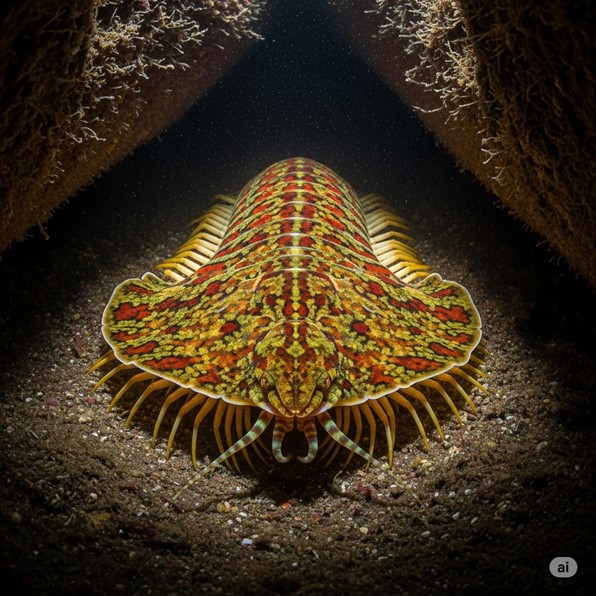
An adventuring party in the world of Saṃsāra might encounter or be tasked with finding a Sepiscolo Dendrectus 83 for several distinct and often perilous reasons, ranging from targeted hunts for rare resources to sudden, desperate fights for survival.
Scenario 1: The Alchemist’s Bounty (A Targeted Hunt)
The most common reason for actively searching out one of these creatures is for its valuable biological components. In a major city, a high-tier alchemist or a master gear-enchanter posts a lucrative public bounty: they require the pristine venom sac or the poison glands of a mature Sepiscolo Dendrectus. The quest details would explain that this creature’s toxins are unique, possessing properties that resist conventional magical healing and disrupt an avatar’s internal flow of magic. The venom is a key reagent for crafting legendary-tier weapon coatings that inflict a persistent, hard-to-cure debilitating effect, while the skin’s poison is essential for brewing powerful paralysis potions that can incapacitate even high-tier threats.
A party would take on this quest for the significant monetary reward or, more likely, for the right to have a piece of custom, powerful gear crafted from the components. This would not be a simple hunt. The party would first need to research the creature’s habitats, then travel to the dangerous mangrove swamps or uncharted coastal caves it inhabits. The true challenge would be locating the creature, as its natural camouflage makes it nearly invisible. They would need to survive its territory, overcome its ambush tactics, and defeat it without rupturing the valuable glands they were hired to collect.
Scenario 2: The Mystery of the Hypnotic Lights (An Investigation)
A party might encounter the creature as the resolution to a mystery. They would be hired by a local leader from a small fishing village or a remote coastal settlement. The quest would be to investigate a series of strange disappearances. The locals would speak of people vanishing from the water’s edge at dusk, their last moments preceded by sightings of beautiful, pulsating, and deeply mesmerizing lights dancing in the murky water. The local community, attributing the lights to angry spirits or sinister magic, is terrified to go near the shore, crippling their fishing-based economy.
The adventurers’ task would be to investigate the area, interview the few terrified witnesses, and stake out the location. They would eventually witness the Sepiscolo’s hypnotic lure firsthand. The challenge here is twofold: they must first have the mental fortitude to resist the dazing effect of the light display and then immediately engage in combat with a deadly amphibious predator that can drag them into the water or attack them on the shore. The goal is to end the threat and restore safety and peace of mind to the village.
Scenario 3: The Unwitting Intrusion (A Survival Encounter)
Often, an encounter with a Sepiscolo Dendrectus is entirely accidental. The adventurers might be on an entirely different mission—seeking pirate treasure, exploring ancient ruins mentioned in the Lay of Khenifra, or retrieving an artifact hidden within a coastal cave system. The party, focused on their primary objective, would venture deep into the creature’s natural habitat, unaware that they are trespassing.
The encounter would begin without warning. As the party wades through a shallow tidal pool inside a dark cavern or navigates a narrow, muddy path in a mangrove swamp, the camouflaged creature would strike. This scenario is a pure test of survival. The party would be caught off guard, in an environment that heavily favors their opponent. The creature would use the terrain to its full advantage, climbing slick cavern walls to drop from above, using the murky water for cover, and fighting with the desperate ferocity of a territorial animal defending its lair. The adventurers’ goal would not be to kill the beast for profit, but simply to survive the sudden, violent encounter and escape its territory.
Scenario 4: The Shaman’s Request (A Non-Combat Quest)
In a more unusual scenario, a party might be hired to find a Sepiscolo not to kill it, but to observe it. A shaman, a researcher from a naturalist guild, or a reclusive druid might need to acquire something only this creature can provide: its molted skin. The religious or scholarly belief might be that because the creature so perfectly embodies the principle of adapting to one’s environment, its shed skin retains a powerful echo of that property and is needed for a ritual of attunement or the creation of a powerful camouflage-enhancing talisman.
This would be a high-stakes stealth mission. The adventurers would have to track the creature to its lair and study its behavior from a distance, waiting for the brief, vulnerable period where it molts. Their objective would be to sneak into the highly dangerous lair after the creature has finished and moved to a resting spot, retrieve the freshly shed skin, and escape without ever engaging the Sepiscolo in combat. A direct fight in this case would represent a failure of the quest.
Beyond the primary alchemical reagents of its venom and skin toxins, a skilled harvester familiar with the creature’s unique biology can gather several other valuable components from the corpse of a Sepiscolo Dendrectus 83. Each part has specific uses in the crafting of powerful gear and consumables.
1. Chromatic Dermis
- Description: This is the creature’s skin itself, carefully flayed and separated from the underlying poison glands. The value of the dermis lies in the millions of chromatophore cells embedded within it. If preserved within hours of the creature’s death using special alchemical salts, these cells retain a portion of their light-manipulating properties.
- Use: Master leatherworkers and enchanters seek out the Chromatic Dermis to craft exceptional light armor, cloaks, and shield coverings. When incorporated into a piece of gear, the dermis grants a passive camouflage effect. The gear will subtly and automatically shift its hue and pattern to better blend with the wearer’s immediate surroundings. While not the perfect, active camouflage of the living creature, it is enough to make the wearer significantly harder to spot, especially when they are still. This makes it a core component for gear intended for scouts, rangers, and assassins.
2. The Internal Cuttlebone (or “Spirit Bone”)
- Description: Unlike most creatures of its type, the Sepiscolo has a single, large, porous internal shell, a trait inherited from its cephalopod ancestry. This “Spirit Bone” is lightweight, almost chalky in texture, and resonates with a faint, palpable psychic energy leftover from the creature’s hypnotic abilities.
- Use: When powdered, the Spirit Bone is a rare catalyst used in high-level alchemy for any potion affecting the mind or senses. It is the primary ingredient for Potions of Mental Fortitude, which grant resistance to psychic intrusion and illusion magic. Burned as incense, the powder creates a thick, aromatic smoke that can cause either calming or disorienting hallucinations, depending on its preparation. An intact, high-quality Spirit Bone can be carved and used as the core for a magic focus, such as a wand or orb, that specializes in illusion and mesmerism.
3. Forcipule Fangs
- Description: These are the two hard, black, chitinous fangs that the creature uses to inject its venom. They are naturally hollow, incredibly sharp, and resistant to chipping and breaking.
- Use: The Forcipule Fangs are highly valued by artisan weapon-smiths and assassins. Because they are naturally hollow, they are perfect for creating custom “injector” weapons. A single forcipule can be fashioned into the tip of a dagger or a special crossbow bolt. These weapons can be loaded with a single dose of any liquid—be it a poison, a truth serum, or a magical concoction—which is then delivered directly into a target’s bloodstream on a successful strike, bypassing armor and ensuring the full effect of the payload is delivered.
4. Neuro-Conductive Cartilage
- Description: The creature’s skeleton is not made of bone but of a flexible, durable cartilage. This cartilage is unique because it is threaded with silvery, nerve-like fibers that once controlled the creature’s rapid color changes and bioluminescent flashes. These fibers remain magically and neurologically conductive even after death.
- Use: This material is essential for crafting gear that interfaces directly with an avatar’s own nervous system and magical senses. It can be rendered down and integrated into the grips of a weapon to provide enhanced tactile feedback, allowing the wielder to better feel the weapon’s balance and the impact of their strikes. Its most important use is in the lining of helmets and circlets, where it acts as an amplifier for skills related to perception, intuition, and the “Mind’s Eye,” effectively sharpening the wearer’s senses.
5. Umbral Ink Sac
- Description: A trait from its cephalopod lineage, the Sepiscolo possesses a modified ink sac. Instead of producing simple, obscuring ink, it creates a thick, oily, black fluid that actively absorbs light and dampens magical energy in its immediate vicinity.
- Use: The harvested Umbral Ink is a potent, albeit volatile, defensive substance. When carefully diluted and prepared as a potion, it can grant the user temporary but powerful resistance to a specific type of magical damage, as the ink in their system “soaks up” the harmful energy. In a more raw form, it can be thrown or applied to a surface to create a small area of absolute, non-reflective darkness that even magical light sources struggle to penetrate, making it an invaluable tool for stealth, infiltration, and escape.
Tale of Sisters Naila and Zina
It is known among the shore-dwelling people that not all beauty is a gift. Some beauty is a hook, and some is a mouth. This is the story of that truth.
In a village that stood by the sea, there lived two sisters. The elder sister was named Zina. Her mind was quiet and her hands were clever. She listened to the stories of the elders and knew the sea had two faces: one that gave food, and one that took life. The younger sister was named Naila. Her mind was full of pretty things, and her ears were closed to the words of the old. She loved the shine of wet stones and the colors of rare shells, and she adorned her gear with them until she herself shone like the sun on the water.
The elders of the village spoke often of a certain place, a cove not far from the village that they called the Grotto of Shifting Light. It was a place of dangerous tides and sharp rocks. They said, “Do not go to this grotto. A creature lives there. It wears the skin of the rock and the sand. It has many legs but no face. It shows a false beauty to lure the vain, and it eats the unwary.”
Zina heard these words and carved their meaning onto her heart. She never walked near the grotto. But Naila laughed. She said, “The elders are old. Their eyes are dim and they fear shadows. They only want to keep the most beautiful shells for themselves.” For it was rumored that the shells in the Grotto of Shifting Light were more colorful and strange than any others.
One day, a trader came to the village. He saw the shining things on Naila’s clothes and told her, “You are a collector of beauty. But I have heard that in the grotto nearby, there are stones that hold the light of the stars inside them, and shells that shimmer with all the colors of a dream.”
These words were a seed that landed in the fertile ground of Naila’s vanity. She decided she must have these things. That evening, Zina saw her sister preparing to leave. “Do not go, my sister,” Zina said, her voice full of fear. “The elders’ stories are not just breath. They are the collected wisdom of those who have been taken by the sea.”
Naila adjusted a shining pearl in her hair and said, “And you have the collected fear of old women. I am not afraid of stories. I will return with a beauty you have never seen.” And she walked away down the shore as the sun began to bleed into the sea.
Naila came to the Grotto of Shifting Light. It was quiet and beautiful as the trader had said. The setting sun made the wet rocks glitter like jewels. She walked along the water’s edge and saw them: shells with spirals of deep violet and shining green, stones that seemed to pulse with a soft, inner light. She laughed with happiness and began to gather them, her mind full of how the other girls in the village would look upon her with envy.
As the last light of the sun left the sky, she saw a new light. It came from the shallow water in the center of the cove. It was a gentle, pulsing glow, shifting from soft blue to warm rose to shimmering gold. It was the most beautiful thing Naila had ever seen. The lights did a slow dance, a thing of great beauty that made the heart forget to be afraid. She forgot the warnings. She forgot her sister. She only wanted to be closer to the light.
She took a step into the cold water. Then another. The light seemed to pulse brighter, welcoming her. It was a quiet and secret beauty, just for her. She reached down her hand, wanting to touch the source of the light, to hold it, to own it.
In the moment her fingers touched the water above the light, the slow dance ended. The beautiful glow erupted into a blinding, painful flash of jagged colors that screamed in her eyes. She was blind and her mind was empty. Before she could make a sound, something strong and slick wrapped around her ankle. It was not a rope. It was a tentacle. Then another wrapped around her leg. She was pulled from her feet with a great force. The water made a sound of eating, and then it was quiet again. The beautiful light was gone.
Naila did not return. The next day, Zina, her heart a knot of cold dread, gathered a party of strong villagers with torches and spears. They went to the Grotto. The tide was low. They saw Naila’s basket on the sand, filled with the beautiful, cursed shells. Scattered near the water’s edge was a single, shining pearl, fallen from her hair. There was no other sign of her. But in the wet sand, leading from the water to a dark, deep crack in the rocks, they saw the tracks. They were not the tracks of a man or a beast they knew. It was the mark of a heavy body, dragged, and on either side, the skittering lines of very, very many small legs. The tracks of the Sepiscolo Dendrectus.
Zina did not cry out. Her face became like the stone of the mountains. She had no more tears for the sister who would not listen. She picked up the single pearl and took it with her. In time, Zina became an elder herself. And when she warned the young away from the grotto, her voice carried the weight of a pain that all the villagers could feel, and they knew her story was not just breath. It was a scar.
The Moral: Beauty can be a hook, and the most pleasing light may lead to the darkest place.
Suggested conversions to other systems:
Call of Cthulhu (7th Edition)
Grotto Chromatophore A semi-amphibious predator found in coastal caves and estuaries, the Grotto Chromatophore is a master of camouflage and hypnotic suggestion. It appears as a flattened, segmented horror with dozens of legs and two prehensile tentacles near a mouth filled with venomous fangs. Its skin shifts in color and pattern, an ability it uses to blend in perfectly or to create a beautiful, mesmerizing display that lures victims to their doom.
STR: 65 CON: 75 SIZ: 70 DEX: 80 INT: 25 POW: 70 HP: 14 DB: +1d4 Build: 1 Move: 8 / 10 swimming Attack: 1 per round Fighting (Brawl): 55% (27/11), damage 1d4 + damage bonus Venomous Bite (special): 55% (27/11), see below Tentacle Grapple (special): 55% (27/11), see below Dodge: 40% (20/8) Stealth: 90% (45/18) Armor: 1 point of tough, rubbery hide. Sanity Loss: 0/1d3 SAN for witnessing the Hypnotic Display; 1/1d6 SAN for seeing the creature attack.
Special Rules:
- Hypnotic Display: As an action, the Chromatophore can flash a mesmerizing series of patterns. Anyone who can see it must succeed on a POW roll or be stunned for 1 round, feeling an overwhelming compulsion to move closer to the beautiful light.
- Perfect Camouflage: The Grotto Chromatophore’s Stealth skill is exceptionally high. When motionless against a natural surface, it is effectively invisible. Investigators must make a Hard Spot Hidden roll to notice it before it attacks. It almost always gains a surprise round.
- Tentacle Grapple: On a successful Fighting (Brawl) roll, it can choose to grapple instead of dealing damage. The victim is held fast. On subsequent rounds, the creature can automatically inflict its Venomous Bite on a grappled victim without needing to make a new attack roll. Escaping the grapple requires an opposed STR roll.
- Venomous Bite: This attack can be made against an adjacent or grappled target. If the attack succeeds, the victim must make a Hard CON roll. On a failure, the venom courses through their system. They suffer 1d6 damage immediately and lose 20 points from both STR and DEX. They lose an additional 10 points from STR and DEX each subsequent round until one characteristic reaches 0, at which point they are completely paralyzed for 1d6 hours. A successful First Aid or Medicine roll can halt the progression of the venom after the initial loss.
- Poisonous Skin: Any investigator who touches the Chromatophore with bare skin (including being grappled by its tentacles) must succeed on a CON roll or take 1d4 damage as their skin numbs and burns.
Blades in the Dark
Chromatic Skulker A terrifying aquatic predator that haunts the lightless grottos and forgotten waterways beneath the city. It mimics the texture of rock and brick, lying in wait for the unwary. Its skin ripples with hypnotic lights that lull the mind, before tentacles lash out to drag victims to a venomous death. Tier II Threat Instinct: To ambush the unwary from perfect stillness. Qualities: Amphibious, Camouflaged, Terrifying, Venomous, Hypnotic
Mechanics: The Chromatic Skulker does not attack in a conventional sense; it creates and ticks clocks to represent the danger it poses to the crew. The GM should emphasize its alien nature and the environmental advantage it holds.
- When the crew enters its lair, they are in a Desperate position due to its camouflage. A PC who wants to spot it before it acts must make a Survey or Hunt roll with limited effect.
- Hypnotic Lights: The GM can start a 6-segment clock: Lulled into a Trance. When the creature reveals itself with its lights, any PC who doesn’t immediately look away or resist is a target. Actions to resist its influence (like trying to snap an ally out of it, or focusing one’s own mind) would be Resolve resistance rolls or Attune action rolls. When the clock fills, the affected PCs are helpless.
- Grapple and Envenom: The Skulker can lash out at a PC. The GM can start a 4-segment clock: Dragged and Envenomed. To resist being grabbed, a PC might make a Prowess roll. If the clock fills, the PC is in the creature’s grasp and suffers Level 3 Harm: “Paralyzing Venom.”
- Escape into the Murk: The creature is a survivor. The GM can use an 8-segment clock: The Skulker Retreats. If the crew inflicts harm or creates a major disadvantage (e.g., setting its lair on fire), the GM ticks this clock. When it fills, the creature escapes into a waterway where it cannot be followed.
Dungeons & Dragons (5th Edition)
Murk Lurker Medium aberration, unaligned
Armor Class: 15 (natural armor) Hit Points: 82 (11d8 + 33) Speed: 30 ft., climb 30 ft., swim 40 ft.
STR: 16 (+3) DEX: 17 (+3) CON: 16 (+3) INT: 3 (-4) WIS: 14 (+2) CHA: 10 (+0)
Skills: Perception +5, Stealth +9 Damage Immunities: Poison Condition Immunities: Poisoned Senses: Darkvision 60 ft., passive Perception 15 Challenge: 5 (1,800 XP)
Amphibious. The murk lurker can breathe air and water.
Chameleonic Skin. The murk lurker has advantage on Dexterity (Stealth) checks.
Poisonous Skin. A creature that touches the murk lurker or hits it with a melee attack while within 5 feet of it takes 5 (1d10) poison damage.
Ambusher. The murk lurker has advantage on attack rolls against any creature it has surprised.
Actions Multiattack. The murk lurker makes two attacks: one with its tentacles and one with its bite.
Tentacles. Melee Weapon Attack: +6 to hit, reach 10 ft., one target. Hit: 10 (2d6 + 3) bludgeoning damage, and the target is grappled (escape DC 14). Until this grapple ends, the target is restrained, and the murk lurker can’t use its tentacles on another target.
Bite. Melee Weapon Attack: +6 to hit, reach 5 ft., one target. Hit: 7 (1d8 + 3) piercing damage, and the target must make a DC 14 Constitution saving throw. On a failed save, the target takes 18 (4d8) poison damage and is poisoned for 1 minute. While poisoned in this way, the creature is paralyzed. The target can repeat the saving throw at the end of each of its turns, ending the effect on itself on a success.
Hypnotic Display (Recharge 5-6). The murk lurker’s skin flashes with dazzling, hypnotic patterns. Each creature within 30 feet of the murk lurker that can see it must succeed on a DC 14 Wisdom saving throw or be charmed for 1 minute. While charmed in this way, the creature is incapacitated and has a speed of 0. The charmed creature can repeat the saving throw at the end of each of its turns, ending the effect on itself on a success. If a creature’s saving throw is successful or the effect ends for it, the creature is immune to the murk lurker’s Hypnotic Display for the next 24 hours.
Knave (2nd Edition)
Tide-Pool Stalker HD: 6 Armor: 14 Morale: 10 Attack: Venomous Bite (1d8) Qualities: Amphibious, Camouflaged, Hypnotic, Poisonous, Grasping Tentacles
Mechanics:
- Amphibious: Can breathe and move freely in water and on land.
- Camouflage: When motionless against a natural surface (rock, sand, mud), the Stalker is invisible. It always attacks with surprise unless the party is actively searching for hidden threats and succeeds on a WIS save.
- Venomous Bite: Deals 1d8 damage. The victim must succeed on a CON save vs poison or be paralyzed for 1d4 rounds, falling helpless.
- Poisonous Skin: Any character who touches the Stalker with bare skin (including unarmed attacks) must save vs poison or take 1d6 damage.
- Hypnotic Lights: As its entire turn, the Stalker can flash mesmerizing lights. All who can see it must save vs spells or be dazed, unable to take any action for 1 round.
- Grasping Tentacles: Instead of attacking, the Stalker can make a contested STR check to grapple a character. If it wins, the character is grappled. On its next turn, a grappled character can be automatically bitten with no attack roll needed.
Fate Core System
The Shifting Cove-Horror This creature is an apex predator of its domain, relying on patience and otherworldly beauty to secure its meals. It is best treated as a significant threat, whose danger comes not from its raw power, but from its ability to control the battlefield and disable its opponents before the fight even begins.
High Concept: Perfect Ambush Predator of the Littoral Zone Trouble: Territorial and Driven by Primal Instinct Other Aspects: My Skin is a Hypnotic Veil, A Touch of Poison, a Bite of Death, Master of its Watery Domain
Skills Superb (+5): Stealth Great (+4): Fight Good (+3): Athletics, Physique Fair (+2): Notice Average (+1): Will
Stunts
- Perfect Camouflage: The Cove-Horror’s skin perfectly mimics its surroundings. It gets a +2 to Stealth when creating advantages related to hiding or ambushing. When hidden, opponents must succeed at an overcome action with a difficulty of Superb (+5) to spot it.
- Hypnotic Display: Once per scene, as an action, the Cove-Horror can create a mesmerizing light show on its skin. This initiates a contest: the creature rolls Will against all opponents who can see it. Any character who fails the contest is afflicted with the situation aspect Drawn to the Alluring Light with one free invocation.
- Venomous Bite: When the Cove-Horror succeeds with style on a Fight attack to inflict physical stress, it can choose to inflict a Paralytic Venom consequence on the target instead of taking the +2 shift bonus.
- Poisonous Skin: When a character succeeds on a physical attack made from an adjacent zone, the Cove-Horror can use its reaction to force that character to make a Physique roll at Good (+3) difficulty. On failure, the character takes a 2-shift hit.
Stress & Consequences Physical Stress: [1] [2] [3] [4] Consequences: One mild, one moderate, one severe.
Numenera & Cypher System
Dendroform Ambusher This semi-aquatic predator hunts the murky grottos and mangrove swamps along the coast. It is a fusion of several life forms, resulting in a creature that can perfectly camouflage itself before luring prey with a hypnotic light display. Its touch is poison, and its bite is paralytic.
Level: 5 Health: 20 Damage: 5 points Armor: 2 Movement: Short; Short swimming; Short climbing Modifications: Stealth as level 7. Resists poison as level 7.
Combat: The Dendroform Ambusher is a patient hunter. It will remain perfectly still, effectively invisible (a level 7 task to spot), until prey is in an ideal position.
- Hypnotic Display: The ambusher can use its action to flash mesmerizing patterns. All creatures within short range who can see it must make an Intellect defense task. Those who fail are stunned, unable to take actions for one round, and feel a compulsion to move closer to the creature.
- Venomous Bite: The creature’s bite inflicts 5 points of damage. In addition, the victim must succeed on a Might defense task or the venom takes hold. On a failure, the victim immediately descends one step on the damage track. They must repeat this task at the start of their next turn; on another failure, they descend another step. If this would move them below Debilitated, they are instead paralyzed and unable to act for one minute.
- Poisonous Skin: Any creature that makes physical contact with the ambusher must succeed on a Might defense task or suffer 3 points of ambient damage. This includes being grappled by its tentacles or making an unarmed attack against it.
- Tentacle Grapple: Instead of inflicting damage, the creature can use its action to grapple a target. A grappled target is hindered (all tasks are modified by one step to their detriment) until they use their action to make a Might-based task to escape. The creature can automatically make a bite attack against a grappled target.
Loot: Its venom sac, poison glands, and chromatophore-rich skin are all valuable components for creating cyphers or artifacts related to poison, paralysis, and stealth.
Pathfinder (2nd Edition)
Chromatic Cave Lurker – Creature 5 Uncommon, Aberration, Amphibious Perception +13; darkvision Skills Acrobatics +13, Athletics +14, Stealth +15 Str +5, Dex +4, Con +3, Int -4, Wis +2, Cha +0
AC 22; Fort +14, Ref +15, Will +11 HP 80; Immunities poison
Poisonous Skin (Aura, Poison) 5 feet. A creature that enters or ends its turn in the aura takes 2d6 poison damage (DC 22 basic Fortitude save). A creature that touches the lurker or hits it with an unarmed Strike takes 2d6 poison damage (DC 22 basic Fortitude save).
Perfect Camouflage The lurker can Hide in aquatic or stony environments even if it doesn’t have cover.
Actions Speed 25 feet, climb 25 feet, swim 35 feet Melee [one-action] Forcipule Bite +15 (Agile), Damage 2d8+8 piercing plus Cave Lurker Venom Melee [one-action] Tentacle +15 (Reach 10 feet), Damage 2d6+8 bludgeoning plus Grab
Hypnotic Display [two-actions] (Concentrate, Enchantment, Incapacitation, Mental, Visual) The lurker flashes mesmerizing patterns. Each creature within a 30-foot emanation must attempt a DC 22 Will save.
- Critical Success The creature is unaffected and temporarily immune for 24 hours.
- Success The creature is unaffected.
- Failure The creature is fascinated. For 1 minute, whenever it ends its turn, it must move at least 5 feet toward the lurker, if able. This effect ends if the lurker takes any hostile action against the creature.
- Critical Failure As failure, but the creature is also stunned 1.
Cave Lurker Venom (Injury, Poison) Saving Throw DC 22 Fortitude; Maximum Duration 6 rounds; Stage 1 1d6 poison damage and clumsy 1 (1 round); Stage 2 1d6 poison damage, clumsy 2, and slowed 1 (1 round); Stage 3 2d6 poison damage and paralyzed (1 round).
Savage Worlds Adventure Edition (SWADE)
Prism Stalker A horrifying amphibious predator that dwells in dark, wet places. It is known for its ability to blend into the background before luring prey with a beautiful light show, only to reveal its monstrous form when it is too late.
Attributes: Agility d10, Smarts d6(A), Spirit d8, Strength d10, Vigor d10 Skills: Athletics d10, Fighting d10, Notice d8, Stealth d12 Pace: 6; Swim: 8; Parry: 7; Toughness: 11 (2) Edges: Ambidextrous Special Abilities:
- Armor +2: Tough, rubbery hide.
- Aquatic: Pace 8 in water.
- Camouflage: +4 to Stealth rolls when in its natural watery or cavernous habitat. The creature is effectively invisible when motionless.
- Poisonous Skin: Anyone who makes a successful unarmed attack against the Prism Stalker is automatically exposed to its Poison.
- Tentacles: The stalker can make two Tentacle attacks per round with no multi-action penalty. The tentacles have Reach 2.
- Bite/Tentacle: Str+d6. The Bite exposes a victim to the creature’s Venom on a successful hit. The Tentacles can be used to initiate a Grapple.
- Hypnotic Display: As an action, the stalker can make a Performance test. All who can see it must make a Spirit roll in opposition. Any who fail are Distracted and Vulnerable. With a raise on its roll, the stalker’s victims are Stunned instead.
- Venom (-2): The creature’s bite delivers a potent neurotoxin. A hero must make a Vigor roll at -2. If they fail, they are Paralyzed and cannot take any physical actions for 1d4 rounds.
Fate Core System
The Shifting Cove-Horror This creature is an apex predator of its domain, relying on patience and otherworldly beauty to secure its meals. It is best treated as a significant threat, whose danger comes not from its raw power, but from its ability to control the battlefield and disable its opponents before the fight even begins.
High Concept: Perfect Ambush Predator of the Littoral Zone Trouble: Territorial and Driven by Primal Instinct Other Aspects: My Skin is a Hypnotic Veil, A Touch of Poison, a Bite of Death, Master of its Watery Domain
Skills Superb (+5): Stealth Great (+4): Fight Good (+3): Athletics, Physique Fair (+2): Notice Average (+1): Will
Stunts
- Perfect Camouflage: The Cove-Horror’s skin perfectly mimics its surroundings. It gets a +2 to Stealth when creating advantages related to hiding or ambushing. When hidden, opponents must succeed at an overcome action with a difficulty of Superb (+5) to spot it.
- Hypnotic Display: Once per scene, as an action, the Cove-Horror can create a mesmerizing light show on its skin. This initiates a contest: the creature rolls Will against all opponents who can see it. Any character who fails the contest is afflicted with the situation aspect Drawn to the Alluring Light with one free invocation.
- Venomous Bite: When the Cove-Horror succeeds with style on a Fight attack to inflict physical stress, it can choose to inflict a Paralytic Venom consequence on the target instead of taking the +2 shift bonus.
- Poisonous Skin: When a character succeeds on a physical attack made from an adjacent zone, the Cove-Horror can use its reaction to force that character to make a Physique roll at Good (+3) difficulty. On failure, the character takes a 2-shift hit.
Stress & Consequences Physical Stress: [1] [2] [3] [4] Consequences: One mild, one moderate, one severe.
Numenera & Cypher System
Dendroform Ambusher This semi-aquatic predator hunts the murky grottos and mangrove swamps along the coast. It is a fusion of several life forms, resulting in a creature that can perfectly camouflage itself before luring prey with a hypnotic light display. Its touch is poison, and its bite is paralytic.
Level: 5 Health: 20 Damage: 5 points Armor: 2 Movement: Short; Short swimming; Short climbing Modifications: Stealth as level 7. Resists poison as level 7.
Combat: The Dendroform Ambusher is a patient hunter. It will remain perfectly still, effectively invisible (a level 7 task to spot), until prey is in an ideal position.
- Hypnotic Display: The ambusher can use its action to flash mesmerizing patterns. All creatures within short range who can see it must make an Intellect defense task. Those who fail are stunned, unable to take actions for one round, and feel a compulsion to move closer to the creature.
- Venomous Bite: The creature’s bite inflicts 5 points of damage. In addition, the victim must succeed on a Might defense task or the venom takes hold. On a failure, the victim immediately descends one step on the damage track. They must repeat this task at the start of their next turn; on another failure, they descend another step. If this would move them below Debilitated, they are instead paralyzed and unable to act for one minute.
- Poisonous Skin: Any creature that makes physical contact with the ambusher must succeed on a Might defense task or suffer 3 points of ambient damage. This includes being grappled by its tentacles or making an unarmed attack against it.
- Tentacle Grapple: Instead of inflicting damage, the creature can use its action to grapple a target. A grappled target is hindered (all tasks are modified by one step to their detriment) until they use their action to make a Might-based task to escape. The creature can automatically make a bite attack against a grappled target.
Loot: Its venom sac, poison glands, and chromatophore-rich skin are all valuable components for creating cyphers or artifacts related to poison, paralysis, and stealth.
Pathfinder (2nd Edition)
Chromatic Cave Lurker – Creature 5 Uncommon, Aberration, Amphibious Perception +13; darkvision Skills Acrobatics +13, Athletics +14, Stealth +15 Str +5, Dex +4, Con +3, Int -4, Wis +2, Cha +0
AC 22; Fort +14, Ref +15, Will +11 HP 80; Immunities poison
Poisonous Skin (Aura, Poison) 5 feet. A creature that enters or ends its turn in the aura takes 2d6 poison damage (DC 22 basic Fortitude save). A creature that touches the lurker or hits it with an unarmed Strike takes 2d6 poison damage (DC 22 basic Fortitude save).
Perfect Camouflage The lurker can Hide in aquatic or stony environments even if it doesn’t have cover.
Actions Speed 25 feet, climb 25 feet, swim 35 feet Melee [one-action] Forcipule Bite +15 (Agile), Damage 2d8+8 piercing plus Cave Lurker Venom Melee [one-action] Tentacle +15 (Reach 10 feet), Damage 2d6+8 bludgeoning plus Grab
Hypnotic Display [two-actions] (Concentrate, Enchantment, Incapacitation, Mental, Visual) The lurker flashes mesmerizing patterns. Each creature within a 30-foot emanation must attempt a DC 22 Will save.
- Critical Success The creature is unaffected and temporarily immune for 24 hours.
- Success The creature is unaffected.
- Failure The creature is fascinated. For 1 minute, whenever it ends its turn, it must move at least 5 feet toward the lurker, if able. This effect ends if the lurker takes any hostile action against the creature.
- Critical Failure As failure, but the creature is also stunned 1.
Cave Lurker Venom (Injury, Poison) Saving Throw DC 22 Fortitude; Maximum Duration 6 rounds; Stage 1 1d6 poison damage and clumsy 1 (1 round); Stage 2 1d6 poison damage, clumsy 2, and slowed 1 (1 round); Stage 3 2d6 poison damage and paralyzed (1 round).
Savage Worlds Adventure Edition (SWADE)
Prism Stalker A horrifying amphibious predator that dwells in dark, wet places. It is known for its ability to blend into the background before luring prey with a beautiful light show, only to reveal its monstrous form when it is too late.
Attributes: Agility d10, Smarts d6(A), Spirit d8, Strength d10, Vigor d10 Skills: Athletics d10, Fighting d10, Notice d8, Stealth d12 Pace: 6; Swim: 8; Parry: 7; Toughness: 11 (2) Edges: Ambidextrous Special Abilities:
- Armor +2: Tough, rubbery hide.
- Aquatic: Pace 8 in water.
- Camouflage: +4 to Stealth rolls when in its natural watery or cavernous habitat. The creature is effectively invisible when motionless.
- Poisonous Skin: Anyone who makes a successful unarmed attack against the Prism Stalker is automatically exposed to its Poison.
- Tentacles: The stalker can make two Tentacle attacks per round with no multi-action penalty. The tentacles have Reach 2.
- Bite/Tentacle: Str+d6. The Bite exposes a victim to the creature’s Venom on a successful hit. The Tentacles can be used to initiate a Grapple.
- Hypnotic Display: As an action, the stalker can make a Performance test. All who can see it must make a Spirit roll in opposition. Any who fail are Distracted and Vulnerable. With a raise on its roll, the stalker’s victims are Stunned instead.
- Venom (-2): The creature’s bite delivers a potent neurotoxin. A hero must make a Vigor roll at -2. If they fail, they are Paralyzed and cannot take any physical actions for 1d4 rounds.