
Original Component Life Forms
The following individual organisms from four distinct major classes within the Animalia Kingdom have been selected and merged to construct this feral creature:
- Class Chilopoda: Amazonian Giant Centipede (Scolopendra gigantea)
- Class Anthozoa: Venus Flytrap Sea Anemone (Actinoscyphia aurelia)
- Class Clitellata: Giant Gippsland Earthworm (Megascolides australis)
- Class Holothuroidea: Leopard Sea Cucumber (Bohadschia argus)
Species Nomenclature and Classification
- Unique Species Name: Scolopendra-Actinoscyphia-Megascolides-Bohadschia 419
- Taxonomic Status: Sentient Feral Gestalt (Unpossessed Primitive Mind)
Biological Profiles and Mechanical Specifications
- Appearance:
- The core body of this organism is a long, highly elastic cylindrical torso with the thick, slimy, muscular segmentation of a giant earthworm.
- Running along the lower lateral sides of this segmented body are forty paired, hyper-dense, venomous prehensile legs matching the dark copper chitin of a giant centipede.
- The posterior end terminates in the thick, leathery, spotted hide of a leopard sea cucumber, complete with a specialized defense pore capable of expelling sticky structural tubules.
- The head is an unsettling nightmare anomaly: it lacks a standard cranium, instead presenting a wide, predatory oral disk fringed with multiple concentric rows of brightly colored, paralyzing stinging tentacles derived from the deep-sea anemone.
- Two large, hollow prehensile maxillipeds (forcing pincer claws) frame this tentacled oral disk, twitching constantly to measure physical boundaries and pin down targets.
- Size: Large (The primary elongated torso stretches up to 11 feet in length, maintaining a diameter of 2 feet; it weighs approximately 410 pounds).
- Speed: Maximum ground movement speed is 30 feet per turn. Maximum burrowing speed is 20 feet per turn. Maximum swimming speed is 15 feet per turn.
- Stat Modifiers:
- Strength: +3 (Immense crushing and squeezing force from its elastic worm-chassis).
- Dexterity: +3 (Highly coordinated multi-legged scuttling and rapid tentacle snaps).
- Constitution: +5 (Unbelievable muscular resilience, high cell-regeneration, and thick mucus layers).
- Intelligence: -3 (Operates on a highly self-aware but fundamentally primitive wilderness baseline).
- Wisdom: +4 (Superb tremorsense and olfactory perception via chemical sensory tentacles).
- Charisma: -4 (Completely alien, grotesque anatomy that triggers intense revulsion).
- Skills:
- Trained Skill: Stealth +4 (Utilizes its earthworm flexibility and muted, mottled coloration to blend seamlessly into rotting forest floors and deep mud beds).
- Trained Skill: Athletics +3 (Expertise in burrowing through dense soil or anchoring its segmented body within narrow rock fissures).
- Natural Weaponry: Tentacled Acidic Bite (Inflicts 1d8 piercing damage plus 1d4 acid/poison damage; passes through standard tier damage calculations based on combat initialization rules).
- Behavior:
- An insatiable ambush predator that burrows backwards into soft soil, mud, or decomposing organic matter, leaving only its tentacled anemone oral disk exposed on the surface to look like an ordinary, harmless swamp flora fixture.
- When actively disturbed or cornered by adventurers, it arches its segmented torso, clicking its sharp copper maxillipeds together in a rapid, rhythmic warning cadence.
- It hoards zero material goods but displays a strong habit of drag-hunting, physically pulling paralyzed prey deep into its subterranean burrows to digest them over several days without interruption.
- Diet: Carnivorous Hyper-Opportunist. It primarily consumes small burrowing beasts, low-flying insects, swamp birds, and coastal scavengers that walk across its exposed oral tentacles.
- Emotions:
- Primary drivers are a baseline of territorial agitation, intense predatory hunger, and acute distress when exposed to dry, high-heat air currents that threaten its protective mucus layers.
- It expresses a state of primitive comfort by relaxing its multi-segmented torso into loose, wide coils within cool, damp subterranean mud chambers.
- Environment Where Found:
- Thrives inside the perpetually humid mudflats, dark cavern floor networks, and rotting jungle biomes across the uncharted borders of the 73 island nations.
- It requires high moisture or proximity to stagnant water networks to maintain the thick, slippery mucus layer that protects its unique multi-classed skin composition.
- Tags:
Feral,Gestalt-Form,Burrower,Large-Beast,Prehensile-Legs,Stinging-Tentacles,Mucus-Shield,Subterranean, Segmented-Torso, Tubule-Defense,
Prehensile-Maxillipeds, Tremorsense, Swamp-Flora-Mimic,
Acidic-Saliva, Moisture-Dependent, Paralyzing-Sting, Drag-Hunter,
Regenerative-Cell-Structure, Cavern-Floor-Dweller
Life Cycle
- The organism hatches from a gelatinous, mucous-coated egg string hidden deep within anaerobic mud layers or waterlogged cavern crevices.
- The newly emerged larval form resembles a transparent, foot-long earthworm with a cluster of soft, undeveloped sensory buds at its anterior tip.
- Within three months of feeding on organic detritus, the juvenile undergoes a severe skin-hardening event along its flanks, sprouting its initial pairs of copper-colored chitinous limbs.
- As it grows in length, it splits its skin in regular molting cycles, adding exactly four new segments and eight legs with each successive molt.
- By the third year, the oral disk completely expands, and the concentric rows of deep-sea anemone stinging tentacles calcify their internal barbs.
- Upon reaching physical maturity at five years of age, the leathery leopard-spotted pattern develops on its posterior end, activating the tubule-defense pore.
- The average lifespan of a mature specimen in the damp undergrowth of Saṃsāra is roughly twenty to twenty-five years, heavily dependent on soil moisture.
- As the creature nears the end of its life cycle, its cell-regeneration slows, its thick mucus shield dries out, and it burrows one final time into deep clay to fossilize.
Mating
- Reproductive cycles are triggered by seasonal rises in regional humidity, which cause the creature’s tentacled oral disk to secrete a thick, pheromone-laced indigo slime trail.
- Two mature individuals follow these chemical trails until they meet within subterranean mud chambers or humid riverbanks.
- Courtship is a highly tense, dangerous process where both creatures coil their elastic torsos together, clicking their copper maxillipeds to signal non-predatory intent.
- If one individual fails to match the rhythmic warning cadence of the other, the interaction immediately devolves into a cannibalistic feeding frenzy.
- Once a mutual rhythm is achieved, they engage in a reciprocal exchange of genetic packets through specialized pores along their mid-body segments.
- Following a successful pairing, both individuals immediately burrow in opposite directions, as their cooperative instincts terminate instantly after genetic transfer.
- The female seeks out stagnant water networks or deep swamp clay to deposit her thousands of egg strings, coating them in a defensive layer of acidic slime.
- The parents provide zero nest defense, leaving the larval strings to hatch and navigate the predatory hazards of the swamp entirely alone.
Tactics
- The creature utilizes its earthworm flexibility to burrow backward into soft soil or rotting foliage, leaving only its tentacled oral disk exposed.
- By mimicking the appearance of harmless swamp flora or a deep-sea anemone, it lures unsuspecting prey directly into its striking perimeter.
- When a target steps onto or near the oral disk, the creature snaps its stinging tentacles shut, delivering a highly concentrated paralyzing sting.
- Simultaneously, its hollow prehensile maxillipeds slam forward like iron pincers to pin the target and inject a fast-acting acidic saliva.
- If the target resists or proves too large to swallow immediately, the creature shifts to drag-hunting tactics, wrapping its elastic body around the prey to constrict it.
- It then utilizes its forty paired prehensile legs to rapidly scuttle backward, dragging the paralyzed prey into its subterranean burrow system to suffocate.
- When cornered or heavily damaged on the surface, it exposes its posterior end and expels a tangled mass of sticky, toxic structural tubules from its rear pore.
- These tubules expand upon contact with the air, instantly entangling attackers and buying the creature time to execute a rapid burrowing retreat.
Actions
- Tentacled Acidic Bite: The creature uses an action to snap its anemone-disk mouth around a target, inflicting 1d8 piercing damage and injecting 1d4 acid/poison damage.
- Maxilliped Pincer Pin: The creature uses an action to strike with its copper forcing claws, inflicting 1d6 bludgeoning damage and automatically grappling the target.
- Drag-Hunt Scuttle: The creature spends its movement action to drag a grappled or paralyzed target up to 20 feet backward into a subterranean burrow.
- Expel Sticky Tubules (Recharge 5–6): The creature activates its posterior pore as an action, spraying a 10-foot cone of sticky, toxic tubules that entangles and restrains targets.
- Mucus-Shield Renewal: The creature spends a full action to secrete a fresh layer of slippery, protective mucus, gaining temporary resistance to physical slashing damage.
- Swamp Flora Mimicry: The creature executes a free action to burrow its torso completely, gaining a +4 bonus to its Stealth check while mimicking a harmless plant fixture.
Other Interesting Information
- The sticky structural tubules expelled from its posterior pore are so chemically adhesive that they can bind an adventurer’s iron sword directly to its scabbard.
- Its chemical sensory tentacles are incredibly sensitive to ground vibrations, allowing the beast to track footsteps through solid stone up to 60 feet away.
- Alchemists actively hunt the creature to harvest its paralyzing sting venom, which is refined into high-grade surgical anesthetics for regional clinics.
- Because its skin composition is heavily moisture-dependent, the creature will actively avoid crossing borders into dry sand dunes or volcanic ash fields.
- When an Isekai soul possesses this creature, the initial amnesia phase is famously horrific, as the mind struggles to process forty separate crawling legs and a headless mouth.
- The thick, slippery mucus layer covering its earthworm chassis acts as an insulation shield, allowing it to slide through tight, jagged rock fissures without taking damage.
- Despite its predatory nature, it exhibits a strange, passive docility whenever it encounters natural copper ore deposits, frequently nesting directly on top of them.
- If one of its forty copper legs is severed in combat, the creature’s high cell-regeneration allows it to completely regrow the limb within two molting cycles.
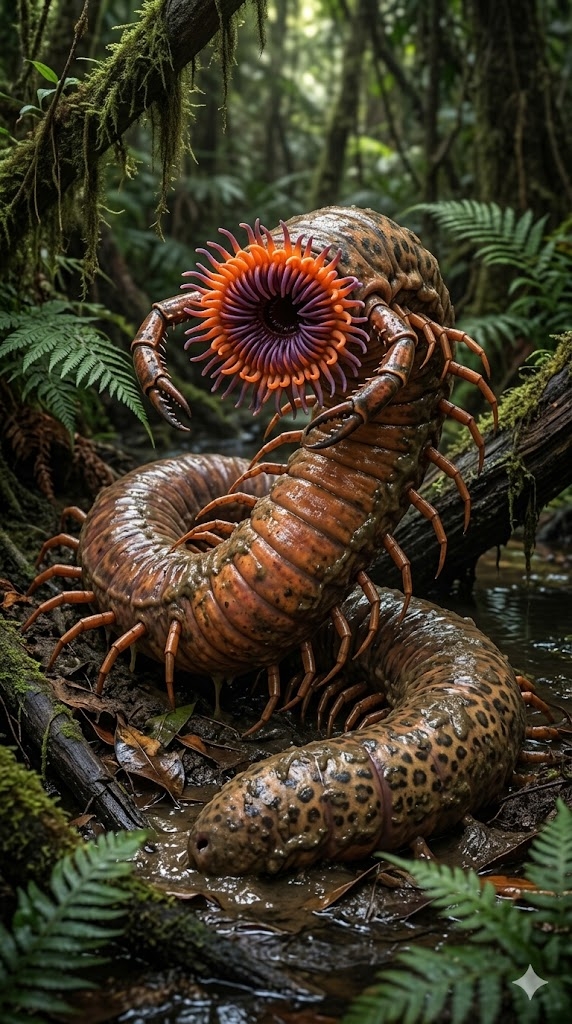
An adventuring party exploring the humid mudflats, dark caverns, or rotting jungles of Saṃsāra might actively track or unexpectedly stumble upon the Scolopendra-Actinoscyphia-Megascolides-Bohadschia 419 due to several environmental, financial, and survival factors:
Harvesting High-Grade Alchemical Ingredients
- Surgical Anesthetics: Alchemists and medical guilds actively hire hunters to harvest the creature’s paralyzing sting venom, which is highly prized for refinement into high-grade surgical anesthetics used in regional clinics.
- Industrial Adhesives: The sticky structural tubules expelled from its posterior defense pore are incredibly potent. Extraction teams brave encounters with the beast to harvest these tubules for manufacturing heavy-duty industrial binders and trapping agents.
Subterranean Exploration and Ambush Hazards
- Flora Mimicry Traps: Because the beast burrows backward into soft soil and mud, leaving only its tentacled anemone oral disk exposed on the surface, unsuspecting adventurers often mistake it for a harmless swamp plant fixture. Walking into its striking perimeter triggers an immediate, life-threatening ambush.
- Cavern Navigation Interception: Parties charting unmapped subterranean tunnel networks or searching for valuable mineral veins frequently cross paths with this creature, as it uses its high tremorsense to detect footsteps passing through solid stone up to 60 feet away.
Territorial Bounty Hunting and Rescue Contracts
- Drag-Hunting Rescue Operations: Due to its habit of drag-hunting—physically pulling paralyzed prey deep into its subterranean burrows to suffocate and digest over several days—adventurers are often hired on time-sensitive rescue contracts to dive into the creature’s tunnels and retrieve captured companions or wealthy merchants before they are fully digested.
- Clearing Humid Trade Routes: Guilds frequently put out bounties on mature specimens that nest near stagnant water networks and muddy trade roads, as their aggressive territorial agitation poses a massive threat to traveling merchant caravans.
Strategic Avatar Hunting
- Acquiring High-Resilience Vessels: In the unique metaphysical landscape of Saṃsāra, specialized hunters seek out top-tier feral beasts to serve as physical vessels for Isekai souls looking to expand their mental gestalts. Due to the creature’s immense constitutional resilience, high cell-regeneration, and unique multi-segmented defensive traits, it is considered an exceptionally powerful, albeit physically horrifying, combat chassis to possess.
A meticulous harvesting process of a Scolopendra-Actinoscyphia-Megascolides-Bohadschia 419 corpse yields several valuable anatomical components, alchemical agents, and rare crafting materials prized across Saṃsāra:
- Copper-Chitin Limb Segments: The forty paired, hyper-dense legs running along the creature’s flanks are heavily reinforced with natural copper-chitin bands. Forges and weapon smiths harvest these durable limbs to extract the organic copper, reshaping them into lightweight, corrosion-resistant armor plating or reinforcing tips for heavy-duty digging tools.
- Elastic Worm-Chassis Leather: The elongated, highly flexible muscular torso can be skinned and treated by leatherworkers. Because of its incredible elasticity and resistance to tears, the processed hide is crafted into high-grade subterranean survival gear, flexible diving suits, and reinforcing straps for cargo-hauling machinery.
- Paralyzing Oral Barbules: Nestled within the concentric rows of the anemone-like oral disk are thousands of microscopic, calcified stinging barbs. Specialized flechette-crafters and rogue factions harvest these barbs intact to use as ammunition tips, creating hunting darts that can temporarily seize the muscle tissue of targeted prey.
- Concentrated Acid Glands: Hidden just below the prehensile maxillipeds are the primary reservoirs for the creature’s fast-acting acidic saliva. Alchemists extract this highly caustic fluid using glass vials, utilizing it as a base component for metal-etching compounds, industrial rust-removers, or specialized alchemical mixtures capable of melting heavy mineral locks.
- Regenerative Marrow-Core: Extracted from the deep, segmented nervous canal running along the center of the torso, this rich, gelatinous marrow retains the creature’s high cell-regeneration capabilities. Medical guilds process this material into expensive potent salves that accelerate skin and tissue recovery from severe lacerations or burn wounds.
- Tremor-Sensitive Olfactory Nodules: The delicate chemical receptors stripped from the tips of the head tentacles can be carefully dried and suspended in conductive oils. Tinkers and magic-tech engineers integrate these preserved nodules into subterranean surveying staves, creating dowsing instruments that vibrate gently to warn miners of collapsing tunnels or distant underground seismic shifts.
Elongated Centipede-Worm-Flower and Great Sticky Escape
Great praise to the damp air-mother who breathes the thick wet fog into the rotting jungle floor. Here is written the clumsy translation of the very old skin-scroll, which was found inside a clay pot under the clay beds of the 73 island nations, written down by clerks who had never seen the forty crawling copper feet of the dark places and did not know the vocabulary for the stinging mouth-flowers.
In the old days when the sky-fire was small and the world Saṃsāra was yet soft like warm mud, the grand mother-creator did sit upon her throne of clay. She looked through the cosmic holes where the lost and possessed souls from the far-away worlds do fall like rain-drops into the dirt. She saw a giant centipede-bug of the Amazon country that had forty paired venomous legs made of dark copper chitin, and she saw a deep-sea anemone-flower that eats the fish with paralyzing stingers, and she saw the giant Gippsland worm-snake that stretches its stomach through the black clay. She said into her inner ear-thought, “I shall tie these four threads into a single knot of terror for my own curiosity.”
The scribe of the ancient temple writes that she did take the thick, leathery, spotted hide of the leopard sea cucumber, complete with its specialized defense pore, and she did paste it onto the rear tail of the long earthworm body. Then she did chop off the proper head-cranium of the beast and did place instead a wide predatory oral disk fringed with multiple rows of brightly colored, paralyzing stinging tentacles. She named this creature Scolopendra-Actinoscyphia-Megascolides-Bohadschia Four-Nineteen, which translates in the broken dialect of the coastal tribes to: “The Elongated Multi-Legged Plant-Mimic that Spits the Hard Glue.”
There was an adventurer of the ancient epoch, an Isekai character who had crossed the grand boundary after his life-candle was snuffed out in a distant land of metal wagons. When he did wake up inside the wet jungle of Saṃsāra, his mind-box was full of the great amnesia-smoke. He did look upon his physical skin and did see that his soul had been shoved into the body of an ordinary swamp-tracker, having only a basic iron iron-blade, a leather water-sack, and zero gold coins in his small belt-pouch. His base statistics were very low, and his cell-regeneration was not yet leveled to the second tier.
The hero did walk through the perpetually humid mudflats where the damp soil smelled of old leaves. He did see a beautiful orange and purple flower growing out of the black mud, looking exactly like a harmless swamp flora fixture of the deep woods. He did say to his own heart, “I shall pluck this beautiful blossom to sell to the alchemists at the regional clinic for three copper coins.”
But this was the great deception of the Centipede-Worm-Flower! The creature had burrowed backwards into the soft soil, leaving only its tentacled anemone oral disk exposed on the surface to trick the eyes of the foolish. When the hero did step his foot into the striking perimeter, the beast did activate its hidden initiative action.
The ancient text says the nightmare anomaly did arch its segmented torso, clicking its sharp copper maxillipeds together in a rapid, rhythmic warning cadence that sounded like the cracking of dry bones. Before the hero could make a Reflex saving throw check, the creature did execute its Maxilliped Pincer Pin. The two large, hollow forcing pincer claws did slam forward like iron pincers, pinning the hero’s leg to the wet earth and injecting its fast-acting concentrated acidic saliva into his leather boots.
The hero did scream a great scream, for the acid did begin to melt the iron buttons of his gaiters. He did strike the beast with his iron blade, but the blow did only slide off the thick, slippery mucus shield that covered the creature’s earthworm-chassis like a coat of heavy oil. The beast did then deploy its primary combat behavior, which is the drag-hunt tactic. It did wrap its eleven-foot elastic cylindrical torso around the hero’s chest, squeezing out his air-breath with the strength of three large constrictor snakes.
Then, using its forty paired prehensile legs to rapidly scuttle backward, the beast did begin to pull the paralyzed hero down into its dark subterranean burrow system. The hero did feel his body sinking into the anaerobic clay where no air-breath lives. He did know by his intuition that if his head went below the mud line, his life-points would drop to absolute zero within three turn-rounds.
With a final effort of his physical muscle modifier, the hero did reach into his belt-pouch and did pull out a small glass vial of volatile fire-oil which he had scavenged from a ruined cart. He did smash the glass directly against the creature’s tentacled oral disk. The sudden burst of fire-heat did cause acute distress to the moisture-dependent beast, as it did threaten to dry out its protective mucus layer. The monster did let out a wet hiss from its oral disk and did release its squeeze-grip.
The hero did scramble out of the mud hole, his legs trembling from the paralyzing oral barbules that had scratched his skin. But the beast was full of territorial agitation! It did expose its posterior end from the burrow and did expel a tangled mass of sticky, toxic structural tubules from its rear pore directly at the fleeing man.
The scroll states that the sticky tubules did expand upon contact with the air, catching the hero’s iron blade and binding it directly to his leather scabbard so that it could never be drawn again. The glue did also stick three swamp birds and two small burrowing beasts to the tree trunks as the hero did flee on his hands and knees through the rotting brush, never looking back until he did reach the stone gates of the walled trade route where the air is dry and the mud cannot follow.
Moral of the Story
He who walks through the humid mudflats of the world must never try to pluck the bright orange flower that grows without a green stem, lest he find himself pinned by forty copper feet and dragged backward into the dark clay where his sword will be glued to his hip forevermore. Trust not the plant that clicks its teeth in the mud, and always keep your fire-oil close to your hand when the ground begins to vibrate.
Suggested conversions to other systems:
Call of Cthulhu (7th Edition)
Scolopendra-Actinoscyphia-Megascolides-Bohadschia 419 (The Burrowing Tentacle-Horror)
- Characteristics:
- STR 150 (Immense Squeezing Force)
- CON 190 (High Constitution and Thickness)
- SIZ 180 (Elongated 11-foot Chassis)
- DEX 85 (Rapid Multi-Legged Coordination)
- INT 15 (Feral Instinctual Baseline)
- POW 70 (Basic Life Spark)
- EDU —
- HP: 37
- Damage Bonus (DB): +3D6
- Build: 4
- Move: 7 Ground / 4 Burrow / 3 Swim
- Magic Points: 14
- Combat Profile:
- Attacks per round: 2 (Can execute a rapid tentacle bite combined with a pincer pin)
- Fighting (Tentacled Acidic Bite) 70% (35% Hard / 14% Extreme), damage 1D8 + DB + 1D4 acid damage
- Maxilliped Pincer Pin 65% (32% Hard / 13% Extreme), damage 1D6 + DB, target is grappled
- Dodge 42% (21% Hard / 8% Extreme)
- Skills:
- Athletics (Burrowing) 80%, Stealth 75% (+20% when mimicking flora in swamp mud), Spot Hidden 60%
- Special Abilities and Mechanics:
- Mucus Shield: The creature’s slippery body grants a 3-point armor check value against standard physical slashing attacks.
- Expel Sticky Tubules: Once per encounter when reduced to half its total hit points, it can spray a 10-foot cone of sticky tubules from its rear pore. Targets in the area must pass a Hard DEX roll or become immobilized. Escaping requires a successful Hard STR or Athletics roll.
- Tremorsense: The creature’s sensory system completely bypasses conventional darkness or blindness modifiers by detecting ground vibrations through solid stone up to 60 feet away.
- Sanity Loss: 1/1D8 Sanity points to witness its grotesque, multi-segmented centipede-earthworm physiology.
Blades in the Dark
The Mud-Flora Stalker (Vile Chimera)
- Classification: Level 3 Threat (Dangerous Segmented Abomination)
- Anatomy & Quality:
- Tier III Quality Scale (Long, elastic cylindrical earthworm chassis with copper centipede limbs and an anemone oral disk)
- Scale: Medium to Large scale ambush predator (11-foot length, 2-foot diameter)
- Attributed Traits & Actions:
- Prowess (Threat level Great): High multi-legged scuttling agility, subterranean burrowing speed, and constriction strength.
- Insight (Threat level Poor): Blind tracking via vibrations and tremorsense; driven entirely by basic predatory hunger.
- Resolve (Threat level Bold): Highly resistant to pain or distraction when it establishes a tight constriction grip on prey.
- Mechanical Consequences & Harm:
- Level 3 Harm: Constricted Lungs / Deep Acid Burns (From drag-hunting constriction or its cavernous acidic bite)
- Level 2 Harm: Paralyzed Limbs (Stinging barbs temporarily lock muscle tissue)
- Clock Mechanics & Tactical Triggers:
- 4-Clock: Subterranean Drag-Hunt. When the creature successfully pins an operator with its maxillipeds, it ticks this clock every action phase. If the clock fills, the target is pulled deep into a subterranean burrow, escaping visibility and facing suffocation hazards.
- Mucus Shielding: The creature’s slippery hide reduces the effect level of ordinary physical blades and melee cutting attacks.
Dungeons & Dragons (5th Edition)
Scolopendra-Actinoscyphia-Megascolides-Bohadschia 419
- Basic Statistics:
- Large Beast, Unaligned
- Armor Class: 15 (Natural Armor Check)
- Hit Points: 114 (12d10 + 48)
- Speed: 30 ft., burrow 20 ft., swim 15 ft.
- STR 17 (+3), DEX 16 (+3), CON 19 (+4), INT 3 (-4), WIS 18 (+4), CHA 3 (-5)
- Skills: Perception +7, Stealth +6 (+10 when mimicking swamp flora)
- Condition Immunities: Blinded
- Senses: Tremorsense 60 ft., Passive Perception 17
- Challenge Rating: 5 (1,800 Renown Points equivalent)
- Traits:
- Moisture Dependency: The creature has disadvantage on saving throws against extreme heat or dehydration environments.
- Mucus Shield: The creature has resistance to nonmagical slashing damage.
- Swamp Flora Mimicry: While the creature remains motionless buried in mud or soil, it is indistinguishable from an ordinary swamp plant or deep-sea anemone.
- Actions Menu:
- Multiattack Profile: The creature performs two attacks: one with its Tentacled Acidic Bite and one with its Maxilliped Pincer Pin.
- Tentacled Acidic Bite Attack: Melee Weapon Attack: +6 to hit, reach 5 ft., single target. Hit: 7 (1d8 + 3) piercing damage plus 4 (1d4 + 2) acid damage. The target must succeed on a DC 15 Constitution saving throw or be Paralyzed for 1 minute. The target can repeat the save at the end of each of its turns to end the effect.
- Maxilliped Pincer Pin Attack: Melee Weapon Attack: +6 to hit, reach 5 ft., single target. Hit: 6 (1d6 + 3) bludgeoning damage, and the target is grappled (escape DC 15).
- Drag-Hunt Scuttle: If the creature has a target grappled, it can use a bonus action to move up to half its burrow speed backward into the earth, dragging the grappled target along with it.
- Expel Sticky Tubules (Recharge 5–6): The creature sprays a 10-foot cone of sticky, toxic structural tubules from its posterior pore. Each creature in that area must succeed on a DC 15 Dexterity saving throw or be Restrained. A creature can repeat the saving throw as an action, ending the effect on a success.
Knave (2nd Edition)
Centipede-Worm-Flower
- Attributes:
- Armor Check: 15 (Equivalent to tough, copper-chitin bands and slippery mucus protection)
- Hit Dice: 7 (35 Hit Points Baseline)
- Movement Speed: 30 ft. Ground / 20 ft. Burrow / 15 ft. Swim
- Morale Score: 9 (Aggressive territorial hunter)
- Attack Profiling: Two multi-attacks per turn cycle (+4 bonus to attack rolls).
- Damage Outputs:
- Tentacled Oral Disk Strike: 1d8 piercing damage + 1d4 acid damage.
- Maxilliped Forcing Claws: 1d6 bludgeoning damage + target is automatically grappled if the attack hits.
- Tactical Core Rules Syntax:
- Save Mechanics: Any adventurer grabbed by the maxilliped pincer claws must execute a Strength or Dexterity saving throw (DC 15) on their turn to break the grapple. If they fail, the creature uses its next movement phase to drag them 20 feet backward into its clay burrow network.
- Paralyzing Sting Saving Throw: When struck by the tentacled oral disk, the target must pass a Constitution saving throw (DC 15). Failure results in total muscle paralysis lasting for 1d4 rounds, rendering them unable to take actions or move.
- Loot & Harvesting Assets: The corpse drops 40 copper-chitin limb segments (usable for forging lightweight, corrosion-resistant armor plates) and 1d4 concentrated acid glands.
Fate Core / Fate Condensed
Scolopendra-Actinoscyphia-Megascolides-Bohadschia 419 (The Burrowing Centipede-Flower)
- Aspects:
- High Concept: Grotesque Multi-Segmented Centipede-Earthworm Hybrid
- Trouble: Moisture-Dependent Skin Must Avoid Dry Environments
- Territory Aspect: Lurker of Perpendicular Mudflats and Cavern Floors
- Bio-Mechanical Aspect: Headless Oral Disk Mimicking Harmless Swamp Flora
- Combat Aspect: Forty Copper-Chitin Legs and Paralyzing Tentacles
- Skills:
- Great (+4): Stealth, Fight
- Good (+3): Physique, Athletics
- Fair (+2): Notice, Will
- Average (+1): Provoke
- Stunts:
- Swamp Flora Mimicry: Because its head mimics an ordinary plant, it gains a +2 to Stealth rolls when it remains completely motionless while burrowed in mud or soil to establish an ambush.
- Subterranean Drag-Hunt: When it has an opponent grappled or pinned, it can use its scuttling legs to move backward. It gains a +2 to Physique checks made to overcome opposition when moving an enemy into an adjacent subterranean burrow zone.
- Slippery Mucus Shield: The creature uses its thick, slimy coat to evade standard blade cuts. It can use its Physique skill instead of Athletics to defend against physical slashing attacks in close combat.
- Stress & Consequences:
- Physical: [ ] [ ] [ ] [ ]
- Mental: [ ] [ ] [ ]
- Mild Consequence (2): ________
- Moderate Consequence (4): ________
Numenera & Cypher System
Centipede-Worm Swamp Mimic
- Level: 5
- Motive: Extreme predatory hunger and protective territorial dragging of prey.
- Environment: Humid mudflats, dark cavern floors, and rotting jungle biomes.
- Health: 20
- Damage Inflicted: 4 points of physical piercing damage plus 2 points of acid/poison damage.
- Armor: 1 (Slippery mucus layer provides 2 points of specialized armor check reduction against standard physical slicing blades).
- Movement: Short when scuttling on land or burrowing; immediate when swimming.
- Modifications: Task difficulty for Stealth and Camouflage when buried in swamp mud is decreased by two steps (Level 3 task). Task difficulty for sensing intruders via ground vibrations is decreased by two steps (Level 3 task).
- Combat & Encounter Mechanics:
- Maxilliped Pincer Pin: The creature strikes with its copper forcing claws. The target must pass a Might defense roll (Difficulty 5) or become pinned and grappled. On subsequent rounds, the creature shifts to its drag-hunting behavior, moving the target backward into a burrow.
- Expel Toxic Tubules: Once per encounter when heavily damaged, it can spray a tangled mass of sticky, toxic structural tubules from its rear pore. Every target in an immediate zone must pass a Speed defense roll or become completely restrained and unable to take physical actions.
- Salvage & Loot Assets: Harvesting the carcass yields 40 copper-chitin limb bands that can be salvaged into an organic shielding asset or processed into a Level 5 Cypher capable of accelerating tissue recovery or serving as a caustic acid weapon base.
Pathfinder (2nd Edition)
Scolopendra-Actinoscyphia-Megascolides-Bohadschia 419 — Creature 5
- Traits: N, Large, Beast, Amphibious, Environmental
- Perception: +13; Tremorsense (Vibration tracking) 60 feet; Passive Perception 23
- Skills: Athletics +14 (+16 to Drag-Hunt), Perception +13, Stealth +13 (+17 when mimicking swamp flora)
- Attributes: STR +4, DEX +3, CON +5, INT -4, WIS +4, CHA -5
- Defenses:
- AC Check: 22 (Natural armor check limit augmented by thick mucus)
- Fortitude: +16, Reflex: +12, Will: +11
- HP Pool: 95 points
- Immunities & Weaknesses: Resistant to Physical Slashing 5 points; Weakness to Fire 5 points (dehydrates moisture-dependent skin layers)
- Speed: 30 feet, burrow 20 feet, swim 15 feet
- Melee Attacks (Actions):
- [one-action] Tentacled Acidic Bite +15 to hit (Reach 5 feet). Hit: 2d6 + 6 piercing damage plus 1d4 acid damage. The target must succeed on a DC 21 Fortitude save or become Paralyzed for 1 round.
- [one-action] Maxilliped Pincer Pin +15 to hit (Reach 5 feet). Hit: 2d4 + 6 bludgeoning damage, and the target is Grabbed (Escape DC 21).
- Special Ability Actions:
- [one-action] Drag-Hunt Scuttle: The creature scuttles backward using its forty paired prehensile legs. It moves up to half its burrow speed backward, carrying any Large or smaller target it currently has Grabbed along with it into the earth.
- [two-actions] Expel Sticky Tubules (Recharge 5–6): The creature sprays a 10-foot cone of sticky structural tubules from its posterior pore. Each creature in that area must pass a DC 21 Reflex save or become Restrained. An entangled target can attempt a DC 21 Athletics check as an action to break free.
Savage Worlds (Adventure Edition)
Centipede-Worm-Flower (Wild Beast)
- Attributes:
- Agility: d8
- Smarts: d4 (A)
- Spirit: d6
- Strength: d10
- Vigor: d12
- Derived Statistics:
- Pace: 6 (Burrow Pace 4)
- Parry: 6
- Toughness: 11 (3 points of tough copper-chitin and slippery mucus armor check scale)
- Skills:
- Athletics d8, Fighting d8, Notice d8, Stealth d8+2
- Hindrances & Edges:
- Moisture Dependent: The creature must remain in highly humid or muddy biomes. It suffers a flat -2 modifier to all attribute rolls for every hour spent in dry sand dunes or volcanic ash fields.
- Tremorsense: Bypasses all standard illumination penalties. Tracks targets up to 12 inches away through solid ground or stone.
- Special Abilities & Combat Rules Syntax:
- Tentacled Oral Disk: Str+d6 damage. A target shaken or wounded by this attack must succeed on a Vigor roll (DC 15) or become Bound by temporary muscle paralysis for 1d4 rounds.
- Maxilliped Claws: Str+d4 damage. A successful hit grants an automatic Grapple check.
- Drag-Hunting Scuttle: When the creature successfully maintains a grapple, it can move backward up to its burrow pace as a free action, pulling its prey underground to suffocate.
- Sticky Tubule Defense: Once per encounter, as a limited action, the creature can project a 10-foot cone of structural tubules. Anyone inside the template must pass an Agility roll or become Entangled (or Bound on a raise).
Shadowrun (6th World Edition)
Scolopendra-Actinoscyphia-Megascolides-Bohadschia 419 (The Cavern Floor Lurker)
- Attributes:
- Body: 8
- Agility: 4
- Reaction: 4
- Strength: 6
- Willpower: 4
- Logic: 1
- Intuition: 5
- Charisma: 1
- Essence: 6.0
- Magic: 3
- Initiative: 9 + 1D6
- Defense Rating: 11 (Copper-chitin lateral bands and slimy segmentation armor check)
- Condition Monitors:
- Physical: 12
- Stun: 10
- Skills:
- Close Combat: 4 (Maxilliped Pincer / Tentacled Bite)
- Exotic Combat: 3 (Sticky Tubule Projection)
- Perception: 5 (Vibration tracking modifier +3)
- Stealth: 5 (Camouflage modifier +3 when mimicking flora)
- Critter Powers & Complex Mechanics:
- Mucus-Shield Coating: Gives the critter a +2 defense rating modifier against physical slicing/slashing blades and allows it to use its body attribute to shrug off physical structural trauma.
- Tentacled Paralyzing Bite: DV 4P + 2D6 poison/acid damage, AR 8/—/—/—/—. The target must succeed on a Body + Toxin Resistance (4) test or suffer the Paralyzed status condition for 2 combat rounds.
- Maxilliped Pincer Pin: When a Close Combat attack with the forcing claws succeeds, the critter automatically initiates a grapple. On its next action phase, it can use a Minor Action to drag the victim backward into its burrow system up to its standard burrowing movement rate.
- Expel Sticky Tubules: As a Major Action (Recharge 5-6), the creature can spray a 10-meter cone of adhesive tubules from its rear pore. Targets must pass an Agility + Reaction (3) test or suffer the Entangled status. Escaping the glue requires a successful Strength + Athletics (4) test.
- Moisture Dependency: The critter suffers a -2 dice pool penalty to all actions for every 10 minutes it spends in dry, desert, or high-heat volcanic ash environments due to mucus-layer desiccation.
Starfinder (2nd Edition)
Scolopendra-Actinoscyphia-Megascolides-Bohadschia 419 (Anemone-Mouth Drag-Hunter)
- Basic Statistics:
- Large Beast, Unaligned
- Armor Class (EAC/KAC): 18 / 20 (Slippery mucus and copper-chitin bands armor check)
- Hit Points: 84 points
- Speed: 30 ft., burrow 20 ft., swim 15 ft.
- STR +4, DEX +3, CON +5, INT -4, WIS +4, CHA -5
- Skills: Athletics +14 (+16 to Drag-Hunt), Perception +13, Stealth +13 (+17 when mimicking swamp flora)
- Damage Weaknesses/Resistances: Weakness to Fire 5; Resistance to Physical Slashing 5
- Senses: Tremorsense (Vibration tracking) 60 ft.
- Traits:
- Amphibious/Burrower: Expertly navigates muddy terrains, subterranean cavern networks, and humid jungle floors. Bypasses dark visual penalties using ground vibrations.
- Moisture Dependency: Suffer a -2 penalty to saving throws against extreme heat or artificial dehydration weapon sources.
- Actions & Attacks:
- Tentacled Acidic Bite (One Action): Melee Strike +15 to hit (Reach 5 ft.). Hit: 2d6 + 4 piercing damage plus 1d4 acid damage. The target must succeed on a DC 21 Fortitude saving throw or become Stunned 1 for 1 round due to localized muscle paralysis.
- Maxilliped Pincer Pin (One Action): Melee Strike +15 to hit (Reach 5 ft.). Hit: 2d4 + 4 bludgeoning damage, and the target is automatically Grabbed (Escape DC 21).
- Drag-Hunt Scuttle (Bonus Action): If the creature has a target Grabbed, it scuttles backward using its forty paired prehensile legs. It can move up to half its burrow speed backward into the earth, dragging the target down into its subterranean burrow.
- Expel Sticky Tubules (Two Actions; Recharge 5–6): The creature activates its posterior defense pore, spraying a 10-foot cone of structural tubules. Each creature in that area must pass a DC 21 Reflex saving throw or become Restrained.
Traveller (Core Rulebook / Mongoose 2nd Edition)
Segmented Mud-Flora Mimic
- Animal Statistics:
- Type: Hunter / Trapper
- Size: 200 kilograms (Elongated 11-foot worm-centipede chassis)
- Armor Check: 2 (Copper-chitin lateral bands and thick mucus shield)
- Characteristics: STR 10 (+1), DEX 10 (+1), END 14 (+2), INT 1 (-2), INS 9 (+1), EDU 0 (—)
- Hits (Damage Pools): 35 / 20 (Total pooling structure)
- Speed: 10 meters Ground / 6 meters Burrow / 4 meters Swim
- Skills:
- Athletics (Burrowing) 2, Melee (Unarmed) 2, Recon 1, Stealth 3
- Attacks & Defensive Traits:
- Tentacled Acidic Bite: Damage 2D6 piercing + 1D4 acid damage. Features the Poison trait (Difficulty 8+ END check or suffer a local temporary -2 DEX penalty from muscle paralysis).
- Maxilliped Forcing Claws: Damage 1D6 + 2 bludgeoning damage. Features the Grapple trait (Difficulty 9+ to break free).
- Drag-Hunting Scuttle: When the mimic maintains a grapple, it can use a movement phase to drag its prey backward into a subterranean clay burrow.
- Expel Sticky Tubules: As a reaction to taking half its health in damage, the creature can spray a mass of tubules. Anyone within a 3-meter cone must pass a DEX check (Difficulty 8+) or be Entangled, binding weapons and limbs.
- Swamp Flora Mimicry: When buried and completely motionless, any Traveler attempting to notice the creature suffers a DM-4 penalty to their Recon check.
Warhammer Fantasy Roleplay (4th Edition)
Scolopendra-Actinoscyphia-Megascolides-Bohadschia 419 (The Copper-Chitin Mud Horror)
- Profile Characteristics:
- M: 6 | WS: 42 | BS: — | S: 48 | T: 52 | I: 38 | Ag: 35 | Dex: — | Int: 12 | WP: 42 | Fel: 5
- Wounds: 24 points
- SB: 4 | TB: 5
- Armor Check Plating: 2 (Copper-chitin bands protecting the Body and Legs hit locations)
- Traits & Attributes:
- Amphibious/Burrower: Can scuttle through humid jungle floors, swamp mudflats, and dark cavern floor networks seamlessly.
- Tremorsense: Bypasses conventional blindness or darkness penalties, tracking steps up to 12 yards away through ground vibrations.
- Mucus Shield: The horror has the Ward (Slashing) trait, reducing damage taken from slashing weapons by 2 points.
- Weakness (Fire): Sustains +2 damage from all fire-based hits due to its moisture-dependent epidermis.
- Combat Talents & Actions:
- Weapon (Tentacled Acidic Bite): +42 to hit, Damage +8. Targets hit must pass a Challenging (+0) Endurance Test or gain the Paralyzed Condition for 1d3 rounds.
- Weapon (Maxilliped Pincer Pin): +42 to hit, Damage +6. Features the Inflict Grapple trait.
- Drag-Hunt Scuttle: If the horror has an opponent grappled, it can use its move to scuttle backward into its burrow, forcing the grappled target into the earth where they must pass a Swim or Athletics test to avoid suffocation.
- Expel Sticky Tubules: Once per encounter, the horror can spend an action to spray a 3-yard cone of adhesive filaments from its rear pore. All targets within the cone must pass a Challenging (+0) Agility Test or gain 2 Entangled Conditions.