
Original Life Forms:
- Kingdom: Animalia
- Class (Reptilia): Komodo Dragon (Varanus komodoensis)
- Class (Aves): Shoebill Stork (Balaeniceps rex)
- Class (Insecta): Giant Weta (Deinacrida spp.)
- Class (Chondrichthyes): Sawfish (Pristidae)
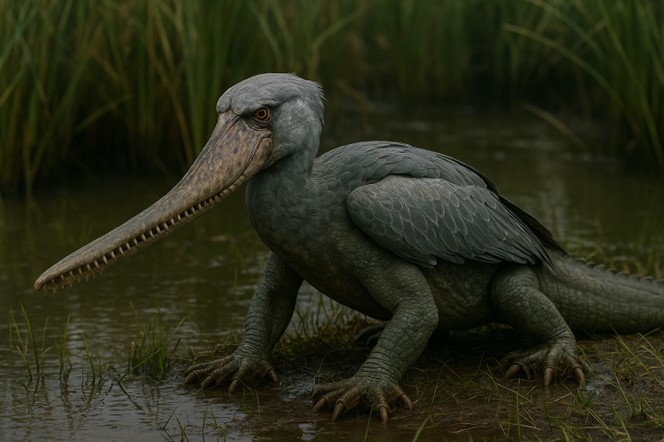
Appearance: The Pristobalaeveta 9 is a nightmarish amalgamation of its progenitors. It possesses the powerful, low-slung reptilian body of a Komodo dragon, covered in tough, grey-green scaly hide that offers excellent camouflage in its marshy environment. Its head is its most terrifying feature: a massive, disproportionately large avian head identical to that of a Shoebill stork, complete with a huge, hooked beak and unsettlingly intelligent, forward-facing eyes. From the front of this avian head extends a long, flat, bony rostrum lined with sharp, tooth-like denticles on either side, exactly like that of a sawfish. Its four sturdy, reptilian legs end not in claws, but in large, insectoid feet reminiscent of a Giant Weta, complete with powerful, spiny hind legs that can be used for defense or to deliver a punishing kick. A pair of broad, feathered wings, also like a Shoebill’s, are folded tightly against its back, more suited for short, clumsy glides than for true flight.
Size: A mature adult stands roughly 4 to 5 feet tall at the shoulder but measures 10 to 12 feet from the tip of its saw-nose to the end of its long, reptilian tail. It weighs between 200 and 300 pounds.
Speed: On land, it moves with a slow, deliberate, reptilian gait, but it can break into a surprisingly fast, clumsy run for short distances. In water, it is a powerful swimmer, using its long tail for propulsion. Its wings are not strong enough for sustained flight but allow it to make powerful, soaring leaps or to glide from a high perch down onto unsuspecting prey.
Stat Modifiers:
- Strength: +4
- Endurance: +3
- Agility: -1
- Perception: +2
- Wisdom: +1
Skills:
- Intimidation: Its bizarre appearance and the unnerving stare of its avian eyes are deeply unsettling.
- Stealth: Despite its size, it is capable of remaining perfectly motionless for hours, blending into the reeds and murky water of its habitat.
- Survival: An expert hunter and tracker in its native swampy environment.
- Athletics: A powerful swimmer and capable of short, explosive bursts of speed.
Behavior: The Pristobalaeveta is a solitary ambush predator. It spends most of its day standing perfectly still in shallow, murky water or dense reeds, its grey-green hide making it appear like a dead log or a strange rock formation. It uses the patience of the shoebill, waiting for prey to come within striking distance. When it attacks, it does so with explosive speed. It will use its saw-like rostrum to slash and disable prey in the water, or lunge with its massive beak to crush smaller targets on land. If threatened, it will hiss like a reptile, clatter its huge beak loudly, and kick with its powerful, spiny hind legs. It is extremely territorial and will aggressively defend its chosen hunting ground from rivals and intruders.
Diet: Strictly carnivorous. Its diet consists mainly of large fish, water birds, and any land animals unfortunate enough to come to the water’s edge to drink, including creatures as large as wild boar or deer. It is not a picky eater and will consume carrion if available.
Emotions: The Pristobalaeveta operates on a primal level. Its primary emotions are a patient, calculating hunger and a fierce, violent territoriality. It can display sudden, explosive rage when its territory is challenged or when an attack is unsuccessful. It shows no signs of fear, only aggression or strategic retreat.
Environment where found: It is found exclusively in brackish water environments, such as mangrove swamps, murky river deltas, and large, stagnant marshlands where dense reeds and murky water provide ample cover.
Tags: Feral, Beast, Amphibious, Predator, Territorial, Solitary, Reptilian, Avian, Insectoid, Aquatic, Ambush Hunter, Sawtooth-Rostrum, Marsh dweller, Carnivorous, Glider, Camouflaged, Large, Cold-Blooded
Age and Life Cycle
• Egg Stage: Oval, leathery eggs are laid in clutches of 6 – 8 within shallow, mud-lined depressions above the high-tide mark. Incubation lasts roughly nine lunar cycles.
• Hatchling (0 – 2 years): Newly hatched young measure about 14 inches long, display mottled rust-green hides, and remain in dense reeds while feeding on small crustaceans and amphibian larvae. Rapid growth occurs during seasonal monsoon surges when prey is abundant.
• Juvenile (3 – 8 years): Length surpasses 6 feet. Denticle rows harden, and wing-feathers broaden, enabling the first practice glides from mangrove roots into water. High mortality results from cannibalistic adults and salt-water crocodilians.
• Sub-Adult (9 – 12 years): Sexual characteristics—throat-pouch color in males, sagittal crest feathering in females—brighten. Territory scouting begins, and the animal perfects stealth stillness.
• Mature Adult (13 – 40 years): Peak hunting efficiency. Individuals claim roughly 12 square miles of marsh. Molting occurs twice yearly to maintain scale flexibility and wing integrity.
• Venerable (41 – 55 years): Growth slows; denticles dull; aggression intensifies. Some abandon roaming and establish semi-permanent lairs in submerged logjams, relying more on ambush than pursuit. Few survive beyond 55 years.
Mating
• Seasonality: Courtship coincides with the first heavy rains of the warm season, when water levels rise.
• Display: Males perform “bill-clatter booms” by snapping the beak shut underwater to create resonant drumming that carries for hundreds of yards. Concurrently, they sweep the saw-rostrum in a slow lateral arc, scattering bioluminescent plankton at dusk to mark display arenas.
• Selection: Females inspect multiple arenas, evaluating rostrum symmetry and throat-pouch coloration. A female approaches the favored male and mirrors his beak clatter six times—a signal of acceptance.
• Copulation: Occurs on a partially submerged sandbar, lasting several minutes. Both partners maintain vigilance; nearby juveniles often attempt opportunistic strikes at floating fish dislodged by the commotion.
• Post-Mating: Partners separate immediately. The female selects a secluded nest site within her own hunting grounds. Parental care rests solely with the female until hatchlings disperse at three lunar cycles.
Tactics
• Ambush Stillness: Hours-long immobility while partially submerged, nostrils raised just above waterline.
• Saw-Sweep: Sideways sweep of the rostrum to stun fish or sever limbs of wading mammals. Effective radius about 4 feet.
• Beak Crush: Direct forward lunge; upper mandible drives downward with enough force to break femurs of small deer.
• Kick-Back Defense: Hind-leg strike aimed at predators approaching from behind; spines inflict deep lacerations.
• Glide-Drop Assault: From overhanging mangrove branches, an adult spreads wings and executes a controlled glide of up to 60 feet, landing atop prey to pin it before biting.
• Territorial Intimidation: Inflates throat-pouch, hisses, and slams tail on water to generate splash curtains that obscure movement and disorient rivals.
Actions
• Hold Breath (25 minutes average) enabling submerged stalking.
• Scale Rattle—vibrates lateral scale edges, producing a low rattling that warns juveniles away from kills.
• Mud-Mask—coats head and wings with marsh mud, reducing reflected moonlight for nocturnal hunts.
• Thermal Basking—spreads wings on exposed logs at dawn to regulate body temperature after cool nights.
• Rostrum Sharpening—scrapes denticles against basaltic rocks once per fortnight to maintain cutting efficiency.
• Cannibalistic Cull—targets weak juveniles during seasonal food shortages to reduce competition.
Other Interesting Information
• Sensory Adaptations: Forward-facing eyes grant depth perception; lateral vibration-sensing canals line the rostrum, detecting minute water disturbances comparable to sawfish ampullae.
• Venom-Resistance: Regular consumption of certain puffer-like marsh fish grants immunity to tetrodotoxin derivatives, allowing exploitation of toxic prey avoided by other predators.
• Symbiotic Cleaners: Small heron-like birds perch atop basking adults, removing parasites from leg joints; the reptile tolerates their presence even when prey is scarce.
• Cultural Impact: Local fisher-folk carve effigies of the creature’s saw into boat prows, believing the likeness deters real attacks.
• Resource Use: Shed rostrum denticles, collected seasonally along riverbanks, are fashioned into serrated knives prized by swamp-dwelling smiths for maintaining edge in humid conditions.
• Environmental Indicator: A sudden absence of the species in a delta often precedes catastrophic saline surges, as their sensory canals detect early changes and prompt migration upriver.
Adventuring groups find themselves drawn toward, or unwittingly blundering into, Pristobalaeveta territory for a variety of practical, mercantile, scholarly, and strategic reasons:
• Rostrum-Denticle Harvest
Local smith-alchemists value the shed denticles that drift to shore only a few days each high-sun cycle. When collected fresh they alloy readily with river-iron, producing saw-edge weapons that bite through chitin and rope with minimal sharpening. Guild buyers pay up to eight silver per intact denticle, while a whole discarded rostrum fetched intact earns more than a small cargo of hardwood. Gathering parties therefore slip into the mangroves during the shedding window, knowing the owners linger close by to guard the cast-off ivory.
• Commissioned Trophy Hunt
Coastal lords embellish great-hall walls with the mounted saw-nose because its silhouette evokes dominion over untamed delta spirits. A single commission can equal a year’s billet of coin, provisions, and permits. Specialists hire escorts to track a prime adult, document the pursuit for heraldic legitimacy, and deliver the cleaned trophy before the rainy season bloats the rivers and renders transport impossible.
• Safeguarding Fishery Rights
Silting canals that feed village pond-farms often twist into Pristobalaeveta feeding lanes. When a mature individual stakes claim, fish stocks plummet and boat traffic halts. Communities request armed mediation: force the beast farther upriver, fence breeding shallows, or at minimum map its ambush stands so ferries can reroute. Crews must verify the creature’s exact range and habits without provoking a lethal charge.
• Nest-Raiding for Alchemical Components
Unfertilized eggs, rare but obtainable if the female’s courtship failed, contain albumen whose colloidal structure bonds smoothly with powdered sky-opal. The resulting gel holds luminescent runes for double the usual duration—prized by lantern-magi and map-makers. Harvesting requires dawn infiltration of the reed-mound, swift extraction, and retreat before the sentinel male returns from his predawn patrol.
• Crisis Early-Warning Mission
Marsh settlements heed folk wisdom: when the “Steel-Saw Heron” abandons a delta, a brine surge, toxic algal bloom, or tidal quake soon follows. Scholars studying magic-weather hire escorts to verify sudden absences, retrieve water samples, and track retreat paths. Confirmed flight of multiple adults may grant a ten-day margin to evacuate crops and reinforce levees.
• Pilgrimage for Spirit Trials
Certain mud-shrine cults teach that wresting a single intact wing-feather grants the bearer the “Still Patience”—a meditative trance useful for divination. Initiates must approach the basking creature on floating reed mats, pluck the feather without spilling blood, then depart unseen. Guides experienced in silent poling and mangrove concealment command high fees.
• Rescue or Recovery of the Lost
Deltas littered with shipwrecked steam-barges and driftwood villages occasionally host disappearances blamed on the saw-beaked predator. Families raise coin purses seeking proof of fate or return of keepsakes. Search groups brave the fog-thick byways, following drag marks that lead toward submerged logjams where the Pristobalaeveta caches kills and scavenged cargo.
• Scholarly Dissection and Morphic Study
Anatomists researching cross-kingdom fusion phenomena can advance reputation markedly through a full specimen study. Live capture yields insights into rostrum vibration-sensing canals and the junction of avian musculature with reptilian skeletal mass. University charters provide letters of marque and cover expenses, but stipulate humane termination and intact organ preservation—difficult goals amid lethal counter-attacks and infectious swamp humidity.
• Securing Safe Passage for Trade Caravans
During dry-ebb months, overland caravans shortcut through exposed delta flats. A resident Pristobalaeveta treats the procession as encroachment. Mercenary patrols accept contracts to scout ahead, distract the beast with false splashes or decoy carrion, and keep wagons moving before dusk. These escorts often double as salvage divers, retrieving cargo from overturned rafts struck by rostrum sweeps.
• Retrieving Legendary “Saw-Scribed” Map Shards
Tales circulate of an elder Pristobalaeveta whose rostrum bears natural scar patterns resembling river-glyph cartography. A cartographer’s guild sponsors expeditions to collect moulting fragments, believing they reveal hidden deep-water routes to submerged crystal quarries. Whether truth or myth, the lure of an uncharted trade artery drives seasoned explorers into the creature’s most jealously guarded lagoon.
In each circumstance the marsh predator is not a random obstacle but a pivotal presence—keeper of coveted resources, omen of environmental flux, test of skill, and emblem of dominion over the world’s primeval waterways.
Additional items or ingredients harvested from their corpses:
• Rostrum Core Bone
The central shaft of the saw-nose cures into a naturally serrated spar that steam-artificers embed in reciprocating saw frames. Its innate resonance shortens cutting passes through dense aether-wood and rune-hardened crystal without blunting.
• Denticle Sheath Membranes
Thin connective tissues that once anchored each rostrum tooth render down into a fibrous gel. When brushed onto parchment and allowed to dry, the film strengthens pages against mildew and insect damage, a prized safeguard for field logbooks carried through swamp mists.
• Ocular Globes
The forward-facing eyes concentrate trace silver-fire motes. Alchemists distill the vitreous humor into a clear suspension that, when painted on lenses, grants brief night-piercing sight to navigators steering balloon gondolas above moon-shrouded deltas.
• Tympanic Vibration Plates
Situated behind the ear slits, these calcified discs register minute water quivers. Engineers mount shaved sections inside valve housings on river pumps; the discs flex when debris threatens to jam an impeller, tripping shutters that avert catastrophic stall.
• Throat-Pouch Skin
Thin, elastic, and naturally hydrophobic, the skin stretches over beacon globes filled with phosphor vapor. A single pouch supplies enough material for three waterproof signal lantern covers that continue glowing even when submerged by monsoon surges.
• Primary Wing Feathers
Each feather’s rigid mid-vein channels elemental wind threads. Fletchers split the veins lengthwise and clamp them to arrow shafts, producing quarrels whose trajectory self-corrects against cross-gusts—highly sought by skirmishers guarding aerial freight lines.
• Hind-Leg Femoral Spines
Dense keratin ridges along the femur grind into iridescent powder that, when mixed with steam-seal grease, prevents gearboxes from seizing at low swamp-night temperatures. Clockwork guilds allot a full gold per handful during storm season.
• Ventral Scale Panels
The broad belly scales remain subtly flexible after tanning. Armor smiths stitch them into overlapping cuirasses that shrug off barbed trident heads yet bend enough for oar duty aboard shallow-draft galleys.
• Caudal Tendon Cables
The tail’s anchoring ligaments stretch without losing tensile strength. Rope-wrights braid stripped fibers into silent retraction cords for grapple-belts, favored by salvage crews climbing dripping hulls where metal chains would clang and reveal position.
• Gastric Acid Reservoir
A musky, emerald fluid within the first stomach dissolves shell and sinew. Glassblowers temper crucible interiors with a thin wash of the acid; the treated clay withstands shock when molten sand meets cooler molds, reducing fissures in stained-pane production.
• Parietal Optic Node
A pearl-like organ atop the skull senses ambient mana tides. Embedding the node in a brass gimbal creates a passive “flux compass” that tilts toward gathering magic fronts, warning steam-rig captains before weather-surges overload boiler seals.
• Marrow-Rich Humeri
The upper arm bones store a fatty marrow fragrant with copper salts. Apothecaries boil the marrow down to a salve that accelerates clotting in puncture wounds inflicted by marsh-leeches, stanching blood loss within breaths.
• Liver Filtration Plates
Dozens of thin bony lamellae strain swampborne toxins. Powdered plates stirred into fermenting rice-mash strip bitter impurities, yielding a clear spirit prized at diplomatic banquets where a dull palate would offend emissaries.
• Cardiac Conduction Cords
Long nerve bundles that conduct the creature’s massive heartbeat emit faint electrum flashes even post-mortem. Coil-winding artisans inlay the cords around quartz cores to craft low-voltage pulse batteries, driving reed-relay alarms along levee walls for a season before decay.
• Metatarsal Claw Sheaths
Though blunted in life, the keratin housings temper into translucent amber-brown horn. Lapidaries carve them into flute mouthpieces whose tone remains pure during humid festival evenings when wooden pipes warp.
Each harvest demands swift processing before swamp fungi set in, and every successful retrieval adds another layer of trade, invention, or defense to delta civilization while reminding all who profit of the predatory titan that once lorded over the reeds.
Saw-Nose Whose Patience Devoured the Moonlight
In the long-dimmed era when sky-stones still whispered and rivers had not yet selected their beds, there dwelt among the hush-reeds a beast whose body was of lizard-iron, whose head was of bird-doom, and whose nose was a blade grown from the dreaming bones of old ocean. Elders of clay-tongue called it Pristobalaeveta, though each village peeled that name into fresh shards, for no mouth held the true syllables entire.
The first line of drift-memory tells that a child of the salt-fisher tribe gathered night-lilies beside the mirror-marsh. She sang to keep the gnats from her breath. The water answered not with echo but with stillness too perfect, as though time itself throttled its own pulse. From that stop-silence the beast rose slow as winter dawn: wings folded like stone shutters, saw-nose glimmering with star-glass, eyes bright with the candle of thinking hunger. Yet it did not strike. Instead, it watched the child pluck each lily and arrange them by petal count, approving—so the translated tablets claim—with a tilt of the blade-beak. The child, knowing not fear’s grammar, gifted the smallest bloom to the beast. It accepted, then sank beneath the mire, leaving only ripples that spelled an omen few could read.
Later chronicles, etched on brittle bark and interlineated by silt-scribes, speak of the moon-weighted drought when heron-folk and mangrove smiths quarreled over the last sweet current. Desperate, they forged a spear of brass promises and marched to fell the guardian of the green-cataract delta, believing its death would unstop the hidden springs. They found the beast perched upon a drowned cedar, wings spread to drink cloud-light. The warriors hurled chains enchanted with river-salt. The chains hissed upon the creature’s hide yet found no purchase, for every scale remembered the shape of freedom. The beast rose on a draft of quiet air, glided between spears, and sang with its saw-nose through the fog—a note so low it rattled bone-marrow like millet in a sieve. Every warrior stumbled; some claimed their hearts forgot which beat was next. When dawn bled into grey, the spear of promises lay snapped, and the delta kept its secret water.
Third fragment, carved in shell and mistranslated thrice, recounts a lone scholar of cloud-ink who sought the creature to harvest the plates behind its ear, tongues of stone said to sense the quiver of unborn storms. With such spoils he hoped to foretell thunder and sell predictions by the barrel. For seven ebb-tides he shadowed the beast, measuring each breath of reed and shadow. On the eighth, he stepped upon a floating skull of crocodile, which cracked like a laughter jar. The guardian turned neither quick nor cruel; it merely regarded him with the gaze of eons and dipped its saw-nose beneath the surface. From the mud it lifted a mirror of water and flung that mirror into the scholar’s chest. In that splintered reflection he beheld every city ruined by knowledge sold without wisdom: roofs peeled by gales, families kneeling where walls had stood. When the mirror shattered, the scholar fled, leaving his instruments to rust into silence.
The final stretch of tale surfaces in reed-knotted song, preserved by throat-drummers who hammer words into dusk: A famine of silver-scale fish struck the river mouths, and children wasted to branch-thin shadows. The village shaman, throat lined with moss prayer, approached the beast at the hour when cicadas trade secrets with stars. She carried no spear, only a basket of marrow-herbs. She set the basket upon a stone and bowed until her hair drank mud. The creature inhaled the scent of humble offering, then carved a single arc upon the water with its nasal blade. From that cut sprang a surge of glimmer-sprats, enough to tip canoes. The beast departed, and for nine harvests the river fed everyone who spoke gratitude before thirst.
Moral: One who misunderstands patience calls it menace; one who barters respect for haste fills their baskets with emptiness.
Suggested conversions to other systems:
Call of Cthulhu 7th Edition — The Saw-Rostrum Marsh Guardian
• STR 115 (23) CON 90 (18) SIZ 100 (20) DEX 55 (11) INT 30 (6) POW 60 (12)
• Hit Points 19 Move 6 land / 7 swim
• Damage Bonus +1D6 Build 2 Armor 2-point scale hide (dorsal)
• Weapons
– Rostrum Slash: 60%, 1D8+1D6, impale on 10 ≤ attack roll ≤ 20
– Beak Crush: 55%, 1D10, counts as grapple on special success
– Spine-Kick: 45%, 1D6+knockback 1d2 yards
• Skills
Stealth 70% in reeds, Swim 60%, Listen 60%, Track 55%, Intimidate 50%
• Traits
Amphibious, Night Vision, Hold Breath 25 min, Glide Leap 15 yds (roll DEX×5 to land safely)
• Sanity Loss: 0/1D8 when first witnessing its feeding strike
• Ecology Note: A lair yields 1-2 clutches of leathery eggs, each worth 25 magic points to certain folk-magic rites.
— — —
Blades in the Dark — Sawbeak Lurk of the Tide-Sluice
• Danger Rating: 4 (equivalent to an elite gang)
• Scale: Solo apex predator; counts as scale 4 when fighting groups in marsh water
• Most Relevant Actions: Prowl 2, Skirmish 3, Finesse 1 (rostrum sweep), Survey 2, Wreck 2
• Stress Clock: 8-segment to drive it from territory; 4-segment to wound a limb; Desperate Position if ambushed in water
• Edges
– Saw-Sweep: on a critical Skirmish it inflicts severe harm on two targets in reach
– Uncanny Stillness: opposing group positions start at Risky unless they spend 1 coin in prep or flashback for specialized reed-camouflage
– Hide like Stone: armor counts as heavy; resist harm from edged weapons at +1d
• Soft Complication: loud beak-clatter fills stress clocks of patrols in adjacent zones by one tick as fear spreads
• Bargain: feeding it a skinned fish grants +1d to Parley action to cross its lagoon unmolested, but starts a six-tick “Territorial Rage” clock on any rival faction nearby.
— — —
Dungeons & Dragons 5th Edition — Pristobalaeveta, Apex Sawbeak
• Large monstrosity, neutral; AC 17 (natural) HP 168 (16d10+80) Speed 30 ft., swim 40 ft., glide 60 ft.
• STR 19 (+4) DEX 10 (+0) CON 20 (+5) INT 3 (-4) WIS 13 (+1) CHA 8 (-1)
• Saving Throws CON +9, WIS +5
• Skills Perception +5, Stealth +4, Athletics +8
• Damage Resistances poison; Condition Immunities frightened while in home territory
• Senses darkvision 60 ft., passive Perception 15; Languages —; CR 9 (5,000 XP)
• Amphibious It can breathe air and water.
• Hold Breath The creature can hold its breath for 25 minutes.
• Standing Leap Its long jump is up to 25 ft. and high jump up to 15 ft. with no run-up.
• Multiattack It makes two attacks: one with Rostrum or Beak and one Kick.
• Rostrum Slash Melee Weapon Attack: +8 to hit, reach 10 ft., one target. Hit 15 (2d10+4) slashing; on a 20 it rends, adding 14 (4d6) slashing to the total.
• Beak Crush Melee Weapon Attack: +8 to hit, reach 5 ft., one target. Hit 18 (2d12+4) bludgeoning and the target is grappled (escape DC 16) if Large or smaller.
• Spine-Kick Melee Weapon Attack: +8 to hit, reach 5 ft., one target. Hit 11 (2d6+4) piercing and the target must succeed on a DC 17 STR save or be knocked prone.
• Saw-Sweep (Recharge 5-6) It sweeps the rostrum in a 15-ft. cone; creatures make DC 17 DEX saves, taking 27 (5d10) slashing on a fail or half on success.
• Territory Awareness While in its marsh lair the creature has advantage on initiative and Perception checks, and sense of movement in water within 120 ft.
— — —
Knave Second Edition — Saw-Nosed Shoemarsh Chimera
• Hit Dice 8 Hit Points 48 Armor 13 (scale hide) Move 30 ft., swim 40 ft., glide 60 ft.
• Attack Bonus +8 Damage Rostrum 2d8, Beak 2d10, Kick 1d10+knockdown
• Morale 10 (8 if wounded to half HP)
• Saves: STR 13, DEX 11, CON 14, INT 6, WIS 9, CHA 7
• Abilities
Amphibious Breathes air or water.
Still as Driftwood If motionless in reeds it surprises on 4-in-6.
Saw-Sweep Once every other round may attack all targets in a 10-ft. arc for Rostrum damage.
Wing-Leap Glide up to 50 ft. on a failed jump check, landing prone only on a blown DEX save.
Thick-Hide Ignore the first 3 damage from non-magical slashing weapons each round.
• Harvest Notes A full rostrum sells for 300 gp; hide strips equal medium armor of 13 AC with swimming retained; ocular silver-fire may grant night sight for one exploration turn when distilled.
— — —
Fate Core — Saw-Rostrum Delta Sentinel
High Concept: Apex marsh guardian with a blade-nose forged by old tides
Trouble: Fierce territoriality triggered by intrusion or loud craft noise
Other Aspects: Still as drifting wood; Wing-assisted glide pounce; Revered by river-folk for omens
Skill Pyramid
• +4 Fight
• +3 Athletics, Notice
• +2 Physique, Stealth, Will
• +1 Lore (marsh lore), Provoke, Investigate, Burglary
Stunts
• Saw-Sweep Once per exchange the creature may attack every opponent in its zone; any defender that ties still takes a single stress.
• Glide-Drop-Assault When it succeeds with style on an Athletics overcome to leap or glide into a zone, it may immediately make a free Fight attack.
• Unblinking Patience Gain +2 to Stealth when remaining motionless in partial cover.
Stress & Consequences
Physical Stress 4 boxes; Mental Stress 2 boxes
Consequences 2 (Mild), 4 (Moderate), 6 (Severe)
Extras Amphibious; Hold Breath (functions as situational Aspect for up to a scene underwater, invoked for +2 on Athletics to resist currents).
— — —
Cypher System Revised — Pristobalaeveta (Level 7)
• Difficulty 7 (Target Number 21) • Armor 2 natural scale • Health 35
• Damage 8 points (rostrum or beak), sees through darkness
Special Abilities
• Saw Sweep (action): every creature within immediate distance rolls Speed defense; failure suffers 8 damage and is dazed one round. Costs 2 Speed from the creature’s pool.
• Glide Pounce (action): moves a short distance ignoring intervening hazards and makes a free attack at +1 step.
• Hold Breath: functions normally underwater for thirty minutes.
• Territorial Rage (trigger): when first Bloodied, gains an immediate extra action and adds 2 damage for the rest of the encounter.
Interaction Typically ignores distant observers but becomes hostile if approached within short distance of a lair.
Loot Harvesting yields d6 rostrum denticles (each worth 1 XP or 25 shins) and 1 significant cypher determined by the GM infused in its ocular nodes.
— — —
Pathfinder Second Edition — Marsh Sawbeak Apex
Large Animal
Perception +15, darkvision, tremorsense (water) 30 ft.
Languages —
Skills Athletics +19, Stealth +17 in concealment, Survival +14
Str +6, Dex +2, Con +5, Int –3, Wis +1, Cha –1
AC 27; Fort +19, Ref +15, Will +13
HP 185; Hold Breath 25 min; Territorial Rage (reaction, once per hour) when first reduced to 90 HP or fewer the creature gains +2 circumstance bonus to damage until combat ends.
Speed 25 ft., swim 40 ft., glide 60 ft.
Melee
• Rostrum +19 (Reach 10 ft., Sweep) 2d10+6 slashing
• Beak +19 (Reach 5 ft., Grab) 2d12+6 bludgeoning
• Spine Kick +17 (Reach 5 ft., Knockdown) 2d8+6 piercing
Two-Action Abilities
• Saw Sweep (Recharge 1 d6): 15-foot cone, DC 27 Reflex save; 5d10 slashing on failure, half on success.
• Glide Drop: Stride then glide up to 60 ft.; if it lands adjacent to a creature it makes a Rostrum Strike.
Still as Driftwood When the creature is motionless in natural marsh cover, creatures must succeed at DC 29 Perception to Detect it.
— — —
Savage Worlds Adventure Edition — Steel-Saw Shoebill Chimera
Attributes Agility d8, Smarts d4, Spirit d6, Strength d12, Vigor d10
Skills Athletics d8, Fighting d10, Notice d8, Stealth d10, Swimming d10
Pace 6; Glide 12; Parry 7; Toughness 15 (3)
Special Abilities
• Armor +3 (scale hide)
• Amphibious (breathes air or water)
• Fear (–2): unsettling visage
• Hold Breath: 30 minutes
• Sweep: may attack all adjacent foes at –2
• Saw-Rostrum: Str +d8, AP 4, Reach 2; on Raise inflicts an automatic Shaken result in addition to damage.
• Beak Crush: Str +d10, Grapple; if grappled victim is automatically hit next round.
• Spine Kick: Str +d6; on Raise pushes target back 1d4″ and possibly prone.
• Glide Drop: ignores Falling damage up to 6″ and counts as charging (+2 Fighting, +d6 damage).
• Territorial Rage: when first Wounded, gains Frenzy until combat ends.
Typical Encounter A single adult stakes a 2-mile stretch of reed-choked waterway; it attacks boats or swimmers that linger more than one round within that range.
— — —
Shadowrun Sixth World Edition — Saw-Nosed Tide Stalker
Body 9, Agility 4, Reaction 4, Strength 9, Willpower 5, Logic 2, Intuition 4, Charisma 2, Edge 2, Essence 6
Condition Monitor (P/S) 12/10 Initiative 8 + 1d6 Movement 8 m walking, 16 m swimming, 20 m glide-leap
Armor 3 (natural scale hide)
Skills: Unarmed Combat 7, Sneaking 6 (marsh +2), Perception 6, Survival 5, Athletics 6 (swim +2), Intimidation 4
Natural Weapons:
• Rostrum Slash (Reach 2, DV 10P, AP –2)
• Beak Crush (DV 11P, AP –1, inflicts Knockdown on net hit)
• Spine Kick (DV 9P, AP 0, Knockback one meter per net hit)
Powers:
• Amphibious (breathes air and water)
• Enhanced Senses (Low-Light Vision, Smell/Taste, Vibration Sense in water 20 m)
• Natural Camouflage (+3 dice to Sneaking while motionless in reeds)
• Hold Breath (30 minutes)
• Glide Pounce (Simple Action to leap or drop up to 20 m; counts as Charging, +2 DV)
Weakness: Territorial Rage — when first injured to 50 % Bod or lower, gains +1 Initiative Die and +2 dice to all Attack Tests for the encounter.
Note: Slain specimens yield rostrum denticles worth ¥500 each to talisleggers for weapon foci fabrication.
— — —
Starfinder — Pristobalaeveta Marsh Sentinel CR 8
XP 4,800 N Large animal
Init +2; Senses darkvision 60 ft., blindsense (vibration, water) 60 ft.; Perception +16
DEFENSE HP 135 EAC 22; KAC 24
Fort +14, Ref +12, Will +8
Defensive Abilities fast healing 5 while submerged; Immunities suffocation (water)
OFFENSE Speed 30 ft., swim 50 ft.; glide 60 ft.
Melee rostrum (P) +20 (3d10+14 S; critical wound)
Melee beak (B) +20 (3d8+14 B; grapple)
Melee spine kick (P) +18 (2d10+14 P; knockdown)
Space 10 ft.; Reach 10 ft. (rostrum), 5 ft. (others)
Special Attacks saw sweep (3/Day, 15-ft. cone, 6d10 S, DC 21 Reflex half), glide-drop (counts as charge with +4 circumstance bonus to damage)
STATISTICS Str 26, Dex 14, Con 22, Int 3, Wis 14, Cha 6; BAB +12; Skills Athletics +21, Stealth +16 (+20 in cover), Survival +16; Racial Modifiers +4 Stealth when motionless in natural terrain
ECOLOGY Environment swamp or river delta (temperate/tropical); Organization solitary or pair
SPECIAL ABILITIES
Territorial Awareness (Ex) While within its 2-square-mile hunting ground, the sentinel gains a +2 insight bonus to attack rolls and AC.
Hold Breath (Ex) Can hold its breath for 30 minutes before needing to breathe again.
Treasure harvested: one intact rostrum valued at 5,000 credits to biotech vendors; ocular fluid refined into darkvision serum (level 8, price 1,900 credits).
— — —
Traveller (Mongoose 2nd Edition) — Saw-Rostrum Delta Behemoth
UCP A/5B9 103-3
(Strength A, Dexterity 5, Endurance B, Instinct 9, Education 1, Social 0, Size 3 = Large)
Hit Characteristics: 30 + End (11) = 41 Hits; Armor 3 (natural); Move 6 (land) / 8 (swim)
Attacks (choose one per round):
• Rostrum Slash — Skill 2, Range Close, Damage 5D, Traits: Armour Piercing (2), Cleave (can strike two adjacent targets)
• Beak Crush — Skill 2, Range Close, Damage 4D, Trait: Grapple (opposed STR 14)
• Rear Spine Kick — Skill 1, Range Close, Damage 3D, Trait: Knockdown (Ref 8+)
Special Traits:
• Amphibious — breathes air or water; ignores difficult terrain in marsh.
• Still as Driftwood — if motionless, surprise opponents on 2+ instead of 8+.
• Glide Drop — may move up to 20 m ignoring elevation loss and attack with Advantage.
• Territorial Rage — when reduced below half Hits, gains DM +2 to all attacks.
• Hold Breath 30 minutes.
Habitat: Tropical and subtropical deltas; solitary.
Value: A complete rostrum worth KCr 50 to starship hull-scale vibrosaw manufacturers; hides yield 2 tons of flexible ceramoleather.
— — —
Warhammer Fantasy Roleplay 4th Edition — Steel-Saw Marsh Guardian
Main Profile WS 55, BS 0, S 65, T 60, I 35, Ag 30, Dex 25, Int 15, WP 40, Fel 10
Secondary W 46, SB 6, TB 6, M 5 (swim 6, glide 8), Mag 0, IP 0, FP 0
Traits: Amphibious; Armour Points (Body 2); Dark Vision; Fear 2; Frenzy (triggered at half Wounds); Hover (glide only); Night Vision; Size (Large); Weapon Qualities (Damaging, Hack on rostrum).
Special Rules
• Saw Sweep (Full Action) — Everyone in a 15-yard cone must oppose with Dodge; those who fail take SB + 4 damage ignoring Armour (but not Toughness) and gain the Prone Condition.
• Beak Crush — Melee, Damage SB + 6, Dangerous; if critical, target also gains Entangled Condition.
• Spine Kick — Melee, Damage SB + 4; on Success Levels + 4 or more the victim is moved d10 yards and must test Agility or fall prone.
• Still as Driftwood — when motionless in concealment, opposing Perception Tests suffer –30.
• Territorial Roar (Free Action, once per round) — all living creatures within 20 yards must pass a Cool Test or suffer Broken.
Weapons: Rostrum (Hack, Damaging), Beak, Hind-Leg Spines.
Harvest: A successful Trade (Taxidermist) or Lore (Beasts) Test (2 hours work) yields 1d10 serrated denticles (worth 2 gc each), hide sections providing materials for one suit of leather jack waterproofed, and a luminescent eye-jelly used in Night-Oil preparation (worth 3 gc).