
Original life forms woven into the hybrid
• Axolotl (Amphibia)
• Orchid Mantis (Insecta)
• Flamboyant Cuttlefish (Cephalopoda)
• Slate-Pencil Sea Urchin (Echinoidea)
Appearance
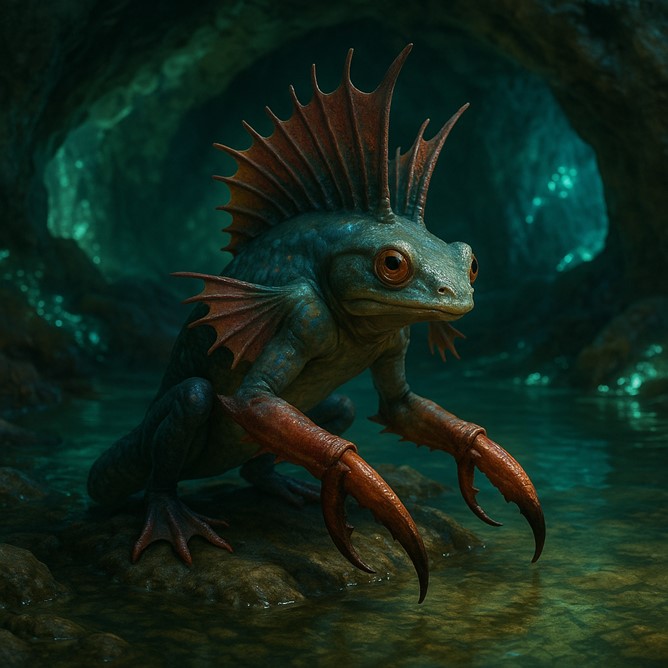
A supple, salamander-like trunk four feet long supports two pairs of limbs: the forelimbs are raptorial mantis claws folded against the chest, each lined with chitinous hooks; the hind limbs mimic axolotl legs tipped with webbed toes. Skin carries micro-chromatophores that erupt into pulse patterns of violet, amber, and ink-black, bordered by soft urchin spines that flare along the dorsal ridge. Frilled external gills bloom behind a wedge head whose eyes shift like cuttlefish W-pupils. Along the lateral line, rows of short slate-gray spicules jut outward, shedding and regrowing monthly.
Size
Adult length: 1.2 m snout to tail fin; standing height on claws: 0.8 m; mass: 34 kg dense with cartilage and chitin.
Speed
Land scuttle or bounding hop 35 ft per heart-beat count; vertical leap 10 ft; swim 50 ft with rapid undulations; sudden jet burst (expelling gill water) 15 ft once every few breaths.
Stat modifiers (relative to an average bipedal avatar)
+3 Dexterity
+3 Stealth checks in low light or reef shadow
+2 Perception (vibration and color shift detection)
−1 Strength (short muscle levers)
−2 Social Charisma (unnerving visage and venom scent)
Skills
• Camouflage change in one heart-beat, granting advantage against visual tracking.
• Grapple Strike: mantis claws close with vice grip; escape demands high Dexterity.
• Spine Volley: flicks three dorsal spines up to 20 ft; each spine carries mild neurotoxin causing limb tremor.
• Reef Clamber: adhesion pads climb jagged stone at normal movement without checks.
• Shade Mimicry: mimics oscillating reef flora, imposing disadvantage on ranged attacks from unaware foes.
Behavior
Ambush solitary or pair-bond hunters that lurk half-buried near thermal vents where glow-moss casts mottled light. They synchronize breathing with vent pulses to mask vibration, then explode upward in a blur of color inversion—inner hide flashes white while outer chromatophores darken—dazzling prey for the lethal claw snatch. Outside mating season they tolerate overlapping territories only if food is abundant; otherwise, ritualized spine-flare standoffs settle the dispute.
Diet
Carnivorous generalist: reef crabs, juvenile river eels, dragonfly nymphs, and occasionally mineral-rich carrion which strengthens spine regrowth. Will consume lotus pods for copper trace to maintain chromatophore health.
Emotions
Displays curiosity through slow shifting pastel hues; agitation ripples crimson-to-indigo bands; courtship glows gold-green accompanied by soft click-chirps. Protective of egg-creches, lashing intruders without warning.
Environment where found
Brackish mangrove channels and geothermal tide caves of Erlitou’s lower delta; prefers water temperature 26–31 °C and stone ledges within arm’s reach of surface air pockets. In drought years it migrates upriver to mist-fed terraces where steam vents keep creek heads warm.
Tags: Amphibio-Chitin, Chromatophore-Flash, Raptorial-Claws, Dorsal-Spines, Jet-Burst, Reef-Ambush, Shade-Mimic, Webbed-Leap, Neurotoxin, External-Gills, Spicule-Armor, Terrace-Migrant, Glow-Courtship, Vent-Dweller, Lotus-Forage, Pair-Bonded, Heat-Seeker
Life cycle
Eggs lie in grape-sized gelatin capsules glued to tidal-vent rock. Clutches number thirty-three exactly—the parent claws away surplus embryos to match the vent’s pulse count, a rhythm believed to minimize suffocation. Incubation lasts nine dusk-rises; hatchlings (called glimmers) resemble thumb-long axolotls bearing a single spine row and translucent claw buds. They feed on micro-shrimp until the first molt at fourteen days, when chromatophores activate, and the initial set of spicules fractures away like slate dust. Juveniles triple in size over four moon-turns, shedding dorsal spines at each new moon to accommodate cartilage growth. Sexual maturity follows the fourth spine cycle, roughly eleven months after hatching. Adulthood can span nine to eleven years before chromatophore fatigue dulls flash patterns, leading to the elder “ashen” stage; elders retreat to deeper vents, becoming passive filter-feeders until internal toxins crystallize their gills and they expire, leaving a rigid spine fan that reef polyps colonize.
Mating
Breeding season begins when delta water warms past 28 °C. Courting males perform “pulse mirroring,” aligning gill-jet bursts with geothermal vent rhythm to create synchronized puffs that warp surrounding color bands. Females observe from crevice ledges; if impressed, a female flashes strobe bands of gold-green and approaches. Pair-bonding lasts one full chromatic cycle (eight days). The couple excavates a shallow depression near constant steam flow, claws interlocking to churn silt and set anchoring mucus. After egg deposition the female guards the creche, using spines and color threats, while the male patrols a wider ring, luring predators away with false luminance displays. Once eggs hatch, guardianship ceases; both adults separate but retain mutual scent recognition, forming seasonal pairings in subsequent years.
Tactics
Ambush governs every hunt. The Mantacutlotl lowers heart rate until chromatophores match surrounding glow-moss. Mantis claws tuck beneath webbed chin lobes, presenting only a spine-cluttered silhouette. When prey swims or crawls within one body length, the creature fires a brief white-flash bloom, stunning with sudden brilliance. Simultaneously it lunges, fore-claws jabbing to hook soft tissue before a tail-propelled twist drags victim beneath overhang. If faced with multiple attackers it executes a “spine bloom”: arching dorsal ridge forward, it snaps three detachable spines in a fan. The spines spin briefly, scattering neurotoxic shards that numb extremities. The creature then jet-bursts backward, retreating into narrow channels inaccessible to larger foes.
Actions
• Flash-Grapple: instantaneous color inversion followed by dual claw strike; successful grapple imposes disorientation from bright after-image.
• Spine Volley: launch up to three spicules in 120-degree arc; each spicule induces tremor and −30 % fine-motor accuracy for ten breaths.
• Jet Burst: expel compressed gill water to dash 15 ft; leaves ink-dark silt plume masking retreat.
• Chromatophore Drift: hold still one heartbeat to assume surroundings’ hue; next attack gains surprise edge.
• Webbed Leap: spring upward using hind limbs; may clamp to overhanging stalactites, dropping on target the following beat for bonus momentum damage.
• Intimidation Frill: flare gills and spines while issuing cuttle-click chatter; compels lesser predators to choose alternate prey paths.
Other interesting information
• The neurotoxin breaks down in fresh air within two hours, making it safe for riverfolk to cook captured specimens if organs are removed quickly—a delicacy called “steam-spine stew.”
• Slate spicules, once shed, grind into fine abrasive ideal for polishing bronze mirrors; Erlitou craft guilds pay two silver for a fist-sized pouch.
• Glow-moss farms encourage Mantacutlotl presence; their hunting reduces burrowing crab populations that uproot moss mats.
• Eggs emit faint violet luminescence visible through muddy water, guiding night-shift dredgers away from vent fissures.
• Juveniles sometimes ride river debris downstream into city canals; children play a guessing game tapping canal planks to feel for their vibration signature.
• Alchemists distill chromatophore sacs into heat-sensitive dye used in resonance scrolls—ink shifts color whenever spoken tones deviate from proper cadence, serving as teaching tools in Liútōng Hua academies.
Artisan guilds, shrine wardens, canal magistrates, and clandestine brokers commission field teams for a dozen distinct motives that all converge on Mantacutlotl hunting grounds.
- Copper-leaf apothecaries crave the creature’s dorsal spines; once dried and steeped with lotus resin, powdered spicule becomes the vital tremor-damp salve mandatory for confluence surgeons before nerve-binding operations. Guild inspectors reject any spine older than a single lunar molt, so expeditions must arrive during the waxing moon when fresh fans loosen. Militia escorts hired for such runs wade knee-deep through vent mist, clearing dripstone choke-points while toxin alchemists saw off still-pulsing spines into turquoise brine coffers.
- Glow-moss terrace stewards petition troubleshooters whenever burrowing crab populations surge. Mantacutlotl predation keeps these crabs in check; a missing matriarchial pair often heralds entire moss terraces collapsing into sludge. Adventurers track predator absences upriver, spearhead nest censuses, and repatriate captured juveniles to restore ecological cadence. Payment arrives as steam-silk bolt rolls and pallet-loads of edible reed-grain.
- Resonance archivists covet chromatophore sacs to brew hue-shifting script lacquer; each sac yields a narrow vial of dye that exposes tonal errors by flashing amber when a reciter warbles flat. Scholar convoys contract seasoned swimmers to harvest sacs without rupturing delicate color glands, rewarding success with enclave reading privileges and engraved alloy bookmarks that bypass urban gate tolls.
- Quench-smith fraternities sponsor spine-regrow studies. They dispatch adventurers to retrieve living specimens, transport them in steam-heated glass tubs, and deliver them unscathed to under-forge vivaria. Safe conduct demands constant vent-stoke vigilance: water temperature must never drop below twenty-six degrees lest toxin crystallise and kill the cargo. Crews navigate river ambushes from slag-eel poachers eager to hijack the valuable cargo for black-market tonic distillers.
- Canal hazard wardens hire scouting troupes after spring flood sediment reroutes juvenile Mantacutlotl into urban water lanes. Defensive spine volleys sent at startled dock workers can paralyse crane crews and stall rice shipments. Teams equipped with manta-net corrals coax the creatures back to geothermal coves, press-ganged trawler captains earn tax forgiveness for each live relocation.
- Alchemist-bards pursue the faint violet luminescence of egg clusters hidden among tide-vent boulders. They believe distilling the gelatin capsule grants “twilight timbre,” an elixir said to widen vocal resonance across eight tonal steps, prized by Liútōng Hua opera masters. Securing eggs demands silent operations: a guarding female detects vibration through fin-ridges and will spine-lash at the first clang of carelessness.
- Royal botanists hire spy-parties to sample shed spicule fragments for highland cedar experiments. Trace mineral composition might strengthen sap-ducts, allowing the sacred charcoal groves to survive hotter furnace cycles. Collections occur at ebb tide when fragments settle like slate confetti; teams sift riverbed silt with magnetized bronze combs, mindful of buried juvenile ambushers hungry for eel bait.
- Steam-sail navies occasionally require Mantacutlotl toxin for non-lethal deck defense. Brewed into wax-tipped quarrels it pacifies press-gang mutineers without bloody reprisals. Naval quartermasters therefore issue writs of marque encouraging privateer crews to capture adults, promising pardons for customary smuggling fees.
- Reincarnate wayfarers stumble upon the hybrid while tracing shard-flash memories of past amphibian lives. A vision of chromatic ripple over copper-flecked skin lures them into mangrove mazes where they beg adventuring escorts to keep journals of every observed color pulse, believing one pattern matches a forgotten personal sigil.
Whether driven by medical necessity, ecological stewardship, artisanal innovation, civic safety, royal research, or private nostalgia, all roads into Erlitou’s vent-lit caverns eventually cross the Mantacutlotl’s territorial band. Parties prepared with warm river-infused canteens, antivenom lotus paste, reflective bronze paddles to mimic flash signals, and reed-woven mud creepers fare far better than reckless fortune seekers lured only by rumors of shimmer-spine profits.
Harvesting a Mantacutlotl after it dies—or after a swift, targeted kill that preserves delicate tissues—yields a surprising range of reagents, each coveted by a different craft or discipline across Erlitou.
- Chromatophore Mantle
Thin, iridescent skin layer beneath the dorsal ridge. When dried under low-heat steam and ground to powder it becomes Hue-Memory Pigment, a lacquer mixed into resonance scrolls. The ink flares pale amber whenever the reciter’s tones drift off key, making it indispensable for Liútōng-Hua diction tutors and shrine chant examiners. - Gill-Frill Filaments
Feathered external gills contain copper-binding proteins. Distilled with lotus resin they form Breath-Hold Ampoules—liquid drops taken by canal dredgers and pearl divers to double lung capacity for roughly a third of an hour before expelling a harmless turquoise mist through the nose. - Raptorial Claw Sheaths
The chitin of the fore-claws flexes without splitting under sudden heat. Forge-armourers boil them with slag-garden lime to brew Flex-Bond Varnish, a finish that keeps bronze fan-armor from warping during rapid furnace-room temperature swings. - Neurotoxin Gland Pairs
Each detachable spine’s root houses a pea-sized venom sac. Alchemists steep the glands in low-grade ether for three days, separating a clear suspension known as Tremor-Still Draught—a measured dose that calms involuntary shakes in convalescing smiths. Excessive draught turns reflexes sluggish, so the Collegium of Healing limits its sale. - Spicule Root Knots
Base nodes where dorsal spines anchor into cartilage. Carved into beads they resonate faintly when rotated between fingers, useful as Cadence Counters for apprentices learning the Heat-Quench-Flow rhythm; the bead clicks in perfect three-beat cadence, echoing vent pulses. - Eye Lens Discs
Hard, amber-tinted cuttle-style lenses behind the outer globes. Mounted in precision bronze frames, they filter forge glare yet sharpen edge contrast, prized by lapidaries cutting patina-glass or by river-sentry spotters scanning sun-flooded canals. - Cartilage Ribbon (Tail Fin Core)
When boiled and stretched, this ribbon retains elastic memory. Weaved into Vent-Seal Cords, it expands minutely with rising temperature, creating self-tightening gaskets for steam-pump pistons. - Slate-Matrix Dermal Plates
Compact rows of micro-spicules along the lateral line. Crushed and mixed with cedar-char they yield Mirror-Grit, a polish that brings struck bronze to near-liquid reflectivity, mandatory for ceremonial Molten-Current stele that must display an unbroken river image. - Ink-Silt Pouch
At the base of the gut a sac stores fine silt particles used in the creature’s Jet Burst. Dried and blown through reed pipes, the silt forms a low-visibility screen that muffles resonance echoes—elite burglary crews prize it for silencing footfalls in echo-prone forge vaults. - Webbed Hind-Toe Webbing
Oil-rich and naturally hydrophobic. Tanned into thin sheets it serves as Steam-Silk Primer, bonding steam-silk moth filaments without adding brittleness, allowing cloaks to shed brackish spray. - Spine Sheath Collars
Flexible keratin cylinders that once surrounded the detachable spines. Ammo-wrights fit them over bolt tips; upon impact they split into razor petals, replicating the creature’s natural spine bloom—legal only for military crossbow units under crown contract. - Fractured Elder Spines (if the carcass is from an ashen elder)
The calcified, crystalline tips spark faintly when struck. Powdered and infused into slag-brick glaze, they create Glow-Edge Tiles that demarcate night-walk paths through misted vent districts, flickering green-white whenever geothermal tremors rise above safe thresholds. - Copper-Rich Blood Slurry
Rapidly coagulates into sponge-like clots. Dried under low-ember heat and shredded, it forms Forge-Mend Wadding—a patch stuffed into micro-cracks of crucible walls where, on reheating, it re-melts and fuses the fissure closed until the next overhaul. - Bone-Lumen Rods
Hollow limb bones infused with cuttlefish fluorescence. Carved into thin slats they vibrate and emit faint teal light when river mist touches them, acting as Fog-Alarms along canal barges. - Chromatophore Core Oil
Extracted during pigment rendering, the residual oil mixes with powdered nacre to create Temp-Shift Vanish, a surface coat for stealth gear that dulls reflective sheen until exposed to sudden heat, whereupon it blooms brilliant, allowing quick shift from hiding to blinding distraction.
Timely field-dressing is essential; chromatophores collapse within an hour of cardiac standstill, toxins oxidize, and cartilage ribbon stiffens irreversibly if left outside warm water. Successful harvesting teams travel with steam-pan vats, amber pith preservative, and river-root antifungal paste to keep each reagent in prime state for guild acceptance.
Tide-Vent Lullaby of Spine-Bloom
Long before the river measured its path in bronze echo or the mangrove roots learned to tap molten mist, the vent caverns beneath Erlitou were a hushed gallery of green steam. Within that hush drifted a single Mantacutlotl called Ripple-Under-Noon, sole guardian of the Fragrant Fissure where lotus seeds fell through ceiling cracks like slow rain. Her chromatophore skin shimmered violet-to-gold each heartbeat, guiding blind cave-eels to safer eddies and luring glow-moths away from scalding jets.
One drought cycle the lotus seeds failed to drop. Steam grew bitter, blotched gray, and Ripple-Under-Noon felt her colors slide to dull slate. She searched tunnel after tunnel until the gill-stars at her neck sputtered. At last she surfaced into twilight reeds never seen before, where surface folk hammered copper leaves that rang a language of sharp angles.
These surface artisans feared the sudden arrival of a spine-ridged crawler dripping vent water. They raised paddles, shouting in the cadence of Heat-Quench-Flow, believing the creature a frost omen. Ripple-Under-Noon understood no hammer tongue, yet sensed the metal notes tasted like lotus lost. She flashed a single white-flag bloom—her brightest signal of truce—but white dazzled the artisans, who thought lightning had burst from a river ghost.
They cast nets of reed-silk. Nets tightened. Spines snapped and scattered neuro-ash that numbed their arms, yet they held firm, binding her in copperwire rings. On the foundry shore they planned to flense the hide for pigment and brew spicule tonic for tremor-still draughts. A lone apprentice, Sand-Between-Breaths, watched quietly. She noticed every time the captive exhaled, steam shivered into silhouettes of blooming lotus petals. Steam-silk tradition taught that vent spirits manifest truth as vapor-glyph, so she crept close and tasted the scent—salt, copper, and faint floral ache.
That night Sand-Between-Breaths smuggled the bound Mantacutlotl onto a slag-raft and floated downstream toward the delta. Copperwood lanterns swayed; spine shards flickered. She sang broken lullabies her grandmother once carved into reed flutes. Ripple-Under-Noon answered with muted color waves that pulsed against rope knots. Each pulse loosened a single loop. At fog-blank dawn ropes fell; the creature slipped into brackish shallows but paused, turning raptorial claws outward, offering nothing but motionless silence. The apprentice stepped into water up to her knees, placed a single lotus stamp—fresh from shrine alms—on Ripple’s dorsal ridge. Color flared back violet-to-gold like sunrise stitched with starlight.
Restored, Ripple-Under-Noon dived beneath canal sludge, guiding lost lotus seeds in muddy current, her returning hues shepherding pods back to the Fragrant Fissure. Steam regained scent of blooming tea. Glow-moss fields brightened. But artisans awoke to find pigment vats empty, spines gone, nets collapsed. They followed tracks to riverbank, swore vengeance upon the thief they could not see. Rumor spread that a silent claw-witch had cursed the forge water.
Years slid by. Surface welds cracked less often, for vent pressure calmed under Ripple’s renewed garden. Yet every equinox Sand-Between-Breaths left a copper reed-leaf on the slag shore. At night it disappeared—no splash, only a faint ripple of color drifting downstream. When the apprentice grew master, her students found secret dyes that shifted hue by river temperature, inheriting the memory of spine-bloom gratitude.
Village grandmothers tell this tale in fractured cadence: the river still owes its hidden glow to the lotus lost and found, to a single apprentice who listened to steam before listening to hammer, and to a Mantacutlotl who traded colors for seeds and nearly dissolved into gray silence.
Moral: Hear the bloom inside the hiss, for rescue sometimes speaks in colors that fear would cage.
Suggested conversions to other systems:
CALL OF CTHULHU 7th EDITION — Mantacutlotl Ambush Stalker
STR 70, CON 65, SIZ 55, DEX 80, INT 35, POW 55. Luck 55. Move 9 land / 11 swim.
Hit Points 12 (CON + SIZ ÷ 10). Build 1. Damage Bonus +1d4. Armour 3-point chitin (half damage from blunt; double from extreme cold). Sanity Loss 0/1d6 on first sight.
Skills: Stealth 75, Swim 80, Climb 60, Track (scent/vibration) 50, Spot Hidden 55.
Attacks (one per round)
• Raptorial Claw 55% — 1d8 + db; on a hard success the victim is grappled (DEX vs DEX) and suffers −1 penalty die on further actions.
• Bite 45% — 1d6 + db plus venom POT 60 (victim CON roll: failure = paralysis for 1d10 minutes).
• Spine Volley 50% — 1d4 per spine (may fire up to three); each successful hit forces CON vs POT 50 or limb tremors impose −2 penalty dice for 1d6 rounds. Re-grows spines after one hour submerged.
Special Abilities: Chromatic Flash (spend 1 Magic Point, DEX vs target POW): dazzles prey, inflicting one penalty die on its next action; Jet Burst (automatic once per fight) — moves up to 10 m and gains +20% to Dodge that round.
BLADES IN THE DARK — Vent-Shade Predator
Threat 3 (single) or 2 (pack of three), Quality = Tier + 1, Scale as noted.
Attributes: Prowess 2, Insight 1, Resolve 1. Natural Armour (1).
Special Abilities
• Flash-Grapple — when it springs from hiding add +1d and inflict Immobilized if the victim resists with fewer than three segments remaining.
• Spine Storm — spend 2 Stress; release an Area attack (small gang scale) that inflicts Level-2 Harm “Tremor-poisoned.”
• Jet Escape — gain Potency to Prowl away through water or narrow shafts and leave a concealing ink-silt cloud; enemies pursue at −1d.
Weakness: frost salt or sudden cold reduces Threat by one and strips natural armour until the creature finds warm water.
DUNGEONS & DRAGONS 5e — Mantacutlotl 411
Medium aberration, unaligned.
Armour Class 15 (spicule hide) • Hit Points 82 (11d8 + 33) • Speed 35 ft., climb 25 ft., swim 50 ft.
STR 15 (+2) DEX 18 (+4) CON 17 (+3) INT 6 (−2) WIS 12 (+1) CHA 5 (−3)
Saving Throws Dex +7, Con +6 • Skills Stealth +9, Perception +4 • Damage Resistances bludgeoning, piercing, and slashing from non-magical weapons that aren’t silvered • Damage Vulnerabilities cold • Senses darkvision 60 ft., tremorsense 30 ft.; passive Perception 14 • Languages — • Challenge 5 (1 800 XP)
Traits
Amphibious • Rapid Camouflage: advantage on Dexterity (Stealth) if motionless at the start of its turn.
Paralytic Venom: creature hit by bite or spine must succeed on DC 15 Con save or be paralyzed 1 min (repeat save end of each turn).
Actions
Multiattack — two claw attacks and one bite; or one spine volley.
Claw — +7 to hit, reach 5 ft., 10 (2d6 + 3) slashing; target Large or smaller is grappled (escape DC 15).
Bite — +7 to hit, 9 (1d10 + 4) piercing plus venom.
Spine Volley (Recharge 5–6) — hurls up to three spines in a 15-ft cone; each creature must make DC 15 Dex save or take 7 (2d6) piercing plus venom.
Jet Burst (Bonus Action, Recharge 4–6) — the Mantacutlotl moves up to 30 ft without provoking opportunity attacks, leaving a 10-ft-radius cloud that grants disadvantage on ranged attacks until start of its next turn.
KNAVE — Mantacutlotl Stalker
Hit Dice 5 (average HP 25). Defence 14 (natural). Attack Bonus +5. Move 35 ft land / 50 ft swim / 25 ft climb.
Attacks: Raptorial Claw 1d10 damage; on a failed CON save (Difficulty 14) victim is grappled. Bite 1d8 damage plus paralysis save (as above). Spine Volley once per exploration turn: 1d6 damage to all in a 15-ft arc, targets test CON 14 or suffer disadvantage on physical tests for 10 minutes.
Abilities: Adaptive Camouflage (advantage to hide if stationary), Amphibious, Jet Dash (bonus move 15 ft; usable again after resting in water five minutes). Vulnerable to frost—takes double damage from cold iron, ice, or winter wind.
FATE CORE — Vent-Shade Mantacutlotl
High Concept: Chromatophore-flashing ambush predator of geothermal caves
Trouble: Chill air cracks my spines, dulls my color
Aspects: Raptorial Mantis Claws • Jet-Burst Escape • Neurotoxin Spine Bloom
Approaches: Quick +3, Sneaky +3, Forceful +2, Clever +1, Flashy +1, Careful 0
Stress: 3 boxes Consequences: Mild (2), Moderate (4), Severe (6)
Stunts
• Flash-Grapple – When you succeed with style on a Sneaky attack from hiding, spend 1 Fate point to add the “Paralysed Prey” aspect (opponents need a Fair (+2) overcome action to shake it).
• Spine Volley – Once per scene you may attack everyone in your zone; each target defends at −2 or takes a moderate consequence “Tremor Venom.”
• Jet Dash – Spend a Fate point to move through an enemy-occupied zone without provoking free attacks and gain +2 to the next defend roll that turn.
Extras: Natural Armour (treat physical stress as one step lower) removed if an enemy invokes “Cold Vapour” against you.
NUMENERA / CYPHER SYSTEM — Mantacutlotl Ambusher (Level 5; target number 15)
Environment Warm tidal-vent caves, brackish river mouths
Health 20 Damage 5 (claw) or 4 (spine) plus Level-5 paralytic poison (Might defense)
Armor 2 natural plates Movement short land/climb, long swim, immediate jet leap
Modifications Stealth as Level 7 in low light; Speed defense as Level 6 in water; tasks to notice colour-shift attacks are two steps harder
Combat Attacks once with raptorial claw and once with bite, or spends an action to release a cone of three spines; creatures failing the poison defense are immobile for one minute.
Abilities Chromatic Flash (1 Intellect point) lowers enemy attacks by one step for one round; Jet Burst (1 Speed point) gives an immediate move without drawing free attacks.
Loot d6 chroma sacs (valuable to dye-makers), 1d3 venom glands, 1 intact claw sheath.
GM Intrusion The creature’s sudden flash dazzles all PCs in immediate range, imposing one step difficulty increase to tasks for a round.
PATHFINDER SECOND EDITION — Mantacutlotl Stalker
Creature 6 N Medium Aberration (aquatic, amphibious)
Perception +13; darkvision, wavesense 30 ft
Languages —
Skills Stealth +16, Athletics +14, Survival +11
Str +3 Dex +4 Con +4 Int −2 Wis +1 Cha −3
AC 24 Fort +16 Ref +14 Will +11
HP 105; Resist bludgeoning 5; Weakness cold 5
Reactive Camouflage ◆ Trigger: It is targeted by a ranged or melee strike; Effect: Gains concealment until end of triggering creature’s turn.
Speed 35 ft, climb 25 ft, swim 50 ft
Melee ◆ raptorial claw +17 (agile, grapple), Damage 2d8+7 slashing plus Grab
Melee ◆ bite +17, Damage 1d10+7 piercing plus paralytic venom (DC 24 Fort)
Ranged ◆◆ spine volley (30-ft cone, usable every 1d4 rounds), DC 24 Reflex; 2d6 piercing plus venom; failure = venom, success = half damage, crit = no effect
Paralytic Venom On failed save, victim paralyzed 1 minute (save at end of each turn).
Jet Burst ◆ (recharge 4–6) Move up to 30 ft without triggering reactions, creating a 10-ft cloud that is a visual obscurity until start of its next turn.
SAVAGE WORLDS ADVENTURE EDITION — Mantacutlotl (Wild Card)
Attributes Ag d10, Sm d6, Sp d6, St d8, Vi d10
Skills Athletics d10, Fighting d12, Stealth d10 (+2 in dim light), Notice d8, Swimming d12, Survival d8
Pace 8; Parry 9; Toughness 11 (4)
Edges Ambush, First Strike
Special Abilities
• Amphibious – Moves at full Pace in water.
• Natural Armour +4; removed versus Cold.
• Chromatic Flash – Opponents in a Medium Burst must make Agility roll (−2) or be Distracted for a round.
• Paralytic Venom – Bite or spine causes Vigor roll (−2); on failure take Wound and become Stunned; critical failure Paralysed (cannot act, Vigor roll each minute to recover).
• Spine Volley – Range 3/6/12; ROF 3, Damage Str+d4, AP 0, Venom as above; 3 shots/day, regenerates after 1 hour submerged.
• Jet Burst – As an action, leaps 6″ ignoring difficult ground and gains +2 Parry versus ranged until next turn.
These fully compatible profiles preserve the hybrid’s rapid camouflage, raptorial claws, spine-borne venom, and jet-burst mobility while fitting smoothly into each rule framework for mid-tier play.
SHADOWRUN 6E — Chromafang Mantacutlotl
Attributes BOD 7, AGI 8, REA 7, STR 7, WIL 4, LOG 2, INT 5, CHA 2, EDG 1, ESS 6
Condition Monitor P 12 / S 10 Initiative 12 + 1D6 (land) or 13 + 1D6 (swim)
Movement 10 m Walk, 20 m Run; Swim ×1.5; Climb 6 m Armor 7 (spicule hide)
Skills Athletics (Climb) 5 (+2), Exotic Ranged (Spines) 5, Unarmed (Raptorial Claws) 7 (+2), Perception 4, Sneaking 6, Survival 4
Powers Adaptive Camouflage (Simple Action, –3 dice to opponent Perception for 3 Combat Rounds) • Amphibious • Enhanced Sense (Thermographic, Low-Light, Vibration) • Natural Weapon (claws, bite, spines) • Venom Reservoir (Injection, Power 8; paralysis)
Attacks
– Raptorial Claw DV 8P, –1 AP, counts as Unarmed, Reach +1, may grapple on net hit ≥ 2.
– Bite DV 9P, –2 AP, applies Venom on hit.
– Spine Volley Simple Action, 3-round Narrow Burst, Range 15 m, DV 7P, –3 AP, Venom on hit; 3 spines/day, regrows 1/hour submerged.
Weaknesses Cold-Blooded (+2 DV from cold; –2 dice to physical actions below 5 °C).
STARFINDER — Mantacutlotl Flash-Lurker CR 6
XP 2 400 N Medium aberration (aquatic, amphibious)
Init +6; Senses blindsense (vibration) 30 ft, low-light vision; Perception +14
DEFENSE HP 100; RP 4 EAC 21; KAC 23
Saves Fort +12, Ref +10, Will +8; Resist fire 5; Weakness cold 10
OFFENSE Speed 40 ft, climb 25 ft, swim 60 ft, jet 15 ft (Ex, swift)
Melee raptorial claw +16 (2d8+9 S; grab)
Melee bite +16 (2d6+9 P + paralytic venom, Fort DC 17)
Ranged spine volley +14 (1d12 P + venom, 30 ft; 3/day)
STATISTICS STR +4, DEX +6, CON +4, INT –1, WIS +2, CHA –2
Skills Acrobatics +16, Athletics +18, Stealth +21 (+26 in water), Survival +14
Languages —
SPECIAL ABILITIES
Paralytic Venom (Ex) Failure = paralysis 1 minute (new save each round).
Chromatic Flash (Ex) As move action radiates dazzling light; creatures in 15 ft cone gain dazzled and flat-footed for 1 round (Will DC 17 negates).
Spine Regrowth (Ex) Recovers all volley uses after 1 hour submerged.
ECOLOGY Warm geothermal deltas; solitary or mated pair.
TRAVELLER (Mongoose 2e) — Delta Spine-Bloom
Characteristics STR B (+1), DEX C (+2), END A (+1), INT 6 (+0), EDU 4 (-1), SOC 2 (-1)
Traits Amphibious • Camouflage (+2 Stealth) • Natural Armour 8 • Venomous (Paralysis; END 8, 1D rounds) • Jet Burst (Dodge +1DM once/round)
Skills Athletics 1, Melee (Claws) 2, Stealth 2, Survival 2, Recon 1
Armour 8 Movement Land 10 m, Swim 15 m, Climb 7 m, Jet 5 m/round
Attacks Raptorial Claws 3D damage & Grapple • Bite 2D damage + Venom • Spine Volley 2D damage at 10 m (3 shots, regrow in warm water)
Instincts Ambush from shade, retreat if cold weapons used.
Economic Value Chromatophore hide Cr5 000, venom gland Cr3 000 each.
WARHAMMER FANTASY ROLE-PLAY 4e — Mantacutlotl Vent-Stalker
M 7, WS 60, BS 20, S 45 (4), T 50 (5), I 45, Ag 55, Dex 40, Int 25, WP 35, Fel 10
Wounds 28 TB 5 SB 4
Traits Amphibious, Armour 3 (Natural), Fast, Night Vision, Pounce, Skittish, Weapon (Claws), Venom (Hard –20 Endurance or Paralysed 1d10 Rounds), Camouflage (+20 Stealth when motionless), Regeneration (spines only; 1/day).
Attacks Claws (SB+3 → 7) with Grapple; Bite (SB+2 → 6) plus Venom; Spine Volley (Ranged 10 yd, Dam 5, Impale, Venom, 3/day).
Psychology Causes Fear (1) in riverfolk; subject to Frenzy if nest threatened.
Weakness Cold Damage ignores natural armour.
Experience Award 130 XP.