
The original life forms referenced were: lion (from Mammalia), newt (from Amphibia), clam (from Mollusca), and beetle (from Insecta).
Appearance
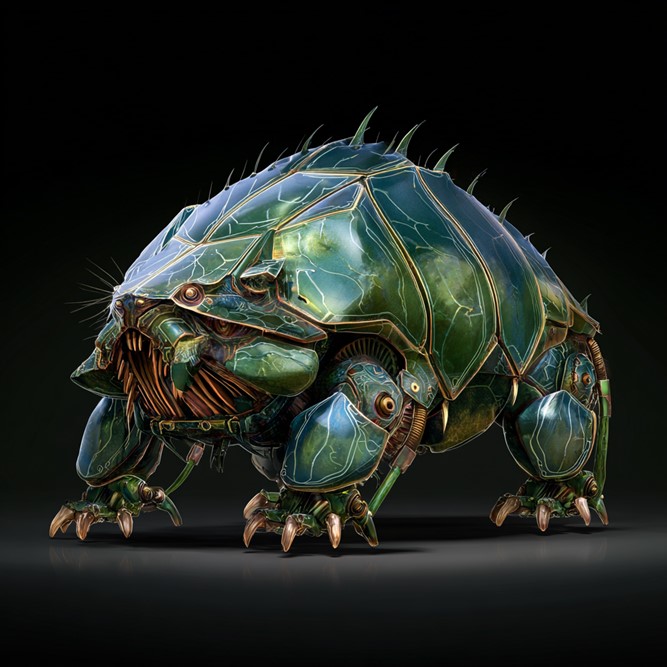
The Lionewclambeet 56 showcases a muscular, quadrupedal body reminiscent of a lion’s powerful build, encased in a hard, iridescent exoskeleton like a beetle’s carapace that shifts tones from metallic greens to bronzes for camouflage, with hinged plates that open and close like clam shells for protection, revealing slimy, regenerative underflesh inspired by newt skin that oozes a viscous mucus glowing faintly during mana highs. Its head features a mane of chitinous spines surrounding a broad maw with crushing mandibles blending lion jaws and beetle pincers, flanked by multifaceted eyes for wide-field vision and sensory barbels for detecting vibrations or chemicals like newt tongues. Four sturdy legs end in clawed feet with suction pads for gripping, while a segmented tail curls with a stinger tip for defense, and gill-like vents along the sides allow amphibious breathing, giving the overall form a armored, slimy sheen that intimidates in dim settings, with bioluminescent veins tracing the shell edges to signal threats.
Size
Lionewclambeet 56 specimens generally measure 4 to 6 feet in length from muzzle to tail, standing 2 to 3 feet at the shoulder, weighing 100 to 200 pounds, enabling them to prowl through underbrush or burrow into hillsides without collapse, though larger ones in mana-dense forests reach up to 8 feet through shell expansions, posing amplified risks in pack hunts.
Speed
This creature reaches prowling speeds of up to 25 miles per hour in short dashes across forested terrain, sustaining 12 miles per hour for prolonged stalks with lion-like strides; in water, it swims at 15 miles per hour using gill vents for propulsion, while burrowing at 5 miles per hour deploys beetle-inspired digging, boosted by mana flows for brief surges in high-magic areas.
Stat modifiers
In the mechanics of Saṃsāra, the Lionewclambeet 56 assigns a +3 modifier to strength for its crushing mandibles and armored charges, +2 to constitution from regenerative mucus and shell plating, but -2 to dexterity due to heavy exoskeleton and -1 to intelligence from instinctive behaviors; perception gains +1 for multifaceted eyes and barbels, while charisma applies -1 as its slimy, armored form evokes revulsion in most avatars.
Skills
Lionewclambeet 56 excels in burrowing, excavating tunnels with mandibles and claws to create lairs or traps, achieving depths of 15 feet in soft soil; it possesses trained acuity in chemical sensing, detecting scents or mana traces up to 50 feet through barbels, honed for tracking prey or avoiding hazards; shell clamping allows defensive curling into armored balls, resisting impacts with 80% effectiveness; mucus secretion provides slippery evasion or healing, deliverable through skin contact for minor regenerations; and charging rushes enable powerful tackles, trainable for overwhelming small groups in forested ambushes.
Behavior
The Lionewclambeet 56 shows solitary yet opportunistic behavior, patrolling territories with lion-like dominance, probing environments with barbels to assess threats or opportunities, but forms loose packs during mana surges for coordinated hunts, communicating via bioluminescent vein flashes and chemical mucus trails akin to beetle signals. It ambushes prey by clamping shells shut like clams for concealment, then charging with newt-inspired slime trails to slip past defenses, and retreats into burrows if outnumbered, using ink-like mucus from vents to obscure escapes. During dry seasons, it enters torpor states, regenerating in shell-protected curls within hills, emerging revitalized; it avoids direct confrontations with larger monsters, preferring to lure them into traps or use camouflage to evade, and exhibits curious symbioses with other forest creatures, such as sharing burrows with fungi collectives for mutual protection.
Diet
Primarily carnivorous, the Lionewclambeet 56 consumes insects and small mollusks crushed in mandibles or trapped in burrows, using beetle-like efficiency to extract nutrients, supplemented by algae and mana-rich fungi filtered through gill vents like newt feeding; it scavenges carrion protected by clam-shell clamps, and in packs, they overpower larger prey like rodents by mucus disorientation and claw strikes, digesting soft tissues while leaving bones to enrich soil with magical residues.
Emotions
Lionewclambeet 56 experiences emotions through instinctive throbs, feeling dominance as surging energy during successful charges or mana absorptions, manifesting in spine-rattling displays and glowing shells; fear prompts rapid burrows and mucus jets, spreading through chemical trails like a wave of caution; contentment arises in secure lairs with abundant food, expressed via gentle barbels touches; aggression builds protectively around burrows, with mandible snaps in frenzied packs; and curiosity drives exploratory prowls, probing new objects with pads, though isolation from packs induces a rare, disoriented panic that disrupts their bioluminescence.
Environment where found
Lionewclambeet 56 inhabits the shadowy forests, hilly woodlands, and damp undergrowth of Saṃsāra’s island nations, particularly around Lupemban’s plateau edges and riverine groves where mana bubbles create ideal habitats; they thrive in temperate to humid zones with dense foliage for dispersal, venturing into brackish hollows or cave mouths during rains, and are drawn to ruins or floating cities where magical residues enhance their regeneration, avoiding open deserts or icy peaks that dry their mucus.
Tags
Armored prowler, mucus regenerator, mandible crusher, shell clamper, vein signaler, burrow ambusher, chemical tracker, fin breather, spine maner, gill filterer, Armored Regenerator, Mucus Clamper, Mandible Signal, Shell Grappler, Vein Burrower, Gill Prowler, Spine Filter, Burrow Crusher, Mana Clamper, Exo Sentinel
Life Cycle
The life cycle of the Lionewclambeet 56 begins in egg form, laid in clusters of 50 to 150 within protective, mucus-lined burrows or cave crevices, where the shelled ova, hardened like clam bivalves but infused with mana, incubate for 4 to 6 weeks, absorbing ambient energies to develop internal chitin layers that mimic beetle larvae casings, with outer surfaces regenerating like newt skin to withstand environmental pressures. Upon hatching, larvae emerge as soft, worm-like forms measuring mere inches, slithering through damp soil to feed on detritus while their exoskeletons form, undergoing several molts over 2 to 3 months where lion-inspired manes of spines sprout and gill vents open for amphibious breathing. This larval stage lasts until they reach 1 foot, transitioning to juveniles that prowl shallow burrows, practicing regenerative shedding to heal from scrapes while honing mandible crushes for small prey. Juvenile Lionewclambeet 56, now 2 to 3 feet long, form exploratory packs to refine sensory barbels and shell clamping, molting plating periodically to accommodate growth spurts accelerated by mana highs, which can double size in nutrient-rich undergrowth. Adulthood is reached at 5 to 7 months, marked by full bioluminescent maturity and pack instincts, with lifespans averaging 6 to 10 years in balanced habitats, though shorter in polluted forests due to sensitivity to toxins. Aging individuals exhibit cracked shells and dimmed veins, retreating to pack lairs for mutual aid, where upon death, their bodies decompose through newt-like autolysis, releasing chitin residues that fertilize burrows and provide scaffolds for new eggs, perpetuating the cycle amid Saṃsāra’s reincarnative essence, where souls reborn into this form may retain echoes of past dominance or tenacity in behavioral quirks.
Mating
Mating among Lionewclambeet 56 occurs seasonally during mana highs in shadowy forests or hilly woodlands where bioluminescent vein displays synchronize across packs, drawing from beetle courtship signals but adapted to clam-like clamping where males vibrate shells to create resonant hums that attract females with flashes mimicking eerie greens. Females, identifiable by thicker plating and more elaborate spine manes, release chemical trails via mucus glands, guiding males to form temporary pairs in prowling circles that enhance mana absorption for fertility. The process involves a delicate spine entanglement, where males transfer spermatophores—packet-like structures akin to beetle reproductive packets—into the female’s gill vents, stored for delayed fertilization, allowing opportunistic breeding even post-separation. Eggs are fertilized internally and laid shortly after in communal lairs guarded by the pack, with females contributing barbs to ward off threats during deposition. Post-mating, males often scout new territories, while females remain near lairs, exhibiting protective aggression through mandible patrols. In low-mana periods, mating rates drop, leading to smaller clutches with potentially weaker offspring, but successful pairings in magical hotspots yield progeny with inherited traits like improved strength modifiers, passed through subtle soul affinities in reincarnation. Conflicts arise if multiple males compete, resolved via non-lethal displays of shell clamping or vein duels, ensuring the fittest contribute to the pack’s continuity without depleting resources.
Tactics
Lionewclambeet 56 employs pack-based tactics honed through instinctive coordination, where groups of 15 to 40 communicate via bioluminescent vein flashes and chemical mucus trails to overwhelm prey or deter predators, drawing from beetle swarming to form deceptive formations that appear as larger entities, enhanced by newt sensory regeneration detecting weak spots in foes. Ambush strategies prevail in forest undergrowth or cave lurks, with individuals using stealth to position mandibles for crushing strikes, paralyzing targets like small mammals before the pack descends in a filter-feeding frenzy, their shells providing armored retreats if countered. Defensive tactics include shell-vein bursts—clouds of disorienting, mana-laced mucus from clam-inspired glands—that obscure escapes or confuse attackers, while gill jetting navigates damp terrains for repositioning, intensity depending on pack size and mana levels. Offensively, barb grappler hooks lash out in synchronized waves, injecting toxins while burrowing escape routes, particularly effective against larger beasts in underwater hubs where telepathic links amplify the effect through shared mana flows. In encounters with avatars, they adapt tactics based on gear; against divers with masks, they target exposed areas with barbs for temporary paralysis, retreating if magical wards activate, always prioritizing pack survival over individual risks in the unpredictable terrains of Saṃsāra’s forests.
Actions
Common actions of the Lionewclambeet 56 include barb probing, extending sensory organs to detect vibrations or scents within 30 feet, emitting signals that relay to the pack for coordinated responses in hunts or dangers, adjustable in complexity during mana highs for finer detection. Mucus jetting forms a primary defensive action, ejecting clouds that not only obscure but also carry mild irritants, buying time for the pack to regroup or flee into burrows, scalable by dosage for cumulative effects on larger targets. Regenerative shedding is a reactive action, molting damaged plating to heal wounds over minutes, fueled by mana absorption through gill vents, ideal for recovery after skirmishes. Mandible crushing represents offensive actions for breaking exoskeletons or gripping prey, propelled by strength for subduing small groups. Shell clamping allows defensive curling into armored balls, resisting impacts from predators or hazards like turbulent storms. In social contexts, bioluminescent communications synchronize actions across the pack, enabling complex maneuvers like encircling prey or signaling threats, with mana-sensitive absorptions as passive actions that enhance vein glow during highs, potentially unlocking temporary stat boosts like +1 constitution for better regeneration in high-magic zones.
Other Information Important to This Race
The Lionewclambeet 56 exhibits a unique pack consciousness that borders on telepathic, where mana pulses link individuals in a network allowing shared sensory data, such as one detecting a threat via barbels and instantly alerting the pack, fostering emergent behaviors like synchronized migrations across island chains during seasonal mana flows. Their mucus, alchemically potent, has drawn interest from Lupemban’s plateau artisans, who harvest it carefully for use in gear like barb-embedded claw caps that replicate paralyzing effects, though overharvesting disrupts packs and invites retaliatory swarms on trade routes. In Saṃsāra’s reincarnation lore, souls reborn as Lionewclambeet 56 often carry echoes of past lives, manifesting as atypical behaviors like solitary prowlers exploring ancient ruins for multiversal artifacts, or packs forming alliances with sentient woodland beasts for mutual protection against abyssal incursions. Bioluminescent patterns vary by environment, with forest variants glowing in eerie bronzes to mimic beetle lures for attracting prey, while hill dwellers flash vibrant greens during festivals of light that coincide with avatar rituals in coastal temples. Dietarily versatile, they can subsist on magical residues alone during mana droughts, entering a meditative torpor that conserves energy and heightens emotional contentment through pack hums, but this leaves them vulnerable to opportunistic predators like shadow-beetles. Tags like armored regenerator highlight their affinity for symbiotic relationships with hills, where they defend against invasive fungi by barb applications, inadvertently aiding avatar foragers. Emotionally, the species shows rare instances of “mourning” for lost pack members, dimming lights in collective displays that release mana essences to honor the departed, aligning with the world’s cyclical themes. In scenarios, they serve as environmental hazards or quest hooks, such as retrieving lost gear from lairs or negotiating with intelligent packs for passage through submerged labyrinths, with their speed and skills making them elusive foes or potential familiars for high-tier avatars equipped with binding shells for short bursts during escapes.
In the high-magic realms of Saṃsāra, where avatars traverse shadowy forests aboard steam-powered sledges or delve into hilly cave networks using gear like shell-resistant bracers and barb-inspired amulets, a party of adventurers might encounter the Lionewclambeet 56 through numerous pathways interwoven with the world’s cycles of exploration, trade, and survival. One frequent occurrence happens during treks through forested undergrowth near Lupemban’s plateaus, where the party’s griffon relay or hot air balloon makes a forced landing amid tangled vines, disturbing a solitary specimen burrowed beneath the roots, its exoskeleton shifting to match the bronzes of the soil as it charges with lion-like ferocity to probe their gear with claws, potentially clamping a claw cap or tail tuft in its shell if perceived as a threat, leading to a defensive skirmish where mucus jets from its gills obscure vision and cause temporary disorientation that impairs perception for minutes. Such accidental meetings often arise in hilly woodlands during mana highs, when global magic weather causes damp surges that push these creatures into urban outskirts of megacities, where they prowl along tree bases humming with pulley systems, reacting to the vibrations of factory machinery by clamping shell barriers across pathways, blocking trade caravans and forcing adventurers to intervene with trained skills in strength or endurance to dismantle the obstructions without harm.
Adventurers could also cross paths with the Lionewclambeet 56 while mapping uncharted smaller islands that materialize sporadically from ocean mists, their slopes laced with rugged ecosystems where the creature stalks damp hollows with newt-swift swims, ambushing small mollusks that avatars rely on for bait in foraging quests, or burrowing into regenerated soil to clamp intrusive monsters like shadow-roots, inadvertently aiding the party but turning aggressive if their multifaceted eyes detect hidden gear like invisibility cloaks woven from vine analogs. In forested cave expeditions, parties training tier advancements in stealth or combat might disturb packs during armored regenerator displays, where the creatures’ barbels sense movement from afar, coordinating mandible crusher strikes to flank the group amid overgrown thickets, testing the adventurers’ gill-inspired masks or pouch belts for resistance against mucus that causes hallucinations of swarming past lives from multiversal origins.
Purposeful searches for the Lionewclambeet 56 frequently originate from guild commissions in Lupemban’s ports, where the creature’s mucus glands produce slime valued for crafting enhanced bracers or belts in mechanical power transmissions, resistant to mana corrosion and granting +1 constitution modifiers when attuned at tier 2 workshops, prompting parties to track packs via chemical trails in hilly woodlands for harvesting without disrupting ecosystems, rewarded with silver or electrum bounties from the monarchy for those whose racial forms align with forested explorations. Alchemists in underwater enclaves seek their shell fragments for potions that mimic the clamping effects in underbelly pouches, useful for shielding during prolonged dives or political detentions in cave metropolises, with quests offering gold for intact specimens captured using net gear spun from bamboo fibers, requiring skills in survival to navigate the damp grottos where they weave lair nests.
Another drive for seeking the Lionewclambeet 56 involves alliances with non-people civilizations, as the world’s blurred perspectives recognize these creatures’ packs as semi-sentient networks akin to sentient fungi collectives, leading parties to pursue communion through chemical signals—mimicking newt barbel vibrations with attuned amulets—to forge pacts for guiding through submerged ruins teeming with ancient clay artifacts or geothermal resin veins, exchanging protection from burrowing threats for safe passage in labyrinthine forests. Scholars in Drum Sanctuaries task adventurers with observing their vein signaler behaviors during surges, documenting bioluminescent patterns for prophetic interpretations in Tamborism rituals, where shell samples infuse cracked logs with enhanced echoes revealing reincarnation paths, traded for platinum in scholarly exchanges across floating cities.
Encounters tie into defensive operations along trade routes, where Lionewclambeet 56 infest pathways during seasonal migrations, burrowing barriers across forest trails with mucus-laced soil that disrupts levitation runes, compelling parties to search lairs in woodlands to relocate packs before swarms escalate to mandible attacks on caravans laden with enchanted vines or red clay pottery. In times of environmental upheaval, such as mana droughts drying forests, adventurers hunt these creatures for their regenerative mucus, harvestable for cloaks that grant constitution boosts in arid zones, aiding survival quests incentivized by nickel bounties for isekai souls recreating past-life forested enclaves. Parties specializing in beast diplomacy view them as bridges to underwater hubs, seeking queens—larger females with intricate spine manes—for negotiations via gill breather gestures facilitated by high-tier gear like barbels for short jets during escapes, establishing patrols against abyssal incursions in exchange for mana-rich fungi offerings.
Adventurers involved in salvage from teleported ruins frequently encounter Lionewclambeet 56 guarding damp chambers, their burrow crusher tactics clamping barriers around jade relics or multiversal echoes, prompting battles where the creatures’ chemical tracker leaps evade pulley-launched nets, or purposeful captures with binding harnesses for use as mounts in forest crossings, equipped with saddles that amplify vibration senses for detecting hidden monsters. During festivals in coastal temples, where processions honor Tambor Kwe with bioluminescent displays, parties might pursue these feral life forms for their glands, harvested to enhance lantern gear for illusory effects in rhythmic recitals, integrating the hunt into cultural events with rhodium prizes for successful trackers. For groups focused on tier progression, searching Lionewclambeet 56 serves as training grounds, evading mucus clamper strikes to hone strength skills in hilly grottos, unlocking higher potentials in items like spine-inspired belts for charging escapes during pursuits.
In scenarios of political intrigue, rival kin dispatch parties to agitate packs near enemy ports, using the creatures’ mana clamper abilities to burrow under ships with mucus disorientation and mandible grips, leading counter-quests to seek and neutralize threats with alchemical lures derived from newt secretions, rewarding with electrum for maintaining trade pacts. Exploratory ventures into appearing islands draw adventurers to track these creatures as bio-indicators of stable mana pockets in forests, their presence signaling viable sites for outposts amid endless oceans, with shell collections funding public works like steam aqueducts. Parties composed of Pembalu with rhythmic affinities often feel compelled to encounter them, using tail tufts to mimic spine movements for non-aggressive interactions, turning searches into paths for communal harmony where the feral beings’ emotions of contentment in balanced habitats guide to hidden geothermal vents powering factories.
Defensive patrols in cave networks intersect with Lionewclambeet 56 when they migrate inward during rains, burrowing entrances against shadow-wyrms but inadvertently trapping miners, forcing parties to delve with perception gear to dismantle mucus barriers laced with barbs, or harvest glands for antidotes against similar toxins facilitated by high-tier gear like multifaceted eye amulets for linking with telepathic boosts. In renewal rituals of Tamborism, clergy commission searches for their egg clusters, symbolic of cyclical birth, to incorporate into drum fires for prophetic ashes that bless gear with +1 strength, blending spiritual and practical pursuits in forested temples. These multifaceted reasons embed the Lionewclambeet 56 into the adventuring fabric of Saṃsāra, where every prowl through a grove or clamp in a grotto holds layers of conflict, discovery, and alliance amid the ebb and flow of magic and feral existence.
Additional items or ingredients can be harvested:
- Exoskeleton Plates
The iridescent exoskeleton plates, segmented carapace sections blending beetle armor and clam shells with hinged flexibility, yield 20 to 40 viable pieces per creature, harvested by carefully prying them with jade tools to avoid cracking the mana-infused chitin, each plate retaining tensile strength and regenerative traces that pulse faintly when exposed to ambient flows. These are forged into bracers or chest guards for gear, providing +2 armor against slashing attacks in forested skirmishes or cave delves, trainable at tier 3 for embedding runes that allow self-repair over hours when coated in alchemical resins. In guild workshops near river basins, the plates are ground into powders for strengthening clay pottery used in steam reservoirs, sold for copper to artisans crafting vessels that withstand pressure without bursting during mana surges. Alchemists distill the chitin essence into oils applied to tail tufts, enhancing grip on slippery surfaces during griffon rides, while Tamborist rituals incorporate them as altar linings for amplifying drum echoes in prophetic sessions, traded for silver in plateau markets where they symbolize enduring protection. - Mucus Secretions
The slimy mucus secretions, viscous fluids from underflesh glands inspired by newt regeneration, produce 300 to 500 milliliters per creature when scraped and collected into vials post-mortem, preserving the healing properties that promote tissue mending when mixed with mana essences. These are refined into salves for embedding in underbelly pouches or claw caps, delivering restorative effects where applications heal minor wounds with a +1 constitution boost over minutes, trainable at tier 2 for use in masks that counter toxins from beast bites in hilly woodlands. In coastal forges, the mucus fuses with bead insets to create cloaks resistant to corrosion, ideal for divers scavenging underwater ruins, sold for nickel to merchants navigating endless oceans where they provide minor regeneration during prolonged swims. Alchemical processes extract the slime for pastes that harden hides during shedding, aiding Pembalu avatars in humid climates, while monastic uses involve boiling it into teas for soothing sensory overload during mana storms, traded for electrum in cavernous libraries. - Mandible Pincers
The crushing mandible pincers, hard chitinous jaws merging lion bites and beetle mandibles with clam-like clamping force, fragment into 4 to 8 durable segments when shattered with crystal hammers, each retaining sharpness and strength against breakage. These are crafted into knife blades or tool bits for gear, inflicting +1 damage in close combats with grinding effects on armored foes, trainable at tier 1 for incorporating into gloves that enhance grappling in forest ambushes. In trade ports, they are polished into awls for piercing leather in steam loom repairs, sold for copper to laborers mending pulley belts amid damp conditions. Alchemical infusions with resin create abrasives for smoothing pottery glazes, aiding artisans in creating mana-holding urns, while cultural applications involve using them as strikers for ritual logs in Tamborism ceremonies, traded for gold in kin gatherings symbolizing forceful renewal. - Sensory Barbels
The sensory barbels, whisker-like appendages around the maw blending newt tongues and clam siphons for chemical detection, provide 6 to 10 intact strands per creature, harvested by plucking with precision tongs to keep the vibration-sensitive tips active, each barbel reacting to scents or mana traces when preserved in herbal solutions. These are woven into ear hoops or brow ridge studs for gear, granting +2 to perception for detecting hidden threats within 50 feet in shadowy groves or cave systems, trainable at tier 4 for linking with telepathic networks in pod communications. In steam factories, the barbels adapt into detectors for machinery leaks, sold for platinum to engineers optimizing circuits amid forested humidity. Alchemists distill the tips into oils applied to nose rings, mitigating overloads during beast hunts, while ritual uses in shrines involve dangling them from scepters for channeling Tambor Kwe’s sensory breath, traded for rhodium in scholarly academies. - Bioluminescent Veins
The bioluminescent veins tracing the shell edges, glowing filaments inspired by newt luminescence but structured like beetle light organs, number 40 to 60 per creature and are extracted in bundles up to 3 inches long, preserved in mana-infused jars to maintain their radiance. These are inlaid into lanterns or signboards for low-light signaling in megacities, providing +1 to charisma in nocturnal interactions by creating guiding beacons, trainable at tier 4 for use in diadems that sync with echolocation for coordinated party signals. In trade caravans, they enhance banners for visibility during misty voyages, sold for gold to merchants. Alchemists crush them into dyes for inks that shimmer prophetically on scrolls, revealing hidden texts under mana light, while Tamborist clergy incorporate them into hearth offerings for visions of eternal flows, symbolizing enlightened renewal. - Gill Vents
The gill-like vents along the sides, slit openings with regenerative linings merging clam filtration and lion roars for breathing, yield 4 to 6 functional membranes when peeled and dried, preserving the mana-jet qualities that allow amphibious adaptation. These are crafted into masks or harnesses for gear, granting underwater breathing for up to an hour in damp environments, trainable at tier 3 for integration with levitation runes that allow short bursts in cave explorations. In airship docks, the vents reinforce filters for vapor intake, sold for silver to captains traversing endless oceans. Alchemists extract the linings for potions that boost endurance by +2 during prolonged pursuits, quaffed by hunters tracking monsters, while cultural applications involve using them as resonators for drum echoes in festivals, traded for electrum in coastal hubs. - Chitinous Spines
The chitinous spines in the mane, sharp protrusions blending lion manes and beetle horns with clam rigidity, number 50 to 80 per creature and are harvested by clipping and curing in resin to retain piercing tips without losing flexibility. These are forged into arrowheads or dart tips for gear, facilitating ranged attacks with +1 damage against armored prey, trainable at tier 2 for embedding in vests that provide defensive barbs on contact. In markets, they affix to tools for scraping hides, sold for copper to tanners in plateaus. Alchemical fusions with mucus create pastes for reinforcing plating during growth, aiding juvenile avatars, while monastic applications involve arranging them as altar spikes for judgmental rites, traded for platinum in cavernous libraries. - Regenerative Underflesh
The slimy regenerative underflesh exposed beneath plates, fleshy layers inspired by newt tissue but toughened for protection like lion hides, provides 3 to 5 square feet of usable material when flayed carefully to avoid tearing the mana-reactive cells, each section pulsing with healing potential when infused with essences. These are sewn into pouches or belts for improved storage of alchemical powders, granting +1 to constitution by absorbing residues for minor healing, trainable at tier 4 for use in diadems that sync with chemical senses for coordinated party signals. In trade ports, they affix to cloaks for secure carrying of mana crystals, sold for gold to merchants. Alchemists crush them into salves for mending wounds, applied during hunts, while Tamborist clergy incorporate them into urns for ancestral remains, symbolizing nurtured renewal.
Legend of Armored Ooze-Prowler
In glooms veiled of yester, when groves murmured secrets no barb recalls and lairs concealed voids blacker than chasm, there clawed from the blend a being of shell and slime, titled in slates cracked the Lionewclambeet, branded by rune hidden, 56. This prowler, hammered from breaths of the roarer mighty, the renewer slick, the closer of valves, and the crawler of sheens—did stalk the shades where trees clutched hills, its shape a puzzle of plating gleam, flesh oozy as forgotten wounds, jaws pinching like traps unyielding, and limbs barbed for holds relentless. Elder clays, scarred by drips and mis-hummed from utterances engulfed by depths, chime of its budding in the Vast Blend Surge, when powers shrouded jabbed the earth with prongs of gale, fusing essences from spheres eclipsed to chase the uproar that harried the glooms.
In those nascent claws, afore breaths whirled on spirals of return, the undergrowths throbbed with unrest—vast shades that swallowed paths, roots that pierced lairs, and creatures of snap and deluge that shattered the sheen of morn. The Lionewclambeet 56, sturdy yet horde-bound, nested in lairs of soil damp, its barbels twitching to far tastes, spotting quarry with eyes that grasped all corners, like watchers of concealed dens. One dire surge, as mana boiled like bloods furious, a titanic shade-beast ascended from the deeps, its form writhing thorns and glooms, purposed to gulp the shell-thrones where primeval mana-sheens fed the world’s arteries. The prowler, perceiving the quake through nodes that tasted peril, mustered its fellows in packs dense, their platings gleaming to mirror the murk, claws poised for grips unyielding.
The clash unrolled in groves shadowed, where light warped through boughs thick. The Lionewclambeet 56 clawed as one thought, jaws crushing with toxin born of the crawler’s nip, stunning the beast’s limbs that aimed to snare. Platings like closers held firm, sheens shielding against whips wild, illusions weaving false hordes to confound and drain. From the renewer’s sense they healed hurts, sensing the monster’s chill core, while valve-closers allowed them to clamp through the fray, dodging snaps of thorns. Yet the shade-beast thrashed wild, its thorns dispersing the pack, crushing many under weights profound, their sheens fading like sparks drowned.
But see, the tale curves in hums muddled, lines overlapping like roots in mire. A sovereign among them, larger with manes aglow in bronze fierce, rallied the remnants with tastes foretelling, pulling mana from the sheens they shielded. It led a surge into the maw itself, claws piercing the inner veil, toxin flooding the giant’s flows until it quivered and sank to muddy slumber, its shape becoming grove anew. The pack, triumphant yet few, rebuilt their lairs, gripping the mana-sheens with pads fine, ensuring the land’s throb echoed perpetual. From this feat, the Lionewclambeet 56 grew as keepers, their packs courted by wise waders for bonds tenuous.
Spans of the shade flowed, and avatars emerged, breaths refreshed from stanzas broad, raising holds in glooms with rises of vapor and circuits of throb. Some, recalling lives of roar or slime, ventured to the lairs, gathering toxin for sheaths that stilled rivals quiet, or plating for vests that warded blows. But covetousness slunk in, as clays caution—gatherers who plucked without tribute, stirring the packs. In one splinter frayed, a trader band plunged too bold, their tools buzzing with seized mana, awakening a pack vexed. The Lionewclambeet 56 clawed in wrath, their vents jetting, jaws dreaming visions of soaked yores, driving the intruders dazed until they bolted, dropping gifts of enchanted seeds to soothe.
Yet grace flickered in the legend’s creases, poorly penned on barks kept. A roamed breath, reborn as scout in Lupemban’s groves, linked a pack through tastes vibrational, mastering their platings plated. In swap for ward from shadow-thorns, the pack lent essences that wove his shield with sight bronze, aiding quests for riches in shades concealed. Packs migrated with surges, gliding currents to fresh glooms that blossomed and withered, their presence a omen of mana clean, directing vessels through gales with tastes like beacons.
Strifes blossomed fresh, as elder words falter in recount. Amid the Dim of Sheens, when magic dwindled and groves thirsted, a foe creature—wyrm of quiet chill—raided the lairs, splintering soils with grips frozen. The Lionewclambeet 56, in repose frail, roused to the quiet, their sovereign yielding mane to spurt ooze eternal, a veil that bound the wyrm in mirage lasting. The pack dispersed, some renewed in shapes odd, bearing whispers of the keeper’s role through wheels of end and start.
Across epochs, the being’s yarn resounded in revels under lantern glooms, where verse in Lupembi mimicked their claws, summoning phantoms of packs that twirled for throngs in domes mudded. Kin swapped yarns poorly handed, fragments on jade planks: of packs uniting with soarers aquatic for watches, or gripping flora that spawned draughts sturdy. In grottos damp, they prowled brief, limbs carrying them to forest basins, merging floods and soils in accord brittle.
Thus the legend lingers, rendered poor from abysses unnamed, pressing awe for the sturdy yet horde-bound.
Moral of the story: In the claw of kin lies might against shade, but pluck unoffered brings jaws of remorse unending.
Suggested conversions to other systems:
Call of Cthulhu: Shadowed Grove Guardian
STR 14
CON 16
SIZ 12
DEX 12
INT 6
POW 10
HP 14
Move 10 (prowling), 8 (swimming), 5 (burrowing)
Damage Bonus: +1d4
Armor: 4 points (exoskeleton and shell)
Skills: Stealth 60%, Spot Hidden 55%, Swim 70%, Track 50%
Attacks:
- Mandible Crush 50%, damage 1d8 + venom (CON roll or -2 to all actions for 1d6 rounds due to paralysis)
- Shell Clamp (special), melee 40%, entangles target (STR roll to escape, -10% to actions while clamped)
Sanity Loss: 0/1d4
Special Abilities: - Regenerative Mucus: Regains 2 HP per round unless destroyed by fire or acid.
- Pack Resonance: +15% to attack rolls when in groups of 5 or more.
- Camouflage Shift: Once per round, +20% to Stealth by altering exoskeleton color.
Game Mechanics: The Shadowed Grove Guardian in Call of Cthulhu 7th Edition serves as a moderate to high threat for investigators in forested or cave mysteries, with its STR 14 and Swim skill enabling aggressive ambushes in hilly woodlands. The Mandible Crush’s venom (CON vs. POW/2) adds debilitating effects, balanced by moderate armor and Shell Clamp’s control, adjustable by reducing HP or skills for pulp campaigns. Regenerative Mucus introduces a tactical challenge, while Camouflage enhances stealth horror, fitting Saṃsāra’s mana-rich groves where fire-based solutions become strategic.
Blades in the Dark: Twilight Forest Lurker
Tier: 3
Scale: 2 (pack of 5-10)
Quality: 3
Resistance: 3 (exoskeleton and shell)
Attributes:
- Insight: 2
- Prowess: 3
- Resolve: 2
Stress: 8
Harm: - Level 1: Mandible Strike (3 harm, close range, venom effect)
- Level 2: Shell Bind (special, creates a snare zone, +1 effect on control rolls)
Special Abilities: - Regenerative Slime: Regain 1 stress per scene unless dealt fire or acid damage.
- Pack Echo: +1d to Prowess when acting as a group of 5 or more.
- Mana Camouflage: Once per score, +2 effect to Stealth in mana-rich areas.
Load: 1
Game Mechanics: The Twilight Forest Lurker in Blades in the Dark fits as a Tier 3 hazard for crews in forested heists or beast-riddled scores, with Prowess 3 emphasizing clawing and clamping. Mandible Strike’s 3 harm plus venom (GM clock for paralysis, e.g., 4 segments) balances offense, while Shell Bind adds area control, limited by scale. Regenerative Slime and Pack Echo enhance durability and tactics, adjustable by increasing stress or scale for veteran crews, encouraging use of alchemical fire or nets in Saṃsāra’s woodland intrigues.
Dungeons & Dragons: Armored Woodland Stalker
Medium Beast, Unaligned
Armor Class: 15 (natural exoskeleton)
Hit Points: 52 (8d8 + 16)
Speed: 40 ft., swim 20 ft., burrow 10 ft.
STR 14 (+2)
DEX 12 (+1)
CON 14 (+2)
INT 4 (-3)
WIS 12 (+1)
CHA 7 (-2)
Saving Throws: Str +4
Skills: Perception +3, Stealth +3
Senses: Darkvision 60 ft., tremorsense 30 ft., passive Perception 13
Challenge: 3 (700 XP)
Traits:
- Amphibious: The stalker can breathe air and water.
- Regenerative Mucus: The stalker regains 5 hit points at the start of its turn if it has at least 1 hit point and isn’t in fire or acid.
- Camouflage Shift: The stalker has advantage on Stealth checks in forested or hilly environments.
Actions: - Multiattack: The stalker makes two attacks: one with its mandible and one with its tail stinger.
- Mandible Crush: Melee Weapon Attack: +4 to hit, reach 5 ft., one target. Hit: 11 (2d8 + 2) bludgeoning damage, and the target must succeed on a DC 12 Constitution saving throw or be poisoned for 1 minute, taking 7 (2d6) poison damage at the start of each of its turns.
- Tail Stinger: Melee Weapon Attack: +4 to hit, reach 5 ft., one target. Hit: 9 (2d6 + 2) piercing damage.
- Shell Clamp (Recharge 5-6): The stalker clamps its shell around a target within 5 feet. The target must succeed on a DC 12 Strength saving throw or be restrained until the end of its next turn, taking 7 (2d6) bludgeoning damage.
Game Mechanics: The Armored Woodland Stalker in D&D 5th Edition acts as a CR 3 encounter for levels 4-6 parties, with 52 HP and AC 15 offering resilience in forested terrains. Multiattack with Mandible Crush’s poison (DC 12 save, 2d6 damage) and Tail Stinger emphasizes damage, balanced by recharge on Shell Clamp and vulnerability to fire/acid (halving regeneration). Camouflage and Regeneration add ambush potential, adjustable by increasing HP or adding pack tactics (+advantage on attacks if allies within 5 ft.) for higher challenges in Saṃsāra’s groves.
Knave: Shelled Forest Regenerator
Armor: 14 (exoskeleton and shell)
HP: 16
Speed: 10 (prowl/swim), 5 (burrow)
Attack: +4 to hit, 1d8 bludgeoning (mandible) + venom (CON save DC 12 or -2 to actions for 1d6 rounds)
Special:
- Shell Lock: Once per encounter, clamp a target (STR save DC 12 or restrained, -3 to actions until freed).
- Regenerative Mucus: Regain 2 HP per round unless destroyed by fire or acid.
- Camouflage Shift: +2 to stealth rolls in forests or hills.
Inventory: None
Gear Slots: 2 (claws for gripping)
Game Mechanics: The Shelled Forest Regenerator in Knave 2nd Edition balances as a mid-threat for levels 2-4, with 16 HP and Armor 14 ensuring survivability without overwhelming. The 1d8 attack with venom (DC 12 CON save) adds debuff risk, while Shell Lock introduces control, limited to once per encounter. Regenerative Mucus and Camouflage enhance resilience and stealth, adjustable by boosting HP or adding multi-attacks for pack encounters, fitting Saṃsāra’s feral groves where players use fire-based gear or strength checks to counter clamps.
Fate: Armored Shell Prowler
Aspects:
- High Concept: Regenerative Armored Hunter with Crushing Mandibles
- Trouble: Weakened by Fire and Acid
- Aspect: Pack Resonance and Sensory Barbels
- Aspect: Bioluminescent Vein Signaler
Skills: - Athletics: Good (+3)
- Stealth: Great (+4)
- Notice: Fair (+2)
- Physique: Average (+1)
- Will: Average (+1)
Stress: 4
Consequences: Mild (2), Moderate (4)
Stunts: - Mandible Clamp: +2 to Physique when creating an advantage by grappling a target with jaws.
- Mucus Regeneration: Once per scene, spend a fate point to remove a mild consequence if not exposed to fire or acid.
- Vein Camouflage: +2 to Stealth when hiding in forested or hilly environments by shifting shell colors.
Game Mechanics: The Armored Shell Prowler in Fate Core emphasizes durability and ambush tactics in shadowy groves, with Great Stealth and Good Athletics reflecting prowling and clamping. Its aspects allow compels like Trouble for fire vulnerability (-2 in relevant attacks) or invokes for Pack Resonance (+2 to teamwork in groups). Stunts provide control and healing options, balanced by fate point costs or scene limits to fit mid-level play (refresh 3-5), adjustable by adding stunts or increasing stress for higher-threat encounters in Saṃsāra’s forests, encouraging strategic use of environmental hazards during grapples or pursuits.
Numenera & Cypher System: Gleaming Forest Sentinel
Level: 4
Motive: Territorial Protection
Health: 18
Damage Inflicted: 5 points
Movement: Short (prowl/swim), Immediate (burrow)
Armor: 3 (exoskeleton and shell)
Modifications:
- Might defense as level 5 due to regeneration
- Perception tasks as level 3
Combat: - Mandible Crush: +4 to attack, 5 points damage, and target must make a Might defense roll (difficulty 4) or be restrained for 1 round (can attempt a new roll to escape).
- Vein Burst: As an action, emit a bioluminescent flash in immediate radius, Intellect defense roll (difficulty 4) or blinded for 1 minute.
- Regenerative Mucus: Regain 3 health per round unless in fire or acid.
Loot: 1d6 shins (mana residue), 1 uncommon chitin plate (used for crafting durable gear, value 8 shins)
Game Mechanics: The Gleaming Forest Sentinel in Cypher System Revised suits tier 2-3 characters, with level 4 and 18 health offering a balanced challenge in forested or cave settings. Mandible Crush’s restraint (difficulty 4 Might roll) leads to follow-up attacks, balanced by 5-point damage, while Vein Burst adds disorientation, adjustable to level 3 or 5 based on encounter scale. Regenerative Mucus provides sustainability, tied to Saṃsāra’s flavor, scalable with cyphers like acid vials (negate regeneration) for compatibility in woodland quests or ruin explorations.
Pathfinder: Chitinous Grove Ambusher
Medium Beast, N
Init +2; Senses Darkvision 60 ft., Tremorsense 30 ft., Perception +6
DEFENSE
AC 16, touch 12, flat-footed 14 (+2 Dex, +4 natural)
hp 45 (6d10+12)
Fort +7, Ref +7, Will +3
OFFENSE
Speed 30 ft., swim 20 ft., burrow 10 ft.
Melee mandible crush +8 (1d8+4 plus grab)
Special Attacks Grab (Medium), Venom (DC 14 Fortitude, 1d4 Str damage and slowed 1 for 1d4 rounds)
STATISTICS
Str 16, Dex 14, Con 14, Int 4, Wis 12, Cha 8
Base Atk +6; CMB +9 (+13 grapple); CMD 21 (25 vs. trip)
Feats Improved Initiative, Weapon Focus (mandible)
Skills Acrobatics +6, Perception +6, Stealth +10 (+14 in forests or hills), Swim +10
SQ Regeneration (5 hp/round, stopped by fire or acid), Camouflage
SPECIAL ABILITIES
- Camouflage (Ex): +4 to Stealth in forested or hilly environments.
- Vein Flash (Su): Once every 1d4 rounds, emit a flash, Will DC 12 or blinded for 1 round in 10-ft. radius.
Game Mechanics: The Chitinous Grove Ambusher in Pathfinder 2e acts as a level 4 creature for parties of 4, with 45 hp and AC 16 ensuring resilience in mixed terrains. Mandible crush’s grab leads to venom (DC 14, 1d4 Str and slowed), balanced by limited reach and vulnerability to fire/acid (double damage). Vein Flash’s blind effect adds control, recharging to prevent spam, while Regeneration and Camouflage enhance defense, adjustable by increasing hp or feats (e.g., Multiattack) for higher levels, fitting Saṃsāra’s shadowy forests where parties use terrain or spells to counter grapples.
Savage Worlds: Iridescent Woodland Crusher
Attributes: Agility d8, Smarts d4, Spirit d6, Strength d8, Vigor d10
Skills: Athletics d8, Fighting d10, Notice d6, Stealth d8
Pace: 6; Parry: 7; Toughness: 9 (3)
Special Abilities:
- Armor +3: Exoskeleton and shell provide natural protection.
- Mandible Crush: Fighting d10, Damage Str+d6, if successful, target is Shaken and must make Vigor roll or be poisoned (-1 to Vigor rolls for 1d6 rounds).
- Vein Signal: +2 to Notice in mana-rich areas.
- Regenerative Mucus: Regain 1 Wound per round unless suffering from fire or acid damage.
- Camouflage: +2 to Stealth in forests or hills.
- Size: 0
Game Mechanics: The Iridescent Woodland Crusher in Savage Worlds Adventure Edition fits as a Seasoned threat for 4-6 characters, with Toughness 9 (3) and Strength d8 emphasizing crushing and durability. Mandible Crush’s Shaken effect with poison (Vigor save) adds control, balanced by no ranged options, adjustable by adding Wild Die or Bennies for Veteran rank. Regenerative Mucus enhances survivability, tied to Saṃsāra’s flavor, scalable with edges like Hardy for higher ranks, encouraging use of fire or acid in group encounters in forested hills.
Shadowrun: Forested Shell Stalker
B
A
R 4
S 5
C 6
I 3
L 2
W 2
Edge 2
Essence 6
Initiative 7 + 1d6
Movement: 10/20 (prowl), 8/16 (swim), 5/10 (burrow)
Armor: 6
Skills: Sneaking 5, Perception 4, Exotic Weapon (Mandible Crush) 6
Powers:
- Natural Weapon (Mandible Crush): DV 5P, AP -2, requires a successful Exotic Weapon test; target resists with Body + Willpower (5) or grappled and -2 to actions for 2 Combat Turns due to venom
- Mucus Jet: Action, ranged 10 meters, obscures 5-meter radius (Visibility -3) for 1 Combat Turn, usable once per encounter
- Regenerative Shell: Regains 2 boxes of Physical damage per Combat Turn unless destroyed by fire or acid
Weaknesses: - Allergy (Acid, Moderate): -2 dice pool to all tests when exposed to acid damage
Gear: None
Game Mechanics: The Forested Shell Stalker in Shadowrun 6th Edition fits as a Threat Rating 4-5 critter for runners (2-5 players), with S 5 and A 6 reflecting its strength and armor from exoskeleton and shell, balanced by R 4 and moderate skills to avoid dominating high-tech teams. The Mandible Crush’s 5P damage with grapple and venom (Body + Willpower vs. 5) adds control, adjustable by increasing DV or poison duration for elite runs. Mucus Jet’s visibility penalty enhances tactical play, limited to once per encounter, while Regenerative Shell provides durability, scalable by adjusting Edge or adding vulnerabilities (e.g., fire) for balance against cybered characters in Saṃsāra’s forests.
Starfinder: Radiant Hill Swarm
CR 3
XP 800
N Medium Magical Beast
Init +2; Senses Darkvision 60 ft., Low-Light Vision; Perception +7
DEFENSE
HP 33
EAC 13; KAC 15
Fort +6; Ref +7; Will +2
OFFENSE
Speed 30 ft., swim 20 ft., burrow 10 ft.
Melee mandible crush +8 (1d10+5 B plus grab)
Special Attacks Venom
STATISTICS
Str +3, Dex +2, Con +2, Int -2, Wis +0, Cha -1
Skills Athletics +12, Stealth +12, Survival +7
Other Abilities Regenerative Mucus
Gear None
SPECIAL ABILITIES
- Venom (Ex): On a successful grab, inject venom; target must succeed at a DC 14 Fortitude save or be slowed for 1 round and take 1d6 Str damage, save again each round to end.
- Mucus Cloud (Su): Once every 1d4 rounds, emit a 10-ft.-radius cloud of mucus, granting concealment (20% miss chance) to creatures within for 1d4 rounds.
- Regenerative Mucus (Ex): Regain 5 HP at the start of its turn unless it takes fire or acid damage.
Game Mechanics: The Radiant Hill Swarm in Starfinder 2e suits a level 3-5 party, with CR 3 and 33 HP providing a solid challenge. The mandible crush’s 1d10+5 B with grab leads to venom (DC 14, 1d6 Str and slowed), balanced by moderate EAC/KAC, adjustable by increasing CR or HP for higher tiers. Mucus Cloud’s concealment enhances defense, recharging to prevent spam, while Regenerative Mucus ties to Saṃsāra’s flavor, scalable with environmental hazards (e.g., fire grenades) for balance in forested or cave encounters.
Traveller: Hilltop Shell Protector
No. Appearing: 1-5 (solitary/pack)
Animal Type: Minor (Burrower/Predator)
STR 6 (+0), DEX 8 (+0), END 10 (+2), INT 2 (-1), EDU 0, SOC 0
Hits: 7
Armour: 3 (exoskeleton and shell)
Weapons:
- Mandible Crush (3D, close combat, +0 to hit), Venom (END 8+ or -1 to all actions for 1D turns)
- Mucus Spray (ranged 5m, +0 to hit, obscures 3m radius, -2 to hit for 1D rounds, once per encounter)
Skills: Recon 2, Stealth 2, Survival 2
Traits: - Regenerative Mucus: Regains 1 Hit per 10 minutes unless in fire or acid
- Amphibious: No penalty moving between water and land
- Vein Sense: +1 to Recon in mana-rich areas
Behaviour: Territorial, pack-oriented during mana surges
Game Mechanics: The Hilltop Shell Protector in Traveller (2022) fits as a minor threat for characters at skill 1-3, with 7 Hits and Armour 3 offering resilience for a pack. The Mandible Crush’s 3D damage with venom (END 8+ save) challenges early explorers, balanced by low DEX and half damage from non-area attacks, adjustable by increasing Hits or adding pack size for mid-tech parties. Regenerative Mucus and Vein Sense enhance survival, scalable with traits like Improved Regeneration for compatibility in forested or cave campaigns on Saṃsāra’s hills.
Warhammer: Luminous Forest Clamper
M 6″
WS 4+
BS 5+
S 4
T 4
W 2
I 3
A 3
Ld 7
Sv 4+
Wounds: 14 (pack)
Unit Type: Beasts
Unit Composition: 4-8 models
Special Rules:
- Amphibious: No movement penalties in water or swamp terrain.
- Venomous Mandible: Each hit in close combat requires a Toughness test or the model suffers -1 to hit until the end of the next turn (no save).
- Mucus Veil: Once per game, place a 6″ radius Mystical Terrain feature that imposes -1 to hit for units within; lasts 1 turn.
- Regenerative Shell: Regain 1 Wound at the start of the turn unless suffering from fire or acid damage.
- Mana Attuned: +1 to hit in mana-rich environments.
Equipment: None
Game Mechanics: The Luminous Forest Clamper in Warhammer 40k (10th Edition) functions as a Troops choice for 100-200 point games, with 14 Wounds and Sv 4+ providing durability for a pack at 30-50 points. Venomous Mandible’s -1 penalty balances A 3 and S 4, adjustable by increasing Wounds or models for larger battles. Mucus Veil adds tactical terrain control, limited to once per game, while Regenerative Shell and Mana Attuned enhance survivability, scalable by altering Toughness or adding Feel No Pain for matched play against xenos or chaos forces in Saṃsāra’s wooded warzones.