
ORIGINAL LIFE FORMS:
- Class Mammalia: Wolverine (Gulo gulo)
- Class Insecta: Bombardier Beetle (family Carabidae)
- Class Cephalopoda: Cuttlefish (order Sepiida)
- Class Chondrichthyes: Goblin Shark (Mitsukurina owstoni)
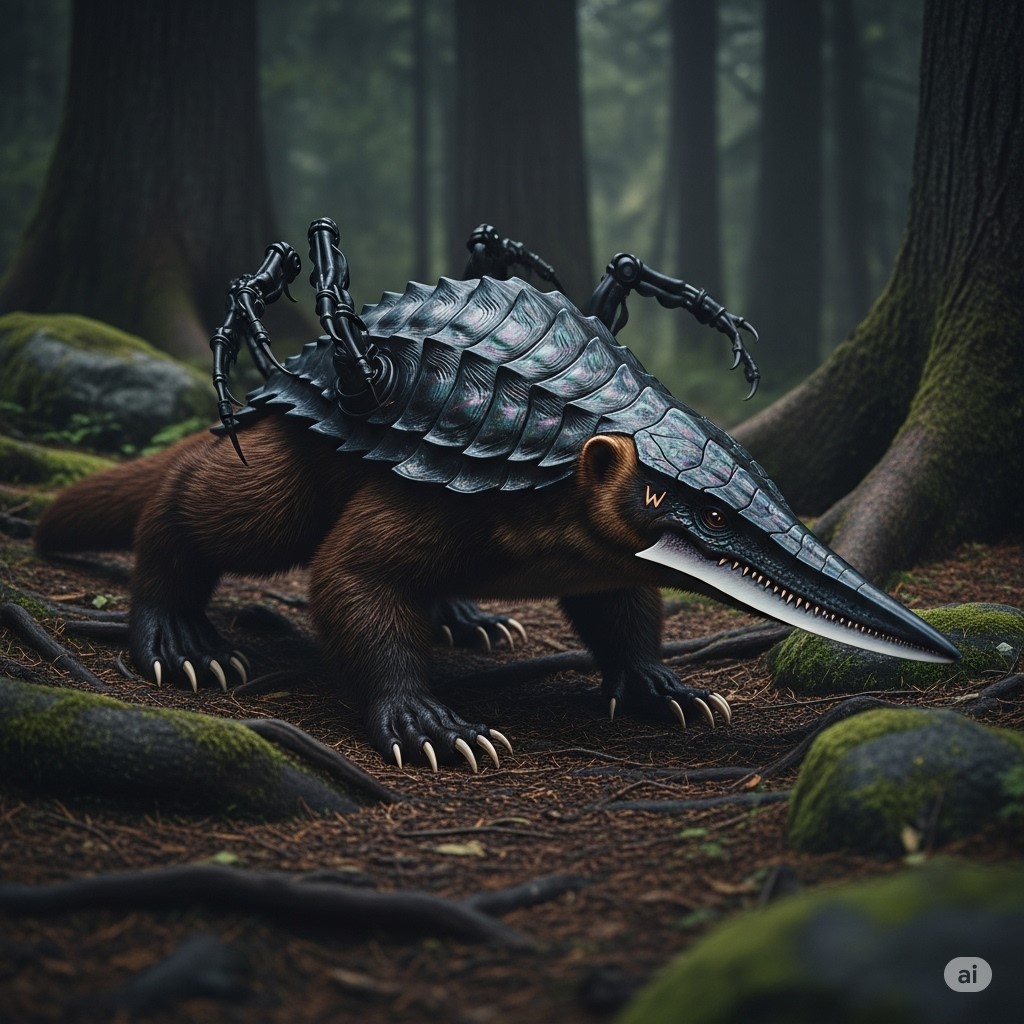
APPEARANCE: The Gulsepidon is a horrifying amalgam of disparate evolutionary paths, resulting in a creature of profound strangeness. Its core body is low-slung, powerfully muscled, and dense, similar to that of a wolverine, covered in a thick, oily, dark-brown fur on its underside and legs. Its back, however, is protected by a segmented, chitinous carapace of iridescent black, much like a beetle’s elytron, that ends in a flexible, turret-like nozzle at the creature’s rear. The most disquieting feature is its skin, which is visible where the fur is sparse. It is a rubbery, chromatophore-rich hide that can shift its color and texture in hypnotic, flowing patterns to match its surroundings, an ability inherited from its cephalopod ancestor.
The creature has six limbs: four short, incredibly strong legs ending in long, non-retractable claws perfect for digging and climbing, and two smaller, multi-jointed manipulator arms located just behind the head, which are used for grasping prey. Its head is a nightmare. It possesses the elongated, blade-like snout of a goblin shark, dotted with sensitive pits. Its eyes have the eerie, W-shaped pupils of a cuttlefish, granting it exceptional vision in dim light. Its most terrifying feature is its jaw; like the goblin shark, the entire jaw structure is protractile, capable of launching forward from beneath the snout with shocking speed to snatch prey. The mouth is filled with the wolverine’s powerful dentition, capable of crushing bone.
SIZE: The Gulsepidon is a dense and compact creature. A typical adult stands about two feet high at the shoulder, is roughly four feet long from its snout to the base of its tail, and weighs between 70 and 100 pounds. Its perceived size can change slightly as it manipulates its skin texture, making it seem to puff up when threatened.
SPEED: The creature is not a pursuit predator. Its speed is deceptive, capable of explosive, short bursts of acceleration to lunge from an ambush. It is an excellent climber, using all six limbs to scale rock walls and trees, and a prodigious burrower, able to excavate tunnels in packed earth with astonishing speed. Its movement is typically a low, fluid prowl.
STAT MODIFIERS: Strength: High Stamina/Constitution: Very High Dexterity: Moderate Perception: High (sight and electro-senses) Intelligence: Moderate (cunning and adaptive) Willpower: High Charisma/Social: Very Low
SKILLS: Stealth/Ambush: Exceptionally skilled at using its chameleonic skin to blend into its surroundings and lie in wait. Burrowing: Capable of creating tunnels and dens in earth and soft rock. Climbing: Adept at scaling vertical surfaces. Intimidation: Its bizarre appearance and aggressive displays are highly effective at frightening other creatures. Grappling: Its protractile jaws can latch onto prey with immense force. Electro-reception: The pits on its snout can detect the faint magical and electrical impulses of living creatures, allowing it to “see” in total darkness or through thin layers of mud or water.
BEHAVIOR: The Gulsepidon is a solitary and ferociously territorial ambush predator. It spends most of its time motionless, perfectly camouflaged against a rock face, a tree trunk, or a pile of debris, waiting for prey to wander within range of its lunge. It uses its electro-senses to detect approaching life forms long before they are visible. Once prey is within range, it launches its jaws forward to inflict a devastating initial bite, then uses its powerful body and claws to wrestle the victim to the ground. It is highly intelligent for a feral creature, capable of learning from past encounters, avoiding established threats, and creating simple traps, such as a burrow concealed with loose debris. When threatened or cornered, it will first use an intimidating display, flashing vibrant, threatening color patterns on its skin and snapping its jaws. If this fails, it will use its rear nozzle to spray a noxious, boiling chemical concoction, a defense inherited from its bombardier beetle ancestor.
DIET: The Gulsepidon is a strict and opportunistic carnivore. Its diet consists of any living thing it can successfully ambush and kill, ranging from large rodents and deer to unwary adventurers or other magical beasts. Its powerful jaws allow it to easily crush the shells of armored creatures, making turtles, crabs, and even smaller steam-powered constructs potential prey. It is not a scavenger and prefers fresh kills.
EMOTIONS: The creature’s emotional range is primal and limited. It is primarily driven by territorial aggression, predatory hunger, and a deep-seated instinct for survival. It does not feel empathy or joy, but is capable of a cold, patient cunning that can be mistaken for contemplative thought. When threatened or wounded, it can enter a state of incredible, single-minded rage, fighting to the death with no regard for its own safety.
ENVIRONMENT WHERE FOUND: The Gulsepidon thrives in dark, damp, and structurally complex environments that allow it to capitalize on its camouflage and ambush tactics. It is most commonly found in extensive coastal cave systems, the twilight floor of dense old-growth forests, and the deep, wet jungles of the world’s hidden areas. They have also adapted with alarming success to artificial environments, making lairs within the vast sewer networks, steam tunnels, and forgotten under-levels of major cities.
TAGS: Feral, Magical Beast, Carnivore, Solitary, Ambusher, Burrower, Camouflage, Electro-reception, Chemical Defense, Forest, Caverns, Urban Under-levels, Chimera, Abomination, Predator, Hexapod, Territorial, Armored, Protractile-Jaw, Chromatophore-Skin
AGE
The Gulsepidon 818 has a lifespan that reflects its extreme hardiness, typically living for 20 to 25 years. Its life cycle is solitary and fraught with peril from the moment of birth. Reproduction is a rare and violent affair, after which the female undergoes a unique gestation. She develops and broods a single, large, leathery egg internally, providing nourishment and protection. After nearly a year, she gives live birth to a single, highly developed pup.
The Juvenile stage lasts for approximately two years. The pup is born with its abilities in a nascent form; its camouflage is patchy, its jaws cannot fully extend, and its chemical spray is weak. It relies on its mother for protection and food, learning to hunt by observing her. The mother is brutally pragmatic, and after the first year, she will aggressively drive the pup away to fend for itself.
The Sub-Adult stage, from age two to five, is the most dangerous period in a Gulsepidon’s life. Now solitary, it is a nomad, constantly searching for food and avoiding the territories of established adults. They are hyper-aggressive during this phase, challenging anything they think they can kill as they attempt to carve out a territory of their own through sheer force and tenacity. Most do not survive this period.
An Adult Gulsepidon, from age five onward, is an apex predator that has successfully established and defended a territory, which can span several square miles of dense forest or a complex network of caves. It knows its territory intimately, with multiple dens, ambush points, and escape tunnels.
In its Elder stage, beyond twenty years, the creature becomes less physically active. Its movements are more deliberate, and its explosive speed has waned. It relies far more on its cunning, creating more elaborate deadfall traps and ambushing prey from the comfort of its primary den. Its carapace is often scarred and pitted, and its color-shifting skin may be slower to change, sometimes retaining mottled patches of its previous pattern.
TACTICS
The Gulsepidon is a master of the calculated ambush; its every action is geared toward a sudden, overwhelming alpha strike. Its primary tactic begins with patience. It will spend hours, sometimes even days, completely motionless in a high-traffic area, using its Adaptive Camouflage to become functionally invisible against a rock wall, tree trunk, or pile of rubble. It remains still, conserving energy, its mind in a state of low awareness until its electro-senses detect the tell-tale bio-signature of an approaching life form.
Once a target is identified and enters the optimal range (typically within 15 feet), the attack is a sequence of devastatingly swift actions. It begins with the Abyssal Snap, launching its protractile jaws to strike and latch onto the prey. The goal is not always to kill instantly, but to snare, cripple, and secure the target. Immediately following the bite, it uses its powerful body in a Chitinous Slam, leveraging its weight to knock the victim off balance and to the ground. Once the prey is down, it will use its main claws to pin and tear while its smaller manipulator arms grasp at limbs or weapons, preventing escape or retaliation.
Against rivals or creatures too large to ambush, the Gulsepidon employs psychological warfare. It will first use a Terrifying Display, flashing vivid, threatening color patterns across its skin while emitting a deep guttural hiss and snapping its extendable jaws. This is a test of will. If the intruder does not retreat, the Gulsepidon will engage in a series of short, feinting lunges, testing its opponent’s speed and defenses before committing to a full attack.
The Bombardier Burst is a tactic of last resort. It is used exclusively for defense when the creature is cornered or grievously wounded. It will aim its turret-like abdomen at the attacker’s face and release the chemical spray to blind and burn them, using the ensuing chaos to flee to a prepared escape tunnel or den.
ACTIONS
Abyssal Snap: The Gulsepidon launches its jaw structure forward in a lightning-fast strike. This attack has extended reach and on a successful hit, can grapple the target, holding them in place.
Flensing Claws: A flurry of attacks with its four main legs, each tipped with long, sharp claws designed for rending flesh and digging through rock.
Chitinous Slam: The creature lowers its head and charges, striking a target with its armored carapace. An opponent hit by this attack can be knocked prone.
Terrifying Display: As a full-round action, the creature flashes complex, dizzying patterns on its skin, snaps its jaws, and releases a menacing hiss. Opponents who witness this display must test their resolve or become frightened.
Bombardier Burst: A cone of noxious, boiling chemicals erupts from the creature’s abdomen. Anyone caught in the area takes immediate chemical damage and can be blinded for a short time. This ability can only be used once every few hours as the creature must metabolize new chemicals.
Adaptive Camouflage: The creature can take an action to alter its skin’s color and texture to perfectly match a new surface, rendering it nearly invisible as long as it remains still.
Electro-Sense: A passive ability that allows the Gulsepidon to perceive the bio-electric fields of living creatures within a certain radius, ignoring all penalties from darkness, fog, or even total cover, so long as the cover is not thick enough to block the electrical field.
OTHER INTERESTING INFORMATION
The Gulsepidon is a keystone species in its ecosystem. By preying on a wide variety of creatures, it prevents any one species from becoming dominant. Its extensive, abandoned burrows also create ready-made homes for countless smaller animals, fungi, and insects.
Magically, the creature is a fascinating product of Saṃsāra. Its unique combination of traits is believed to be the result of the world’s high-magic saturation acting upon the reincarnated souls of many different animals over millennia, eventually forcing a stable, chimeric form. The hide is highly sought after by enchanters, as its chromatophores can be magically treated to create shifting patterns in leather armor. Its carapace, when powdered, is a key ingredient in potions of defense.
Its primary weakness is its reliance on its electro-senses. It can be confused by multiple, overlapping bio-signatures and has great difficulty targeting non-living constructs, such as golems or steam-automatons, which it perceives only as moving rocks. Powerful, directed electrical or sonic attacks can also overload its senses, leaving it stunned and disoriented.
An encounter with a Gulsepidon 818 is rarely a simple affair. These creatures are not wandering monsters but territorial apex predators, deeply embedded in their chosen environments. A party of adventurers might cross paths with one incidentally, their own goals intersecting with the beast’s domain, or they might deliberately seek one out, driven by the promise of rare rewards or the need to overcome a formidable obstacle.
WHY A PARTY WOULD ENCOUNTER A GULSEPIDON
These encounters typically occur when adventurers are forced off the beaten path and into the dark, complex, and forgotten places where a Gulsepidon thrives. The creature itself is not the objective, but it becomes an unexpected and highly dangerous environmental hazard that must be survived or overcome.
The Blocked Passage: The party may have a clear objective, such as reaching a hidden ruin, tracking a fugitive, or delivering an important message through a remote wilderness. The most direct, or perhaps only, route leads through a narrow mountain pass, a dense, ancient forest, or a specific network of caves. Unfortunately for the party, a Gulsepidon has recently established its territory directly on this path. The adventurers would first find evidence of its presence: unnervingly large claw marks gouged into rock, the foul, chemical scent of its territorial spray, and the half-eaten carcasses of powerful local wildlife. They are then faced with a choice: risk a lengthy and dangerous detour, attempt to sneak through the domain of a creature with hyper-sensitive perception, or face the ferocious beast head-on to clear the way.
Intrusion into the Lair: Adventurers often find themselves delving into the depths of the world, whether exploring a lost city, navigating the steam-tunnels beneath a metropolis, or mapping a newly discovered cave system. In their exploration, they might unknowingly breach the perimeter of a Gulsepidon’s territory. The encounter would begin not with a fight, but with a growing sense of dread. They find tunnels that are not part of the original structure, burrowed through ancient walls with terrifying force. The air grows still, and they get the unnerving feeling of being watched. The Gulsepidon, now aware of the intruders, would begin to hunt them within its own lair, using its perfect camouflage and intimate knowledge of the terrain to separate the party, create ambushes, and turn the dungeon itself into a predator’s playground.
The Urban Predator: A city’s growth is often built upon its own forgotten history, creating a labyrinth of old sewers, abandoned substations, and collapsed tunnels beneath the bustling streets. When citizens or workers from a new excavation project start to disappear without a trace, the party may be hired to investigate what is assumed to be the work of a secret cult or a common sewer-dwelling monster. Their investigation, however, would lead them deeper than expected, into a section of the undercity that has become the hunting ground for a Gulsepidon. The adventurers would have to track the creature through a complex, man-made environment where it uses its unique abilities to thrive, realizing that they are not just clearing out a pest, but hunting a monster far more intelligent and dangerous than anyone suspected.
WHY A PARTY WOULD SEARCH FOR A GULSEPIDON
Actively seeking out one of these chimerical horrors is a task only undertaken by brave, skilled, or desperate adventurers. The motivation is almost always centered on acquiring something that only the Gulsepidon possesses, whether a biological component, a valuable hide, or something it unwittingly guards.
A Commission for Rare Components: The Gulsepidon is a walking treasure trove of unique biological materials. A master alchemist might offer a substantial reward for the creature’s chemical sac, needing the potent, volatile compound for a powerful elixir or solvent that cannot be synthesized by other means. Alternatively, a renowned armorer, commissioned by nobility, may require the Gulsepidon’s hide and carapace. The chromatophore-rich skin can be treated to create stealth cloaks that shimmer and shift, while the iridescent black carapace can be fashioned into a lightweight, durable breastplate. In either case, the party must hunt the creature while being careful not to destroy the very component they were hired to retrieve, forcing them into a more difficult and tactical confrontation.
The Unwitting Guardian: In a classic twist of fate, the object of the party’s quest might lie directly within the heart of a Gulsepidon’s lair. A shaman may have a vision of a lost ancestral artifact, a historian may have records of an ancient tomb, or a treasure map may point to a location that, over the centuries, has become a Gulsepidon’s den. The creature is not intentionally guarding the item, but its ferocious territoriality makes it the de facto guardian. The quest then becomes one of immense challenge: the party must research the creature’s habits, track it to its lair, and then decide how to proceed. Do they attempt an impossible stealth mission, sneaking in while the beast is away hunting, or do they face the creature in its own territory, where it holds every advantage, to claim their prize?
The Test of a Hunter: For some, the motivation is not treasure, but glory. In certain cultures or hunter’s lodges, slaying a Gulsepidon is considered the ultimate test of a tracker’s and warrior’s skill. An aspiring champion or a braggart lord might hire the party to accompany them on such a hunt, to act as support, trackers, or simply as witnesses to their great deed. The party’s role would be to ensure the patron survives the encounter and successfully lands the killing blow, a task made difficult by the creature’s ferocity and the patron’s potential arrogance or inexperience.
Beyond the previously mentioned hide, carapace, and chemical sac, the corpse of a Gulsepidon 818 is a treasure trove of rare and potent biological components. A skilled harvester with knowledge of alchemy, anatomy, and engineering can procure a variety of unique ingredients, each with its own specialized use in the industries and arcane arts of Saṃsāra.
PROTRACTILE JAW TENDONS
Harvest: This is a difficult harvest requiring precise, deep incisions around the creature’s complex jaw musculature. The two primary tendons are thick, silvery, and possess an unnatural elasticity. If cut improperly, they will instantly lose their unique properties and become simple, tough ligaments. Use: These tendons are highly prized by master bowyers and steam-engineers. When properly cured and braided, they can be used as bowstrings that provide a dramatically increased draw weight and projectile speed without a corresponding increase in the required pull strength. In the industrial world, they are reverse-engineered as kinetic drivers. A steam-piston fitted with a recoil mechanism made from these tendons can achieve a cyclical rate far beyond what standard mechanical springs can offer, leading to more efficient and powerful steam-hammers, pumps, and mechanical saws.
ELECTRO-SENSITIVE NERVE CLUSTERS
Harvest: An extremely delicate process. The nerve clusters are located in small pits along the creature’s blade-like snout. They look like small, gelatinous grey nodes and must be harvested with non-metallic tools within an hour of the creature’s death, then immediately placed in a saline and mild preservative solution. Use: These nerve clusters are the key to the Gulsepidon’s ability to sense living things. An artisan skilled in both alchemy and magical circuitry can integrate a preserved cluster into a complex device. Most commonly, they are used to create “Life-Finder’s Compasses,” handheld devices whose needle quivers and points towards the nearest concentration of living souls. They are also used in high-security perimeter wards; a series of these nerves submerged in alchemical baths and linked by magic circuits can create a detection grid that is impossible to fool with visual illusions or stealth, as it detects the presence of life itself.
W-PUPIL LENSES
Harvest: This requires careful extraction of the creature’s eyeballs and a precise dissection to remove the unique, W-shaped crystalline lenses without scratching them. They are surprisingly durable but will cloud over permanently if exposed to open air for too long before being treated. Use: The unique shape and composition of these lenses grant unparalleled vision in low-light and murky conditions. A skilled optician can grind them down to fit into specialized goggles or helmet visors. An avatar wearing these lenses can see in near-total darkness as if it were dim twilight and can see through turbid water or fog with much greater clarity than normal. Some mages also use the powdered lenses as an ingredient in scrying pools, believing they help pierce the “murk” between worlds.
VISCERAL FUR PELT
Harvest: This is a relatively simple harvest, involving the skinning of the creature’s underbelly and legs. The fur is thick, dark, and naturally saturated with a foul-smelling but incredibly effective waterproofing oil. Use: Once properly cleaned and tanned (a process that takes weeks to remove the smell), the visceral pelt is one of the finest insulating materials available. It is superior to the hide of any seal or bear. Coats and boots lined with this fur can keep the wearer warm and dry in the most brutal cold-weather or subterranean environments, making them highly valued by explorers, miners, and sailors traveling in the arctic regions.
THE HEART OF THE TENACIOUS
Harvest: The creature’s heart is a large, dense, four-chambered organ. It must be harvested whole and bled out immediately. For alchemical use, it is often sliced thin and slow-dried over a cool, smokeless fire. Use: The Gulsepidon’s incredible stamina is concentrated in its heart. When properly prepared by an alchemist, the dried heart can be ground into a potent powder. This powder is the primary ingredient in “Unflagging Endurance Draughts,” potions that allow the imbiber to perform strenuous physical activity for hours without feeling the effects of fatigue. A small, raw piece, if consumed by an individual with shamanistic attunement, is said to grant a brief but overwhelming vision of the creature’s hunting territory, though this is often accompanied by a temporary bout of feral aggression.
MANIPULATOR ARM BONES
Harvest: The two small, secondary arms near the creature’s head are multi-jointed and complex. Extracting the full set of delicate, interlocking bones without breakage requires care and anatomical knowledge. Use: These bones are remarkably light, yet strong and intricate. They are a treasure for artisans who specialize in fine, articulated work. Clockmakers, automaton creators, and even surgeons use these bones to create the articulated fingers of mechanical hands, the delicate inner workings of complex gear-trains, or specialized surgical tools that require both strength and a high degree of precision movement.
MANY BEASTS BOUND AS ONE
From the cracked tablets, etched by hands long turned to dust, comes a fragmented account. The words stumble, the meanings shift like desert sands in a wind, yet the core echoes across the ages. It speaks of a time when the world-skin was still young, and the breath of creation had not yet settled into familiar forms. Creatures walked that were puzzles of flesh, whispers of what might be, before the Great Ordering smoothed the edges of life.
In that blurred time, the story tells of a place where the very earth sighed with dampness, and the trees were thick as slumbering gods. There lived a solitary horror, a thing stitched from the leavings of forgotten experiments of nature. They called it by many names, each a broken mirror reflecting a facet of its strangeness: the Ground-Listener with Teeth Like Rain, the Shadow-Stalker with a Shell of Night, the One Who Wears the Colors of Deception, the Burrower Whose Voice is Fire. But the oldest name, worn smooth by the grinding of centuries, seems to have been something like “Ghul-Sep-Eye-Don,” a jumble of sounds hinting at the beasts that lent it pieces of its being.
The telling says it moved like a hunger made flesh, low to the earth, yet with a back armored as if by fallen stars. Its face was a drawn-out point, sensing the secret heartbeats beneath the soil. And from its back sprouted not wings, but small, grasping hands, as if it yearned to hold the very ground it walked upon. Its skin was a canvas of fleeting hues, a constant lie against the world, allowing it to vanish into shadow or stone with equal ease.
The people of that forgotten time lived in fear of this creature. They did not understand it. It was not born of any mother they knew, nor did it follow the hunts of any pack. It was an echo of a dream gone wrong, a chimera wandering a world that was still learning its own shape. When it came, it was like a silent landslide, a sudden eruption from the unseen. Travelers disappeared on well-worn paths. Hunters became the hunted in their own woods. The creature left behind only strange tracks and the lingering scent of bitter smoke, a phantom echo of its hidden defense.
One brave, or perhaps foolish, seeker of wisdom, a chanter of the old ways named Borash (or perhaps Morash, the script is unclear), resolved to understand the beast. He did not seek to kill it, for he sensed it was not born of malice, but of a deeper, unknowable process. He followed its trails, the broken earth and the patches of strangely bare ground where its camouflage had been perfect. He watched it from afar as it lay still for days, a living part of the forest floor, and then erupted in a burst of terrible speed to claim its prey.
Borash observed that the creature was a solitary sorrow, forever alone in its mismatched form. It did not call to others of its kind, for there were none. It did not seem to fight out of rage, but out of a primal need to survive in a world that surely must have looked at it with equal bewilderment.
One day, Borash left an offering: a freshly killed deer, placed at the mouth of a burrow he had seen the creature enter. He retreated and waited. After a long silence, the creature emerged cautiously, its strange eyes regarding the offering with a wary curiosity. It dragged the deer into its lair, and Borash did not see it again for many days.
But when the wrongness in the world began to stir – when the familiar paths seemed to shift and the stars danced in unfamiliar patterns – Borash found the Gulsepidon (for that is the sound that feels closest to its ancient name) acting strangely. It would press its snout to the ground, its skin rippling with anxious colors. It would pace the edges of its territory, a low, guttural hum vibrating in its chest. It was as if the creature, in its alien way, could sense the world itself fraying at the edges.
The fragmented tale ends abruptly here. One version hints that the creature, sensing a greater threat, abandoned its solitary ways and even, perhaps, guided some lost travelers to safety through the shifting lands. Another suggests it was ultimately consumed by one of the very world-tears it seemed to sense. The final lines, barely legible, speak of Borash understanding that even the most monstrous form could be a part of the world’s delicate balance, a strange note in the song of existence.
Moral of the story: Even a creature stitched from disparate parts has a thread that connects it to the great tapestry of being. Judge not by shape alone, for even the most unfamiliar heart beats with the rhythm of survival in a world that is ever-becoming.
Suggested conversions to other systems:
CALL OF CTHULHU
THE CHTHONIC AMALGAM
This creature is a profound violation of natural law, an impossible fusion of mammal, insect, fish, and cephalopod. Its very existence is a testament to some ancient, misguided power or a world where evolution has gone mad. Merely witnessing its unnatural anatomy is enough to strain the sanity of the most hardened Investigator.
STR 80, CON 90, SIZ 75, DEX 70, INT 45, POW 50, HP 16 Move: 8 / 4 (burrowing) ATTACKS:
- Attacks per round: 2 (claws) or 1 (bite or spray)
- Fighting (Brawl) 50% (25/10), damage 1d6+1d4 (claws)
- Bite 40% (20/8), damage 1d10+1d4, with special rule
- Caustic Spray 30% (15/6), damage 1d4 and blinding, with special rule
Dodge 35% (17/7) Armor: 2-point chitinous carapace on its back; 1-point tough hide elsewhere. Skills: Stealth 70%, Listen 60%.
SPECIAL RULES:
- Protractile Jaws: The Chthonic Amalgam’s Bite attack has a reach of 5 feet. On an Impaling hit, the jaws latch on and the victim is considered Grappled.
- Caustic Spray: As one of its attacks, the creature can spray a 15-foot cone of boiling chemicals. Anyone in the cone takes 1d4 damage and must succeed on a Hard CON roll or be blinded for 1d6 rounds. The creature can only do this three times before needing several hours to metabolize more chemicals.
- Chameleonic Skin: If the creature is motionless against a natural or debris-strewn background, it requires a Hard Spot Hidden roll to notice.
- Electro-sense: The creature senses the bio-electricity of living things. It ignores all penalties due to darkness or fog when attacking living creatures within 30 feet.
- Sanity Loss: 1/1d8 SAN points for seeing a Chthonic Amalgam for the first time.
BLADES IN THE DARK
THE SUMP-GNASHER (A terrifying, subterranean aberration; Tier III Threat)
This creature is a solitary hunter found in the forgotten and lightless places of the world—the sewers and sump-drains of Doskvol, the ruins of the Deathlands, or the foundations of old noble estates. It is a chimera of impossible biology, perfectly adapted to ambush and terrorize those who trespass in its domain.
DRIVES:
- To hunt and consume any living thing that enters its territory.
- To maintain the security and solitude of its complex lair.
- To drive away or destroy any creature it perceives as a threat.
MOVES (GM ACTIONS):
- Erupt from the shadows with shocking speed.
- Launch its nightmare jaws to drag someone into the darkness.
- Blend into the grime and rubble, vanishing from sight.
- Unleash a scalding, blinding spray of chemical filth.
- Tear through a barricade or obstacle with its powerful claws.
- Reveal its unnatural cunning and tactical awareness.
NOTES FOR THE GM: A Sump-Gnasher is best used not as a straightforward fight, but as a source of terror and pressure during a score. Its presence can be a 6- or 8-segment clock representing the crew’s attempt to navigate its lair without being killed. A direct confrontation would be a dangerous group action, likely resisted by the creature’s Tier. Its chemical spray can inflict the Blinded or Poisoned Harm, and its bite can separate a crew member from the group.
DUNGEONS & DRAGONS
GULSEPIDON (Medium monstrosity, unaligned)
Armor Class: 15 (natural armor) Hit Points: 75 (10d8 + 30) Speed: 30 ft., burrow 20 ft., climb 30 ft.
STR 16 (+3), DEX 14 (+2), CON 17 (+3), INT 5 (-3), WIS 12 (+1), CHA 7 (-2)
Skills: Perception +4, Stealth +7 Senses: Darkvision 60 ft., Electrolocation 30 ft., Passive Perception 14 Challenge: 4
Electrolocation. The gulsepidon can detect the location of any living creature within 30 feet of it, unless that creature is behind total cover made of a non-conductive material like wood or thick stone. It does not need to see to use this sense.
Chameleonic Carapace. The gulsepidon has advantage on Dexterity (Stealth) checks made to hide in rocky, subterranean, or forested terrain.
Ambusher. In the first round of a combat, the gulsepidon has advantage on attack rolls against any creature that hasn’t taken a turn yet.
ACTIONS:
- Multiattack. The gulsepidon makes two Claw attacks.
- Claw. Melee Weapon Attack: +5 to hit, reach 5 ft., one target. Hit: 7 (1d8 + 3) slashing damage.
- Snapping Jaws (Recharge 5-6). Melee Weapon Attack: +5 to hit, reach 10 ft., one target. Hit: 12 (2d8 + 3) piercing damage, and the target is grappled (escape DC 13). Until this grapple ends, the target is restrained, and the gulsepidon cannot use its Snapping Jaws on another target.
- Caustic Spray (1/Day). The gulsepidon sprays hot chemicals in a 15-foot cone. Each creature in that area must make a DC 13 Dexterity saving throw, taking 14 (4d6) acid damage on a failed save, or half as much damage on a successful one. A creature that fails its save is also blinded for 1 minute. A blinded creature can use its action to wipe the chemicals away, ending the condition.
KNAVE
CHITIN-MAW
HD 6, Armor as Plate (16), Morale 10, Claws d8/d8, Bite d10
- Camouflage: When motionless on a natural surface (rock, dirt, trees), it is invisible. Characters must make a successful opposed Wisdom save to spot it before it attacks.
- Jaw Lunge: The Chitin-Maw’s bite attack has a reach of 10 feet. A character hit by it must save versus paralysis or be grappled and unable to move. They may attempt to break free on their turn with a successful opposed Strength save.
- Caustic Spray: Once per combat, it can spray a 15-foot cone. All characters in the cone must save versus poison or take 2d8 damage.
- Electro-sense: It is aware of all living creatures within 50 feet, regardless of light, fog, or invisibility. It can only be surprised by non-living things (like constructs or traps).
- Tenacious: It is immune to all fear or morale-based effects.
FATE
THE ABYSSAL AMBUSHER
This creature is treated as a significant NPC threat, a force of nature defined by its predatory instincts and bizarre physiology. It is a creature of ambush and terror, not open confrontation.
HIGH CONCEPT: Terrifying Chimeric Predator TROUBLE: Ferociously and Uncannily Territorial OTHER ASPECTS: Skin of Shifting Lies, Jaws That Leap from Shadow, Armored Like Beetle-Shell
SKILLS:
- Great (+4): Stealth
- Good (+3): Fight, Athletics
- Fair (+2): Physique, Notice
- Mediocre (+1): Will
STUNTS:
- Perfect Camouflage: The Abyssal Ambusher can use its Stealth skill to Create an Advantage on itself called Perfectly Hidden. When it does so, it gets two free invocations on that aspect instead of one.
- Snapping Maw: When the Ambusher succeeds with style on a Fight attack to Create an Advantage, it can attach the aspect Snared by the Maw to a target in an adjacent zone. This aspect has one free invocation.
- Caustic Burst: Once per conflict, the Ambusher can make a special Fight attack against all targets in its zone. This is an Overcome action for the targets using their Athletics skill. Anyone who fails gains the situational aspect Blinded and Stinging until they can take an Overcome action to clear it.
NUMENERA & CYPHER SYSTEM
THE CHROMATOPHORE STALKER
LEVEL: 5 MOTIVE: To hunt, to defend its territory with extreme prejudice. ENVIRONMENT: Almost any dark, complex terrain, from deep forests and cave systems to the forgotten underworks of a city or a derelict spacecraft. HEALTH: 15 DAMAGE: 5 ARMOR: 2 MOVEMENT: Short; short burrowing. MODIFICATIONS: Stealth as level 7 due to its adaptive camouflage. Perception as level 6 due to its electro-senses.
COMBAT: The Chromatophore Stalker attacks from ambush whenever possible. It will lie perfectly still, using its camouflage until prey is at an immediate distance. Its primary attack is its Jaw Lunge. The stalker can attack a target up to 10 feet away. If the attack hits, it inflicts 5 points of damage and the target is held fast. Each round thereafter, the target takes an automatic 5 points of damage until they can succeed on a Might-based task (difficulty 5) to break free. As a secondary attack, it can use its claws, inflicting 5 points of damage. If it feels seriously threatened, it can unleash its Caustic Burst. This is a cone affecting all targets at immediate range. All targets must make a Speed defense task. Those who fail take 3 points of ambient damage and the difficulty of their perception-based tasks is increased by one step for one minute. The stalker’s Electro-sense means it is not affected by darkness, fog, or visual illusions when targeting living creatures.
PATHFINDER
GULSEPIDON AMBUSHER (CREATURE 4) RARE, N, MEDIUM, ABERRATION, ANIMAL
Perception +12; darkvision, electrosense (imprecise) 30 feet Skills: Acrobatics +11, Athletics +12, Stealth +13 Str +4, Dex +5, Con +3, Int -3, Wis +2, Cha -2 Electrosense: The gulsepidon can sense the bioelectric fields of living creatures as an imprecise sense.
AC 21; Fort +11, Ref +13, Will +8 HP 60 Reactive Camouflage [reaction] Trigger: A creature ends its move within 10 feet of the gulsepidon. Effect: The gulsepidon becomes hidden from the triggering creature. It can then Sneak as part of this reaction.
Speed 30 feet, burrow 20 feet, climb 30 feet Melee [one-action] Jaws +14 (Reach 10 feet), Damage 2d8+6 piercing plus Grab Melee [one-action] Claw +14 (agile), Damage 1d10+6 slashing Sudden Lunge [two-actions] The gulsepidon Strides up to its speed and makes a Jaws Strike at the end of its movement. Caustic Spray [two-actions] (acid, primal) The gulsepidon expels a cone of boiling chemicals. Creatures in a 15-foot cone take 5d6 acid damage (DC 21 basic Reflex save). A creature that critically fails its save is also blinded for 1 round. The gulsepidon cannot use Caustic Spray again for 1d4 rounds.
SAVAGE WORLDS
THE ABYSSAL WOLVERINE (WILD CARD)
This territorial horror is an amalgamation of several creatures, possessing the worst traits of all of them. It is cunning, incredibly durable, and shockingly fast when it strikes from ambush.
Attributes: Agility d8, Smarts d6 (A), Spirit d8, Strength d10, Vigor d10 Skills: Athletics d10, Fighting d10, Notice d8, Stealth d12 Pace: 6; Parry: 7; Toughness: 9 (2) Edges: Ambidextrous, First Strike, Frenzy (can make two Fighting attacks at -2 penalty)
SPECIAL ABILITIES:
- Armor +2: Tough chitinous carapace.
- Bite/Claw: Str+d8
- Burrow: Pace 4
- Camouflage: +4 bonus to Stealth rolls when holding still in natural or ruin environments.
- Electro-sense: Ignores all Illumination penalties when attacking living creatures within 12″.
- Lashing Jaws: The creature’s Bite has Reach 1″.
- Caustic Spray: Once per encounter, as an action, the creature can spray chemicals in a Cone Template. Any character in the template must make a Vigor roll. With a failure, they are Distracted and Vulnerable. On a critical failure, they are also blinded for 1d4 rounds.
- Tenacious: Immune to Fear and Intimidation tests.
- Size 1
SHADOWRUN
GUTTER-GOYLE (CHIMERIC PREDATOR)
Gutter-goyles are terrifying chimeras, rumored to be the result of a rogue Aztechnology bio-corp’s failed experiments in creating the perfect urban hunter-killer, now breeding true in the sewers and underbellies of major sprawls. They are ferociously territorial and cunning, a Tier-1 threat for any shadowrunner team contracted to work in the deep underground.
Attributes: Body 6, Agility 5, Reaction 4(6), Strength 6 Essence: 6.0, Magic: 6.0 Initiative: 10 + 2d6 Matrix AR: N/A Condition Monitor: 11P / 11S
Skills: Athletics 4, Exotic Ranged Weapon (Caustic Spray) 3, Perception 3, Stealth 6, Unarmed Combat 5 Powers: Armor 6, Camouflage (Urban and Natural), Enhanced Senses (Electrosense), Natural Weapon (Claws/Bite, DV 3P, AP -1), Toxin Spray (see below)
Electrosense: The gutter-goyle perceives the bio-electric fields of living beings. It ignores all visibility penalties when attacking living targets. This sense does not work on drones or inorganic constructs. Protractile Bite: The creature’s Bite attack has Reach 1. Caustic Spray: The gutter-goyle can fire a chemical jet from its abdomen as a Major Action. This is a Ranged Exotic Weapon attack that uses a narrow cone template. Anyone hit takes 6P chemical damage (resisted with Body + Armor) and must make a Body + Willpower (3) test or be affected by the Blindness status effect for 1d6 rounds. The gutter-goyle can only use this ability three times before needing an hour to recover.
STARFINDER
SUBTERRANEAN PHASE HUNTER (CR 4) XP 1,200 N Medium magical beast Init +4; Senses blindsense (electricity) 60 ft., darkvision 60 ft.; Perception +10
DEFENSE EAC 16; KAC 18 HP 55 Fort +8; Ref +8; Will +3 Defensive Abilities: Ferocious Tenacity (1/day)
OFFENSE Speed 30 ft., burrow 20 ft., climb 30 ft. Melee bite +12 (1d6+8 P plus grab) or claw +12 (1d4+8 S) Multiattack bite +6, 2 claws +6 Offensive Abilities: Lashing Jaws
STATISTICS Str +4; Dex +2; Con +2; Int -3; Wis +1; Cha -2 Skills Athletics +10, Stealth +15
SPECIAL ABILITIES Adaptive Camouflage: The creature can use the Stealth skill to hide, even if it is only lightly obscured by dim light, foliage, or rubble. Ferocious Tenacity (Ex, 1/day): As a reaction when the phase hunter is reduced to 0 HP, it can choose to remain at 1 HP instead. Lashing Jaws (Ex): The creature’s bite attack has the reach property. Caustic Jet (Ex, 1/day): As a standard action, the phase hunter can spray a 20-foot cone of boiling chemicals. Creatures in the area take 4d6 acid damage (Reflex DC 13 half). A creature that fails its save is also blinded for 1d4 rounds.
TRAVELLER
THE CHITIN-MAW AMBUSHER (FERAL CARNIVORE)
A solitary, genetically chimeric predator found on a handful of high-G, jungle worlds. It is believed to be a bio-engineered creature from the time of the Ancients, designed as a territorial guardian. It is incredibly durable and a master of ambush.
UPP: 8A9621-0 Skills: Stealth-3, Athletics-2, Recon-1 Pace: 12m Armor: 4 (Chitinous Carapace) Weapons:
- Bite (long): 10, 2d6+2 crushing, range 2m, grapple
- Claw: 10, 1d6+2 slashing
- Caustic Spray: 8, chemical spray (see below)
Traits: Camouflage (all natural environments), Tenacious, Territorial Behavior: Ambush predator. It lies in wait, perfectly camouflaged, until prey is within 2m. It will initiate combat with its long Bite attack to grapple a target, then use its claws to dispatch them. It is highly aggressive and will fight to the death to defend its territory. Caustic Spray: Once per encounter, the creature can spray a cone of chemicals (originating from itself, 10m long, 5m wide at the end). Anyone in the cone must make an Average (8+) Endurance check or suffer 1d6 damage and be blinded for 1d6 rounds, unable to take any action requiring sight.
WARHAMMER FANTASY ROLEPLAY
THE DRAKWALD PIT-FIEND
This horrifying creature is a thing of nightmare, a chimera that stalks the deepest, darkest parts of the Drakwald, though similar beasts have been reported in the Grey Mountains and even the sewers of Altdorf. It is a creature of pure predatory instinct, whose very form seems to defy the natural order, hinting at a subtle, underlying taint of Chaos.
M 4, WS 45, BS -, S 45, T 50, I 30, Agi 35, Dex 20, Int 15, Wp 40, Fel 5 Wounds: 18
Traits: Armour (2), Bite (10), Claws (8), Die Hard, Fear (1), Night Vision, Size (Medium), Territorial, Weapon+8 Skills: Athletics 45, Climb 55, Endurance 60, Perception 45, Stealth (Rural, Underground) 55
SPECIAL ABILITIES:
- Chameleonic Hide: The Pit-Fiend gains a +20 bonus to all Stealth Tests when in forests, caves, or ruins.
- Protractile Maw: The creature’s Bite attack has the Reach quality, allowing it to attack targets up to 2 yards away. If it successfully hits a surprised target with this attack, it automatically inflicts a Grappled condition.
- Caustic Spit: Once per combat, the creature can spend its action to spray a cone of noxious chemicals. All targets within a 4-yard cone must make a Challenging (+0) Dodge Test. Failure results in taking a hit that inflicts 1d10+2 damage which ignores Armour Points, and gains the Blinded 3 condition.
- Electro-Sense: The Pit-Fiend can perceive living creatures through the vibrations and energy they emit. It ignores all penalties related to darkness, fog, or concealment when attacking such targets.