
(From Grulla [gray avian tone], Ulak [a courier creature in northern folklore], Kar [hollow-bodied or callused])
- Original Life Forms Referenced (Animalia Kingdom):
- Aves – Secretary Bird (long-legged terrestrial bird of prey, snake-killer, sharp stomper)
- Mollusca – Nudibranch (vividly colored, toxic sea slug with feather-like gills)
- Mammalia – Pika (mountain-dwelling lagomorph, rapid gatherer, high-pitched alarm calls)
- Arthropoda – Camel Spider (fast, aggressive predator; large mandibles; desert-adapted)
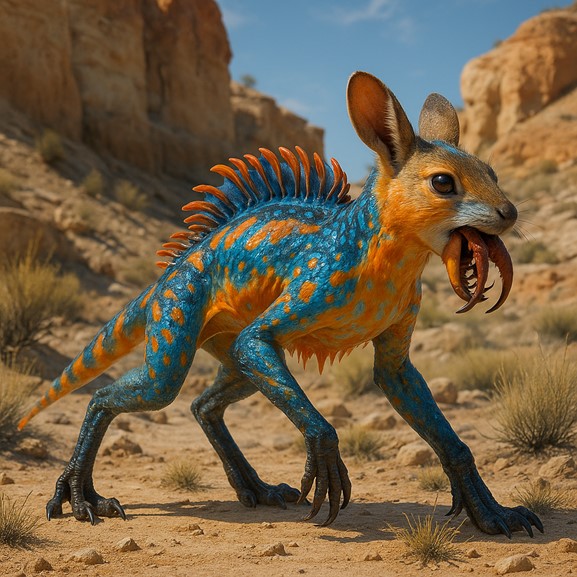
Appearance: Grullakar 153 is an angular-limbed, low-slung predator-creature covered in a shimmering, mucus-lacquered pelt of bright sapphire, bone-white, and poison-orange striping. Its front half resembles a long-legged bird with hooked talons and an arched spinal crest that rattles when it shifts weight. Rather than feathers, its back is lined with fluttering gill-fronds, faintly pulsing with vapor heat and bioluminescence.
Its head sports a compact, expressive snout like a pika’s, with oversized ears that fold into armored ridges when alarmed. Beneath its soft face, a secondary jaw structure—chitinous, serrated, and mandible-like—unfurls when feeding or threatened.
The belly and inner limbs are translucent, showing threads of glowing orange fluid moving like sap between sacs. When it glides, jumps, or sprints, its spine undulates and disperses scent-pollen-like toxin bursts into the air.
Size:
- Height: ~2.5 feet at shoulder
- Length: ~4.5 feet nose to tail
- Spread (limbs extended during leap or display): ~6 feet
- Weight: 55–65 lbs
Speed:
- Land Speed: 40 ft (rapid, bounding sprint; excels on rock and sand)
- Climb Speed: 15 ft (can scale bark, stone, and crumbled ruin walls)
- Leap Range: Up to 20 feet horizontal leap with full stance
- Burrow Speed: None (but can displace loose debris to nest or ambush)
Stat Modifiers (Tier 1):
- Strength: +1 (lethal stomping, surprising bite torque)
- Dexterity: +2 (fast and evasive; sudden turns and acrobatic leaps)
- Constitution: −1 (heat-tolerant but lacks defense against deep wounds or cold)
- Intelligence: +0 (low cunning, recognizes symbols, simple tactics)
- Wisdom: +2 (sharp senses, acute danger and terrain awareness)
- Charisma: −2 *(unnerving behavior, scent, and sudden twitching movements)
Skills (Tier 1):
- Perception: +3 (keen eyesight, echolocation chirps, and tremor-sensing claws)
- Stealth: +3 (camouflage via stillness and terrain mimicry; often mistaken for rocks or sea-polished sculpture)
- Survival: +2 (gathers mineral-rich moss, tracks prey across dried riverbeds, stores moisture in throat sacs)
- Athletics: +2 (explosive jump burst, can disarm foes or leap vertical gaps)
- Intimidation: +1 *(rattling backcrest, flash-frond toxin spray, dual-jawed screech)
Behavior: The Grullakar is an opportunistic territorial pouncer. It hunts by lying in rocky shadows or among reef-colored underbrush, storing moisture and slowing its own pulse until prey comes near. It then lashes out in three motions:
- Frond-flare and hiss to blind/startle
- Pounce with claw crush
- Secondary jaw snap and toxin spit to kill or incapacitate
Despite its aggression, it shows high environmental sensitivity: it avoids mana-tainted land, tracks incoming storms by pressure change, and reacts to spell echoes. In nesting season, it becomes bizarrely playful, stealing bright items and arranging them in patterned circles around burrows.
Diet:
- Carnivorous–insectivorous
- Feeds on snakes, rodents, birds, scavenged meat, magical larvae, and thermic crustaceans
- Known to chew stone-lichen and geothermal salt to supplement toxins
Emotions:
- Calm: Flicking of gills, soft chirruping, tail flick like a metronome
- Hunting: Body low, frond static, eyes slightly dilated and unblinking
- Territorial: High-pitched scream-chirp, mandibles partially visible
- Playful: Tosses small rocks or shells, mimics call notes, performs brief mock-stomps
- Fearful: Rattle-crests flare, full-body twitch, rolls and bolts erratically
Environment Where Found:
- Arid cliff oases, salt-stone canyons, abandoned upper-ridge monasteries
- Shimmering volcanic terraces where desert meets marsh
- Fossil reef plateaus exposed by shifting sands
- Sometimes kept by isolated desert witch-circles as guardian beasts
Tags: Feral, Toxic, Desert-Dweller, Climber, Sprinter, Territorial, Ambush Predator, Bioluminescent, Fronded, Dual-Jawed, Heat-Tolerant, Vibration-Sensitive, Collector, Rare, Tier 1, Nocturnal, Spirit-Averse, Sound-Responsive
Stat Modifiers (Tier 1):
- Strength: +1 *(powerful legs and sudden stomps with secondary jaw pressure)
- Dexterity: +2 *(high-speed bursts, leaping, evasive agility)
- Constitution: −1 *(resilient to heat and toxins but not to injury or cold)
- Intelligence: +0 *(low intelligence but tool-aware and terrain-savvy)
- Wisdom: +2 *(heightened perception, environmental alertness, natural hazard avoidance)
- Charisma: −2 *(erratic posture, disturbing double-mouth behavior, predator aura)
Skills (Tier 1):
- Perception: +3 *(tracks vibrations, motion, distant movement, scent shifts)
- Stealth: +3 *(can blend into rocky terrain and sun-glare; feigns inanimate shape)
- Survival: +2 *(adapts to scarce resources, nests using found materials, tracks prey and water)
- Athletics: +2 *(high leap range, burrow-clearing swipes, cliff-hugging sprints)
- Intimidation: +1 *(venom-frond flare, stomping display, dual-jawed screech)
Age:
- Lifespan: 11–14 years in the wild
- Maturity: ~9–12 months
- Tier 1 Typical Age Range: 1–3 years *(nimble, territorial, and increasingly brave)
Height:
- Standing at shoulder: ~2.5 feet
- Full body length (nose to tail): ~4.5 feet
- Leap-stretched height (during pounce or threat posture): ~6 feet
Weight:
- Average: 55–65 lbs
- Most of its weight is distributed across long, muscled limbs and frond-laced dorsal mass
Speed:
- Land Speed: 40 ft *(fast bounding sprint, sudden zigzagging lunge-escape patterns)
- Climb Speed: 15 ft *(adept at vertical rock, twisted roots, and ruin surfaces)
- Leap Distance: 20 ft horizontally; ~10 ft vertically
- Burrow Speed: N/A (can displace loose material to hide or nest but does not dig tunnels)
Adventurers might encounter or seek out the Grullakar 153 for multiple reasons—each rooted in its hybrid biology, territorial mystique, and connection to rare desert phenomena on the world of Saṃsāra. It is not simply a predator, but a living node in certain ecological, magical, and social systems that affect frontier settlements, ruined shrines, and mystic resource routes.
1. Commissioned Hunt for a Bioluminal Frond Toxin
The Grullakar’s dorsal fronds secrete a neurotoxic ichor that glows when exposed to truth-magic or spell detection. Alchemists from guilds such as the Verdant Prismarc or Saltglass Loom pay high sums for this compound, which is distilled into:
- Purge-salts for binding deception in contracts
- Spell-anchors that dim illusions or ghostly projections
- Burn-ink that reveals ancient sun-scars in lost desert manuscripts
A party may be hired to kill or capture a living specimen, or to extract fresh fronds for use in an upcoming binding rite, trial of truth, or forgotten temple unlocking.
2. Guardian of an Echo-Dry Oasis Shrine
Some Grullakar dens are found near ancient sites where no sound travels. These oases, known as Stillstone Wells, are suspected to be burial fonts for the grief-bound souls of pre-Saṃsāran spirits. The Grullakar, drawn to the mineral hum of such places, often nests above or beside slumbering relics.
The adventurers might be:
- Seeking a memory-scroll or echo-crystal locked beneath a nesting den
- Defending a caravan that accidentally disturbed one
- Escorting a veil-monk sworn to commune with the creature as part of a Silence Rite
3. Eliminating a Threat to Trade Routes
Due to its agility and territorial hostility, a single Grullakar 153 can paralyze a stretch of high-cliff passage or desert root-road, especially where shade and ledges allow ambush. Traders have reported:
- Sudden losses of pack-beasts with no noise
- Clattering frond-hisses at dusk
- Missing scouts or only partial gear found strewn in odd radial circles
The party may be hired by:
- Waywatchers’ Guilds to remove the beast
- Desert lords trying to keep trade flowing
- Boneglass prospectors searching beneath the nesting grounds
4. Catalyst for a Curse Awakening or Ritual Failure
Because it is drawn to emotionally charged relics and toxic residual magic, a Grullakar might interrupt or corrupt:
- A soul transition ceremony
- A fertility blessing tied to buried memory-offerings
- A grief-wind incense ritual along salt-cliffs
The adventurers might have to:
- Lure it away with a false relic
- Slay it before it pollutes a rite
- Bind it into a local shrine for balance, risking backlash
5. Experimental Familiar or Runaway Ritual Beast
A rogue ritualist, steamsage, or lorebreaker might have captured a Grullakar in a state of egg-stupor or toxin-sleep, only to lose control during a trial or binding attempt. Adventurers could:
- Track it through heat hallucinations or glyph-burnt scavengers
- Re-contain it using stolen notes and scent-mimics
- Face an altered variant, enhanced by arcane reagents or a failed glyph merge
6. Harvesting Lore-Encoded Frond Patterns
The frond patterns of some Grullakar are not random—they reflect desert leyflow shifts, resonant ghostwalks, or forgotten sigils. These beasts are chased not to be slain, but photographed by memory-mirror, tranquilized and copied, or watched during sandstorms, when their fronds display ethereal writings only visible through heated air.
The party might be escorting:
- A lorecartographer seeking to map the last known route of a vanished culture
- A cipher-savant who believes the fronds describe a ritual lost to time
- A whispermage chasing frond-borne visions while hallucinating from a desert fever
A slain Grullakar 153 yields several exotic and rare biological components highly valued across Saṃsāra for their arcane, alchemical, and ritualistic properties. These ingredients, drawn from its hybrid body, are especially prized in frontier regions, desert-bound monasteries, and memory-binding cults that depend on frond-toxin, sensory fibers, and silence-linked components.
Harvestable Components from a Grullakar 153 Corpse
1. Frond-Gills (Bioluminal Toxin Ribbons)
- Appearance: Translucent, lace-like dorsal fronds pulsing with orange-blue light.
- Use:
• Crushed into Glowvine Extract for anti-illusion poultices and ritual scent inks.
• Used in Memory Frond Paper—scrolls that record soundless images or emotional residue.
• Mixed with shimmerroot and ironvine sap to form Silent Halo Balm, which grants temporary resistance to mind-affecting magic. - Rarity: Unstable after 6 hours unless kept in mana-damp cloth.
- Value: 100–300 gp depending on frond condition.
2. Mandibular Lashbone (Inner Jaw Blade)
- Appearance: Serrated, ivory-black second jaw piece with resonance notches.
- Use:
• Forged into Rattlebite Knives, which cause hallucinated guilt in the wounded.
• Powdered into Bonewake Ink, enabling texts that vibrate when falsehoods are spoken nearby.
• May be inset into a staff or rod to amplify psychic backlash when casting curse spells. - Rarity: One per adult Grullakar; brittle if exposed to direct sunlight.
- Value: 200–500 gp depending on ritual demand.
3. Tarsal Clawplates (Hooked Stomper Talons)
- Appearance: Hooked keratin plates with etched terrain-wear patterns.
- Use:
• Smelted into Cliffbinder Hooks for boots or climbing gauntlets; reduce fall damage.
• Ground into Treaddust, an ingredient in stealth-enhancing potions.
• Used in charm crafting—when engraved with glyphs, they become anti-pursuit talismans. - Rarity: Common; usually 4 per creature.
- Value: 50–75 gp per matched pair.
4. Scent-Sacs (Located beneath fronds and ear folds)
- Appearance: Small, flexible bulbs that store emotional residue from prey and territory.
- Use:
• Distilled into Wanderer’s Reagent, used in emotion-mapping rituals or lost-person tracking scrolls.
• May be brewed into Frondmist, a vapor that evokes the most potent memory of a chosen object’s owner.
• Key component in Mnemonic Lanterns, which glow in the direction of emotionally charged artifacts. - Rarity: Fragile; spoil within 8 hours unless chilled with shadowpetal.
- Value: 80–120 gp.
5. Vibrissal Ear-Folds (Cartilage Sensing Panels)
- Appearance: Thin, stiffened cartilage fans, able to pick up windflow and tremor.
- Use:
• Used in crafting Wind-Finding Circlets or Sand-Whisper Fans, tools for tracking unseen threats.
• Occasionally consumed raw by veil monks to induce short-term awareness boosts during ritual trials. - Rarity: One pair per corpse; typically intact post-mortem.
- Value: 60 gp or more in ritual communities.
6. Fracture-Skin Pellicle (Desert-Camouflage Mucus Layer)
- Appearance: Patchy outer membrane with dune-sand gloss and crusted micro-ridges.
- Use:
• Alchemically refined into Fracture Oil, used by assassins and desert scouts to mask heat signatures.
• When treated with glyphsilver and laid over paper, forms Heatmap Scrolls that react to body presence.
• May also be mixed with saltglass and smoke resin to coat cloaks for visual stealth. - Rarity: Must be skinned carefully—tears reduce effectiveness.
- Value: 125 gp (fully intact hide)
Optional Rare Organ Drops (1d6 on adult specimens only):
- Throat-Song Nodule – Crystalized wind-chamber, can be enchanted to repeat one sentence once per day
- Desert Gland Cluster – Allows water reclamation; used in survival gear enchantments
- Mirror-Reflex Spine – Reflects momentary illusions; used in cursed amulets
- Stoneleaf Sac – Found only in nesting females; slows magical decay of nearby objects
- Hunger Pulse Core – Pulsing organ that can be attuned to attract frond-born beasts
- Echo-Fur Quills – Bristled hairs that store ambient sound and can be pressed into silence-glyph scrolls
Tale of the Wound-Walker’s Frond
As transcribed from the Silent Clay-Tiles of Dhalren-Ka by the Sand-Reader Akophnex, sixth iteration, under moonsplit veil, in season of echo-birth. Widely believed to be a fractured retelling of an even older oral fugue lost to heat-silence.
There was once the beast-with-no-throat-who-remembered.
It was not born but leapt from the shadow between two moons when the river of tears turned to sand, and the elders called it Grullakar, though none agreed what that meant. Some said “frond-dancer,” others “tooth-hidden-in-pity,” and a few, “the name we dare not end.”
Grullakar 153—it is said—was neither the first nor last of its kind, but the most remembering, and that made it most hunted.
It was born when the sky was cracked and rain came out wrong.
It fed not on meat but on motion of pain, the echo of things that wanted to scream but could not.
In the desert valley of whisper-glyphs—where bones sit and stare at stars—it carved its circle-nest of shells and glass and blinkless stone-eyes.
And from the circle, it chose the Wound-Walker.
The Wound-Walker was once a priestess. Or a thief. Or a broken midwife.
She had forgotten her voice not because it was taken—but because she had given it to a promise long ago. A promise never honored.
The beast came to her not as hunter, but as mirror. It showed her the wound made of silence, and she looked back at it, and wept. Not from sorrow.
But from recognition.
And the fronds of the beast opened.
Wide.
Slow.
Glowing like memory-salt and thornfruit oil under a dying lantern.
From its fronds it gave her a single gift:
A strip of flesh that sang only in windless places.
The first frond—still warm, still trembling with the last grief it remembered.
She took it. She sewed it beneath her skin.
And so it was that wherever the Wound-Walker stepped, no sound came.
Not bird.
Not footfall.
Not truth.
Not lie.
She walked into the city of banners and broken bells.
She stood before the king whose tongue never stopped.
And in silence, she laid the frond on his throne.
The wind died.
The banners wilted.
The bells forgot their shape.
And the king opened his mouth to speak,
and from it came sand.
They say she left then.
Or became wind.
Or curled into the shadow of the Grullakar again.
Some say she lives still, beneath the cliffs where no bird flies,
and that her heartbeat matches the silent tempo of the frond.
Some have found such fronds,
though none claim to have survived using them for long.
One boy used it to silence the screams of his dying sister.
They say he never spoke again.
One thief used it to hide from the guards.
They say her shadow was eaten.
One sage tried to write on it.
They say the ink remembered too much—and began writing back.
Moral of the Story: The frond that silences pain also silences truth. Do not seek the wound that listens unless you are ready to forget what healing ever sounded like.
Comments
One response to “Grullakar 153”
[…] From: Grullakar 153 […]