
Original Life Forms Referenced:
- Mammalia: Dik-dik (Madoqua genus)
- Aves: Superb Lyrebird (Menura novaehollandiae)
- Amphibia: Glass Frog (Centrolenidae family)
- Malacostraca: Pistol Shrimp (Alpheidae family)
Appearance
The Glass-Tailed Mimicrab is a small, delicate, and truly bizarre-looking creature. It has the slender, graceful body and long legs of a Dik-dik antelope, standing no taller than a large cat. Its skin, however, is its most striking feature: it is smooth, moist, and almost perfectly transparent, like that of a glass frog. Through its translucent hide, one can faintly see its internal organs, many of which pulse with a soft, bioluminescent blue light. Its face is that of a Dik-dik, with huge, dark, gentle eyes and a small, prehensile, twitching snout. Its two front legs are shockingly different from each other; one is a normal, delicate cloven hoof, while the other is a disproportionately large, brightly-colored chitinous claw, like that of a pistol shrimp. In place of a tail, it has a magnificent plume of long, elegant feathers shaped like a lyre, which it can raise and fan out in a display.
Size
This is a very small and lightweight creature, a true Tier 1 life form. It stands approximately 1.5 feet tall at the shoulder and weighs no more than 20 to 25 pounds.
Speed
Exceptionally fast and quick to bolt. Its long, deer-like legs make it a phenomenal sprinter over short distances, perfectly adapted for fleeing into dense underbrush at the first sign of danger.
Stat Modifiers
- Strength: Very Low. It is a delicate creature with no physical power.
- Durability: Very Low. Its translucent skin is fragile.
- Agility: Very High. It is incredibly swift and nimble.
- Perception: High. Its large eyes and ears are excellent at detecting threats.
- Intellect: Low. It operates on pure instinct.
- Social: Moderate to High. Its mimicry ability is its most complex trait.
Skills
- Stealth: Excellent at hiding in dense foliage.
- Acrobatics: Capable of impressive bursts of speed and nimble leaps when fleeing.
- Vocal Mimicry: Its primary skill. It can perfectly replicate any sound it has heard, from the call of another bird to the snap of a twig, the sound of rushing water, or even the terrifying roar of a much larger predator.
- Special Abilities:
- Startle Snap: The creature can snap its large pincer claw shut with incredible speed, creating a blinding flash of light and a deafening “POP” sound right in front of it. This ability is not used to cause damage, but to startle and disorient a predator long enough for the Mimicrab to escape.
- Translucent Skin: Provides a natural camouflage, especially in dappled light or near water, making it difficult to focus on.
Behavior
The Glass-Tailed Mimicrab is the definition of a skittish prey animal. It is shy, nervous, and constantly alert. It spends its days moving quietly through the densest parts of the forest, using its prehensile snout to forage. Its first line of defense is its vocal mimicry. To hide its own sounds, it will often replicate the ambient noises of the forest around it—the chirp of crickets, the call of a common bird. If it senses a predator, its mimicry becomes more defensive, perfectly recreating the terrifying roar of an apex predator like a Chimeragulo Rex or the subterranean laugh of a Geostellatus, hoping to scare the threat away. The Startle Snap is an absolute last resort, used only when a predator is within lunging distance.
Diet
Strictly herbivorous. It feeds on tender shoots, leaves, flowers, and sweet fruits found in the forest undergrowth.
Emotions
Its emotional spectrum is very limited and centered on survival. Its dominant states are high-alert nervousness, outright terror when pursued, and a quiet, peaceful contentment when it is hidden and foraging. It is not an aggressive or curious creature.
Environment Where Found
The Glass-Tailed Mimicrab is found exclusively in lush, wet, and ancient forests and jungles that have a thick, nearly impenetrable understory. It requires dense vegetation for both food and cover, and is never seen in open plains, grasslands, or rocky terrain. Its presence is often only known by hearing a familiar sound in an unfamiliar place—like the perfect sound of a blacksmith’s hammer deep in a forest where no smith could possibly be.
Tags: Feral, Creature, Herbivore, Prey, Skittish, Mimic, Sonic Attack, Tier 1, Forest, Jungle, Chimeric, Amphibious, Bioluminescent, Auditory, Defensive, Fast, Translucent
The Glass-Tailed Mimicrab 4 is a skittish and highly specialized creature, whose survival depends on its unique and clever defensive adaptations rather than any form of aggression.
Age & Lifecycle
- Lifespan: The Mimicrab has a short and precarious life, with a natural lifespan of only 5 to 7 years.
- Egg Clutch: The life cycle begins not with a live birth, but with a small clutch of 3-5 soft, gelatinous eggs, similar to a frog’s. These are laid in extremely damp and well-hidden locations, such as the hollow of a mossy log or beneath the broad leaves of a giant fern, where they will not dry out.
- Fledgling: A hatchling is incredibly fragile. Its skin is almost perfectly transparent, and its slender legs are wobbly and weak. For the first few weeks, it relies entirely on its translucence and ability to stay motionless to avoid detection. Its mimicry is limited to simple, ambient sounds like dripping water or rustling leaves, and its snapping claw is not yet developed enough to produce the startling “pop.”
- Adult: After about six months, the creature reaches its adult stage. It has achieved its full speed and its vocal mimicry has become highly complex. Its Startle Snap ability is now fully functional, serving as its ultimate defense mechanism. The adult’s life is a constant cycle of foraging and evading predators.
- Elder: A Mimicrab that survives beyond five years is considered an elder and a master of its craft. Its mimicry becomes truly artistic; it can weave entire soundscapes to deter threats, perfectly replicating the sounds of a large herd of animals passing by, a territorial dispute between two larger monsters, or even the complex sounds of a steam-powered logging machine to frighten away natural predators.
Tactics
The Mimicrab’s tactics are entirely defensive and predicated on avoidance and misdirection.
- Ambient Sound Cloaking: Its default survival tactic is to mask its own presence by becoming part of the forest’s natural chorus. As it forages, it constantly emits a low-level stream of mimicked sounds—the chirping of crickets, the buzzing of insects, the gentle rustle of leaves—to cover the noise of its own delicate footsteps and chewing.
- Threat Deterrence by Deception: When the Mimicrab detects an approaching predator, its mimicry becomes targeted. It will cease its ambient sounds and replicate a sound specifically chosen to deter the threat. For a pack of wolves, it might perfectly mimic the deep, guttural roar of a large bear. For a lone hunter, it might replicate the sound of another hunter’s voice shouting a challenge just over the next ridge. The goal is to convince the predator that a greater threat or a wasted effort lies ahead.
- The Startle Snap: This is a tactic of last resort, used only when camouflage and mimicry have failed and a predator is within lunging distance. The Mimicrab aims its large pincer in the direction of the threat and snaps it shut. The resulting flash of light and deafening “POP” is designed to overwhelm the senses of a predator for a split second, causing it to flinch or recoil. This is not an attack; it is a flash-bang grenade used to create a window for escape.
- Escape into the Thicket: The Mimicrab never forages far from extremely dense undergrowth. When it flees, it always does so by bolting into the thickest, thorniest part of the woods. Its slender body and surprising agility allow it to pass through terrain that would stop or slow down a larger pursuer.
Actions
- Vocal Mimicry (Action or Reaction): The creature can perfectly replicate any sound it has previously heard. This can be used to create a distraction, to hold perfectly still while mimicking the ambient sounds of its hiding spot, or as a Reaction to another creature’s action to attempt to scare it away.
- Startle Snap (Action): Usable once per encounter. The creature snaps its large claw, creating a blinding flash and a deafening report in a 5-foot radius directly in front of it. Any creature in that radius must make a Durability saving throw or be deafened and blinded for one round. This ability deals no damage.
- Flight of the Frail (Action): The creature takes the Flee action, moving up to twice its speed. It does not suffer any movement penalties for moving through difficult terrain caused by dense undergrowth.
- Distracting Display (Action): The creature fans and shimmers its elaborate lyrebird-like tail feathers. This is primarily a mating display but can be used to draw an observer’s attention. A creature focused on the beautiful display must succeed on a Perception check to notice the Mimicrab’s translucent body hidden in the nearby foliage.
Other Interesting Information
- Ecological Indicator: The Mimicrab’s vocalizations serve as an excellent indicator of an ecosystem’s health. A forest where the Mimicrabs replicate a wide variety of animal and bird calls is thriving and diverse. A forest where they only mimic the sound of wind and water is likely in ecological decline.
- Unwitting Warning System: Experienced rangers and woodsmen have learned to pay close attention to out-of-place sounds. Hearing the roar of a mountain creature in a low-lying swamp might not be the creature itself, but a Mimicrab reacting to its presence. They can act as an inadvertent early warning system for dangers in the region.
- Bioluminescent Organs: The faint blue glow of the creature’s internal organs, visible through its glass-like skin, brightens and pulses more rapidly when it is frightened. In the dark, a fleeing Mimicrab looks like a string of frantic, dancing blue lights disappearing into the undergrowth.
- Harvestable Ingredients: As a small, Tier 1 creature, its components are not used for powerful weapons or armor. The beautiful lyre-shaped tail feathers are highly prized by nobles for decorative purposes. The snapping claw contains a unique resonant crystal that some artificers and jewelers can use to create sonic-based alarms or novelty “popping” jewelry. Its translucent skin is extremely difficult to harvest and cure, but alchemists value it for creating potions that grant temporary transparency.
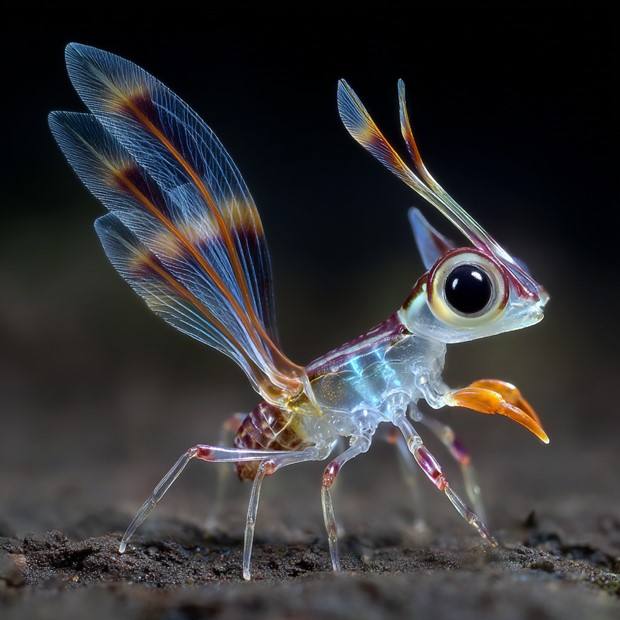
An encounter with the Glass-Tailed Mimicrab is almost never a matter of straightforward combat, as the creature is a Tier 1 prey animal that will always choose flight over fight. Instead, adventurers would cross paths with this bizarre creature through mysteries, strange commissions, or by becoming entangled in its unique and confounding survival tactics.
Accidental Encounters: The Confused & The Lost
Most encounters with a Mimicrab are accidental and are defined by confusion rather than aggression. The party is rarely in danger from the creature itself, but from the situations its mimicry can create.
- The Phantom Predator: The most common encounter begins with sound. The party is deep in a jungle when they hear the terrifying, unmistakable roar of a massive predator—perhaps even the shriek of a Griffon or the roar of a Chimeragulo Rex they have heard tales of. They might spend hours tracking the “beast” or setting up defenses, only to discover that the source of the fearsome sound is this tiny, cat-sized creature, who was trying to scare them away. The encounter becomes one of discovery and wonder, not combat.
- The Ghostly Guide: The party might be hopelessly lost in a dense forest. As their hope wanes, they begin to hear a series of out-of-place sounds from a single direction: the distant peal of a bell, the rhythmic chop of a wood axe, a snippet of a familiar folk song. Believing these to be signs of a nearby settlement, they follow the sounds. They are eventually led not to a village, but to a skittish Mimicrab that happens to live near a village and has learned its sounds. The creature becomes an unwitting guide that saves the party from being lost forever.
- The Cacophonous Clearing: Adventurers might stumble into a small clearing filled with a deafening and bizarre symphony of disconnected noises—a steam whistle, a roaring fire, a charging horse, a clap of thunder, a baby crying—all at once. This surreal cacophony is the result of two male Mimicrabs engaging in a territorial or mating dispute, using every sound in their arsenal to try and intimidate each other. The party is not in danger from the creatures, but the sheer sensory overload is disorienting and could easily attract the attention of actual predators.
Problem-Solving: The Misguided Task
Sometimes, the Mimicrab’s behavior, while harmless, is misinterpreted by locals, leading them to hire adventurers for a task that is not what it seems.
- The Haunted Grove: A superstitious village elder hires the party for what seems like a simple task: a “trickster spirit” has taken up residence in a nearby grove and is tormenting the locals by mimicking the voices of their deceased relatives or by creating sounds of ghostly weeping at night. The adventurers are hired to cleanse the grove. Their investigation will lead them not to a malevolent spirit, but to a Mimicrab that has simply learned the sounds of the nearby village. The quest then becomes a moral dilemma: do they harm the innocent creature to fulfill their contract, or do they find a clever way to relocate it and explain the true nature of the “haunting” to their employers?
- The Hunter’s Bane: A local hunter’s guild posts a bounty on a mysterious “predator” that has ruined their season. They report that every time they stalk their prey, a sudden, terrifying roar echoes through the woods, scattering all the game in the area. They believe it to be a rival monster encroaching on their territory and want it eliminated. The party will discover the “rival” is a single, clever Mimicrab that has learned that roaring sounds make all the other animals—and the hunters—go away, giving it peace and quiet.
The Deliberate Search: The Collector’s Quest
Given the creature’s beauty and unique biology, a party would be specifically hired to find one, not for its power, but for its rare components—a perfect low-risk, high-reward quest for Tier 1 adventurers.
- The Perfect Plumage: A high-society noble is having a lavish piece of art commissioned and requires the magnificent, lyre-shaped tail feathers of a Mimicrab as the centerpiece. They are willing to pay handsomely, but with a strict condition: the creature must not be killed, as harming such a gentle beast would make the prize worthless. The quest becomes a challenge of stealth and ingenuity, requiring the party to figure out how to acquire the feathers from a creature that will bolt at the slightest disturbance.
- The Alchemist’s Secret: A master alchemist believes the translucent skin of the Glass-Tailed Mimicrab holds the key to creating a true potion of transparency. They hire the party to bring them a viable, undamaged sample of the skin, providing them with non-lethal nets and sleeping darts. The challenge is not in defeating the creature, but in capturing it safely.
- The Artificer’s Crystal: An artificer or a member of a bards’ college is fascinated by the “Startle Snap” ability. They believe the creature’s large claw contains a unique resonant crystal that can amplify and release sound in an instant. They hire the party to bring back a live, healthy specimen for study, offering a large reward and providing specialized, non-lethal traps. This becomes a classic “capture, don’t kill” monster hunt, where the party’s wits are tested more than their might.
Given its skittish nature and small size, the Glass-Tailed Mimicrab is not hunted for trophies of conquest like a mighty beast. Instead, it is sought after by specialists for its rare and delicate components, which are prized for their unique applications in alchemy, artistry, and espionage. Harvesting these ingredients is a challenge of precision, not power, as a violent death can easily ruin their subtle properties.
Lyrebird Tail Feathers
The creature’s most visually stunning feature is its magnificent, lyre-shaped tail plume. These feathers are long, elegant, and possess a natural, shimmering iridescence.
- Use: These feathers are purely decorative but are considered a luxury item of the highest order. They are sought after by high-society clothiers, milliners, and artisans to be used as the centerpiece in extravagant gowns, elaborate fans, and the hats of nobles and wealthy merchants. A single, perfect tail plume can be worth more than the rest of the creature’s parts combined, simply as a symbol of status and beauty.
Sonic Crystal
Hidden within the mechanism of the large, shrimp-like snapping claw is a small, quartz-like crystal node. This is the component that generates the creature’s “Startle Snap.”
- Use: This crystal is a natural sonic amplifier. An artificer or a master jeweler can carefully extract it. When integrated into a small clockwork or magical device, it can be used to create powerful personal alarms that emit a single, deafening “POP” when triggered. Bards and musical instrument makers also value them for creating unique percussive instruments that can produce incredibly sharp, loud staccato notes.
Translucent Hide
The creature’s glass frog-like skin is thin, delicate, and loses its transparency almost immediately after death if not properly treated. It is one of the most difficult components to harvest successfully.
- Use: If a harvester is also a skilled alchemist who can place the hide in a complex preservative solution within minutes of the creature’s death, its unique properties can be saved. The preserved hide is a key and very rare ingredient for creating high-quality Potions of Transparency or for crafting the lenses of scrying orbs that are exceptionally difficult for others to detect.
Bioluminescent Organs
The faint, glowing blue organs visible through the creature’s skin can be carefully extracted and preserved.
- Use: While not powerful enough to light a room, these organs produce a continuous, cold blue light without any need for fuel. Scribes and scholars value them highly; a single preserved organ can be set into the tip of a stylus, creating a self-illuminating pen for writing in archives or at night without a candle. Alchemists can also grind them into a paste to create a glowing ink, useful for marking trails in the dark or creating subtle, luminous messages.
Mimetic Syrinx (Vocal Organ)
The source of the creature’s perfect mimicry is a complex and unique vocal organ, or syrinx, located in its throat.
- Use: This is perhaps the most valuable component for spies and information brokers. An artisan with an almost surgical skill can extract the syrinx and preserve it. When integrated into a specially designed magical or clockwork music box, the device can be “programmed” to replicate any sound the Mimicrab had heard in its life. By carefully stimulating different parts of the organ, a user can “play back” entire conversations, the sounds of a secret meeting, or the precise details of a private password, making it the ultimate passive recording device in a world without electronics.
Tear Gland Secretions
The preorbital glands beneath the creature’s large, Dik-dik-like eyes produce a clear, viscous fluid used for scent marking.
- Use: This fluid is a potent pheromonal compound that reeks of anxiety and fear. Alchemists can harvest it to create “Potions of Skittishness” or “Fear Bombs.” These concoctions, when thrown, release a scent that can make guard animals nervous and jumpy, or cause a crowd to feel a sudden, baseless sense of panic, creating an excellent diversion.
Spirit with a Borrowed Body
Before the time of now, in a great jungle, there was a small spirit. It had no name, for it had no voice of its own. It was a spirit of echoes. When a bird sang, it could sing the song back. When a branch cracked, it could make the crack-sound again. But it could not make its own sound. It was lonely to be only a copy.
In this jungle lived four creatures of great pride. Each had one great thing, and they made a boast of it all day long.
The first was a Swift-Leg Deer. He would run in circles and say, “See my legs! They are the fastest things! No one can run like me!”
The second was a Lyre-Feathered Bird. He would fan his great tail and say, “See my tail! It is the most beautiful thing! All the world must look at me!”
The third was a Frog of Crystal Skin. He would sit by the water and say, “See my skin! It is so clear you can see my honest heart inside! I have no secrets!”
The fourth was a Shrimp with a Thunder-Claw. He would snap his great claw and make a sound like a breaking stone. He would say, “Hear my claw! It is the loudest thing! My power is the greatest power!”
The little echo-spirit heard these boasts. All day, the boast of speed, the boast of beauty, the boast of honesty, the boast of power. And the spirit grew sad. It went to the Old Man of the Woods, who was resting as a mossy stone. The spirit made an echo of a sad wind. It said, “Old Man, I have no great thing. I have no legs, no tail, no skin, no claw. I am only an echo. I wish to be a real creature.”
The Old Man of the Woods opened one eye of slow-moving bark. He said, “One great thing is a heavy rock to carry. It makes you forget all other things. But if you wish for a body, you must borrow the pieces from those who have too much pride in them.”
So the spirit went to the Swift-Leg Deer. It made an echo of the deer’s own proud words. “Your legs are so fast,” said the echo-spirit. “Could I borrow just the shape of them, so I too may know speed?” The deer was so full of pride he said yes. And the spirit was given small, swift legs.
Then the spirit went to the Lyre-Feathered Bird. “Your tail is so beautiful,” said the echo-spirit. “Could I borrow just the shape of it, so I too may know beauty?” The bird was so vain he said yes. And the spirit was given a great tail of feathers.
Then the spirit went to the Frog of Crystal Skin. “Your skin is so honest,” said the echo-spirit. “Could I borrow just the feeling of it, so I too may be true?” The frog was so lazy he said yes. And the spirit was given a skin that was clear as water.
Then the spirit went to the Shrimp with a Thunder-Claw. “Your claw is so powerful,” said the echo-spirit. “Could I borrow just a tiny piece of its great sound?” The shrimp was so arrogant he said yes. And the spirit was given one great claw.
The spirit went back to the Old Man, and it had a body of borrowed parts. It was now a real creature. But then a great danger came to the forest. A monster of fire and shadow.
The Swift-Leg Deer tried to use his great thing. He ran fast across the open ground. But the danger was faster, and it caught him.
The Lyre-Feathered Bird tried to use his great thing. He fanned his beautiful tail to awe the danger. But the danger did not care for beauty, and it caught him.
The Frog of Crystal Skin tried to use his great thing. He sat still to show his honest heart. But the danger did not care for honesty, and it caught him.
The Shrimp with a Thunder-Claw tried to use his great thing. He made his loudest thunder-sound. But the danger was louder, and it caught him.
The new little creature, the one with all the borrowed parts, was filled with a great fear. It did not try to be fast, or beautiful, or honest, or loud. It used the one thing that was its own. It used its echo-voice. It heard the roar of the great danger, and it made the same roar back. The danger was confused. It thought there was another monster like it nearby. While the danger was confused, the little creature used its borrowed fast legs to run, not in the open, but into the deep woods. It used its borrowed clear skin to hide behind a leaf. And when the danger came close one last time, it used its borrowed claw, not to make a great thunder, but one tiny, surprising pop of sound. And in that moment, it was gone.
The little creature, the Glass-Tailed Mimicrab, survived. The great ones did not. And it learned that its own small, clever spirit was the most important part of its body.
The Moral of the Story: One great piece of pride can be a weakness, but many small pieces of cleverness will always be a strength.
Suggested conversions to other systems:
Call of Cthulhu
The Forest Echo
A bizarre and elusive creature of the deep woods, the Forest Echo is more a source of mystery and confusion than a physical threat. It is a biological curiosity whose perfect mimicry can lead Investigators astray, creating phantom sounds of other, more dangerous entities, or mimicking the voices of lost companions to lure search parties into natural hazards. Encounters with it are rarely dangerous due to the creature itself, but because of the maddening situations its abilities can create.
Statistics: STR 15, CON 25, SIZ 10, DEX 80, INT 25, POW 50 HP: 3
Damage Bonus: -2 Build: -2 Move: 10
Attacks
- Fighting (Brawl): 25%, deals only minimum damage (a panicked flail).
- Dodge: 40%
Armor: None.
Spells: None.
Skills: Stealth 70%, Listen 60%.
Sanity Loss: 0 Sanity points to see the creature itself. However, hearing it perfectly mimic the voice of a dead or lost companion may require a Sanity roll (0/1d2 SAN loss).
Special Abilities:
- Supernatural Mimicry: The Forest Echo can perfectly replicate any sound it has heard, from a complex mechanical noise to a human voice. The Keeper can use this to create false leads, auditory illusions, and red herrings to complicate an investigation.
- Startling Pop: If an Investigator moves within 5 yards of the creature or attempts to grab it, the Forest Echo can use its large claw to create a deafening “pop” and a flash of light. All Investigators within that range must succeed on a POW roll or be stunned, unable to act for one round. The creature will use this opportunity to flee.
- Translucent Skin: The creature’s semi-transparent skin gives it one bonus die on all Stealth rolls when in dappled light, foliage, or shallow water.
Blades in the Dark
The Whisper-Weed An Elusive, Desired Prize for Collectors and Spies
The Whisper-Weed is not a threat; it is a resource. A small, skittish creature that lives in the forgotten greenhouses of the wealthy or the strange fungal gardens beneath the city. Its ability to perfectly replicate sounds makes it an invaluable tool for espionage. Most scores involving a Whisper-Weed are about capture and containment, not combat.
- Threat Level: A Tier 0 creature. It is an objective, not an opponent.
- Drives: To hide, to eat flowers, to escape.
- Qualities:
- Perfect Mimic: Can replicate any sound it hears.
- Startling Pop: Can create a disorienting flash and sound to aid its escape.
- Translucent & Skittish: Extremely difficult to spot and catch.
- Game Mechanics:
- Objective: A typical job might be a 6-segment clock: “Capture the Whisper-Weed for the Hive.” Progress would be made through Prowl, Finesse, or Study actions, not combat.
- As Gear: If a crew manages to capture and keep one, it can be used as a piece of Subterfuge Gear. Once per score, they can use it to create a perfect auditory distraction. The player tells the GM what sound the creature makes and where, which can help Create a Diversion or improve the position for a subsequent action.
- As a Complication: If a PC tries to grab the creature without proper care, the GM can inflict a consequence like Deafened, Stunned, or Dropped your Gear as the creature uses its Startle Pop and flees.
Dungeons & Dragons
Lyrebark Trickster Tiny beast, unaligned
Armor Class 13 Hit Points 2 (1d4) Speed 40 ft.
Ability Scores: STR 3 (-4), DEX 16 (+3), CON 10 (+0), INT 3 (-4), WIS 12 (+1), CHA 14 (+2)
Skills Perception +3, Stealth +7 Senses passive Perception 13 Languages — Challenge 0 (10 XP)
Translucent Camouflage. The Lyrebark Trickster has advantage on Dexterity (Stealth) checks made to hide in terrain with ample obscuration like forests or jungles.
Mimicry. The Lyrebark Trickster can mimic any sound it has heard. A creature that hears the sounds can tell they are imitations with a successful DC 14 Wisdom (Insight) check.
ACTIONS
Startle Snap. Each creature within 5 feet of the Lyrebark Trickster must succeed on a DC 11 Constitution saving throw or be blinded and deafened until the end of its next turn. Immediately after using this ability, the Trickster can move up to half its speed as a reaction without provoking opportunity attacks.
The Lyrebark Trickster has no effective attacks.
Knave
Glass Antelope A tiny, timid chimera that mimics sounds to avoid danger.
HD 1/2 (1 HP); AC 14; Morale 2 Attack: None.
- Mimicry: Can perfectly imitate any sound it has heard. It is a tool for the GM to create confusing situations, false alarms, or clever clues.
- Startle-Pop: If a character moves adjacent to it, the Glass Antelope uses its reaction to create a loud pop and a flash of light. The character must make a DC 14 Constitution save or be stunned and unable to act for one round. The Glass Antelope will always use this round to flee.
- Translucent: Has advantage on all saves made to hide in natural environments.
- Skittish: Will attempt to flee from any perceived threat. It cannot be domesticated or tamed.
Fate
The Forest’s Echo
The Forest’s Echo is not an antagonist to be fought, but rather a living, breathing part of the environment. It does not have stress tracks or skills in the traditional sense. Instead, the GM can use its aspects and stunts to add texture, mystery, and complications to a scene.
- Aspects: Perfect, Unthinking Mimic, Skittish Prey Animal, Translucent Forest Phantom
Stunts (GM-Controlled):
- The Sound of Danger: The GM can spend a Fate Point to have the Forest’s Echo perfectly mimic the sound of a major threat (a monster’s roar, a troop of soldiers, a crackling fire). This places a discoverable Situation Aspect on the scene, such as Terrifying Roar Over the Next Hill, which can create a false lead, build tension, or misdirect the players.
- Startle Pop: If a character gets too close to the Forest’s Echo or attempts to capture it, the GM can declare that it uses its Startle Pop. The character must succeed on an Overcome action with a Fair (+2) Physique roll or accept the temporary aspect Deafened and Seeing Stars. The Forest’s Echo then immediately vanishes into the undergrowth.
- Unwitting Guide: A character can attempt to Create an Advantage by using their Lore or Investigate skill to interpret the strange, out-of-place sounds the creature is making. A success might reveal an aspect like Sounds of a Smithy to the North, as the creature mimics the sounds of a hidden settlement it lives near.
Numenera & Cypher System
The Vitreous Mimic
This creature is a bizarre, bio-engineered life form from a prior world, a kind of living recording device that has gone feral and integrated itself into the ecosystem. It is harmless but exceptionally difficult to approach or capture.
- Level: 2 (due to its speed and defensive abilities, not its combat prowess)
- Health: 6
- Damage: 1 point (a panicked hoof strike).
- Movement: Long (when fleeing).
- Modifications: Stealth tasks as level 5 due to its translucent skin and mimicry.
- Combat: The Vitreous Mimic will always flee from combat if possible. If it is cornered or grabbed, it will use its Startle Snap as its action. All creatures in immediate range must make a Speed defense roll (difficulty 2). Those who fail are dazed for one round, unable to act as their senses are overwhelmed by a deafening pop and a flash of light. The Vitreous Mimic uses this opportunity to flee.
- Interaction: The creature’s mimicry can be a source of information. A character can make an Intellect-based task (difficulty 3) to try and identify the sounds it’s making or notice their artificial quality. A success might reveal that the “raging beast” it’s mimicking isn’t native to this ecosystem, providing a clue that something is amiss.
- GM Intrusion: A character thinks they are expertly tracking a dangerous beast by the sounds it is making. The GM can intrude and reveal they’ve actually been following a Vitreous Mimic for an hour, and are now hopelessly lost in the jungle.
Pathfinder
GLASS-TAILED ECHO-FAWN — CREATURE -1 N TINY ANIMAL BEAST
This incredibly shy and delicate creature lives in the deepest, most secluded forests. It is known for its startling ability to perfectly mimic any sound it hears, and for its translucent skin that makes it seem to vanish in the dappled light of the jungle.
- Perception +7
- Skills Acrobatics +7, Stealth +9, Performance +6 (for mimicry)
- Str -4, Dex +4, Con +0, Int -4, Wis +2, Cha +1
AC 15; Fort +2, Ref +9, Will +5 HP 8
- Translucent Skin In any environment with foliage or natural cover, the echo-fawn is concealed.
ACTIONS
Speed 40 feet The echo-fawn has no effective melee attacks.
Vocal Mimicry The echo-fawn can perfectly imitate any sound it has heard. This is a deception effect with a DC of 18 for a creature to determine it is a mimicry.
Startle Snap [one-action] (auditory, visual); Frequency once per 10 minutes; Effect The echo-fawn snaps its large claw, producing a flash and a deafening pop. Each creature in a 5-foot emanation must attempt a DC 16 Fortitude save.
- Success The creature is unaffected.
- Failure The creature is deafened and dazzled for 1 round.
- Critical Failure The creature is stunned 1.
Fleet Escape [reaction] Trigger The echo-fawn uses Startle Snap; Effect The echo-fawn Strides up to its full speed. This movement does not trigger reactions.
Savage Worlds
The Lyre-Frog Deer A small, skittish chimera of the deep woods, this creature is a master of sound and evasion. It is a prized, if frustrating, quarry for collectors and naturalists.
Attributes: Agility d10, Smarts d6(A), Spirit d8, Strength d4, Vigor d6 Skills: Athletics d10, Notice d8, Performance d10, Stealth d10 Pace: 10; Parry: 2; Toughness: 4
Hindrances: Skittish (Major), Timid (Major) Edges: Fleet-Footed
Special Abilities:
- Mimicry: The Lyre-Frog Deer can perfectly replicate any sound it has heard. This can be used as a Test with its Performance skill against a target’s Smarts. Success can make the target Distracted or Shaken (due to a terrifying sound).
- Sonic Pop: As an action, the creature can snap its claw. All adjacent characters must make a Vigor roll. Those who fail are Distracted and Shaken.
- Small: Attackers suffer a -2 penalty to attack rolls against this creature due to its size.
- Translucent Hide: In any natural, vegetated environment, attackers suffer an additional -2 penalty to attack rolls against the creature as it seems to fade into the background.
Shadowrun
Evo “Whisper-Fawn”
A designer paracritter developed by Evo’s “Zoological Artistry” division, the Whisper-Fawn was intended to be the ultimate exotic pet for the corporate elite. Its docile nature, bizarre beauty, and ability to mimic the owner’s voice made it a status symbol. However, they proved impossible to domesticate, and escaped specimens have now gone feral in the high-end arcology bio-domes and corporate-owned terraformed enclaves. They are not dangerous, but are highly sought after by collectors and bio-trackers.
- Attributes:
- Body: 2
- Agility: 5
- Reaction: 5
- Strength: 2
- Willpower: 3
- Logic: 2(A)
- Intuition: 4
- Charisma: 3
- Edge: 4
- Magic: 6
- Initiative: 9 + 2d6
- Matrix Initiative: N/A
- Astral Initiative: N/A
- Condition Monitor (P/S): 9 / 10
- Skills: Athletics 5, Perception 4, Stealth 6.
- Powers:
- Concealment (Self): The Whisper-Fawn’s translucent skin gives it a form of active camouflage, imposing a -4 dice pool modifier on all Perception tests to spot it in natural or dimly lit environments.
- Mimicry: The Whisper-Fawn can perfectly replicate any sound it hears, from speech to the sound of a gunshot.
- Sonic Burst: If cornered, the creature can snap its large claw, creating a powerful sonic burst. It makes an opposed test using its Magic + Willpower against the Willpower + Intuition of all characters within 5 meters. Anyone who loses the test is deafened and disoriented, suffering a -2 dice pool modifier to all actions for one combat round. The Whisper-Fawn will use this opportunity to escape.
Starfinder
Phonic Glade-Hopper CR 1/3 XP 135 N Tiny animal Init +4; Senses low-light vision; Perception +8
DEFENSE HP 6 EAC 14; KAC 15 Fort +1; Ref +5; Will +2 Defensive Abilities Translucent Hide
OFFENSE Speed 40 ft. Melee hoof +3 (1d4-1 B nonlethal)
STATISTICS STR -2; DEX +4; CON +0; INT -4; WIS +1; CHA +2 Skills Acrobatics +8, Stealth +13
ECOLOGY Environment temperate or warm forests and jungles Organization solitary or pair
SPECIAL ABILITIES
- Vocal Mimicry (Ex) A phonic glade-hopper can perfectly replicate any sound it has heard. A creature can identify the sound as a mimicry with a successful DC 16 Wisdom (Insight) check.
- Startle Flash (Ex) As a standard action, the phonic glade-hopper can snap its large claw, creating a blinding flash and deafening pop. Each creature within a 10-foot radius must succeed at a DC 11 Fortitude save or be blinded and deafened for 1 round. After using this ability, the creature can immediately take a guarded step as a reaction.
- Translucent Hide (Ex) In any area of natural foliage, the phonic glade-hopper has concealment (20% miss chance).
Traveller
Virushi Sound-Mirror Beast
A small, herbivorous creature native to the dense, high-gravity jungles of the planet Virush (Solomani Rim). It is known throughout the sector for its two unique biological traits: a form of cellular translucence that makes it exceptionally difficult to see, and a complex vocal system capable of perfect auditory mimicry. It is a prime example of a prey animal that has evolved purely defensive, non-violent survival mechanisms.
- UPP: 3A4121
- Skills: Recon-1, Stealth-2
- Attacks: None (will not fight).
- Armor: 0.
- Traits:
- Mimicry (Audio): The creature can replicate any sound or voice it has heard with perfect fidelity. A character must make a Difficult (10+) Recon check to identify the sound as a mimicry.
- Sonic Stunner: If a character moves adjacent to the creature, it can snap its oversized claw. This forces the character to make a Difficult (10+) Endurance check or be stunned for one round, unable to take any actions as they are deafened and disoriented.
- Natural Camouflage: The creature’s semi-transparent hide imposes a DM-2 penalty on any check to spot it in its native jungle environment.
- Skittish: The creature will flee from any perceived threat.
Warhammer Fantasy Roleplay
Athel Loren Echo-Fawn A creature of fey-stuff and illusion, the Echo-Fawn is said to be a spirit of the deep forest given physical form. It is a shy, gentle beast that embodies the magic of Athel Loren, rarely seen by outsiders. Its appearance is considered a good omen by the Asrai (Wood Elves), but its disembodied, mimicked calls can be deeply unsettling to humans and Dwarfs.
Main Profile M 8, WS 15, BS 0, S 10, T 15, I 45, Ag 55, Dex 40, Int 10, WP 35, Fel 25 Wounds: 6
Traits: Armour (0), Fear (0), Skittish, Size (Tiny), Stealthy (Forest), Tracker Talents: Flee!, Mimic
Attacks:
- Tiny Hoof: WS 15, Damage S+0. The creature will never willingly attack.
Special Rules:
- Ethereal Skin: The creature’s skin is semi-transparent and shifts with the light. All ranged and melee attacks targeting the Echo-Fawn suffer a -20 penalty.
- Startling Pop: As an Action, the Echo-Fawn can snap its large claw. All characters within 4 yards must make a Challenging (+0) Endurance Test or gain 1 Stunned Condition from the blinding flash and deafening sound. The Echo-Fawn will then immediately use its Flee! talent to escape.
- Perfect Mimicry: The Echo-Fawn possesses the Mimic talent and can replicate any sound it hears with unnerving accuracy, from the speech of a specific person to the clang of a blacksmith’s hammer. It does not understand the sounds it makes.