
- Original Life Forms:
- Class Chondrichthyes: Great White Shark (Carcharodon carcharias)
- Class Hydrozoa: Portuguese Man o’ War (Physalia physalis)
- Class Insecta: Bombardier Beetle (Brachininae subfamily)
- Class Cephalopoda: Giant Squid (Architeuthis dux)
Appearance
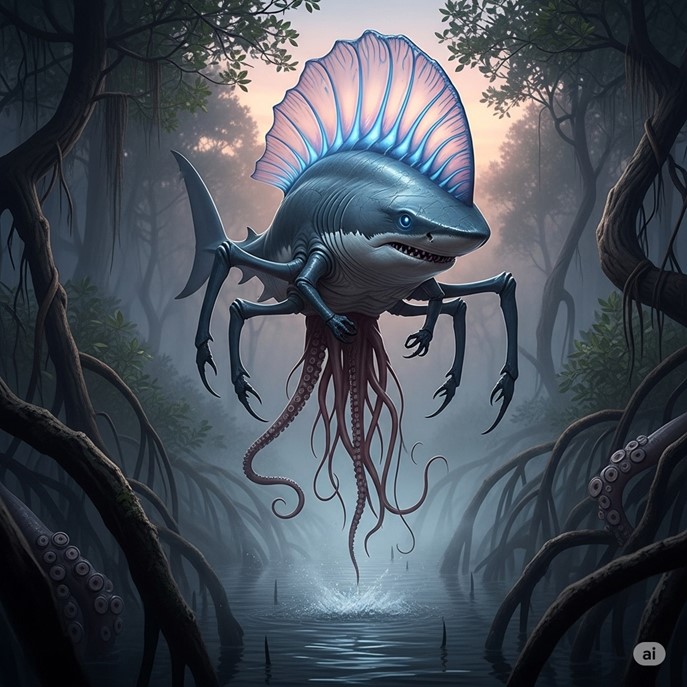
The Chondro-vela 77 is a terrifying amalgam of marine and terrestrial life. Its core body is that of a large, powerful shark, approximately 12 to 15 feet long, with smooth, grey, counter-shaded skin. Instead of fins, it possesses six jointed, chitinous legs like those of a massive beetle, allowing it to move on land with an unsettling skittering motion. Rising from its back is a large, translucent, and iridescent gas-filled bladder, similar to the sail of a Man o’ War. This bladder pulses with a soft, internal bioluminescence and allows the creature to hover and drift silently through the air. Trailing from its underside is a nightmarish curtain of dozens of long, prehensile tentacles. Some are thick and muscular like a squid’s, equipped with suckers, while others are thin, nearly invisible, and packed with potent stinging nematocysts. Its head is shark-like, but its eyes are the vast, intelligent, and eerily expressive orbs of a giant squid, glowing with a cold, blue light.
Size
- Length: 12 – 15 feet (excluding tentacles)
- Height: 4 – 6 feet at the shoulder; 8 – 10 feet to the top of the sail
- Weight: 1,800 – 2,500 lbs
Speed
- Swimming: Very Fast. It uses its powerful shark-like body to move through water with incredible speed and agility.
- Land: Moderate. Its six insectoid legs allow for a steady, if somewhat clumsy, skittering gait across most terrain.
- Hovering: Slow. It uses its dorsal sail to catch breezes and magical currents, allowing it to drift silently and hover several feet off the ground.
Stat Modifiers
- Strength: +3
- Dexterity: +0 (-2 on land, +2 in water/air)
- Constitution: +4
- Intelligence: -3
- Wisdom: +1
- Charisma: -4
Skills
- Perception: Excellent. It combines the shark’s ability to sense minute electrical fields in water with the giant squid’s highly developed eyesight.
- Stealth: High (in water and while hovering), Low (on land).
- Athletics: Excellent (for swimming and grappling with tentacles).
- Intimidation: Innately high due to its monstrous form.
Behavior
The Chondro-vela 77 is a solitary ambush predator. It leverages its multiple modes of movement to hunt. A common tactic is to use its sail to hover silently within the dense canopy of a swamp or jungle, its stinging tentacles dangling invisibly towards the ground. When prey passes beneath, it drops, ensnaring the victim and dragging it to a secluded waterway to be devoured. It is highly territorial, marking its domain with a noxious chemical spray released from its rearmost pair of legs, a trait inherited from the bombardier beetle. This spray is also its primary defensive mechanism on land, creating a boiling, steaming cloud to deter attackers.
Diet
Strictly carnivorous. Its diet consists of anything it can catch, from large fish and marine mammals in the water to deer, wild boar, and unlucky adventurers on land. It is an indiscriminate and opportunistic feeder.
Emotions
As a feral creature, its emotional range is limited to primal states. Aggression is displayed by flaring its dorsal sail to its full size, causing the bioluminescent colors to shift rapidly from blue to a threatening violet. Its tentacles writhe and its chitinous legs produce a loud chittering sound. When hunting or curious, it is unnervingly silent, with only a slow, gentle pulsing of light from its sail and eyes.
Environment Where Found
The Chondro-vela 77 thrives in temperate and tropical coastal regions, particularly mangrove swamps, large jungle river deltas, and mist-shrouded archipelagos. It requires an environment with immediate access to both deep water and dense land cover to effectively utilize its unique hunting strategies. They are commonly found along the treacherous coasts of the Chavín Hegemony and in the murky bayous beyond Carthaginian control.
Tags
Feral, Magical Beast, Predator, Amphibious, Hover, Chitinous, Bioluminescent, Venomous, Abomination, Solitary, Territorial, Chimera, Carnivore, Electrosensitive, Caustic Spray, Tentacled, Coastal, Swamp-dweller, Ambush Predator
Life Cycle
The life cycle of a Chondro-vela 77 is a solitary and alien process, reflecting its chimeric nature. They do not age or die in a conventional sense.
- Reproduction (Budding): The Chondro-vela reproduces asexually. When an adult has reached a certain age and mass, and has an abundance of food, it seeks out a secluded, magically resonant underwater cavern. There, it anchors itself to a surface, and a biological “bud” begins to form on its flank. This process, which can take several months, is a huge drain on the parent’s energy, during which it is extremely aggressive and guards the bud with its life.
- Larval Stage: The bud eventually detaches as a larval Chondro-vela, roughly the size of a large dog. This juvenile form is purely aquatic; its insectoid legs are weak and its dorsal sail is small and not yet inflated. It is a silvery, translucent creature that hunts small fish and crustaceans in the relative safety of mangrove roots or reef systems, using its underdeveloped tentacles.
- Adolescence: After two to three years, the juvenile undergoes a significant metamorphosis. Its sail inflates with the magically-generated gas, its legs strengthen to allow for terrestrial movement, and its skin darkens to the adult’s grey hue. At this point, it is driven by instinct to leave its nursery and find its own territory, a perilous journey where it must avoid adult members of its own species.
- Maturity and Decline: The creature is considered a mature adult once it reaches its full size, usually within ten years. It will then hunt and defend its territory for several decades. After budding two or three times over its life, the parent creature enters a state of decline. Its body, weakened by the immense energy expenditure of reproduction, becomes sluggish and its healing slows. It inevitably falls prey to a younger, stronger rival or a mob of other powerful creatures. Their lifespan is estimated to be between 40 and 50 years.
Mating
As asexual reproducers, the Chondro-vela 77 has no concept of mating. There is no courtship, no pairing, and no social interaction between adults beyond violent territorial disputes. The reproductive cycle is a solitary, instinct-driven event triggered by a combination of age, resource availability, and environmental magic levels. An adult will never interact with its offspring; by the time the larval bud detaches, the parent has already abandoned the nursery cavern to continue its own cycle of hunting.
Tactics
The Chondro-vela 77 is an intelligent and adaptable ambush predator that masterfully exploits its unique physiology.
- Aerial Ambush: Its most terrifying tactic involves using its sail to hover silently and nearly invisibly within the high canopy of a jungle or swamp. It dangles its long, stinging tentacles down towards a game trail or riverbank, sometimes for hours at a time. When prey passes underneath, it can either drop its entire body onto the target or simply retract the tentacles, pulling the victim up into the canopy to be killed and consumed without a struggle.
- Aquatic Lunge: When hunting in murky water, it will patrol just beneath the surface, using its electrosensitive senses to detect the movements of creatures on the shore. It will then erupt from the water in a devastating lunge, using its powerful jaws and grappling tentacles to drag prey back into the depths.
- Defensive Spray: When confronted on open ground where it is most vulnerable, its primary tactic is defensive. It will flare its sail and hiss aggressively before unleashing its Caustic Burst. This boiling, noxious cloud is not intended to kill but to blind, disorient, and choke its enemies, allowing the Chondro-vela to skitter away to the safety of water or dense cover.
Actions
In a combat scenario, a Chondro-vela 77 might perform the following actions:
- Multi-attack: The creature makes one Bite attack and one Tentacle Lash attack.
- Bite: A melee attack using its powerful shark-like jaws to inflict severe piercing damage.
- Tentacle Lash: A melee attack with a long reach. On a hit, it inflicts bludgeoning damage, and the target is grappled. A grappled creature is subject to the Nematocyst Sting.
- Nematocyst Sting: Any creature that starts its turn grappled by the Chondro-vela’s tentacles is automatically stung by the thousands of venomous nematocysts, inflicting potent poison damage and potentially causing paralysis.
- Caustic Burst (Rechargeable): The creature exhales a 30-foot cone of boiling, alchemical fluid from specialized glands near its rearmost legs. All creatures in the area suffer immediate acid and fire damage. The area is also heavily obscured by a noxious, steaming cloud for a short time.
- Silent Drift (Movement): When hovering, the creature can move slowly through the air. This movement is unnervingly silent and does not provoke attacks of opportunity.
Other Interesting Information
- Bioluminescent Communication: The light that pulses within its sail and large eyes is its only form of communication. A slow, steady blue pulse indicates a passive or hunting state. A rapid, flashing violet pulse signals extreme aggression or territorial defense. A soft, inquisitive green pulse has been observed when it is investigating a new or unusual object.
- Alchemical Value: The Chondro-vela is a mobile treasure trove for high-tier alchemists and enchanters. The gas within its sail can be harvested to create powerful levitation potions. The venom from its nematocysts is a key ingredient in paralysis poisons. The glands that produce its caustic spray can be used to craft alchemical bombs.
- Symbiotic Remoras: Often, small, magically-resistant creatures can be seen clinging to the Chondro-vela’s hide or swimming among its non-stinging tentacles. These symbionts clean the creature’s tough skin of parasites in exchange for protection and scraps from its meals.
Male and Female versions of the Chondro vela 77

An adventuring party in the world of Saṃsāra would cross paths with a monstrous Chondro-vela 77 for a variety of reasons, ranging from high-stakes, deliberate hunts to terrifying accidental encounters. Given the creature’s ferocity, territorial nature, and the unique value of its biological components, interaction with one is never a trivial matter.
Deliberate Hunts and Bounties
Parties may be actively hired to seek out and engage a Chondro-vela 77, missions that are only ever offered to seasoned, high-tier adventurers due to the immense risk involved.
- The Alchemist’s Grand Commission: The most common reason to hunt a Chondro-vela is for its incredibly rare alchemical and enchanting components. A master enchanter in a metropolis like Carthage’s Kad-Vira might post a bounty requiring specific parts. The gas from its dorsal sail could be the only known reagent for crafting permanent levitation gear for an airship. The potent venom from its nematocysts might be essential for creating a powerful paralysis-curing antidote. The glands that produce its caustic spray could be needed to forge unique alchemical weapons for a nation’s military. In these cases, the party is not just tasked with killing the beast, but with carefully harvesting its valuable parts without destroying them.
- A Matter of Security and Commerce: A Chondro-vela 77 that establishes its territory too close to a vital waterway can cripple local trade. A Carthaginian merchant consortium or a local governor would pay handsomely to have the “Swamp Chimera” eliminated. If fishing vessels are being destroyed or cargo barges are disappearing in a specific river delta, a party would be hired to put a stop to the threat, clearing the way for safe commerce to resume.
- The Shaman’s Rite of Balance: An encounter might be initiated not for profit, but for spiritual reasons. The shaman-priests of the Chavín Hegemony might view a Chondro-vela as a powerful but “unbalanced” spirit of the natural world. If one becomes overly aggressive and disrupts the ecosystem of a sacred jungle, a party might be sought out by the reclusive priests. Their goal might not be to kill the creature, but to perform a dangerous ritual to “cleanse” or pacify it, or to simply drive it from the territory. This would require the adventurers to subdue the beast without killing it—a far greater challenge.
Accidental and Incidental Encounters
More often than not, a party will encounter a Chondro-vela 77 not because they were looking for it, but because their own quest has led them into its deadly domain.
- The Perilous Shortcut: The party may be on a time-sensitive mission, such as delivering an urgent message or pursuing a fleeing enemy. Ignoring local warnings about the “Hovering Death,” they decide to take a shortcut by raft or skiff through a notoriously dangerous mangrove swamp. What begins as a time-saving measure quickly devolves into a desperate survival scenario as they realize they are being stalked by a silent predator from the canopy above, turning their journey into a running battle to escape the creature’s territory.
- The Lair in the Ruins: Many forgotten ruins and temples are located in remote, monster-infested jungles and swamps. An adventuring party seeking an ancient artifact, a piece of lost lore, or simply exploring a newly discovered ruin might find that a Chondro-vela 77 has made the ruin’s central flooded chamber or subterranean waterway its lair. The creature, having existed there for years, now serves as an unintentional and highly effective guardian. The party must then figure out how to get past the monster to reach their objective, either through direct combat, stealth, or some clever diversion.
- The Wrong Quarry: A quest might lead the party to believe they are hunting something else entirely. They could be hired to track down a band of pirates who have been raiding ships in a coastal maze of islands. Following the trail of wreckage, they venture deeper into the pirates’ supposed territory, only to find the pirates’ own wrecked vessels. They soon discover the true culprit is not human at all, but a Chondro-vela 77 that has been preying on anyone foolish enough to enter its hunting grounds. Their pirate-hunting mission instantly becomes a desperate fight against a monster far more dangerous than they were equipped to handle.
Beyond the previously mentioned bounty items like the dorsal sail gas, nematocyst venom, and caustic glands, the corpse of a Chondro-vela 77 is a treasure trove of rare and powerful reagents for skilled artisans, enchanters, and alchemists. Almost every part of its chimeric body can be repurposed.
From its Shark Anatomy
- Chondro-vela Teeth: The creature’s numerous serrated teeth are unnaturally dense and sharp. When harvested, they can be fashioned into exceptionally potent arrowheads, dagger blades, or spear tips. Weapons crafted from these teeth are known to inflict grievous wounds that bleed profusely and are magically difficult to close.
- Cartilaginous Spine: The creature’s skeleton is not bone, but a flexible and incredibly durable cartilage. When ground into a fine powder, it is a key ingredient in alchemical potions that grant temporary resistance to bludgeoning damage or allow the imbiber to contort their body in unnatural ways. Larger sections can be carefully shaped by master armorers into lightweight, resilient shield cores.
- Hyper-oxygenated Blood: The creature’s blood is a bizarre, dark purple slurry capable of carrying immense amounts of oxygen to fuel its powerful body. When carefully filtered and stabilized, it can be used to create Potions of Waterbreathing or Potions of Incredible Stamina, allowing the user to perform strenuous physical activity for hours without tiring.
- Tough Dermal Hide: The shark-like skin is rough and exceptionally durable. When properly tanned, it becomes a material known as “Abyssal Leather.” This hide is naturally water-resistant and offers superior protection against slashing attacks. It is highly sought after for crafting waterproof boots, gauntlets, and reinforcing conventional armor.
From its Cephalopod Aspects
- Ocular Lenses: The massive, squid-like eyes of the Chondro-vela contain crystalline lenses, some as large as dinner plates. If extracted without shattering, these lenses are peerless components for scrying. A skilled artificer can set them into a navigator’s spyglass to see through dense fog or into an oracle’s device to pierce magical illusions.
- Bioluminescent Ink Sac: The creature possesses a large ink sac, but its ink is not merely for obscuring vision. It is a thin, bioluminescent fluid that glows with a cold, blue light. When used as a medium for writing magical scrolls or inscribing runes, it makes the resulting magic harder to identify and counter. It can also be used in potions that temporarily suppress the target’s own magical aura, making them harder to detect by magical means.
- Nerve Clusters: The complex nerve bundles that control the creature’s many tentacles are saturated with magical energy. These can be carefully harvested and preserved. They are used in the creation of high-level enchanted gloves that enhance the wearer’s dexterity or in the crafting of magical whips that can move with a semblance of their own volition.
From its Insectoid and Hydrozoan Parts
- Chitinous Leg Plates: The six insectoid legs are covered in thick plates of dark, iridescent chitin. This material is lighter than steel but nearly as strong, and it is naturally resistant to acid and heat due to its proximity to the caustic glands. It is a prized material for crafting articulated plate armor, vambraces, and greaves that offer protection from both physical and elemental attacks.
- Articular Sinew: The powerful sinews that operate the creature’s complex leg joints are incredibly elastic and strong. They are prized by bowyers for use as bowstrings on powerful composite longbows, allowing for a much greater draw weight and power.
- Stinging Tentacle Barbs: While the venom is valuable, the microscopic nematocyst barbs themselves can be harvested from the thin, stinging tentacles. Alchemists can embed these barbs into oils or unguents. When applied to a weapon, this substance ensures that even a glancing blow delivers the venom directly into the target’s bloodstream.
Folly of Sunken Alchemists
It is known from fragments of water-damaged scrolls that in an age before the present age, there was a city that now has no name. It was a city of glass domes and brass towers, built not on solid ground but amidst the deep and winding mangrove swamps. Here dwelled a cabal of alchemists, men and women of great power and greater pride. They believed that the forms of life given by the world were but rough drafts, and that with their knowledge, they could create perfected beings. They sought to build the ultimate guardian, a creature that could master the three realms: the water below, the land between, and the air above.
So it was that they began their great and terrible work. From the deep sea, they captured the essence of the Great Shark, for its might and its unceasing hunger. From the crawling things of the earth, they took the spirit of the Armored Beetle, for its chitinous resilience and its caustic fire. From the sunlit surface of the ocean, they harvested the soul of the Floating Sail, for its silent grace and its venomous touch. And from the abyssal dark, they wrested the mind of the Kraken-Squid, for its cold intelligence and its grasping arms.
These four great spirits they placed in a vast vat of shimmering, life-giving fluid. They chanted words of power that are now forbidden and drew down the light of the moons with lenses of polished crystal. They sought to weave the four spirits into a single, harmonious being. Local folk, those who lived in tune with the swamp, came to them and warned them. They said, “A single thread can be woven into a tapestry. But four threads that wish to go in four directions will only create a knot of chaos.” The alchemists, in their arrogance, laughed and sent the swamp-folk away.
For a time, it seemed their work was a grand success. A form took shape in the vat, a creature of terrifying symmetry. It had the sleek, powerful body of the shark, the jointed legs of the beetle, the luminous sail, and the wise, knowing eyes of the squid. The alchemists rejoiced, for they had made a thing of unmatched power. They prepared the final ritual, the one that would bind the creature to their will and make it their eternal servant.
But when they spoke the words of binding, they did not find a single mind to command. They found four warring souls trapped within a single prison of flesh. The creature awoke, not as a servant, but as an abomination. The unceasing hunger of the shark was enraged by the cold patience of the squid. The venomous grace of the sail was maddened by the earthy fire of the beetle. It was a being at war with its own heart.
And so it turned its warring fury upon its creators. The first Chondro-vela rose from the great vat. Its jaws snapped with the might of the deep sea. Its tentacles lashed out with the venom of the surface. Its chitinous legs carried it through the brass halls, and from its rearmost limbs, it sprayed the beetle’s caustic fire, boiling the air and melting the glass domes. The city of the alchemists became a charnel house. The creature, in its rage, destroyed the foundations of the towers, and the entire city, a monument to hubris, sank forever into the black and murky water of the swamp.
The first Chondro-vela escaped into the wild, a solitary monster born of broken harmony. The magic that made it was flawed, and it could not mate. Instead, its own flesh remembered the agony of its birth. In time, it would find a secluded place and its body would bud, creating a new, smaller copy of its own torment, another warring soul given form. And so it is to this day. The creatures that haunt the coastal swamps are the children and the children’s children of that first abomination, each one a living testament to the folly of the Sunken Alchemists.
Moral: To combine many strengths is not always to create a greater strength. A crown made of four different metals will never be as pure as one, and a soul made of four warring beasts will only know how to wage war upon itself and the world.
Suggested conversions to other systems:
Dungeons & Dragons (5e)
Vela-Shark Abomination Large monstrosity, unaligned
Armor Class 16 (natural armor) Hit Points 142 (15d10 + 60) Speed 30 ft., swim 60 ft., fly 30 ft. (hover)
STR 17 (+3) DEX 10 (+0) CON 18 (+4) INT 5 (-3) WIS 13 (+1) CHA 4 (-3)
Skills Perception +5, Stealth +4 Damage Resistances poison, acid Senses darkvision 60 ft., blindsight 30 ft. (in water only), passive Perception 15 Languages — Challenge 9 (5,000 XP)
Amphibious. The abomination can breathe air and water.
Bioluminescent Sail. The abomination sheds dim light in a 15-foot radius. It can extinguish or restore this light as a bonus action.
Sure-Footed. The abomination has advantage on saving throws made against being knocked prone.
Actions
Multiattack. The abomination makes one Bite attack and one Tentacle Grapple attack.
Bite. Melee Weapon Attack: +7 to hit, reach 5 ft., one target. Hit: 14 (2d10 + 3) piercing damage.
Tentacle Grapple. Melee Weapon Attack: +7 to hit, reach 15 ft., one target. Hit: 10 (2d6 + 3) bludgeoning damage, and the target is grappled (escape DC 15). Until this grapple ends, the target is restrained, and the abomination can’t use this tentacle on another target.
Nematocyst Sting. At the start of each of the abomination’s turns, each creature grappled by it must make a DC 16 Constitution saving throw. On a failed save, the creature takes 18 (4d8) poison damage and is paralyzed for 1 minute. On a successful save, the creature takes half as much damage and is not paralyzed. A paralyzed creature can repeat the saving throw at the end of each of its turns, ending the effect on itself on a success.
Caustic Burst (Recharge 5–6). The abomination sprays a 30-foot cone of boiling chemicals. Each creature in that area must make a DC 16 Dexterity saving throw, taking 28 (8d6) acid damage on a failed save, or half as much damage on a successful one.
Call of Cthulhu (7th Edition)
The Mangrove Dweller Nightmarish Chimera of the Sunken Coasts
STR 90 CON 80 SIZ 95 DEX 50 INT 25 POW 60 APP 05
HP: 18 Damage Bonus: +2d6 Build: 3 Move: 7 / 12 swimming / 6 hovering Sanity Loss: 1/1d8
Attacks Attacks per round: 2 (Bite and Tentacle, or Caustic Spray)
- Fighting (Bite) 50%, 1d10 damage + damage bonus
- Fighting (Tentacle Lash) 60%, 1d6 damage + damage bonus and begins a grapple.
- Nematocyst Sting: An investigator grappled by a tentacle at the start of a round is automatically stung. They must make a Hard CON roll or be paralyzed for 1d6 rounds and take 1d8 damage.
- Caustic Spray: A boiling chemical spray affects all targets in a cone. Targets may make a Dodge roll to avoid the spray. Those who fail take 2d10 damage and are blinded for 1d4 rounds. The Mangrove Dweller has a 33% chance of being able to use this attack each round.
Armor: 4 points of tough, chitinous hide.
Skills: Dodge 25%, Listen 50%, Spot Hidden 60%, Stealth (in water) 70%.
Blades in the Dark
Death-Tide Chimera An unnatural horror that stalks the polluted waterways of the Shattered Isles.
Tier: IV Scale: Large (Scale 3) Qualities: Terrifying, Amphibious, Armored, Swift (in water), Unnatural
Drives/Motives:
- To defend its blighted territory.
- To ambush and consume trespassers.
- To find a safe place to spawn its horrific progeny.
Clocks
- Escape the Chimera’s Lair: 8-segment clock
- Slay the Death-Tide Chimera: 12-segment clock
GM Actions / Monster Moves:
- Ensnare with venomous tentacles: Inflict level 3 harm “Paralyzed & Poisoned.”
- Erupt from the black water: Appear suddenly from an unexpected vector.
- Spray a boiling, caustic fog: Create a dangerous zone that inflicts level 2 harm “Chemical Burns.”
- Hover silently overhead: Set up an ambush or create a threat from above.
- Shatter a boat’s hull with its powerful jaws.
Knave (2e)
Hovering Shark-Thing A horrifying chimera of shark, insect, and some abyssal squid-like creature. It floats on a gaseous sac, its tentacles dangling, and guards its swampy territory with extreme prejudice.
HD: 10 Armor: As Plate (15) Morale: 10 Speed: Normal, Swim (Fast), Hover (Slow) Attack: Two attacks per round (Bite/Tentacle or Tentacle/Tentacle)
- Bite: d10 damage
- Tentacle: d6 damage and target must save versus paralysis or be unable to act for d4 rounds.
Special Abilities:
- Caustic Spray: Once per combat, all targets in a 30ft cone must save versus breath weapon or take 4d6 damage.
- Amphibious: Can breathe both air and water.
- Hover: Can fly slowly and remain airborne indefinitely without needing to land.
- Territorial: Always fights to the death if its lair is threatened. Its lair will contain treasure from past victims (1d4 x 1,000 sp) and 1d6 larval buds in murky pools.
Fate Core System
The Chimera of the Sinking Coast This horrifying creature is an unnatural fusion of Saṃsāra’s most formidable predators, a territorial monster that haunts the misty swamps and coastal ruins where its creators once dwelled.
High Concept: Terrifying Amalgam of Sea, Land, and Sky Trouble: A Prison of Warring Instincts
Other Aspects:
- My Swamp is My Fortress
- A Cloud of Boiling, Caustic Mist
- Paralyzing Tentacles Like Living Barbed Wire
Skills
- Great (+4): Physique
- Good (+3): Fight, Athletics
- Fair (+2): Notice, Stealth
- Average (+1): Will
Stunts
- Nematocyst Venom: When the Chimera succeeds with style on a Fight attack using its tentacles to Create an Advantage, it can attach the Paralyzing Venom aspect to the target with a free invocation, instead of taking a boost.
- Caustic Burst: Once per scene, the Chimera can make a special attack against every target in a single zone. It rolls Physique to attack, and all targets must defend individually against that single roll.
- Silent Hover: The Chimera’s gas-filled sail allows it to use Stealth to move silently through the air, despite its large size.
Stress:
- Physical: [][][][][]
- Mental: [][][]
Numenera & Cypher System
The Vela-Nautiloid A chimerical bio-weapon from a prior world, the Vela-Nautiloid is a testament to the foolishness of those who sought to perfect nature. It now haunts the flooded ruins and coastal chasms of the Ninth World, a solitary and instinct-driven predator.
Level: 6 (A formidable and terrifying opponent) Motive: To defend its territory, to hunt, to replicate its tormented existence. Environment: Almost any coastal or swamp environment, especially near ancient ruins. Health: 18 Damage: 6 points Armor: 2 Movement: Swims a long distance each round. Skitters a short distance each round. Hovers a short distance each round.
Modifications: Tasks related to perception, stealth while in water or hovering, and resisting poison are level 7 (+1 step).
Combat: The Vela-Nautiloid attacks with its powerful jaws or its long, stinging tentacles. A hit from a tentacle deals 6 points of damage, and the target must immediately make a Level 6 Might defense roll. On a failure, they are entangled by the tentacle and paralyzed by its venom. An entangled and paralyzed target takes an additional 3 points of ambient poison damage each round until they use an action to succeed on a Might defense roll to break free. Once per encounter, as its entire action, the Vela-Nautiloid can spray a cloud of boiling chemicals in a 20-foot (6 m) cone. All targets in the cone take 6 points of acid damage (Might defense for half damage). GM Intrusion: The creature erupts from the murky water without warning, granting it the first action. Or, the rhythmic, bioluminescent pulse of its sail becomes hypnotic, inflicting a -1 penalty on all actions for any character who can see it for one round.
Interaction: The Vela-Nautiloid is a feral beast. It cannot be reasoned with, only avoided, overcome, or killed.
Pathfinder (2e)
Abyssal Fen Terror – Creature 9 Unaligned, Large, Aberration, Amphibious
Perception +18; darkvision, wavesense 60 ft. (imprecise) Skills Acrobatics +16, Athletics +21, Stealth +18 (+22 in water) Languages — Str +6, Dex +1, Con +5, Int -4, Wis +3, Cha -3
AC 28; Fort +20, Ref +16, Will +18 HP 165; Resistances acid 10, poison 10
Speed 25 feet, swim 50 feet, fly 25 feet (hover)
Melee [one-action] Jaws +21 (reach 10 feet), Damage 2d12+10 piercing. Melee [one-action] Tentacle +21 (agile, reach 20 feet), Damage 2d8+8 bludgeoning plus Grab.
Caustic Expulsion [two-actions] (acid, evocation, primal) Frequency once per minute; The Terror expels a 30-foot cone of boiling chemicals. All creatures in the cone take 10d6 acid damage (DC 28 basic Reflex save).
Abyssal Venom (poison) Saving Throw DC 28 Fortitude; Maximum Duration 6 rounds; Stage 1 2d6 poison damage and clumsy 1 (1 round); Stage 2 3d6 poison damage and clumsy 2 (1 round); Stage 3 3d6 poison damage and paralyzed (1 round).
Constrict [one-action] 2d8+6 bludgeoning, DC 28 Fortitude. Requires a creature to be grabbed or restrained by the Abyssal Fen Terror.
Savage Worlds Adventure Edition (SWADE)
The Mangrove Horror A legendary beast that stalks the swamps, the Mangrove Horror is a terrifying fusion of the world’s most vicious predators. It can swim like a shark, skitter on land like an insect, and hover silently through the air on its glowing sail.
Attributes: Agility d6, Smarts d4(A), Spirit d8, Strength d12+2, Vigor d10 Skills: Athletics d10, Fighting d10, Notice d8, Stealth d8 Pace: 5; Swim: 10; Fly: 4 Parry: 7 Toughness: 12 (3)
Special Abilities:
- Armor +3: Tough hide and chitinous plates.
- Aquatic: Pace 10 in water. Breathes water.
- Bite: Str+d8.
- Caustic Spray: Once per encounter, may use the Cone Template. Targets in the cone must make an Agility roll vs the Horror’s Athletics. Failure results in 2d10 damage and the victim is Distracted.
- Flight: Can fly at Pace 4.
- Large: Attackers add +2 to their attack rolls against the Horror due to its size.
- Tentacles (x4): Reach 3″. Str+d6. A character hit by a tentacle is automatically Entangled.
- Venom (Paralytic): Anyone Entangled by the tentacles at the start of their turn must make a Vigor roll. On a failure, they are Paralyzed. A Paralyzed victim is Shaken and may not attempt to recover from being Shaken until they are no longer Paralyzed. They may attempt a new Vigor roll at the start of each of their subsequent turns to break the paralysis.
Shadowrun (6th World)
Saeder-Krupp Sumpfdrache This paracritter is a terrifying example of corporate bio-engineering, rumored to be one of Saeder-Krupp’s “escaped” territorial denial assets. It blends the deadliest aspects of several aquatic and terrestrial creatures into an apex predator designed to operate in polluted swamps and waterways.
Attributes
- BOD: 9, AGI: 4, REA: 5(7), STR: 8, WIL: 5, LOG: 2, INT: 5, CHA: 2, EDG: 2, ESS: 6.0, MAG: 5
Derived Attributes
- Initiative: 10 + 3d6
- Defense Rating: 9 (REA 5 + INT 5 – 1 for size)
- Physical Condition Monitor: 13
- Stun Condition Monitor: 11
Skills Athletics 4, Close Combat 5, Exotic Weapon (Caustic Spray) 4, Perception 4, Stealth 4
Powers
- Armor: 10
- Bioluminescence: Can actively create dim light in a 5-meter radius, imposing a -1 penalty to its own Stealth checks.
- Caustic Spit: Ranged attack using Exotic Weapon + Agility. DV 8P, AP -4, Damage Type: Chemical.
- Dual Natured: Can perceive and travel on the astral plane.
- Engulf: After a successful Tentacle Strike attack, the creature can make an opposed STR + Close Combat test to pull a victim towards its jaws as a Minor Action.
- Enhanced Senses: Electrosense, Low-Light Vision.
- Paralyzing Venom: Toxin, Vector: Injection, Speed: Immediate, Power: 8, Effect: Paralysis (target suffers Stun damage and a -2 dice pool penalty to all actions for each net hit on the Toxin Resistance test).
- Regeneration: Recovers 1 box of Physical damage at the start of each Combat Turn, unless the damage is from Fire.
Attacks
- Bite: Attack Rating 9 vs. Defense Rating. DV 6P, AP -2.
- Tentacle Strike: Attack Rating 9 vs. Defense Rating. DV 4P, AP –, plus Engulf and Paralyzing Venom on a successful hit.
Starfinder
Hydra-Carcharion – CR 9 XP 6,400 N Large magical beast Init +4; Senses blindsense (electricity) 60 ft., darkvision 60 ft.; Perception +18
Defense HP 145 EAC 22; KAC 24 Fort +13; Ref +13; Will +10 Defensive Abilities buoyant sail; Resistances acid 10, poison 10
Offense Speed 30 ft., fly 30 ft. (Ex, hover, clumsy), swim 60 ft. Melee bite +21 (2d10+14 P) or tentacle lash +21 (2d6+14 B plus grab) Space 10 ft.; Reach 10 ft. (20 ft. with tentacle lash) Offensive Abilities caustic burst, constrict (2d6+14 B), paralytic venom
Statistics STR +5; DEX +1; CON +4; INT -4; WIS +2; CHA -2 Skills Athletics +23, Stealth +18
Ecology Environment coastal swamps and oceans on newly discovered worlds Organization solitary
Special Abilities Buoyant Sail (Ex) The creature’s dorsal sail makes it naturally buoyant. It automatically succeeds on Athletics checks to swim and gains its fly speed. Caustic Burst (Ex) Once every 1d4 rounds, the hydra-carcharion can spray a 30-foot cone of chemicals, dealing 10d6 acid damage (Reflex DC 18 for half). Paralytic Venom (Ex) A creature hit by a tentacle lash must succeed at a DC 18 Fortitude save or be paralyzed for 1d4 rounds.
Traveller (Mongoose 2e)
Amphibious Hover-Predator A large and highly aggressive lifeform found in the swampy coastal regions of newly charted worlds. Its chimeric nature makes it a dangerously unpredictable foe, capable of attacking from land, sea, or air.
Profile: INST 8(+1), STR 12(+3), DEX 7(+0), END 14(+4) Hits: 28 Speed: 6m (walking), 12m (swimming), 4m (hovering) Skills: Athletics (swimming) 2, Melee (natural) 2, Recon 1, Stealth 1
Traits:
- Amphibious: Breathes both water and atmosphere.
- Armor: Carapace (Armor 6).
- Flyer (Hover): Can fly at a slow but steady pace.
- Large: As a large creature, all attack rolls against it gain a DM+2.
- Electrosense: Can automatically detect living beings and active electronics within 20m while in water.
Attacks:
- Bite: Melee (natural) 2, Damage 3d6+3.
- Tentacle (4): Melee (natural) 2, Damage 2d6. On an Effect of 4 or more, the target is grappled.
- Paralytic Sting: A grappled target is automatically stung at the start of their turn. They must make an END 10+ check or be paralyzed for 1D minutes.
- Caustic Jet: Once per encounter, this attack affects all targets in a 3m-wide line extending 10m from the creature. Targets must make a DEX 8+ check or take 4D damage, ignoring armor.
Warhammer Fantasy Roleplay (4e)
Bog Kraken A truly foul beast of Chaos, the Bog Kraken is a nightmarish fusion of the Old World’s deadliest creatures. It haunts the foetid swamps and estuaries, a living embodiment of nature twisted into a state of perpetual, warring rage.
Main Profile WS 55, BS -, S 65, T 70, I 45, Ag 25, Dex 30, Int 15, WP 50, Fel –
Secondary Profile A 4, W 28, SB 6, TB 7, M 3, Mag -, IP -, FP –
Traits:
- Amphibious: Can breathe water and air.
- Armour: 4 (Chitin and Tough Hide)
- Bite: WS 55, +12 Damage.
- Big: Grants the creature the Large quality.
- Caustic Spray: Once per combat, as an action, sprays a Cone template. Any target in the area must pass an Average (+20) Dodge Test or suffer a Damage 12 hit that has the Ignores Armour quality.
- Fear 2: Any who see this creature must pass a Challenging (+0) Cool Test or gain a Broken Condition.
- Flight (3): Can hover and fly at a Movement of 3.
- Tentacles (4): WS 55, +12 Damage. A target successfully struck by a tentacle gains the Entangled Condition.
- Venom (Paralytic): A character who suffers a Wound from a Tentacle attack must pass a Hard (–20) Endurance Test or gain the Paralysed Condition for 1d10 rounds.
- Size: Large
- Skills: Athletics 55, Melee (Brawling) 55, Perception 55, Stealth 45