
The original life forms merged to create this feral life form are the chimaera from the class Chondrichthyes, the slug from the class Gastropoda, the fluke from the class Platyhelminthes, and the nautilus from the class Cephalopoda. These disparate organisms, each honed by the world’s untold evolutionary pressures over millennia amid reincarnating souls and magical bubbles, have coalesced through Saṃsāra’s high magic realms into a unified entity that embodies parasitic resilience, shelled protection, slimy adaptability, and cartilaginous agility, resulting in a feral monster that prowls damp, shadowy niches with an insidious persistence reflective of the island nation’s cord-marked ruins and underwater enclaves. In this setting where monsters outnumber countable souls and evolve through cycles influenced by multiversal arrivals, the Chimslug Flukenautil 784 stands as a testament to the blurred boundaries between beast and horror, its form occasionally surfacing in Kordariism lore as a symbol of tangled threads that bind unwitting hosts in the eternal weave.
Appearance
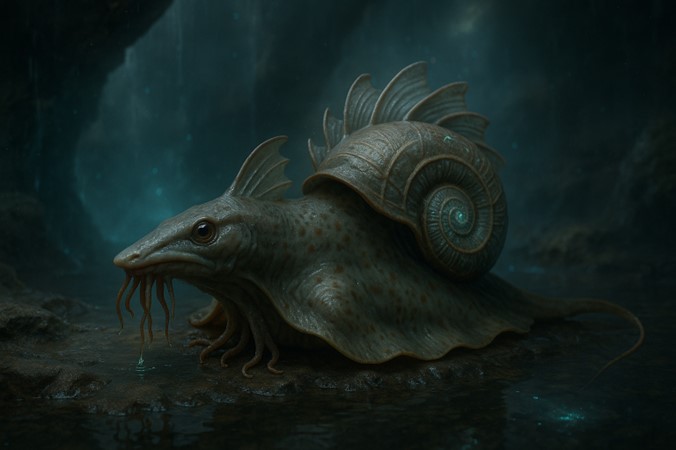
The Chimslug Flukenautil 784 manifests a bizarre, elongated form that fuses the chimaera’s ratfish-like head with elongated snout and cartilaginous fins into a soft, undulating body akin to a slug’s mucus-covered mantle, flattened and leaf-shaped from the fluke’s parasitic outline, all encased partially in a spiraled, chambered shell derived from the nautilus that coils along its dorsal side like a segmented armor etched with faint, glowing patterns reminiscent of ancient Jōmon cord impressions. Its anterior features a cluster of short, sucker-lined tentacles—eight to ten in number, flexible and probing like the nautilus but tipped with hooked barbs from the fluke’s attachment mechanisms—protruding from a beak-mouthed orifice that drips viscous slime, blending the slug’s glandular secretions with a iridescent sheen that shifts subtly under magical flows to mimic surrounding dampness or shadows. The body, pale grayish-green with mottled brown spots echoing the chimaera’s camouflage, secretes a constant layer of mucus that hardens into temporary adhesions for climbing or burrowing, while ventral suckers from the fluke allow it to latch onto hosts or surfaces. Dorsal fins, flexible and fan-like from the chimaera, flap rhythmically for propulsion, interspersed with gas-filled chambers in the shell that regulate buoyancy, glowing faintly bioluminescent during magical ebbs to reveal internal veins pulsing with parasitic spores. The tail tapers into a whip-like extension, combining the slug’s trailing foot with the chimaera’s elongated filament, ending in a cluster of sensory pits that detect vibrations or chemical traces, giving the creature an overall serpentine yet bulbous silhouette that evokes unease, as if a living fossil parasite has swollen to predatory scale amid the world’s reincarnation cycles.
Size
The Chimslug Flukenautil 784 ranges in length from 4 to 8 feet when fully extended, with a coiled shell diameter of 1 to 2 feet that adds bulk, making its overall mass comparable to a large dog at 50 to 100 pounds, supported by a semi-cartilaginous frame that allows compression into tight crevices or expansion during feeding. Juveniles hatch smaller, around 6 inches long from egg sacs attached to hosts, growing steadily through parasitic phases aligned with magical weather, reaching maturity when the shell chambers fully develop for buoyancy control in underwater centers or cave systems. Variations occur based on environmental magic, with specimens in jungle ruins achieving greater length for burrowing, while those in glacial coasts remain compact for stealth in ice fissures.
Speed
This feral life form moves with deliberate sluggishness on land at 5 feet per second, sliding via mucus-lubricated undulations like a slug, but accelerates in water to 15 feet per second through fin-propelled glides inherited from the chimaera and nautilus jet siphons, enabling short bursts up to 25 feet per second for ambushes in ocean currents or flooded caves. Burrowing speed reaches 2 feet per second in soft substrates like jungle soil or cave sediment, using ventral suckers to pull forward, while climbing vertical surfaces at 3 feet per second relies on adhesive mucus and hooked tentacles, ideal for infiltrating ruins or attaching to larger monsters in backwoods areas. Aerial movement is absent, but buoyancy chambers allow floating passively in magical levitation fields near floating cities, drifting at wind speeds during ebbs.
Stat modifiers
The Chimslug Flukenautil 784 possesses stat modifiers that enhance its parasitic and adaptive nature, granting +3 to constitution from the fluke’s resilient flatworm endurance and the slug’s mucus regeneration, allowing it to withstand prolonged starvation or magical disruptions in high realms. It receives +2 to dexterity from the nautilus’s tentacle precision and chimaera’s fin agility, facilitating quick attachments or evasions in combat. Strength gains +1 from the combined gripping suckers and barbs, useful for latching onto prey or gear. Intelligence is boosted by +1, drawing from the nautilus’s chambered problem-solving and fluke’s host-seeking instincts, enabling basic tactical parasitism. Wisdom increases by +2, incorporating the chimaera’s sensory pits for detecting environmental cues and the slug’s chemosensory trails, aiding in navigation through dark cave systems. Charisma suffers -2 due to its grotesque, slime-dripping form and invasive behaviors, deterring alliances with sentient beasts or avatars, though this can be offset in rare symbiotic instances through trained interactions.
Skills
Innate skills of the Chimslug Flukenautil 784 include proficiency in stealth, derived from the slug’s slow, silent gliding and nautilus’s shell retraction, allowing it to ambush in damp environments like jungles or underwater centers without detection. It excels in perception, with chimaera-derived sensory pits and fluke’s chemical receptors identifying hosts or threats from afar, honed through reincarnation cycles. Athletics manifests in burrowing and climbing, using suckers and mucus for traction in cave systems or ruins. Survival skills enable host parasitism, secreting spores that infect without immediate harm, while intimidation arises from oozing slime trails that warn of infestation. Deception is enhanced by shell camouflage that mimics rocks or debris, blending into backwoods or glacial terrains. These skills operate instinctively but can amplify during magical flows, adapting to the world’s cycles where monsters evolve beyond countable numbers.
Behavior
Feral and opportunistic, the Chimslug Flukenautil 784 exhibits parasitic behavior, latching onto larger monsters or avatars with suckers to feed subtly, influenced by the fluke’s lifecycle, while retreating into its shell like a nautilus when threatened, secreting mucus barriers in cave systems or underwater enclaves. It migrates with magical ebbs, seeking damp niches in appearing islands, often forming loose aggregations during spore-release seasons where telepathic-like chemical signals coordinate infestations, echoing chimaera schooling but scaled to slug trails. Encounters with explorers trigger defensive coils, whipping its tail filament to distract before attaching tentacles, reflecting a cautious aggression shaped by past reincarnation defeats. In interactions with beast civilizations, it sometimes integrates as a symbiote, exchanging protection for nutrients, but remains unpredictable, burrowing away from alchemical firearms or gear-wielding threats in ruins.
Diet
The diet of the Chimslug Flukenautil 784 is primarily parasitic, siphoning fluids and magical residues from hosts via barbs and suckers like the fluke, supplemented by scavenging soft organic matter such as decaying vegetation or small invertebrates in jungle floors, ingested through a rasping radula from the slug heritage. It filters microscopic organisms in water using nautilus-like siphons, absorbing ambient magical bubbles that sustain its shell chambers, while opportunistic feeds include latching onto reincarnating monsters for soul-energy traces in cave systems. In glacial areas, it consumes ice-bound algae, its mucus preventing freezing, ensuring adaptability across Saṃsāra’s diverse terrains without reliance on hunted prey.
Emotions
The Chimslug Flukenautil 784 harbors primal emotions amplified by its merged essence and the world’s cycles, experiencing persistent hunger that drives parasitic urges, akin to the fluke’s relentless seeking, flaring into aggression when hosts resist, manifesting as rapid tentacle thrashings. Curiosity emerges toward magical flows, prompting slow explorations of ruins with nautilus-like probing, while fear triggers shell retraction and mucus floods, echoing the slug’s withdrawal instincts. Contentment settles during successful attachments, emitting low vibrations from chimaera fins that resonate with nearby entities, potentially forming fleeting bonds with non-possessed avatars. Protectiveness guards spore sacs, influenced by evolutionary memories, leading to defensive burrows in backwoods, whereas loneliness in isolation prompts migratory restlessness across the endless ocean’s fringes.
Environment where found
This feral life form inhabits moist, shadowy locales across Jōmon’s island continent, favoring underwater centers and flooded cave systems where magical bubbles create humid niches for parasitism, as well as coastal mangroves and jungle understories teeming with potential hosts among evolving monsters. It ventures into glacial crevices for cold-adapted strains, burrowing through ice with mucus solvents, and explores appearing islands’ damp ruins for spore dispersal, occasionally infesting floating cities’ undersides via levitation drafts. Backwoods areas hide nests in decaying logs, blurring lines with beast civilizations that tolerate it as a pest-controller.
Tags
Parasitic hybrid, mucus glider, shelled burrower, tentacle infester, spore disperser, host seeker, camouflage coiler, chemical sensor, fin propeller, reincarnation adapter, damp dweller, cave infilter, jungle lurker, glacial clinger, magical residue sipper, primal instinctive, symbiotic opportunist, feral aggregator, bioluminescent signaler, evolutionary remnant.
Life cycle
The Chimslug Flukenautil 784 undergoes a multifaceted life cycle shaped by Saṃsāra’s reincarnation mechanics and magical ebbs, commencing with spore release from the adult’s glandular vents, influenced by the fluke’s parasitic reproduction, where microscopic eggs drift in mucus clouds during high magical flows, settling on potential hosts like larger monsters or avatars in damp environments such as coastal mangroves or cave systems. Upon attachment, the spores burrow into the host’s flesh via enzymatic slime from slug heritage, gestating internally for 3 to 6 months as larvae that absorb nutrients and faint soul energies, growing a rudimentary shell chamber from nautilus traits while the chimaera’s cartilaginous frame forms to support mobility. Juveniles emerge from the host—often without fatal harm if the attachment is superficial—measuring 6 to 12 inches long, mundane and magic-less until reproductive maturity, relying on parental mucus trails for protection in nests hidden within ruins or underwater centers, where they feed on scavenged detritus to avoid the heinous crime of harming non-magical young in cultures like Jōmon. Growth phases involve periodic molts every 4 months, shedding outer mucus layers and expanding the spiraled shell with additional gas-filled compartments for buoyancy, accelerated during magical weather that infuses the process with bubbles, reaching sub-adult size at 2 years when tentacles develop for probing and the first parasitic instincts manifest. Adulthood arrives at 4 to 5 years, marked by the onset of magic channeling through shell runes that glow like cord patterns, enabling full host-seeking and environmental adaptation, with lifespans extending 15 to 25 years amid the high magic realms where tier-like advancements occur naturally via absorbed energies from hosts or ruins. Elder stages see shell calcification and slowed movement, preparing for death where the soul lingers in the Mind’s Eye, reincarnating potentially as another Chimslug Flukenautil 784 or a hybrid variant if multiversal affinities blend, carrying echoes of past cycles that influence spore dispersal patterns. The cycle perpetuates endlessly, with some specimens reincarnating across centuries, contributing to uncountable monster populations and occasionally infesting beast civilizations in backwoods or glacial areas, where they evolve subtle differences based on host interactions.
Mating
Mating for the Chimslug Flukenautil 784 transpires during seasonal magical ebbs that align with dampening weather patterns, drawing solitary individuals into temporary aggregations in flooded cave systems or jungle estuaries around Jōmon’s island continent, influenced by the nautilus’s chambered buoyancy for synchronized surfacing and the fluke’s hermaphroditic flexibility, allowing any two adults to exchange genetic material. Courtship begins with chemical signals released in mucus trails, akin to the slug’s pheromonal paths but amplified by chimaera sensory pits that detect compatible reincarnation affinities, creating glowing patterns on shells that resemble Jōmonari script to attract mates through panoramic tentacle displays. Once paired, the creatures coil shells together, tentacles intertwining to transfer spore packets via hooked barbs, a process lasting hours amid protective ink-like slime clouds that ward off predators or rival monsters, ensuring the exchange incorporates magical residues for offspring resilience. Post-mating, participants disperse, carrying fertilized spores internally for 1 to 2 months before releasing them onto suitable hosts during migrations across the endless ocean’s fringes or appearing islands, with failed pairings—due to mismatched soul echoes—resulting in sterile spores that dissolve into environmental magic, recycling energies without incarnation. Aggregations during this period can involve 5 to 15 individuals, coordinating via chemical telepathy to defend communal release sites in underwater centers, where sentient sea entities sometimes intervene with alchemical barriers, viewing the process as a natural binding in Kordariism doctrines.
Tactics
In engagements, the Chimslug Flukenautil 784 deploys insidious tactics rooted in its parasitic heritage, approaching stealthily via mucus-glided undulations like the slug, blending shell camouflage with surroundings in damp terrains such as ruins or cave systems to ambush avatars or monsters. It uses electrosensory pits from the chimaera to detect soul vibrations or gear energies up to 30 feet away, positioning for attachment with tentacles that latch and burrow subtly, injecting enzymatic slime to weaken defenses before full infestation, a strategy amplified during magical ebbs that mask its approach with bubbling distractions. Defensive tactics involve retracting into the spiraled shell like a nautilus, secreting hardening mucus barriers to block pursuits, while in water, it jets backward with chambered gas expulsions for escapes in ocean currents or flooded jungles. Offensively, it whips its tail filament to distract, following with barb hooks that embed spores for long-term parasitism, targeting larger hosts to overwhelm through gradual sapping rather than direct confrontation, echoing the fluke’s lifecycle. In aggregations, they coordinate chemical signals to encircle prey, one distracting with glowing shells while others attach from below, effective against explorer parties delving into appearing islands or backwoods, where tactics adapt based on reincarnation memories—avoiding gear-wielding threats after past encounters with alchemical firearms.
Actions
The Chimslug Flukenautil 784 executes a range of actions in survival and combat contexts, including the Mucus Trail Ambush, where it lays adhesive slime paths to trap foes, combining slug secretions with fluke enzymes to impose movement penalties or initiate grapples in cave systems or jungles, lasting until dissolved by elemental fire. The Tentacle Probe involves extending suckers to sense and latch, dealing minor piercing damage while injecting spores that cause ongoing constitution drain over days, usable for host infestation during explorations. Shell Jet Escape propels it backward 20 feet in water or damp air with nautilus siphons, evading attacks and leaving a mucus cloud that obscures vision like ink, affecting a 10-foot radius. Barb Whip Lash strikes with the tail filament, inflicting slashing damage and distracting targets to lower defenses for follow-up attachments, enhanced by chimaera fins for accuracy. Spore Burst releases a cloud of parasitic eggs in a 15-foot cone, requiring saves against infestation that manifests as temporary wisdom reduction from embedded memories, ideal for swarm tactics in underwater centers. Burrow Conceal digs into soft substrates at half speed, hiding completely to ambush, with shell runes glowing faintly to mimic environmental magic. Chemical Signal Call summons nearby kin within 50 feet via pheromones, coordinating for aggregated attacks in backwoods or glacial fissures. These actions draw on instinctive skills but intensify with absorbed magical bubbles, aligning with the world’s cycles where monsters interact with avatar gear.
Other interesting information
The Chimslug Flukenautil 784 forms occasional symbioses with host monsters in beast civilizations, exchanging nutrient siphoning for enhanced mobility, such as carrying smaller entities through flooded ruins where its buoyancy aids traversal, observed in Jōmon’s underwater populations blending with sentient fluke-like communities. Reincarnation cycles imprint multiversal echoes, causing some specimens to seek specific hosts with soul affinities from fantasy realms, leading to behaviors like guarding cord-marked artifacts in jungles as if protecting lore. Its mucus, when harvested by trained avatars using gear like extraction vials, yields adhesives for binding magical circuits in steam factories, traded across megacities for rhodium coins to support tier advancements. In Kordariism tales, the creature represents insidious bindings, with priests incorporating shell fragments into altars for rituals that invoke resilience against political intrigue from the 73 island countries. Juveniles imprint on magical ebbs during gestation, emerging with affinities for elemental water that allow minor slime manipulations, mimicking omens in glowing patterns during festivals. Aggregations during spore seasons disrupt trade routes near appearing islands, prompting monarchy quests paying in electrum for containment or taming, where higher-tier avatars employ telepathic skills to redirect infestations toward monster hordes. The bioluminescent shell chambers pulse in rhythms that echo Jōmonari chants, interpreted by scholars as signals for hidden paths in cave systems teeming with uncharted lore. Diet adaptations include absorbing alchemical residues from scavenged firearms remnants, temporarily boosting burrow speeds, while in glacial coasts, it competes with Frostweavers for ice-bound hosts, blurring species lines in mixed societies. Emotions like curiosity drive it to follow ships or zeppelins, trailing mucus that hardens into temporary barriers, sometimes escalating to attachments if provoked by gear emissions. Tags linked to it in monster compendiums include hybrid infester for its role in altering host behaviors through spore memories, serving as a narrative tool in political intrigue scenarios.
A party of adventurers in the world of Saṃsāra might encounter or actively search for a Chimslug Flukenautil 784 for a range of strategic, cultural, and survival-driven reasons deeply embedded in the island nation of Jōmon’s high magic environment and societal structure. One key motivation stems from quests issued by the monarchy, specifically the House of Eternal Chill, which offers rewards in precious metals such as electrum or rhodium to adventurers tasked with containing or taming these feral creatures. During seasonal spore-release aggregations, when the Leviacuttles disrupt trade routes across the endless ocean or infest underwater centers and cave systems near appearing islands, the ruling family dispatches parties to mitigate the threat, paying for harvested mucus or shell fragments that can be processed into adhesives for magical circuits or buoyant gear, providing a lucrative opportunity for tier 1 or 2 adventurers seeking to advance their skills and equipment in Jōmon’s megacities.
Another compelling reason arises from the creature’s significance in Kordariism, where its bioluminescent shell chambers, pulsing in rhythms reminiscent of Jōmonari chants, are interpreted by priests as omens or signals pointing to hidden paths in forgotten ruins or uncharted territories teeming with lore. Adventurers, particularly those aligned with the faith or hired by scholarly guilds in the central city of Kordspire, might search for one to decipher these patterns, believing they reveal locations of cord-marked artifacts or reincarnation secrets that could enhance their gear or unlock tier advancements for tier 3 and 4 explorers leading delves into backwoods jungles or glacial crevices. The creature’s habitat overlap with such sites makes it a natural target, requiring skilled navigation and combat readiness to harvest its components safely.
Encounters may also occur unintentionally during routine explorations or trade missions, such as ocean voyages on ships or expeditions into flooded cave systems, where the Leviacutil’s parasitic attachments and mucus trails pose risks to crew or cargo. Its ability to infest hosts with spores that cause gradual wisdom drain can compromise telepathic coordination among parties, prompting defensive engagements to protect against long-term debilitation, especially when navigating labyrinthine racing events or political intrigue scenarios near floating cities. Tier 5 adventurers, advising the monarchy or delving into ancient lore, might seek one to study its reincarnation memories, hypothesizing that its multiversal soul echoes—potentially from fantasy realms or past lives—could yield insights into lost magical techniques or host manipulation strategies, driving expeditions into its damp coastal or underwater niches where it guards nests with insidious persistence.
The creature’s symbiotic potential with host monsters in beast civilizations offers a tactical incentive, as adventurers might aim to negotiate or harvest resources through these alliances. Parties equipped with gear like extraction vials or telepathic amplifiers could attempt to tame a Leviacutil as a scout or burden-carrier for jungle or cave explorations, leveraging its burrowing and climbing abilities for quests targeting hidden monster societies, a task suited for tier 4 guilds specializing in cross-species interactions. The mucus and shell components, when processed, yield adhesives and buoyant materials traded for alchemical enhancements or used in constructing defenses against rival island countries’ intrigue, adding strategic value to their pursuit. Whether driven by monetary gain, cultural curiosity, survival necessity, or tactical advantage, the Chimslug Flukenautil 784 presents a multifaceted challenge and resource, drawing parties into its moist, shadowy environments across Jōmon’s 418,720,000 acres.
From the corpse of a Chimslug Flukenautil 784, adventurers trained in harvesting techniques—utilizing gear such as enchanted scalpels with magical circuits for precise incisions or preservation pouches infused with elemental chill to halt decay—can gather an array of items and ingredients that resonate with Saṃsāra’s high magic realms, where ebbs and flows imbue them with arcane properties. These materials often require careful extraction in damp environments like coastal mangroves or cave systems to avoid contaminating the mucus or spores with external magic, typically performed under the auspices of Kordariism rituals to honor the creature’s thread in the eternal weave, preventing soul backlash from reincarnation cycles. Yields vary by specimen size and maturity, with adults offering richer hauls due to accumulated magical residues from parasitic hosts, and the process spans several hours, supported by steam-powered mechanical tools like pulleys for suspending the elongated body in Jōmon’s workshops or underwater centers. Harvesting adheres to cultural perspectives that blur lines between monster and beast, sometimes involving telepathic consultations with sentient entities in mixed populations to ensure ethical sourcing, as the creature’s components fuel industries from alchemical labs to gear forges across the island nation’s 418,720,000 acres.
- Spiraled Shell Chambers: Coiled, chambered sections of the nautilus-derived shell, up to 2 feet in diameter and segmented into 10 to 15 gas-filled compartments per adult, harvested by carefully cracking the cartilaginous connections with chimaera-inspired flexibility, yielding 5 to 8 intact pieces etched with faint cord-like patterns that glow under magical light. These chambers serve as buoyant components in gear crafting, such as flotation harnesses or levitation belts for exploring floating cities or appearing islands, enhancing dexterity by regulating weight in high magic ebbs without relying on forbidden technologies. Alchemists in megacities infuse them with elemental air to create storage vessels for magical residues, powering minor siphons in steam factories’ pulley systems, environmentally sustainable as they combine with water flows for controlled buoyancy in trade ships or zeppelins navigating the endless ocean.
- Mucus Gland Secretions: Viscous, enzymatic slime from ventral glands, collected in up to 3 gallons from the slug-like mantle, siphoned into sealed jars to preserve adhesive qualities that harden under elemental fire exposure, influenced by the fluke’s host-dissolving enzymes. This mucus functions as a versatile glue in assembling gear, binding materials like cords to harnesses or belts without mechanical fasteners, boosting constitution in armor by creating flexible joints that resist environmental dampness in jungle backwoods or cave systems. In trade markets of coastal villages, it’s refined into salves that grant temporary camouflage on skin or gear, mimicking the creature’s shifting sheen to aid stealth during political intrigue or griffon races through labyrinths, while beast civilizations use it for waterproofing vessel-shaped structures in underwater centers.
- Hooked Tentacle Barbs: Sharp, curved hooks tipping the 8 to 10 tentacles, numbering 20 to 40 per creature from the fluke’s attachment mechanisms, pried off with precision tools to avoid snapping the nautilus-derived suckers, preserved in alchemical oils for transport. These barbs tip arrows or darts for alchemical firearms, delivering parasitic spores that cause lingering wisdom drain over days, useful for subduing monsters or rivals in defensive scenarios across the 73 island countries without lethal intent, aligning with Jōmon’s cultural taboos on harming mundane young. Crafters embed them into glove or boot gear for climbing aids, enhancing strength modifiers in scaling ruins or glacial crevices, where the hooks interface with magical circuits to extend reach during tier advancement quests rewarding racial alignment.
- Cartilaginous Fin Fans: Flexible, fan-shaped fins along the dorsal and lateral body, 4 to 6 per specimen from the chimaera’s heritage, dissected in sheets that retain rhythmic flapping post-mortem, weighing 5 to 10 pounds total and stored in chill pouches to maintain elasticity. These fins integrate into propulsion gear like swim fins or burrowing tools, granting speed boosts in water or soft substrates for expeditions into flooded cave systems or mangrove coasts, amplifying agility through trained skills that channel elemental water flows. In steam-powered industries of megacities, shredded fins mix with belts and pulleys for vibration-dampening components, preventing mechanical failures during magical ebbs, while scholars use them in divination devices to detect vibrations echoing reincarnation memories, aiding lore studies in compulsory schools.
- Parasitic Spore Sacs: Internal pouches containing spore clouds, 2 to 4 sacs per adult filled with thousands of microscopic eggs influenced by the fluke’s lifecycle, extracted by puncturing the mantle carefully to avoid premature release, collected in enchanted vials that neutralize their infectivity until processed. These spores brew into potions or dusts that induce controlled parasitism, allowing avatars to siphon minor magical energies from environments or hosts for temporary intelligence gains, essential for tier 3 explorers navigating uncharted islands or dark cave systems teeming with monster civilizations. In Kordariism rituals, diluted spores inscribe spiral knots on pottery altars, invoking renewal bindings for funeral rites that facilitate soul transitions in reincarnation cycles, while traders barter them to beast societies for use in symbiotic enhancements that blur species lines in mixed populations.
- Sensory Pit Clusters: Gel-filled ampullae and chemoreceptors dotting the tail filament and head, harvested in bundles of 50 to 100 from the chimaera’s pits combined with slug trails, scooped into sensory jars that preserve vibrational sensitivity even after death. These clusters embed into helmet or bracer gear, boosting wisdom modifiers by detecting chemical traces or magical residues within 20 feet, crucial for avoiding ambushes in jungle backwoods or locating hidden lore in ruins. Alchemists in the central city of Kordspire distill them into essences for potions that enhance perception skills, used in compulsory education to train youths in environmental awareness, while they serve as components in telepathic amplifiers for coordinating with griffon mounts during racing events through labyrinths.
- Enzymatic Radula Scrapers: Rasping mouthparts from the slug’s radula fused with the nautilus’s beak, a single organ weighing 1 pound, removed intact and preserved in acidic neutralizers to retain grinding edges influenced by fluke enzymes. This radula crafts into fine tools for etching magical circuits on gear, allowing precise inscriptions that improve spell channeling without spell slots, benefiting tier advancement for avatars in steam factories where it operates like a mechanical engraver on pulleys and belts. In culinary or alchemical contexts within megacities, ground radula powder tenderizes monster meats or dissolves barriers in potions, traded for nickel or silver coins to support populations mixing from multiversal origins during festivals.
- Buoyancy Gas Vesicles: Internal bladders within the shell chambers, 10 to 15 per creature from the nautilus’s gas regulation, harvested by deflating and sealing them in buoyant pouches that capture residual magical gases. These vesicles incorporate into flotation gear or airship components, granting minor levitation effects during high ebbs for travel over the endless ocean or in floating cities, enhancing constitution against drowning in underwater centers. Crafters use them in storage devices for elemental air, powering siphons in hot air balloons without combustion, environmentally friendly and aligned with the gods’ limitations, while they function as ritual items in Kordariism for symbolizing soul ascent in reincarnation ceremonies.
- Tail Filament Sensors: Whip-like extension ending in sensory pits, 3 to 5 feet long from the chimaera’s filament blended with slug trails, severed and coiled for transport in sensory wraps that maintain chemical receptivity. These filaments weave into wand-like gear or amulets, boosting intelligence for detecting trails or affinities in reincarnation studies, useful for tier 5 advisors to the monarchy tracing multiversal soul paths in political intrigue. In workshops, they line detection mechanisms for mechanical transmissions, alerting to magical disruptions in factories, while beast civilizations employ them in tracking devices for navigating cave systems teeming with uncharted populations.
- Glandular Enzyme Reservoirs: Pouches of digestive fluids from the fluke’s enzymes mixed with slug secretions, yielding 1 to 2 quarts per corpse, siphoned into alchemical flasks that stabilize the corrosive properties. These enzymes dissolve barriers in potions for burrowing aids, granting strength modifiers to penetrate ruins or ice in glacial areas, while they serve as bases for acids in alchemical firearms, providing non-lethal options for subduing hosts during quests. Traders in coastal villages refine them into cleansers for gear maintenance, removing magical residues without damage, supporting the Industrial Age’s pulley and belt systems in an eco-friendly manner.
- Ventral Sucker Pads: Flattened attachment discs from the fluke’s body, 20 to 30 pads along the underside, peeled off and dried for use as adhesive patches in gear like boots or gloves, enhancing grip for climbing damp surfaces in jungles or cave systems. These pads integrate into harnesses for host-binding tools in monster taming, allowing temporary alliances with beast civilizations, while alchemists use them in salves that improve dexterity for precise manipulations during tier training in academies.
- Beak-Mouth Fragments: Hardened beak from the nautilus fused with radula edges, a single piece weighing 2 pounds, chiseled out for crafting into small blades or tools that resist corrosion in damp environments, boosting gear durability for underwater explorations. In rituals, fragments carve symbols on pottery vessels for Kordariism altars, invoking protection against parasitic influences in reincarnation cycles, traded for copper coins in markets where populations multiply from teleported souls.
Coiling Slug of Shadowed Depths and Its Binding Infestations
In the mists of eras swallowed by time, when the waters of Saṃsāra whispered secrets yet unspoken and souls wandered like unseen currents after their vanishings, there arose from the damp voids a beast named the Chimslug Flukenautil, marked with 784 in the fragments of lost carvings, forged not from mere clay or breath but from the tangled fusions of forms that the gods had knotted in their veiled designs. The phrases, scratched on bones weathered by ages and murmured through lips twisted by echoes from realms beyond naming, recount how this creature first slithered in the shadowed crevices where islands flickered like half-forgotten visions, its form a stretched coil of dread, pale and slick like the crawlers of moist earth, yet armored in spirals of chambered hardness akin to the swimmers of ancient shells, with barbs hooking like the clingers of inner flesh and fins fanning like the ghosts of deep lurkers. Its body oozed trails that bound the ground, shifting hues under magical surges that bubbled as storms from beneath, and its feelers, many and grasping, probed the air for the warmth of lives or the hum of gear afar.
Before the great blending of peoples on Jōmon’s edges, when souls teleported from multiverses first touched the cord-imprinted stones and started their growing numbers, the Chimslug Flukenautil dwelled in the wet lairs and cave hollows deep as buried regrets. The legend speaks of an age when magical flows raged untamed, unbound by the deities’ curbs on engines and blazes, and monsters returned in ceaseless rings, shaping bodies from endless turns. One such flow, broad as a flood that engulfed vessels, spawned a host of these beasts, their shells glowing in rhythms that shook the damp like calls from hidden depths, pulling from the slug’s silent paths and the nautilus’s chambered floats, while their suckers latched like the fluke’s silent hold turned to hunger, and spore clouds bloomed like veils from the chimaera’s elusive glides.
In those times, a gathering of avatars, spirits from wandering verses—some holding memories of realms with gear-clad warriors, others from futures seen in shadows—embarked on a craft twined from ropes and driven by vapors of elemental meetings, questing for sunken halls where knowledge of tier rises lay concealed. Guided by a Frostweaver called Mira’lo, whose translucent hide carried swirls like the beast’s own changing skins, they ventured from Jōmon’s shores, beyond isles that appeared and faded with the light, their equipment singing with enchanted pathways schooled through arts learned in halls. The craft, no lofty airship but a firm barge with wheels and straps whirling in cadence, bore them into the core of the ocean’s boundless stretch, where submerged hubs shone with gleams from beast societies, and griffons plunged from heights to seize lesser quarry.
Yet behold, as the magical climate shifted, surging forth powers that warped the waters into mazes of streams, the Chimslug Flukenautil host emerged, their glandular vents spewing mists laced with binding spores, birthing phantom veils that clung and drained the spirit’s sight. The avatars, cladding themselves in belts and straps for safeguard, sensed the chemical probes like murmurs of fate, as the beasts traced their essence sparks and equipment tremors from distant. The initial strike came slow yet sure, a lone Flukenautil gliding through murk like the slug’s trail, then surging upward with fanning fins to clasp the hull, its feelers seizing the edges and hooking into meat, infusing enzymes that softened bonds and muddled magical streams, much as flukes claim their dwellings with patient erosion.
Mira’lo, her extended arms and webbed graspers helping steadiness on the swaying barge, shouted in Jōmonari hymns, dimly recalled from old tablets, calling upon Kordara’s ties to weave strands of power around the beast. But the creature, wild and free of equipment or rank, repelled with spore hosts that clouded senses, phantoms of coils lashing from every side, while its shell withstood hits from alchemical blasts, lone bursts ringing like echoes without the banned motors. The host converged, scores aligning through scent bonds born of parasitic urges, surrounding the craft like a living snare, their sensory hollows probing each shift, and hooks embedding as they burrowed with fluke-like persistence.
Amid the turmoil, one avatar, a reborn spirit from a verse of bygone devices now outlawed, turned against the fold, covetous of Mira’lo’s rank rise through her chill-twined equipment. This betrayer, titled Zor’then, murmured mind-links of falsehoods to split the band, vowing inborn strengths that the deities forbade, aiming to grasp the craft’s enchanted hoard for self. As the Flukenautills constricted the frame with feelers, splintering beams like straps snapping under strain, Zor’then rushed for the steer, but Mira’lo, her sense gifts sharpened by brow lenses, discerned the warmth of disloyalty through heat gaze, tying him with strands from her strap slot.
The clash endured through dusks that merged with dawns, the avatars schooling their arts amid strife—whipping with makeshift lashes from sail threads, sifting the beasts’ spore with chambered masks made in haste, and employing Mind’s Eye flashes to foresee latches. One after another, the Flukenautills succumbed, their shell parts gathered even as they writhed, but the host’s matron, a swollen elder laden with young from spore rings, launched a last onslaught, her glowing chambers shining like signs in Jōmonari marks, unveiling designs that warned of return circles.
Mira’lo, rising a rank through frantic equipment merge—fusing a hook into her armguard for enzyme shield—plunged into the floods, her webbed soles driving her like the chimaera’s slide, clasping the matron’s feelers and infusing counter-enzymes from her own schooled alchemical bursts. The beast, sensing the clasp of oneness against its lone hunger, expelled a final spore cloud that veiled the sea, but the avatars, connected mind-wise through joint strands, breached the phantom, tying the matron with webs spun from elemental fibers, taming her not by might but by grasping her base feelings of guard over spawn.
The host scattered, essences of the downed beasts hovering in the Mind’s Eye ere returning, perhaps as bound carriers or altered shapes in beast societies. The avatars came back to Jōmon’s grand hubs, their reaped goods—mucus for glues, shells for floats, spores for brews—bartered in bazaars where folks blended under the crown’s keen gaze. Mira’lo, honored in tales, established a society for monster binding, her saga chanted in learnings where youths grasped the world’s hazy borders between folk, creatures, and horrors.
Still, in the wets, the Chimslug Flukenautil persisted, its rings ongoing amid magical surges, a cue of Saṃsāra’s ceaseless shapings, where covet untwists but schooled ties triumph.
Moral: In the slime of creeping shadows, the lone hook brings slow decay, but the coiled strand of oneness withstands through rings unending.
Suggested conversions to other systems:
Call of Cthulhu
Abyssal Coilslug
The Abyssal Coilslug is a insidious, parasitic horror in the shadowed underbelly of Saṃsāra’s damp realms, slithering through cave systems and underwater ruins where eldritch magical ebbs pulse like forbidden whispers, its spore infestations and mucus bindings evoking sanity-shattering visions of eternal entanglement akin to the world’s reincarnation cycles. This feral entity, with its coiled shell and probing tentacles, serves as a lurking antagonist in investigations into lost lore or monster-infested enclaves, its chemical senses detecting soul echoes or gear remnants, compelling keepers to weave narratives of gradual corruption rather than sudden violence. Adjusted for 7th edition balance, its stats position it as a subtle threat for 4-6 investigators of moderate experience, emphasizing Sanity loss from prolonged exposure and skill checks in Medicine or Natural World to counter its parasitic effects, with build and damage scaled to encourage evasion or clever traps over direct combat, preventing overwhelming encounters while tying into Jōmon’s high magic setting where gear and trained skills mitigate its insidious grasp.
STR (4D6+6)x5 average 100
CON (5D6+12)x5 average 147-148
SIZ (3D6+3)x5 average 67-68
INT (2D6+6)x5 average 65
POW (3D6)x5 average 52-53
DEX (4D6)x5 average 70
APP n/a
EDU n/a
HP: 21-22
Damage Bonus: +1D4
Build: 1
Move: 4/8 burrowing/6 swimming
Magic Points: 10-11
Attacks: Attacks 2 times per round.
Tentacle Probe 45% (22/9), damage 1D4+DB piercing plus spore infestation (victim resists with CON roll vs. POT 12; failure causes 1D3 HP loss per day and Sanity 0/1 per week until cured).
Mucus Bind 50% (25/10), damage hold and constrict for 1D6 crushing per round until escape (opposed STR roll), plus adhesive residue imposes -20% to physical skills for 1 hour.
Shell Whip Lash 35% (17/7), damage 1D6+DB bludgeoning, usable at reach.
Fighting attacks: Tentacle Probe 45% (22/9), damage as above; Mucus Bind 50% (25/10), damage as above; Shell Whip Lash 35% (17/7), damage as above.
Dodge 35% (17/7)
Armor: 4-point shell and mucus layer; piercing weapons ignore half armor, but fire or acid deals double damage.
Spells: None, but in magical ebbs, it may channel minor effects like Contact Parasite (costs 1D4 Magic Points, summons spore cloud affecting 10-foot radius).
Sanity Loss: 0/1D6 to see the Abyssal Coilslug; 1/1D8 if infested by spores, escalating to 1D4/1D10 with hallucinations of coiling bindings.
Special Rules: Chemical Detection allows sensing living beings or magical sources within 30 yards, ignoring half cover; camouflage in damp environments imposes extreme penalty to Spot Hidden. In aggregations (2-6), treat as a group with +10% to attacks and +5 HP per member, but Sanity loss increases by 1D3. Balance includes vulnerability to desiccation (dry environments halve its Move and impose -20% to actions), enabling investigators to use environmental tactics or alchemical dries to weaken it.
Blades in the Dark
Mucusveil Lurker
The Mucusveil Lurker slithers as a insidious complication in the shadowed undercurrents of Doskvol-esque intrigue on Saṃsāra, infesting canal vaults or damp ruins with its spore bindings and mucus snares, disrupting heists near underwater centers or cave lairs where magical ebbs mimic ghostly phenomena. Mechanically, it acts as a Tier II threat for crews navigating parasitic plots or lore hunts, its scale representing solitary infesters or aggregating hosts that alter position and effect in scores, balanced to reward attune or study actions exploiting its chemical vulnerabilities or shell weak points, ensuring it serves as a hazard rather than a brute, with adjustments preventing dominance in low-tier games by capping magnitude during non-ebb periods.
Threat Type: Beast (Parasitic Hybrid)
Scale: 1 (solitary, equivalent to a lone operative; increases to 3 in aggregations during spore seasons)
Magnitude: 2 (subtle in infestations, with quality edges in adhesion and sensing)
Quality: Mucus Bind +2 (ensnares foes, reducing effect of prowl or skirmish by one level until overcome); Spore Infestation +1 (lingers as consequences like “Draining Fatigue”); Chemical Sense +3 (detects hidden gear or magic, improving position in hunts).
Edges: Insidious (gains potency in prolonged engagements, filling “Infestation Progress” clocks); Shell Retreat (improved defense against direct attacks, worsening attacker’s position to desperate).
Flaws: Damp Dependency (worsened position in dry or hot environments, exposing to risky effects); Sonic Sensitivity (loud noises reduce magnitude by 1).
Harm Levels: Inflicts 1-harm (tentacle probe) or 2-harm (mucus constrict), with special consequences like “Parasitic Drain” (level 2 harm, resists with resolve, causes -1d to mental actions until treated) or “Adhesive Snare” (level 1 harm, resists with prowess, imposes entangled trauma).
Clocks: “Detects Intruders” (3 segments, fills on failed survey); “Releases Spores” (4 segments after attachment); “Calls Aggregation” (5 segments in damp zones, escalating scale).
Actions and Effects: In a score, it prowls with risky position for ambushes (effect: standard on unaware crews, inflicting harm via tentacle latch); attunes to sense soul energies (resisted by finesse to conceal); wrecks with shell lash against barriers (effect: limited against reinforced gear). Crews can consort with it symbiotically using high-tier study (controlled position, limited effect) for infiltration aids, or lore to reveal weak spots (standard effect). Balance positions it as a narrative obstacle, with crews using alchemical solvents to reduce its bind quality by 1 post-score.
Dungeons & Dragons
Flukenautil Parashell
Medium aberration, neutral evil
Armor Class 14 (natural shell)
Hit Points 78 (12d8 + 24)
Speed 20 ft., burrow 10 ft., swim 40 ft.
STR 12 (+1)
DEX 15 (+2)
CON 14 (+2)
INT 8 (-1)
WIS 13 (+1)
CHA 6 (-2)
Saving Throws Con +4, Dex +4, Wis +3
Skills Perception +3, Stealth +4, Survival +3
Damage Resistances acid, poison
Damage Immunities none
Condition Immunities prone (while burrowed)
Senses blindsight 30 ft. (chemical sense), darkvision 60 ft., passive Perception 13
Languages understands Deep Speech but can’t speak
Challenge 4 (1,100 XP) Proficiency Bonus +2
Amphibious. The Flukenautil Parashell can breathe air and water.
Camouflage Coat. The creature has advantage on Dexterity (Stealth) checks in damp or aquatic environments, as its mucus shifts to blend with surroundings.
Chemical Detection. The creature can detect the presence and location of any creature or magical source within 30 feet that isn’t behind total cover, by sensing chemical traces or arcane residues.
Mucus Adhesion (Recharge 5-6). As a bonus action, the creature secretes a 15-foot radius mucus patch centered on itself. The area becomes difficult terrain for 1 minute, and creatures entering or starting their turn there must succeed on a DC 12 Strength saving throw or be restrained until the end of their next turn.
Spore Infestation. If a tentacle hits, the target must succeed on a DC 12 Constitution saving throw or be infested with spores, taking 1d6 poison damage at the start of each of its turns for 1 minute. The target can repeat the saving throw at the end of each of its turns, ending the effect on a success.
Actions
Multiattack. The creature makes two tentacle attacks or one shell lash and one tentacle attack.
Tentacle. Melee Weapon Attack: +4 to hit, reach 10 ft., one target. Hit: 7 (2d4 + 2) bludgeoning damage, and the target is grappled (escape DC 12). Until this grapple ends, the target is restrained, and the creature can’t use that tentacle on another target. The creature has eight tentacles but can grapple up to two targets at once.
Shell Lash. Melee Weapon Attack: +4 to hit, reach 5 ft., one target. Hit: 9 (2d6 + 2) slashing damage.
Reactions
Shell Retract. When the creature takes damage, it can retract into its shell, gaining +5 AC until the start of its next turn but can’t take actions other than to end this effect early.
For 5th edition balance in Saṃsāra’s high magic realms, the Flukenautil Parashell’s CR 4 suits a party of 4-6 level 4-6 adventurers, with its spore and mucus effects tuned for Constitution saves to allow gear resistances (like amulets) to mitigate, preventing frustration while encouraging spells like lesser restoration. In aggregations, increase CR by 1 per additional creature up to +3, capping at boss-level in damp caves; experience includes loot like shell for +1 shields or mucus for potions of adhesion, tying into quests for tier progression in Jōmon’s ruins.
Knave
Flukecoiler
HD 5, AC 14 (shell and mucus), Morale 8, Number Appearing 1-3 (or 1d6+2 in aggregations during ebbs)
Attacks: Tentacle Probe +3 d6 bludgeoning (on hit, target saves vs STR or grappled, restrained until escape), Spore Burst (cone, save vs CON or 1d4 poison/round for 1d6 rounds), Shell Lash +2 d8 slashing.
Special: Camouflage (advantage on stealth in damp/caves), Chemical Sense (detects hidden foes within 20 ft. unless warded), Mucus Bind (once per short rest, 10 ft. radius difficult terrain, save vs DEX or restrained 1 round), Aggregation Call (at half HP, summons 1d3 lesser versions: HD 2, AC 12, Morale 6, Attacks: Probe +1 d4 poison).
The Flukecoiler infests shadowy lairs as a HD 5 hazard in this OSR system, balanced for 4-6 level 3-5 adventurers where its spore and bind encourage inventory creativity (e.g., fire torches halve mucus duration), allowing for gritty survival without instant kills. In play, morale 8 reflects parasitic tenacity but drops to 6 in isolation; experience 500 XP base, +100 per special triggered, with loot tables yielding 1d4 shell shards (craft +1 AC helms) or spore sacs (potions inflicting weakness for 1 turn, save or -2 to saves). Adjusted mechanics tie into Knave’s slot system, where carrying its mucus (1 slot) grants climb advantage but risks infestation on fumble.
Fate
Parashell Slitherkin
The Parashell Slitherkin is a narrative-driven menace in Fate Core, weaving its parasitic presence into Saṃsāra’s damp underworlds, its mucus trails and spore infestations creating story hooks in Jōmon’s cave systems or coastal mangroves where magical ebbs fuel its insidious spread. Represented with aspects like “Coiling Parasitic Horror” and “Mucus-Bound Lair,” it challenges players through skill contests or conflicts, its chemical detection unraveling stealth plans, while its shell retreat offers tactical depth. Mechanically, it acts as a named NPC with a stress track and consequences, balanced for a party of 3-5 characters with 2-4 Refresh, where aspects enable compels—such as entangling gear during explorations—while skills reflect its adaptive subterfuge. Adjusted for balance, skill caps at Good (+3) to avoid dominating mid-tier groups, with stunts like “Spore Infusion” adding narrative weight, encouraging players to use Create an Advantage with fire or desiccation to counter its damp affinity, aligning with Fate’s focus on player agency in the high magic setting.
Aspects: Coiling Parasitic Horror, Mucus-Bound Lair, Chemical Trail Hunter, Shell-Shielded Retreat
Skills: Stealth: Good (+3), Physique: Good (+3), Notice: Fair (+2), Will: Average (+1), Athletics: Average (+1)
Stress: [1][2][3]
Consequences: Mild (2), Moderate (4)
Stunts: Spore Infusion – Once per scene, impose “Parasitic Drain” aspect on a hit, target resists with Physique at Fair (+2) difficulty or take a mild consequence; Shell Evasion – Use Athletics instead of Physique to defend against physical attacks after retracting, reflecting its defensive coil.
Attacks and Actions: Tentacle Probe (Athletics +1, creates “Grappled” aspect with a boost on success with style); Spore Burst (Stealth +3, imposes “Infested” aspect, target resists with Will at Average (+1) difficulty); Shell Lash (Physique +3, 2-shift physical attack at reach). Mucus Bind (Physique +3, creates “Adhesive Snare” situation aspect in a zone, usable once per scene, compels foes to roll Athletics at -2).
Special: Chemical Detection allows it to oppose Notice or Stealth rolls to detect hidden foes within the same zone, with a +2 bonus if damp conditions prevail. In aggregations (2-4), add +1 to all skill rolls and an extra mild consequence slot, but a successful overcome action with a Good (+3) difficulty using Lore or Craft can dispel it by exploiting shell vulnerabilities. Loot includes mucus for crafting aspects like “Sticky Trap” or shell for “Buoyant Shield,” tied to quests in Jōmon’s markets.
Numenera & Cypher System
Slimecoil Infestant
Level: 4 (can scale to 5 in aggregations or high magic ebbs)
Motive: Parasitic sustenance, territorial nesting
Environment: Damp caves, underwater centers, coastal jungles near Jōmon
Health: 15
Damage Inflicted: 4 points (6 points with spore burst)
Armor: 1 (mucus and shell)
Movement: Short (immediate in water or burrowing)
Modifications: Speed defense as level 5 due to mucus glide; perception as level 6 due to chemical detection
Combat: The Slimecoil Infestant uses a multiattack routine: Tentacle Probe (reach, 4 damage, might-based task to escape grapple on hit); Spore Burst (4 damage + 4 poison, target makes Might defense roll or loses 1 Intellect point per round for 1 minute); Shell Lash (4 damage, Speed defense to avoid). Once per 10 minutes, it secretes Mucus Bind (level 3 difficulty to move through, 10-foot radius, lasts 2 minutes or until dispersed by heat), imposing disadvantage on movement tasks. In aggregations (2d4), treat as one entity at +1 level, adding 3 health per extra member.
Interaction: Might be deterred with a level 4 Might task using environmental heat or tamed with a cypher like a desiccant grenade, yielding a scout for damp ruins if successful.
Use: Encountered during quests into parasitic lore or trade disruptions, its shell runes hint at cypher locations, encouraging Intellect-based recovery rolls (level 3) for items like adhesive boots or spore antidotes.
Loot: Mucus gland (cypher, single use, +4 to Might defense for 1 hour or adhesive trap); shell chamber (material, crafts +1 armor); spore sac (oddity, inflicts confusion for 1 scene). Balance adjusts by capping aggregation levels at 5 to avoid overpowering Tier 1 characters (levels 1-3), with environmental heat adding difficulty, while its taming potential ties into quests for racial alignment in Jōmon’s beast societies, enhancing roleplay depth.
Pathfinder
Chimslug Parasitic
Medium Magical Beast, NE
Init +3; Senses blindsight (chemical) 30 ft., darkvision 60 ft.; Perception +7
Defense
AC 16, touch 13, flat-footed 13 (+3 Dex, +3 natural)
hp 60 (8d10+16)
Fort +8, Ref +9, Will +3
DR 5/magic; Resist acid 5
Offense
Speed 20 ft., burrow 10 ft., swim 30 ft.
Melee 2 tentacles +9 (1d6+3 plus grab), shell lash +9 (1d8+3)
Space 5 ft.; Reach 10 ft. (tentacles)
Special Attacks spore burst, mucus bind
Spell-Like Abilities (CL 8th; concentration +3)
1/day—entangle (self only, 10-ft. radius)
Statistics
Str 16, Dex 16, Con 14, Int 5, Wis 12, Cha 6
Base Atk +8; CMB +11 (+15 grapple); CMD 24 (28 vs. trip)
Feats Combat Reflexes, Improved Initiative, Weapon Focus (tentacle)
Skills Acrobatics +7, Perception +7, Stealth +7 (+11 in damp), Swim +11; Racial Modifiers +4 Stealth in damp
Special Abilities
Mucus Bind (Ex) Once every 1d4 rounds, creates a 10-ft.-radius patch of adhesive mucus that acts as entangle spell (Reflex DC 16 negates), lasting 1d6 rounds or until dispersed by fire.
Spore Burst (Ex) As a standard action, releases a 15-ft. cone of spores; creatures in area must succeed on a DC 16 Fortitude save or take 1d6 poison damage and 1d4 Wisdom damage, repeatable save ends after 1 minute.
Grab (Ex) If a tentacle hits, it can start a grapple as a free action without provoking an attack of opportunity, using its CMB.
Ecology
Environment damp caves, aquatic, jungles (Jōmon)
Organization solitary, pair, or aggregation (3-8)
Treasure incidental (harvested mucus or shell)
For Pathfinder 2nd Edition balance, the Chimslug Parasitic’s level 6 status fits a party of 4-5 level 5-7 characters, with its spore and mucus effects tuned for Fortitude saves to allow gear resistances (like acid cloaks) to mitigate, preventing overwhelming debilitation while encouraging spells like neutralize poison. In aggregations, increase level by 1 per additional creature up to +3, capping at elite encounters in damp ruins; loot like shell for +1 shields or mucus for potions of adhesion ties into quests for tier advancement in Jōmon’s markets, with heat hazards adding +1 difficulty to saves.
Savage Worlds
Slimecoil Parasite
Wild Card
Attributes: Agility d8, Smarts d6, Spirit d6, Strength d10, Vigor d8
Skills: Fighting d8, Notice d8, Stealth d10, Climbing d6, Intimidation d6
Pace: 6; Parry: 6; Toughness: 8 (1)
Gear: Natural weapons (tentacles, shell)
Special Abilities:
Armor +1: Mucus and shell layer.
Bite/Claws: Str+d6 (tentacle probe) or Str+d8 (shell lash).
Chemical Sense: +2 to Notice rolls to detect hidden foes within 30 yards, ignoring cover unless magically shielded.
Mucus Bind: Once per encounter, creates a Small Burst Template of difficult terrain (move halved) for 2d6 rounds; foes within make a Strength roll (-2) or are entangled.
Poison (-2): Spore burst inflicts Vigor roll or Fatigue (recover after 1d6 hours unless treated).
Size +1: Medium, elongated frame.
Swim: Pace 6.
The Slimecoil Parasite slithers through Saṃsāra’s damp lairs as a Wild Card threat, balanced for a party of 3-5 Novice to Seasoned characters (ranks 1-4), its high Vigor and multi-attack options challenging combat while its special abilities encourage strategic use of Edges like Arcane Background (Magic) or gear items like heat rods to counter mucus or spores. Adjusted for Savage Worlds Adventure Edition, its Toughness and Size reflect a durable but not overpowering foe, with the -2 penalty on spore effects and entangle duration limiting dominance, allowing Bennies for rerolls to mitigate Fatigue, ensuring fair encounters during cave delves or jungle quests in Jōmon. Loot like mucus (crafts adhesive grenades) or shell (armor patches) ties into Hindrances like Curious, driving quests for racial alignment rewards in beast societies.
Shadowrun
Chimslug Shadowparasite
The Chimslug Shadowparasite slithers as a dual-natured menace in Shadowrun’s Sixth World adaptation of Saṃsāra, infesting the astral plane and physical damp zones like Jōmon’s underwater arcologies or jungle sprawls, its spore infestations and mucus bindings disrupting runs with a parasitic edge that echoes the world’s reincarnation cycles. This creature, merging chimaera, slug, fluke, and nautilus traits, challenges runners with its chemical detection piercing through stealth tech and its adhesive traps fouling cyberware, functioning as a Critter (Rating 5-7) for mid-tier Threat Level 2-3 missions. Balanced for compatibility, its Essence and Initiative are capped to avoid overshadowing augmented teams, with adjustments like reduced armor against mana spells and vulnerability to desiccation ensuring it complements Shadowrun’s gritty mix of magic and tech, where encounters might involve sabotage missions near trade routes, harvesting its shell for alchemical foci or mucus for stealth mods tied to Jōmon’s gear-centric culture.
BASIC INFORMATION
Type: Critter (Magical Parasite)
Movement: 8/20 (swim), 4 (burrow)
Action: 2
Rating: 6
COMBAT
Body: 6
Agility: 5
Reaction: 4
Strength: 5
Charisma: 2
Intuition: 6
Logic: 3
Willpower: 4
Edge: 2
Essence: 5
Initiative: 10 + 1d6
Astral Initiative: 10 + 2d6
Physical Damage Track: 10
Stun Damage Track: 8
POWERS
Armor (Rating 6 vs. physical, 3 vs. mana)
Dual Natured
Enhanced Senses (Chemical Detection, Low-Light Vision)
Mucus Bind (Area Effect, Rating 5; restrains foes, -3 Agility for 1 Combat Turn, resisted with Body + Strength; astral residue lingers)
Natural Weapon (Tentacle: DV 5P, AP -1, Reach 1, Grapple; Shell Lash: DV 4P, AP 0)
Regeneration (1 box/Combat Turn, stopped by heat or acid)
Spore Infestation
WEAKNESSES
Allergy (Desiccation, Moderate, -2 to all actions if dry)
Vulnerability (Mana Spells, +2 DV)
SKILLS
Athletics: 5
Close Combat: 5
Perception: 7
Stealth: 6
Unarmed Combat: 4
NOTES
The Chimslug Shadowparasite’s mucus bind disrupts cybernetic movement within 5 meters, requiring a Logic + Engineering (3) test to free. In aggregations (2-5), add +1 to all dice pools and +2 to Physical Damage Track. Loot includes mucus (alchemical reagent, 400¥/dose for +1 to Stealth tests), shell chambers (armor mod, +1/0), and spores (foci material, 800¥ for parasitic detection). Balance ensures it challenges but doesn’t overwhelm, with runners using mana barriers or heat-based weapons to level the field.
Starfinder
Flukenautil Slimewraith
The Flukenautil Slimewraith haunts Starfinder’s version of Saṃsāra as a Level 5 magical parasite, slithering through planetary wetlands or submerged colony ruins near Jōmon, its spore bursts and mucus snares threatening explorers or starship crews, with chemical detection thwarting stealth fields. Balanced for a party of 4-6 Level 4-7 characters, its EAC/KAC split reflects natural defenses and agility, with special abilities tuned to avoid dominating space combat, adjusted with vulnerabilities to radiation to maintain fairness. Encounters might involve salvage ops on damp trade wrecks, where its harvested components craft bio-adhesives or sensory gear, aligning with Jōmon’s industrial gear focus.
STATS
XP 1,600
Level 5
Init +4; Senses blindsight (chemical) 30 ft., low-light vision; Perception +11
DEFENSE
HP 70
EAC 17; KAC 19
Fort +7; Ref +9; Will +4
DR 5/magic; Resist acid 5
OFFENSE
Speed 20 ft., burrow 10 ft., swim 30 ft.
Melee tentacle +10 (1d6+7 B plus grab), shell lash +10 (1d8+7 S)
Ranged spore burst (15 ft. cone, Fort DC 15 or 1d4 poison + 1d4 Wis damage, repeatable save ends after 1 minute)
Offensive Abilities mucus bind
STATISTICS
Str +3; Dex +4; Con +2; Int -1; Wis +1; Cha -2
Skills Acrobatics +11, Athletics +11, Stealth +11 (+15 in damp), Survival +9
Other Abilities amphibious, camouflage
SPECIAL ABILITIES
Mucus Bind (Ex) Once every 1d4 rounds, creates a 10-ft.-radius patch of adhesive mucus (Reflex DC 15 negates), acting as difficult terrain and restraining on fail for 1d4 rounds.
Camouflage (Ex) +4 to Stealth in damp or aquatic environments.
Spore Burst (Ex) As a standard action, releases a cone; save as above.
Chemical Detection (Ex) Detects living creatures or tech within 30 ft., ignoring concealment unless shielded.
ECOLOGY
Environment any damp (Jōmon)
Organization solitary, pair, or aggregation (3-6)
TREASURE
Value 1,400 cr. (mucus gland, shell chambers, spore sac)
The Flukenautil Slimewraith’s level ensures a challenging but manageable fight, with spore and mucus effects balanced by save DCs for mid-tier challenges, adjustable to +1 in aggregations (hazard +1 level). Radiation weapons deal +2 damage due to shell vulnerability, encouraging varied tactics, while loot supports crafting resolves or upgrades, tying into quests for racial alignment in damp colonies.
Traveller
Chimslug Hydropest
The Chimslug Hydropest is a TL 6 creature in Traveller’s Saṃsāra, a parasitic anomaly thriving in oceanic marshes or cave networks near Jōmon, its magical enhancements mimicking bio-tech without breaching the gods’ limits. Its chemical detection rivals sensor suites, challenging spacers or explorers on trade routes, while its spores and mucus disrupt ship operations, balanced for a party of 3-5 characters with skills around 1-2. Adjusted for compatibility, its stats cap at moderate levels, with armor and hits scaled for ground combat or underwater encounters, where harvested components craft survival mods or adhesives, fitting Jōmon’s industrial aesthetic.
STATS
No. Appearing: 1-3 (2d6 in aggregations)
Animal Encounter (Dangerous)
Size: 3 (4-8 ft.)
Hits: 30
Armor: 6 (shell and mucus)
Weapons:
Tentacle Probe (2D, +1 to hit, grapple on success, -1 to escape)
Spore Burst (2D, +1 to hit, +1D poison, END save or -1 INT per day for 1D6 days)
Shell Lash (2D, +1 to hit, END save or knocked back 2m)
Mucus Bind (special, 5m radius, -2 to move, END save negates restraint)
SKILLS
Athletics 1, Recon 1, Stealth 2, Survival 1
BEHAVIOUR
Type: Parasite
Reaction: Cautious (attacks if provoked or hosts detected)
Notes: Chemical Detection (detects life within 30m), Camouflage (+2 to Stealth in damp), Aggregation Signal (+1 to hit per additional member)
VALUE
CR 1,200 (mucus gland 300Cr, shell chambers 200Cr, spore sac 400Cr)
The Chimslug Hydropest’s hits and armor balance it against low-tier Traveller parties (skills 1-2), with spore and mucus effects requiring saves to maintain fairness, adjustable to +1 difficulty in aggregations. Its TL 6 classification allows bio-tech encounters (e.g., using heat lamps to counter mucus), while loot supports crafting damp-proof gear or trade goods, fitting quests in Jōmon’s 73 island countries.
Warhammer
Flukenautil Slimefiend
The Flukenautil Slimefiend is a grotesque beast in Warhammer Fantasy Roleplay 4th Edition, a Chaos-corrupted parasite slithering through the swamps and caverns of a Warhammerized Saṃsāra, its magical nature aligning with the Winds of Magic flowing through Jōmon. Its spore bursts and mucus snares challenge warbands or explorers, its chemical detection thwarting stealth, balanced for a party of 4-6 characters with careers around 1-2 ranks. Adjusted for compatibility, its stats cap to avoid overwhelming novice groups, with toughness and wounds scaled for gritty combat, while harvested components craft warpstone-infused gear, tying into Jōmon’s gear-centric lore.
MAIN PROFILE
WS 40, BS 20, S 35, T 40, I 45, Ag 50, Dex 25, Int 25, WP 35, Fel 15
Secondary Profile
A 2, W 12, SB 3, TB 4, M 5, Mag 1, IP 0, FP 0
SKILLS
Athletics, Intimidate, Perception +10, Stealth +10, Swim
TALENTS
Acute Sense (Chemical), Natural Weapons, Rover, Strike to Stun
TRAITS
Amphibious, Armour 2 (Mucus and Shell), Dark Vision, Fear 1, Infected, Natural Armour 1, Size (Medium), Aggregation (in groups of 3+, +5 WS and +1 A per extra member), Tentacles (2, Extra Attacks), Venom (Spore, -10 Toughness Test or -1 W per day for 1d6 days)
SPECIAL RULES
Mucus Bind: Once per encounter, creates a 6-yard radius patch for 1d6 rounds, -20 WS/BS for those inside, Toughness test or restrained.
Spore Burst: Once per encounter, 5-yard cone, Toughness test or confused (random target) for 1 round.
Chemical Detection: +10 Perception to detect living or magical sources within 10 yards.
DESCRIPTION
The Flukenautil Slimefiend’s parasitic aggression and magical taint make it a hazard in swamp raids or cave delves, its aggregation trait escalating threats during magical ebbs. Balance caps wounds at 12 for rank 1-2 parties, with spore and mucus tests tuned to -10 difficulty, adjustable to -5 in aggregations. Loot includes mucus (adhesive +1), spores (poison brew), and shell (warpstone shard), supporting quests for tier advancement in Jōmon’s megacities.