
Original Life Forms:
- Class Mammalia: Wolverine (Gulo gulo)
- Class Reptilia: Gaboon Viper (Bitis gabonica)
- Class Insecta: Bombardier Beetle (Family Carabidae)
- Class Cephalopoda: Cuttlefish (Order Sepiida)
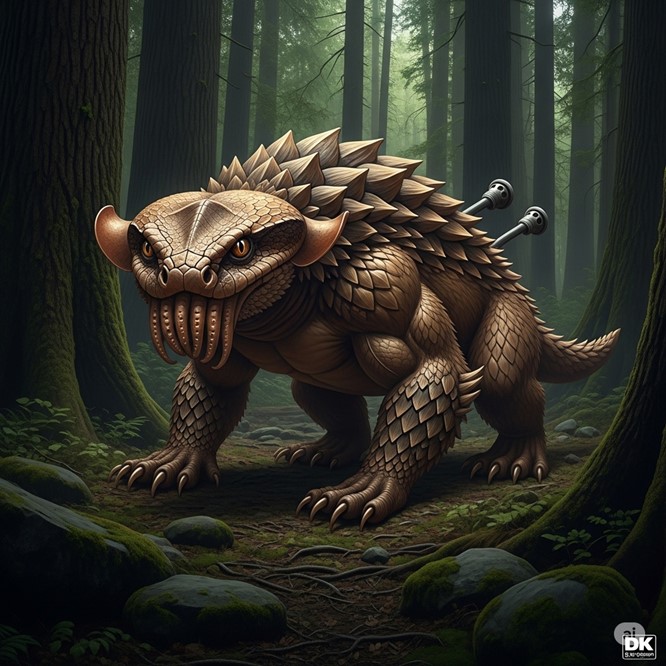
Appearance The Chimeras-Viperidae 9 is a terrifying fusion of mammalian ferocity and reptilian stealth, layered with unnatural adaptations. It possesses the powerful, low-slung, and muscular body of a wolverine, giving it a distinct “don’t mess with me” posture. Its head is wide and spade-shaped like that of a Gaboon viper, with large, forward-facing eyes that have the uncanny, W-shaped pupils of a cuttlefish. Inside its powerful jaw are enormous, retractable fangs, capable of delivering a potent neurotoxin. Its body is not covered in fur, but in a sequence of overlapping, chitinous plates reminiscent of a beetle’s carapace. This plating is not a single color; instead, it is covered in a network of chromatophores, allowing the creature to shift its patterns and colors with hypnotic speed, blending into its surroundings or displaying shocking threat patterns. The creature’s five-toed feet are wide, like a wolverine’s, but end in thick, non-retractable chitinous claws used for traction and tearing. At its rear, just above a short, stubby tail, are two small, hardened nozzles, the external apparatus of its chemical defense system.
Size An adult specimen stands approximately 2 to 2.5 feet tall at the shoulder, measures 4 to 5 feet in length from snout to tail, and weighs between 70 and 100 pounds. Its dense musculature and chitinous plating make it deceptively heavy for its size.
Speed The creature is not a sprinter built for long pursuits. Its movement is a powerful, rolling gait on land, capable of surprising bursts of speed over short distances. It excels at ambush, moving with an unnerving combination of a viper’s stillness and a wolverine’s explosive charge. It is also a surprisingly capable climber, using its powerful limbs and sharp claws to scale rocky terrain and large trees.
Stat Modifiers
- Strength: High
- Constitution: High
- Dexterity: Moderate
- Intelligence: Moderate (possesses an unsettling, predatory cunning)
- Wisdom (Perception): High
- Charisma: Very Low (it is an intimidating and terrifying creature)
Skills
- Stealth: Masterful. Its ability to remain perfectly still for hours, combined with its active camouflage, makes it nearly impossible to spot before it strikes.
- Intimidation: Its threat displays, involving flashing colors, hissing, and revealing its enormous fangs, are highly effective.
- Survival: An expert hunter and tracker within its chosen territory.
- Perception: Keen eyesight and an excellent sense of smell.
Behavior The Chimeras-Viperidae 9 is a solitary and intensely territorial ambush predator. It spends the vast majority of its time motionless, perfectly camouflaged, and waiting for prey to wander within striking distance. It exhibits the patience of a viper, the cunning of a cuttlefish, and the unyielding ferocity of a wolverine. If its ambush is successful, it will strike with its venomous fangs and then pursue the envenomed prey with dogged tenacity. If threatened or cornered, it will not hesitate to attack creatures many times its size. Its first line of defense against a rear attack is its chemical spray—a boiling, noxious blast of chemicals. Its second, and final, line of defense is an all-out explosion of violence, using its claws and fangs to devastating effect.
Diet Strictly carnivorous. It is capable of taking down prey as large as deer or wild boar, but will opportunistically hunt anything it can ambush and kill. It is not a picky eater and will also scavenge from fresh carcasses if the opportunity arises.
Emotions Its emotional range is primal and centered on survival. It primarily exhibits a patient, cold-blooded predatory focus, which can explode into incandescent rage when it is threatened, injured, or its territory is challenged. It can also display a high degree of cunning, suggesting a cognitive ability beyond simple instinct.
Environment Where Found The creature thrives in environments that offer dense cover and a wide variety of prey. It is most commonly found in old-growth forests, swamps, and humid jungles with thick undergrowth and rocky outcrops. It dens in caves, hollowed-out logs, or dense thickets, and its territory is often marked by the strange, acrid smell of its chemical spray.
Tags: Feral, Beast, Monster, Solitary, Ambusher, Poisonous, Territorial, Chitinous, Camouflage, Caustic, Carnivore, Predator, Venomous, Durable, Cunning, Hybrid, Magical Beast, Chromatic, Rage
Age
The Chimeras-Viperidae 9 possesses an unusually long lifespan for such an aggressive and metabolically active creature, a trait attributed to the potent mixture of vital energies from its component life forms.
- Lifespan: An individual can live for 40 to 50 years, growing larger, more cunning, and more territorial with each passing decade.
- Hatchling: The life cycle begins not with a live birth, but with a clutch of leathery, fist-sized eggs laid in a secluded, warm, and humid den. The hatchlings are grub-like and vulnerable, resembling large, chitin-plated larvae. They are blind and rely on a keen sense of smell, subsisting on carrion brought back to the den by the mother.
- Juvenile: After several months, the larva molts into its mobile juvenile form. At this stage, it is roughly the size of a small dog. Its venom is less potent, and its chromatophores are not yet fully developed, primarily offering mottled brown and green patterns for hiding. Juveniles are more reckless and prone to attacking anything that moves, leading to a high mortality rate.
- Adult: Reaching maturity at around three years of age, the adult is the formidable creature described previously. Its abilities are fully developed, and it has established a hunting territory that can span several square miles.
- Elder: A rare specimen that survives for multiple decades is known as an Elder. These individuals can be significantly larger than a typical adult, with more complex and intricate skin patterns. Their cunning is legendary, and they are known to set simple traps or use their environment with deliberate intelligence. Their venom becomes more complex, often resisting simple antidotes.
Tactics
The creature’s tactics are a terrifying blend of patience, deception, and overwhelming ferocity. It is an ambush predator at heart and will almost never engage in a prolonged, open chase.
- The Patient Ambush: Its primary tactic is to find a high-traffic area within its territory and wait. Using its Chromatic Shift, it will blend seamlessly into the surrounding environment—becoming part of a rock face, a mossy log, or a patch of leafy undergrowth. It can remain perfectly motionless for hours, waiting for prey to enter its strike zone.
- Hypnotic Assault: Just before striking, it may use its Chromatic Shift not to hide, but to dazzle. It can produce a rapid, pulsating wave of confusing colors and patterns across its body. This display can mesmerize or disorient prey for the split second it needs to launch its attack, ensuring its venomous bite finds its mark.
- Venom and Tenacity: Once the initial bite is delivered, the creature’s tactics shift. If the prey is small, it will hold on and tear with its claws. If the prey is large, it will retreat a short distance and begin a relentless, unyielding pursuit, following the envenomed creature with the tenacity of a wolverine until the neurotoxin paralyzes it completely.
- Defensive Deterrence: When confronted by a threat it deems superior, or if attacked from behind, it will use its Caustic Blast to cover a retreat. The goal is to create a screen of noxious vapor and pain, allowing it to escape into the dense terrain it calls home.
Actions
- Multi-attack: The creature can chain its attacks in a single, ferocious flurry. It can make two attacks with its claws and one venomous bite.
- Chitinous Claws: A tearing melee attack using its heavy, sharp claws. This attack is meant to shred armor and flesh, causing deep wounds and bleeding.
- Venomous Bite: The creature’s primary attack. It lunges forward, unhinging its wide jaw to sink its massive, retractable fangs deep into a target. This attack delivers a potent neurotoxin that causes immediate, spreading paralysis, intense pain, and eventual respiratory failure.
- Caustic Blast: The creature can aim the nozzles at its rear and eject a 15-foot cone of boiling, noxious chemicals. Anything caught in the blast suffers from severe chemical burns and is often blinded or choked by the acrid vapor. This ability has a short recharge period as the internal glands must mix a new batch of reactants.
- Chromatic Shift: As a fluid, nearly instantaneous action, the creature can alter the color and pattern of its entire body. This can be used to become nearly invisible against a chosen background, granting it a massive advantage when attempting to hide. Alternatively, it can be used to create a dazzling, confusing display of shifting patterns to mesmerize an opponent.
Other Interesting Information
- Origin: Most scholars in Saṃsāra believe the Chimeras-Viperidae 9 is not a naturally evolved species. Its combination of traits from wildly different animal classes suggests it is the result of a magical catastrophe or a deliberate, twisted experiment by a powerful biomancer in the forgotten ages. No two specimens share the exact same geometric patterns on their chitin, leading some to believe each one is a unique reincarnation of a singular, tormented soul.
- Ecological Role: As an apex predator, it plays a crucial role in its local ecosystem by keeping populations of other large herbivores and predators in check through sheer aggression and territoriality. Areas known to house a Chimeras-Viperidae are often given a wide berth by other dangerous creatures.
- Lair: The creature does not build a nest. It claims an existing, defensible location like a cave, a large hollow log, or a dense, thorny thicket as its den. These lairs are often identifiable by a collection of bleached bones near the entrance and the distinct, acrid scorch marks on the surrounding foliage from its defensive spray.
- Harvestable Components: Avatars who manage to slay one of these beasts can harvest valuable and rare components. Its fangs are prized by assassins for creating poison-delivery systems. Its venom sacs contain potent neurotoxins highly sought after by alchemists. The glands for its caustic blast can be used in the creation of alchemical bombs. Most valuable of all is its chitinous hide, which, if carefully removed, can be crafted by a master armorer into a suit of light armor that retains some of the creature’s camouflage properties.
A party of adventurers would be exceptionally unlucky to encounter a Chimeras-Viperidae 9 by accident, and exceptionally brave or foolish to seek one out on purpose. This creature is not a common pest; it is a localized apex predator, a living catastrophe that wise travelers mark on their maps as a place to avoid. The reasons for an encounter, therefore, fall into two distinct categories: unfortunate circumstance or a high-stakes, specific quest.
Incidental Encounters
These encounters happen not because the party is the target, but because they have unknowingly trespassed into the creature’s domain. The Chimeras-Viperidae does not hunt for sport; it hunts for survival and kills to protect its territory.
- Territorial Trespass: This is the most common reason for an accidental encounter. The adventurers’ path—perhaps a forgotten road to some ancient ruins, a shortcut through a dense jungle, or the tracking route for another quarry—leads them directly into the heart of a Chimeras-Viperidae’s territory. The party might first notice the unsettling quiet, the lack of other wildlife, or the faint, acrid smell of the creature’s chemical spray clinging to the air. By the time they see the bleached bones arranged around its den, they are already deep within the kill zone, and the camouflaged beast is already watching them.
- Lured into the Lair: The creature is cunning and instinctively understands how to use its environment. An older, more intelligent specimen might make its lair in or near a location that naturally attracts outsiders. Adventurers following a map to a crumbling temple, a crashed airship, or a grove of rare alchemical plants might find themselves being funneled down a path that offers perfect ambush opportunities. They believe they are approaching their goal, when in fact they are walking directly into the monster’s carefully chosen hunting ground.
- The Interrupted Kill: The party could stumble upon the creature in the middle of its own hunt. They might hear the sounds of a struggle and, thinking it’s a lesser beast like a wild boar, rush in to get an easy meal or hide. Instead, they find the Chimeras-Viperidae standing over its fresh kill. Having been interrupted, the intensely territorial creature would immediately redirect its incandescent rage toward the new intruders.
Purposeful Quests
No one hunts a Chimeras-Viperidae 9 for sport. The risks are far too great. A purposeful quest is always motivated by the need for one of the creature’s unique and incredibly valuable biological components. These are high-paying, high-risk jobs posted by desperate or ambitious individuals.
- The Alchemist’s Reagents (Caustic Glands): A master alchemist or an agent from a steam-works guild posts a lucrative contract. They require the catalytic chemicals found only within the creature’s defensive glands. These reactants are needed to create a universal solvent capable of dissolving magical wards, or perhaps a new, volatile fuel source for advanced engines. The challenge is not just killing the beast, but subduing it in a way that forces it to expend as little of its precious chemical spray as possible.
- The Healer’s Antitoxin (Venom Milking): A person of great importance—a noble, a guild master, a beloved child—has been afflicted by a complex, paralytic poison that defies all known antidotes. A master physician determines that the only known biological agent complex enough to synthesize an anti-venom is the neurotoxin produced by the Chimeras-Viperidae. This is not a simple hunt. The party must capture the beast alive, or at the very least restrain it long enough to milk its venom glands—a task requiring immense skill, specialized equipment, and unthinkable bravery.
- The Armorer’s Masterpiece (Chromatic Chitin): A legendary armorer has a vision: to create a suit of light armor that can actively change its color and pattern to blend in with its surroundings. The only known source for such a material is the chromatophore-laced chitin plating of an adult Chimeras-Viperidae. The armorer offers a king’s ransom for a large, pristine hide, with bonuses for size and the vibrancy of the colors. The difficulty lies in slaying the beast without riddling its valuable hide with holes and scratches.
- The Scholar’s Obsession (Live Capture): A reclusive biomancer or a researcher from a major university is obsessed with the creature’s chimeric nature. They believe that understanding how four different animal classes could be merged into one stable life form could unlock the secrets of life, death, and reincarnation on Saṃsāra. They hire the party for what is considered an insane task: to capture a juvenile specimen alive. This requires non-lethal tactics, complex traps, and a method of transporting a creature that is both terrified and homicidally aggressive.
- The Assassin’s Edge (Hollow Fangs): A representative from a shadowy guild puts out a discreet but high-paying contract for the fangs of an Elder specimen. These fangs, being naturally hollow, incredibly durable, and capable of piercing armor, are the perfect raw material for crafting the ultimate poison-delivery weapon: a dagger that injects venom on impact, or a nigh-unbreakable blowgun dart. The contract stipulates that the fangs must be intact, a difficult feat when fighting such a powerful creature.
Beyond the previously mentioned fangs, venom, hide, and caustic glands, the corpse of a Chimeras-Viperidae 9 is a treasure trove of rare and potent biological components. A skilled harvester with knowledge of alchemy, anatomy, and engineering can procure a wealth of valuable and unique ingredients, assuming they survive the process of acquiring the corpse.
Here are additional items and ingredients that can be harvested and their uses:
1. Cuttlefish Eye Lenses
- Harvestable Item: The creature’s large, W-shaped, crystalline eye lenses. They are surprisingly hard and refract light in strange, hypnotic patterns.
- Use: When carefully extracted and ground into a fine powder by a skilled alchemist, these lenses are the primary reagent in potions of Aura Sight or Glimmer-Piercing. An unguent made from the powder and applied to the eyelids can grant the user temporary ability to see the polarized light often associated with low-level illusionary magic, causing such spells to appear as a shimmering, oily haze. For artisans, a whole, polished lens can be set into the eyepiece of a navigator’s scope or surveyor’s transit to help reduce glare and clarify distant images in a way normal glass cannot.
2. The Viper Cranial Plate
- Harvestable Item: The single, large, spade-shaped plate of bone that forms the top of the creature’s skull. It is incredibly dense and carries a faint, rhythmic vibration even after death.
- Use: This plate is too dense to be easily worked by common smiths, but a master carver or runewright can shape it. When incorporated as the central boss of a shield, it retains its unsettling vibratory properties; a solid blow to the shield will cause the boss to emit a deep, disorienting hum that can unnerve an attacker. Powdered shavings from the plate are also used in fear-inducing alchemical powders or as an incense burned by shamans attempting to commune with predatory spirits.
3. The Wolverine’s Heart
- Harvestable Item: The creature’s heart is disproportionately large and dense for its body size, a testament to the wolverine’s tenacity. The muscle tissue is tough and shot through with potent energetic pathways.
- Use: For many warrior cultures, consuming the prepared heart of a Chimeras-Viperidae is a sacred rite of passage. It is believed to temporarily bestow the diner with a measure of the beast’s unyielding ferocity, allowing them to ignore minor wounds and fight past the point of normal exhaustion. Alchemists render the heart down to create potent Potions of Rage or Draughts of Endurance, highly valued by pit fighters and shock troops.
4. Tenacious Limb Sinew
- Harvestable Item: The long, fibrous, and incredibly strong tendons harvested from the creature’s powerful limbs. Even after being removed, they resist being stretched or cut.
- Use: Once properly cured and treated, this sinew is one of the strongest and most resilient organic fibers known. Master bowyers use it to create bowstrings for greatbows that can handle immense draw weights without snapping. Engineers and artificers use the cords in the construction of high-tension springs for advanced steam-werk, complex traps, and even the internal mechanisms of large clocks or automatons.
5. Venom Gland Membrane
- Harvestable Item: The tough, flexible, and semi-permeable sac that contains the neurotoxin. It must be carefully removed and thoroughly cleaned of any residual venom.
- Use: This membrane has unique filtration properties. Alchemists use it to create the most effective filters for gas masks or alchemical respirators, as it can neutralize a wide variety of airborne toxins. A small piece of the membrane can be fashioned into a “purifying pouch.” When a liquid is stored inside it, the membrane will slowly leech out and neutralize any common poisons over the course of several hours.
6. The Chimeric Core
- Harvestable Item: This is the rarest component, found only in Elder specimens. It is a small, stone-like, crystalline concretion, often no larger than a thumb, located at the nexus of the creature’s nervous and circulatory systems. It appears as a dark, swirling crystal with flashes of colored light deep within. It is the physical manifestation of the creature’s conflicting vital energies, harmonized into a single, potent focus.
- Use: The Chimeric Core is a legendary magical component. A biomancer who possesses one can use it as a powerful focus for spells involving transmutation, hybridization, or regeneration. If the Core is carefully ground down and ingested (a very dangerous act), it can grant the user a temporary, unstable version of one of the creature’s abilities, such as a single caustic spit or a few moments of perfect camouflage, often with unpredictable and dramatic side effects. When set into a staff or scepter by a master runecrafter, it creates a powerful and chaotic magical implement, highly prized by experimental mages.
Weaver Who Wove With Life
From the time of whispers, long before the great steam-works, comes a story of a man who thought his mind was greater than the world. He was known as the Weaver, for he did not work with thread, but with the flesh and bone of living things. He lived in a stone tower in the deep woods where the sun was afraid to look. The Weaver saw the beasts of the forest and the fish of the sea, and he was not happy. He said, “The world is a clumsy child that has made these things. I am a master, and I will make a thing that is perfect.”
And so, the Weaver began his great and terrible work. First, he sought the purest rage. He went to the cold mountains and trapped a great wolverine, a beast of white-hot hunger with claws of black glass. From it, he took its heart of never-surrender and its unbending will. This, he said, would be the engine of his new creation.
Second, he sought the most patient deceit. He traveled to the wet jungles and found a Gaboon viper, as thick as a man’s leg and with a skin that held the pattern of the forest floor. From it, he took its hollow teeth of poison and its skin of many lies. This, he said, would be the clever skin and the deadly kiss of his new creation.
Third, he sought the deepest cleverness. He journeyed to the sea and caught a giant cuttlefish, a water-ghost whose skin was made of moving pictures and whose mind was full of many thoughts. From it, he took its strange seeing-eyes and its skin of changing color. This, he said, would be the seeing and the thinking of his new creation.
Fourth, he sought the strongest armor. He dug deep in the earth and found a bombardier beetle as large as a dog, a walking stone that spat hot liquid from its tail. From it, he took its shell of hardness and its glands of burning juice. This, he said, would be the unbreaking shield of his new creation.
The Weaver took these parts, these four spirits, back to his tower. He put them in a great stone pot. And he began to weave. He chanted the words that untie the knots of life. He stirred the pot with a staff of lightning-struck bone. The sky grew dark though it was midday. The Weaver commanded the Rage of the wolverine to live inside the Armor of the beetle. He commanded the Deceit of the viper to see through the Eyes of the water-ghost. He twisted the threads of life in a way they were not meant to be twisted. And the world groaned.
From the pot, a thing climbed out. But it was not perfect. It was a creature made of four agonies trapped in one body. The rage of the wolverine screamed inside the hard shell of the beetle. The slow poison of the viper fought with the quick thoughts of the cuttlefish. Its skin tried to be a forest floor and a moving picture at the same time, and so it rippled with colors of pain.
The Weaver raised his staff to command his creation. But the creature did not have one mind to command. It had four minds, all screaming. It looked at the Weaver, and it saw the source of its pain. It hissed with the viper’s hiss, and its skin flashed with the cuttlefish’s confusing lights. The Weaver was blinded. It charged with the wolverine’s speed, and the Weaver was knocked from his feet. As he lay on the stone floor, the creature turned, and from its back it shot the hot liquid of the beetle, and the Weaver’s robes began to burn. And last, it bent its head, and with the viper’s great fangs, it gave its master the kiss of poison.
The creature, in its rage and pain, destroyed the tower. It fled into the deep woods where the sun was afraid to look. And it was alone. And its children, born from the strange magic of its making, were also alone. And this is why the Chimeras-Viperidae hates all things, for it was born of a hate for the way things were, and it is made of four things that hate each other, trapped in one skin forever.
The moral of the story is: If you try to weave together the threads of life, do not be surprised when you are strangled by your own rope.
Suggested conversions to other systems:
Call of Cthulhu
The Gulo-Viper Amalgam Unnatural Biological Specimen
This creature is a singular horror, believed to be the result of forbidden biological experiments conducted by a rogue Miskatonic University professor who fled to the uncharted tropics. It is a testament to the unnatural fusion of life forms that should never have been combined, a walking, breathing violation of natural law.
STR: 80 CON: 90 SIZ: 60 DEX: 65 INT: 40 POW: 50 HP: 15 Move: 9 Build: 1 Damage Bonus: +1d6
Attacks:
- Claw: 1d6+1d6 damage, attacks twice per round. Fighting 55%.
- Bite: 1d8 damage + Venom. Fighting 45%.
Venom: A potent neurotoxin. A victim must make a Hard CON roll or suffer 1d10 damage and begin to feel their limbs grow heavy. A second failed CON roll on the following round results in full-body paralysis for 2d6 hours.
Special Abilities:
- Caustic Spray: Once per hour, the amalgam can spray a 15-foot cone of boiling chemicals from its rear. Anyone in the cone must make a Dodge or Hard DEX roll to avoid it. Failure results in 1d8 damage from chemical burns.
- Hypnotic Camouflage: When motionless in its natural habitat, the amalgam is exceptionally difficult to see, requiring a Hard Spot Hidden roll. Before it attacks from ambush, it may flash a dizzying array of hypnotic patterns on its hide. Anyone witnessing this must make a Sanity roll (0/1d3 SAN loss).
- Armour: Its chitinous plating provides 3 points of armour.
Skills: Stealth 75%, Track 60%.
Sanity Loss: 1/1d6 Sanity points to see the Gulo-Viper Amalgam.
Blades in the Dark
The Weavers’ Wrath A Forgotten God’s Abomination, A Demonic Hybrid
This isn’t just an animal; it’s a living curse left over from some forgotten tragedy in the Shattered Isles. The Weavers’ Wrath is a solitary, territorial horror that haunts the dense, ghost-haunted swamps and overgrown ruins far outside the city walls. Alchemists and Whispers prize its components, but a score to acquire them is considered a death sentence. It is a Tier III threat.
Qualities:
- Terrifying: Its unnatural form and aggressive displays are enough to break the will of hardened scoundrels. (Causes level 2 Harm Terrified).
- Supernaturally Tough: Its chitinous plates and tenacious life force make it incredibly difficult to put down. (Requires multiple sources of harm or a specific weakness to be exploited).
- Perfect Ambusher: Uses its unnatural camouflage to strike without warning. (Begins conflicts by inflicting harm before the crew can react).
- Debilitating Venom: Its bite delivers a fast-acting paralytic agent. (Inflicts level 2 Harm Paralyzed).
- Caustic Defense: Sprays a boiling chemical that melts flesh and equipment. (Can destroy a piece of a PC’s gear or inflict level 3 Harm Melted).
Clocks:
- Stalking the Intruders: (6-clock) When filled, it launches a devastating ambush.
- Venom Takes Hold: (4-clock) When a PC is bitten, start this clock. When filled, their harm is upgraded to Level 3 Near Death.
- Enraged Frenzy: (8-clock) When it takes significant harm, start this clock. It will fight to the death, ignoring lesser wounds until this clock is filled, at which point it collapses.
Dungeons & Dragons
Gulovipex Medium monstrosity, unaligned
Armor Class 16 (natural armor) Hit Points 93 (11d8 + 44) Speed 30 ft., climb 30 ft.
STR 18 (+4), DEX 14 (+2), CON 19 (+4), INT 5 (-3), WIS 14 (+2), CHA 7 (-2)
Skills Perception +5, Stealth +8 Damage Resistances Poison Senses Darkvision 60 ft., passive Perception 15 Languages — Challenge 5 (1,800 XP)
Chromatic Camouflage. The gulovipex has advantage on Dexterity (Stealth) checks made to hide in forest or rocky terrain.
Relentless (Recharges after a Short or Long Rest). If the gulovipeg takes 14 damage or less that would reduce it to 0 hit points, it is reduced to 1 hit point instead.
Actions Multiattack. The gulovipex makes three attacks: one with its bite and two with its claws.
Bite. Melee Weapon Attack: +7 to hit, reach 5 ft., one target. Hit: 8 (1d8 + 4) piercing damage, and the target must make a DC 15 Constitution saving throw, taking 14 (4d6) poison damage on a failed save, or half as much damage on a successful one. If the poison damage reduces the target to 0 hit points, the target is stable but poisoned for 1 hour, even after regaining hit points, and is paralyzed while poisoned in this way.
Claws. Melee Weapon Attack: +7 to hit, reach 5 ft., one target. Hit: 11 (2d6 + 4) slashing damage.
Caustic Spray (Recharge 5–6). The gulovipex sprays a boiling chemical in a 15-foot cone. Each creature in that area must make a DC 15 Dexterity saving throw, taking 22 (4d10) acid damage on a failed save, or half as much damage on a successful one.
Knave
Chimeric Rage-Viper HP 10, Armor 13 (chitin plates), Morale 11, Bite/Claw +5 (d8/d6)
Qualities: Tenacious, Cunning, Territorial.
- Ambush Predator: When motionless in its forest or swamp habitat, it is completely invisible. Anyone approaching must succeed on a Wisdom save or be surprised.
- Venomous Bite: Anyone taking damage from its bite must make a Constitution save vs poison (DC 15) or become paralyzed after d4 rounds. A new save can be attempted every hour.
- Caustic Spray: Once per combat, it can spray a 15-foot cone behind it as its action. All targets in the cone take d8 damage (Constitution save for half).
- Unstoppable Rage: The creature continues to act for one full round after reaching 0 HP. It will use this round to attack the creature that felled it. It only dies instantly if it takes a critical hit or is decapitated.
- Armored Hide: Its chitinous plates provide Armor 13. However, its softer underbelly has an effective Armor of only 10. A character can make a “called shot” to target the underbelly at a disadvantage.
Fate
The Weaver’s Abomination
This creature is a significant threat, suitable as a major antagonist for a scenario. It is a being of conflicting instincts and potent natural weaponry, driven by a pain that it seeks to inflict upon the world.
- High Concept: Territorial Amalgam of Rage and Deceit
- Trouble: A Mind at War With Itself
- Other Aspects: Hide of Shifting Patterns, Venom-Tipped Fangs, Unstoppable Ferocity
Skills:
- Superb (+5): Physique
- Great (+4): Fight
- Good (+3): Athletics, Stealth
- Fair (+2): Notice
- Average (+1): Will
Stunts:
- Caustic Burst: Once per scene, the Abomination can make a special Physique attack against every target in its zone.
- Perfect Ambush: The Abomination has permission to already be in the scene when it starts, perfectly hidden. It can inflict a 2-stress physical hit on a single character before the first round of combat begins.
- Paralytic Venom: When the Abomination succeeds with style on a Fight attack using its fangs, it can choose to attach the Paralyzing Venom situation aspect to the target with one free invocation, instead of reducing the stress shift by one.
Stress: [1] [2] [3] [4] Consequences: One Mild, one Moderate
Numenera & Cypher System
The Chromatophore Mauler
A bio-engineered predator from a prior world, this creature is a masterful synthesis of several organisms. It is a cunning, territorial beast that uses deception and overwhelming force in equal measure.
- Level: 5 (attacks as level 6 due to its ferocity)
- Health: 20
- Damage Inflicted: 5 points
- Armor: 2
- Movement: Short
- Modifications: Stealth as level 7 due to its active camouflage.
- Combat: The mauler attacks with a flurry of claws and a venomous bite. A character damaged by the bite must succeed on a Might defense roll or the toxin paralyzes them, preventing them from taking any physical actions on their next turn. Its hide of shifting colors is confusing; all tasks to attack the mauler are hindered by one step.
- GM Intrusion: The creature turns and fires a spray of boiling chemicals from nozzles on its back. This attack inflicts 4 points of ambient damage on any character in short range behind it and creates a zone of noxious, obscuring vapor.
Pathfinder
Chimeric Ambusher — Creature 4 Uncommon, Aberration, Beast Perception +12; darkvision Skills Acrobatics +11, Athletics +13, Stealth +13 Str +5, Dex +3, Con +4, Int -3, Wis +2, Cha -2
AC 21; Fort +12, Ref +11, Will +8 HP 65; Resistances poison 5
Wolverine’s Fury [reaction] Trigger The chimeric ambusher takes damage from a creature within its reach; Effect The ambusher makes a claw Strike against the triggering creature.
Actions Speed 30 feet, climb 20 feet
Melee [one-action] Jaws +13 (deadly d10), Damage 2d8+5 piercing plus Chimeric Venom
Melee [one-action] Claw +13 (agile), Damage 2d6+5 slashing
Caustic Spray [two-actions] The ambusher sprays a boiling chemical in a 15-foot cone. Each creature in the cone must make a DC 21 Reflex save.
- Critical Success The creature is unaffected.
- Success The creature takes 2d6 acid damage.
- Failure The creature takes 4d6 acid damage and 1d6 persistent acid damage.
Chimeric Venom (poison) Saving Throw DC 21 Fortitude; Maximum Duration 6 rounds; Stage 1 1d6 poison damage and clumsy 1 (1 round); Stage 2 1d6 poison damage and clumsy 2 (1 round); Stage 3 1d6 poison damage and paralyzed (1 round).
Sudden Lunge [two-actions] The ambusher Strides up to twice its Speed. If it ends its movement within melee reach of at least one enemy, it can make a single Jaws Strike against that enemy.
Savage Worlds
The Rage-Viper (Wild Card)
This creature is a terrifying predator, a fusion of rage, venom, and deception. It is often the apex predator of its domain, a solitary boss monster that requires significant planning to take down.
Attributes: Agility d8, Smarts d6(A), Spirit d8, Strength d10, Vigor d10 Skills: Athletics d8, Fighting d10, Intimidation d8, Notice d8, Stealth d10 Pace: 6; Parry: 7; Toughness: 9 (2)
Edges: Berserk (when Shaken, its melee damage is +2), First Strike
Special Abilities:
- Armor +2: Hardened chitinous plates.
- Bite/Claws: Str+d8.
- Camouflage: The creature’s hide shifts color and pattern. This imposes a -2 penalty on Notice rolls to spot it when it’s still or moving slowly.
- Fear (-2): The creature’s unnatural appearance and aggressive displays cause a Fear check at -2.
- Poison (Venom): Anyone Shaken or wounded by a Bite attack must make a Vigor roll. Failure means they suffer a level of Fatigue. A Critical Failure means they are Paralyzed. Fatigue can be recovered at a rate of one level per hour. Paralysis lasts for 2d6 hours.
- Caustic Spray: As an action, the creature can spray a Cone Template from its rear. All targets in the template must make an Agility roll versus the creature’s Athletics. Those who fail suffer 2d10 damage.
Shadowrun
The Chromacore Stalker (Paranormal Critter)
The Chromacore Stalker is a terrifying example of magical pollution’s effect on native wildlife, or perhaps the escaped result of a corporate gene-splicing project gone horribly wrong. It blends the ferocity of an awakened wolverine with the stealth of a viper and the unnatural defenses of augmented insects and cephalopods. It is a highly aggressive, territorial predator found in remote, magically dense forests and toxic swamp zones.
Attributes:
- Body: 7
- Agility: 5
- Reaction: 5
- Strength: 6
- Willpower: 4
- Logic: 2
- Intuition: 4
- Charisma: 2
- Edge: 2
- Magic: 6
- Initiative: 9 + 2d6
Skills:
- Perception: 5
- Stealth: 6
- Unarmed Combat: 5
Powers:
- Armor: 8
- Chameleon Skin: Provides a +3 dice pool bonus to Stealth tests.
- Natural Weapon (Bite/Claws): Damage Value (DV) of (STR + 2)P, AP -1.
- Venom: A target hit by the bite attack must resist 8P damage and make a Body + Willpower (3) test. Failure results in the victim suffering the Paralyzed condition, their muscles locking up for 1d6 combat turns.
- Chemical Spray: Ranged attack, DV 7P (chemical), AP -2, with a range of 10 meters. The creature can use this once every 3 combat turns.
Starfinder
The Gulon Ambusher CR 4 XP 1,200 N Medium magical beast Init +3; Senses darkvision 60 ft., low-light vision; Perception +10
Defense EAC 16; KAC 18 HP 55 Fort +8; Ref +8; Will +3 Resistances poison 5
Offense Speed 30 ft., climb 20 ft. Melee bite +12 (1d6+7 P plus venom) or claw +12 (1d6+7 S) Offensive Abilities multiattack (bite, 2 claws)
Statistics Str +3; Dex +3; Con +5; Int -3; Wis +1; Cha -1 Skills Athletics +10, Stealth +15
Special Abilities Chromatic Skin (Ex): The gulon ambusher can change the color of its skin to match its surroundings. When it attempts to hide, it gains a +5 racial bonus to Stealth checks. It can also create a dazzling display of colors as a standard action; any creature within 30 feet that can see the display must succeed at a DC 13 Will save or be fascinated for 1 round. Venom (Ex): A creature hit by the gulon ambusher’s bite attack must succeed at a DC 13 Fortitude save or be paralyzed for 1d4 rounds. Caustic Burst (Ex): Once every 1d4 rounds, the gulon ambusher can spray a 15-foot cone of boiling chemicals. Creatures in the area take 4d6 acid damage (DC 13 Reflex save for half).
Traveller
Ambush Predator (Guloform-B)
This creature is a highly aggressive predator native to worlds with dense, competitive ecosystems. It combines the traits of multiple terrestrial lifeforms into a single, brutally efficient killing machine. Its hide shifts in color, making it a nightmare to spot before it attacks. It is notoriously difficult to dislodge from a territory once it has established a lair.
(Guloform-B) 9A9A44- C Skills: Stealth-2, Athletics-1, Melee(natural)-2, Recon-1 Pace: 10m Damage: 3d6 (claws/bite) Armor: Chitin Plates (Armor 3) Traits: Enhanced Senses (Scent), Territorial
Special Abilities:
- Camouflage: The creature’s hide can change color and pattern, granting DM+2 to all Stealth checks in its native environment. Attacks against it suffer a DM-1 penalty due to the disorienting display.
- Venom: A target hit by a bite attack must make an Endurance 10+ check. Failure indicates the potent neurotoxin takes hold, causing paralysis in 1d6 minutes. The paralysis lasts for 2d6 hours.
- Caustic Jet: As an attack, the creature can fire a jet of corrosive chemicals up to 10m. This is an Athletics (dexterity) 8+ attack that inflicts 3d6 damage on a successful hit.
Warhammer Fantasy Roleplay
The Rage-Maw Ambusher
A terrifying beast of the deep woods, the Rage-Maw is a creature so unnaturally conceived that scholars suspect it is a manifestation of Chaos, a creature twisted by the winds of magic into a form of pure predatory rage. It is a solitary hunter whose territory is marked by an eerie silence and the half-dissolved remains of its prey.
Main Profile WS 55, BS 0, S 50, T 55, I 45, Ag 40, Dex 30, Int 15, WP 45, Fel 10
Traits: Armour (2), Bite (5), Creature, Fear (2), Hardy, Poison, Stealthy, Territorial, Venom, Weapon (Claws) +9 Skills: Athlethics 50, Climb 60, Endurance 65, Intimidate 60, Perception 55, Stealth (Rural) 60
Special Abilities:
- Chromatic Hide: The creature’s chitinous hide shifts and writhes with disorienting patterns. Any character targeting it in combat suffers from a -10 penalty to their Weapon Skill Tests.
- Unstoppable Fury: If the Rage-Maw suffers a Wound, it may immediately make a free Bite attack as a reaction against the creature that wounded it.
- Caustic Spray: As a Full Action, the creature can spray a cone of boiling chemicals. All targets within 4 yards must make an Opposed Agility/Dodge Test against the creature’s Agility of 40. Those who fail suffer 1 Bleeding Condition and must make a Challenging (+0) Endurance Test or gain 1 Blinded Condition for 1d5 rounds.
- Venom: A character hit by the creature’s Bite must make a Difficult (-10) Endurance Test or suffer the Paralyzed Condition for a number of rounds equal to the amount they failed the Test by.