
Original Life Forms Referenced
- Reptilia: Jackson’s Chameleon (Trioceros jacksonii)
- Aves: Shoebill Stork (Balaeniceps rex)
- Chondrichthyes: Sawfish (Pristidae family)
- Insecta: Bombardier Beetle (Brachinini tribe)
Appearance: The Chamaebill Sawardier is a nightmarish fusion of its progenitors. Its quadrupedal body has the deliberate, swaying gait of a chameleon, supported by four powerful legs ending in zygodactylous (grasping) feet perfect for climbing on rough terrain or thick branches. Its skin is a thick, leathery hide that can shift in color and pattern with startling speed, allowing it to blend into its surroundings. From its spine erupts a ridge of stiff, feather-like bristles. The head is distinctly reptilian, featuring the three horns and independently swiveling turret-eyes of a Jackson’s Chameleon. Instead of a chameleon’s mouth, however, it possesses the massive, hooked, and terrifyingly sharp-edged beak of a shoebill stork. Protruding from the front of this beak is the long, flat rostrum of a sawfish, lined on both sides with wicked, tooth-like denticles. A long, prehensile tail, often kept coiled, provides balance and a fifth gripping point.
Size: This creature is roughly the size of a large, stout mastiff or a small panther. It stands about 3 feet tall at the shoulder and measures 4 to 5 feet from beak-base to rump, with its saw-rostrum adding another 2 to 3 feet and its tail adding an additional 4 feet when uncoiled. It is dense and powerfully built, weighing between 150 and 200 pounds.
Speed: The Sawardier is not a creature of sustained speed. It moves with the slow, patient deliberation of a chameleon, often remaining perfectly motionless for hours at a time. However, it is capable of shockingly fast lunges and powerful, rapid swipes with its saw-like rostrum when attacking or defending itself. Its climbing speed is moderate and secure.
Stat Modifiers: This creature’s physical form suggests the following modifiers for an avatar’s gear seeking to emulate its abilities:
- Strength: +3
- Perception: +2
- Intellect: -3
- Agility: -1
- Charisma: -4
Skills
- Camouflage: Its ability to change skin color and remain motionless makes it exceptionally difficult to spot.
- Climbing: Its grasping feet and prehensile tail allow it to navigate difficult terrain, trees, and ruins with ease.
- Intimidation: Its horrifying appearance—the unblinking stare, the massive beak, the horns, and the saw—is often enough to deter potential threats.
- Ambush: It is a master of the surprise attack, using its patience and camouflage to strike when prey is most vulnerable.
- Perception: Its independently moving eyes grant it a nearly 360-degree field of vision, making it very difficult to sneak up on.
Behavior: A solitary and highly territorial ambush predator. The Chamaebill Sawardier will find a location with good cover overlooking a source of water or a game trail and wait with inhuman patience for prey to wander within range. It is largely silent, its only vocalization a loud, machine-like clattering of its beak to warn off intruders. When it attacks, it does so with explosive speed, aiming to cripple prey with its saw before finishing it with its crushing beak. Its most unique defensive behavior is adapted from the bombardier beetle; when cornered or seriously threatened, it can expel a boiling, noxious chemical spray from a specialized organ near its gullet, creating a cloud of painful, steaming vapor.
Diet: The Chamaebill Sawardier is a carnivore. Its diet consists of fish, large crustaceans, swamp-dwelling creatures, and any unwary animal or avatar up to its own size. It uses its rostrum to stir up sediment in the water to flush out prey or to slash at larger targets, then uses its powerful beak to crush shells, bones, and armor.
Emotions: As a feral creature, its emotional range is limited and primal. It operates on instinct, primarily driven by hunger and territorial defensiveness. It can display extreme aggression when its territory is challenged and unnerving patience when hunting. It is capable of fear and will retreat from overwhelming threats, often using its chemical spray to cover its escape. It does not form bonds and views all other creatures as potential food or potential threats.
Environment Where Found: This creature thrives in warm, humid, and magically-dense environments where there is abundant cover and water. It is most commonly found in the swamps, jungles, and river deltas of Saṃsāra’s island nations. They are particularly adept at living within overgrown and forgotten ruins, using the crumbling architecture as hunting perches. The marshy lowlands and tidal caves of a nation like Azilian would be a prime habitat.
Tags: Feral, Predator, Ambush, Reptilian, Avian, Camouflage, Horned, Saw-Rostrum, Chemical Defense, Swamp Dweller, Territorial, Solitary, Composite Beast, Crushing Beak, Turret Eyes, Prehensile Tail, Patient Hunter, Piscivore, Ruin Dweller, Noxious Spray
Age and Life Cycle: The lifespan of a Chamaebill Sawardier is relatively short and brutal, typically lasting 15 to 20 years in the wilds of Saṃsāra.
- Hatchling: The creature begins life by hatching from a large, leathery egg. At this stage, it is only a foot long, with a soft, rubbery rostrum and a beak that has not yet hardened. Lacking its adult weaponry and potent chemical defense, its only survival tool is its innate camouflage, which it uses to hide from the countless predators of the swamp. Mortality is extremely high at this stage.
- Juvenile (Years 1-3): After its first year, the Sawardier’s beak and rostrum harden into formidable weapons, and its three horns begin to sprout. It starts hunting small fish and insects, honing its ambush tactics. Its chemical spray begins to develop during this time, though it is weak and inconsistent.
- Maturity (Years 3-15): The creature reaches its full size and reproductive capability. This is the peak of its existence, where it is a dominant apex predator within its chosen territory. Its camouflage, weaponry, and chemical defenses are at their most potent.
- Elder (Years 15+): After 15 years, the Sawardier begins a slow decline. Its color-changing abilities may become patchy, its movements slower, and its saw-rostrum is often chipped or broken from a lifetime of conflict. Unable to effectively hunt or defend its territory from younger, stronger rivals, it is often forced into scavenging until it falls prey to another creature or starves.
Mating: As a fiercely solitary and territorial creature, mating is a rare, tense, and dangerous affair that occurs only once every few years.
- The Call: During the height of the wet season, a female Sawardier will find a secure location at the center of her territory and begin guarding a suitable nesting site. A male, sensing seasonal readiness through unknown primal means, will enter the general vicinity and emit a deep, low-frequency booming sound that travels through the water and mud, announcing his presence.
- The Courtship: The female will respond aggressively to the male’s approach. The male must prove his fitness and placate her. This is not a gentle ritual; he may present a fresh, impressive kill, dropping it at the edge of her territory as an offering. More commonly, the two will engage in a tense display, facing off and clattering their massive beaks while raising their horns. They may clash their saw-rostrums together, not to injure, but to create a loud, grating noise and test each other’s strength.
- Nesting and Abandonment: After mating, the male departs immediately, leaving the female to her task. She lays a small clutch of 2-4 large eggs in a shallow nest, which she buries with mud and decaying vegetation for camouflage and incubation. She will guard this nest with extreme aggression, not leaving its vicinity until the eggs hatch. Upon hatching, her parental duty is complete. The hatchlings scatter, and she abandons the site, offering no further protection or guidance.
Tactics: The Sawardier is a master of the patient ambush and uses its unique physiology with lethal efficiency.
- The Vigil: Its primary tactic is to select a strategic location—submerged in a murky pool, clinging to the underside of a ruin’s archway, or perfectly blended against a mossy tree—and enter a state of near-total stillness. It can remain motionless for days, its independently swiveling eyes monitoring its surroundings for any sign of prey.
- The Strike: The attack is a sudden, violent explosion of movement. It lunges from its hiding place, using its saw-rostrum in a powerful, sweeping slash. This initial strike is not always meant to kill, but to cripple, disembowel, or inflict a grievous bleeding wound that prevents the target from fighting back or escaping.
- The Kill: Once the prey is disabled and bleeding, the Sawardier closes in. It uses its powerful shoebill-like beak to crush bone, snap spines, or clamp down with immense force to end the struggle.
- Defense: When confronted by a threat, it first relies on intimidation, fixing its unblinking stare and clattering its beak. If pressed, it will use its long rostrum to keep enemies at a distance. The Noxious Outgassing is a defense of last resort, used only when it is trapped or near death, as the chemical glands take several days to fully recharge, leaving it vulnerable.
Actions
- Crushing Beak: A single, devastatingly powerful bite. This attack can easily shatter bone, punch through sturdy armor, and sever limbs.
- Rostrum Slash: A wide, sweeping arc with its serrated saw. This attack is designed to strike multiple times in one pass, leaving a series of deep, ragged wounds that cause severe bleeding.
- Prehensile Tail Grab: It can use its long, muscular tail to lash out and grapple a target, potentially pulling them off-balance, dragging them closer, or holding them in place for a subsequent attack.
- Noxious Outgassing: The creature rears up and expels a pressurized, conical cloud of boiling, foul-smelling chemicals. Any creature caught in the blast suffers from intense burning pain, temporary blindness, and choking fits as the vapor sears their lungs. This ability cannot be used more than once per day.
Other Interesting Information
- Alchemical Value: The gland that produces the Sawardier’s defensive chemical spray is a highly prized and dangerous reagent for alchemists. If harvested correctly, it can be used to create powerful acids, corrosive bombs, or potent smokescreen potions. This makes the creature a target for high-risk hunts by well-equipped avatars.
- Living Fossils: The serrated denticles from its rostrum are incredibly durable. They are often found embedded in ancient trees or the bones of long-dead creatures, and less experienced adventurers sometimes mistake them for the teeth of some much larger, unknown beast.
- Cultural Symbolism: Some isolated, swamp-dwelling societies revere the Sawardier as a spirit of death and patience. Its image is a common ward against trespassers, and its three horns are sometimes worn by tribal champions as a symbol of their martial prowess and connection to the savage nature of the swamp.
- The Unblinking Gaze: There is a persistent legend among those who live near its territory that the creature’s stare is a weapon in itself. They claim that to be caught in the dual, overlapping gaze of its independently swiveling eyes is to feel a primal terror that can freeze an avatar in place, a magical effect that is likely just a natural reaction to its utterly alien and horrifying appearance.
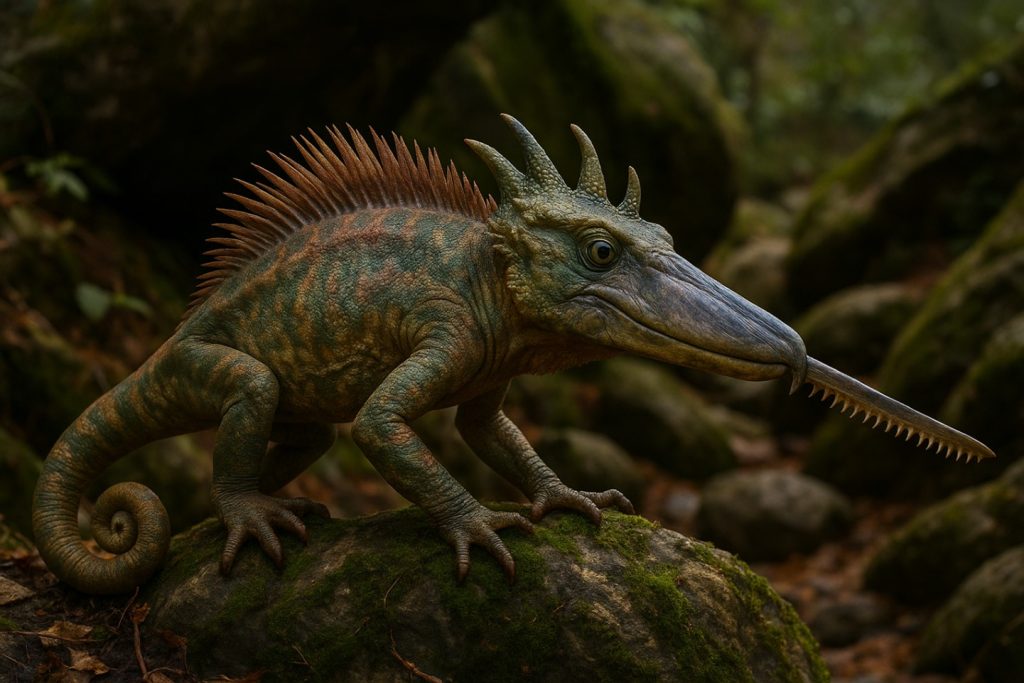
An adventuring party in the world of Saṃsāra might encounter or be tasked with finding a Chamaebill Sawardier 77 for a variety of reasons, ranging from accidental intrusion to high-stakes quests. Given the creature’s dangerous nature and unique physiology, interactions are rarely simple. Why a party would encounter or search for one:
1. The Accidental Encounter: Survival as the Goal
This is the most common and often most dangerous way to meet a Sawardier. The party is not looking for the creature; they have simply made a grave navigational error.
- Guardian of the Path: The adventurers are on a completely unrelated quest—seeking a forgotten ruin, retrieving a lost artifact, or mapping a new route through a jungle. They find that their destination is deep within a swampy, ruin-filled territory that a Sawardier has claimed as its lair. The creature is not guarding the objective intentionally; it simply lives there. The party must now figure out how to get past a perfectly camouflaged, territorial apex predator that has made their goal its home.
- The Wrong Shortcut: To save time on a journey, the party decides to cut through a dense, unmapped marshland. They unknowingly blunder into the hunting grounds of a Sawardier. Their first sign of its presence might be the unsettling sight of its turret eyes tracking them from the canopy, or the sudden, violent lunge from the murky water’s edge. The encounter becomes an immediate and desperate fight for survival.
2. The Hunt: Seeking a Valuable Resource
In these scenarios, the party is actively searching for the creature, fully aware of the dangers, because its unique biological components are immensely valuable.
- The Alchemist’s Reagent: A renowned alchemist has posted a lucrative contract for a rare ingredient: the intact chemical gland from a mature Chamaebill Sawardier. This gland, which produces the creature’s “Noxious Outgassing,” is a key component for creating powerful corrosive acids or military-grade smokescreen devices. The party must hunt the beast and perform a delicate extraction, making this a high-risk, high-reward mission.
- The Masterwork Weapon: A master weaponsmith, perhaps a Zel-Tar artisan from Azilian, requires the serrated rostrum of an elder Sawardier. The denticles on the saw are said to possess a natural, magical sharpness that cannot be replicated by normal forging. The smith intends to incorporate the saw into a legendary piece of gear—a sword that inflicts grievous, bleeding wounds. The quest requires the party to not only find a Sawardier but to target an older, more seasoned one whose rostrum is fully developed.
- The Trophy Collector: A wealthy and eccentric noble has offered a small fortune for the perfectly preserved head of a Chamaebill Sawardier. The collector is adamant that the trophy must have all three horns and the saw-rostrum fully intact. This is a quest driven by vanity, but the pay is substantial enough for a party to risk facing the creature purely for sport and profit.
3. The Quest: A Task of Local Importance
These quests are often given by local communities or factions who have a specific problem related to the creature.
- The Local Menace: A small village bordering a swamp reports that a “three-horned river demon” has been dragging away livestock and even lone villagers who wander too close to the water. They believe the creature is a malevolent spirit and have pooled their resources to hire the adventurers to eliminate the threat that their local hunters cannot handle.
- A Rite of Passage: A remote swamp-dwelling culture venerates the Sawardier as a totem of strength and patience. They have a rite of passage where their champions must hunt and kill one to prove their worth. The tribe might hire the adventurers to act as support and backup for their young champion, ensuring the ritual is completed without the warrior’s death. The party’s role is not to kill the beast themselves, but to intervene only if their charge is about to be killed.
- The Conservation Mission: In a twist, a Circle of Zoryn Tidecallers or a faction of nature-revering mages might hire the party to protect a Sawardier. They have determined that a specific ancient Sawardier is a keystone to a fragile, magically-significant ecosystem. A rival corporation or faction plans to clear the swamp for resources, which would kill the beast. The party must either fend off the intruders or, even more difficult, capture and safely relocate the incredibly dangerous creature to a new habitat.
4. The Mystery: An Investigation’s Lethal Conclusion
The party may not know what they are looking for at first, only that something is wrong.
- The Missing Researcher: An ecological researcher studying the flora of a magically-dense jungle has gone missing. The party is hired to find them. The trail leads deep into the swamp, where they find a damaged research camp and signs of a violent struggle. Following the tracks, they find strange evidence—a single, tooth-like denticle embedded in a tree, an unnerving silence in the air—before finally discovering the creature’s lair and the researcher’s fate. The mission shifts from rescue to recovery, and potentially, revenge.
Harvesting the corpse of a Chamaebill Sawardier 77 is a dangerous but potentially rewarding task for adventurers skilled in skinning and alchemy. Beyond the previously mentioned chemical gland and rostrum, several other parts of the creature can be repurposed for powerful gear, alchemical reagents, and other unique uses. Additional items and ingredients that can be harvested:
- Shifting Sawardier Hide
- Use(s): The creature’s most remarkable feature after its weaponry is its tough, leathery hide that actively changes color. When properly tanned by a skilled leatherworker, it can be crafted into armor, cloaks, or boots. Gear made from this hide grants the wearer a significant natural advantage in stealth, allowing them to blend more effectively into their surroundings. Masterwork versions might even allow the user to magically influence the pattern for a moment to create a near-perfect camouflage.
- Sawardier Horns (Set of Three)
- Use(s): These three horns are made of a dense, bone-like material. Ground into a fine powder, they are a potent alchemical reagent for potions that enhance aggression, territorial instinct, or physical fortitude. When incorporated whole into the design of a helmet or shield, they lend the item an intimidating appearance and are hard enough to help deflect blows, providing a bonus to intimidation and physical defense.
- The Oculi of the Sawardier (Pair)
- Use(s): The creature’s independently moving turret-eyes are complex sensory organs. If carefully extracted and preserved by an artisan specializing in magical optics, their unique crystalline lenses can be set into goggles, helmets, or scrying devices. Gear created with the Oculi can grant the user a vastly expanded field of vision or even the magical ability to focus on two separate points at once, making them invaluable for scouts and sentries.
- Crushing Beak Plates
- Use(s): The massive shoebill-like beak is too large to use whole, but it can be broken down into plates of incredibly dense, sharp material. These plates are prized by weapon smiths for their armor-shattering properties. They can be fashioned into the heads of warhammers or picks designed to puncture heavy armor, or be shaped into brutally effective arrowheads that can punch through shields and plate.
- Rostrum Denticles
- Use(s): While the entire saw-rostrum is a major prize, the individual “teeth” lining its edges can be harvested separately. Each denticle is like a naturally serrated dagger. Crafters embed these into the blades of swords, axes, or daggers to give the weapon a serrated edge, causing grievous, bleeding wounds on a successful hit. They are also used as the deadly tips for high-end caltrops and hunting traps.
- Tail Sinew
- Use(s): The long, prehensile tail is powered by bundles of exceptionally strong and elastic sinew. This sinew is highly sought after by bowyers, as it can be used to create bowstrings that allow for a faster, more powerful draw than nearly any other natural material. It is also the core component in crafting magical whips that can be enchanted to constrict or grab targets.
- Hollow Spinal Bristles
- Use(s): The stiff, feather-like bristles along the creature’s spine are lightweight and hollow. They are perfectly shaped for use as blowgun darts or fletching for specialized arrows. Alchemists favor them as delivery systems; their hollow shafts can be filled with poisons, paralytic agents, or sleep draughts, making for a silent and effective weapon.
- Volatile Blood
- Use(s): The blood of the Sawardier is tainted by the proximity of its chemical gland. While not as potent as the gland’s direct contents, the blood is chemically unstable. It can be used as a volatile catalyst in alchemy, jump-starting reactions or adding an unstable, corrosive property to various concoctions. It is dangerous to handle and has a short shelf life, making it a reagent that must be used quickly after being harvested.
Vorlag and Stillness in Ruin
Hark now to the words that were etched on the Shell of Elders, for their meaning is slippery as a swamp-eel, yet their lesson is sharp as a saw-tooth. The tongue that first spoke them is gone, scattered like spores on the wind, so the telling is clouded, as water stirred by mud.
There was, in the village of Fenmoot, a man whose name was Vorlag, and his arm was strong, and his eye was true. Great was his renown among the people, for he had brought low many great beasts of the marsh, and the gear he wore was fashioned from the horns and hides of his conquests. His pride was a bright, hot fire, and he believed no creature in the deep fens could stand against his spear and his will. He had heard the whispers of the true elder beasts, the Chamaebill Sawardier, which the old ones called the Stillness in the Ruin, or the Saw that Reaps the Unwary. But he had not seen one, and so, he did not fear it.
It came to pass that a child of the village, a girl with eyes like polished river stones, wandered from the safe paths and into the crumbling maze of the Sunken Citadel, a place long abandoned to the swamp and to things that thrive in shadow. The people despaired, for the Citadel was known to be the territory of a Saw that Reaps. They gathered their trinkets and offered a great reward, but none would dare the journey.
None but Vorlag. He stood before the people, his spear in hand, and declared, “My strength shall be the child’s shield. My eyes will find her where others see only shadow. I will walk into the place of stillness and return with the lost one.”
But the Old Woman Yisma, whose eyes held the memory of many seasons and whose skin was mapped with time, spoke to him thus: “O, Vorlag the Steadfast, your strength is a great fire, but a fire cannot burn the deep water. The Saw that Reaps does not hunt; it merely waits. Do not take your haste into the place of its patience. To find the child, you must become as the moss, silent and seeing. Move not as the hunter, but as the mist.”
Vorlag, his heart full of his own fire, heard only the quavering voice of fear. He smiled and said, “Fear not, Old Mother. My spear is faster than any mist.” And so he left the village and went into the swamp.
For two days, he walked the sunken paths of the Citadel. The air was thick and wet, and the silence was a heavy blanket. He saw tracks of beasts he knew, but of the great Sawardier, there was nothing. No print, no sound, no sign. He felt the unnerving sensation of being watched, and he turned this way and that, his spear ready, but saw only crumbling walls and hanging vines. The sun beat down, and the silence of the swamp pressed upon his ears, and the heart of Vorlag grew hot with frustration. He forgot the stillness of the hunter and became as the loud boar, crashing through the undergrowth, calling out the child’s name, his voice a sharp intrusion in the quiet dark.
On the third day, he came to the central courtyard of the Citadel. There, beside a deep and murky pool, he saw it: a small doll made of reeds, the very one the child had carried. It lay near the base of a great, moss-covered archway. Relief washed over Vorlag, for this was a sign. He lowered his spear, his discipline broken by hope, and strode forward to retrieve the doll.
And in the moment his eye was drawn to the false prize, the wall beside him moved. For it was not a wall of moss and stone, but a thing of scale and horn and patience. The Stillness in the Ruin, camouflaged beyond the ken of a hurried man, exploded into motion. It was a nightmare of beak and saw, a blur of reptilian fury. Vorlag had no time to raise his spear, no time to cry out. The saw-rostrum, that which reaps the unwary, slashed through the air in a single, brutal arc. It did not kill him. It struck his leg, and the world became only white-hot pain and the sound of his own bone breaking.
He fell into the mud, his great spear lost. He looked up and beheld the creature for the first time. He saw the three horns, the impossible beak, and the two eyes that swiveled independently, watching him and the world around him with a cold, absolute lack of malice. It was not angry. It was not triumphant. It had simply defended its place from an intruder. It stared at him, then let out a low, rattling clatter from its beak. Knowing Vorlag was no longer a threat, it turned with a slow, deliberate motion and melted back into the shadows of the ruin, becoming stone and moss once more, resuming its endless wait.
Vorlag was found a week later, near death, by a party that heeded the Old Woman’s words and moved with the slowness of the swamp itself. He returned to the village not a hero, but a broken man who had learned the difference between bravery and pride.
The moral of the story is this: Haste is a blindfold, and the deadliest hunter of all is patience.
Suggested conversions to other systems:
Call of Cthulhu, 7th Edition
The Saw-Mouthed Fen Stalker A chimerical predator whispered about by inhabitants of swamp-adjacent communities, the Fen Stalker is a thing that should not be. It is an ambush predator of terrifying patience and brutal efficiency, often making its lair in sunken ruins or overgrown river deltas. Its unnerving, unnatural appearance is enough to shatter the psyche of any unfortunate soul who stumbles upon it.
STR 85 CON 70 SIZ 80 DEX 55 INT 25 POW 50 APP 05
HP: 15 Damage Bonus: +1d6 Build: 2 Move: 7 / 4 (climbing)
Attacks Fighting (Brawl) 60% (30/12), damage 1d3 + damage bonus or special Rostrum Saw: A sweep with its saw deals 1d8+1d6 damage. On an Impaling wound (an attack that deals more damage than the target’s damage bonus), the saw rips a grievous wound, causing the target to lose 1 HP per round from bleeding until they receive a successful First Aid or Medicine roll. Crushing Beak: Deals 1d10+1d6 damage. The beak can crush through body armor; any hit reduces the armor value of the location struck by 1 point permanently. Tail Slap: A successful grapple check allows the Stalker to use its prehensile tail to hold a target. The target cannot move until they succeed on an opposed STR roll on their turn.
Armor: 3 points of tough, leathery hide. Skills: Stealth 80%, Climb 65%, Dodge 27%. Special Abilities: Perfect Camouflage: The Stalker’s hide shifts to match its surroundings. It gains a bonus die on all Stealth rolls when motionless. Spot Hidden rolls to detect it are always made at a Hard difficulty. Noxious Outgassing: When reduced to half its hit points or less, the Fen Stalker can unleash a 15-foot cone of boiling, noxious chemicals. Anyone in the cone must make a Hard CON roll. Failure results in 1d8 damage and temporary blindness for 1d4 rounds. Success results in half damage and no blindness. The Stalker can only use this ability once per encounter. Unnerving Visage: The creature’s appearance is a violation of natural law.
Sanity Loss: 1/1d8 Sanity points for seeing the Saw-Mouthed Fen Stalker. 1d3/1d10+1 for witnessing it kill or use its Noxious Outgassing.
Blades in the Dark
The Stillness of the Sump A territorial, chimerical predator from beyond the ghost-haunted Deathlands, sometimes finding its way into the forgotten waterways and sump-ruins beneath Doskvol. It does not hunt like a normal beast; it waits with an unnatural patience, becoming one with the rot and ruin until the unwary draw too close.
Drives: To ambush the unwary, to defend its territory with brutal finality, to embody patient, silent death.
Threat Level: A powerful, solitary threat. Its danger comes from its environment and its sudden, overwhelming violence. A Tier III threat for a single entity.
Qualities:
- Terrifying Chimera: Its appearance is a horrifying mash-up of reptile, bird, and saw-toothed fish. Causes hesitation and fear.
- Perfectly Camouflaged: Blends into its surroundings. It is almost impossible to spot before it moves. It acts with surprise, giving it the initiative.
- Ambush Predator: Its first action is always devastatingly effective. Start a clock for the consequences of its initial strike.
- Armored Hide: Its leathery skin acts as armor.
- Serrated Rostrum: A long, saw-like weapon capable of tearing flesh and disabling limbs. A source of grievous harm.
- Crushing Beak: Can shatter stonework, bend metal, and crush bone.
- Noxious Gas Cloud: When threatened, it can expel a cloud of scalding, choking vapor. This is an area-of-effect attack that inflicts chemical burns and blindness.
Example Clocks:
- The crew wanders into its lair [8-segment clock]: It reveals itself.
- A crewmate is caught by the initial ambush [6-segment clock]: Suffer level 3 Harm “Mangled Limb”.
- The creature is cornered [4-segment clock]: Unleashes the Noxious Gas Cloud.
Dungeons & Dragons, 5th Edition
Sawardier Large monstrosity, unaligned
Armor Class 15 (natural armor) Hit Points 114 (12d10 + 48) Speed 30 ft., climb 30 ft., swim 30 ft.
STR 18 (+4) DEX 12 (+1) CON 18 (+4) INT 3 (-4) WIS 14 (+2) CHA 5 (-3)
Skills Perception +5, Stealth +7 Senses Darkvision 60 ft., Passive Perception 15 Languages — Challenge 6 (2,300 XP)
Chameleon Skin. The sawardier has advantage on Dexterity (Stealth) checks made to hide.
Amphibious. The sawardier can breathe air and water.
Siege Monster. The sawardier deals double damage to objects and structures with its Beak attack.
ACTIONS Multiattack. The sawardier makes two attacks: one with its Beak and one with its Rostrum Saw.
Beak. Melee Weapon Attack: +7 to hit, reach 5 ft., one target. Hit: 15 (2d10 + 4) piercing damage.
Rostrum Saw. Melee Weapon Attack: +7 to hit, reach 10 ft., one target. Hit: 13 (2d8 + 4) slashing damage. If the target is a creature, it must succeed on a DC 15 Constitution saving throw or take 5 (2d4) necrotic damage at the start of each of its turns from a bleeding wound. Any creature can take an action to stanch the wound with a successful DC 12 Wisdom (Medicine) check. The wound also closes if the target receives magical healing.
Tail. Melee Weapon Attack: +7 to hit, reach 10 ft., one creature. Hit: 8 (1d8 + 4) bludgeoning damage. If the target is Large or smaller, it is grappled (escape DC 14). Until this grapple ends, the target is restrained, and the sawardier cannot use its tail on another target.
Noxious Gas (Recharge 5–6). The sawardier exhales a cloud of boiling chemicals in a 15-foot cone. Each creature in that area must make a DC 15 Constitution saving throw. On a failed save, a creature takes 22 (5d8) acid damage and is blinded for 1 minute. On a successful save, the creature takes half as much damage and is not blinded. A creature can take an action on its turn to end the blindness.
Knave, 2nd Edition
The Ruin-Saw A patient, chimerical predator that infests overgrown ruins and swamps. It blends perfectly with stone and moss, waiting motionless for days before lunging to attack with its horrifying saw-toothed beak.
Level 5 HP 22 (5d8) Armor 15 Morale 9
Attacks: Saw-Rostrum (d10) or Crushing Beak (d8)
Qualities:
- Perfect Ambush: Surprises targets on a 1-4 on a d6 unless they are actively and cautiously searching for it.
- Crushing Beak: This attack ignores 3 points of armor.
- Grievous Saw: A target damaged by the Saw-Rostrum must save versus Hazard or suffer a deep wound, imposing a -2 penalty to attack rolls until the wound is properly bound and healed.
- Noxious Spray: Once per day, it can spray a 20ft cone of scalding vapor. All in the cone must save versus Hazard or take 1d6 damage and be blinded for 1d4 rounds.
- Climber: Can climb any surface without needing to make a check.
- Territorial: Will not pursue foes far from its chosen lair or ruin.
Fate Core System
The Saw That Waits This creature is a significant threat, best treated as a main antagonist for a scenario or a powerful guardian protecting something the PCs want. Its danger comes less from its raw power and more from its patience and the environment it controls.
High Concept: Territorial Chimerical Ambush Predator Trouble: Driven by Primal Instinct, Incapable of Reason Other Aspects: Patience is My Greatest Weapon, My Lair is My Hunting Ground, A Horrifying Violation of Nature
Skills
- Peak (+4): Stealth
- Great (+3): Fight, Physique
- Good (+2): Provoke, Athletics
- Fair (+1): Notice, Shoot (for its noxious spray)
Stunts
- Perfect Camouflage: Because I am one with my lair, I gain a +2 to Stealth rolls to create an advantage when I have remained motionless for at least one exchange.
- Grievous Saw: Because I have a terrifying rostrum saw, when I succeed with style on a Fight attack, I can attach a Grievous Bleeding Wound aspect with a free invocation to my target instead of taking a boost.
- Noxious Outgassing: Because I have a boiling chemical defense, once per scene, I can make a Shoot attack against all targets in a zone. I do not have to split my roll. Anyone hit takes a 2-stress hit and must overcome a Blinded and Choking aspect on their next turn.
Stress: [1] [2] [3] [4] Consequences:
- Mild (2):
- Moderate (4):
- Severe (6):
Numenera & Cypher System
Chameleonic Saw-Maw A bizarre, bio-engineered predator from a prior world, or perhaps a mutated creature warped by the Ninth World’s strange energies. It is a perfect ambush hunter, making its home in ruins and swamps where its unique physiology gives it every advantage.
Level: 6 (18) Health: 24 Damage: 6 points Armor: 2 Movement: Short; Short climb Modifications: Stealth as level 8 when motionless. Perception as level 7 due to its independent eyes.
Combat The Saw-Maw attacks with a brutal efficiency, often from surprise.
- Rostrum Saw: A sweep with its saw can disable a foe quickly. An Intrusion might be that a failed Speed defense roll results in the character being knocked prone and taking 3 points of damage from blood loss at the start of their next turn.
- Crushing Beak: This powerful beak ignores 1 point of armor.
- Noxious Gas: When the Saw-Maw is first injured or if the GM spends 1 GM Intrusion, it can spray a cloud of chemicals at a target within immediate range. The target must make a level 5 Might defense task. Success means they scramble out of the way. Failure means they take 4 points of ambient damage and, due to choking and pain, are dazed; their actions are hindered for the next round, increasing the difficulty of all their tasks by one step.
- Perfect Camouflage: When motionless, the Saw-Maw is a level 8 stealth creature. Unless the PCs are actively looking for it or have specialized gear, it will almost always act first in an encounter, lunging from hiding.
Interaction: The creature is feral and territorial. It cannot be reasoned with. It views anything that enters its territory as a threat or food.
Loot: Its hide can be used to craft armor that grants an asset to stealth tasks. The chemical gland is a valuable oddity or cypher component for a skilled crafter. The rostrum saw can be fashioned into a large, exotic weapon.
Pathfinder, 2nd Edition
Sawardier Ambusher | CREATURE 6 UNCOMMON, N, LARGE, AMPHIBIOUS, MONSTROSITY
Perception +15; darkvision, lifesense 30 feet Skills Acrobatics +13, Athletics +16, Stealth +17 Str +6, Dex +3, Con +5, Int -4, Wis +3, Cha -2
AC 24; Fort +17, Ref +13, Will +11 HP 95 Resistances poison 10
Speed 25 feet, climb 25 feet, swim 25 feet
Melee [A] Beak +16 (fatal d12), Damage 2d8+8 piercing Melee [A] Rostrum Saw +16 (reach 10 feet), Damage 2d6+8 slashing plus Persistent Bleed 1d6 Melee [A] Tail +16 (agile, reach 10 feet), Damage 1d6+8 bludgeoning plus Improved Grab
Perfect Camouflage The Sawardier Ambusher can Hide, even if it doesn’t have cover or concealment. As long as it remains stationary, it is treated as having standard cover for the purpose of Hiding.
Ambush Lunge [AA] The Sawardier Ambusher Strides up to its Speed. If it ends its movement within melee reach of at least one enemy it was hidden from at the start of this action, it can make a Rostrum Saw Strike against that enemy.
Noxious Spray [AA] (acid, evocation, primal) The Sawardier unleashes a spray of boiling chemicals in a 15-foot cone. Each creature in the cone must attempt a DC 24 basic Reflex save. A creature that fails its save is also blinded for 1 round (or for 1 minute on a critical failure). The Sawardier cannot use Noxious Spray again for 1d4 rounds.
Savage Worlds Adventure Edition (SWADE)
The Swamp-Saw Horror A fearsome predator found in the deepest swamps and ruins, this creature is the stuff of local legends. It is a patient hunter with a brutally effective array of natural weapons.
Attributes: Agility d8, Smarts d4(A), Spirit d6, Strength d10, Vigor d10 Skills: Athletics d8, Fighting d10, Notice d8, Stealth d10 Pace: 5; Parry: 7; Toughness: 11 (4)
Edges: First Strike Hindrances: —
Special Abilities:
- Armor +4: Its thick, leathery hide is incredibly tough.
- Aquatic: Pace 8 in water.
- Camouflage: +4 to Stealth rolls when in its native swamp or ruin environment and remaining still. On its first turn of combat, if it was hidden, it may add +4 damage to its first attack.
- Crushing Beak: Str+d6, AP 2.
- Rostrum Saw: Str+d8, Reach 1, AP 2. A raise on the Fighting roll causes a Bleeding wound; the target must make a Vigor roll at the start of their next turn or suffer a Wound.
- Noxious Gas: As an action, the Horror can spray a Cone Template. All targets in the cone must make a Vigor roll. Failure results in becoming Distracted and Vulnerable. A Critical Failure also inflicts the Blinded status for 1d4 rounds. It can only do this once per encounter.
- Size 2 (Normal): A large and bulky predator.
- Three-Horned: Its horns are primarily for display but can be used as part of a grapple.
- Prehensile Tail: The Horror may make a grapple attempt using its Athletics instead of Fighting.
Shadowrun, 6th World
The Sump Stalker A rare and terrifying critter found in the toxic marshlands and industrial sumps of the Sixth World. Scholars speculate it’s either a horribly mutated reptile that has adapted to pollution or a bioweapon—an escaped corporate experiment combining genes from multiple species. It is a prime example of nature’s brutal response to an unnatural world.
ATTRIBUTES Body: 7 Agility: 4 Reaction: 4 Strength: 6 Willpower: 4 Logic: 1 Intuition: 4 Charisma: 1 Edge: 2 Essence: 6.0 Magic: 6.0
INITIATIVE: 8 + 2d6 DEFENSE RATING: 8 ARMOR: 10 (Natural Armor) CONDITION MONITOR: 12 (P) / 10 (S)
SKILLS Athletics: 4, Close Combat: 5, Perception: 4, Stealth: 6, Unarmed Combat: 5
POWERS & QUALITIES
- All-Around Vision: Has 360-degree vision from its independently moving eyes.
- Amphibious: Can breathe air and water.
- Camouflage (Rating 3): When motionless, gains 3 bonus Edge on Stealth tests.
- Dual Natured: This Awakened critter is active on the astral plane and can perceive astral forms.
- Enhanced Senses: Low-Light Vision.
- Natural Weapons (Beak/Saw): The Stalker’s Beak (Unarmed Combat) and Rostrum Saw (Close Combat) attacks have a Damage Value of (STR+3)P and an Armor Pierce of -3. The Rostrum Saw has Reach 1.
- Noxious Breath: The Stalker can exhale a chemical irritant. This is a Chemical attack targeting anyone in a Cone area. (Toxin: DMSO/Pepper Punch; Power 8, Speed 1 round).
Starfinder Roleplaying Game
VORO-STALKER | CR 6 XP 2,400 N Large magical beast Init +3; Senses all-around vision, darkvision 60 ft.; Perception +13
DEFENSE EAC 18; KAC 20 HP 90 Fort +10, Ref +10, Will +5 Defensive Abilities adaptive camouflage
OFFENSE Speed 30 ft., climb 20 ft., swim 20 ft. Melee rostrum saw +16 (1d8+10 S; critical bleed 1d6) Melee beak +16 (1d6+10 P) Melee tail slap +16 (1d4+10 B; critical grapple) Offensive Abilities ambush lunge
STATISTICS Str +4, Dex +3, Con +5, Int -4, Wis +2, Cha -2 Skills Athletics +18, Stealth +13 Other Abilities amphibious
ECOLOGY Environment warm swamps, jungles, or ruins on any planet Organization solitary
SPECIAL ABILITIES Adaptive Camouflage (Ex) When the voro-stalker has not moved during its turn, it gains the effects of invisibility. All-Around Vision (Ex) The voro-stalker’s independently moving eyes give it a +4 racial bonus to Perception checks and prevent it from being flanked. Ambush Lunge (Ex) As a full action, the voro-stalker can move up to its speed and make a single rostrum saw attack at the end of its movement. Noxious Burst (Ex) Once every 1d4 rounds, as a standard action, the voro-stalker can spray a 15-foot cone of boiling chemicals. Creatures in the cone take 6d6 acid damage (Reflex DC 14 for half).
Traveller, Mongoose 2nd Edition
Rostrumatus Chameleo (Colloquial: Ruin-Saw) An ambush predator found on wet, tropical worlds with extensive ruins or dense jungles. It is highly territorial and relies on its extreme patience and natural camouflage to hunt. Its biology is complex, featuring a saw-like snout for disabling prey and a chemical spray for defense.
UPP-ANIMAL 98C1A1 Skill: Melee (natural) 2, Recon 1, Stealth 3 Pace: 4m (8m swimming, 2m climbing) Armor: 4 (thick hide) DM: +0 Attacks:
- Rostrum Saw (2D, AP 4)
- Crushing Beak (3D)
- Tail Slap (1D, Grapple)
Traits:
- Amphibious: Can breathe water and air.
- Camouflage (Expert): Provides DM+3 to all Stealth checks when motionless in its native environment (swamps, ruins).
- Pouncer: If it attacks with surprise, it adds +1D to its damage roll on the first round.
- Noxious Spray: As a significant action, the creature can spray a 10m cone. Targets in the cone must make an Average (8+) END check. Failure results in 2D damage and the target is blinded (DM-4 to most actions) for 1d6 minutes. This can be used only once per encounter.
- Territorial: Will not typically pursue prey that flees its established territory (usually a 1-2 km radius around its lair).
Warhammer Fantasy Roleplay, 4th Edition
The Fen-Reaver A horrifying creature of the deep fens and river systems of the Old World, particularly the marshes bordering Lustria or the soggiest depths of the Reikwald. It is a creature of terrifying patience, often mistaken for a moss-covered log or lump of river debris until it strikes. Scholars who have survived encounters believe it to be a distant, primeval cousin to the Cold Ones, though its true origins are unknown and likely best left that way.
| WS | BS | S | T | I | Ag | Dex | Int | WP | Fel |
| 55 | – | 50 | 55 | 45 | 30 | 15 | 10 | 40 | 5 |