
Tapeworm, Squid, Sea Anemone, Leech
Appearance
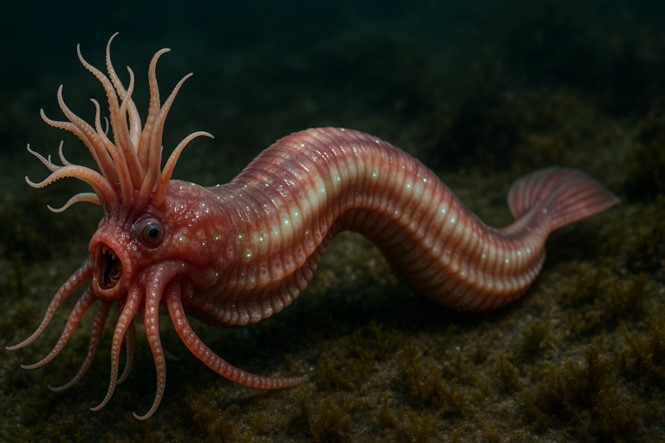
The Anemotapeworm Squidleech presents as a grotesque amalgamation of segmented flatworm anatomy fused with cephalopod agility, cnidarian venomous tendrils, and annelid suction capabilities, forming a sinuous, elongated body that undulates through water or across moist surfaces like a living ribbon of nightmare. Its primary form is a flattened, ribbon-like torso segmented into hundreds of flexible rings, each segment derived from tapeworm and leech influences, covered in a slimy, translucent skin that shifts colors from pale white to deep crimson when agitated, mimicking the camouflage of a squid’s chromatophores. At the anterior end, a cluster of eight to ten writhing tentacles sprouts, blending squid arms with sea anemone polyps—long, sucker-lined appendages tipped with stinging nematocysts that deliver paralyzing toxins, capable of extending up to twice the body length for grasping prey. Suckers along the ventral surface, inherited from the leech, allow attachment to hosts or surfaces, while a central maw opens like a squid’s beak, ringed with hooked teeth for rasping flesh. Posteriorly, the body tapers into a finned siphon for jet propulsion, expelling water or ink-like mucus clouds for escape, and the entire creature glistens with a bioluminescent glow from embedded anemone-like photophores, illuminating dark waters in eerie patterns. Scattered across the segments are tiny, retractable hooks and barbs, enhancing its parasitic grip, and the skin secretes a regenerative mucus that heals wounds rapidly, echoing the tapeworm’s resilience in hostile environments.
Size
This feral life form varies in size depending on age and nutritional intake, but mature specimens typically measure 3 to 6 feet in length, with a flattened body width of 6 to 12 inches and a thickness of merely 1 to 2 inches, allowing it to squeeze through narrow crevices or burrow into substrates. Juveniles start at around 6 inches long, growing exponentially by absorbing nutrients from hosts or prey, potentially reaching up to 10 feet in overgrown, magic-rich environments where the high-magic flows of Saṃsāra accelerate their development. Weight ranges from 5 to 20 pounds, distributed along the elongated form for buoyancy in aquatic settings or traction on land.
Speed
The Anemotapeworm Squidleech moves with a deceptive burst capability, slithering at a base speed of 15 feet per round on land via undulating contractions of its segmented body, similar to a leech’s inching motion, but accelerating to 30 feet per round in water through squid-like jet propulsion from its siphon. It can perform short dashes of up to 60 feet in aquatic bursts by expelling pressurized water or mucus, though this exhausts it after a few uses, requiring a cooldown period akin to recharging internal fluids. On uneven terrain like mud or silt, its speed reduces to 10 feet per round due to the flat body’s drag, but it excels in confined spaces, navigating at full speed through tunnels or vegetation.
Stat Modifiers
In the tiered system of Saṃsāra, where gear determines magic but feral creatures rely on innate physicality, the Anemotapeworm Squidleech gains +4 to Constitution for its regenerative and resilient segmented form, +3 to Dexterity for tentacle precision and jet evasion, +2 to Strength for gripping suckers and hooks, but -2 to Intelligence due to primitive instincts overriding complex thought, -1 to Wisdom for impulsive predatory drives, and -3 to Charisma as its grotesque appearance instills revulsion in sentient observers. These modifiers apply when avatars encounter or perhaps tame such creatures, influencing combat or interaction rolls, with higher-tier gear potentially countering negatives if equipped on a domesticated variant.
Skills
Naturally proficient in skills honed by its merged heritage, the Anemotapeworm Squidleech excels in Stealth (+5 bonus) through color-shifting camouflage and silent undulation, Athletics (+4) for powerful suction attachment and tentacle grapples, Perception (+3) via vibration-sensitive segments and chemical-sensing tentacles detecting prey in murky waters, Survival (+4) for parasitic host-finding and environmental adaptation, and Intimidation (+2) by deploying stinging nematocysts or ink clouds to deter threats. It lacks trained social skills but possesses an innate Acrobatics (+3) for twisting through obstacles, with all proficiencies derived from instinct rather than training, scalable by environmental magic flows that might enhance them in high-magic zones.
Behavior
Feral and opportunistic, the Anemotapeworm Squidleech exhibits a blend of parasitic patience and predatory aggression, often lurking attached to larger hosts like fish or beasts via its suckers, siphoning nutrients slowly like a tapeworm or leech while using anemone-like tentacles to snare passing small prey. When threatened, it detaches explosively with a jet burst, releasing ink-mucus to obscure escape, or lashes out with stinging arms in squid-fashion to paralyze foes before fleeing or counterattacking. Solitary by nature, it avoids packs but may congregate in nutrient-rich areas during mating seasons, communicating through bioluminescent pulses and chemical trails. It displays curiosity toward magical anomalies, drawn to ebbing flows like weather patterns, and can become territorial over prime attachment sites, ambushing intruders with hidden burrows in silt or coral-like structures it secretes from mucus.
Diet
Primarily carnivorous and parasitic, the Anemotapeworm Squidleech sustains itself on a mix of blood and tissue fluids drawn from hosts via leech-like suckers, supplemented by small invertebrates or fish captured with squid tentacles and digested internally like a tapeworm’s absorptive lining. It uses anemone stings to immobilize prey, then rasps away flesh with its beak, favoring soft-bodied organisms in its environment but capable of opportunistic scavenging on decaying matter. In magic-infused areas, it absorbs ambient energies to reduce feeding frequency, and overfeeding leads to rapid growth, potentially shedding segments that regenerate into new individuals.
Emotions
Driven by basic primal urges rather than complex sentience, the Anemotapeworm Squidleech experiences emotions in raw, instinctual forms: hunger manifests as frantic tentacle thrashing and aggressive pursuit, fear triggers ink expulsion and rapid retreat, contentment appears as slow, rhythmic pulsing of bioluminescence while attached to a host, and agitation causes color shifts to warning reds with nematocyst readiness. It shows rudimentary curiosity through tentative probing of new stimuli, and during reproductive phases, a form of excitement via increased activity and chemical signaling, but lacks higher emotions like joy or sorrow, reacting purely to survival imperatives in the cycle of Saṃsāra.
Environment Where Found
Native to the humid, aquatic fringes of the Badarian Archipelago’s river deltas and wetlands, the Anemotapeworm Squidleech thrives in shallow, murky waters rich with black silt, where it burrows into mud banks or attaches to submerged vegetation, blending with the fertile, magic-pulsing soils. It frequents mangrove coasts, underwater cave systems, and slow-moving canals, adapting to brackish mixes of fresh and saltwater, but ventures onto moist land during floods or high humidity. In forgotten ruins overgrown with jungle or hidden in dark cave metropolises, it parasitizes local beasts and monsters, drawn to areas of ebbing magical weather that enhance its regeneration. Rare sightings occur in uncharted smaller islands that appear sporadically, where it infests isolated pools, but it avoids arid or frozen zones, preferring the warm, nutrient-dense environments of the delta’s endless cycle.
Tags: Aquatic-Parasite, Segmented-Body, Tentacle-Predator, Stinging-Nematocysts, Ink-Expulsion, Regenerative-Mucus, Camouflage-Shifter, Suction-Gripper, Bioluminescent, Host-Attacher, Ambush-Hunter, Fluid-Jet, Primal-Instinct, Magic-Absorber, Delta-Dweller, Feral-Amalgam, Venomous-Rasp
Life Cycle
The Anemotapeworm Squidleech begins its existence as a microscopic larva, hatched from eggs deposited in nutrient-rich silt or attached to decaying organic matter in the shallow waters of river deltas, where the high-magic flows of Saṃsāra infuse the environment with energies that accelerate initial growth. These larvae, resembling tiny, translucent ribbons with nascent suckers, drift passively in currents for the first few weeks, absorbing ambient magical particles and microscopic plankton through their permeable skin, much like a tapeworm’s early stages. As they mature over the next month, they develop rudimentary tentacles and nematocysts, transitioning into juvenile forms about 6 inches long, at which point they seek out small hosts such as fish or aquatic insects to attach via suckers, siphoning fluids parasitically while avoiding detection through color-shifting camouflage. This juvenile phase lasts 3 to 6 months, during which the creature grows segments rapidly, shedding excess ones that can regenerate into clones if conditions are favorable, a process enhanced by magical ebbs that promote asexual reproduction in low-population areas. Adulthood is reached at around 1 year, when the body elongates to 3 feet or more, fully equipping it with jet propulsion, bioluminescent photophores, and a functional siphon for independent hunting. Lifespans vary from 5 to 15 years, influenced by environmental magic; in high-flow zones, they regenerate segments indefinitely, extending life, while in stagnant areas, they succumb to predation or nutrient scarcity. Death typically occurs from exhaustion after repeated bursts or parasitic overload, with the body dissolving into mucus that fertilizes the silt, releasing any stored magical energy back into the cycle, potentially seeding new larvae if eggs are present internally.
Mating
Mating among Anemotapeworm Squidleech occurs seasonally, triggered by the waxing of Saṃsāra’s moons and surges in magical weather that flood deltas with fertile energies, drawing solitary individuals to congregate in shallow pools or mangrove roots during what locals call the “Slime Tides.” Males and females are hermaphroditic, each capable of producing both sperm and eggs, but they prefer cross-fertilization for genetic diversity, approaching potential partners with cautious bioluminescent displays—pulsing patterns of green and blue lights along their segments to signal readiness and health, derived from anemone-like photophores. If accepted, they entwine tentacles in a slow, undulating dance lasting hours, exchanging gametes through specialized suckers that inject packets directly into the partner’s body cavity, minimizing exposure to predators. This process can involve multiple partners in a single gathering, forming temporary clusters where chemical trails in the water coordinate the event, echoing squid mating swarms but with leech-like attachment for stability. Post-mating, fertilized eggs develop internally for 2 to 4 weeks before being expelled in gelatinous clusters attached to submerged vegetation or host bodies, protected by a toxic mucus sheath that deters scavengers. In magic-rich environments, mating success rates increase, sometimes leading to hybrid vigor where offspring inherit amplified regenerative traits, and failed encounters may result in aggressive stings if signals are misread, scattering participants with ink clouds.
Tactics
In predation and defense, the Anemotapeworm Squidleech employs ambush tactics honed from its merged origins, often burrowing partially into silt or attaching to underwater foliage to blend seamlessly via chromatophore shifts, waiting for vibrations or chemical cues to detect approaching prey. Once targeted, it launches tentacles with anemone-derived nematocysts to deliver paralyzing venom, reeling in victims like a squid while rasping with its beak, then attaching suckers to drain fluids leech-style, all while segments absorb nutrients tapeworm-fashion for efficiency. Against threats, it uses evasion tactics such as jet-propelled bursts to dart away, expelling ink-mucus clouds to obscure vision and confuse pursuers, or counterattacks by lashing barbs and hooks to entangle foes, buying time for escape. Parasitic tactics involve stealthy attachment to larger hosts, burrowing under scales or skin with minimal disturbance, sustaining on slow siphoning to avoid detection, and detaching only when the host weakens or a better opportunity arises. In territorial disputes, it inflates segments to appear larger, pulsing red lights as warnings, and may release regenerative segments as decoys that wriggle independently to distract rivals. These tactics adapt to magical flows; during ebbs, it conserves energy in passive parasitism, while flows enable bolder hunts with enhanced venom potency.
Actions
The Anemotapeworm Squidleech performs a repertoire of actions dictated by instinct and environment, including the “Suction Latch,” where it deploys ventral suckers to affix to surfaces or hosts, enabling prolonged feeding or stability during floods. The “Tentacle Sting” involves extending arms to inject nematocysts, paralyzing targets for consumption or defense, with a recharge time based on toxin regeneration. “Jet Burst” propels it through water via siphon expulsion, covering short distances rapidly but requiring fluid intake afterward. “Ink Veil” releases a cloudy mucus secretion to create temporary cover, disorienting enemies and masking scents, effective in murky deltas. “Segment Shed” allows deliberate detachment of body parts, which regenerate into clones or serve as distractions, a survival action amplified in high-magic areas. “Biolume Signal” pulses photophores for communication during mating or to lure prey in dark caves, mimicking light patterns of smaller organisms. “Rasp Feed” uses the beak to scrape flesh while attached, absorbing nutrients directly through skin, and “Mucus Coat” secretes a healing layer to repair damage, closing wounds in minutes. These actions are innate, not requiring gear like avatars, but influenced by tier-like magical absorption, where specimens in potent zones exhibit stronger effects.
Other Interesting Information
In the ecosystems of Saṃsāra, the Anemotapeworm Squidleech plays a dual role as both pest and benefactor, parasitizing fish stocks in Badarian fisheries but also aerating silt through burrowing, enhancing soil fertility for crops like iridescent barley. Some Clayborn view it as a minor manifestation of Khem-Ur’s cycles, harvesting specimens for alchemical glazes derived from their mucus, which hardens pottery with regenerative properties. In underwater communities, it forms symbiotic relationships with certain monsters, attaching to clean parasites while providing venomous defense. Magical anomalies can mutate individuals, creating oversized variants up to 15 feet that lead “slime packs” in rare congregations, or bioluminescent strains used in cave lighting by subterranean dwellers. Predators include larger aquatic beasts, but its ink and stings deter most, and avatars sometimes train skills to handle them for quests involving delta navigation or toxin extraction. Folklore in the archipelago tells of “silt ghosts,” where clusters mimic humanoid shapes with glowing tentacles, inspiring rituals to appease them during floods. Their segments, if ingested by avatars, can cause temporary hallucinations of underwater visions, tied to absorbed multiversal soul echoes, and in trade, dried nematocysts fetch silver coins for use in single-shot firearms as alchemical projectiles. Environmental changes, like appearing islands, introduce new variants with adapted colors, and in political intrigue, they serve as unwitting vectors for smuggling tiny items attached to migrating hosts across canals.
A party of adventurers in the world of Saṃsāra might encounter or actively search for an Anemotapeworm Squidleech for a variety of compelling reasons tied to the creature’s unique properties, the cultural and economic dynamics of the Badarian Island Nation, and the broader challenges of the high-magic setting. One primary motivation could arise from a quest issued by the Badarian monarchy or a local Clay-Shaper guild, seeking the creature’s regenerative mucus for use in crafting alchemical glazes that enhance the durability and magical resonance of pottery, a prized export. The mucus, when harvested carefully, can be distilled into a substance that hardens clay structures or gear worn by avatars, potentially elevating their tier levels, making it a valuable commodity worth the risk of facing the creature’s venomous tentacles and ink clouds. The adventurers might be tasked with collecting a specific quantity, guided by the promise of platinum or rhodium coins, or even land rent reductions as rewards, aligning with the monarchy’s tax-based economy.
Another reason could stem from a need to address a growing ecological imbalance in the delta wetlands, where an overpopulation of Anemotapeworm Squidleech has begun to weaken fish stocks or disrupt trade routes along the canals. Local fishing communities or underwater populations might hire the party to cull the creatures, offering silver or electrum payments, or perhaps a rare piece of inscribed gear as incentive. This encounter could occur inadvertently while the adventurers navigate flooded areas or explore uncharted islands that have appeared, where the creature’s burrowing and parasitic nature threatens submerged ruins or cave metropolises, drawing them into conflict as they seek to protect allied beast or monster civilizations.
The creature’s magical properties also make it a target for adventurers seeking to harness its potential. Its ability to absorb ambient magical flows and its bioluminescent photophores could be studied or exploited for creating light sources in dark cave systems or enhancing magical circuits used in steam-powered industries. A scholar or Silt-Speaker might commission the party to capture a live specimen for research, offering knowledge of Vel-Khar chants or access to sacred Kiln-Heart rituals as payment, appealing to those training skills in magic or craftsmanship. The challenge lies in subduing the creature without killing it, requiring tactical use of gear to counter its jet bursts and stings, testing the party’s endurance and coordination.
Additionally, the Anemotapeworm Squidleech’s association with folklore as “silt ghosts” could drive a search motivated by cultural or spiritual intrigue. A party might be drawn to investigate sightings near a village during the Season of Thirst, where the creature’s glowing tentacles mimic ancestral spirits, prompting a quest to appease or banish it through ritual. This could involve retrieving a segment or egg cluster to present at a Great Stillness ceremony, earning the favor of the Clayborn community and potentially unlocking alliances with local monsters who trade knowledge. The encounter might occur naturally during such rituals, as the creature is drawn to the magical ebbs, adding a layer of tension to the proceedings.
Political intrigue could necessitate an encounter, with rival factions in Badarian using the creature as an unwitting courier for smuggling tiny items across trade routes. Adventurers might be hired by the monarchy or a competing city council to intercept these creatures, extracting any hidden goods from their mucus or segments, with rewards tied to thwarting espionage. This search could lead them into mangrove coasts or underwater centers, where the creature’s adaptability makes it a challenging quarry, requiring the party to employ airships or griffons to track its movements across the delta’s labyrinthine waterways. Each scenario leverages the creature’s ecological, economic, and mystical significance, offering diverse motivations for adventurers to face its feral nature in the rich tapestry of Saṃsāra.
Additional items or ingredients:
- Regenerative Mucus
The slimy, translucent mucus secreted by the Anemotapeworm Squidleech’s skin and segments can be harvested in viscous globs from the corpse, often collected by scraping the body with clay tools to avoid contamination. This substance, infused with the creature’s tapeworm-derived resilience and amplified by Saṃsāra’s magical flows, serves as a key ingredient in alchemical concoctions for healing salves and potions that accelerate wound closure and tissue repair, commonly used by healers in Badarian villages to treat injuries from farming accidents or beast encounters. In crafting, it is distilled into glazes for pottery and gear, enhancing durability and allowing items to self-mend minor cracks over time, which is particularly valued for reinforcing steam-powered machinery components like belts and pulleys that endure constant wear. Traders export it to other island nations for use in magical storage devices, where it stabilizes energy circuits against fluctuations, fetching prices equivalent to several gold coins per vial due to its role in extending the lifespan of enchanted tools. - Nematocyst Venom
Stinging cells from the anemone-like tips of the tentacles yield a potent, paralyzing venom that can be extracted by carefully milking the nematocysts post-mortem using fine needles or magical siphons to prevent accidental discharge. This clear, acrid fluid, blending squid ink toxicity with anemone neurotoxins, finds application in the creation of paralytic darts or coatings for single-shot alchemical firearms, enabling non-lethal subduing of foes or beasts during hunts and conflicts in the delta’s labyrinthine waterways. Artisans incorporate it into trap mechanisms for securing ruins or cave entrances, where it deters intruders without permanent harm, aligning with the Path of the Black Silt’s emphasis on cycles rather than destruction. In medical contexts, diluted versions act as anesthetics for surgeries or rituals, numbing areas for precise work, and its trade value supports Badarian economies, often bartered for electrum in exchanges with underwater populations seeking defenses against larger predators. - Segmented Hooks and Barbs
The tiny, retractable hooks and barbs scattered across the creature’s segments and suckers can be pried from the corpse with pincers, resulting in small, curved spines of chitinous material that retain a faint magical hum from the leech and tapeworm influences. These are ground into powders or embedded whole into fishing lures and hooks, improving catch rates in the fertile rivers by mimicking the creature’s gripping action, which is essential for sustaining the nation’s abundant crop trade reliant on fish fertilizers. Crafters use them to reinforce belts, chains, and pulleys in mechanical power systems, adding tensile strength that prevents slippage in steam factories, while higher-tier gear incorporating them grants bonuses to grappling or climbing skills through enhanced adhesion. In rituals of the Clayborn, they symbolize attachment to the cycle, woven into shrouds for funeral rites to ensure the soul-seed’s secure transition, and their harvest supports local artisans, valued at silver per handful in markets near Vel-Nur. - Bioluminescent Photophores
Embedded photophores, the anemone-inspired glowing organs along the body, can be excised as small, jelly-like sacs that continue to emit soft light for days after death, harvested by slicing open segments under dim conditions to preserve their luminescence. These serve as natural light sources in dark cave metropolises or underwater centers, strung into lanterns or embedded in gear for navigation through foggy deltas, reducing reliance on magical fire-water combinations that might disrupt environmental harmony. Alchemists brew them into inks for Vel-Clay scripts on pottery, creating glyphs that glow during Vel-Khar chants to amplify fertility spells on fields, boosting yields of iridescent barley. In trade, they are sought by airship crews for signaling during racing events through labyrinths, exchanged for nickel or copper in bulk, and their use in meditative practices helps attune the Mind’s Eye to Khem-Ur’s rhythms, providing insight into hidden ruins or forgotten areas. - Ink-Mucus Glands
The glands producing the ink-like mucus for escape clouds, located near the siphon, yield a thick, opaque fluid when squeezed from the posterior end, combining squid defense mechanisms with leech anticoagulants for a substance that obscures and clings. This is refined into dyes for textiles and gear, creating camouflage patterns that shift subtly with magical ebbs, ideal for scouts or hunters in jungles and mangroves to evade monsters or beasts. In industry, it coats mechanical components like gears to reduce friction and prevent corrosion from humid air, extending the life of factories powered by elemental steam. Ritually, it is used in the Great Stillness observances to create veils of darkness for introspection, symbolizing the dormant soul in the silo, and its anticoagulant properties make it a base for blood-thinning remedies against clots from prolonged labor, traded for silver among healers in rural villages. - Hooked Beak
The central maw’s hooked beak, a fusion of squid and leech rasping tools, can be removed intact as a hard, curved implement resembling dark horn, extracted by severing connective tissues around the mouth. This serves as a durable tool for scribes etching Vel-Clay glyphs onto clay tablets or stone, its sharpness enhanced by residual magical resonance for precise work in preserving agricultural knowledge or rituals. Crafters fashion it into awls or needles for sewing heavy fabrics used in lavish gear costumes, granting minor tier bonuses to crafting skills when worn as amulets. In combat applications, it tips spears or arrows for piercing tough hides of delta beasts, and its use in pottery shaping evokes the faith’s vessel metaphors, often gifted in coming-of-age ceremonies. Trade sees it valued at gold per pristine specimen, exported to cave dwellers for mining tools adapted to dark environments. - Translucent Skin Membranes
The slimy, color-shifting skin can be peeled in sheets from the flattened body, yielding flexible, chromatophore-dotted membranes that retain some camouflage ability post-harvest. These are tanned into lightweight leathers for gear slots like cloaks or belts, providing stealth enhancements in wetland explorations or political intrigue, where blending with silt aids evasion. Alchemists incorporate them into lenses for scrying devices, filtering magical weather to predict ebbs and flows, crucial for timing harvests or travel by ship and zeppelin. In underwater communities, they line air pockets for better visibility, and their ritual application in the Shaping festival blesses new vessels with adaptive traits. Economically, processed skins fetch platinum in megacity markets, supporting the nation’s trade in magical materials. - Finned Siphon
The posterior finned siphon, a squid-derived propulsion organ, can be dissected as a tubular structure with muscular walls, harvested by cutting it free while preserving internal chambers. This is repurposed into bellows or pumps for steam systems, its natural jet mechanism aiding in fluid transfer for irrigation canals or factory operations, improving efficiency in the Industrial Age without advanced tech. Crafters enchant it for use in breathing apparatuses for cave or underwater dives, storing air pockets sustained by magic. In rituals, it symbolizes release in the Breaking, used to disperse ashes or offerings, and its elastic properties make it ideal for slingshots in single-shot firearms. Trade values it at electrum, bartered with floating city dwellers for levitation aids. - Absorptive Lining Segments
Internal linings from the segments, tapeworm-like absorptive tissues, can be scraped from the corpse’s interior, producing spongy, nutrient-rich pads that hold magical residues. These are dried and powdered for fertilizers in fields, enhancing soil fertility to grow resonant crops, directly tying into the Path of the Black Silt’s cycles. Alchemists use them in potions for energy absorption, allowing avatars to temporarily store magical flows for tier boosts without gear overload. In medicine, they treat malnutrition by aiding nutrient uptake, and their application in gear pouches stores herbs or coins securely. Valued at copper per segment in local markets, they bolster rural economies. - Gelatinous Egg Clusters (If Present)
If the corpse contains developing eggs, these gelatinous clusters can be gathered as sticky orbs protected by toxic sheaths, harvested by gentle extraction to avoid rupture. They serve as bases for cloning experiments in alchemical labs, regenerating into materials for hybrid crafts or beasts in monster alliances. Ritually, they represent potential in fertility festivals, buried to bless fields. In trade, viable clusters command rhodium for their role in creating symbiotic aids for griffon riders or airship crews.
Writhing Shadow of Silt Depths
In the days when the river’s tongue licked the black earth without name, and the moons hung like forgotten seeds in the sky-vault, there dwelled a beast of many arms and no mercy. It was born from the mud’s secret whispers, where the waters met the decay, and the old ones called it the Anemotapeworm Squidleech, though in the tongue of the deep silt, its name was a hiss of forgotten curses. The creature slithered in the shadows of the Great Delta, where the black silt pulsed like a living heart, and the people of the Clayborn feared its grasp, for it was a thief of life and a weaver of nightmares.
Long ago, before the kilns burned steady and the cycles turned with patience, there was a village by the endless canals, where the farmers shaped the land as pots and the fishers drew bounty from the murky flows. The elder of this place was named Thal-Nur, which is to say Deep-Root, for his wisdom was like the buried vein of water that sustains through thirst. He had daughters many, and sons who tended the fields, but the youngest, a girl called Mira-Kel, which is to say Quick-Tide, had a spirit like the sudden flood—full of rush and no caution. She dreamed of the hidden treasures in the delta’s veins, where ruins slept under the silt, and she believed the old tales of lost magic that could make crops bloom eternal.
One season, when the magical weather ebbed low and the waters grew thick with hidden hungers, the village suffered a blight. The fish vanished from the nets, their scales found scattered like broken shards on the banks, and the beasts that pulled the plows grew weak, their blood thinned by unseen bites. The people whispered of the Writhing Shadow, the Anemotapeworm Squidleech, that lurked in the canals, attaching its suckers to the living and draining the essence slow, like a leech that dreams of squid arms and anemone stings. It would jet through the murk with bursts of ink-cloud, stinging with tentacles that paralyzed the swift, and its segments glowed with false lights to lure the foolish near.
Deep-Root gathered the elders under the thatch of the Kiln-Heart, where the great oven hummed with steady fire. He spoke in a voice like settling mud: “The cycle turns harsh. We must seek the beast’s lair, not with haste, but with the patience of the husbandman. For Khem-Ur teaches that the rushed harvest yields only dust.” But Quick-Tide, her eyes like malachite fire, stood and cried: “Father, the slow path leaves us empty! I will take the canoe of reed and the net of woven vine. I will command the waters and drag the shadow forth. My will is strong; the creature will bend to me, and its secrets will feed our fields!”
The people, their bellies thin from the blight, murmured praise for her fire. They gave her offerings of barley sheaves and clay beads, and turned away from Deep-Root’s warnings, which sounded like dry wind over cracked earth.
So it came that Quick-Tide set forth at dawn, when the sun was a brass eye low on the horizon. She paddled into the labyrinth of canals, where mangroves twisted like forgotten vessels, and the silt whispered secrets. Her hands gripped the pole with hurry, pushing deeper where the waters grew dark and the magical flows hummed low. She sang no slow songs to the earth, but shouted challenges to the depths: “Come forth, Writhing Shadow! I am Quick-Tide, and I will bind your arms and take your glow for my people!”
The creature heard, for its segments felt the vibrations like a spider’s web. It lurked attached to a sunken root, its body flat and ribboned, colors shifting to match the mud. As Quick-Tide’s canoe glided near, it stirred, extending tentacles slow at first, like anemone polyps tasting the current. But Quick-Tide saw the glow—a faint blue pulse—and thrust her net with haste. “You are mine!” she roared, like the kiln-fire forced too hot.
The net caught a tentacle, but the beast was no simple fish. It burst with jet from its siphon, ink-mucus clouding the water like a veil of night, and its stings lashed out, nematocysts piercing her arm. Pain like fire in the veins seized her, paralyzing limb and will, and the suckers latched to the canoe’s side, pulling it under with grinding hooks. Quick-Tide fought, her paddle swinging wild, but the segments writhed, shedding one to distract as the main body coiled. She gasped as the beak rasped her skin, draining essence slow, and the world blurred into cycles she had not heeded.
Meanwhile, Deep-Root had not idle sat. He took his own path, slow and deliberate, following the silt’s omens—patterns in the cracked banks and the whisper of wind over barley. He carried a pot of sacred clay, unfired and soft, and a sheaf of iridescent grain as offering. For days he wandered the edges, kneeling to feel the earth’s pulse, singing the old, patient hymns that attuned his Mind’s Eye to the rhythms of growth and decay. “The shadow is part of the field,” he murmured. “It takes, but in taking, it renews if met with stillness.”
On the third day, he found the lair—a burrow in the mangrove roots, where the creature had dragged Quick-Tide’s canoe, now half-sunk and fouled with mucus. The Anemotapeworm Squidleech pulsed there, its body swollen from the feast, segments glowing with stolen magic. Deep-Root did not strike with fury. He placed the clay pot in the shallows, scattering grain upon the water, and sat in meditation, his voice a low hum like the river’s silt settling.
The beast, sated but curious, extended a tentacle toward the offering. It tasted the grain, felt the pot’s earth-memory, and in that moment of attunement, Deep-Root spoke the Vel-Khar words of binding—not to command, but to guide. “You are the harvester of the weak; return to the cycle, and let the strong seed grow.” The creature, drawn by the patience that mirrored its own parasitic wait, released its grip on the hidden prey. Quick-Tide emerged from the murk, weakened but alive, her limbs thawing from the sting.
But the beast was not slain; Deep-Root allowed it to slither away, shedding a segment that he collected as a token. From this, the village learned to harvest the mucus for healing, and the venom for tools, turning the shadow’s curse into bounty. The blight lifted as the creature moved to deeper waters, culling only the frail and renewing the delta’s balance.
Quick-Tide, her spirit cracked like a rushed vessel, learned the slow songs and became a Silt-Speaker, teaching that haste invites the breaking.
Moral: The shadow that is rushed with fire yields only poison. The soul that waits in stillness harvests the renewal from the depths.
Suggested conversions to other systems:
Call of Cthulhu
Silt-Dwelling Parasite STR 40 (2D6x5 avg. 35), CON 60 (3D6x5 avg. 52), SIZ 30 (1D6x5 avg. 17), DEX 70 (4D6x5 avg. 70), INT 20 (1D6x5 avg. 17), POW 50 (3D6x5 avg. 52) HP: 8 (average), Build: -1, Damage Bonus: -1D4, Move: 4/8 swimming Combat Attacks per round: 2 (tentacles or suckers) Tentacle Sting 40% (20/8), damage 1D3 + poison (victim must succeed on Extreme CON roll or be paralyzed for 1D6 rounds) Sucker Attach 50% (25/10), damage 1D2 blood drain per round attached (automatic after hit, requires opposed STR to detach) Dodge 35% (17/7) Armor: 1-point slimy skin (regenerates 1 HP per round until dead) Spells: None Sanity loss: 0/1D4 to see the Silt-Dwelling Parasite; 1/1D6 if stung and paralyzed Notes: This creature lurks in murky waters, ambushing with camouflage (Spot Hidden Hard difficulty to detect). It can expel an ink cloud once per encounter, obscuring a 10-yard radius and imposing a penalty die on attacks and perception rolls within it for 1D3 rounds. Balanced for novice investigators, it poses a threat through paralysis and drain rather than raw damage.
Blades in the Dark
Canal Lurker Scale: Small (individual threat, magnitude 1 for a single specimen, up to 3 for a swarm in infested waters) Quality: 2 (potent venom and grip, but fragile body) Edge: Desperate (venomous stings that can paralyze, ink clouds for escape) Flaw: Limited (relies on ambush in water; weak on dry land) Spotlight: Eerie (bioluminescent glow lures prey, creating clocks for “Drawn into the Depths” or “Paralyzed and Drained”) Actions: The Canal Lurker inflicts 2-harm with tentacle stings (level 2 harm: “Paralyzing Venom,” resisted with Prowess), or latches with suckers for ongoing 1-harm blood drain per tick on a clock (“Siphoned Vitality,” 4-tick clock). It uses Finesse for stealthy ambushes (position risky/desperate in murky canals) or Skirmish for grappling (effect limited/great based on water presence). Defenses include a 4-tick clock for “Ink Obscured Escape” to flee, regenerating 1 segment per scene if not fully destroyed. Encounters often start with a fortune roll (2d for detection in deltas) and scale to crew threats during heists in Badarian waterways, balanced by narrative positioning—great effect in ambushes, zero on open ground.
Dungeons & Dragons
Delta Squidleech Small aberration, unaligned Armor Class 13 (natural armor) Hit Points 22 (5d6 + 5) Speed 10 ft., swim 40 ft. STR 8 (-1), DEX 16 (+3), CON 12 (+1), INT 3 (-4), WIS 10 (+0), CHA 5 (-3) Skills Stealth +5 Senses darkvision 60 ft., passive Perception 10 Languages — Challenge 1/2 (100 XP) Amphibious. The Delta Squidleech can breathe air and water. Regenerative Mucus. At the start of its turn, the Delta Squidleech regains 3 hit points if it has at least 1 hit point and is in water or mud. Actions Multiattack. The Delta Squidleech makes two tentacle attacks. Tentacle. Melee Weapon Attack: +5 to hit, reach 10 ft., one target. Hit: 5 (1d4 + 3) piercing damage plus 3 (1d6) poison damage, and the target must succeed on a DC 11 Constitution saving throw or be poisoned for 1 minute. While poisoned, the target is paralyzed if it fails the save by 5 or more. Ink Cloud (Recharge 5-6). The Delta Squidleech expels ink in a 10-foot radius cloud underwater or on moist ground. The area is heavily obscured for 1 minute, though a strong current disperses it early. Bonus Actions Sucker Attach. If the Delta Squidleech hits with a tentacle, it can attach a sucker. While attached, it deals 3 (1d6) necrotic damage at the start of its turn, and the target can’t regain hit points until detached (action, Strength DC 11). Notes: Balanced for low-level parties, this creature ambushes in wetlands, using paralysis to isolate foes; adjust CR down if solitary or up in swarms for higher threats.
Knave
Anemoworm Leech HD 2, AC 12 (slimy hide +2), Morale 6, Saves +2 all Attacks: Tentacle sting +3 (1d6 piercing + poison: save or paralyzed 1d4 rounds), Sucker drain (after hit, automatic 1d4 damage/round until save ends attachment) Special: Regenerates 1d4 HP/round in water; ink burst 1/day (obscures 20 ft. area, -4 to attacks/perception for 1d6 rounds); camouflage (+4 to hide in mud/water) XP: 50 Notes: A feral parasite lurking in deltas, the Anemoworm Leech ambushes with venom, balanced for beginner knights by its low morale and vulnerability to fire (double damage); swarms add +1 HD per additional creature for scaling encounters in ruins or canals.
Fate
Silt-Twisted Parasite Aspects: Feral Parasite of the Delta, Venomous Tentacle Ambusher, Regenerative Slime Horror, Ink-Shrouded Escape Artist Skills: Athletics +3, Stealth +4, Physique +2, Notice +2, Fight +1 Stunts:
- Venomous Grasp: Gain +2 to create an advantage with Fight when using tentacles to paralyze a target (opposed by Physique; success imposes “Paralyzed” aspect for one scene).
- Slippery Retreat: Once per scene, spend a fate point to invoke Ink-Shrouded Escape Artist to automatically succeed at creating a “Cloud of Obscurity” aspect, granting +2 to defend or create distance. Stress: 3 Physical, 0 Mental Consequences: Mild (2), Moderate (4) Notes: This creature thrives in watery ambushes, balanced for Fate by its moderate skill set and reliance on aspects. Encounters involve creating narrative complications (e.g., “Sucked Dry” or “Stung Still”) for players to overcome, with its regeneration countered by sustained attacks or environmental hazards like fire. Adjust difficulty by adding minions or boosting skills for higher-tier parties.
Numenera & Cypher System
Silt Leech Aberration Level: 2 (6 for health, damage, effort) Motive: Hunger, survival Environment: Wetlands, rivers, caves Health: 6 Damage Inflicted: 2 points (tentacle sting or sucker drain) Armor: 1 (slimy skin) Movement: Short (immediate in water with jet burst) Modifications: Speed defense as level 3 due to agility; stealth tasks as level 3 in mud or water Combat: The Silt Leech Aberration attacks with a tentacle sting (2 damage + might defense roll or paralyzed for 1 minute) or attaches with suckers (2 damage per round, requires Might task at difficulty 3 to detach). Once per hour, it uses an ink cloud (level 2 difficulty to see through for 28 seconds). It regenerates 1 health per round unless burned or dried out. Interaction: Unintelligent; may be distracted by food or magical lures (Intellect task, difficulty 4). Use: Explorers might hunt it for mucus (cypher: healing salve, level 1d6) or venom (cypher: paralyzing dart, level 1d6). Balanced as a minor threat, scale to level 4 in swarms or magic-rich zones for cypher campaigns.
Pathfinder
Delta Squirming Leech Small aberration Init +3; Senses darkvision 60 ft.; Perception +0 DEFENSE AC 14, touch 14, flat-footed 11 (+3 Dex, +1 size) hp 18 (4d8) Fort +1, Ref +4, Will +1 Defensive Abilities regenerative mucus (regains 2 hp/round in water or mud unless fire damage taken); DR 2/– OFFENSE Speed 20 ft., swim 40 ft. Melee tentacle +5 (1d4+1 plus poison), or sucker +5 touch (attach) Special Attacks ink cloud (10-ft. radius, heavily obscured, 1/day, 1d4 rounds), blood drain (1d2 Con damage/round while attached) STATISTICS Str 8, Dex 16, Con 10, Int 2, Wis 10, Cha 4 Base Atk +3; CMB +1; CMD 14 Feats Weapon Finesse, Improved Initiative Skills Stealth +10 (+14 in water), Swim +7; Racial Modifiers +4 Stealth in water SPECIAL ABILITIES Poison (Ex) Tentacle—Injury; save Fort DC 12; frequency 1/round for 4 rounds; effect 1d2 Dex damage; cure 1 save. Attach (Ex) On a hit with sucker, attaches to target; requires DC 12 Strength check to remove. Notes: Designed for low-level Pathfinder parties (CR 2), this creature challenges with paralysis and drain, balanced by its vulnerability to fire (double damage) and limited ink use. Adjust HP or DR for higher CR encounters in swamps or ruins.
Savage Worlds
Silt-Writhing Parasite Attributes: Agility d8, Smarts d4 (A), Spirit d6, Strength d6, Vigor d8 Skills: Fighting d6, Notice d6, Stealth d8, Swimming d8 Pace: 6; Parry: 5; Toughness: 6 Special Abilities:
- Tentacle Sting: Str+d4, plus poison (Vigor roll or Paralyzed for 2d4 rounds).
- Sucker Attach: Fighting attack attaches (opposed Strength to remove); drains 2d4 fatigue per round until detached.
- Ink Cloud: 10″ radius, obscures vision (-4 to attacks/Notice), 1/day for 1d6 rounds.
- Regenerative Mucus: Natural healing roll each round in water (ignores 1 wound level unless fire damage taken).
- Aquatic: Pace 12 when swimming; ignores water hazards. Edges: None Hindrances: Bloodthirsty (minor, relentless feeding), Clueless (minor, poor environmental awareness) Gear: None Notes: Balanced as a Wild Card for Savage Worlds, this creature suits novice crews with its moderate stats and special abilities, countered by fire or drying out. Fatigue drain and paralysis add tension; increase Toughness or add minions for tougher encounters in Badarian deltas.
Shadowrun
Delta Biohorror B 4, A 7, R 5, S 3, W 3, L 2, I 4, C 2, ESS 6, EDG 2 Initiative: 9 + 1D6 Movement: 10/20/+1 (swim 15/30/+2) Condition Monitor: 10/10 Limits: Physical 4, Mental 3, Social 3 Armor: 4 (slimy hide) Skills: Exotic Ranged Weapon (Tentacle Sting) 4, Gymnastics 3, Perception 3, Sneaking 5, Swimming 6, Unarmed Combat 4 Powers: Camouflage (Rating 2), Natural Weapon (Tentacle Sting: DV 4P, AP -1, Reach 2, plus Venom toxin: Vector: Injection, Speed: Immediate, Penetration: 0, Power: 6, Effect: Physical Damage, Paralysis), Regeneration (recovers 1 box of Physical damage per Combat Turn in water), Venom (as above) Qualities: Aquatic, Low-Light Vision Weapons: Tentacle Sting (Exotic Ranged, Acc 5, DV 4P + Venom, Mode SS, Reach 2), Sucker Attach (Unarmed, Acc Physical, DV 3S, Reach 1, on hit attach and drain 1 box Physical per turn until detached with Complex Action opposed Strength test) Notes: This critter ambushes from murky waters, using camouflage (Threshold 3 to spot). It can release an ink cloud (Free Action, 1/encounter) creating a -4 visibility penalty in a 5m radius for 3 turns. Balanced for street-level runners, emphasizing toxin and attachment over direct damage; adjust Edge for higher threats.
Starfinder
Squidleech Symbiote CR 1; XP 400 N Small aberration (aquatic) Init +3; Senses darkvision 60 ft.; Perception +5 Defense HP 20 EAC 12; KAC 13 Fort +3; Ref +3; Will +2 Defensive Abilities regenerative mucus (fast healing 2 while in water) Offense Speed 10 ft., swim 40 ft. Melee tentacle sting +6 (1d4+1 P plus poison) Offensive Abilities attach (after hit, target grappled, DC 12 to escape), blood drain (1d4 Con damage/round while attached), ink cloud (20-ft. spread, concealment 20% miss chance, 1/round, 1d4 rounds) Statistics Str +0; Dex +3; Con +1; Int -4; Wis +0; Cha -2 Skills Stealth +10 (+14 in water), Survival +5 Other Abilities amphibious Special Abilities Poison (Ex) Tentacle—injury; save Fort DC 11; track Dexterity; frequency 1/round for 4 rounds; cure 1 save; effect progression (1 Dex damage per failed save, paralyzed at crippled). Notes: Adapted for Starfinder 2E compatibility with PF2E mechanics, this low-CR creature suits early adventures in aquatic biomes, balanced by vulnerability to fire (weakness 3) and limited mobility on land; scale CR by adding swarm traits for groups.
Traveller
Anemotapeworm Predator Type: Omnivore/Pest Terrain: Wetland/Delta Number Encountered: 1D3 Size: 1D kg (Size -2) Hits: 2D (average 7) Speed: 2 (swim 4) Weapons: Tentacles (as Thrasher, damage 1D), Suckers (as Grappler, opposed Strength to detach) Armor: Hide (equivalent Jack, +1) Attacks: Ambush (surprise on 8+), Sting (2D damage + poison: Endurance DM -2 for 2D hours, paralysis on fumble) Defenses: Camouflage (stealth DM +2 in water), Ink Burst (once per encounter, obscures sensors/visuals in short range for 1D minutes) Behavior: Parasitic (attaches to drain 1 Endurance/round), Regenerative (recovers 1 Hit/round in moist environments) Notes: In Mongoose Traveller 2E (2022 Update), this animal encounters as a hazard in riverine exploration, balanced for novice travellers with low Hits but potent poison (Endurance throw 8+ or incapacitated); adjust for tech level by adding bio-luminescence as a sensor decoy (DM -1 to scans).
Warhammer
Silt Writher M 3 (swim 6), WS 35, BS 0, S 30, T 35, I 40, Ag 45, Dex 20, Int 10, WP 30, Fel — Wounds: 12 Skills: Athletics 50, Perception 45, Stealth (Aquatic) 55, Swim 60 Talents: Aquatic, Strike to Stun Traits: Amphibious, Armour (Slimy Hide) 1, Poison (Tentacle Sting: +1 SL damage, Inflict Paralyzed Condition for rounds equal to SL), Regenerate (recover 2 Wounds/round in water), Size (Small), Venom (Easy), Weapon (Tentacles +4) Trappings: Ink Gland (spray once/combat: all in Close Range gain Blinded Condition for 1d10 rounds, dispersed by wind or current) Notes: In Warhammer Fantasy Roleplay 4th Edition, this creature profiles as a minor threat (Challenge +0) for low-career characters, emphasizing ambush in wetlands with paralysis and drain (lose 1 Wound/round attached, Dodge or Strength test to escape); balanced by low WS and vulnerability to fire (double damage); increase Wounds for boss variants in Chaos-tainted deltas.