
From: Lineage 13 of the Veridian
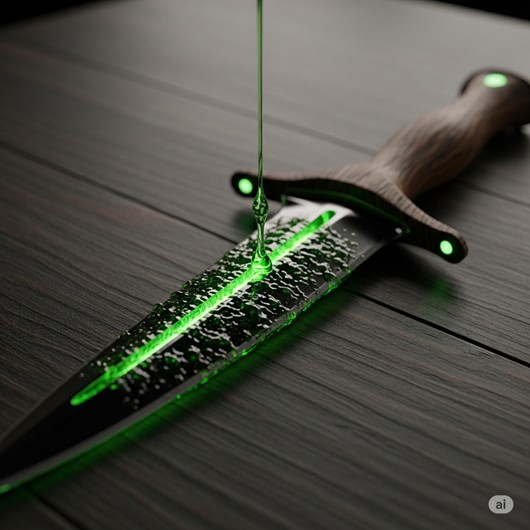
This weapon appears to be a long, elegant pruning knife or a botanist’s scalpel rather than a dagger. The blade is crafted from pale, polished obsidian, sharp enough to shave with and etched with a single, hair-thin channel running from the crossguard to the tip. The hilt is not cold metal but living, smooth-barked ironwood that feels slightly warm to the touch. Function: The hilt has a small, capped reservoir where a single dose of a poison, paralytic agent, or potent sap can be stored. With a subtle twist, the liquid is drawn along the blade’s inner channel, coating it for a single, decisive strike. It is a weapon designed to deliver a concoction directly into a target’s bloodstream, making the potency of the poison far more important than the physical damage of the cut.
Expounded Lore
The Veridian Thorn is not a weapon of war but a tool of profound precision, a physical embodiment of the Veridian philosophy that the smallest touch can bring about the greatest change. The pale obsidian of the blade is known as a “Tear of the First Mountain,” harvested from the cooled magma flows of a volcano that sits upon a nexus of life energy. This gives the blade two inherent properties: it is supernaturally sharp on a molecular level, and it is completely sterile, making it the perfect instrument for surgery.
The living Ironwood hilt is more than a handle; it is the Thorn’s engine. It is a cutting from an ancestral tree, and its living fibers create a gentle, constant capillary action. This is what allows it to draw a liquid from the reservoir and hold it in the blade’s single, hair-thin channel, preventing it from evaporating or dripping until the moment of impact. The designation “18” in the Veridian lexicon refers to tools designed for “Surgical Removal or Implantation.” Its use as a weapon to deliver poison is a relatively modern, grim adaptation of its original purpose, born from the necessity of surviving in a world that often mistakes quiet precision for weakness.
Item Values
- Tier 1 Stats: This weapon is a dagger with the Finesse and Light properties. It deals 1d4 piercing damage.
- Skills Gained: Proficiency with the Medicine skill and the Poisoner’s Kit.
- Passive Magics:
- Perfectly Sharp: The blade’s edge is supernaturally keen. This weapon scores a critical hit on a roll of 19-20.
- Sterile Blade: The obsidian is naturally aseptic. Any Medicine checks made to perform surgery or treat a wound using this blade are made with Advantage.
- Organic Affinity: The blade is attuned to living matter. You deal an additional 1d4 damage when you hit a Plant creature or a Beast with this weapon.
- Activatable Magics:
- Envenom Blade (1/Short Rest): As a bonus action, you can twist the base of the hilt, drawing one dose of a liquid stored in its reservoir along the blade’s channel. The blade remains coated for 1 minute. The next time you hit a creature with a melee attack using this weapon, the target is subjected to the liquid’s effect. The saving throw DC of any poison delivered in this way is increased by 2.
- Vital Point Strike (3/Day): When you hit a creature with this weapon, you can choose to activate this ability. You deal no damage. Instead, you strike a nerve cluster or vital point. The target must succeed on a DC 13 Constitution saving throw or suffer one of the following effects for 1 minute: its speed is halved, it cannot take reactions, or it has disadvantage on all attack rolls (your choice).
- Specific Slot: Weapon Slot
- Tags: Finesse Weapon, Veridian, Living Item, Alchemical, Surgical, Poison, Precision, Tool, Critical, Debuff, Injector, Assassin-Gear, Healer’s-Tool, Masterwork
The Veridian Thorn 18 is a unique object whose value changes dramatically depending on the observer. To a healer, it is the perfect surgical tool. To an assassin, it is the perfect weapon. The markets where it might be found are therefore highly specialized, each valuing a different facet of its deadly elegance.
1. The Alchemist’s or Physician’s Guild
- Type of Shop: This is not a public shop, but the private dispensary or guildhall of a prestigious organization like the Royal College of Physicians or the Argent Hand Alchemists. They cater exclusively to their own masters and wealthy patrons who require the absolute best in medical and alchemical services.
- How It Is Bought & Sold: The Thorn would be a treasured instrument, likely acquired from the estate of a legendary surgeon or through a complex trade with a Veridian for rare medical knowledge. It would be kept in a sterile, secure case and would only be offered for sale to a trusted member of the highest standing or a benefactor of immense importance. The sale would be framed entirely around its utility for performing miraculous surgery or handling volatile alchemical reagents. Its function as a weapon would be a distasteful, unspoken detail.
- Cost: The price reflects its status as a perfect, one-of-a-kind medical instrument.
- Price: Approximately 5,000 Gold Sovereigns. Alternatively, the Guild might trade it for a service of immense value, such as discovering the formula for an antidote to a new plague or securing an exclusive trade route for a rare, life-saving herb.
2. The Broker for the Quiet Trade
- Type of Shop: Not a shop, but a shadowy broker known only by a title like “The Valet of Whispers,” who deals exclusively in high-end tools for assassins, spies, and saboteurs. Their business is conducted through coded messages, dead drops, and intermediaries. They value function, discretion, and lethality above all else.
- How It Is Bought & Sold: The broker would have acquired the Thorn from a freelancer who looted it or received it as payment. It would be offered only to their most elite clientele. The demonstration would be simple and chilling: the broker would use the Thorn to apply a single drop of colorless liquid to a piece of vellum, which would instantly blacken and crumble to dust, showcasing the perfection of the delivery system. The transaction is swift, silent, and final.
- Cost: The price is based purely on its deadly efficiency and reliability. Its artistic or medical value is irrelevant.
- Price: A non-negotiable 7,000 Gold Sovereigns, or a trade of equal value in the quiet trade—a ledger of a spymaster’s secret agents, a guaranteed safe-passage writ from a corrupt official, or the completion of a high-level contract on the broker’s behalf.
3. The Collector of Exotic Blades
- Type of Shop: A legitimate, opulent gallery or armory catering to wealthy connoisseurs of weaponry, such as “The Baron’s Collection.” The owner is likely a retired duelist or noble with a passion for the art of the blade. They collect items based on beauty, history, and unique craftsmanship.
- How It Is Bought & Sold: The owner would have likely purchased the Thorn at an estate auction or from an adventurer, captivated by its elegant shape, the strange living hilt, and the beautiful, pale obsidian blade. They may not even fully understand its primary function, seeing the reservoir and channel as a curious, decorative feature. It would be displayed in a velvet-lined, magically-lit case, described as a “Veridian Ritual Scalpel” or an “Elven Noble’s Dagger.”
- Cost: The price is based on its perceived value as a beautiful and rare art object. This is where a knowledgeable buyer could find a functional bargain, as the seller isn’t pricing its deadliest feature.
- Price: Around 3,500 Gold Sovereigns. The owner might also be more interested in a trade for another unique piece for their collection, such as “a matched pair of wave-patterned rapiers from the sea-lords” or “a ceremonial axe from a lost dwarven hold.”
The Veridian Thorn 18 is a tool of precision before it is a weapon of force. Its roleplaying use in any environment is less about overt aggression and more about applying a single, perfect touch to create a desired—and often deadly—result.
1. In a Duel or against a Single, Skilled Opponent
This environment highlights the Thorn’s use as a scalpel against a specific target, disabling them with precision rather than overwhelming them with power.
Roleplaying Defense:
- Crippling an Attacker: You are facing a heavily armored warrior whose powerful blows are impossible to parry effectively.
- Roleplay: “His axe is a monster; I can’t block it. I won’t even try. I’ll duck inside his guard, under the swing, and use my action to activate Vital Point Strike. I’m not aiming for the gaps in his armor to do damage. I’m aiming for the exposed hamstring muscle on his leg. A quick, precise flick of the Thorn’s obsidian tip is all it takes. I deal no damage, but now his leg seizes up, his speed is halved, and his powerful charges are reduced to a clumsy limp. I have defended myself by taking away his ability to attack effectively.”
Roleplaying Offense:
- Delivering a Decisive Toxin: Your opponent is a nimble duelist, hard to hit and harder to put down. You have a fast-acting paralytic poison in the Thorn’s reservoir.
- Roleplay: “Trading blows with her is a losing game. I need to make one hit count. As we engage, I use my bonus action to twist the hilt, feeling the faint click as the blade is coated. I’m no longer trying to land a solid, damaging stab. My entire focus is on creating a single, tiny scratch. I’ll use the Thorn’s supernatural sharpness to my advantage, aiming for a quick slice across her sword arm during a parry. A normal dagger might just glance off, but the Thorn is sharp enough to bite deep on a 19 or 20. The moment it touches flesh, the poison, now with its DC increased by 2, will do the real work.”
2. In the Wilderness against Natural Creatures
Against beasts and sentient plants, the Thorn’s dual nature as a botanist’s tool and a weapon comes to the forefront.
Roleplaying Defense:
- Battlefield Surgery: Your companion is gored by a wild boar and is bleeding profusely. The beast is still a threat.
- Roleplay: “I need to stop that bleeding now! While our fighter keeps the boar’s attention, I slide next to my fallen friend. I use the Thorn not as a dagger, but as the surgical tool it was meant to be. The Sterile Blade passive means I don’t have to worry about infection. Its scalpel-like precision allows me to clean the wound and sever the damaged blood vessel with a surgeon’s touch, even in the mud and chaos of a forest battle. My Medicine check has Advantage, and I’m able to stabilize him long before he would have bled out.”
Roleplaying Offense:
- Wounding a Monstrous Plant: The party is fighting a huge, shambling mound whose body is a mass of thick, regenerating vines and tough bark.
- Roleplay: “Our swords are just bouncing off its hide! I need to be more precise. I use the Thorn’s Organic Affinity to my advantage. I’m not hacking at the creature; I’m pruning it. I target the ‘knots’ and ‘burls’ where the main vines converge, like a gardener cutting a branch at the stem. Each slice with the obsidian blade deals an extra 1d4 damage, cutting deep into the creature’s vital tissues and severing the flow of life to its limbs.”
3. In an Alchemical Lab or Trapped Sanctum
In these fragile environments, the Thorn’s precision can be used to manipulate the world itself, turning a liability into an asset.
Roleplaying Defense:
- Creating a Barrier: You’ve triggered a trap, and a heavy portcullis is slowly descending, about to trap you. The release mechanism is a thick, taut rope on the other side of the bars.
- Roleplay: “We can’t lift it! I won’t try. I take out the Thorn. The bars are too narrow for my arm, but not for the blade. I reach through and, thanks to the Finesse property, I can make a precise, ranged attack. I throw the Thorn not at an enemy, but at the rope. The supernaturally sharp obsidian blade slices cleanly through the thick hemp in a single pass. The portcullis shudders and slams shut, but now we’re on the right side of it.”
Roleplaying Offense:
- Subtle Sabotage: You need to ruin a rival alchemist’s life’s work—a massive cauldron of a longevity potion that is nearing completion. Smashing it would cause an explosion.
- Roleplay: “A direct assault is too dangerous. I’ll use the Thorn’s primary function. I have a single drop of a substance that will curdle the potion but is otherwise harmless. I use Envenom Blade to coat the Thorn. Then, I’ll approach the simmering cauldron as if to inspect the quality of the heating runes on its side. In a single, fluid motion that looks like I’m brushing away some dust, I dip the very tip of the Thorn into the potion for less than a second. The single dose is delivered. The potion is ruined, and no one will know how it happened until it’s far too late.”
Perception of Activation:
User’s Perspective (The Wearer)
By the Five Senses
- Sight: You see the polished obsidian of the blade momentarily darken as a shimmering, viscous film of liquid crawls up the hair-thin channel from the hilt, spreading evenly across the surface. The liquid may have its own faint color—a sickly green for a poison, a silvery sheen for a curative.
- Hearing: The activation is almost silent, felt more than heard. There is a soft, internal click from the hilt as the reservoir opens, followed by a low, organic hum that seems to vibrate up your arm as the living wood draws the liquid forth.
- Touch: The living ironwood hilt grows noticeably warm in your grasp. A fine, high-frequency vibration runs through the handle, a tactile confirmation that the delivery mechanism is active and the blade is coated.
- Smell: A sharp, distinct scent is released from the hilt, corresponding to the liquid within. A poison might release a bitter, acrid smell like crushed bitter almonds, while a healing sap might smell of ozone and fresh clover.
- Taste: A phantom taste flashes on the back of your tongue, mirroring the smell—metallic and unpleasant for a toxin, or clean and sweet for a curative.
By Extra-Sensory Perception
- Kinesthetic/Psionic: You feel a sudden, sharp spike of focus. The Thorn feels weightless, an extension of your own nervous system. You become preternaturally aware of the blade’s edge and its precise location in space, guiding your intent for a single, perfect strike.
- Empathic (with the item): You feel a sense of purpose and readiness from the living hilt. It feels “awake” and eager to fulfill its function, whether that is to heal or to harm. This creates a powerful feeling of symbiosis between user and tool.
Positives
- You have absolute certainty that the weapon is prepared for a decisive strike, focusing your mind and removing all doubt.
- The heightened awareness and control over the weapon make it feel like a perfectly calibrated instrument, boosting your confidence.
- The sensory cues (smell, taste) confirm the nature of the liquid being used without needing to visually inspect it.
Negatives
- The spike in focus can lead to tunnel vision, causing you to miss details in your peripheral awareness.
- The subtle “eagerness” from the living hilt can be a difficult impulse to ignore, creating a slight mental push to use the prepared strike quickly.
- The distinct smells released upon activation could potentially alert a creature with an exceptionally keen sense of smell.
Observer’s Perspective
By the Five Senses
- Sight: The effect is subtle and easily missed. A keen-eyed observer would notice the user make a slight, sharp twisting motion on the hilt of the weapon. Immediately following this, a thin, wet-looking sheen spreads across the obsidian blade, catching the light differently than the dry polish.
- Hearing: The activation is silent to anyone not holding the weapon.
- Touch: None.
- Smell: If standing very close (within a few feet) and downwind, an observer with a sharp sense of smell might catch a brief, strange, and out-of-place scent (bitter, acrid, or unusually sweet).
- Taste: None.
By Extra-Sensory Perception
- Magical/Aural: Anyone capable of perceiving magic would see a small pulse of Transmutation magic within the hilt, followed by the blade itself radiating a faint, temporary aura corresponding to the liquid’s school of magic (e.g., Necromancy for poison, Evocation for a healing agent).
- Subconscious/Intuitive: A trained warrior or perceptive individual would not see the poison, but they would notice the wearer’s entire posture shift. Their intent becomes incredibly focused, their gaze sharpens, and the way they hold the weapon changes from passive to active readiness. It’s a powerful, non-verbal “tell” that the user’s next attack is meant to be decisive.
Positives
- To an ally who knows what to look for, it is a clear, silent signal that a special attack is being prepared, allowing for tactical coordination.
- The subtlety of the activation means it will likely go completely unnoticed by the average opponent.
Negatives
- To an alert and knowledgeable enemy, it is a dead giveaway that the user is applying a substance to their weapon. It telegraphs intent, removing the element of surprise.
- The sudden, sharp focus of the wearer can make them seem cold, calculating, and dangerous, potentially unsettling allies and escalating social situations. It clearly marks the user as someone who is prepared to use poison or other substances in a fight.
Artisan’s Formula: The Hollow-Point Scalpel
Materials Needed
- Blade Component: One flawless, hand-sized shard of Whispering Obsidian. (Note: This rare obsidian is found only in caves or deep earth pockets of absolute, supernatural silence. It is prized for its naturally porous internal structure and its unnaturally keen edge.)
- Hilt Component: A single, healthy branch from an Elder Ironwood Tree, at least two inches in diameter. (The branch must be cut and immediately placed in nutrient-rich soil; it must be kept alive throughout the entire crafting process.)
- Reservoir Component: The fully intact venom sac of a Giant Phase Spider or Wyvern. (The sac must be carefully harvested to prevent punctures and preserved in a mild saline solution.)
- Delivery Mechanism: One hollowed-out primary spine from a Manticore’s tail. (Valued for being needle-sharp, incredibly durable, and naturally hollow.)
- Binding Agents: A spool of fine adamantine wire and a small pouch of powdered, blessed river pearls.
Tools Required
- Masterwork Lapidary or Knapping Kit: Standard tools will shatter Whispering Obsidian. Diamond-edged files and precise pressure-flaking tools are required.
- Masterwork Woodcarving Tools: Especially fine gouges and curved knives are needed to hollow out the living ironwood branch without killing it.
- An Alchemist’s Workstation: For preserving the venom sac and preparing the powdered pearl binding paste.
- Fine-Gauge Mechanical Drills and Files: For crafting the intricate twisting mechanism within the hilt.
Skill Requirements
- Mastery in Weaponsmithing (Exotic Materials) or Lapidary: To successfully shape the obsidian blade and, most critically, to etch the hair-thin channel down its length without shattering the entire piece.
- Mastery in Woodcarving: To hollow out the living hilt with the precision of a surgeon, leaving the exterior alive while making room for the internal mechanism.
- Expertise in Engineering or Alchemy: To design and assemble the reservoir, tubing, and twisting mechanism that makes up the weapon’s core function.
- Unwavering Dexterity: This is a meta-skill. The components are small and fragile. A crafter without exceptionally steady hands will inevitably fail.
Crafting Steps
- Shaping the Blade: This is the most difficult and high-risk step. The Whispering Obsidian must be slowly and patiently knapped into the shape of a scalpel-like blade. Once the shape is achieved, the true test begins: using a diamond-tipped file, you must etch a single, perfectly straight, hair-thin channel down the exact center of the blade, from the base to the tip. One slip, one moment of too much pressure, will shatter the blade, ruining it completely.
- Hollowing the Hilt: While the blade is being worked, the living ironwood branch must be prepared. It must be kept rooted in its soil pot. Carefully, using the fine woodcarving tools, hollow out the inside of the branch to create a chamber large enough for the venom sac and the twisting mechanism, leaving the outer “living” layer of the wood intact.
- Assembling the Mechanism: This is the engineering challenge. The Manticore spine must be cut to size, creating a micro-tube that will connect the venom sac to the blade’s channel. The venom sac is fitted into the prepared chamber, and the twisting cap mechanism is assembled at the base of the hilt, allowing a turn to gently squeeze the sac and force liquid into the tube.
- Setting the Blade: The tang of the finished obsidian blade is carefully fitted into the top of the hollowed-out hilt, aligning the Manticore spine tube perfectly with the blade’s channel. The powdered river pearls are mixed with a bonding agent to create a paste, which is packed into the remaining space. Before it sets, the adamantine wire is wrapped tightly around the hilt’s collar, creating an immensely strong, permanent bond.
- The First Test: The scalpel is now fully assembled. The final step is to test the delivery system. Fill the reservoir with a simple, colored liquid like ink or wine. Hold the blade downwards and give the pommel a single, gentle twist. You must witness an unbroken, perfect bead of the liquid travel up the channel and form a shimmering, even coat across the entire surface of the blade. If it leaks, bubbles, or is uneven, there is a flaw in the internal mechanism, and it must be carefully and painstakingly disassembled and re-fitted.
Healer’s Hand and the Eighteenth Heart
In the Age of Sorrow, long after the time of the Sky-Scream, there came a new sickness upon the people. It was not a fever of the blood or a rotting of the skin. It was a thorn of grey, crystalline corruption that grew inside a person’s heart-house, a bad seed in the soil of their life. The Grey Veil, it was called, for it took the light from the eyes of the living, and the people wept.
There was a woman of the Verdant People then. Her name is lost, but she was called the First Surgeon. A great knowledge of plants and poultices she had. Her hands knew the secret ways of healing. But the Grey Veil was a faster runner than her herbs. Potions could not dissolve the crystal thorn, and balms could not soothe the heart it pierced.
Her deep knowing, the memory of her past lives, told her the truth. The thorn must be cut away. It must be plucked like a splinter from the muscle of the beating heart. But this was an impossible thing. To touch a living heart with any normal knife was to invite the spirits of decay. To make a mistake smaller than a grain of sand was to give the gift of forever-sleep. A great thinking-pain she had, for the answer was a door she could not open.
So she set out to make a tool that was not yet in the world. A tool for an impossible task.
She journeyed to the First Mountain, the one that weeps the hot tears of the world’s birth. From its core, she took a shard of black glass, a piece of cooled, pale obsidian. This stone was pure, unwelcoming to the bad spirits that cling to metal and bone. It was sharp enough to cut a shadow. This was her blade.
Then she went to the Elder Ironwood, the one whose roots drink from the heart of Saṃsāra. She took a cutting, a living branch that was still full of the world’s life-thirst. She kept it alive in wet moss and soil. This was her hilt.
But the sharpness and the purity were not enough. The heart, when touched, was a frightened bird that would beat itself to death. She needed a way to give the heart a drink of calming sap while she worked, a single drop to soothe it. So with her great mind, she carved the living hilt until it was hollow. And with her great skill, she etched a tiny path, a channel like a river, down the center of the obsidian blade. The thirsty wood of the hilt would draw the sap and offer it to the blade. And the blade would offer it to the heart. A great cleverness she had.
She returned to her people. She was ready. A man was brought to her, his breath shallow from the Grey Veil. She tried the surgery. But the heart was a frightened bird, and it stopped. The man slept the forever-sleep.
She tried again, on a woman whose hope was gone. But her hand was not perfect, and the blade cut too deep. And the people wept.
Seventeen times she tried. Seventeen times the Grey Veil was victorious. Seventeen times she held a heart that grew still in her hands. Her own heart-pain was a mountain. The people said the task was impossible, a challenge to the gods. But the First Surgeon knew that knowledge was a mountain made of failure, and she had not yet reached the peak.
On the eighteenth try, a small child was brought to her, the last living child of a village swallowed by the plague. This was her last chance. The child’s breath was a tiny whisper. The First Surgeon filled the thirsty hilt with a sap made from the calm-flower. She took up her black glass knife.
She opened the child’s bone-house. She saw the small, beating heart, and the grey thorn within it like a shard of winter ice. Her hand, which had failed seventeen times, was now perfectly steady. But as she drew the blade near, the child’s heart jumped with fear. Its rhythm became a panic.
In that moment, she twisted the living hilt. The calm-sap, drawn by the thirsty wood, ran in a perfect, shimmering line along the channel of the blade. She touched the tip of the obsidian to the surface of the heart. The calm-sap was delivered. The jumping stopped. The heart became still and steady, beating with a slow, trusting rhythm. It was a heart without fear.
And with one, perfect cut, the First Surgeon slid the Thorn between the muscle and the crystal, and she plucked the bad seed free. And the heart beat on. The child lived.
The tool was named the Veridian Thorn, in memory of the grey thorns it was made to conquer. And it was given the number 18, for the child who lived, and for the seventeen who had to die so that she could learn.
The Moral of the Story: Great skill is not a gift given by the gods. It is a mountain made of seventeen sorrows, and the peak is the one time you do not fall.
Suggested conversions to other systems:
Dungeons & Dragons (5th Edition)
Veridian Surgical Thorn Weapon (dagger), rare (requires attunement)
This elegant weapon appears more like a surgeon’s scalpel than a common dagger. The blade is polished, pale obsidian, and the hilt is made of smooth, living Ironwood that feels warm to the touch.
You have a +1 bonus to attack and damage rolls made with this magic weapon. When you score a critical hit with it, you roll the damage dice three times, instead of twice.
The hilt of the dagger can hold a single dose of one liquid, such as a poison or potion. As a bonus action, you can twist the hilt to coat the blade. For the next minute, the next time you hit a creature with an attack using the Thorn, the target is subjected to the liquid’s effects. If the liquid is a poison, the saving throw DC to resist the poison is increased by 2.
Additionally, if you use this dagger as a tool while making a Wisdom (Medicine) check, you are considered proficient in the Medicine skill and add double your proficiency bonus to the check, instead of your normal proficiency bonus.
Call of Cthulhu (7th Edition)
The Alchemical Scalpel Artifact Weapon/Tool
A beautifully crafted instrument, ostensibly for surgery. The blade is a piece of impossibly sharp, pale obsidian, and the hilt is a strange, smooth wood that seems to be alive. The hilt contains a small, capped reservoir and a microscopic channel running to the blade’s tip, designed for precise delivery of chemical agents.
- As a Weapon: The scalpel functions as a Small Knife (1d4 damage). Its supernatural sharpness allows it to ignore 2 points of armor.
- As a Tool: When used for any procedure, it provides one Bonus Die on all First Aid and Medicine rolls. The blade is naturally aseptic, preventing secondary infections.
- Delivery System: The hilt can be loaded with a single dose of any liquid. As an action, the user can twist the hilt to coat the blade. The next successful attack delivers the substance. If it is a toxin or drug, the target suffers one Penalty Die on their CON roll to resist its effects.
- Sanity Cost: The first time an Investigator uses this medical instrument to intentionally deliver a lethal poison to a human target, they must make a Sanity roll (0/1d3 SAN loss). Fully understanding that the living hilt “thirsts” to deliver its payload, whether helpful or harmful, requires a Cthulhu Mythos roll and costs 1/1d4 SAN.
Blades in the Dark
The Quiet-Sting Scalpel Special Gear | Fine Weapon | Fine Tool
A beautiful, dangerous tool favored by high-end physicians and the most subtle assassins. The blade is sharpened obsidian, the hilt a living piece of wood. Its true genius lies in the internal reservoir, allowing for the perfect application of a single dose of liquid.
- As a Weapon: A fine, subtle weapon. When you use it to make an attack, you may take +1d to your Skirmish or Finesse roll.
- As a Tool: When you use the scalpel for a delicate task requiring precision (surgery, alchemy, taxidermy), you may take +1d to your Tinker roll.
- Perfect Application: Once per score, you may declare that you have flawlessly delivered the contents of the scalpel’s reservoir. Examples: a poison is applied to the rim of a glass, a knockout drug is injected into a guard during a “coincidental” bump in a corridor, a curative is administered to a wounded crewmate with perfect efficiency. You do not need to make a roll; describe how your deftness makes it work.
- Vital Strike (Costs 2 Stress): You can push yourself to make a perfect, debilitating strike. Instead of inflicting harm, you can inflict a condition on the target by starting and ticking a 4-segment clock (e.g., “Bleeding Out,” “Hamstrung,” or “Nerve Damage”).
Knave (2nd Edition)
Hollow-Point Obsidian Knife Dagger (one-handed)
A wickedly sharp dagger made from pale obsidian with a hilt of living wood. The blade has a nearly invisible channel running its length, connected to a hidden reservoir in the hilt.
- Damage: 1d6
- Qualities: The blade is so sharp it ignores 1 point of a target’s armor.
- Hollow Point: The hilt can hold a single dose of any liquid (a potion, poison, etc.). As an action, you can coat the blade. The next creature damaged by the blade is immediately subjected to the liquid’s effect. If the liquid forces a saving throw, the target has Disadvantage.
- Surgical Instrument: If used to perform a medical procedure, the patient has Advantage on any saving throws required to survive the operation.
Fate Core System
The Surgeon’s Dilemma
In Fate, a complex item like this is best represented by a new Aspect for the character who wields it, granting them narrative permissions and providing access to unique stunts. Its name reflects its dual purpose as a tool for healing and for harm.
New Character Aspect: A Tool for a Perfect Cut This Aspect defines the character’s relationship with their peerless instrument. It represents their potential for incredible precision, but also the constant temptation to use such a perfect tool for nefarious ends.
- Invoking this Aspect: A player can spend a Fate Point to invoke this for a +2 bonus or a reroll on any Crafts, Physique (when performing surgery), or Burglary (when disarming fine mechanisms) roll where extreme precision is the deciding factor.
- Compelling this Aspect: A GM can offer a Fate Point to compel this. For example: “Your reputation for wielding A Tool for a Perfect Cut precedes you, and the City Watch now considers you a prime suspect in a series of subtle poisonings, adding the complication Unwarranted Scrutiny.”
Stunts Granted:
- Alchemical Reservoir: Because I wield The Surgeon’s Dilemma, I can store a single dose of any liquid within its hilt. Once per scene, I can coat the blade as a free action. The next character I succeed on a physical attack against is automatically subjected to the liquid’s effects.
- Debilitating Strike: Because I wield The Surgeon’s Dilemma, when I succeed with style on a Fight attack, instead of receiving a boost, I can choose to place the situational Aspect Precisely Hamstrung on my opponent with one free invocation.
Numenera & Cypher System
Nanite Delivery Scalpel
This artifact is a piece of advanced medical or assassination technology from a prior world. The blade is synth-obsidian, honed to a monomolecular edge, and the hilt is a warm, semi-organic bio-mechanism containing a reservoir and an injector system.
- Level: 6
- Form: A sleek, dark scalpel with a living, ergonomic hilt.
- Effect: This weapon deals 2 points of damage and ignores 1 point of Armor due to its sharpness. Its primary function is as a delivery system for complex chemical or nanite payloads.
- Action: A single dose of a liquid, drug, poison, or nanite vial can be loaded into the hilt’s reservoir.
- Action: The user makes a melee attack. If the attack hits, in addition to dealing damage, the loaded substance is delivered to the target. The effective Level of the delivered substance is treated as being 1 Level higher for all purposes (e.g., a Level 4 poison is resisted as if it were Level 5).
- Depletion: 1 in 1d20 (Check each time a substance is delivered.)
Pathfinder (2nd Edition)
Alchemist’s Lancet Item 5 Traits: Magical, Dagger, Finesse, Agile, Uncommon Price: 160 gp Usage: Wielded, 1 hand; Bulk: L
This +1 striking dagger is crafted from a single piece of pale, polished obsidian. The hilt is made of a strange, warm ironwood that can house a single dose of a liquid in a hidden reservoir.
Any poison applied to this blade is treated as a virulent poison: the DC to resist it is increased by 2, and its maximum duration is increased by half its normal value.
Activate [One-Action] Interact; Requirements The lancet’s reservoir is loaded with one dose of a poison or elixir; Effect You coat the blade with the contained liquid. The coating lasts for 1 minute or until your first successful Strike with the weapon.
Savage Worlds (Adventure Edition)
The Viper’s Thorn Magical Weapon
This elegant dagger has a blade of pale, razor-sharp obsidian and a hilt of smooth, dark wood that is warm to the touch. It is perfectly balanced and designed to deliver poison with terrifying efficiency.
- Damage: Str+d4
- Armor Piercing: 2 (due to its supernatural sharpness).
- Magical: This weapon can harm creatures with an immunity to normal attacks.
- Special Ability – Injector: The hilt can hold one dose of any poison. As a Limited Free Action, the user can twist the hilt to coat the blade. The first time the user gets a success on a Fighting roll with the Thorn, the poison is delivered. Any creature attempting to resist a poison delivered by the Thorn suffers a -2 penalty to their Vigor roll.
Shadowrun, 6th Edition
Viper-Thorn Bodkin Magical Weapon (Blade)
This elegant, obsidian-bladed knife is a masterpiece of talismongery, often attributed to reclusive elven meta-communities. The hilt is living wood, warm to the touch, and contains a magically-sealed reservoir. While prized by healers and alchemists, it is infamous in shadow circles as the perfect tool for delivering potent toxins in a single, silent strike.
- Stats: DV 2P, AP -2
- Focus: This is a Weapon Focus, Rating 3. It adds its Rating as a dice pool bonus to melee combat tests.
- Availability: 16R
- Cost: 35,000 nuyen
- Effects:
- Injector Hilt: The hilt can be loaded with one dose of any toxin or drug. As a Minor Action, the user can coat the blade. The next time the weapon deals damage, the toxin is delivered. Any toxin delivered by the Bodkin has its Power (for the resistance test) increased by +2.
- Surgical Precision: The blade is perfectly sterile and unnaturally sharp. When used to perform a medical procedure, it provides a +2 dice pool bonus to any Biotech test.
Starfinder
Injector Scalpel Advanced Melee Weapon Level: 6 Price: 4,100 credits Damage: 1d4 P Critical: Injection (DC +2) Bulk: L Special: Analog, operative
This sleek, obsidian scalpel has a bio-mechanical hilt that contains a micro-reservoir and a pressurized injection system. It is a favored tool of black-ops medics and corporate assassins who value precision.
- Properties: The wielder’s hands are immune to any poison or drug loaded into the Injector Scalpel’s reservoir.
- Injection System: The hilt can hold one dose of any liquid with a Bulk of L or negligible (such as a poison, drug, or medicinal compound). Reloading the reservoir is a standard action. When you hit a creature with this weapon, you deliver the stored liquid as part of the attack.
- Critical Effect: When you score a critical hit, the delivered substance is particularly effective. The saving throw DC to resist the substance’s effects is increased by 2.
- Surgical Tool: This scalpel can be used as a medkit and grants a +2 item bonus to Medicine checks.
Traveller (Mongoose 2nd Edition)
Pressurized Hypo-Blade Melee Weapon, Tech Level 12
A sophisticated and often illegal blade designed for covert operations. The weapon is a mono-edged knife with a hilt containing a high-pressure, single-dose injection system. It allows an operative to deliver a drug, toxin, or sedative with a simple cut.
- Damage: 1d6+2 AP: 3
- Cost: Cr 15,000
- Properties:
- Injector System: The hilt can be loaded with a single-dose canister of any liquid. Upon a successful attack that deals damage, the payload is delivered. Any character attempting to resist a drug or poison delivered by this blade suffers one Penalty die on their roll.
- Surgical Instrument: The blade is exceptionally sharp and sterile. It grants one Boon die to any Medic checks made to perform surgery.
- Ammunition: The system requires special pressurized canisters to be reloaded. A single canister costs Cr 100 (plus the cost of whatever liquid it is filled with).
Warhammer Fantasy Roleplay (4th Edition)
The Witch-Elm Scalpel Magical Dagger
This unsettling weapon has a blade of polished black stone that never dulls and a hilt carved from the living branch of a Witch-Elm tree. It is said the wood thirsts, and eagerly draws any poison loaded into its hidden reservoir along a channel in the blade, making it a terrifyingly efficient tool for assassins and spies.
- Enc: 0
- Qualities: Magical, Fine, Armour Piercing, Defensive
- Passive Properties:
- Surgical Precision: The blade grants its wielder a +10 bonus on all Heal Tests that involve cutting, such as surgery or amputation.
- Active Ability – Envenomed Strike: The hilt can hold a single dose of any poison. As a Swift Action, the user can twist the pommel, coating the blade. Any poison delivered by an attack with this blade is considered to have its Virulence increased by +15 for the purpose of the victim’s Endurance Test. For example, Black-venom (Virulence 50) would be treated as Virulence 65. The coating lasts for one attack.