
From: Lineage 422 of the Kwe Sar
Tool Type: Precision Measurement and Harmonic Analysis Device
Origin: A marvel of Acheulean craftsmanship, the Resonant Caliper is both a measuring instrument and a sensor of geological and magical vibration. It resembles a pair of articulated, rune-etched obsidian arms joined by a crystal-core fulcrum. When opened across a surface, it hums with the frequency of the material beneath.
- Function and Effects:
- Vibrational Mapping: Allows the user to “see” the structural and magical integrity of stone, metal, or enchanted constructs. Provides +2 to investigation, crafting, or repair checks involving solid materials.
- Harmonic Alignment: When placed against unstable structures, can emit a counter-frequency that stabilizes them for 10 minutes.
- Resonance Detection: Identifies hidden hollows, veins of ore, or dormant ley lines within 100 ft through subtle vibration patterns.
- Song of the Stone (1/day): When paired with Kwe-Va chanting, grants insight into the history or crafting origin of the examined material.
- Perception of Activation: Low harmonic hum audible only through touch; faint glowing geometric patterns across the obsidian arms; air vibrates gently like the breath of a forge bellows.
- Crafting Materials: volcanic obsidian, copper-veined crystal, Va-Shar resonance runes, elemental echo stone.
- Lore: The Lithic Choir—an order of stone-speakers devoted to Korrath—developed these calipers to translate the “songs” of mountains into readable frequencies. Tharion’s set once helped map the inner ley-chambers of the Great Fire Mountain.
Lore
Forged during the zenith of Acheulean’s Long Tempering, the Resonant Caliper 678 was born from the collaboration of three disciplines: forge-smiths, rune-chanters, and litho-harmonic engineers of the Lithic Choir. The Choir—an ancient guild that believed every stone held a voice—sought not to shape the mountain through brute strength but through resonance and understanding.
The caliper’s obsidian arms were carved from the cooled tears of the Great Fire Mountain after the First Ashfall. Each arm was inscribed with Va-Shar harmonic runes, meticulously aligned to channel both vibration and mana. At its heart lies a copper-veined crystal core, a relic once called an Echo Heart, capable of translating seismic frequencies into patterns perceivable by the Kwe-Sar mind. When properly attuned, the device emits tones that harmonize with the material it examines—each note a whisper of creation, each vibration a revelation of truth.
Tharion’s personal caliper, numbered 678, was refined beyond its peers. It was the instrument that unveiled the Thirteenth Ley Vein deep beneath Sar-Kwe’s Emberforges—a discovery that expanded the nation’s geothermal reach and secured the Kwe-Sar monarchy’s industrial dominance. The Lithic Choir declared it “a voice of the earth, bound in human hands.”
Over time, lesser engineers replicated fragments of its function, but none could reproduce the flawless crystalline resonance of the original. It remains a sacred symbol of patience and precision—the idea that every creation must first listen before it acts.
Tier One Statistics
- Durability: 40/40
- Weight: 2.5 lbs (balanced for handheld precision)
- Cost (Baseline): 600 gp (Artisan markets)
- Rarity: Uncommon (Guild-restricted relic)
Skills Gained
- Investigation (Structural Analysis): +2 bonus when examining stone, metal, or enchanted materials.
- Arcana (Geomancy / Resonance Studies): +1 bonus when identifying magical harmonics, ley energy, or forge-lattice imbalances.
- Crafting / Engineering (Precision Fabrication): +2 bonus when forging, repairing, or aligning stonework or metal components using harmonic calibration.
Passive Magics
- Vibrational Awareness: Constant passive detection of tremors, pressure shifts, or magical vibration in a 30-ft radius. Grants advantage on saving throws against cave-ins, tremors, or collapsing structures.
- Leyline Sensitivity: The caliper faintly glows when within 100 ft of active ley energy, molten cores, or unstable forge matrices. Provides a +2 bonus to Arcana or Survival checks to locate magical resources.
- Resonant Stability Field: When held open for longer than 1 minute, the device automatically aligns with the most stable harmonic nearby, subtly reducing external seismic interference by 10%.
Activatable Magics
- Harmonic Alignment (2/day):
- Activation: Action, press calipers to unstable structure or surface.
- Effect: Emits a counter-frequency pulse that reinforces structural integrity. Prevents collapse, cracking, or magical resonance failure for 10 minutes within a 15-ft radius.
- Bonus: +4 to all repair or reinforcement checks during effect duration.
- Drawback: Overuse in unstable terrain (more than twice per day) risks harmonic backlash (1d4 force damage).
- Song of the Stone (1/day):
- Activation: Requires touch and soft Kwe-Va chant lasting 1 minute.
- Effect: Reveals the memory of the examined material—who forged it, how it was shaped, or where it was mined. The information manifests as rhythmic pulses, audible only to the attuned user.
- Bonus: Grants advantage on History, Arcana, or Investigation checks related to that material for 24 hours.
- Extra-Sensory Effect: Induces faint synesthetic visions of geological memory (lava flow, pressure, or shaping touch).
- Resonance Detection (At-Will, Passive Mode):
- Activation: Touch to surface for 10 seconds.
- Effect: Creates a mental sonar map within 100 ft of the user, revealing hidden hollows, ore veins, or ley-thread channels. Provides +3 to perception or survival when mapping subterranean regions.
Tags: Tool, Geomantic, Resonance, Engineering, Surveying, Archaeology, Kwe-Va, Structural Analysis, Magical Instrument, Seismic Detection, Leyline Sensor, Precision Device, Artisan Relic, Rune-Etched, Vibro-Arcane, Construct Aid, Material Insight, Sonic Calibration, Magitech Utility, Tool, Geomantic, Resonance, Engineering, Surveying, Archaeology, Kwe-Va, Structural Analysis, Magical Instrument
Commerce and Acquisition of the Resonant Caliper 678 of the Lithic Choir
In the world of Saṃsāra, the Resonant Caliper 678 of the Lithic Choir is not a common merchant’s tool, nor is it typically found in public bazaars. It occupies a high niche between sacred craftsmanship, scientific precision, and industrial pragmatism—sold primarily through specialized guilds, research enclaves, and state-licensed engineering houses. Its sale is regulated by the Order of the Lithic Choir, whose members still guard the harmonic formulas required to align its Va-Shar runes and crystal fulcrum.
Below are the primary venues where one might buy or sell such an item and the corresponding typical price ranges:
1. Emberforge Guild Consortium (Sar-Kwe Capital)
Type of Establishment: Government-licensed industrial forge, laboratory, and auction house under direct monarchy oversight.
Description:
This is the most prestigious—and most regulated—market for Acheulean forge instruments. The Emberforge Consortium oversees the trade of geomantic, pyromantic, and resonance-based devices. Each transaction is recorded in the state archives, and buyers must possess guild credentials or academic authorization. Transactions are often ceremonial, accompanied by a Va-Kwe chant of provenance.
Buying Price: 850–1,100 gp
Selling Price: 700–850 gp (if authenticated and attuned)
Conditions: Guild registration, oath of use, and resonance attunement certification.
Atmosphere: Polished basalt halls lit by volcanic lamps; shelves of rune-glowing devices hum faintly as guild clerks chant harmonic sigils to verify authenticity.
2. The Quarry-Heart Markets of Korra-Shar (Northern Coastal Foundries)
Type of Establishment: Industrial and mercantile foundry district specializing in export of Acheulean instruments.
Description:
In Korra-Shar, the caliper is sold among master engineers, naval architects, and rune-forgers. Traders here value efficiency over ceremony, often testing the tool directly on ship hulls or ore-carved docks. Because of its industrial nature, slight imperfections or lower-tier reproductions of the 678 model may circulate.
Buying Price: 600–800 gp
Selling Price: 450–650 gp (depending on resonance accuracy)
Conditions: Proof of trade license; buyers without guild ties pay a 20% import surcharge.
Atmosphere: Loud clang of steam hammers, scent of oil and brine; merchants weigh tools on scales of glowing copper as steam rises from quenching vats.
3. The Deepforge Exchange (Subterranean Trade Ring, Western Volcanic Belt)
Type of Establishment: Semi-legal artisan enclave built into cooled lava tubes.
Description:
A black-market yet highly reputable forum for engineers and magi seeking relic-grade equipment no longer in production. Original Lithic Choir relics are traded here—some calibrated to ancient harmonic codes. Transactions occur in coded Va-Shar inscriptions and heat-sealed contracts.
Buying Price: 900–1,200 gp for true relics; replicas may sell for as low as 500 gp.
Selling Price: 700–950 gp (more if historical provenance is proven).
Conditions: Payment in refined obsidian bars or molten-core crystals preferred over coin; all sales final.
Atmosphere: Dim orange light reflecting off molten streams; voices echo in rhythmic patterns that match the resonant frequencies of the tools themselves.
4. The Scholar’s Promenade (Melodious Expanse, Northern Highlands)
Type of Establishment: Academic quarter and magical research market.
Description:
Located near the Conservatories of Geomantic Study, this market deals in instruments of measurement, study, and divination. Scholars seek calipers to explore ley-song acoustics, tectonic harmonics, and runic synthesis. Purchases here are often funded through royal grants or temple research stipends.
Buying Price: 700–950 gp
Selling Price: 500–750 gp
Conditions: Proof of academic or temple affiliation; item must pass harmonic purity test via chanting pitch-resonance.
Atmosphere: Quiet halls, air filled with warm mineral scent; glowing glyph-projectors chart ley-currents as buyers hum test tones through polished resonance chambers.
5. The Stone-Singer’s Caravan (Wandering Merchant Collective)
Type of Establishment: Mobile market of Lithic Choir journeymen and independent stone-mystics.
Description:
These rare caravans traverse the volcanic and savanna belts of Acheulean, trading tools and harmonics in exchange for relic ore or sacred ash. Their stock is unpredictable but often includes salvaged or re-tuned instruments from the Ashfall ruins. They honor barter and performance as currency—offering discounts for those who can sing the stone properly in Kwe-Va.
Buying Price: 400–700 gp (negotiable through barter or demonstration)
Selling Price: 300–600 gp
Conditions: Trade favored to those with crafting skill or harmonic proficiency.
Atmosphere: Open-air markets of brass-framed tents; the air alive with soft choral hums as stone-singers test resonance under the setting sun.
6. Antiquarian Curio Houses (Independent Collectors, Saṃsāran Mainland)
Type of Establishment: Cross-island artifact collectors and curators specializing in multiversal craftsmanship.
Description:
These shops—especially in the floating ports of Dreamtide or the inland trade city Vara-Sul—treat Resonant Calipers as art as much as science. They rarely sell operational units, preferring display-quality relics or partially inert copies.
Buying Price: 1,000–1,400 gp (museum-quality examples)
Selling Price: 800–1,000 gp
Conditions: Typically nonfunctional, but purchases include provenance scrolls and cultural appraisals.
Atmosphere: Marble and brass galleries, climate-controlled chambers, soft luminescent cases where each caliper is displayed as a symphony of geometry and history.
Roleplay Applications of the Resonant Caliper 678 of the Lithic Choir
The Resonant Caliper is not a weapon in the conventional sense, yet in the world of Saṃsāra, it carries great power through precision, vibration, and insight. Whether in the hands of a disciplined engineer, a battle-forger, or a stone-chanter, it becomes an extension of the user’s connection to the living geology of Acheulean and beyond. The following outlines how it may be roleplayed in diverse environments — as both a defensive and offensive tool.
Urban & Industrial Environments
Defense:
Within the forge-cities of Sar-Kwe or the steamworks of Korra-Shar, the caliper functions as a stabilizer against sabotage or mechanical failure. When pressed to trembling pipes or overstrained boilers, it identifies dangerous harmonic stresses before they rupture. The user can emit a counter-frequency to quiet vibrations or disperse concussive shockwaves from nearby explosions. Defensively, the wielder may use it to redirect tremor energy through the ground, diffusing damage that might otherwise collapse a workshop or harm bystanders.
Offense:
In conflict against automatons or golems, a skilled artisan may use the caliper’s resonant frequency to destabilize an opponent’s internal structure. By striking a surface while chanting through Kwe-Va harmonics, the user can induce cracking, warping, or magical dissonance within enemy constructs. In rare cases, the caliper can be overcharged to produce a focused resonant strike that fractures armor or machinery at its weak point — though this risks damaging the tool or the user’s arm.
Roleplay Tone:
In this setting, the caliper represents intellect as power — the calm artisan who outthinks brute force. Success often comes through quick perception and disciplined resonance control rather than direct aggression.
Mountainous & Subterranean Environments
Defense:
In the volcanic tunnels or caverns of Acheulean, the caliper’s harmonic sensing protects both user and allies. When the ground trembles, it warns of imminent collapse. The user can align the frequencies of stone around them to reinforce natural supports, preventing cave-ins or sealing unstable fissures. In battle, placing the caliper against the ground can generate a resonant barrier — a humming dome of vibration that deflects falling debris or muffles incoming sound-based attacks.
Offense:
The environment itself becomes a weapon. By striking a stalactite, pillar, or wall while channeling the device’s harmonic surge, the wielder can cause localized cave collapses or shockwaves to disorient burrowing monsters. Against crystalline or lithic enemies, the caliper’s frequency pulses may cause painful resonance, forcing them into retreat or shattering their brittle cores.
Roleplay Tone:
The caliper’s wielder acts as both scientist and shaman — using knowledge of terrain and harmony to turn the mountain’s voice into a shield or a hammer. The echo of each strike is treated as a prayer to Korrath, thanking the earth for its strength.
Wilderness & Surface Environments
Defense:
In the open plains or dense forests, the caliper aids the user by mapping underground structures or buried threats. When pressed to the soil, it can detect approaching tunneling beasts or ley shifts, giving advance warning of ambushes. By harmonizing the ground’s vibration, the user can even calm stampeding creatures or stabilize collapsing terrain after magical storms.
Offense:
Though less direct, the caliper may be used to create shock patterns across loose soil or sediment, unbalancing enemies or driving them into traps. In skilled hands, it can amplify thunder-based spells or interact with elemental earth magic to produce short-range quakes that knock opponents prone. When paired with a hammer or chant, the caliper’s tuning forks emit slicing air-waves capable of cutting through roots or vines.
Roleplay Tone:
The tool embodies a calm, analytical awareness of nature’s pulse — it transforms perception into tactical advantage. The wielder often pauses to “listen” to the terrain, allowing their intuition to dictate every step.
Urban Conflict or Siege Warfare
Defense:
Used during sieges or structural assaults, the caliper excels at predicting which walls, towers, or gates are near breaking point. The wielder can direct allied engineers where to reinforce or where to focus attacks for maximum efficiency. The Harmonic Alignment function can temporarily fortify walls or bridges, granting defensive bonuses to allied positions.
Offense:
When overdriven or channeled through Kwe-Va, the caliper’s resonance can crack enemy fortifications or disable siege engines by forcing their metal joints out of alignment. In dire cases, a calibrated Resonant Overload may cause an entire wall section to crumble by magnifying its natural fault lines — a devastating but exhausting feat.
Roleplay Tone:
In battle, the user plays the role of a battlefield tactician and engineer — not only fighting, but reshaping the environment to control the outcome. Each movement, each hum, becomes both calculation and prayer.
Underwater or Coastal Environments
Defense:
Though risky, the caliper can harmonize through water when sealed within enchanted shells. Its resonance can stabilize pressure changes and detect vibrations from unseen predators or submersible constructs. When used defensively, it produces a low-frequency hum that calms aquatic beasts or stabilizes crumbling seabeds around ruins.
Offense:
When struck underwater, its crystal core emits superheated vibration pulses that boil small volumes of water, stunning nearby foes or clearing debris. However, prolonged use underwater risks corrosion or misalignment of the crystal core, reducing accuracy until recalibrated in a forge.
Roleplay Tone:
The wielder becomes an explorer between worlds — listening to the ocean’s deep harmonies, translating its pressure into melody. To wield the caliper beneath the waves is to trust the silence as one would trust the earth.
Social and Investigative Roleplay
Beyond combat, the caliper serves as a symbol of mastery and calm intellect. When brought into courts, academic councils, or religious ceremonies, it is recognized as the emblem of an artisan who listens before acting.
- In negotiation scenes, tapping the caliper on a table might release a low, steady tone symbolizing composure.
- When interrogating a structure, artifact, or relic, the caliper’s resonance can uncover hidden histories — a blend of arcane archaeology and empathic insight.
- It is also used in ritual performance: two or more wielders from the Lithic Choir can harmonize their calipers to produce sonic wards or ceremonial blessings.
In essence, the Resonant Caliper 678 transforms every battlefield, forge, or excavation site into a stage for harmonic mastery. In the hands of a true Kwe-Sar artisan, its hum is both shield and sword — proof that understanding is the purest form of strength.
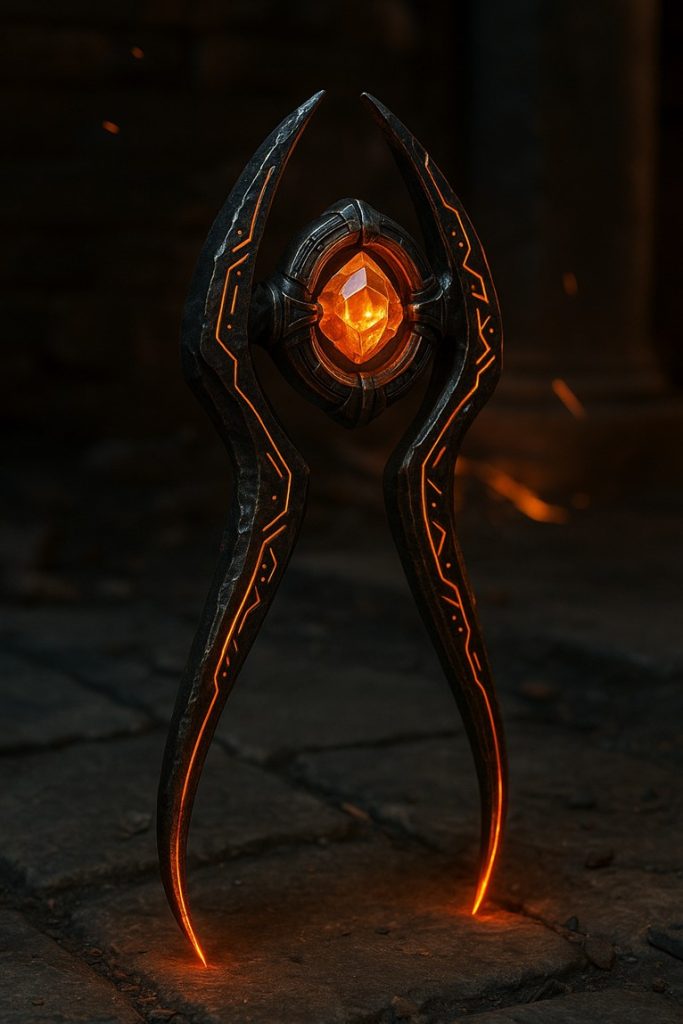
Perception of Activation:
User’s Perspective:
When the Resonant Caliper 678 of the Lithic Choir activates, the user feels a deep hum vibrate through their arms, traveling up the bones like a living pulse. The crystal fulcrum between the caliper’s obsidian arms begins to glow with rhythmic light—each pulse in perfect sync with the avatar’s own heartbeat. The surrounding air thickens, as if alive with invisible density; every sound and vibration becomes clearer, more meaningful. Beneath the user’s feet, the ground feels like a breathing organism—its tremors translating into language: whispers of the earth, murmurs of ore veins, and faint memories of how the rock itself was once molten.
Vision subtly shifts: outlines shimmer, stone veins glow faintly in hues of orange, blue, and violet depending on mineral content. The Mind’s Eye senses harmonic structure in everything solid—architecture, weaponry, even armor—revealing weaknesses or harmonies like chords in a song. Auditory perception deepens; the caliper’s hum merges with the user’s breathing, forming a duet of living resonance. Each inhalation aligns with the earth’s low frequency, grounding the user in absolute stability.
Extra-Sensory Perceptions:
The user perceives geological memory. Surfaces touched reveal impressions—echoes of heat, pressure, and time. Brief flashes appear within the Mind’s Eye: rivers of magma cooling, tectonic compression shaping mountains, ancient hammer strikes leaving phantom imprints. In rare moments, faint silhouettes of the Lithic Choir themselves—ghostly artisans of stone—can be felt through harmonic impressions, as if their chants linger in the tool’s resonance.
Observer’s Perspective:
To others, the activation manifests as a low, thrumming hum that reverberates through the air and ground, subtle yet powerful enough to make dust dance and pebbles roll. The caliper emits geometric runes of soft orange and white light along its arms, expanding and contracting with each pulse like a living diagram. When the user moves, the vibrations follow, making even small gestures resonate audibly through stone or metal. Observers standing close may feel an involuntary tightening in the chest, as though their heartbeats are briefly being tuned to the same rhythm.
The environment around the user subtly reacts: molten seams glow brighter, hanging crystals ring with sympathetic tones, and water droplets vibrate before evaporating into faint mist.
Positives:
• Grants heightened spatial and vibrational awareness — perfect for sensing danger, hidden passages, or structural instability.
• Creates an aura of calm authority; those nearby feel steadied by the rhythmic hum.
• Can synchronize group effort—miners, soldiers, or chanters naturally fall into rhythm, improving teamwork.
• Enhances precision and control, turning every motion into a refined, calculated act.
Negatives:
• The intense resonance can overwhelm sensitive hearing or balance, causing vertigo or nausea after prolonged use.
• Extended activation risks “resonance bleed”—when the user’s heartbeat remains synchronized with the device even after deactivation, leading to lingering tremors or sleeplessness.
• Disrupts stealth; the harmonic hum can betray presence to creatures or machines that sense vibration.
• Overuse near unstable ley-lines can attract elemental attention—spirits of stone or magma may awaken, mistaking the signal for an ancient Choir summons.
In essence, activating the Resonant Caliper 678 is to momentarily become part of the world’s song. The user ceases to merely walk upon the earth—they listen, speak, and breathe in harmony with it.
Crafting Recipe: “Recreation of the Resonant Caliper 678 of the Lithic Choir”
Materials Needed
- Volcanic Obsidian (2 lbs): Harvested from the cooled slopes of the Great Fire Mountain. Must be flawless and resonant when struck with a tuning rod.
- Copper-Veined Crystal (1 core shard): Extracted from subterranean ley-node formations or refined through alchemical lattice growth. Must be properly polarized for harmonic conduction.
- Va-Shar Resonance Runes (4 sets): Hand-inscribed onto copper sheets using molten rune-ink and bound by Kwe-Va chanting during the etching process.
- Elemental Echo Stone (1 small piece): A rare mineral containing trapped vibrational energy from seismic events; serves as the caliper’s harmonic amplifier.
- Ash-Binder Resin (1 vial): A heat-resistant bonding agent mixed with powdered basalt, resin from fire-bloom trees, and essence of stability (distilled from tempered lava steam).
- Essence of Korrath’s Breath (few drops): Optional, but strengthens the link between metal and magic during the final harmonization phase.
Tools Required
• Runic Engraving Stylus: For precision etching of Va-Shar glyphs into the obsidian arms.
• Geomantic Anvil: A forge-stone that resonates in low tones when struck, used to temper harmonics.
• Crystal-Lattice Calibrator: Measures and aligns the vibrational frequency between the crystal core and obsidian arms.
• Chant-Forge Bellows: A steam-powered bellows designed to synchronize airflow with Kwe-Va chants for controlled heat infusion.
• Tuning Mallet and Resonance Chime Set: Used for testing each stage of harmonic response.
• Protective Glass and Stabilization Harness: Ensures safety when handling active echo stones, as misaligned frequencies may cause fractures or sonic backlash.
Skill Requirements
• Runesmithing (Advanced): Essential for correctly inscribing Va-Shar glyphs; any deviation weakens resonance stability.
• Geomantic Engineering (Intermediate): Required for aligning harmonic flow between materials and the ley structure.
• Metalworking and Crystal Shaping (Expert): Needed to fuse the obsidian arms to the copper crystal core without cracking or over-melting.
• Kwe-Va Chant Proficiency (Adept): Each activation rune and harmonic line must be sealed through vocal resonance to bind its energy frequencies.
• Pyromantic Control (Basic): To moderate heat levels during infusion, ensuring the molten copper veins remain stable within the crystal core.
Crafting Steps
- Preparation of the Obsidian Arms:
Carve two symmetrical arms from volcanic obsidian, polished to a mirror sheen. Tap each with a tuning mallet — both must emit identical tones when struck. Any dissonance indicates hidden fractures and renders the piece unusable. - Inscription of Va-Shar Runes:
Using the Runic Engraving Stylus, carve the resonance runes along the inner surfaces. Each rune must correspond to one of the Seven Harmonics of Korrath: Strike, Flow, Bind, Sustain, Echo, Temper, Release. While inscribing, chant each rune’s tone aloud to ensure resonance imprint. - Forging the Core Fulcrum:
Place the copper-veined crystal inside the Geomantic Anvil’s central socket. Heat it with the Chant-Forge Bellows while chanting the Binding Verse of the Lithic Choir. The crystal should pulse in time with the chant, indicating the alignment of magical frequency. - Infusion with Elemental Echo Stone:
Grind the echo stone into powder and mix it into the molten Ash-Binder Resin. Apply the mixture along the joints where the crystal meets obsidian. As the resin cools, strike the caliper arms gently with the tuning mallet at intervals, maintaining a steady tone to guide solidification. - Harmonic Calibration:
Once cooled, connect the caliper to the Crystal-Lattice Calibrator. Adjust the copper filaments within until both arms hum at the same pitch as the core crystal. Any resonance drift greater than one-half tone must be corrected immediately. - Final Harmonization and Blessing:
In a quiet forge or sanctified hall, recite the Song of Still Stone while slowly opening and closing the caliper. Add a single drop of Korrath’s Breath Essence onto the fulcrum at the crescendo of the chant. When complete, the device should emit a faint, continuous hum—signifying it has awakened. - Testing and Stabilization:
Tap the caliper’s tips against a rock wall or metal ingot. Observe the emitted vibrations and glow pattern. A fully functional Resonant Caliper will produce clear geometric light pulses and a perfectly steady pitch. Allow the instrument to rest for 24 hours before full use to prevent structural fatigue from residual resonance.
Result:
A newly forged Resonant Caliper of the Lithic Choir — harmonically tuned, ley-responsive, and capable of deciphering the voice of the world itself. Its hum should match the earth’s pulse within the user’s Mind’s Eye, affirming successful attunement to both material and spiritual frequencies.
Warning: If the caliper emits discordant shrieks or erratic flickering light during activation, disassemble immediately. Such instability risks drawing the attention of dormant stone elementals or triggering micro-seismic feedback loops.
Song Beneath Stone
Tale of the Resonant Caliper
In the age before the shaping of Sar-Kwe’s first forge, when the mountains still groaned from the birth pains of the earth and the voice of Korrath had not yet been carved into the hearts of stone, there was told a tale of the Lithic Choir—those who heard not with ears, but with their bones. The oldest fragments of this tale were etched in basalt tablets, broken and fused again by the heat of ages. Scholars of the Emberforges say it is translated from an even older tongue, one no living throat can fully shape.
It speaks of a mountain that sang before the dawn. The people of that land, the Kwe-Sar’s forebears, lived within its shadow and feared the deep murmurs that rose from its belly. They called it Va-Korathen, the mountain-with-a-heart, and it shook the earth when displeased. Many fled, believing it cursed. But one artisan remained—a young stone-listener named Aru-Ken of the Low Caverns, whose ears had gone deaf to air but open to vibration.
Aru-Ken felt the quakes of the world like the breath of a giant sleeping below, and he desired not to silence it, but to understand it. For seven years, he carved devices that might capture the mountain’s tone, each one breaking under pressure or melting in the heat. His people mocked him, saying:
“You build tools for the dead stone, but you hear no song of life!”
Yet he labored on, guided by the pulse of the ground. One night, as molten rivers tore through the lower caves, Aru-Ken placed his hands upon the trembling rock and felt a pattern within the chaos—a rhythm. With trembling resolve, he forged his final instrument: a pair of blackened arms of obsidian clasping a crystal heart veined with copper. He sang to it as he worked, not with voice but through vibration, striking the metal as one would strike a drum of the soul.
When the mountain roared again, Aru-Ken descended into its throat. There, amid rivers of fire, he opened his device across a cracked wall and the hum grew loud enough to still the tremors. The mountain shuddered once, then quieted. From the molten fissure, a voice like burning iron spoke—not in words, but in harmonic tone:
“You have not silenced me, small one. You have listened.”
The people above saw the fires dim and believed the mountain appeased. When Aru-Ken returned, his hair was turned to ash-white, and his skin bore lines of glassy light, glowing faintly as if magma ran beneath. He carried with him the Resonant Caliper, still pulsing with heat. Through it, he taught others how to read the songs of the world—the hum of ore veins, the sighs of breaking rock, the whispers of buried crystal. These disciples became known as the Lithic Choir, builders of harmony between flame and stone.
But peace did not last. A century later, when the Choir had grown proud, they sought to command the song rather than commune with it. They built forges in the deep that fed on the mountain’s heart. The Caliper was brought forth again to “discipline” the earth’s will, and Aru-Ken’s voice—preserved in the device—cried out in warning:
“The stone sings not to be bound, but to be heard!”
The forges collapsed. The Choir was lost beneath the molten rivers, their voices echoing eternally in the caverns. The Caliper was recovered centuries later, half-melted but still resonant, its arms humming the same steady note that once calmed a mountain. Its hum carries fragments of those who once sang with it—Aru-Ken, the Choir, and perhaps even the heart of Korrath himself.
Today, when the Resonant Caliper is activated, some claim to hear faint chanting beneath the vibration—a chorus of stone and fire in dialogue. Scholars debate its words, but the forgemasters of Acheulean say that the meaning has never changed since the First Tempering:
The world does not yield to mastery, but to harmony.
Moral of the Story: To shape the world, one must first listen to its song. Those who force the voice of creation will be broken by its echo, but those who learn its rhythm will endure as part of it.
Suggested conversions to other systems:
Call of Cthulhu (7th Edition)
Item Name: Resonant Caliper 678 of the Lithic Choir
Type: Mythos Artifact / Engineering Tool
Era: Any Industrial or Modern Epoch
Description:
A twin-armed device of obsidian and copper-crystal, humming faintly when held. Its oscillations reveal unseen structures beneath the earth and awaken echoes of ancient sentience dwelling in stone.
Game Effects:
• Vibrational Mapping: When used for investigation or archaeology, grants a +20% bonus to rolls involving geology, mechanical repair, archaeology, or occult when analyzing stone, metal, or ruins.
• Harmonic Stabilization: Once per day, may emit a counter-frequency to stabilize crumbling structures or prevent a cave-in. The Keeper may allow this to negate 1d6 rounds of collapsing debris or falling damage.
• Resonance Detection: Within 100 feet, can sense hollow spaces, ley lines, or buried mechanisms (Spot Hidden or Listen check, Hard difficulty).
• Song of the Stone: Once per week, after chanting in Kwe-Va, the user may attempt a POW vs. POW roll to glean memories of the stone (Keeper describes an ancient event or echo).
• Sanity Cost: 1D4 SAN when the device reveals the consciousness within a structure; repeated exposure may induce the Lithic Whisper Madness (obsessive rhythmic tapping and sleep resonance).
Value: Priceless (artifact; typically seized by geological societies, cults of Korrath, or private collectors).
Skills Involved: Geology, Occult, Electrical Repair, Archaeology, Mechanical Repair.
Blades in the Dark
Item Name: The Resonant Caliper (Fine Arcane Implement)
Item Type: Tool / Arcane Device
Load: 1
Description:
An obsidian measurement tool that hums the voice of the city’s underbones. It deciphers vibrations of structure and echoes of forgotten craftsmanship.
Mechanics:
• Fine Quality: Grants +1d to rolls when surveying, studying, or crafting involving stone, architecture, or arcane materials.
• Resonant Pulse (Special): When used during a downtime long-term project or score that involves excavation, hidden pathways, or unstable terrain, it reduces the clock by 1 extra segment.
• Harmonic Counter: Once per score, emit a stabilizing tone to prevent collapse or physical harm to allies nearby (counts as spending 2 stress to protect a teammate automatically).
• Whisper’s Connection: A Whisper may attune to the Caliper to communicate briefly with echoing spirits within old foundations (controlled attune roll; risk of attracting stonebound ghosts).
Notes: A precious artifact among Whisper engineers and Leviathan-blooded artisans. Worth 4 coin on the black market, 6 coin to an academic or builder’s guild.
Dungeons & Dragons (5th Edition)
Item Name: Resonant Caliper 678 of the Lithic Choir
Wondrous Item (Rare), requires attunement by an Artificer, Wizard, or Druid
Description:
This obsidian-and-copper instrument vibrates with the memory of the earth. When held open, the user feels the rhythmic heartbeat of stone and the whispers of buried ley energy.
Tier: 1 (Base Magic Item)
Slot: Held / Tool
Weight: 2 lb
Stats & Abilities:
• Passive – Vibrational Mapping: While attuned, you gain advantage on Investigation and Arcana checks related to stone, metalwork, or ancient ruins.
• Passive – Resonance Sense: You can detect cavities, traps, or ley-aligned minerals within 60 ft as if under the effect of Detect Magic focused on solid materials.
• Active (1/day) – Harmonic Alignment: Emit a stabilizing hum. For 10 minutes, all allies within 20 ft gain advantage on Dexterity saving throws against falling debris or cave-ins.
• Active (1/week) – Song of the Stone: Spend 1 minute chanting in Kwe-Va while holding the Caliper against natural stone; learn the geological and magical history of the location (as Legend Lore, but focused on material memory).
• Bonus: Grants +2 to any tool check involving metal or stone (Smith’s Tools, Mason’s Tools, or Tinker’s Tools).
Perceptual Side Effects: When active, faint harmonics echo in the air; creatures sensitive to vibration may sense your location within 60 ft.
Value: 1,200–1,500 gp in high-magic markets; non-magical scholars pay up to 2,000 gp for a functional model.
Knave (Revised Edition)
Item Name: Resonant Caliper of the Lithic Choir
Type: Tool / Relic
Encumbrance: 1 slot
Description:
A strange measuring instrument forged of dark glass and copper veins. It hums softly, revealing the whispers of the world’s bones.
Tier: 1
Slot: Hand
Durability: 20/20
Effects:
• +2 to any checks involving architecture, geology, or crafting with stone/metal.
• Detect Substructure: Spend 1 turn concentrating—discover hollow spaces, ore veins, or magical vibration within 60 ft (no test required).
• Harmonic Counter: Once per day, negate a fall or collapse within 10 ft radius (reduces falling or crush damage by half).
• Song of the Stone (Ritual): After 10 minutes of chanting, the wielder learns one fact about a stone structure’s origin or history (determined by the GM).
Drawback: Continuous use induces tremors in the hands; after three uses in one day, all Dexterity checks are made with disadvantage until rest.
Value: 100 silver in civilized markets, 250 in scholar enclaves, or priceless in the hands of a geomancer.
Fate Core System
Item Name: Resonant Caliper 678 of the Lithic Choir
Item Type: Arcane Tool / Aspect-Bound Artifact
High Concept: Voice of the Stone, Instrument of Harmony
Description: A precision instrument of black glass and copper crystal that reveals and stabilizes the unseen harmonics of the world’s foundation. Its hum carries both the patience of mountains and the danger of awakening their echoes.
Aspects:
• The Stone Remembers Every Touch
• Bound to the Harmonics of Korrath
• The Choir Still Sings Beneath the Earth
Mechanics:
• Passive Benefit: Gain +2 to any Overcome or Create an Advantage action involving stability, construction, or vibration (detecting hollows, reading ley lines, tuning machinery).
• Invoke: Spend 1 Fate Point to automatically stabilize collapsing terrain, fortify a structure, or suppress an earthquake-like effect for one scene.
• Compel: When the Caliper resonates with a living ley-line, it may draw the user’s mind into the Song of Stone, causing momentary deafness or trance.
• Extras:
– Resonance Scan: Once per session, reveal the true history of a crafted object or ruin.
– Echo Feedback (Risk): Failure on a roll using the Caliper creates a Disorienting Vibration aspect with one free invoke against the user.
Cost / Availability: Found only through geomantic guilds or ancient vaults. Considered a Rare Artifact with 3 refresh value equivalent.
Numenera / Cypher System
Item Name: Resonant Caliper 678 of the Lithic Choir
Level: 5 (Difficulty 15)
Form: Complex Device / Artifact (Tool)
Effect:
When active, the Caliper translates vibrational and geomantic patterns into visual and sensory feedback.
• Vibrational Mapping: Adds +2 to any Intellect-based tasks involving structure analysis, crafting, or deciphering ancient construction.
• Harmonic Stabilization: Once per day, emit counter-frequency waves that prevent environmental collapse or grant +1 Armor for one hour to any creature within 10 m standing on stone.
• Resonance Detection: Automatically detects ley-lines, hollows, or energy conduits within 30 m.
• Song of the Stone: Once per day, communicate with inorganic material to learn one significant historical or functional detail (GM intrusion: contact with sentient stone may cause confusion or hallucination).
Depletion: 1 in 1d20 (device overheats or fractures when misused).
Skill Interaction: Geomancy, Numenera Understanding, Crafting, or Engineering.
Special: Characters trained in Attunement or Tuning may reroll one failed check per scene when using the Caliper.
Value: 3d6×100 shins; priceless to Earth-aligned Aeon Priests.
Pathfinder (2e)
Item Name: Resonant Caliper 678 of the Lithic Choir
Item Type: Magical Tool / Wondrous Item
Rarity: Rare
Level: 6
Price: 325 gp
Bulk: L
Usage: Held in one hand (two hands to fully activate)
Traits: Magical, Divination, Earth, Resonant
Effects:
• Vibrational Mapping (Passive): You gain a +2 item bonus to Crafting, Engineering Lore, or Architecture Lore when examining stone, metal, or earthen constructs.
• Resonance Detection (Exploration): Spend 10 minutes surveying an area to learn whether hidden chambers, ore veins, or magical ley currents exist within 60 feet.
• Harmonic Alignment (1 Focus Point or once per hour): Emit stabilizing tone in a 30-foot emanation. Each ally gains a +1 status bonus to Reflex saves and AC against environmental collapse or earthquake effects for 1 minute.
• Song of the Stone (1/day): With a successful DC 20 Occultism or Nature check, learn one key fact about the geological or magical history of a touched surface (functions as Object Reading but limited to inorganic material).
Activation (Interact, Command): 1 action to open or calibrate.
Failure Consequence: A critical failure while activating creates a sonic backlash (1d6 sonic damage to the wielder).
Craft Requirements: Geomantic forge, Va-Shar runes, obsidian arms, and tuning crystal from an elemental earth node.
Savage Worlds (Adventure Edition)
Item Name: Resonant Caliper 678 of the Lithic Choir
Gear Type: Arcane Device / Utility Tool
Rank: Seasoned
Cost: $1,500 (artifact pricing)
Weight: 3 lb
Description: A rune-etched pair of obsidian arms bound by a copper-veined crystal. When spread across a surface, it hums with frequencies that reveal structure, flaws, and buried power.
Powers:
• Analyze Material (Passive): Grants +2 to Notice, Repair, or Weird Science rolls related to stone, metal, or architecture.
• Stabilize Terrain (1 Power Point, Action): Emits counter-frequency; negates one environmental hazard (e.g., collapsing tunnel, earthquake tremor, landslide).
• Sense Ley Energy (1 Power Point, Concentration): Detects sources of arcane energy, ore, or voids within 12″ radius (GM’s discretion).
• Song of the Stone (3 Power Points, 1 minute): The user communes with the geological memory of the area, gaining one clue about past construction or catastrophe.
• Backlash: On a 1 on the Arcane Skill die, the device emits uncontrolled resonance—user must make a Vigor roll or suffer Fatigue from vibration trauma.
Edges / Skills Benefited: Repair, Knowledge (Arcana), Science, Survival (underground).
Notes: Usable by anyone with the Arcane Background (Weird Science, Magic, or Miracles). Non-arcane users can still employ it at +2 difficulty.
Shadowrun (6th Edition)
Item Name: Resonant Caliper 678 of the Lithic Choir
Category: Technomantic / Geomantic Device (Artifact)
Availability: 8R
Cost: 9,500¥
Weight: 1.2 kg
Description:
A relic-like analytical tool constructed of obsidian arms and a copper-etched crystal core. When activated, it emits inaudible subharmonics that visualize geologic or structural vibrations through AR overlays or sensory feedback. Though non-electronic in design, its aura resonates with mana itself, bridging the physical and astral.
Game Effects:
• Geomantic Scan: Grants +3 dice to Engineering, Demolitions, or Arcana tests when analyzing architecture, ore veins, or magical structures.
• Structural Stabilization: Once per scene, emit harmonics that reduce collapsing or environmental damage by half within a 5-meter radius.
• Resonance Detection: Detects mana flows, astral disturbances, or hidden underground structures within 30 meters (Perception [INT] + Arcana test, threshold 2).
• Song of the Stone (Complex Action): The user may interface with the device astrally; success on an Arcana + Willpower (3) test allows them to perceive geological or magical “memories” (GM discretion).
• Drain: 2 Stun (resisted with Willpower + Body) after each Song use due to harmonic feedback.
Notes: Restricted under Corporate Excavation Act—often seized by Aztechnology or MCT for ley-node mapping. Black-market copies fetch 20,000¥ among technomancers.
Starfinder
Item Name: Resonant Caliper 678 of the Lithic Choir
Item Level: 6
Price: 4,800 credits
Hands: 2
Bulk: 1
Type: Hybrid Item (Technomagical Tool)
Usage: 10 charges; 1 charge/hour or per activation
Description:
This precision tool hums softly, resonating with planetary crusts, alloys, or ruins. Its internal crystal processors convert sonic vibrations into visible glyphs across its obsidian arms, revealing material integrity and substructure.
Abilities:
• Vibrational Mapping (Passive): While wielded, you gain a +2 insight bonus to Engineering or Physical Science checks related to construction, minerals, or ruins.
• Resonance Detection (2 charges, 1 minute): Detect hidden voids, caverns, or power veins within 60 ft as per life science scan or detect magic (limited to inorganic materials).
• Harmonic Stabilization (3 charges, standard action): Generate a stabilizing field; all allies in a 15-ft radius gain +1 AC and +2 vs. Reflex effects for 1 minute.
• Song of the Stone (5 charges): Commune with inorganic terrain or material, revealing geological data or ancient history (functions as object reading or commune with nature limited to stone or metal).
Destruction: If exposed to a vacuum for over 24 hours without recharging, the Caliper fractures into inert shards.
Special: Hybrid repair requires both Engineering (DC 25) and Mysticism (DC 22).
Traveller (Mongoose 2e)
Item Name: Resonant Caliper 678 of the Lithic Choir
Tech Level: 13
Mass: 1 kg
Cost: Cr15,000
Type: Scientific / Archaeological Instrument
Description:
An ancient Acheulean instrument capable of reading structural harmonics and planetary crust resonance. The device vibrates when placed against rock or alloy, “singing” the geological truth of its composition.
Mechanics:
• Vibrational Survey: Adds DM+2 to Engineering (Planetary Construction), Science (Geology), or Recon checks when analyzing stone, architecture, or subterranean materials.
• Structural Stabilization: Spend 1 minute calibrating to reduce structural collapse chance by 50% during excavation or combat encounters in ruins.
• Resonance Pulse: Detect voids, unstable tunnels, or energy nodes within 30 meters (requires Routine [8+] Science (Geology) check).
• Song of the Stone: After 10 minutes of concentration, the user may learn geological history or resource composition of the planet (Referee discretion).
Failure Consequences: On a mishap (natural 2), the Caliper emits uncontrolled resonance; user suffers 1D6 END damage from harmonic feedback.
Availability: Rare pre-Imperial relic—found primarily in lost colony caches or corporate black sites.
Warhammer (Fantasy / 4th Edition)
Item Name: Resonant Caliper 678 of the Lithic Choir
Item Type: Arcane Instrument / Relic of the Dwarfen Kindreds
Rarity: Very Rare
Encumbrance: 1
Craftsmanship: Masterwork (Runescribed)
Value: 220 Gold Crowns
Description:
Forged in the molten halls beneath the Fire Peaks, the Caliper is said to channel the Song of Grungni himself. Its blackened metal arms thrum with ancient rune-magic, capable of discerning the living pulse of mountain and forge alike.
Game Effects:
• Vibrational Mapping: Grants +20 to Trade (Engineering), Lore (Geology), or Evaluate when assessing stonework, ore, or fortress integrity.
• Rune of Stabilization (Passive): All cave-in, tremor, or collapse tests within 10 yards gain a +10% chance to succeed.
• Harmonic Counter (1/day): As a Full Action, the bearer may emit a stabilizing tone—negating one environmental hazard or preventing a fall of debris (GM adjudication).
• Song of the Stone (1/week): Commune with the spirit of the mountain for insight into the past or hidden structures. Requires a successful Cool Test or the user becomes overwhelmed by ancient dwarfen grief (1 Fatigue).
Corruption Risk: Those not of dwarfen blood must make a Willpower Test (+0) or suffer disturbing echoes of ancient ruin, gaining 1 Corruption Point.
Craft Origin: Believed to have been forged in the time of the Ancestor Lords; runes correspond to pre-Karak glyphs of Korrath’s Tongue.