
From: Deceivers
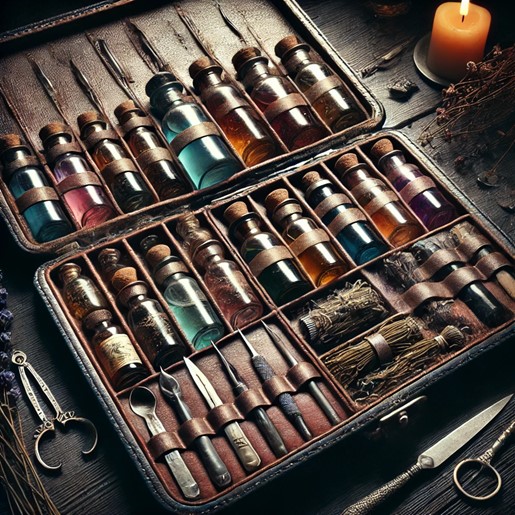
This kit contains vials of deadly toxins, herbs, and specialized tools necessary for the creature to prepare and apply poisons. With expertise in poison-making, the creature can create potent concoctions that can be applied to weapons or used for covert assassination attempts. The kit also includes antidotes and counteragents for the creature’s own protection.
Availability: Uncommon / Level Requirement: (Tier 1)
Skills:
- Poison-Making: Proficiency with poisoner’s tools, allowing the creature to create potent poisons, apply them to weapons, and utilize them in covert operations.
Cost: 40 gold
Tags: Tools (Poisoner’s Kit), Poison-Making, Assassination, Covert Operations, Toxicology, Venomcraft, Stealth Tactics, Precision Application, Herbal Alchemy, Concealed Threats, Silent Kill, Covert Toxins, Antidote Mastery, Counteragent, Espionage, Subterfuge, Bladesmith
| Simple passive: (Always on if worn) |
| Poison Damage Bonus: 1d4 |
Only when the user causes poison damage does this add 1d4 to the damage.
The Poisoner’s Kit is a specialized and potentially illegal item, making it more common in certain discreet or clandestine shops in the world of Saṃsāra. Its availability and price vary depending on the region and the type of establishment where it is sold.
- Black Market Bazaars
- Location: Hidden alleyways in large cities, ports, or lawless territories such as underground markets or shadowy districts within sprawling metropolises.
- Description: These shops are operated by smugglers, assassins, and other underworld figures who deal in contraband and illegal goods. The shops are usually concealed behind innocent fronts like an apothecary or herbalist, where only trusted customers can gain access to the true inventory. These vendors often require buyers to provide proof of intent or membership in secret organizations before selling dangerous items.
- Cost: 80 gold (double the regular cost due to the risk and rarity).
- Guild-Operated Specialty Shops
- Location: Tucked away in secretive locations known to members of assassin guilds, thieves’ guilds, or factions of spies and deceivers, often in hidden corners of bustling trade cities or isolated hideouts.
- Description: Operated by guild artisans or poison-makers with extensive knowledge of toxins and antidotes, these shops cater exclusively to guild members. The shopfront may be hidden behind a legitimate business such as a fletcher’s shop or rare herbalist. Only those who have gained the trust of the guild or those within certain ranks can make purchases.
- Cost: 50 gold (a slight discount due to guild affiliation).
- Traveling Caravan Dealers
- Location: Wandering caravans that travel between dangerous, lawless regions, frontier lands, or remote towns where law enforcement is minimal. These caravans operate on the fringes of society and are often visited by rogues, mercenaries, or adventurers seeking rare items.
- Description: These dealers work out of temporary setups, often pitching tents or operating from the back of large, fortified wagons. They offer all manner of exotic and dangerous goods, including poisons, weapons, and forbidden artifacts. These caravans frequently change locations to avoid detection and maintain secrecy.
- Cost: 60 gold (negotiable, depending on the buyer’s persuasion and loyalty).
- High-End Apothecaries
- Location: In wealthy districts of prominent cities, where alchemists or herbalists operate with a degree of legality and cater to the elite, including nobles and military commanders.
- Description: While most of their products are legal, high-end apothecaries secretly carry Poisoner’s Kits for clients with political power or military influence. These shops often require clients to make discreet inquiries or possess certain connections. The kits sold here might be disguised as expensive medical kits or rare botanical supplies.
- Cost: 100 gold (inflated price due to clientele and the illusion of legitimacy).
- Rogue Artisan’s Hideaway
- Location: Hidden in the wilderness, deep forests, or caves, where reclusive artisans live off the grid to avoid scrutiny. These artisans are often former guild members or master assassins who now work independently.
- Description: These hideaways are rustic, often cluttered with alchemical equipment and rare herbs. Buyers must usually journey through dangerous terrains or complete a special task to gain access to the artisan’s wares. The quality of the items here is unmatched, with custom poisons available for the right price.
- Cost: 70 gold (negotiable depending on buyer’s rapport with the artisan).
In Saṃsāra, these shops maintain secrecy, and their operators often assess buyers’ skills and affiliations before completing transactions. The Poisoner’s Kit is a coveted tool, and its sale is closely tied to the undercurrents of power, espionage, and danger in this high-stakes magical world.
In the world of Saṃsāra, the Poisoner’s Kit is a versatile tool that serves both offensive and defensive purposes in various environments. Its role depends heavily on the setting, the character’s approach to combat, and the social and environmental circumstances they find themselves in.
- Urban Setting
- Offense:
- In crowded city environments filled with political intrigue, the Poisoner’s Kit is often used for covert assassinations. Rogues or spies might lace food, drink, or personal items (like a ring or comb) with a toxin from the kit, targeting corrupt officials, rival guild members, or even high-ranking nobles without drawing attention. A skilled poisoner could blend into the crowd, slipping poison into the victim’s drink at a tavern or marketplace.
- Example: A spy infiltrates a high-class banquet and uses a mild contact poison to incapacitate a guard, then applies a stronger ingested poison to a target’s wine, ensuring a slow and subtle death.
- Defense:
- In cities where enemies or rival guilds can strike from the shadows, the Poisoner’s Kit serves as a critical tool for self-protection. Characters may brew antidotes in advance or coat their clothing or door handles with toxins to deter would-be assassins. If pursued through narrow alleys or darkened streets, they might drop poisoned caltrops to disable their enemies.
- Example: A rogue anticipating a nighttime ambush prepares antidotes and lays a trap by lacing the entrance to their hideout with a paralytic poison, disabling intruders before they can strike.
- Offense:
- Wilderness/Forest Setting
- Offense:
- In the untamed wilds, the Poisoner’s Kit becomes a silent hunter’s tool. Characters might use plant-based toxins found in nature to coat arrows or blades, allowing them to weaken or kill prey from a distance. This method is often favored by rangers, rogues, and survivalists, who need to remain unseen while eliminating enemies or wild beasts.
- Example: A ranger sets up an ambush, applying poison to arrowheads before firing at a band of marauding enemies. Each shot weakens the target, allowing the ranger to maintain distance while steadily reducing their numbers.
- Defense:
- When in the wilderness, a poisoner can use their skills to ward off predators or enemies. Lacing traps with toxins or concocting poisons that deter wild beasts is a common defensive strategy. They may also prepare antidotes to counter natural poisons from the local flora or fauna.
- Example: While camping in hostile territory, a poisoner sets up snares coated with venom from local plants, ensuring any intruder who triggers the trap is paralyzed or weakened before they can approach the camp.
- Offense:
- Dungeon or Chaos Dungeon Setting
- Offense:
- In the dark and twisting corridors of a dungeon, a poisoner’s ability to stealthily weaken enemies is invaluable. Poisons with lingering effects like paralysis or confusion can be applied to weapons to gain an advantage against powerful creatures or dungeon bosses. Poison traps or smoke bombs crafted from the kit can be used to impair groups of enemies, leaving them vulnerable to surprise attacks.
- Example: As the party encounters a powerful chaos dungeon creature, the poisoner dips their blades into a paralytic concoction from the kit. During the battle, each successful hit further immobilizes the creature, allowing the group to focus on dealing damage without retaliation.
- Defense:
- In environments where magic might be unstable, the Poisoner’s Kit offers a reliable, non-magical defense. Poisoners can craft antidotes for toxins present in the dungeon or create smoke bombs laced with irritants, using them to escape deadly encounters or disorient attacking creatures. Poisoned caltrops or traps can block off tunnels or choke points to halt pursuing enemies.
- Example: When surrounded by dungeon monsters, the poisoner throws down a smoke bomb laced with irritants from the kit, blinding the monsters and creating enough chaos for the party to make a quick escape.
- Offense:
- Political and Courtly Setting
- Offense:
- In a royal court filled with scheming nobles and courtiers, poisoners must be exceptionally subtle. They often use slow-acting or rare poisons that are difficult to detect, relying on the victim succumbing days after the initial dose, making the act appear as a natural illness or accident. Poisoned gifts, wine, or even floral arrangements can be used to strike down rivals without revealing the assassin’s hand.
- Example: A poisoner is hired by a noble to eliminate a rival at a feast. They use a colorless, odorless poison from their kit to lace the rival’s dessert, ensuring that they fall ill several days later, after all suspicion has passed.
- Defense:
- In this highly political environment, poisoners also use the kit for self-preservation. They may test food and drink for poisons or craft antidotes to protect themselves and their allies from treacherous nobles who would resort to underhanded tactics. Some characters even poison their personal effects—rings, brooches, or handkerchiefs—as a defense against those who might touch them with ill intent.
- Example: Anticipating betrayal at a royal banquet, a poisoner tests their goblet for toxins before drinking and carries a small vial of antidote for quick use should they sense any suspicious symptoms.
- Offense:
- Military or Battlefield Setting
- Offense:
- On the battlefield, the Poisoner’s Kit becomes a tool for strategic sabotage. Soldiers or mercenaries may use toxins to weaken enemy forces before direct confrontation, lacing the water supply, rations, or arrows with poison. Fast-acting toxins are particularly useful here, as they can incapacitate key targets like commanders or spellcasters during critical moments in battle.
- Example: A rogue assassin slips into the enemy camp at night and poisons their water supply, leaving the enemy forces weakened and disoriented by the time battle breaks out the next morning.
- Defense:
- In battle, poisoners can use the kit to craft antidotes for poisoned arrows or blades used by enemy forces. Additionally, they can brew resistance potions to temporarily bolster their allies against venomous attacks. Poisonous traps or snares can also be laid behind the front lines to slow down or incapacitate enemy scouts or raiders.
- Example: A mercenary leader, forewarned about the enemy’s use of poisoned arrows, has the poisoner craft antidotes for the front-line troops, preventing mass casualties during the skirmish.
- Offense:
- Seafaring or Pirate Setting
- Offense:
- On the high seas, pirates and sailors may use the Poisoner’s Kit to launch stealthy night raids or sabotage enemy ships. Poisoned blades and arrows can be used to silently take out guards or crewmen before boarding the ship. Additionally, poisoners might lace the food or drink in the galley with slow-acting toxins to ensure the crew is incapacitated before an attack.
- Example: Before boarding an enemy vessel, the pirate poisoner applies a swift-acting poison to their dagger, silently dispatching guards during the initial assault.
- Defense:
- On ships, the Poisoner’s Kit may be used to defend against venomous sea creatures or to provide antidotes for dangerous fish or sea serpent bites. Poisoners can also craft antidotes for mutinies where the crew may be poisoned by their own captain or another faction.
- Example: After a ship’s rations are tainted by a poisonous sea creature, the poisoner quickly brews antidotes to prevent illness spreading among the crew, ensuring the ship continues its voyage.
- Offense:
In Saṃsāra, the Poisoner’s Kit plays a dynamic role in both subtle and direct combat, allowing characters to exploit weaknesses, create diversions, or simply end threats before they even begin. The kit’s utility lies in its flexibility, adapting to different environments and tactical needs.
Perception of Activation:
- Sight
- Perception: Upon activation, a faint, shifting aura surrounds the Poisoner’s Kit, visible to the user as a dull, sickly green or purple glow. The liquids in the vials shimmer slightly, as though disturbed by an invisible force. Some items appear darker or lighter than before, enhancing the sense that the kit is charged with dangerous potential.
- Description: The glow is subtle but ominous, alerting the user to the potency of the poisons within. It might also cast eerie reflections on nearby surfaces, hinting at the hidden nature of the poisons.
- Positives: The glow provides visual confirmation of successful activation, warning the user of heightened toxicity or readiness.
- Negatives: The glow may give away the user’s position or alert others to the presence of dangerous substances, especially in dark environments.
- Sound
- Perception: A barely audible, high-pitched hum or hiss, like the sound of liquid under pressure, becomes noticeable when the kit is activated. This sound might intensify if the poisons are particularly lethal or unstable.
- Description: The hum is persistent but faint, only perceptible to those in close proximity. It’s a reminder of the volatile nature of the kit’s contents, emphasizing the danger of improper handling.
- Positives: The sound serves as an indicator of potential danger, making the user more cautious in handling the tools or poisons.
- Negatives: The sound may be unsettling to the user, leading to increased tension or nervousness during use. In extremely quiet environments, it could be heard by others.
- Touch
- Perception: Upon handling the activated kit, the user might feel a sudden chill or prickling sensation in their fingertips, as though the tools and vials are infused with a latent, dangerous energy.
- Description: The sensation is sharp, like handling something electrified or venomous. It causes the user to handle the kit with extra care, aware that a single mistake could result in exposure to the poisons.
- Positives: The heightened tactile sensation serves as a constant reminder to handle the tools and substances cautiously.
- Negatives: The discomfort may cause hesitation or loss of precision during critical moments, increasing the chance of accidental exposure.
- Smell
- Perception: A sharp, acrid scent fills the air when the kit is activated, reminiscent of decaying plant matter mixed with metallic undertones. Depending on the type of poison being prepared, the smell can vary from bitter and caustic to sweet but unsettling.
- Description: The odor is strong enough to signal the presence of toxins, even if they haven’t been fully applied. The user becomes hyper-aware of the distinct smells, associating them with danger and potency.
- Positives: The strong scent can serve as a warning to the user that the poisons are ready for use, preventing accidental exposure.
- Negatives: The odor can linger and be easily detected by others nearby, risking exposure or unwanted attention. Some poisons may cause nausea or disorientation when inhaled.
- Taste
- Perception: Though the user doesn’t taste the poisons directly, the air around the activated kit takes on a bitter or metallic tang, noticeable even from the back of the throat. This sensation can be intensified if the user has been working with the poisons for a prolonged period.
- Description: The taste is uncomfortable and can be distracting, a constant reminder that toxic substances are in play. It leaves a dry, bitter aftertaste.
- Positives: The taste may serve as an additional sensory reminder that the poisons are active and dangerous, keeping the user cautious.
- Negatives: The unpleasant taste can become overpowering, distracting the user or causing mild nausea over time.
- Extra-Sensory Perceptions:
- Magical Aura Sense
- Perception: To those attuned to magic, the kit emits an oppressive magical aura when activated, a sense of creeping dread or malevolent intent. The poisons seem to pulse with a dark, binding energy, amplifying their danger.
- Description: The aura is felt in the core, a sense of being near something inherently wrong or cursed. It can trigger feelings of unease or excitement depending on the user’s disposition toward danger and dark magic.
- Positives: This perception helps mages and sensitive users identify the exact level of toxicity or magical enhancement in the poisons.
- Negatives: Prolonged exposure to this dark aura can cause mental strain, paranoia, or a sense of moral corruption over time.
- Life Force Drain
- Perception: Those who can sense life energy might feel the poisons in the kit leeching vitality from the air, like a slow but deliberate drain of life essence in the immediate vicinity.
- Description: This sensation is subtle but persistent, like feeling the air grow thinner and colder. It serves as a reminder of the deathly nature of the kit and the destructive force it wields.
- Positives: The sensation warns the user of the potency and lethality of the poisons, encouraging careful handling.
- Negatives: Users may feel fatigued or weakened after long exposure, as though their own life force is being drained. The negative aura can also affect allies in close proximity.
- Toxic Influence
- Perception: Some users might sense an influence spreading from the kit, as if it subtly corrupts or manipulates those in its vicinity. A poisoner may feel more reckless, daring, or morally flexible while using it.
- Description: The influence is psychological, manifesting as a growing confidence in the power of poison, and a willingness to use it against foes or even allies. It can create a sense of empowerment or dominance over life and death.
- Positives: This perception may boost the user’s resolve or cunning, making them more effective in covert or deadly operations.
- Negatives: Over time, the influence may cause the user to lose empathy or question their own moral compass, leading to risky or unethical decisions.
- Magical Aura Sense
- Overall Positives:
- Heightened awareness of the kit’s activation status, helping to avoid accidental exposure.
- Multiple sensory indicators (sight, smell, sound) that reinforce the presence of deadly poisons, allowing for better control and focus.
- Extra-sensory cues provide deeper insight into the poisons’ potency and danger levels, making the user more precise in their application.
- The psychological boost provided by the Toxic Influence may enhance cunning, stealth, and resolve in high-stakes situations.
- Overall Negatives:
- Sensory overload from persistent smells, sounds, and feelings of unease, potentially causing distractions or errors.
- The kit’s presence and activation may draw unwanted attention in stealth missions, especially if the glowing aura or smell is detected.
Prolonged exposure to the Life Force Drain and Toxic Influence can lead to physical and mental fatigue, moral degradation, or strained relationships with allies.
Recipe: Crafting a Poisoner’s Kit
- Materials Needed:
- Vials (x5): Small, glass containers capable of sealing toxins. Preferably made from tempered glass to resist corrosion.
- Toxins:
- Crushed Nightshade (x3 doses): A deadly plant-based poison for coating weapons.
- Venom Extract (x2 doses): Gathered from venomous creatures like snakes or spiders.
- Belladonna Essence (x1 vial): A slow-acting ingested poison.
- Paralytic Herb Mixture (x2 doses): Dried herbs with paralyzing properties.
- Antidotes:
- Snakeleaf Extract (x2 doses): A potent antidote to common poisons.
- Cleansing Salts (x2 doses): A general antidote for mild poison exposure.
- Leather for Case: High-quality leather to craft a durable, weather-resistant case with slots for vials and tools.
- Metal Components:
- Needles (x3): For precise injection of poisons.
- Mixing Rod (x1): Small, sturdy rod for stirring.
- Small Knife (x1): Used to prepare and apply ingredients.
- Herbs:
- Wormwood (x2): Used for neutralizing toxins.
- Basilisk Fang Dust (x1 pinch): An ingredient for enhancing the lethality of poisons.
- Tools Required:
- Glassblower’s Kit: To craft the vials.
- Alchemist’s Tools: Mortar and pestle, distillation apparatus, and measuring instruments.
- Leatherworking Tools: Stitching awl, punch, and thread for crafting the case.
- Herbalism Kit: To extract and prepare herbs and venoms.
- Crafting Bench: A sturdy, organized workspace for working with delicate poisons and materials.
- Skill Requirements:
- Poison-Making (Proficiency Required): To safely handle and mix volatile substances.
- Herbalism (Basic Knowledge): To identify and extract useful components from plants and venomous creatures.
- Alchemy (Intermediate Level): For distillation, preparation, and creation of antidotes and advanced toxins.
- Leatherworking (Basic): To craft the case for organizing and storing the components safely.
- Crafting Steps:
- Step 1: Prepare the Vials
- Craft Glass Vials: Use the Glassblower’s Kit to carefully create five small, airtight vials from tempered glass, ensuring they are sturdy enough to resist corrosive substances.
- Sterilize Vials: Heat each vial to sterilize them for safe handling of toxins and antidotes.
- Step 2: Gather and Process Ingredients
- Harvest the Herbs and Venoms:
- Collect Crushed Nightshade, Belladonna Essence, and Paralytic Herb Mixture from local flora, using your Herbalism Kit to dry and crush them into powder or extract liquid essences.
- Carefully extract Venom from live specimens using specialized tools.
- Distill and Refine Poisons:
- Use the Alchemist’s Tools to refine the Nightshade and Belladonna into potent toxins. Ensure proper concentrations, storing them in two separate vials.
- Mix and Prepare Paralytic Herbs by crushing and combining the plant materials into a fine powder, storing it in another vial.
- Prepare Antidotes:
- Using the Herbalism Kit, extract Snakeleaf essence, combining it with Cleansing Salts and other ingredients using the Alchemist’s Tools to create two doses of antidotes.
- Harvest the Herbs and Venoms:
- Step 3: Assemble the Poisoner’s Tools
- Craft the Leather Case:
- Use Leatherworking Tools to cut and stitch a small, durable leather case with slots for vials and tools. The case should include small compartments for the needles, knife, and mixing rod, ensuring they stay secure.
- Create Metal Tools:
- Sharpen and polish the small knife and mix rod, ensuring they are sturdy and precise enough for poison preparation. Prepare three thin, hollow needles for injecting poisons or antidotes.
- Craft the Leather Case:
- Step 4: Store and Label Poisons
- Label Each Vial: Using a small inscription tool or marker, label each vial clearly (Nightshade, Paralytic Herbs, Antidotes, etc.) for quick identification during use.
- Place Everything in the Case: Carefully slot each vial, needle, and tool into its designated space within the leather case, ensuring secure closure and easy access.
- Step 1: Prepare the Vials
Upon completing these steps, you will have crafted a functional Poisoner’s Kit containing a selection of poisons, antidotes, and tools. This kit is fully prepared for offensive use in combat or covert operations, as well as for defensive preparation against toxic substances.
Tale of the Whispered Venom
Long ago, in the days when shadows were long, and voices of men were but echoes of gods, there existed the Whispered Venom, a thing feared and whispered in hushed corners. It was said, though the winds forgot, that the first of such a kit was not made by mortal hands, but by the very breath of darkness itself.
There was a man, or perhaps it was a woman, or some say a creature neither and both. This being, known in tongues forgotten to all but the stars, sought the secret that could kill gods. For the heavens had grown cruel, and the earth beneath had twisted with pain. The being wandered the lands of cracked stone and cursed soil, until stumbling upon an ancient tree—its leaves dark as ink, its roots deep as the bones of the earth.
From the tree, the being plucked a leaf, and this leaf was Nightshade, whose very name causes the winds to still. It was said, the sap from its veins, once touched by flame, turned the blood cold and the heart to stone. The being mixed it with the bile of serpents who had never seen the sun, and from it came the first of poisons, a liquid blacker than the sky between stars.
This alone, though powerful, was not enough. The being, in hunger for more deathly knowledge, descended into the heart of the world, where they found the Cradle of Venomous Beasts, a place where no light had ever dwelled. There, they made pact with the Mother of All Poison, who gave them venom taken from her own fangs. The venom was neither liquid nor smoke but something in between, something that had never been.
Returning from the depths, the being wove together their kit—a case of bone from the fallen, stitched with sinew from those forgotten, and it held the most secret of poisons, each drop containing the power to undo creation itself. In those days, the gods trembled, for they knew the being had found a way to strike at the immortals.
But the being, having held the power to kill gods, did not strike. For in the creation of poisons, the being had learned that power corrupts, but poison consumes all. It is told, though with uncertainty, that the being cast the Whispered Venom into the void between worlds, fearing the price of its use.
In time, others would find pieces of this story, fragments of the knowledge passed through weak tongues and crumbling scrolls. The poisoners of later days crafted their own kits, crude shadows of the original. Yet, each kit bore a trace of the first Whispered Venom, a thing long gone but never truly forgotten.
Moral of the Story: In seeking power over life, one risks being consumed by the same poison they create. Power is fleeting, but the consequence of wielding it remains eternal.
Suggested conversions to other systems:
Call of Cthulhu (7th Edition)
Item: Poisoner’s Kit
- Description: A collection of vials, tools, and herbs used for creating and applying poisons. It includes antidotes for basic toxins.
- Skill: Chemistry (or Pharmacy), combined with the Poison mechanic.
- Game Mechanics:
- Crafting Poisons: The investigator must succeed on a Chemistry or Pharmacy roll (whichever is higher). Poisons take 1d4 hours to prepare, with varying lethality.
- Lethal Poison: Requires a Hard Success. If the victim fails a CON roll, they take 1d6 damage per turn until treated or until death.
- Non-lethal Poison: Requires a Regular Success. Victim must make a CON roll or become incapacitated for 1d6 hours.
- Antidote: A First Aid or Medicine roll can administer an antidote. If successful, the effects of the poison stop within 1d6 rounds.
- Cost: $50
- Availability: Rare, illegal in most areas, typically found in black markets or via criminal contacts.
Blades in the Dark
Item: Poisoner’s Kit
- Description: A portable kit of vials and tools used for creating poisons, antidotes, and other toxins. Essential for assassins, alchemists, and anyone dealing with covert operations.
- Game Mechanics:
- Load: Light (1 slot)
- Crafting Poisons: Requires downtime activity. Roll Tinker to create poisons. The effect and quality depend on the roll result:
- 1-3: Failure, the poison is ineffective or too weak.
- 4/5: Poison is effective but has a limited duration or unintended side effects.
- 6: Poison works as intended, dealing damage or incapacitating a target.
- Critical Success: The poison is potent and has additional effects (e.g., extended incapacitation or immediate lethality).
- Use of Poisons: Apply to weapons or food/drink. Requires a Finesse or Skirmish roll to successfully deliver poison during combat or social encounters.
- Effect: Most poisons deal Level 2 Harm unless antidotes are applied. Crafting antidotes requires a separate downtime activity and Tinker roll.
- Cost: 1 Coin (to acquire the full kit).
Dungeons & Dragons (5th Edition)
Item: Poisoner’s Kit
- Tool Type: Tool (Poisoner’s Kit)
- Description: A kit containing vials, herbs, and specialized tools for creating, applying, and administering poisons.
- Proficiency Bonus: If proficient with the Poisoner’s Kit, gain a +2 bonus to Poisoner’s Kit checks and crafting poisons.
- Game Mechanics:
- Crafting Poisons: A character can use a Poisoner’s Kit during downtime to craft poisons. The character must make a DC 15 Wisdom (Medicine) or DC 15 Intelligence (Nature) check.
- Success: Craft 1 dose of poison (DC 12 for the victim’s Constitution saving throw).
- Failure: Wasted materials; no poison crafted.
- Using Poisons: Apply to a weapon or object. The first creature hit by the weapon or who touches the poisoned object must succeed on a DC 12 Constitution saving throw or take 1d4 poison damage per round for 1 minute. On a successful save, no further damage is taken.
- Antidotes: A creature poisoned by these poisons can use an antidote as an action to neutralize the poison immediately.
- Cost: 50 gp
- Weight: 2 lbs
Knave (Latest Edition)
Item: Poisoner’s Kit
- Description: A compact set of vials and tools used for crafting poisons. Requires basic knowledge of alchemy and poisons.
- Game Mechanics:
- Usage: A Poisoner’s Kit allows the character to create poisons using basic ingredients found during exploration. Crafting a poison takes 1d4 turns.
- Effect: When applied to a weapon, the next successful attack forces the target to make a Fortitude save or take 1d6 damage each round for 1d6 rounds.
- Antidote: Crafting antidotes requires a full turn and a successful Intelligence roll. An antidote can be administered to stop the effects of the poison after the next failed Fortitude save.
- Cost: 30 silver
- Encumbrance: 1 Slot
Fate Core
Item: Poisoner’s Kit
- Description: A collection of vials, herbs, and tools used for creating and administering poisons.
- Aspects:
- “Deadly in the Right Hands”: Grants a situational aspect when crafting or using poisons.
- “A Tool of Shadows”: Use to create poisons or antidotes in secretive, stealthy situations.
- Game Mechanics:
- Poison Creation: The character must roll Crafts or Lore to create poisons. The difficulty depends on the type of poison (e.g., mild poisons are Fair (+2), deadly poisons are Great (+4)).
- Using Poisons: When applying poison to a weapon or in a stealthy action, the player can invoke the kit’s aspect for a +2 bonus or a re-roll on the attack or covert action.
- Consequence Creation: Successfully using a poison allows the creation of a “Poisoned” consequence on the target, such as Mild Poisoned (2 stress) or Severely Poisoned (4 stress), depending on the potency of the poison.
- Cost: 1 Refresh to gain access to the Poisoner’s Kit as part of the character’s gear.
Numenera / Cypher System
Item: Poisoner’s Kit
- Level: 3
- Description: A set of tools and ingredients used for crafting and applying poisons. The kit contains various toxins and antidotes for use in dangerous situations.
- Game Mechanics:
- Crafting Poisons: The user must make a Level 3 Intellect roll to craft a standard poison. More complex or deadly poisons may require a higher-level check. Each poison takes 10 minutes to prepare.
- Poison Effects: When a poison is successfully used, the target must roll a Might Defense against the poison’s level. Failure results in damage or an effect depending on the poison (e.g., Level 3 poison deals 3 points of damage or inflicts a temporary Inability on a skill).
- Antidotes: The kit contains materials to craft antidotes. Crafting an antidote requires a Level 3 Intellect roll, and administering it reduces the effect of a poison by one level.
- Cost: 10 Shins
- Depletion: Roll a d6 after each use. On a roll of 1, the kit is depleted and must be replenished.
Pathfinder (2nd Edition)
Item: Poisoner’s Kit
- Type: Tools
- Category: Adventuring Gear
- Description: A set of vials, herbs, and tools designed to craft and apply poisons. The kit includes materials for creating both poisons and antidotes.
- Game Mechanics:
- Proficiency: If proficient in the Crafting skill with the Poisoner’s Kit, gain a +2 item bonus to crafting poisons or antidotes.
- Crafting Poisons: Requires a Crafting (Alchemy) check. The DC is based on the poison’s potency:
- Basic Poison: DC 15
- Advanced Poison: DC 20
- Deadly Poison: DC 25
- Poison Use: Applying poison to a weapon is an Interact Action. If the weapon hits, the target must make a Fortitude Save against the poison’s DC (typically DC 18 for a basic poison). Failure results in poison effects such as ongoing damage, enfeebled conditions, or paralysis.
- Antidote: Requires 1 hour to craft using the kit and a successful Crafting (Alchemy) check. The antidote can neutralize one dose of poison.
- Price: 50 gp
- Bulk: L
Savage Worlds (Adventure Edition)
Item: Poisoner’s Kit
- Description: A portable kit containing various toxins, antidotes, and tools used for crafting and applying poisons.
- Game Mechanics:
- Poison Creation: The character must roll Knowledge (Chemistry or Alchemy). The difficulty depends on the poison type (e.g., Poisonous Herb is Trivial, while Venomous Toxin is Challenging). Success allows the user to create one dose of poison.
- Using Poison: Applying poison requires an Action. When a poisoned weapon strikes, the target must make a Vigor Roll:
- Failure: The target suffers 1d6 poison damage per turn or suffers an additional condition such as Fatigue or Paralysis.
- Success: The target is unaffected.
- Antidotes: Crafting antidotes requires a Knowledge (Chemistry or Alchemy) roll and takes 1d6 hours. Administering the antidote immediately halts the poison’s effect.
- Cost: 50 silver
- Weight: 2 lbs
Shadowrun (6th Edition)
Item: Poisoner’s Kit
- Description: A specialized kit containing vials, syringes, herbs, and chemical compounds used to craft, prepare, and apply poisons. Essential for assassins, shadowrunners, or covert operatives dealing in toxins.
- Game Mechanics:
- Crafting Poisons: Use Chemistry (Biotech) or Alchemy to create poisons. The crafting time and difficulty are determined by the type of poison being created:
- Standard Poison: Threshold 2, 1 hour.
- Advanced Poison: Threshold 3, 3 hours.
- Lethal Poison: Threshold 4, 6 hours.
- Poison Effects: A successful attack with a poisoned weapon forces the target to resist with Body + Willpower. Damage from poisons varies by type:
- Contact Poison: 3 Physical Damage.
- Ingested Poison: 4 Physical Damage over time.
- Antidotes: Crafting antidotes uses the same skill as poison crafting, but with a Threshold of 2. Administering an antidote allows a second Body + Willpower test to reduce the damage.
- Crafting Poisons: Use Chemistry (Biotech) or Alchemy to create poisons. The crafting time and difficulty are determined by the type of poison being created:
- Cost: 500 nuyen
- Availability: 6R (Restricted due to the dangerous nature of its contents).
Starfinder
Item: Poisoner’s Kit
- Type: Tool
- Description: A set of advanced vials, injectors, and tools used for synthesizing poisons and antidotes. It is often carried by mercenaries, spies, and assassins for creating toxins in both combat and covert scenarios.
- Game Mechanics:
- Crafting Poisons: Requires a Life Science or Medicine skill check. The difficulty depends on the poison type. (Each check takes 1d4 hours, and materials cost 25% of the poison’s market price.):
- Basic Poison: DC 15.
- Advanced Poison: DC 20.
- Deadly Poison: DC 25.
- Poison Effects: A successful application of a poison (via weapon or ingestion) forces the target to make a Fortitude Saving Throw against the poison’s DC. Failure results in various conditions such as Sickened, Weakened, or Paralyzed, depending on the poison’s type.
- Antidote: Creating antidotes requires the same process as poisons but with a DC of 15. Administering an antidote can neutralize a poison and prevent further damage.
- Crafting Poisons: Requires a Life Science or Medicine skill check. The difficulty depends on the poison type. (Each check takes 1d4 hours, and materials cost 25% of the poison’s market price.):
- Cost: 300 credits
- Bulk: Light
- Special: Requires 1 bulk of chemicals per poison or antidote crafted.
Traveller (Mongoose 2nd Edition)
Item: Poisoner’s Kit
- Type: Specialist Equipment
- Description: A collection of small vials, syringes, and chemical compounds used to create toxins and antidotes. Used by assassins, covert operatives, and survivalists to deal with enemies in a discreet manner.
- Game Mechanics:
- Poison Crafting: To create poisons, roll Medic (1D) or Science (Biology). The difficulty is determined by the poison’s lethality:
- Mild Poison: Average (8+).
- Lethal Poison: Difficult (10+).
- Advanced Poison: Very Difficult (12+).
- Using Poisons: Poisons are applied to weapons or ingested. A target struck with a poisoned weapon must roll Endurance (1D) to resist the poison’s effects. Failure results in various damage or conditions, depending on the poison.
- Antidote Creation: Antidotes can be crafted using Medic (1D), with a Difficulty 8+ roll. The antidote neutralizes the poison if administered within a certain time frame (typically 1D6 hours).
- Poison Crafting: To create poisons, roll Medic (1D) or Science (Biology). The difficulty is determined by the poison’s lethality:
- Cost: 1,000 credits
- Weight: 0.5 kg
Warhammer 40k (Wrath & Glory)
Item: Poisoner’s Kit
- Type: Gear (Toxin Crafting Tool)
- Description: A grim collection of vials, syringes, and alchemical agents used to concoct poisons. Favored by assassins, spies, and inquisitors to eliminate targets discreetly.
- Game Mechanics:
- Crafting Poisons: Requires a Tech or Medicae test to successfully brew poisons. The difficulty varies:
- Simple Poisons: DN 3.
- Complex Poisons: DN 5.
- Lethal Poisons: DN 7.
- Poison Application: A poisoned weapon attack forces the target to make a Toughness test against the poison’s DN. Failure results in taking 1d3 Mortal Wounds or suffering from conditions like Fatigue or Blindness, depending on the poison.
- Antidote Creation: Antidotes can be prepared with a Medicae roll (DN 4). A successful antidote roll nullifies the poison effects within 1 hour of exposure.
- Crafting Poisons: Requires a Tech or Medicae test to successfully brew poisons. The difficulty varies:
- Cost: 6 Wealth
- Rarity: Rare
Comments
One response to “Poisoner’s Kit”
[…] Poisoner’s Kit: This kit contains vials of deadly toxins, herbs, and specialized tools necessary for the creature to prepare and apply poisons. With expertise in poison-making, the creature can create potent concoctions that can be applied to weapons or used for covert assassination attempts. The kit also includes antidotes and counteragents for the creature’s own protection. […]