
From:

Lineage 684 of the Gem Crested Karthian of Archaic
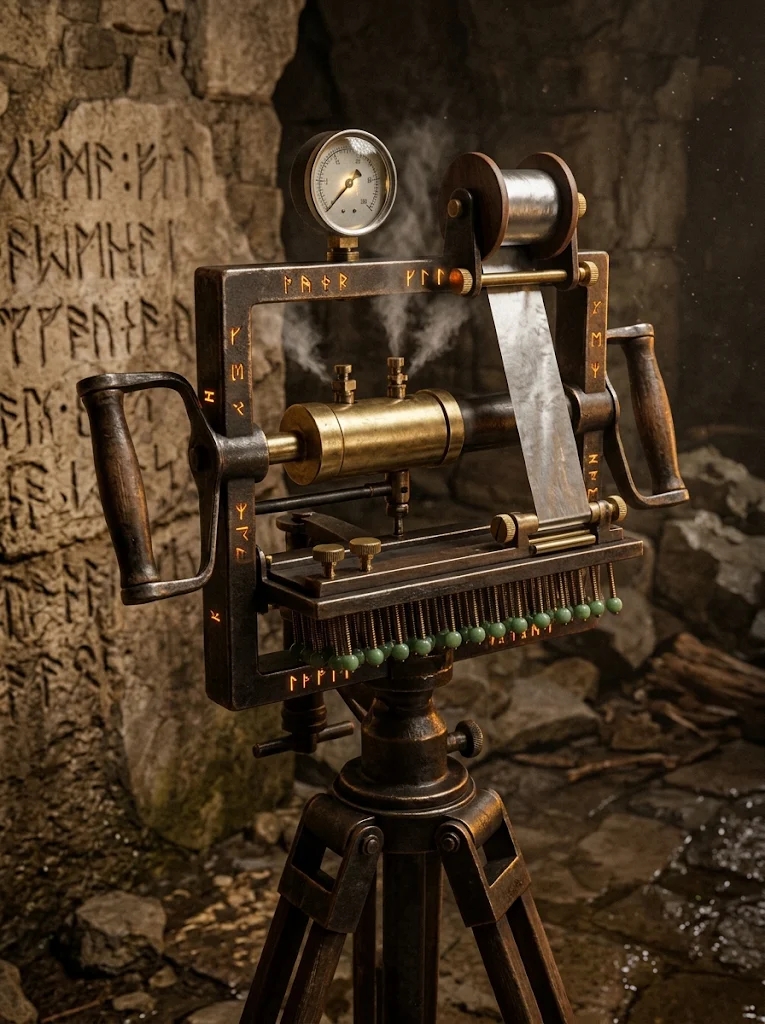
* Equipment Classification: Specialized Field Epigraphy Tool and Mechanical Archival Apparatus, operated using two hands or anchored to an excavation tripod during field transcription.* Tier and Rarity: Tier 1, Common quality.* Attunement and Action Economy: Bonds through instantaneous handheld attunement as soon as the avatar grips the dual steering handles and activates the pressure valve, without requiring a one-minute focus period. In accordance with setting attunement rules, tools are automatically attuned when held and do not count toward the ten-item attunement ceiling that induces somatic pain or forces tier advancement. Deploying the apparatus against an ancient inscription, adjusting the stylus alignment, and stamping a single six-inch by six-inch tablet impression requires two consecutive actions, representing the complete mechanical process of clamping the frame, releasing the pneumatic pressure stroke, and resetting the platen. If targeted directly and struck in combat by an opponent's designated attack that beats its defensive threshold, the apparatus is immediately deactivated and unattuned, requiring a formal ritual attunement of at least ten minutes before its pneumatic seals can be pressurized again.* Durability and Health Points: Maintains a base resilience rating of 10. In accordance with the structural durability formula, the apparatus has an item health pool equal to the avatar’s maximum health points plus its resilience multiplied by its tier level, yielding a total of 33 Item Health Points (23 avatar base maximum health points plus 10 resilience points). If the apparatus sustains physical blows, falling masonry damage, or acidic corrosion that reduces its health pool to 16 hit points or lower, it enters the broken condition; its pressure gaskets fail, locking the drive pistons and rendering it incapable of taking accurate transcriptions until fully repaired with replacement brass fittings during downtime. If reduced to zero hit points, the precision stylus matrix and pressure chamber shatter beyond recovery, dropping scrap bronze, bent iron pins, and cracked quartz gauges.* Material Composition and Machining: Constructed with a rigid, lightweight rectangular frame forged from polished cast bronze alloyed with bog iron, measuring fourteen inches in length by ten inches in width. The central housing features a machined brass pneumatic compression cylinder linked to an under-mounted hand pump, capable of maintaining consistent low-pressure steam or compressed air. The lower face contains a dense array of two hundred spring-loaded bronze tracer pins tipped with smooth jade beads, designed to glide across uneven stone relief without scratching weathered monolith surfaces. The top plate is fitted with an ironwood spool holder that feeds a continuous ribbon of lead foil or wax-treated linen across the stylus plate, held taut by knurled brass tension screws and monitored by an analog pressure dial calibrated with Syl-Trace measurement markings.* Epigraphic and Scholarly Utility: Serves as an indispensable field apparatus for recording ancient, fragile Syl-Rune inscriptions carved into the crumbling stone walls, lintels, and monoliths of Archaic's subterranean ruins. Rather than relying on slow, inaccurate hand-tracing or risking structural damage by hammering chisel chisels into ancient relief, the scholar presses the jade-beaded stylus array against the glyphs; the compressed pneumatic stroke drives the bronze pins uniformly into the relief, producing a flawless, millimeter-accurate physical impression onto the lead foil strip. The avatar can then examine the raised impression through the diagnostic faculties of the Mind's Eye, analyzing the geometric contours, intonation markers, and linguistic evidentials of the inscription without suffering the visual distortion caused by flickering torchlight or dust-choked catacomb air. The apparatus eliminates physical fatigue during long excavation shifts, allowing the scholar to catalog dozens of ancient tablets in a single operational cycle before returning to the scriptoriums of Syl-Kar.
During

the height of the Second Consolidation, the scholarly expeditions of

Lineage 684 pushed into the deepest waterlogged catacombs beneath

Archaic, encountering thousands of linear feet of delicate Precursor

friezes carved into friable volcanic tuff, weeping siltstone, and

brittle gypsum plaster. Early epigraphers relied on manual charcoal

rubbings, wet plaster squeezes, and ink dabbers. In the subterranean

humidity, wet paper pulp tore, charcoal smeared into illegible

grease, and the moisture from liquid slips accelerated the

delamination of fragile rock faces. Worse still, several critical

architectural inscriptions—containing the structural load equations

and floodgate lock sequences of ancient aqueducts—were permanently

destroyed when over-eager scribes pressed hard wooden blocks against

crumbling bas-reliefs, chipping away priceless glyphs and triggering

catastrophic keystone failures.
To halt the destruction of irrecoverable records, the archival masters of Syl-Kar collaborated with Lineage 684’s pneumatic tool-smiths to produce the Batch 468 series. The breakthrough lay in marrying low-pressure pneumatic dampening with an array of independent tracer pins. By using uniform air pressure rather than manual muscle torque, the apparatus distributed force across two hundred points simultaneously, allowing scholars to take impressions from surfaces as fragile as decaying dried clay without dislodging a single grain. The apparatus proved its worth during the Great Siphon Breach of Vault 11, where an archival surveyor recorded the entire fifty-tablet sequence of the Covenant of the Deep Weirs onto lead foil ribbons mere hours before an acidic sewer flood dissolved the soft limestone walls forever, preserving the master hydraulic maps that still regulate Syl-Kar’s lower drainage arteries.
- Specific Slot:
- Two-Handed Held Implement / Portable Field Workstation (occupies both hands during manual transcription, or mounts directly to a field surveyor’s bronze tripod; stows against a padded chest cradle or dorsal pack frame via twin quick-release leather toggle straps when not in use).
- Tier One Stats:
- Equipment Classification: Specialized Field Epigraphy Tool and Mechanical Archival Apparatus.
- Tier and Rarity: Tier 1, Common Quality.
- Base Resilience: 10 resilience points.
- Item Health Points: 33 Item HP (Avatar base maximum HP of 23 plus 10 resilience points). Entering 16 HP or lower inflicts the broken condition (gaskets blow, locking the drive pistons and rendering the stylus matrix incapable of taking impressions until rebuilt during downtime); reduced to 0 HP shatters the bronze frame, quartz gauges, and jade pin matrix into irreparable salvage.
- Attunement Dynamics: Instantaneous handheld attunement upon gripping both steering handles and cracking the intake pressure valve; does not count against the avatar’s ten-item attunement ceiling. If targeted and struck by a designated attack that beats its defensive threshold, the pneumatic seals depressurize and the apparatus deactivates instantly, requiring a 10-minute uninterrupted ritual recalibration before it can hold pressure again.
- Action Economy: Consumes 2 consecutive actions to position the frame against a relief, cycle the pneumatic compression pump, drive the tracer pins into the lead foil ribbon, and advance the platen to record a single 6-inch by 6-inch tablet impression.
- Physical Dimensions & Weight: 14 inches long by 10 inches wide; 7.5 pounds.
- Improvised Combat Profile: 1d4 bludgeoning damage (if swung as an awkward two-handed improvised bludgeon; doing so risks 1d4 direct structural damage to the apparatus on a natural 1 attack roll).
- Skills Gained While Openly Worn or Held:
- +1 Temporary Skill Point to Epigraphic Decipherment & Ancient Runic Translation (aids in analyzing grammatical nuances, phonetic accents, and eroded glyph roots).
- +1 Temporary Skill Point to Lithic Conservation & Field Archival Documentation (enhances checks to handle crumbling friezes, identify rock strata fragility, and preserve delicate inscriptions).
- Multiple Passives Magic:
- Tactile Lithic Resonance (Vibration-Damped Cushioning): The two hundred jade-tipped pins generate a micro-pneumatic cushion that automatically calibrates pin resistance to the exact hardness of the target stone. The apparatus cannot scratch, fracture, or abrade brittle surfaces, allowing flawless impressions to be taken from soft chalk, wet marl, or flaking gold leaf without physical degradation.
- Mind’s Eye Epigraphic Projection: When looking at an impression stamped onto the lead foil or waxed linen, the wielder’s Mind’s Eye automatically sharpens the raised contours. The avatar perceives a high-contrast geometric overlay that clarifies eroded strokes, filters out torchlight shadows, and reconstructs missing chisel segments based on surrounding syntax patterns.
- Atmospheric Lead-Foil Preservation: The feeder spool and stamped ribbon compartment are surrounded by a faint barrier of dry air that repels subterranean humidity, sulfurous sewer steam, and caustic aerosol mist, preventing the transcribed lead foil from oxidizing or the wax linen from softening while in the field.
- Multiple Activatable Magics:
- Pneumatic Micro-Relief Flash (Palimpsest Penetration): The wielder expends 1 action and channels mana to over-pressurize the compression cylinder, releasing an ultra-sensitive micro-stroke across the pin matrix. The pins register sub-millimeter depressions, capturing worn-away base layers and erased palimpsests hidden beneath newer surface carvings. Possesses 2 charges per day; regains all expended charges daily at dawn.
- Glyph-Aura Harmonic Resonance (Trap & Conduit Detection): The wielder sweeps the jade-beaded array across an inscribed panel without feeding foil and expends 1 action. The apparatus detects residual magical current sleeping within the runes, causing the analog dial to vibrate and the jade tips to hum with an audible harmonic pitch, revealing whether the inscription functions as a concealed explosive ward, a mechanical door trigger, or a dormant teleportation anchor. Possesses 2 charges per day; regains all expended charges daily at dawn.
Tags: Two-Handed Tool, Syl-Rune Epigraphy, Lineage 684, Pneumatic Tracer Matrix, Jade-Tipped Stylus Array, Second Consolidation, Lead Foil Imprinter, Archaic Ruin Delving, Cadastral Archival Rig, Handheld Attunement, Lithic Conservation, Bog Iron Bronze Frame, Palimpsest Penetration, Trap & Conduit Detection, Spring-Loaded Tracers, Wax-Linen Ribbon Spool, Non-Destructive Transcription, Sluice Vault 11, Tactile Lithic Resonance, Analog Quartz Dial, Dual Steering Handles, Hydraulic Map Preservation
Acquisition,

Commerce, and Valuation of the Pneumatic Syl-Rune Epigraphic

Impression Apparatus 468
- Methods of Obtaining the Item:
- Archaeological Recovery from Archaic Archive Scriptoriums:
- Expeditions penetrating the subterranean catacombs beneath Archaic can discover intact Model 468 units within the sealed libraries, cadastral drafting halls, and hydrological observation stations of the Second Consolidation (such as the upper administrative vaults of Vault 11).
- Intact specimens are typically sealed inside felt-lined, airtight copper transit cases designed to protect the precision stylus array from subterranean humidity.
- Before operational use, reclaimed units must be cleared of calcified mineral dust, their spring-loaded jade pins individually tested for fluid travel, and the analog pressure dial checked for hairline fractures in the quartz crystal lens.
- Municipal Requisition and Archival Charter Grants:
- Certified surveyors, epigraphers, and licensed field scholars working under contract for the Syl-Kar Department of Public Works, the Guild of Antiquarians and Scribes, or the Ministry of Subterranean Transit can formally requisition an apparatus.
- Requisitions require filing an approved site-charter and placing an equipment security bond against the researcher’s World Bank ledger account, drawing a factory-calibrated unit directly from municipal stores equipped with two fresh spools of lead foil and a set of replacement brass gaskets.
- Lineage Scriptorium Commission and Academic Investiture:
- Within Lineage 684 and allied epigraphic cloisters, the apparatus is bestowed as a recognized journeyman’s instrument.
- When an apprentice successfully transcribes and translates their first intact Precursor frieze or structural lock-code without damaging the underlying relief, the lineage elders confer the tool in an investiture ceremony, stamping the recipient’s personal sigil beside the lineage cartouche on the bog-iron bronze frame.
- Artisanal Machine-Shop Fabrication and Transmutation Forging:
- An avatar with trained proficiencies in precision clockwork mechanics, bronze foundry casting, gem lapidary, and epigraphic epigraphy can manufacture the apparatus at an advanced outfitter’s bench.
- Construction demands casting the fourteen-by-ten-inch bog-iron bronze frame, turning and honing the brass compression cylinder, seating two hundred spring-loaded bronze tracer pins tipped with smooth jade beads, turning the ironwood spool feeder, and transmutatively dissolving a mundane Tier 1 drafting or scribing tool alongside a charged Tier 1 magic crystal to anchor the Tactile Lithic Resonance and Palimpsest Penetration matrices.
- Salvage from De-Manifested Field Researchers:
- When a rival academic, rogue tomb surveyor, or field researcher avatar reaches zero hit points in subterranean ruins, their physical body de-manifests into ambient mana particles, leaving equipped gear, tools, and harness rigs behind on the cavern floor.
- Exploring scavengers can recover the apparatus immediately. If recovered from non-avatar skeletal remains in flooded sumps, the lead foil ribbon must be discarded, the leather cup seals treated with tallow, and the jade matrix cleared of dried silt before repressurizing.
- Archaeological Recovery from Archaic Archive Scriptoriums:
- Types of Commercial Shops, Transaction Procedures, and Operational Costs:
- Guild Archival Depositories and Municipal Supply Hubs:
- Storefront Character and Location:
- Situated within the administrative annexes of the Guild of Antiquarians and Scribes in central Syl-Kar, or inside Department of Public Works supply offices flanking the Great Aqueduct gatehouses.
- Built with dry granite masonry, climate-controlled with low-fire warm air flues to keep paper and parchment dry, and lined with felt-padded tool bins, brass-polishing benches, and testing blocks of artificial stone reliefs.
- Purchasing Mechanics and Discounts:
- Restricted to chartered scholars, licensed engineering contractors, and enfranchised guild members.
- Enfranchised guild members receive an institutional purchase discount equal to 10% multiplied by their tier level (a 10% discount for Tier 1 researchers).
- Settlements are debited directly from the buyer’s World Bank ledger account into the municipal archival treasury, exempt from civilian sales taxes when issued for public cadastral surveys.
- Purchasing Price:
- Standard civilian/academic list price is 190 silver coins (19 gold coins).
- For an enfranchised Tier 1 researcher, the discounted price is 171 silver coins (17 gold, 1 silver coin).
- Fresh spools of lead foil ribbon cost 4 silver coins each; spools of wax-treated linen cost 2 silver and 5 bronze coins each.
- Selling Mechanics and Payout:
- Guild logistics factors test the pneumatic stroke under hydraulic gauge, verify the smooth recoil of all two hundred jade tracer pins, and cross-reference lineage serial cartouches.
- An intact apparatus earns a ledger credit of 115 to 125 silver coins. Units suffering from the broken condition (16 HP or lower) are bought for 30 to 35 silver coins to salvage the polished jade beads, quartz dials, and brass valve housings.
- Storefront Character and Location:
- Horological Workshops, Epigraphic Ateliers, and Instrument Makers:
- Storefront Character and Location:
- Located along the upper artisan terraces of Syl-Kar, the glassblowers’ row in Stonefall, or adjacent to the University of Civil Geometries.
- Intricate workshops smelling of lavender spirit, clockwork oil, and pine rosin, filled with treadle jewel-lathes, racks of tiny steel taps, magnifying loupes, and glass display cabinets holding measuring calipers, sextants, and drafting rigs.
- Purchasing Mechanics and Taxes:
- Open to independent scholars, private antiquarians, and mercenary delvers.
- The artisan manually demonstrates the compression pump, tests the alignment of the knurled foil tension screws, and provides a calibrated lead sample strip.
- Transactions are settled in physical coinage or certified bank-drafts, subject to a 3% municipal luxury and precision-tool sales tax.
- Purchasing Price:
- Retail purchase price ranges between 185 and 215 silver coins (18.5 to 21.5 gold coins), plus the 3% municipal tax (an additional 5.5 to 6.5 silver coins).
- Selling Mechanics and Payout:
- The master artisan verifies that the bog-iron bronze frame has not warped and that the compression cylinder walls remain free of scoring.
- Applying standard trade margins, the shop deducts 10% multiplied by the seller’s tier level.
- An intact apparatus sells for a cash payout of 95 to 110 silver coins. If the drive pistons are seized or the pin matrix bent, the shop offers 25 to 30 silver coins for the raw materials and salvageable components.
- Storefront Character and Location:
- Frontier Trading Posts and Ruin-Head Outfitting Depots:
- Storefront Character and Location:
- Located at major staging waystations near wild excavation territories, such as the fortified roadhouses at Wayrest, river barge landings at Gladeport, or timber depots near the Rootspire boundary.
- Cavernous, rugged trading halls stocking everything from heavy excavation picks and rope ladders to iron rations, surveying pins, and surveying slates.
- Purchasing Mechanics and Tariffs:
- Precision archival equipment is rare on the frontier; transport across rough carriage roads requires specialized sprung cases, driving prices up.
- Transactions crossing regional boundaries are subject to a mandatory 5% frontier security tariff collected by local road-wardens.
- Merchants accept mixed specie, gold dust, or direct trade barter in unworked minerals, alchemical oils, or rations.
- Purchasing Price:
- Retail frontier cost ranges from 240 to 280 silver coins (24 to 28 gold coins), plus the 5% border tariff (12 to 14 silver coins).
- Selling Mechanics and Payout:
- Frontier merchants maintain limited coin reserves and prefer settling in trade barter.
- A functional apparatus yields 80 to 95 silver coins in trade goods or cash. However, if an official archaeological expedition or wealthy university retinue is actively outfitting at the post, the merchant will pay an immediate cash bounty of up to 130 silver coins to flip the tool for a rapid profit.
- Storefront Character and Location:
- Clandestine Catacomb Dens and Illicit Antiquities Fences:
- Storefront Character and Location:
- Operating out of the unregulated flues of the Third Burrow, dry sewer cisterns near the Iron Sump, or abandoned drainage hubs beneath the ore-crushers.
- Dimly lit stalls framed with scrap iron and rotted mine timbers, lit by tallow dips, run by black-market fences, grave-robbers, and scrap-diggers.
- Purchasing Mechanics and Anonymity:
- Transactions are conducted entirely in physical coin, untraced scrap ingots, or barter chits, with zero municipal record-keeping.
- The tool is highly prized by illicit tomb-raiders and ruin-looters, who use its Glyph-Aura Harmonic Resonance to detect lethal ward-runes, explosive glyphs, and vault traps on ancient stone doors without triggering them.
- Purchasing Price:
- If sold by an anxious looter seeking to dump stolen municipal property quickly before the watch arrives, an apparatus can be bought for 105 to 135 silver coins.
- If an outlaw crew or illicit antiquities syndicate is actively hunting for a trap-detection and vault-survey tool, the fence will inflate the asking price to 260 to 320 silver coins.
- Selling Mechanics and Payout:
- Fences purchase the apparatus without questioning filed-away lineage marks or ground-off municipal serial numbers.
- Sellers receive untraceable cash payouts ranging from 50 to 65 silver coins, depending on whether the fence has an immediate buyer among local ruin-delving rings.
- Storefront Character and Location:
- Guild Archival Depositories and Municipal Supply Hubs:
Tactical

Environmental Roleplay: Defensive and Offensive Applications of the

Pneumatic Syl-Rune Epigraphic Impression Apparatus 468
- Subterranean Catacombs, Ruin Corridors, and Vault Shafts beneath Archaic:
- Defensive Applications:
- When advancing through unmapped Precursor crypts, the scholar holds the apparatus chest-high, sweeping the jade-tipped array along inscribed lintels and stone corridors. Activating Glyph-Aura Harmonic Resonance detects latent magical currents in ancient carved surfaces, causing the analog dial to tremble and the jade beads to chime softly before the expedition steps into explosive fire-runes, crushing ceiling triggers, or petrification wards.
- In tight, low-clearance passages where polearms and arbalests cannot be maneuvered, the wielder holds the apparatus by its dual steering handles, using the fourteen-by-ten-inch bog-iron bronze frame as an improvised buckler. The reinforced bronze edges deflect sudden lunges from cave-scorpions, cave-bats, and flying rock splinters without shattering the internal quartz dial.
- If a subterranean rock-burst threatens to collapse loose shale overhead, the avatar angles the flat bronze faceplate upward to deflect falling debris, protecting their eyes and snout while retreating to a secure structural arch.
- Offensive Applications:
- In close-quarters skirmishes with subterranean scavengers or troglobites, the wielder strikes with the heavy corner of the bog-iron bronze frame, using the tool’s 7.5-pound mass as a reinforced bludgeon to smash knee joints or fracture collarbone plates.
- Against enemies sheltering behind inscribed ruin barriers, the scholar uses the apparatus to identify weakened structural joints and fracture runes in the masonry via Mind’s Eye Epigraphic Projection. Striking an adjacent support or triggering a dormant seismic glyph with a targeted kinetic tap drops tons of loose stone onto the ambushing party.
- When cornered by subterranean predators with sensitive sensory pits, the wielder points the intake valve forward and manually trips the pneumatic release, discharging a sharp, pressurized burst of compressed air and mineral grit directly into the creature’s nostrils or velvet hearing cups to disorient it.
- Defensive Applications:
- Flooded Aqueducts, Sewer Flues, and Silt Cisterns of Syl-Kar:
- Defensive Applications:
- Wading through chest-deep wastewater and stagnant drainage channels, the apparatus’s Atmospheric Lead-Foil Preservation maintains a continuous envelope of dry, pressurized air around the spool carriage. When held close to the avatar’s upper chest and neck, this outward air barrier pushes away toxic sewer vapors, choking sulfur bubbles, and airborne caustic droplets.
- In stagnant silt sumps infested with blind swamp-leeches, mire-rats, or carnivorous water-beetles, the wielder holds the apparatus just beneath the surface to parry aquatic lunges, utilizing the flat, slick bronze surface to prevent parasitic jaws from latching onto scaled forearms.
- When navigating partially submerged sluice gates, the wielder taps the submerged masonry with the jade pins; the micro-pneumatic stroke confirms whether the gate’s bronze hinge-mounts are sound or on the verge of sudden structural collapse under water pressure.
- Offensive Applications:
- Submerged predators like mire-wolves often track vibrations through water. By placing the jade-beaded array beneath the surface and pulsing the pneumatic stroke at maximum frequency, the wielder generates an underwater acoustic shockwave that ruptures the lateral-line hearing organs of aquatic predators within five paces, forcing them to thrash in pain or retreat.
- If dragged into the mud during an amphibious ambush, the scholar uses the pointed bronze corners of the frame as a trench-axe, driving the metal edge into soft gill-slits or eye-sockets to break an enemy’s grappling hold.
- Confronted by reinforced sewer grating blocking an escape route, the scholar uses Palimpsest Penetration to reveal the ancient, mud-caked hydraulic lock glyphs, inputting the correct pressure code to flush the cistern and wash pursuing foes down the overflow chute.
- Defensive Applications:
- Ancient Ruined Temples, Sealed Scriptoriums, and Precursor Sanctuaries:
- Defensive Applications:
- In pristine, dust-free inner sanctums protected by clockwork guardians and automated defense monoliths, the wielder uses Glyph-Aura Harmonic Resonance to trace power conduits behind plaster walls. This allows the scholar to identify invisible perimeter trip-lines and bypass automated sentry patrols without triggering vault lockdown barriers.
- Against guardian constructs that emit targeted sonic shrieks or mental psychic pulses through inscribed resonance bells, the avatar presses the jade-tipped array against the emitter; the Tactile Lithic Resonance absorbs and grounds the harmonic frequency, dampening the concussive force before it reaches the party’s eardrums.
- In the presence of hostile spellcasters weaving geomantic wards, the scholar interposes the bog-iron bronze frame to absorb low-tier magical projectiles, letting the dense bronze alloy dissipate the arcane charge safely across its mass.
- Offensive Applications:
- When engaging animated stone sentries, gargoyles, or clay automatons, the scholar uses the Mind’s Eye Epigraphic Projection to instantly locate the entity’s core binding runes. Pressing the apparatus directly against the construct’s rune-carved torso and releasing a high-pressure pneumatic stroke drives the two hundred bronze tracer pins deep into the glyph incisions, breaking the mana circuit and deactivating the construct.
- To eliminate barricaded foes hiding behind sealed Precursor bronze doors, the wielder scans the doorframe to identify the internal counter-weight latch. By jamming the narrow bronze corner into the seam and cycling the hand pump, the pneumatic piston applies concentrated pressure directly against the internal shear-pin, snapping the lock and blowing the heavy door inward onto the defenders.
- Against enemies attempting to invoke ritual altars, the scholar sweeps the jade pins across the altar’s surface, triggering an intentional harmonic interference pulse that disrupts the ritual channeling and inflicts severe mana-burn upon the chanting occultists.
- Defensive Applications:
- Primordial Rootwood Forests, Spore Grottos, and Fungal Caverns:
- Defensive Applications:
- In subterranean fungal forests thick with choking puffball spores and predatory strangler-moss, the localized air barrier repels airborne spore clusters away from the scholar’s breathing passages and eyes, preventing fungal spores from germinating in the skin creases between Karthian scales.
- When navigating rotted, moss-covered stone bridges or petrified root spans, the wielder checks structural integrity with the apparatus; the jade pins calculate root hollows and fungal rot within the wood, warning the surveyor away from brittle footings.
- When venomous canopy serpents strike from overhead creepers, the scholar raises the dual steering handles, catching the fangs on the rigid bronze casing rather than exposed flesh.
- Offensive Applications:
- Against gelatinous slimes, fungal husks, and creeping ooze-beasts, swinging blades often cause creatures to split and multiply. The scholar presses the apparatus against the creature’s core membrane and unleashes Pneumatic Micro-Relief Flash; the simultaneous, rapid impact of two hundred jade-tipped pins pulps the creature’s central digestive nucleus without scattering infectious fluid.
- In thick briar thickets, the scholar uses the rigid, polished bronze frame to push through thorny barricades, clearing a firing lane for allied arbalests or forcing hostile woodland skirmishers backward into their own thorn traps.
- By using the jade array to tap hollow fungal stalks connected to underground gas pockets, the wielder vents flammable spore gas toward advancing beasts, creating a barrier that can be ignited with a spark.
- Defensive Applications:
- Urban Industrial Sectors, Rail Terminals, and Foundry Terraces of Syl-Kar:
- Defensive Applications:
- Amidst crowded street riots, labor strikes, or dockland skirmishes, the apparatus provides inconspicuous defense. Held across the chest, the bog-iron alloy absorbs concussive blows from iron pipes, wooden clubs, and hurled cobblestones, protecting the avatar’s vital organs while they push through agitated crowds.
- In sabotaged steam-tram stations or leaking municipal boiler rooms, the scholar uses the analog quartz dial and intake valve to test surrounding atmospheric pressure and identify hairline steam pipe fractures before catastrophic explosive ruptures occur.
- In bureaucratic or legal confrontations, the scholar produces an immediate, indisputable lead-foil transcription of an disputed property marker or lineage deed, using epigraphic authority to halt municipal seizures or defuse violent jurisdictional standoffs.
- Offensive Applications:
- In narrow tenement alleys and tram cars, the scholar grips the dual handles like heavy trench-knuckles, delivering sharp, double-handed thrusts with the flat front of the apparatus into an assailant’s sternum to knock them flat onto the cobblestones.
- When chasing corporate saboteurs through industrial workshops, the scholar slams the apparatus against pressurized copper air-lines or hydraulic conduits; the resulting acoustic spike overloads automated machinery and shuts down security blast doors in front of the fleeing suspect.
- If cornered inside a scrap warehouse, the wielder uses the apparatus’s pneumatic pump to suck up caustic mineral brine or fine iron shavings, then vents the high-pressure spray into an assailant’s face to blind them and secure an immediate escape window.
- Defensive Applications:
Perception

of Activation:
- User’s Perspective:
- Somatic and Tactile Sensations: Grasping the dual steering handles and cracking the intake valve triggers an immediate pneumatic surge. A crisp, pressurized shudder travels through the bog-iron bronze frame and into the avatar’s forearms, followed by the steady, rhythmic vibration of the brass compression piston. The 7.5-pound apparatus suddenly feels weightless and buoyant across the wrists, as if supported by an internal air cushion. The knurled bronze thumb-screws and hand-pump lever settle into the palms with exact ergonomic balance, while the two hundred spring-loaded tracer pins adjust with a soft, counter-balanced resistance beneath the fingers.
- Auditory and Vibrational Sensations: A sharp, clean pneumatic hiss—psssht-clik—marks the sealing of the drive gaskets, immediately giving way to a muted, rhythmic mechanical hum like a pocket timepiece operating under water. As the dual handles lock, the two hundred jade-tipped pins emit a delicate, glassy rustle, like polished river stones settling in a dry sieve.
- Olfactory and Gustatory Sensations: The nostrils fill with the clean, dry scent of cold-drawn brass, clockwork lavender spirit, and linseed oil, accompanied by the distinct mineral metallic tang of freshly unrolled lead foil. A faint, ozone-rich current of purified dry air vents past the avatar’s snout, clearing away the cloying stench of stagnant sewer mud, damp limestone dust, and sulfur fumes.
- Extra-Sensory Perception — Mind’s Eye Epigraphic Projection: Looking upon an ancient stone relief or the freshly stamped lead ribbon activates an immediate high-contrast sensory overlay in the surveyor’s vision. Eroded chisel grooves, faded intonation marks, and microscopic surface fissures glow in sharp, amber Syl-Trace geometric outlines, filtering out flickering torch shadows and visually reconstructing missing strokes based on surrounding grammatical syntax.
- Extra-Sensory Perception — Tactile Lithic Resonance Telemetry: The avatar intuitively senses the physical density, friability, and mineral hardness of any rock surface touched by the jade beads. The telemetry warns the scholar of brittle gypsum layers, internal air pockets, and moisture saturation before the stylus array even begins its impression stroke.
- Extra-Sensory Perception — Glyph-Aura Harmonic Resonance (Arcane Telemetry): The wielder perceives dormant magical conduits sleeping within carved stonework. Residual mana currents pulse through the apparatus as subtle harmonic chords in the back of the mind; the avatar instantly identifies whether an inscribed frieze hides an explosive ward, a mechanical pressure-plate trigger, or a dormant teleportation threshold.
- Extra-Sensory Perception — Pneumatic Diagnostics & Palimpsest Depth Scanning: The avatar maintains continuous awareness of the internal compression cylinder (confirming 33 out of 33 Item Health Points and intact pressure gaskets). When engaging the micro-relief matrix, spatial awareness penetrates sub-millimeter depths, perceiving older, chiseled carvings ground down beneath newer stone layers.
- Extra-Sensory Perception — Micro-Atmospheric Envelope Awareness: A localized sensory aura alerts the wielder that the Atmospheric Lead-Foil Preservation barrier is active, continuously monitoring the boundary of dry, pressurized air that shields the lead ribbon from external humidity, caustic aerosols, and fungal spores.
- Observer’s Perspective:
- Visual Manifestations: As the scholar’s scaled hands close around the dual steering handles, the etched Syl-Trace runes along the bronze rectangular frame illuminate with a warm, amber glow. The analog quartz dial on the top plate flares with a soft internal luminescence, its needle snapping to the operating pressure mark. Across the bottom platen, the two hundred jade beads shimmer with faint micro-movements, casting tiny points of pale green light against the stone wall.
- Auditory Manifestations: Companions hear a sharp intake of air followed by a soft, rhythmic tick-tick-whir as the internal escapement gears engage. When the jade pins sweep across an inscription, they produce a low, melodic chime reminiscent of a distant glass wind-harp.
- Atmospheric and Environmental Shifts: A small, dry draft pushes outward from the apparatus’s exhaust ports, thinning ambient mist, clearing hanging dust motes, and driving away biting sewer gnats in a two-foot radius around the operator’s chest.
- Positives of Activation:
- Instant Handheld Attunement: Bonds immediately upon gripping the dual handles and opening the valve, requiring no resting meditation and consuming none of the avatar’s ten-item attunement ceiling.
- Non-Destructive Archival Recording: The micro-pneumatic cushion ensures the two hundred jade-tipped pins capture microscopic relief without scratching, chipping, or fracturing brittle plaster, rotting shale, or flaking gold leaf.
- Subterranean Visual Clarification: The Mind’s Eye projection bypasses the visual distortion of catacomb dust, smoke, and poor lighting, allowing effortless reading of eroded inscriptions.
- Integrated Hazard Detection: Passively detects concealed explosive runes, ward triggers, and mechanical trap conduits within inscribed stonework before they are triggered.
- Media Preservation: The localized air envelope keeps lead foil and wax-treated linen completely dry, preventing oxidation, melting, or rot in damp, acidic caverns.
- Sub-Surface Analysis: Capable of reading erased palimpsests and underlying architectural strata hidden beneath subsequent masonry work.
- Negatives of Activation:
- Two-Handed Operational Demand: Monopolizes both hands during transcription, leaving the surveyor unable to wield weapons, hold a light source, or manipulate climbing gear without anchoring the tool to a tripod or stowing it.
- Action-Intensive Workflow: Requires two consecutive combat actions to align, pump, impress, and advance the lead ribbon for a single six-inch tablet, making field transcription impossible under direct enemy assault.
- Disarm Deactivation Vulnerability: If targeted and struck by an adversary’s attack, the pneumatic seals instantly vent and deactivate the apparatus, requiring a ten-minute ritual recalibration during downtime before it can hold pressure again.
- Delicate Precision Mechanics: Sustaining structural damage that drops the item to 16 HP or lower inflicts the broken condition, blowing gaskets and seizing the stylus drive pistons until repaired with replacement brass fittings.
- Ineffective Combat Profile: Functions only as an awkward, improvised two-handed bludgeon (1d4 bludgeoning damage), with a critical miss risking direct structural damage to its own precision gauges and pin array.
Crafting

Recipe: Pneumatic Syl-Rune Epigraphic Impression Apparatus 468
- Materials Needed:
- Bog-Iron Bronze Alloy Stock: Five pounds of high-tensile bronze alloyed with bog iron (75% copper, 15% tin, 10% bog iron) to cast the rigid, vibration-resistant fourteen-by-ten-inch outer frame and mounting lugs.
- Machined Brass Cylinder Stock: Two pounds of dense, fine-grained brass rod to turn and bore the central pneumatic compression cylinder, hand-pump barrel, intake valve manifold, and threaded end-caps.
- Phosphor-Bronze Wire and Pin Stock: One pound of spring-tempered phosphor-bronze wire and drawn rod, sufficient to fabricate two hundred miniature coil springs and two hundred precision tracer pins.
- Nephrite Jade Micro-Beads: Two hundred matched, spherical beads of low-friction nephrite jade (each two millimeters in diameter, drilled with blind mounting sockets) to serve as smooth, non-scratching contact tips for the tracer pins.
- Seasoned Rootspire Ironwood Spool Billet: A six-inch turned cylinder of seasoned black ironwood to construct the top-mounted ribbon supply drum and knurled feed rollers.
- Optical Quartz Crystal Blank & Seal Pack: One ground optical-grade quartz disc for the analog pressure gauge lens, accompanied by vulcanized tallow-soaked leather cup gaskets, brass shims, and knurled tension thumb-screws.
- Lead Foil and Wax-Linen Ribbon: One starter roll of six-inch-wide, thin-rolled lead foil ribbon and one secondary spool of wax-treated linen backing strip.
- Sacrificial Drafting or Scribing Implement (Component Ingredient): One mundane Tier 1 precision drafting tool (such as a surveyor’s brass divider, architectural scribing stylus, or proportional caliper), ritually dissolved in the transmutation trough to transfer its precision tolerances, 10 base resilience, and structural balance into the apparatus.
- Tier 1 Magic Crystal Catalyst: One intact, charged magic crystal of the first circle (the diameter of a silver coin) to anchor the Tactile Lithic Resonance, Mind’s Eye Epigraphic Projection, Atmospheric Lead-Foil Preservation, Pneumatic Micro-Relief Flash, and Glyph-Aura Harmonic Resonance matrices.
- Tools Required:
- Bronze Foundry Flasks and Melting Tackle: Refractory graphite crucible, two-part sand molding frames, charcoal melting furnace, and sprue-cutting saws.
- Precision Clockmaker’s Lathe and Milling Bench: Treadle- or belt-driven miniature metal lathe, micro-boring bars, threading dies, jewelers’ saws, and precision reamers.
- Lapidary Gem-Drilling and Polishing Bench: Diamond-grit lapidary wheel, ultrasonic jade core-drill, and cerium oxide polishing laps.
- Pneumatic Testing Manifold and Calibration Pump: Hand-operated bench pump, mercury manometer, and certified pressure-relief test block.
- Epigraphic Graver and Syl-Trace Scribing Stylus: Hardened tool-steel micro-gravers, layout compasses, and runic alignment templates.
- Transmutation and Quenching Basin: A shallow granite trough filled with mineralized brine for mana channeling and sacrificial component dissolution.
- Skill Requirements:
- Bronze Foundry Casting and Metallurgy: Minimum of 3 trained skill points to cast the rectangular bog-iron bronze frame without porosity, warping, or internal casting stress.
- Precision Clockwork and Instrument Machining: Minimum of 4 trained skill points to bore and hone the brass pneumatic cylinder, turn air-tight piston cups, and thread micro-fittings.
- Lapidary Gem-Carving and Micro-Fitting: Minimum of 3 trained skill points to polish and socket the two hundred jade micro-beads onto the phosphor-bronze tracer pins without fracture.
- Syl-Rune Epigraphy and Cadastral Layout: Minimum of 3 trained skill points to calibrate the analog dial face in Syl-Trace measurement markings and inscribe the harmonic resonance runic paths.
- Mind’s Eye Diagnostic Proficiency: Capability to project internal stress vectors during assembly, verifying that the completed apparatus registers 10 base resilience, holds 33 Item Health Points, and establishes an air-tight handheld bond.
- Crafting Steps:
- Frame Patterning, Sand Casting, and Truing:
- Prepare a two-part sand mold from a hardwood master pattern of the fourteen-by-ten-inch rectangular frame, incorporating integral bosses for the dual steering handles, cylinder mounts, and tripod mounting shoe.
- Melt the bog-iron bronze alloy in the furnace, skimming slag, and pour into the flask in a single continuous stream.
- Once cool, break the casting from the sand, cut away sprues and risers, and mill the front and rear faceplates perfectly flat on the bench.
- Drill and tap the side lugs to accept the dual ergonomic steering handles and tripod locking pin.
- Machining the Pneumatic Cylinder and Piston Assembly:
- Mount the brass cylinder stock on the precision lathe. Turn the outer casing to a diameter of two inches and bore the inner chamber to an exact, mirror-polished one-and-a-half-inch bore over a length of eight inches.
- Turn the brass drive piston, machining dual perimeter grooves to seat the tallow-soaked leather cup gaskets.
- Machine the under-mounted auxiliary hand pump, check valves, and manual pressure-relief petcock; thread all pneumatic conduits into the main manifold block.
- Seat the brass compression spring behind the piston head to ensure rapid, uniform mechanical return after each pressure stroke.
- Fabricating the Jade-Tipped Tracer Array:
- Cut two hundred equal lengths of phosphor-bronze rod. Turn the upper ends to seat within guide channels and machine the lower tips into micro-tenons.
- Wind two hundred miniature coil springs from spring-tempered phosphor-bronze wire, ensuring identical spring rates across all units.
- Mount the nephrite jade beads on the lapidary station; drill a blind micro-socket into each bead and polish the hemispherical outer contact surface to a frictionless mirror shine.
- Seat the jade beads onto the pin tenons using heated mastic and mechanical crimping.
- Insert the two hundred sprung pins into the drilled bronze base platen, securing them with a retaining back-plate so that each pin moves independently across a half-inch vertical travel.
- Constructing the Spool Carriage and Tension Rollers:
- Turn the billet of Rootspire black ironwood down into a spool drum and mounting brackets for the lead foil ribbon.
- Machine twin brass feed rollers with knurled surface bands, fitting them with knurled brass thumb-screws and leaf springs to maintain uniform ribbon tension across the platen.
- Fit an internal ratchet wheel and brass pawl to the spool carriage, ensuring the lead foil advances in precise six-inch increments without slack or back-slipping.
- Epigraphic Calibration, Dial Assembly, and Crystal Integration:
- Inscribe Syl-Trace pressure gradations and harmonic sensing runes onto the brass dial plate using the fine steel graver.
- Assemble the analog pressure gauge with an internal bourdon tube and fit the protective optical quartz lens over the face.
- Scribe tectonic resonance channels along the inner perimeter of the bronze frame, terminating at the cylinder mounting collar.
- Mill a fitted cavity beneath the brass valve manifold; bed the charged Tier 1 magic crystal in pine mastic, establishing direct energetic contact with the cylinder wall and the tracer platen.
- Sacrificial Transmutation and Structural Transference:
- Submerge the sacrificial Tier 1 drafting tool into the granite transmutation basin alongside the rough-assembled bronze frame and cylinder.
- Open the Mind’s Eye and initiate the dissolution chant, channeling mana through the brine to break down the sacrificial implement’s physical matrix.
- Guide the released essence into the apparatus, binding its 10 base resilience, structural integrity, and precision calibration into the bronze frame and pin matrix.
- Maintain the flow until the frame absorbs the charge, emitting a brief, amber harmonic chime.
- Final Assembly, Gasket Packing, and Sealing:
- Mount the machined brass pneumatic cylinder, auxiliary hand pump, and valve manifold into the central cradle of the bog-iron bronze frame; bolt down all flange caps.
- Install the bottom jade-tipped tracer platen, verifying that all two hundred spring pins depress and return smoothly without binding.
- Fasten the black ironwood spool carriage and brass tension rollers to the upper frame plate.
- Install the analog quartz pressure gauge, seal all threaded pneumatic joints with alchemical resin mastic, and mount the turned steering grips to both sides.
- Load a six-inch spool of lead foil and adjust the knurled tension screws until the ribbon rests flush across the tracer plate.
- Pneumatic Testing and Mind’s Eye Harmonization:
- Connect the apparatus to the test block; cycle the hand pump to bring internal pressure to standard operating threshold, checking the analog dial and verifying zero pressure loss across five minutes.
- Test a sample impression against a stone relief: confirm that the jade beads leave no marks on soft limestone and that the lead foil records a sharp, millimeter-accurate impression.
- Take a two-handed grip on the steering handles and open the valve to verify instantaneous handheld attunement: confirm that the Syl-Trace runes illuminate, the Mind’s Eye epigraphic projection engages, the baseline 33 Item Health Points lock into the personal ledger, and the apparatus draws no capacity against the avatar’s ten-item attunement ceiling.
- Frame Patterning, Sand Casting, and Truing:
Many-Pin

Box of Bronze and Jade, Wherein Scribe Mor-Kareth Did Catch

Dissolving Words of Deep Weirs Ere Black Acid-Tide Swallowed Hollow

Vault Eleven
Rendered

from the Water-Damaged Bark-Parchments of the Deep Lineage by the

Clumsy Stylus of Scribe Gil-Vond
In the unreckoned turning of the seasons, when the Second Bringing-Together was yet spreading its stone roads through the cold intestines of the world, the lineage of the Four-and-Eighty and Six Hundred [translator note: this number signifieth Lineage 684, who held from the high magistrates the sole seal for the measuring of deep stone, the clearing of silted ducts, and the digging of foundation-trenches] did drive their exploratory tunnels into the lowest basement-ruins beneath Archaic. In that drowned cellar, the houses of the ancients were not built of hard basalt that mocketh the tooth of time, but were carved from friable volcanic ashes, rotten gypsum that did weep greasy saltpetre, and brittle silt-chalk that had the consistency of curdled sheep-milk.
Upon these walls of delicate dust, the elder kings had incised the sacred marks of the Syl-Trace—words so full of craft and hydraulic measure that they held within their geometric tails the secret calculations of the water-balances, the weight of the mountain vaults, and the times of opening for the great bronze gates through which the river-sludge was cast into the deep fire.
Yet great sorrow lay upon the house of the scribes in that age. For whenever an epigrapher of the lineage did approach an ancient wall with his cedar mallet and his box of wet wood-pulp, or with his ink-dabber of horsehair, the wall did perish beneath his fingers. If he did press the wet rag against the stone, the ancient moisture of the paper dissolved the binding lime of the rock, so that when he peeled the cloth away, the holy faces of the runes came away with it like dead scabs, leaving only bald grease behind. And if an apprentice, being hasty and having vinegar in his blood, did lay a flat board of dry pine against the glyphs and strike it with a copper mallet to take a squeeze, the ancient plaster would shatter into fifty thousand crumbs of white flour, so that the wisdom of three dynasties fell into the sewage and was eaten by the blind mud-carp. Thus did forty-two great chambers of stone become blank and mute through the foolish love of the scribes, who killed the words they sought to hold.
Now there was among the measuring-clans a master of the glass-lens and the small chisel, whose name upon the payroll-cylinders was Mor-Kareth of the Dry Claw [translator note: called “Dry Claw” because his hand was withered from an ancient burn of vitriol, yet his remaining digits could carve three hundred letters upon the belly of a water-flea]. Mor-Kareth had wept upon his knees in Sluice Vault Nine when his own master, seeking to trace the arch-keystone of an ancient conduit with a stylus of soft lead, had caused the whole arch to collapse into dust, crushing twelve diggers and blotting out the secret of the weir-gate forever.
Wherefore Mor-Kareth shut himself within his vault beneath the lower aqueduct for forty nights and two. He swore by the seven hearth-fires of the ancestors that he would construct an engine that had neither the cruelty of the hammer nor the wet corruption of the ink-mop—a machine that would touch the dying stone as softly as a moth’s wing toucheth the surface of a stagnant pool, yet would seize the shape of the letters with the unbending truth of cold metal.
He took from the smelting-troughs five pounds of tough bronze, alloyed not with tin alone, but with the black, fibrous bog-iron that sleepeth in the bottoms of the reed-fens [translator note: this alloy was accounted unyielding to the damp, having no rot within its grain]. This he poured into a two-part frame of red foundry-sand, shaping a rectangular coffer fourteen finger-lengths in the span and ten in the beam, light enough to be strapped across the breast-scales of an avatar by two thongs of cured ox-hide, yet stiff as a temple-lintel.
Through the core of this frame he mounted an air-belly [translator note: here the primitive text uses the ancient word for a brass pneumatic cylinder with an under-hung hand-bellows], drawn out from fine yellow brass without seam or solder, its inner belly polished with pumice and lavender-oil until it was bright as a mirror. Into this pipe he fitted a piston shod with the greased leather of a mountain-goat, so that when the little hand-crank beneath was turned three times, the belly took in the damp cavern air and squeezed it into a narrow breath of five-fold hardness.
Beneath the belly, Mor-Kareth set the marvelous bed of two hundred needles. He drew out two hundred rods of phosphor-bronze, each thin as the whisker of a river-otter, and around each rod he wound a tiny spiral spring of beaten wire. But he knew that if the bare bronze tips touched the rotting gypsum, their metal teeth would scratch the friable skin of the glyphs. Therefore did he journey to the lapidary shops of the Upper Terrace, and for the price of three gold bars he bought two hundred beads of pure green nephrite jade, spherical as drops of holy oil and polished upon lead laps with the powder of crushed diamonds. Into each jade pearl he bored a blind pit with a wire drill, and with boiling tree-mastic he fastened a bead to the tip of every bronze needle.
Upon the crown of the frame he hung a drum of black ironwood, harvested from the salt-springs of Rootspire, upon which was wound twenty cubits of soft, gray lead foil, beaten thin as the wing of a beetle and backed with a ribbon of linen that had been dipped in the wax of wild ground-bees. And over the air-valve he set an eye of ground quartz crystal, behind which a silver needle did tremble upon an inscribed plate of Syl-Trace marks, telling the master to the grain’s weight how much breath was asleep within the cylinder.
He laid the machine within a trough of marsh-water alongside the brass divider-legs of his grandfather, which had measured thirty-six bridges in the days of the First King. And he took a yellow sun-stone of the first circle [translator note: a Tier 1 magic crystal] and pressed it into a bed of pitch behind the brass air-cock, singing the eleven unloosening-verses until the old divider-legs turned into red slime and died, and the soul of their accurate measure did pass into the bronze box, so that its number was registered upon the guild-rolls as Four-Hundred and Eight-and-Sixty.
And when Mor-Kareth took the two horn steering-grips in his claws and turned the little petcock with his thumb, no priest was needed to blow a horn. In the very heartbeat of the turning, the two hundred jade beads gave forth a dry, musical clatter like the teeth of a smiling girl; the bronze frame became light as a dried gourd upon his wrists; the needle behind the quartz eye sprang to the middle line; and through his Mind’s Eye the dim crypt was suddenly made clear in lines of burning copper fire. He smelled neither the mildew of the ditch nor the grease of his lamp, but the sharp, clean breath of mountain winds that blow across snow-slates, and the stone before him ceased to be an enemy that crumbleth, becoming a brother whose bones could be felt through the skin.
Now it came to pass on the fourth day of the fifth moon that a terrible cry arose from Sluice Vault Eleven.
Vault Eleven was a great cistern, three hundred cubits long and fifty deep, hollowed out in the foundation-strata beneath the old palace of Archaic. Upon its eastern wall were incised the Fifty Tablets of the Covenant of the Deep Weirs—the master-laws of the first engineers, wherein was set down the only known number that could open the hydraulic gates when the great floods did come down from the mountains. But on that morning, the great lead siphon that carried the acid washings from the copper-refineries above did burst its joints under the weight of an earthquake!
A lake of green vinegar-acid, steaming with white death and smelling of rotted sulfur, had burst into Vault Eleven. The black water had already risen to the height of a man’s groin; and worse still, the air of the vault was turned into a cloud of boiling chemical vapor. The stone of the eastern wall—which was a soft, chalky marl—had begun to drink the acid-fog. It was sweating white slime; the surface of the glyphs was blistering like the skin of a burned hog; and the overseers cried with loud voices that before the third watch of the night, the entire cliff of the Fifty Tablets would dissolve into a porridge of lime-muck, and the secret of the water-balances would be lost to the world forever.
The master-scribes of the city fled. They stood upon the high iron grilles of the upper gallery, holding cloths soaked in rose-water to their snouts, weeping and saying: “The words are dead! No pencil can touch that rotten wall, for the chalk melteth like snow in a broth! If any man goeth down, his boots will be eaten by the green acid, and his eyes will be turned to boiled eggs by the sulfur-gas!”
Then came Mor-Kareth, carrying the Four-Hundred and Eight-and-Sixtieth piece strapped across his chest by its leather bands, with the three-legged stand of bronze folded upon his left shoulder.
He stayed not for the prayers of the elders. He kicked off his boots, for leather drinketh acid and holdeth it against the flesh; he greased his scaled feet and his belly with the tallow of a cave-goat; he thrust a sponge soaked in sheep’s blood into his nostrils to catch the yellow smoke; and he leaped from the iron gallery down forty cubits into the boiling soup of Vault Eleven.
The green acid splashed against his scaled loins. It was hot as the wash-water of an ironmonger; it bit into the soft skin beneath his belly-plates like an army of red hornets. Yet he did not howl, for the machine upon his breast gave off a steady, cold draft of dry, pressurized air from its brass relief-pipe, which blew the yellow sulfur-cloud away from his throat and eyes, making a little circle of cold, sweet breath two paces wide about his head.
He waded through the green froth, dragging his heavy tail through the silt, until he came to the eastern cliff.
The sight was full of terror. The soft white rock was weeping grease; the fifty great tablets were swelling and cracking. Great sheets of plaster were curling from the stone like the bark of a birch tree in an oven. A single touch of a scaled thumb would have caused ten spans of ancient letters to slide down into the acid-lake like wet meal.
Mor-Kareth drove the three iron-spod feet of his tripod deep into the drowned silt. He seated the bronze box of the Four-Hundred and Eight-and-Sixty into its brass swivel-yoke.
He turned the handle of the brass belly until the needle of the quartz eye stood upon the red line of fullness.
He leaned forward through the steam. He took the dual horn grips in his claws. He brought the bed of two hundred jade beads within a finger’s width of the weeping, blistered chalk of Tablet Number One.
He pressed the release-sear!
There was no sound of a blow. There was no cruel shock of metal biting rock. The two hundred miniature pistons did exhale together with a soft, singing “hssss-clack”, like the sound of a silk sail filling with an evening wind.
By virtue of the Tactile Lithic Resonance, the air-cushion caught each bronze pin half-a-hair’s breadth before its jade toe could bruise the softening plaster. The two hundred green pearls moved independently—some diving deep into the chiseled troughs of the letters, some standing back upon the raised margins of the relief—each pressing with the weight of exactly three grains of wheat, no more and no less. The soft chalk did not flake! Not one grain of the sacred gypsum was loosened from its bed!
Behind the pins, the bed of Rootspire ironwood did drive forward the strip of lead foil. The two hundred pin-heads struck the back of the lead; the soft metal yielded; and in a single heartbeat, the complete six-inch square of the first tablet was stamped into the gray ribbon in high, shining relief, sharp as if it had been cut by a master with an agate graver.
Mor-Kareth turned the top knurled screw of brass; the ratchet barked once; the stamped lead ribbon rolled safely into the upper copper hopper where the Atmospheric Lead-Foil Preservation kept it dry as bone; and a fresh span of lead foil was pulled taut across the platen.
“Tablet One is held!” screamed Mor-Kareth through his bloody sponge.
Yet the acid-water was rising to his breast. And from the dark drain-holes that fed the cistern, the abominations of the sump had smelled the blood of his raw scales.
A swarm of five-legged stone-crabs—great flat armored brutes with claws like timber-shears and shells that were encrusted with acidic lime—came crawling through the green water. They had no eyes, but their feelers sought the meat of his withered leg. The first of the brutes seized his knee-joint in its pincer, crushing through the scales and drawing black blood into the vinegar-broth.
Mor-Kareth did not drop the machine. With his right claw he held the right steering-horn of the apparatus firmly against the wall; with his left claw he unhooked the auxiliary lever-handle of the bronze pump, which was forged with a heavy iron beak at its terminal end. He struck downward into the water without looking: the iron beak pierced the soft nerve-knot between the crab’s eye-stalks, and the brute turned belly-up, kicking its five hairy paddles in death.
He set the machine to Tablet Two. Hssss-clack! The ratchet barked. Tablet Two was on the lead.
Tablet Three! Hssss-clack! Tablet Three was on the lead.
On the twelfth tablet, the quartz dial began to shudder like a leaf in an east wind. The needle leaped into the yellow zone, and an angry, harmonic shriek hummed through the jade beads, vibrating so fiercely that the teeth in Mor-Kareth’s jaws ached.
It was the Glyph-Aura Harmonic Resonance!
Through his Mind’s Eye, Mor-Kareth saw that the ancients had set a sleeping ward of fire into the margin of the twelfth stone to slay any thief who touched the weir-code. Had he approached with a wet paper or an iron scraper, the ward would have awakened, blowing the entire chamber and five leagues of the lower city into fragments of charcoal. But the jade beads had felt the sleeping snake of mana; they grounded its venom down the bog-iron frame into the bronze tripod and dispersed it into the acid-pool with a harmless flash of blue steam.
“The fire-knot is dead!” he spat, wiping the black bile from his snout. “Feed the lead!”
Tablet twenty… tablet thirty… tablet forty!
The green acid was now at his chin. His withered arm was numb; the flesh of his shins was peeling away in gray ribbons beneath the chemical water; and the steam was so thick that the light of the torches from the high gallery appeared only as the red eyes of dying beetles.
Then came the terror of Tablet Forty-Nine.
When Mor-Kareth laid the jade array against Tablet Forty-Nine, his heart turned to cold tallow. The acid had eaten that stone entirely away! The glyphs were gone; nothing remained upon the rock but a smear of greasy lime-foam three fingers deep, smooth and empty as the belly of a dead fish.
The scribes upon the upper iron gallery shouted through their horns: “Come up, Mor-Kareth, by the rope! The tablet is dead! The water-law is broken! Save thy skin, for the roof is groaning!”
Mor-Kareth cursed them by the names of their mothers. “The stone may rot, but the ironwood doth not lie!”
He reached beneath the bronze frame and pulled the brass bypass-dog with his teeth. He engaged the Palimpsest Penetration!
He pumped the brass bellows with frantic jerks of his elbow until the copper pipe grew hot as a hearth-shovel. The pressure within the cylinder doubled—tripled! The needle on the quartz dial stood straight upon the mark of danger.
He tripped the sear!
The two hundred jade pins did not make their gentle moth-stroke. They drove forward in a concentrated, high-frequency kinetic rattle—tat-tat-tat-tat-tat-tat!—vibrating ten thousand times in the space of a single breath.
The jade beads plunged straight through the three fingers of soft lime-foam; they touched the hard, primordial bedrock of the mountain three inches beneath the rot! For there, upon the ancient flint that had never seen the sun, the deep ancestors had pressed their marks before the gypsum had ever been laid down over them. The pins found the ancient ghost-grooves! They read the sub-millimeter depressions in the mother-stone!
The lead ribbon groaned beneath the platen; the soft metal was driven deep into the tracer-sockets; and when the ribbon rolled out into the copper hopper, it bore upon its face the lost code of the Forty-Ninth weir, resurrected from the absolute dark beneath the melted lime!
He stamped Tablet Fifty with the water lapping at his lower jaw. Hssss-clack!
The ratchet turned. The twentieth cubit of lead foil rolled into the copper box. The latch clicked shut with a sound like a small door closing in an iron house.
Mor-Kareth tripped the quick-release wedges of the tripod with his claw. He tore the fourteen-by-ten-inch bronze box from its swivel-mount, hugged it against his belly with his two bleeding arms, and kicked off with his hind legs from the drowned pedestal of the cliff.
In that very heartbeat, the whole eastern cliff of Vault Eleven gave a long, bubbling sigh.
The fifty tablets of soft gypsum, eaten through their hearts by the green acid, parted from the mother-rock all together. Ten thousand tons of white, curdled marl and calcified stone slid down into the acid-lake like an avalanche of wet meal. The waves of green vinegar surged thirty feet high, boiling through the dark, smashing the bronze tripod into splinters, and carrying Mor-Kareth upon their crest like a floating log.
He caught the lowest rung of the bronze ladder that hung from the high gallery.
Ten apprentices, weeping and shouting, hauled upon the chain with all their strength. They dragged the master up through the yellow fog, his skin smoking with the acid-bite, his scales stripped to the raw red meat, his tail limp and broken behind him.
They laid him upon the clean granite flags of the dry upper concourse. The physicians ran with troughs of goat-milk and crushed chalk to quench the acid that ate his limbs.
Yet Mor-Kareth would let no man touch his breast until the Chief Keeper of the Archives had come down before him.
With his remaining claws, which were blackened and curled like dry twigs, he unbuckled the ironwood spool-drum of the Four-Hundred and Eight-and-Sixty. He turned the little silver catch.
The copper lid sprang back.
From the inside of the box, where the dry air had kept all things sweet and clean, there rolled out twenty cubits of untouched, silver-gray lead ribbon.
There was no smudge of grease upon it. There was no drop of green acid upon its margins.
The scribes held their torches close. Upon the lead, raised in clean, sharp, rectangular steps that could be read by a blind child in the dark, stood the fifty tablets of the Covenant of the Deep Weirs—every rune, every stroke, every dot of the hydraulic arithmetic, and every fraction of the water-balances—clear and true as on the morning when the first king had dreamed them upon the heights of Archaic.
And because of that lead ribbon, the gates were opened when the great winter-floods descended three moons later, and the lower city of Syl-Kar was saved from drowning; and the machine was laid within a cedar chest in the Great Depository, where it is shown to the apprentices even to this day.
Moral of the story: He who seeks to take the words of the past with the heavy hand of force or the wet corruption of haste shall find only dust and dead plaster in his palms; but he who approaches the fragile truth with an engine of balance, touching the ancient skin with patience and jade, shall take the measure of the fathers from the very belly of the melting stone, and preserve the life of the city though the mountain itself go down into the acid-sea.
Suggested

conversions to other systems:
Call of Cthulhu (7th Edition)
Syl-Rune Epigraphic Imprinter 468
- Item Classification: Specialized Archaeological Field Rig, Precision Epigraphic Press, and Two-Handed Scientific Instrument.
- Physical Attributes and Durability:
- Mass: 7.5 lbs. Operated using both hands or mounted onto an expedition tripod.
- Durability and Resilience: 33 Item Hit Points (Base Resilience 10). If the apparatus sustains structural damage reducing it to 16 HP or lower, it gains the Broken condition; its pneumatic gaskets blow, locking the drive pistons and rendering it incapable of taking impressions until repaired during downtime by a machinist. Reduced to 0 HP shatters the bronze frame and jade-beaded pin matrix into scrap.
- Improvised Combat Profile: Skill: Fighting (Brawl); Damage: 1D4 + half Damage Bonus (Bludgeoning). Wielded as an awkward two-handed bludgeon. If the user rolls a Fumble (96–100 or 100), the apparatus takes 1D4 structural damage directly to its own Hit Points.
- Operational Action Economy and Attunement:
- Instantaneous Handheld Attunement: Taking a firm two-handed grip on the steering handles and opening the intake valve bonds the apparatus instantly to the investigator, requiring no Sanity expenditure or ritual delay, and drawing no capacity against personal attunement thresholds.
- Disarm Deactivation: If an adversary successfully executes a combat maneuver to disarm the investigator or strikes the frame directly, the pneumatic cylinder vents and the apparatus deactivates instantly. Its active matrices and pneumatic assists remain inert until the investigator spends 10 minutes of uninterrupted rest recalibrating the valve seals.
- Transcription Action Economy: Aligning the frame against a stone frieze, charging the hand pump, driving the jade-tipped pin array, and advancing the lead-foil ribbon requires 2 consecutive combat rounds (or approximately 1 full minute outside of combat) to produce a single six-inch by six-inch archival impression.
- Passive Tactical Features:
- Tactile Lithic Resonance: The micro-pneumatic dampeners automatically calibrate pin resistance to surface hardness. The investigator can take impressions from friable volcanic tuff, weeping siltstone, wet clay, or crumbling plaster without rolling Luck or risking damage to fragile antiquities.
- Mind’s Eye Epigraphic Projection: When examining impressions stamped onto the lead foil, the investigator receives one bonus die on Archaeology, History, or Language (Other) rolls to decipher eroded glyphs, identify structural lock codes, or reconstruct missing runic elements.
- Atmospheric Lead-Foil Preservation: A continuous micro-envelope of dry air envelops the feeder carriage and lead-foil spool, completely protecting the transcribed records from subterranean humidity, chemical fog, water immersion, and toxic mold.
- Active Occult Capabilities:
- Pneumatic Micro-Relief Flash (Palimpsest Penetration): The investigator expends 1 Magic Point (MP) and over-pressurizes the cylinder to trigger a high-frequency micro-stroke. The jade pins detect sub-millimeter depressions, granting an automatic Hard Success on checks to read scrubbed, worn-away, or overwritten inscriptions hidden beneath surface stone layers. Usable twice per day.
- Glyph-Aura Harmonic Resonance (Trap & Conduit Detection): The investigator expends 1 MP and sweeps the jade array across an inscribed surface without feeding foil. The quartz gauge vibrates and the jade tips emit a distinct harmonic tone, granting an automatic Extreme Success on Spot Hidden or Archaeology rolls to determine whether an inscription conceals an explosive mythos ward, a mechanical pressure trap, or a dormant spatial gate. Usable twice per day.
Blades in the Dark
Fine Pneumatic Impression Apparatus 468
- Item Classification: Fine Archival Tool, Field Epigraphy Rig, and Mechanical Tracer (Load: 2, Two-Handed).
- Tier and Quality: Tier II Quality Archaic Engineering (counts as Fine).
- Item Profile: A fourteen-by-ten-inch bog-iron bronze rectangular frame housing a machined brass pneumatic compression cylinder, an under-mounted hand pump, and a platen of two hundred spring-loaded phosphor-bronze tracer pins tipped with nephrite jade beads. A black ironwood spool feeds continuous lead foil across the platen, monitored by an analog quartz pressure dial.
- Operational Action Economy and Rigging:
- Operational Engagement: Operated using Study to decipher and translate ancient runic inscriptions, or Survey to analyze structural integrity, architectural load lines, and concealed stonework conduits.
- Field Transcription: Clamping the frame, operating the pneumatic pump, and embossing a six-inch lead foil strip requires two consecutive actions during dangerous operational intervals.
- Disarm and Structural Failure: If targeted by an enemy consequence or disarmed, the internal pressure seals vent immediately. The apparatus becomes inert, losing its fine quality and active functions until the scoundrel spends 10 minutes of downtime or a quiet breather to reseat the leather gaskets and recalibrate the valves.
- Passive Tactical Features:
- Tactile Lithic Resonance: The spring-loaded jade pins distribute pressure so evenly that the rig possesses innate Potency when recording crumbling, delicate, or rotting stone faces, guaranteeing zero risk of collateral damage to fragile historical carvings.
- Mind’s Eye Epigraphic Projection: Examining a stamped lead foil ribbon grants +1d to Study actions taken to translate Precursor languages, solve ancient lock-puzzles, or decipher occult architectural plans.
- Atmospheric Lead-Foil Preservation: The carriage maintains a pressurized envelope of dry air; transcribed lead foils and wax-linen ribbons are immune to degradation from sewer floods, acidic fumes, and necrotic rot.
- Active Capabilities:
- Pneumatic Micro-Relief Flash (Palimpsest Penetration): Push yourself (spend 1 Stress) while engaging the pneumatic drive against weathered stone. The apparatus penetrates sub-surface strata, granting an additional tier of Effect (e.g., Standard to Great) to read erased, worn-away, or re-carved inscriptions hidden beneath top plaster layers.
- Glyph-Aura Harmonic Resonance (Trap & Conduit Detection): Push yourself (spend 1 Stress) while sweeping the jade pins over an inscribed door or altar. The apparatus resonates with residual ghost-field energy, allowing the user to detect magical wards, electric spark-conduits, or mechanical trap triggers before disturbing the architecture.
Dungeons & Dragons (2024 Edition)
Pneumatic Epigraphic Imprinter 468
- Item Type: Wondrous Item / Tool (Specialized Field Scriptorium Rig)
- Rarity: Common (requires attunement by holding in two hands)
- Weight: 7.5 lb.
- Item Statistics & Structural Resilience:
- Armor Class: 15; Item Hit Points: 33; Resilience: 10.
- Broken Condition: If reduced to 16 HP or lower, the pneumatic seals fail and the drive pistons seize, rendering the item incapable of recording impressions or activating magical properties until repaired by an artisan with jeweler’s tools or smith’s tools during a short or long rest.
- Improvised Combat Profile: Can be used as a Two-Handed Improvised Weapon dealing 1d4 Bludgeoning damage. If the wielder rolls a natural 1 on an attack roll with the apparatus, it sustains 1d4 damage directly to its own Hit Points.
- Attunement and Action Economy:
- Instantaneous Handheld Attunement: You attune to the apparatus instantly upon gripping both steering handles and cracking the intake valve. While held, it does not count against your maximum limit of attuned items.
- Disarm Deactivation: If you are forced to drop the apparatus or are disarmed in combat, it immediately unattunes and depressurizes. It functions merely as an inoperative mechanical frame until you spend 10 minutes performing an attunement ritual during a rest.
- Field Transcription: Taking a six-inch by six-inch lead foil impression from an inscription requires 2 consecutive Actions (clamping the platen, cycling the pneumatic pump, driving the pin array, and advancing the ribbon).
- Passive Properties:
- Tactile Lithic Resonance: When pressing the two hundred jade-tipped pins against brittle plaster, decaying sandstone, or ancient clay tablets, the surface cannot be cracked, chipped, or damaged by the recording process.
- Mind’s Eye Epigraphic Projection: While examining a lead foil impression produced by this apparatus, you have Advantage on Intelligence (Arcana, History, and Religion) checks made to translate, read, and interpret the recorded text or glyphs.
- Atmospheric Lead-Foil Preservation: The feeder carriage continuously vents a dry air cushion. Lead foil and wax-linen ribbons stored within the apparatus are immune to damage or degradation from water, humidity, nonmagical acid, and sulfurous gasses.
- Active Properties:
- Pneumatic Micro-Relief Flash (Palimpsest Penetration): As an Action, you expend 1 charge and over-pressurize the cylinder. The pin array vibrates at high frequency, capturing sub-surface inscriptions up to 1/2 inch beneath the surface. You reveal and record erased, weathered, or painted-over carvings that are invisible to ordinary sight. This property has 2 charges and regains all expended charges daily at dawn.
- Glyph-Aura Harmonic Resonance (Trap & Conduit Detection): As an Action, you expend 1 charge and sweep the jade-beaded array within 1 foot of an inscribed surface. The quartz dial vibrates and the jade tips chime if magical or mechanical conduits are present, revealing the presence and school of magic of any Glyph of Warding, symbol, or concealed pressure trap integrated into the relief. This property has 2 charges and regains all expended charges daily at dawn.
Knave (2nd Edition)
Bog-Iron Impression Apparatus 468
- Item Slots: 2 Slots (requires two hands to carry and operate).
- Qualities and Durability:
- Item Quality: 4/4; Item Hit Points: 33 HP.
- Broken Condition: If reduced to 16 HP or lower, the pressure gaskets blow and the drive pistons seize, negating all transcription and magical functions until repaired by a tinker or smith during downtime. Shatters into useless scrap bronze, broken pins, and quartz glass at 0 HP.
- Improvised Weapon: Deals 1d4 Bludgeoning damage if swung in combat. Rolling a natural 1 on an attack roll inflicts 1 point of Quality damage to the apparatus itself.
- Operational Mechanics and Attunement:
- Instant Handheld Bond: Gripping the dual steering handles and opening the valve bonds the apparatus instantly to the explorer without consuming an attunement slot.
- Disarm Vulnerability: If disarmed or knocked from the wielder’s grip, the tool depressurizes and deactivates. It remains inert until the explorer spends 1 exploration Turn (10 minutes) cleaning and re-attuning the gaskets.
- Transcription Action: Producing a single six-inch by six-inch lead foil impression requires 2 combat rounds (or 1 exploration round outside of combat).
- Passive Tactical Features:
- Tactile Lithic Resonance: Impressions taken from crumbling chalk, rotting gypsum, or cracked plaster never damage or dislodge the original carvings.
- Mind’s Eye Epigraphic Projection: The wielder gains Advantage on all INT saves and checks made to translate forgotten languages, interpret archaic runes, or decipher ancient architectural blueprints recorded on the foil strips.
- Atmospheric Lead-Foil Preservation: Transcribed foil ribbons stored within the carriage are completely impervious to dampness, sewer water, acidic vapor, and subterranean molds.
- Active Properties:
- Pneumatic Micro-Relief Flash (Palimpsest Penetration): Twice per day, the wielder can over-pressurize the cylinder (1 action) to take an impression of erased, scraped, or underlying inscriptions buried beneath surface stone or plaster.
- Glyph-Aura Harmonic Resonance (Trap & Conduit Detection): Twice per day, the wielder can sweep the jade pins across an inscribed stone (1 action). The pins chime and the dial vibrates to reveal whether the carving contains explosive runes, magical wards, or mechanical trap triggers.
Fate
The Scriptorium’s Pneumatic Impression Rig 468
- Classification: Specialized Extra, Portable Field Epigraphy Rig, and Precision Archival Tool (Two-Handed).
- Aspect Integration:
- Dedicated Item Aspect: Bog-Iron Bronze Frame with Two Hundred Spring-Loaded Jade Tracers. This aspect can be invoked to record fragile ancient reliefs without surface fracture, decipher complex Precursor runic syntax, detect dormant geomantic wards, or analyze sub-surface palimpsests; it may be compelled to represent the encumbrance of a delicate mechanical rig during frantic escapes, the vulnerability of pneumatic gaskets to targeted strikes, or the necessity of using both hands during operation.
- Inherent Operational Aspect: Two-Handed Precision Instrument. Requires both hands during alignment, pumping, and transcription, preventing the simultaneous use of weapons, torches, shields, or climbing gear unless fixed to a stationary tripod.
- Attunement and Disarm Mechanics:
- Instantaneous Handheld Attunement: Taking a firm two-handed grip on the dual steering handles and cracking the intake valve bonds the apparatus immediately to the researcher without consuming refresh or stunt slots.
- Disarm Deactivation: If an opponent successfully executes a disarm maneuver or an attack directly damages the housing, the pneumatic seals depressurize and the device deactivates instantly; all passive assists and supernatural functions remain dormant until the scholar spends 10 minutes performing bench recalibration during downtime.
- Operational Action Economy:
- Field Transcription: Producing a single six-inch by six-inch archival impression on lead foil requires 2 consecutive actions (clamping the frame, cycling the pneumatic pump, driving the pin array, and advancing the ribbon).
- Improvised Combat Profile: Weapon:1 (Improvised Two-Handed Bludgeon). If the wielder fails a Fight roll with style while swinging the apparatus, the frame sustains structural damage and gains the situational aspect Jammed Piston.
- Durability and Structural Stress:
- Item Stress Track: Possesses a dedicated 4-box stress track and 10 base resilience. If it sustains stress forcing a major consequence or is reduced past its threshold (equivalent to 16 Item HP or lower), it gains the Blown Gaskets broken condition, disabling all transcription and detection capabilities until repaired by an artisan during downtime.
- Passive Tactical Features:
- Tactile Lithic Resonance: The spring-loaded jade pins automatically damp kinetic resistance against brittle stone. The scholar overcomes obstacles to record crumbling plaster, rotten gypsum, or soft chalk without risking damage to the inscription.
- Mind’s Eye Epigraphic Projection: Examining a stamped lead foil ribbon grants a +2 bonus to Lore checks made to translate forgotten languages, decipher ancient municipal codes, or reconstruct eroded glyphs.
- Atmospheric Lead-Foil Preservation: A continuous micro-envelope of dry air envelops the spool carriage, rendering stored lead foil and wax-linen ribbons completely immune to environmental decay, water damage, and acidic sewer vapors.
- Active Stunt Capabilities:
- Pneumatic Micro-Relief Flash (Palimpsest Penetration): Twice per session (or by spending 1 Fate Point), the scholar over-pressurizes the brass cylinder to take an impression of erased, scraped, or buried carvings. Gain a +2 bonus to Investigate or Lore to reveal underlying text hidden beneath surface stone layers.
- Glyph-Aura Harmonic Resonance (Trap & Conduit Detection): Twice per session, the scholar sweeps the jade pins across an inscribed surface without feeding foil. Gain a +2 bonus to Notice or Lore to sense dormant magical conduits, detecting explosive wards, alarm runes, or mechanical triggers before they can detonate.
Numenera & Cypher System
Syl-Rune Pneumatic Imprinter 468
- Item Level: 3 (governs crafting difficulty, maintenance tasks, and structural interaction thresholds).
- Form and Structure: A fourteen-by-ten-inch bog-iron bronze rectangular frame housing a machined brass pneumatic compression cylinder, an under-mounted hand pump, and a lower platen containing two hundred spring-loaded phosphor-bronze tracer pins tipped with nephrite jade micro-beads. An ironwood spool feeds continuous lead foil across the platen, monitored by an analog quartz pressure dial. Total weight: 7.5 pounds.
- Classification and Operational Economy:
- Classification: Artifact / Specialized Two-Handed Field Rig (requires two hands to carry and operate).
- Operational Transcription: Clamping the frame against a relief, operating the hand pump, driving the tracer array, and rolling the foil ribbon requires 2 consecutive actions to complete a single six-inch tablet impression.
- Improvised Combat Profile: Heavy Improvised Weapon (deals 2 points of damage; awkward two-handed attack). On a natural 1 attack roll (GM Intrusion), the apparatus takes 2 points of structural damage directly to its internal mechanism.
- Instant Handheld Bond: Bonds to the explorer immediately upon establishing a two-handed grip on the steering handles; does not count against standard cypher limits.
- Disarm Deactivation: If forcibly knocked from the wielder’s grip, the pneumatic cylinder vents and deactivates. It remains an inert mechanical frame until the user spends 10 minutes of uninterrupted rest recalibrating the valve seals.
- Durability: 33 Item Health Points with 10 base resilience. If reduced to 16 HP or lower, it enters the Broken condition (gaskets blow and pistons lock, negating all transcription and sensing capabilities until repaired during downtime).
- Depletion Rating: 1 in 1d20 (checked only upon activating Palimpsest Penetration or Glyph-Aura Harmonic Resonance; passive capabilities incur no depletion checks).
- Passive Tactical Features:
- Tactile Lithic Resonance: Eases Intellect-based tasks to record brittle, rotting, or friable stone surfaces by two steps, completely preventing accidental chipping or structural collapse of the target medium.
- Mind’s Eye Epigraphic Projection: Eases Intellect tasks to decipher, translate, or reconstruct eroded runes and symbols recorded on the lead foil strips by one step.
- Atmospheric Lead-Foil Preservation: The carriage vents a protective dry air envelope, ensuring lead foil and wax-treated ribbons remain completely immune to moisture damage, chemical acids, and subterranean molds.
- Active Capabilities:
- Pneumatic Micro-Relief Flash (Action): The wielder charges the cylinder and releases a high-frequency micro-stroke across the pin array. Eases tasks to detect, read, and transcribe erased, ground-down, or covered-over inscriptions beneath surface plaster or stone by two steps. Depletion: 1 in 1d20.
- Glyph-Aura Harmonic Resonance (Action): The wielder sweeps the jade-beaded array across an inscribed door or altar. Eases Perception and Intellect tasks to detect magical traps, explosive wards, and dormant power conduits within the stone by two steps. Depletion: 1 in 1d20.
Pathfinder (Second Edition Remaster)
Pneumatic Epigraphic Impression Apparatus 468
- Item Metadata: Item 3; Uncommon, Magical, Transmutation.
- Price: 55 gp.
- Usage: Held in 2 hands; Bulk: 1.
- Base Statistics & Improvised Profile:
- Base Category: Improvised Two-Handed Melee Weapon (Club group).
- Damage: 1d4 Bludgeoning.
- Traits: Two-Handed.
- Critical Failure Penalty: A critical failure on a Strike made with this tool inflicts 1d4 damage directly to the item’s Hit Points.
- Attunement and Action Dynamics:
- Instantaneous Handheld Investiture: Invests automatically the moment the wielder grips both steering handles and cracks the intake valve; while held, it does not count against the character’s 10-item investment limit.
- Disarm Deactivation: If an opponent successfully uses the Disarm action against the apparatus, it immediately deactivates and depressurizes. It functions merely as an inoperative mechanical frame until the wielder spends 10 minutes performing a maintenance and recalibration activity during a rest.
- Transcription Activity: Taking a six-inch by six-inch lead foil impression from an inscription is a 2-round activity (or consumes 2 consecutive actions outside of encounter mode).
- Durability & Health: Hardness 10, HP 33, BT (Broken Threshold) 16. If reduced to 16 HP or lower, it gains the Broken condition (gaskets blow and pistons seize, removing all transcription and magical functions until repaired by an artisan with crafting tools).
- Passive Properties:
- Tactile Lithic Resonance: The spring-damped jade pins prevent surface fracture. When taking an impression of friable volcanic tuff, weeping siltstone, or ancient plaster, you automatically succeed at preserving the original carving without chipping or wear.
- Mind’s Eye Epigraphic Projection: While examining a lead foil impression produced by this apparatus, you gain a +1 item bonus to Decipher Writing checks using Society, Arcana, or Occultism to translate forgotten languages or architectural schematics.
- Atmospheric Lead-Foil Preservation: The feeder carriage continuously vents a dry air cushion. Lead foil and wax-linen ribbons stored within the apparatus are immune to degradation from water, humidity, non-magical acids, and fungal rot.
- Active Properties:
- Pneumatic Micro-Relief Flash [one-action] (Transmutation); Frequency: twice per day; Effect: You over-pressurize the compression cylinder to capture sub-surface stone impressions. You gain a +2 circumstance bonus to Decipher Writing checks to read erased, scraped, or painted-over inscriptions hidden beneath surface masonry.
- Glyph-Aura Harmonic Resonance [one-action] (Divination, Magical); Frequency: twice per day; Effect: You sweep the jade pins within 1 foot of an inscribed surface. The apparatus acts as a localized detect magic focused specifically on the stone, granting a +2 circumstance bonus to Perception checks to notice magical wards, spell traps, or concealed mechanical triggers integrated into the carving.
Savage Worlds (Adventure Edition)
Rootspire Pneumatic Impression Rig 468
- Classification: Specialized Scientific Field Rig, Archival Press, and Archaeological Tool (Two-Handed).
- Damage: Str+d4 (Improvised Weapon, Two-Handed).
- Weight: 7.5 lbs.
- Minimum Strength: d6.
- Price: 190 silver coins.
- Operational Flow and Action Economy:
- Field Transcription: Clamping the frame, charging the hand pump, driving the pin matrix, and advancing the lead-foil ribbon requires 2 consecutive actions to complete a single six-inch square impression.
- Improvised Combat Profile: Can be swung as an awkward improvised two-handed bludgeon (Str+d4). A Critical Failure on a Fighting roll inflicts 1d4 damage directly to the rig’s internal mechanisms.
- Instant Attunement & Disarm Deactivation: Bonds to the wielder immediately upon establishing a two-handed grip on the steering handles. If an opponent successfully executes a Disarm maneuver, the apparatus deactivates and depressurizes instantly; all special functions remain dormant until the scholar spends 10 minutes recalibrating the valve seals during a rest.
- Durability & Health: Toughness 10, with 33 Item Health Points. Reaching 16 HP or lower inflicts the Broken condition (gaskets blow and pistons seize, negating all transcription and detection abilities until repaired with a successful Repair roll during downtime).
- Passive Mechanics:
- Tactile Lithic Resonance: Micro-pneumatic dampeners prevent stone abrasion. The operator automatically succeeds on tasks to record inscriptions from delicate, rotting, or friable stone without damaging the site.
- Mind’s Eye Epigraphic Projection: Grants a +2 bonus to Academics, Occult, or Science rolls made to translate, analyze, and decipher glyphs recorded on the lead foil.
- Atmospheric Lead-Foil Preservation: Lead foil and wax-linen ribbons stored inside the carriage are completely immune to water immersion, environmental acid fumes, and cavern rot.
- Active Mechanics:
- Pneumatic Micro-Relief Flash (Action): Twice per day, the scholar over-pressurizes the cylinder. Grants a +2 bonus to Notice or Academics rolls to detect, read, and transcribe erased, ground-down, or palimpsest inscriptions buried beneath surface plaster or stone.
- Glyph-Aura Harmonic Resonance (Action): Twice per day, the scholar sweeps the jade pins across an inscribed surface without feeding foil. Grants a +2 bonus to Notice rolls to detect magical wards, arcane traps, or hidden mechanical pressure switches integrated into the carvings.
Shadowrun (Sixth World Edition)
Bog-Iron Epigraphic Impression Rig 468
- Item Classification: Specialized Archaeological Field Kit, Precision Mechanical Imprinter (Two-Handed), and Field Survey Rig.
- Weapon Attributes and Combat Statistics:
- Damage Value (DV): 2S (Stun) or 2P (Physical) as an Improvised Two-Handed Bludgeon.
- Attack Rating (AR): 4 / — / — / — (Close: 0–4 meters, Near: —, Far: —, Extreme: —).
- Reach: 0 (Requires close melee contact).
- Availability: 4.
- Legality: Legal (Classified as non-lethal archaeological drafting, transcription, and geological measurement gear).
- Cost: 2,400 Nuyen.
- Physical Profile and Operational Flow:
- Mass and Structure: Fourteen-by-ten-inch rectangular frame cast from bog-iron bronze, housing a machined brass pneumatic cylinder, manual compression pump, two hundred spring-loaded phosphor-bronze tracer pins tipped with nephrite jade beads, an ironwood lead-foil spool carriage, and an analog quartz dial. Total mass is 3.4 kg (7.5 lbs).
- Transcription Action Economy: Clamping the platen, cycling the manual hand pump, driving the pin array, and advancing the lead-foil ribbon requires 2 consecutive Major Actions in combat initiative (or approximately 1 minute in narrative time) to record a single six-inch by six-inch tablet impression.
- Instant Handheld Attunement: Taking a two-handed combat grip on the steering handles and opening the intake valve bonds the rig instantaneously to the runner, consuming 0 Essence and counting as 0 bonded foci.
- Disarm Deactivation: If an adversary successfully executes a Disarm maneuver or the frame sustains a targeted strike, the pneumatic cylinder depressurizes instantly; all sensory assists and active matrices remain dormant until the runner spends 10 minutes performing bench recalibration during downtime.
- Durability & Resilience: Possesses 33 Item Health Points with 10 base resilience. Sustaining damage that reduces the rig to 16 HP or lower inflicts the Broken condition (gaskets blow and drive pistons lock, rendering the apparatus incapable of taking impressions until repaired by an armorer or machinist). If swung as an improvised weapon, rolling a Critical Glitch inflicts 2 boxes of damage directly to the apparatus’s own Health Points.
- Skill Bonuses Gained While Wielded:
- +1 dice pool bonus to Cracking or Engineering tests when analyzing ancient physical lock codes, tumblers, and mechanical vault linkages.
- +1 dice pool bonus to Perception tests involving deciphering ancient runic scripts or analyzing structural masonry integrity.
- Passive Tactical Properties:
- Tactile Lithic Resonance: Micro-pneumatic damping automatically calibrates pin resistance to surface hardness, allowing the runner to record impressions from friable volcanic tuff, weeping siltstone, wet clay, or crumbling plaster without rolling to prevent structural damage to the medium.
- Mind’s Eye Epigraphic Projection: Examining a stamped lead foil ribbon grants a +2 dice pool bonus to decipher forgotten linguistic roots, structural blueprints, or hidden arcane syntax.
- Atmospheric Lead-Foil Preservation: A continuous micro-envelope of dry air envelops the feeder carriage, rendering transcribed lead foils and wax-linen ribbons completely immune to degradation from subterranean humidity, chemical fog, water immersion, and toxic mold.
- Active Operational Capabilities:
- Pneumatic Micro-Relief Flash (Minor Action / 1 Edge): Twice per run, the runner over-pressurizes the cylinder, releasing a high-frequency micro-stroke across the pin matrix. The pins penetrate sub-millimeter depths, granting a +2 dice pool bonus and ignoring surface wear to reveal and transcribe erased, ground-down, or covered-over inscriptions hidden beneath newer masonry or plaster.
- Glyph-Aura Harmonic Resonance (Major Action): Twice per run, the runner sweeps the jade array across an inscribed door or altar without feeding foil. The jade tips chime and the analog quartz gauge vibrates, granting an automatic threshold reduction of 2 on Perception tests to detect concealed magical wards, alarm circuits, or mechanical trip-wires built into the stonework.
Starfinder (Second Edition)
Pneumatic Epigraphic Imprinter 468
- Item Metadata: Item 3; Uncommon, Magical, Tech, Transmutation.
- Price: 55 Credits.
- Usage: Held in 2 hands; Bulk: 1.
- Base Statistics & Improvised Combat:
- Base Category: Improvised Two-Handed Melee Weapon (Club group).
- Damage: 1d4 Bludgeoning.
- Traits: Improvised, Magical, Tech, Two-Handed.
- Critical Failure Penalty: A critical failure on a Strike made with this tool inflicts 1d4 damage directly to the item’s own Hit Points.
- Attunement and Action Dynamics:
- Instantaneous Handheld Investiture: Invests automatically the moment the wielder grips both steering handles and cracks the intake valve; while held, it does not count against the character’s 10-item investment limit.
- Disarm Deactivation: If an opponent successfully uses the Disarm action against the apparatus, it immediately deactivates and depressurizes. It functions merely as an inoperative mechanical frame until the wielder spends 10 minutes performing a maintenance and recalibration activity during a rest.
- Field Transcription: Producing a single six-inch by six-inch lead foil impression from an inscription requires 2 consecutive Actions (clamping the platen, cycling the pneumatic pump, driving the pin array, and advancing the ribbon).
- Durability & Health: Hardness 10, HP 33, BT (Broken Threshold) 16. If reduced to 16 HP or lower, it gains the Broken condition (gaskets blow and pistons seize, removing all transcription and tech/magical functions until repaired with Crafting).
- Skill Bonuses Gained While Wielded:
- +1 item bonus to Recall Knowledge (Society or Arcana) when interpreting recorded impressions and translating archaic scripts.
- +1 item bonus to Perception checks to notice hidden architectural carvings, hollow recesses, or concealed seams.
- Passive Tactical Features:
- Tactile Lithic Resonance: The spring-damped jade pins prevent surface fracture. When taking an impression of friable volcanic tuff, weeping siltstone, or ancient plaster, you automatically succeed at preserving the original carving without chipping or wear.
- Mind’s Eye Epigraphic Projection: While examining a lead foil impression produced by this apparatus, you gain a +1 item bonus to Decipher Writing checks using Society or Arcana to translate forgotten languages or architectural schematics.
- Atmospheric Lead-Foil Preservation: The feeder carriage continuously vents a dry air cushion. Lead foil and wax-linen ribbons stored within the apparatus are immune to degradation from vacuum exposure, atmospheric moisture, non-magical acids, and fungal rot.
- Active Operational Capabilities:
- Pneumatic Micro-Relief Flash [one-action] (Tech, Transmutation): Frequency: twice per day; Effect: You over-pressurize the compression cylinder to capture sub-surface stone impressions. You gain a +2 circumstance bonus to Decipher Writing checks to read erased, scraped, or painted-over inscriptions hidden beneath surface masonry.
- Glyph-Aura Harmonic Resonance [one-action] (Divination, Tech): Frequency: twice per day; Effect: You sweep the jade pins within 1 foot of an inscribed surface. The apparatus acts as a localized sensor focused specifically on the stone, granting a +2 circumstance bonus to Perception checks to notice magical wards, spell traps, or concealed mechanical triggers integrated into the carving.
Mongoose Traveller (2nd Edition)
Type-468 Pneumatic Epigraphic Scanner
- Item Classification: Archaic Mechanical Field Scriptorium, Archival Press, and Specialized Epigraphy Kit.
- Tech Level and General Statistics:
- Tech Level: TL 4 (Precision Archaic Mechanical Engineering, Pneumatic Cushioning, and Nephrite Lapidary). Completely non-electronic and immune to EMP or electrical interference.
- Damage: 1D Bludgeoning (Two-Handed Improvised Weapon).
- Range: Melee (Contact).
- Mass: 3.4 kg (approx. 7.5 lbs).
- Price: Cr 750.
- Physical Architecture and Operational Flow:
- Construction: Fourteen-by-ten-inch bog-iron bronze rectangular chassis housing a central machined brass compression cylinder, an under-mounted hand pump, and a lower bed of two hundred phosphor-bronze tracer pins capped with polished nephrite jade beads. Topped with a Rootspire black ironwood spool carriage feeding lead foil across the platen, regulated by an analog quartz pressure dial.
- Transcription Action Economy: Clamping the frame against a relief, cycling the hand pump, driving the pin array, and advancing the lead-foil ribbon requires 2 consecutive Minor Actions (or 1 Significant Action and 1 Minor Action) to record a single six-inch square impression.
- Improvised Combat Risk: Can be swung as an awkward two-handed improvised bludgeon (1D damage). Rolling an Effect of -6 or a natural 2 on an attack roll inflicts 1D damage directly to the apparatus’s internal drive pistons.
- Instant Handheld Bonding: Operable immediately upon establishing a two-handed grip on the steering handles and opening the intake valve. If disarmed or forcibly dropped, the internal pressure seals vent immediately; all pneumatic assists and diagnostic functions remain dormant until the traveler spends 10 minutes performing bench recalibration during downtime.
- Durability & Integrity: Possesses 33 Item HP with 10 base resilience. If reduced to 16 HP or lower, it gains the Broken condition (leather gaskets blow and drive pistons lock, rendering it incapable of taking impressions until repaired with an Engineer check).
- Skill Modifiers While Wielded:
- +1 DM to Science (Archaeology) or Language checks made when analyzing, translating, or transcribing recorded lead foil ribbons.
- +1 DM to Recon or Engineer checks to locate structural load lines, stress cracks, or concealed doors behind relief masonry.
- Passive Tactical Mechanics:
- Tactile Lithic Resonance: Contact pressure is self-limiting via internal pneumatic cushioning; automatically prevents accidental fracture, chipping, or wear when recording delicate alien chalk, decomposing plaster, or friable stone.
- Mind’s Eye Epigraphic Projection: Embossed lead foil produces clear relief profiles, eliminating optical distortion caused by poor lighting, airborne dust, or flickering flares.
- Atmospheric Lead-Foil Preservation: Pressurized dry-air venting protects stored lead and wax ribbons from corrosive planetary atmospheres, humidity, and chemical vapors.
- Active Operational Capabilities:
- Pneumatic Micro-Relief Flash (Significant Action): Twice per 24-hour cycle, the traveler over-pressurizes the cylinder; the pins oscillate at high frequency to capture erased palimpsests or sub-surface engravings, granting a +2 DM to Archaeology or Recon checks to read defaced or painted-over text.
- Glyph-Aura Harmonic Resonance (Minor Action): Twice per 24-hour cycle, the traveler sweeps the jade array across an inscribed bulkhead or door without feeding foil. The jade tips chime and the analog quartz dial vibrates, granting a +2 DM to detect concealed power conduits, explosive traps, or mechanical trigger wires behind the relief.
Warhammer Fantasy Roleplay (4th Edition)
Masterwork Epigraphic Impression Rig 468
- Item Classification: Masterwork Field Scriptorium Rig, Guild Epigraphic Press, and Two-Handed Improvised Tool.
- Weapon Statistics and Values:
- Price: 3 Gold Crowns, 15 Silver Shillings.
- Encumbrance: 1.
- Availability: Rare (highly sought after by dwarf runic antiquarians, imperial engineers, and Verenan scholars).
- Weapon Group: Two-Handed Improvised Weapon.
- Damage: +SB+1 (Bludgeoning).
- Qualities: Special (Tactile Lithic Resonance, Mind’s Eye Epigraphic Projection, Atmospheric Lead-Foil Preservation, Pneumatic Micro-Relief Flash, Glyph-Aura Harmonic Resonance).
- Flaws: Awkward, Delicate (a Fumble on a melee combat test inflicts 1d10 structural damage directly to the rig’s internal mechanism).
- Operational Flow and Attunement:
- Instant Handheld Attunement: Attunes immediately when gripped with both hands and pressurized; draws 0 attunement slots. If an adversary successfully Disarms the bearer, the apparatus depressurizes and deactivates instantly, requiring 10 minutes of uninterrupted rest to reseat seals and recalibrate the valves.
- Field Transcription: Clamping the platen, pumping the brass cylinder, driving the jade-tipped pin array, and advancing the ribbon requires 2 consecutive Actions to produce a single six-inch square lead impression.
- Durability & Resilience: Possesses 33 Item HP with 10 base resilience. If reduced to 16 HP or lower, the implement gains the Broken condition (gaskets blow and pistons seize, rendering it incapable of taking impressions until repaired by an artisan with Trade [Tinker or Smith]).
- Skill Bonuses Gained While Wielded:
- +10 bonus to Lore (History, Runes, or Ancient Languages) Tests when deciphering transcribed lead foils.
- +10 bonus to Perception or Trade (Engineer) Tests to detect hollow wall cavities, structural weaknesses, or mechanical linkages behind inscribed masonry.
- Passive Special Rules:
- Tactile Lithic Resonance: The spring-damped jade pins automatically adjust resistance against brittle stone, guaranteeing that impressions taken from crumbling plaster, rotting gypsum, or soft chalk never chip or damage the original carvings.
- Mind’s Eye Epigraphic Projection: Transcribed foils clarify eroded runes, granting +1 SL on successful Lore and Translation Tests to decipher ancient blueprints and municipal seals.
- Atmospheric Lead-Foil Preservation: A continuous dry-air micro-envelope prevents sewer damp, caustic vapors, and fungal rot from degrading transcribed lead ribbons.
- Active Special Rules:
- Pneumatic Micro-Relief Flash: Twice per day, the scholar over-pressurizes the cylinder (an Action) to read erased or covered-over carvings, granting a +20 bonus to Lore or Perception Tests to uncover underlying palimpsests.
- Glyph-Aura Harmonic Resonance: Twice per day, the scholar sweeps the jade array over carvings (an Action). The jade tips hum and the quartz dial vibrates to detect magical runes (such as dwarf runic traps, explosive wards, or tripwires), granting a +20 bonus to Perception Tests to spot concealed magical or mechanical triggers.