
From: Lineage 417 of the Qosqo Pacha
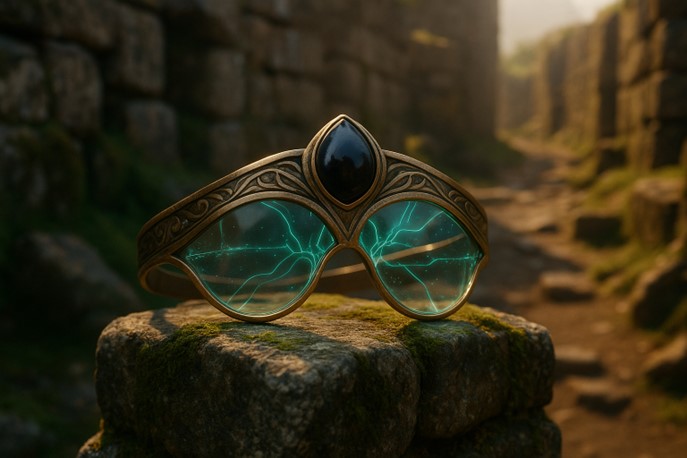
A slim circlet of etched brass and polished obsidian lenses shaped like mountain petals. When activated, faint ley-light outlines flow across the wearer’s vision, mapping magical currents in glowing filigree.
Effects: +1 Intellect; advantage on perception or investigation of magical or structural patterns; detect ley-line disruptions or active enchantments within 20 ft once per hour.
Lore: Designed by the scholars of the Grand Peakshrine to prevent another Rockfall by granting early vision of ley imbalance.
Lore (Expanded):
In the trembling aftermath of the Rockfall of Turrath, when half a mountain turned to dust and scholars wept over broken ley conduits, the surviving geomancers of the Grand Peakshrine devoted themselves to a single vow: “No flow shall fail unseen again.” From that vow arose the first prototypes of the Ley-Threaded Sight—a circlet both humble and sublime, woven of brass tempered in volcanic steam and fitted with obsidian lenses polished until they reflected the faint shimmer of ley energy itself. The artisans discovered that obsidian, when engraved with microscopic Qosqo-Khipu knot-patterns and treated with crystallized ley essence, allowed the wearer’s vision to trace the hidden arteries of the world.
Each circlet was tuned to the resonance of its maker, using a process that braided fragments of the crafter’s aura into the brass etchings. The Matriarch-Seers decreed that such helms would never be hoarded as relics but worn by surveyors, steamwrights, and ley engineers responsible for maintaining the balance between mountain and forge. Over time, the circlet became a symbol of civic duty; its subtle radiance identified those sworn to preserve the geomantic harmony of Andean’s heart. Many who donned one reported that the lenses whispered when the world was wounded—tones rising like glass chimes whenever a ley-thread strained under industrial demand.
To the Qosqo-Pacha, the Helm 556 of the Ley-Threaded Sight represents a reconciliation of knowledge and humility: a reminder that sight without restraint can blind, and that to look into the world’s pulse is to carry its burden. It remains standard issue for Peakshrine scholars, and replicas are commissioned by guild engineers who trust its soft light over any instrument.
Tier: 1
Slot: Head
Stat Modifiers:
• +1 Intellect
• +1 to Investigation and Perception checks involving structural, magical, or mechanical analysis
Skills Gained:
• Geomantic Analysis (identifying ley-line flow and stability)
• Arcane Architecture (understanding magical infrastructure or steam-circuit integrity)
Passive Magics:
- Ley-Field Vision: While worn, faint blue-gold filigree overlays the user’s sight, tracing nearby magical currents and pressure points in materials. The wearer can discern where enchantments pool or fracture.
- Pattern Intuition: The circlet harmonizes the user’s focus, granting advantage or +2 bonus to tasks requiring recognition of repeating motifs, rune layouts, or resonant frequency alignments.
- Steam-Lens Clarity: Brass etchings vent micro-steam to clear dust or fog before the lenses, ensuring visibility even in smog, volcanic ash, or underwater haze.
Activatable Magics:
- Ley-Thread Scan (1/hour): Activating the obsidian lenses causes concentric ripples of pale light to sweep the environment (20 ft radius), revealing active enchantments, magical traps, ley-line disruptions, and unstable machinery. The scan persists for one minute, highlighting anomalies in shimmering filaments.
- Focus of the Peak (1/day): Concentrating for 10 seconds aligns the circlet’s etched brass with the user’s pulse. For the next five minutes, Investigation, Engineering, and Arcana-style checks gain an additional +2, and the wearer can perceive energy gradients through walls of stone or metal up to 10 ft thick.
- Warning Resonance (Triggered): When a nearby ley conduit (within 20 ft) becomes unstable, the helm emits a soft harmonic tone only the wearer can hear, granting immediate awareness of geomantic danger.
Tags: Headgear, Insight, Detection, Geomantic Vision, Steam-Lens Device, Arcane Engineering, Safety Apparatus, Tier 1, Andean Craft, Preventive Tool, Scholar’s Instrument, Headgear, Insight, Detection, Geomantic Vision, Steam-Lens Device, Tier 1, Safety Apparatus
Commerce of the Helm 556 of the Ley-Threaded Sight — Across Saṃsāra
The Helm 556 of the Ley-Threaded Sight occupies a delicate place between sacred responsibility and high-grade instrumentation. It is rarely found in open markets, as most examples are commissioned through guild channels, temple workshops, or artisan contracts overseen by Peakshrine auditors. However, replicas, prototypes, and decommissioned helms circulate through a handful of legitimate and shadow venues. The following summarizes the types of shops, transaction etiquette, and cost variations one might encounter when seeking or selling such an item.
1. Peakshrine Sanctum-Forge (Qosqo-Suma or Hanan-Pacha)
Type: Temple-forge and research annex
Atmosphere: Quiet, incense-laden halls lined with steam conduits and hovering diagrams of ley lattices. Buyers are scholars, state engineers, or licensed Stonegrowers.
Trade Conditions: Requires proof of civic service or academic guild status. Purchasers must sign a “Ley Steward’s Oath,” promising the helm will not be used for exploitation or excavation of sealed ruins.
Typical Cost: 480–550 gold (state-subsidized, includes recalibration ceremony and resonance attunement).
Sales Back: Rare; temples reclaim used helms for refurbishment at 30 % credit value.
Special Notes: Includes blessing from Intayra’s clerics and certification seal etched in runic brass; tampering voids all protection spells.
2. Geomantic Optics Consortium (Peakhold Industrial Quarter)
Type: Guild workshop and experimental optics manufacturer
Atmosphere: Steam-filled laboratories, polished brass tools, and long workbenches covered with crystal prisms.
Trade Conditions: Open to inventors, machinists, and licensed airship navigators. Custom fittings and enhanced-range models may be ordered with additional fees.
Typical Cost: 620–700 gold (plus 20 % for precision-tuned variants).
Sales Back: Accepts damaged helms for parts trade-in (up to 40 % credit).
Special Notes: Guarantees mechanical calibration but not divine alignment; buyers often add their own wards post-purchase.
3. Scholarium of Ley Study (Southflow Dominion)
Type: University curio and relic shop attached to an academy
Atmosphere: Candlelit halls filled with relic cabinets and whispering apprentices.
Trade Conditions: Students and academics may rent or purchase on research grants.
Typical Cost: 400–450 gold (educational rate); rental fees ~10 gold per month with collateral pledge.
Sales Back: Not permitted; items returned to archives for study.
Special Notes: Versions often include detachable copper lens sets for field surveys; magical precision slightly lower than Peakshrine models.
4. Aether-Lens Emporium (Dreamtide Floating Bazaar)
Type: Arcane trade ship specializing in optical and divination gear
Atmosphere: Floating stalls illuminated by bioluminescent kelp lamps, with humming crystal sails.
Trade Conditions: No license required; bargaining common. Stock fluctuates with recovered salvage from underwater ruins.
Typical Cost: 750–900 gold depending on provenance.
Sales Back: 50 % credit for intact resale; higher if verified to originate from Peakshrine production.
Special Notes: Some models modified for underwater ley-reading, using nacre inlays instead of brass—cosmetically beautiful but prone to distortion in high steam environments.
5. Black-Market Relic Brokerages (Under-Peak Cavern Cities)
Type: Shadow vendors, contraband relic markets
Atmosphere: Low-lit lava-vein chambers filled with whispering traders and scent of ozone.
Trade Conditions: No certification; helm often stripped of sanctified seals. Purchases handled through encoded credit or barter.
Typical Cost: 950–1 200 gold, depending on scarcity and craftsmanship.
Sales Back: Only through the same network—risk of counterfeit exchanges high.
Special Notes: Some illicit versions have corrupted ley-threads that cause “Mirror-Sight,” where the wearer briefly sees echo-reflections of themselves in the ley flow.
6. Wandering Steamwright Caravans (Andean Highlands & Saṃsāran Frontiers)
Type: Traveling mechanics, relic restorers, and minor artificers
Atmosphere: Open-air tents with brass gears tinkling in the wind; trades fueled by bartering rather than coin.
Trade Conditions: Caravans exchange the helm for rare crystals, alchemical reagents, or field-grade essence batteries.
Typical Cost: Equivalent to 500–650 gold, though negotiable via material trade.
Sales Back: They may resell your helm to frontier outposts or scholars for 70 % barter credit.
Special Notes: Versions sold here often feature utilitarian engravings and fewer aesthetic flourishes but function flawlessly.
Roleplay Usage of the Helm 556 of the Ley-Threaded Sight — Across Environments
The Helm 556 of the Ley-Threaded Sight is not simply an ornament of observation; it is a tool of survival and strategy, a bridge between perception and power. When its obsidian lenses glow with the veins of Saṃsāra’s magic, they turn the invisible into visible—the pulse of a ley line, the stress of a collapsing wall, or the hidden trap beneath a layer of dust. In the hands (and mind) of a clever avatar, the circlet becomes a defensive sentinel and a subtle weapon.
1. Mountain and Highland Environments (Primary Terrain — Andean Heartlands)
Defensive Use:
In mountain passes or terrace strongholds, the wearer can see tremors before they strike. The helm projects faint ley-threads across cliffs and fort walls, glowing brighter at points of strain. Roleplay this as the avatar pausing mid-stride, their pupils flaring gold as they feel the rock “breathe.” The avatar can warn allies seconds before a landslide, conjure reinforcement with geomantic chants, or avoid ambushes by detecting weight shifts through the ley filigree.
Offensive Use:
The same sensitivity to ley strain can be turned outward. By locating weak spots in stone structures or magical barriers, the wearer guides siege engineers or spellcasters to strike exact nodes where resonance collapses. In combat, an avatar might activate the helm and “see” where an enemy’s enchantment anchors, allowing them to disrupt it with a targeted blow or counter-chant. The effect is cinematic—threads snapping like strings of light as energy bursts free.
2. Urban and Industrial Environments (Steam-Cities and Foundries)
Defensive Use:
In a dense mechanical district, the helm acts as a safety device. Its resonance tones alert the user to pressure buildup, cracked pipes, or overcharged steam conduits before catastrophic rupture. Roleplay the avatar walking calmly through hissing alleys while glowing circuit lines in their lenses pulse in rhythm with the city’s heartbeat. The wearer can prevent explosions, redirect energy flow, or shield civilians from industrial hazards.
Offensive Use:
A skilled operator can weaponize this industrial foresight. In tense conflicts or sabotage missions, they can trigger a controlled failure—loosening a valve or striking a pressure joint to redirect scalding steam or collapse a bridge beneath pursuers. The attack is never direct but always precise, echoing the Andean philosophy that force is most effective when guided by understanding, not rage.
3. Cavern and Subterranean Environments (Cave Cities and Ruins)
Defensive Use:
Within the underground metropolis or during ruin exploration, the helm’s Ley-Thread Scan outlines entire cave systems in ghostly blue arcs. The avatar “feels” hollows, detects hidden passages, and avoids sinkholes or magical traps. Roleplay as the user tracing air currents with fingertips as glowing glyphs shimmer around their vision, murmuring ancient chants of alignment.
Offensive Use:
In combat beneath the earth, where visibility is low, the wearer’s sight extends through walls, allowing them to track enemy movement by their disturbance in the ley fabric. They may collapse a tunnel section on an opponent or create a diversion with a predicted cave-in path. The offensive application is not brute destruction—it’s geomantic chess, moving the battlefield itself.
4. Coastal, Aquatic, or Mist-Bound Regions (Dreamtide and Coral Dominions)
Defensive Use:
Underwater or in heavy mist, normal sight fails—but the ley-light of the helm cuts through opacity like heat through ice. The avatar perceives currents, pressure flows, or concealed predators as strands of motion in glowing hues. Roleplay moments where the character steadies their breathing as the water itself forms radiant channels before their eyes. They might guide divers away from collapsing coral structures or sense a lurking construct before it strikes.
Offensive Use:
The wearer can exploit energy gradients in water to amplify lightning or heat attacks, striking where ley tension is densest. Alternatively, they can destabilize nearby enchantments—say, a binding ward or elemental summon—by focusing their sight until the runic geometry fractures like glass. Against magical opponents, this precision transforms the helm into a tactical weapon of disruption.
5. Battlefield and Open Plains
Defensive Use:
In open conflict, the helm glows with constant shifting filigree, mapping ambient magic like a tactical overlay. The avatar may shout directions—“The ley current breaks left!”—and reposition allies along stable ground or beneath protective arcs of energy. When bombarded by magic, the circlet helps identify where to plant grounding rods or deflect spells through terrain.
Offensive Use:
The avatar uses Focus of the Peak to locate the nexus where battlefield energies converge. By marking this spot, they can coordinate artillery or spellfire to trigger devastating chain reactions, effectively “cutting” enemy ley control. Roleplay this as the user narrowing their gaze, lens reflections spiraling like molten brass before pointing decisively: “Strike there—let the mountain answer.”
6. Ruins, Temples, and Magical Constructs
Defensive Use:
Inside ancient structures or sealed vaults, the helm warns of decaying wards and traps. The avatar perceives glyphs flickering like fading constellations, guiding careful dismantling or safe passage. The defensive posture here is reverent—every movement measured, every breath syncing to the heartbeat of ancient stone.
Offensive Use:
Should hostile constructs awaken, the wearer can identify the ley core animating them. Channeling the helm’s resonance through the Warning Resonance pulse, they can overload or silence that core, temporarily disarming the guardian. Some adventurers pair this with geomantic tools, combining perception and precision strike.
7. Social and Diplomatic Environments (Peakhold Halls or Foreign Courts)
Defensive Use:
Even outside combat, the helm’s subtle energy grants insight. Its lenses reflect fluctuations in emotional or magical auras, letting the avatar detect deceit, illusions, or hidden enchantments on gifts or attendees. Roleplay as the wearer tilting their head, eyes faintly alight as they interpret vibrations beneath a diplomat’s tone.
Offensive Use:
Though rarely wielded aggressively in social arenas, its precision can expose corruption or illusion before an audience—turning perception itself into weaponized truth. With a single phrase, “The ley betrays you,” an avatar could shatter political deception and alter the course of negotiations.
Perception of Activation:
User’s Perspective:
The moment the Helm 556 of the Ley-Threaded Sight awakens, the avatar feels a faint vibration behind the eyes — not pain, but a harmonic pulse synchronized with their heartbeat. The world shifts subtly: outlines of objects blur and reform in glimmering filigree, as if reality itself has been drafted anew in lines of molten brass. Every surface reveals the slow breathing of magic — cracks shimmer like veins of light, air currents curl in visible spirals, and ley lines radiate warmth like sunlight beneath stone. Sounds dull slightly, replaced by a resonant hum that seems to echo from beneath the skin, a “mountain’s heartbeat” that syncs with breath. The scent of heated minerals and ozone fills the air, accompanied by a metallic tang on the tongue, signaling a living current of geomantic energy. Inwardly, the avatar experiences a cascade of extrasensory impressions — weight distribution of structures, the mood of stones, even faint whispers of ley imbalance murmuring in ancient, almost intelligible tones.
Observer’s Perspective:
From the outside, the wearer’s eyes blaze with interlaced rings of gold and blue light, and fine lines of energy crawl from the circlet down their temples like shifting tattoos. Steam and dust in the air bend toward them, forming faint halos that follow every motion. The air hums with the low resonance of crystal vibration, and when they focus, the ground nearby ripples subtly, as if acknowledging their awareness. Observers often feel a sympathetic pressure in their ears or temples, like standing near a deep subterranean engine.
Positives:
– Dramatic enhancement of situational and magical awareness, allowing early detection of traps, hidden structures, or ley distortions.
– Improves teamwork by providing tactical insight—others can rely on the user’s predictive calls.
– Grants emotional calm and focused perception, grounding the avatar in the rhythm of the world.
– Enables empathic resonance with natural environments; stones, steam, and wind feel alive, responsive, and protective.
Negatives:
– Sensory overload in high-magic zones: lights and hums intensify to a blinding, disorienting level, causing headaches or vertigo.
– Extended activation induces “after-sight,” where faint ley patterns linger in vision for hours, distorting normal sight.
– Emotional detachment risk — prolonged focus may desynchronize empathy for living beings as the avatar becomes absorbed in the rhythm of stone and current.
– Metallic aftertaste and heat discomfort build with long use; in rare cases, the circlet leaves faint energy burns around the temples.
To activate the helm is to see as the mountains do — steady, enduring, and unblinking — a gift and a burden in equal measure.
Crafting Recipe: “Forging the Helm 556 of the Ley-Threaded Sight”
A sacred Andean craft once reserved for the geomantic scholars of the Grand Peakshrine, this process rebinds ley perception to metal, allowing sight through the pulse of Saṃsāra itself.
Materials Needed
- Brass of the First Breath (1 ingot):
Smelted from volcanic ore found near ley vents; must be quenched in steam infused with mountain sage to attune it to Andean resonance. - Obsidian Petals (4 shards):
Harvested from cooled magma near sacred peaks; each fragment cut into thin concave lenses that can refract ley-light. - Aetheric Conduit Thread (3 feet):
Copper wire soaked in ley-infused oil and braided with silk drawn from cave-spinners; channels sensory flow between helm and Mind’s Eye. - Pulse Crystal Dust (½ ounce):
Ground crystals gathered from leyline fractures; vibrate faintly when near geomantic disturbances. - Steam-forged Fastenings (8 rivets):
Hand-pressed metal fittings treated with binding salt to stabilize brass-obsidian joins. - Essence of Clarity (1 vial):
Distilled from glacier-spring water under moonlight; ensures the helm’s lens maintains focus during magical storms. - Leystone Fragment (1 small core):
Taken from a dormant ley-line intersection; acts as the circlet’s anchor and resonance regulator. - Blessed Oils of the Stonegrowers (few drops):
Anointing fluid used in all Andean holy crafts; prevents geomantic backlash during binding.
Tools Required
– Geomantic Workbench (with ley-pulse stabilizer)
– Steam Hammer and Miniature Forge Bellows
– Precision Lens Carver (obsidian or diamond-tipped)
– Runic Etching Stylus powered by low-pressure steam
– Spirit Tuning Fork (for resonance testing at each phase)
– Cooling Basin lined with silver and volcanic ash
– Scribing Quill and Qosqo-Khipu Cord for inscription record
Skill Requirements
– Smithing (Journeyman Level or higher): to forge brass alloy and shape the circlet.
– Runecrafting (Adept Level): to etch the ley-thread inscriptions accurately.
– Ley-Attunement or Geomancy (Intermediate): to balance energy through each segment.
– Glass/Obsidian Crafting (Skilled): for shaping and polishing lenses without shattering them.
– Alchemy (Novice or above): to safely distill and apply Essence of Clarity and pulse dust mixtures.
Crafting Steps
- Smelting and Alloying:
Melt the Brass of the First Breath over low blue flame while chanting the “Opening Breath of the Mountain.” Mix in a trace of Pulse Crystal Dust until faint silver ripples appear on the surface. Pour into a circular mold sized for the wearer’s brow. - Lens Shaping:
Grind and polish the Obsidian Petals into lens forms. Submerge them in Essence of Clarity for twelve hours until a pale luminescence emerges. Align them around the circlet’s inner rim. - Ley Conduit Assembly:
Thread the Aetheric Conduit wire along the interior curve of the circlet, embedding it into the brass. Secure with Steam-forged Fastenings while maintaining steady rhythmic breathing—if the crafter’s pulse falters, the thread may backlash and burn out. - Runic Inscription:
Use the Runic Etching Stylus to inscribe the Qosqo-Pacha Ley-Thread glyphs between each fastening. At each symbol’s completion, strike the Spirit Tuning Fork once—this resonance locks the runes to Saṃsāra’s ambient ley tone. - Leystone Integration:
Place the Leystone Fragment at the helm’s rear node. Activate the forge’s ley stabilizer while slowly rotating the circlet so the fragment glows evenly. The helm will emit a low hum when the alignment is correct. - Anointing and Cooling:
Dip the completed helm into the silver-lined basin filled with volcanic ash slurry. As steam rises, drip the Blessed Oils of the Stonegrowers over the circlet. The brassy surface will darken, and luminous filigree will crawl across it like veins of living metal. - Attunement Trial:
Upon cooling, wear the helm within a ley-rich cavern or temple. When activated properly, faint gold lines will trace across vision and the surrounding stone will vibrate gently. If no hum is felt, the energy has not bonded—repeat the anointing.
Result
The finished Helm 556 of the Ley-Threaded Sight will carry a visible ley-pulse pattern that flares during magical detection. Its resonance tone harmonizes with Andean geomantic frequencies, ensuring stability and preventing structural collapse from overcharge.
Crafting Insight:
Many apprentices believe the most critical step is the etching—but true masters know the secret lies in breathing with the mountain. The circlet listens to rhythm; impatience fractures the harmony.
Moral of Craft:
Only by seeing the unseen within oneself may one forge the sight that perceives the hidden world.
Sight That Looked Beneath the Mountain
(Fragmented from the Fifth Codex of Stonegrowers; translation presumed from the lost dialect of Proto-Pacha, itself adapted from an even older geomantic tongue now extinct.)
In the elder days before the second mist-age of the peaks, when the ley veins still sang aloud and the air carried the voice of molten time, there lived a scholar-craftsman whose name was spoken as Aru-Neh the Listener—or so the broken runes imply. It is said Aru-Neh was born in the twilight between avalanches, a child whose first breath was filled with dust and low thunder. The midwives heard humming from the stones, and so they bound copper wire around her wrists, that the pulse of the earth might not consume her.
Aru-Neh grew among the whispering halls of Qosqo-Suma, city of scholars and forges, where the steam never ceased and the sky trembled with heat. She learned to hear what others saw, and to see what others felt. When she listened to the hillsides, they answered in slow syllables; when she gazed upon walls, she saw the memory of hands that built them. Yet her eyes were mortal, and she desired the True Pattern, the lattice of life that the Sentinel Intayra had woven through stone and breath.
The fragments tell that she went before the elders of the Grand Peakshrine and spoke:
“If the Rockfall be born of blindness, then let me craft a sight that shall see the tremor before it wakes.”
But the elders forbade her, for they feared she would touch the veins too deeply and unmake the mountain’s balance. Aru-Neh left their hall, taking only a broken lens, a leystone fragment, and the silence of her own heartbeat.
She wandered the lower terraces, through mines where the molten ghosts whispered, until she reached the Hollow Beneath the Three Peaks, a cavern where ley-light dripped like dew. There she struck her forge not with hammer, but with voice—each note an echo of the mountain’s buried hum. The texts say her breath turned to steam and her words etched brass into runes. She melted the brass with her tears, for no flame could temper her will. Into this circlet she pressed obsidian petals, each one cut from a mirror once used to study the sky, now turned inward to reflect the bones of the earth.
Seven nights she forged, and on the eighth, the stones sang back. When she placed the circlet upon her brow, the world unfolded—rivers flowed beneath her feet, airlines curled around her fingers, and veins of sleeping fire drew maps in the dark. She saw the mountain’s heart beating, slow and vast, and for a moment she believed herself its twin.
But the story twists—scribes disagree. Some say she rejoiced and taught the Peakshrine how to see the tremor before it struck. Others whisper she beheld too much: that she saw a crack reaching not through stone, but through time itself. The fragment called Verse of the Shattered Lens describes her scream as “a tone that made water still.” She carved that sound into the circlet so that others might hear what she had seen.
Afterward, the records grow uncertain. A few tablets speak of Aru-Neh walking into the mountain, her body dissolving into brass dust and light. Another claims the Sentinel took her hand and placed her spirit within the leylines, to whisper through future artisans’ forges. Whatever the truth, the Helm of the Ley-Threaded Sight remained—cool, humming, and awake.
Centuries later, during the rebuilding after the Rockfall of Turrath, Stonegrowers uncovered the circlet sealed in ash. When worn, it traced invisible lines across vision, showing where the next fracture would form. They rebuilt their cities by its counsel, never digging where its filigree dimmed. The circlet’s hum became the tone of safety, and its light, the sign of patience.
And yet, the translation ends with a warning scratched in a later hand:
“Beware the one who sees all patterns, for they shall forget the shape of their own heart.”
Moral of the Story: To seek the rhythm of the earth is noble, but to believe oneself its equal is folly. True sight is not to command the mountain—but to listen before it breaks.
Suggested conversions to other systems:
CALL OF CTHULHU (7th Edition)
Item Name: Helm 556 of the Ley-Threaded Sight (Artifact)
Type: Headgear – Brass Circlet with Obsidian Lenses
Era: Saṃsāra Renaissance Parallel
Description:
A thin circlet of etched brass adorned with obsidian petals, the Helm 556 hums faintly when near geomantic currents. When worn, the user perceives faint glowing lines tracing through solid matter, revealing ley flows, energy veins, and magical anomalies.
Game Mechanics:
– Skill Modifier: +15% bonus to Science (Geology) and Mechanical Repair rolls involving structural or magnetic fields.
– Occult Insight: Once per in-game hour, user may attempt a Cthulhu Mythos or Occult roll with Advantage to identify or stabilize magical disturbances.
– Detect Magical Currents: Spend 3 Magic Points to sense ley-line disruptions, wards, or energy fractures within 6 meters. Success reveals the source’s pattern, heat, and intensity.
– Resonant Overload (Risk): Prolonged use (over 1 hour continuously) calls for a POW×5 roll or suffer temporary sensory overload—1D6 SAN loss and blindness for 1D4 rounds.
– Rarity: Unique Artifact.
– Value: 1,500–2,000 sp equivalent.
Flavor:
Wearing the helm opens perception beyond sanity’s edge—patterns too vast to comprehend flicker beneath the surface of stone. Many scholars have broken their will trying to map its visions.
BLADES IN THE DARK
Item Name: The Leyseer’s Circlet 556
Item Type: Fine Arcane Implement (Worn, 1 Load)
Description:
A delicate circlet of mountain brass and obsidian petals that illuminates ley lines and ghost echoes when worn. Steamlight glimmers through invisible fractures, whispering the pulse of the earth.
Game Mechanics:
– Effect: Grants Supernatural Awareness—you can see ambient electroplasmic and magical energy flows, hidden hollows, and faint ghost echoes in stone or metal.
– Mechanic: +1D on Study or Survey rolls when analyzing arcane energy, structure, or machinery.
– Once per Score: You may Attune to the mountain’s hum to detect a hidden danger or weak point in your surroundings. Gain potency on your next roll related to the result.
– Drawback: After long exposure, you suffer 2 stress unless you spend downtime meditating or purging excess resonance with an Indulge Vice action.
Tier: 1 (Fine Quality, Resonant)
Value: 4 Coin or equivalent trade in rare mineral or ley materials.
DUNGEONS & DRAGONS (5th Edition)
Item Name: Helm 556 of the Ley-Threaded Sight
Wondrous Item (Head), Uncommon (requires attunement by a spellcaster or geomancer)
Description:
This brass circlet with obsidian lenses glows faintly when near magical currents. When attuned, it threads the wearer’s vision with ley-light, allowing them to perceive the hidden geometry of magic.
Properties:
– Stat Bonus: +1 Intelligence (maximum 20).
– Passive Ability: Advantage on Perception or Investigation checks to detect magical effects, traps, runes, or weak structures.
– Ley Vision (1/hour): As an action, detect active enchantments, ley-line flows, or arcane traps within 20 ft. This functions as Detect Magic but also identifies unstable terrain or wards.
– Steady Mind: Gain advantage on saving throws against being blinded by bright light or magical illusions.
– Curse (Hidden): If worn for more than 8 hours continuously, DC 13 Wisdom save or become visually disoriented for 1 minute, seeing ley flows as shifting maze patterns.
– Weight: 1 lb
– Value: 400–600 gp depending on region (double in Andean or geomancer cities).
KNAVE (Latest Edition)
Item Name: Circlet 556 of the Mountain Veins
Slot: Head
Type: Magic Item (Tier 1)
Description:
An ornate brass circlet with obsidian shards that glow faintly when ley energy flows nearby. Those who wear it perceive the breath of the world—currents of magic pulsing beneath matter.
Stats and Effects:
– +1 INT while worn.
– Detect Ley Currents: Once per turn, the wearer may sense ley lines, magical traps, or enchantments within 30 feet. The GM describes visual or sensory cues of these energies.
– Geomantic Awareness: You can automatically detect hidden hollows, unstable stone, or structural weakness while in contact with the ground.
– Passive: Advantage on checks involving investigation of stone, metal, or runic constructs.
– Drawback: Each hour of use requires a WIS save (DC 13) or suffer dizziness—roll at disadvantage for 1d4 minutes.
– Value: 60 gold pieces (common market); 120 gold pieces (geomantic traders).
Lore Hook:
Legends claim the helm was crafted after the Rockfall to prevent another disaster. Some say it still hums the rhythm of the first collapse when worn near buried ruins.
FATE CORE SYSTEM
Item Name: Helm 556 of the Ley-Threaded Sight
Aspect: “Eyes That See the Pulse Beneath the Stone”
Item Type: Artifact (Head Slot, Tier 1)
Description:
A brass circlet inlaid with obsidian petals and copper filigree that glows along ley currents. When worn, the user’s perception fills with shifting runic filigree that maps unseen flows of geomantic energy.
Game Mechanics:
– Passive Bonuses: +2 to Notice and Investigate rolls related to magic, ley lines, or structural stability.
– Invoke (1 FP): Reveal the most unstable or enchanted area in the current zone; gain situational Aspects such as Ley-Fracture Forming or Hidden Vein of Power.
– Compel: The Helm sometimes overwhelms the wearer with sensory overload; GM may compel to inflict temporary blindness or confusion.
– Stunt: Leyline Cartographer – Once per scene, spend a Fate Point to automatically overcome an obstacle involving geomancy, detecting traps, or hidden passages.
Tier/Value: Tier 1 rare artifact; typically worth two major treasures or several favors from an Andean scholar guild.
NUMENERA / CYPHER SYSTEM
Item Name: Ley-Threaded Sight Helm (Cypher)
Level: 4 (1d6 + 2)
Form: Thin circlet of brass and obsidian lenses emitting soft blue light.
Effect:
For ten minutes after activation, the wearer perceives ley currents, magnetic flux, and invisible energy pathways within short range (20 ft radius). Grants an asset on all Intellect-based tasks involving analysis, detection of hidden features, or understanding machines or magic.
Passives:
– +1 Intellect Pool (while worn).
– Constant minor benefit: user senses nearby magical or numenera devices as faint rhythmic vibrations.
Activation (1 Intellect Point): Detect active enchantments, traps, or energy distortions; GM reveals one relevant truth about the environment.
Depletion: 1 in 20 (rolled each use).
Manifestation: Threads of silver light outline objects; faint humming fills the air.
Value: 400 shins or more among geomantic explorers.
PATHFINDER 2E
Item Name: Helm 556 of the Ley-Threaded Sight
Item Level: 4 Rarity: Uncommon Price: 100 gp
Usage: Worn on head; Bulk L
Description:
This delicate brass circlet etched with obsidian petals allows the wearer to perceive magic woven through terrain and architecture.
Mechanical Benefits:
– Item Bonus: +1 item bonus to Perception and Arcana checks to detect magic, runes, or structural weakness.
– Resonant Power (Focus 1, 1/hour): Activate (Concentrate) → Detect Magic at 20-foot emanation. In addition, if the effect reveals a ley line, the wearer can determine its direction and intensity.
– Geomantic Awareness (Passive): You can sense vibrations through stone or metal; gain imprecise tremorsense 10 ft while standing on solid ground.
– Overload Risk: Critical failure on Arcana check while the helm is active causes sensory disorientation (stunned 1).
Craft Requirements: Arcana Expert; special ley-attuned workshop; components worth 50 gp.
SAVAGE WORLDS (Adventure Edition)
Item Name: Helm of Ley-Threaded Sight #556
Gear Type: Arcane Headgear Rarity: Rare Weight: 1
Description:
A steam-etched circlet of brass with obsidian petals that glow when geomantic energy surges.
Game Stats:
– Bonus: +1 to Notice and Investigation rolls involving magic, structure, or traps.
– Edge-Like Effect: Counts as the Detect/Conceal Arcana power with Power Points = 2, usable once per hour.
– Activation: Takes one action; roll Smarts (–2 modifier in areas without magic). Success reveals active enchantments or ley disturbances within 5″.
– Backlash: On Critical Failure, wearer is Distracted for 1d4 rounds as visions overwhelm them.
– Passive: +1 Toughness against blindness or flash-based effects due to the protective obsidian lenses.
Market Value: 1,200 credits or 8 benedictions in Andean guild trade.
SHADOWRUN (6th Edition)
Item Name: Helm 556 of the Ley-Threaded Sight
Type: Awakened Headware (Magical/Technomantic Gear) Availability: 6 Cost: ¥6,500
Description:
A delicate brass circlet set with obsidian micro-lenses and ley-reactive filigree, the Helm 556 enables the user to visualize mana flows and structural auras. It resonates with ambient mana currents, originally crafted in the Saṃsāran highlands by geomancers who merged steamcraft and thaumaturgy.
Game Mechanics:
– Bonus: +2 dice to Assensing and Arcana Tests.
– Function: Functions as a permanent Detect Magic effect (Force 3 equivalent). The wearer perceives astral patterns as faint luminous threads overlaying reality.
– Matrix Crossover: Technomancers gain +1 to Matrix Perception rolls in areas of high mana due to ley-energy harmonics.
– Overload Effect: If worn in a mana void or background count ≥3, user must resist 3S Drain or suffer sensory disorientation (-2 dice to Perception for 1 hour).
– Essence Cost: 0.1 (sympathetic neural integration).
Notes:
Often black-market imported through the Pacific Ring. Dangerous for non-Awakened users, as its field can cause “Ley Burn” in unshielded brains.
STARFINDER (Latest Edition)
Item Name: Helm of Ley-Threaded Sight #556
Item Level: 4 Price: 2,400 credits Bulk: L Slot: Head
Description:
A finely crafted circlet that merges obsidian glass optics with brass filigree and psionic circuits. When active, it projects a faint overlay of luminous ley-lines and energy pathways across the wearer’s vision.
Game Mechanics:
– Enhancement Bonus: +2 circumstance bonus to Perception and Physical Science checks to detect magic, traps, or energy fields.
– Sense Ley Currents (1/hour): As a standard action, sense magical or technological anomalies within 30 ft (functions as Detect Affliction or Detect Magic hybrid effect).
– Geomantic Interface: If worn by a spellcaster or technomancer, it reduces the DC of Engineering or Mysticism checks to identify unstable power sources by 2.
– Overload Hazard: When used in overlapping null-magic and high-energy zones, the wearer must succeed at a DC 15 Fortitude save or be dazzled for 1 round.
– Aura: Moderate divination and transmutation.
Special: Crafted from ancient Saṃsāran designs found in the ruins of Qosqo-Suma; considered cultural relics.
TRAVELLER (Mongoose 2nd Edition)
Item Name: Helm 556, “Ley Sight Circlet”
Tech Level (TL): 13 Mass: Negligible Cost: Cr12,000
Description:
An advanced psionic sensor band blending geomantic engineering with near-psionic interface materials. The brass and obsidian device reads gravitic and energy resonance to visualize substructural patterns and ley fluctuations in the environment.
Game Mechanics:
– Skill Bonus: Grants DM+1 to Electronics (Sensors) and Science (Planetology) checks.
– Psionic Synergy: If user possesses Telepathy or Awareness, they gain DM+2 to detect psionic or gravitational anomalies within 10 meters.
– Environmental Use: Provides automatic detection of unstable geological zones, power surges, or structural faults within 10 meters (GM discretion).
– Drawback: Each continuous hour of use requires END 8+ check or user suffers fatigue (-1 DM to all tasks for 1D6 hours).
– Special Rules: May be jury-rigged into ship sensor systems, granting temporary +1 DM to planetary survey rolls (burns out after 1D6 uses).
Availability: Rare prototype relic; illegal outside licensed archaeological societies.
WARHAMMER 40,000 ROLEPLAY (WRATH & GLORY)
Item Name: Helm 556 of the Ley-Threaded Sight
Type: Archeotech Relic Rarity: Very Rare Value: 7 Tier: 2
Description:
A mysterious circlet of brass and black crystal, humming faintly with energies older than the Imperium. The Helm 556 allows the bearer to perceive the flow of Empyric currents, reading the fractures between warp and matter.
Game Mechanics:
– Passive: +1 bonus to Awareness and Scholar (Archaeotech or Psykana) Tests.
– Active (1/Scene): Spend 1 Wrath to activate the helm’s Ley Vision for 10 rounds. During this time, the wearer automatically detects warp rifts, daemon presence, or unstable machinery within 20 meters.
– Warp Feedback: Each activation requires a DN 3 Corruption Test. On failure, the user suffers 1 Corruption point and temporary hallucinations (Complication).
– Benefit to Psykers: Adds +1 to Psychic Mastery tests involving Divination or Scrying.
– Resilience: The circlet provides +1 Defence against effects that target the mind or sight (e.g., flash grenades, illusions).
Flavor:
Said to be a recovered Saṃsāran relic reforged on a forge world. The Ecclesiarchy forbids its use, claiming the helm “sees too much of the Emperor’s shadow.”