
From:

Lineage 684 of the Gem Crested Karthian of Archaic
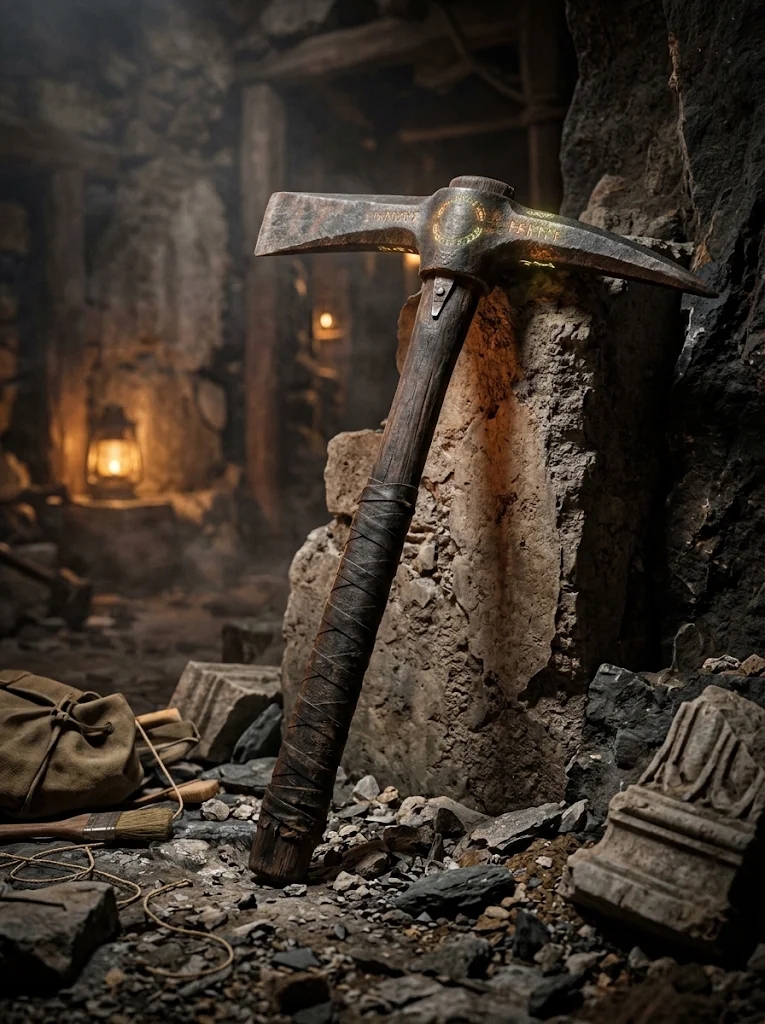
* Equipment Classification: One-Handed Held Melee Weapon and Epigraphic Tool, occupying a primary hand slot when actively wielded.* Tier and Rarity: Tier 1, Common quality.* Attunement and Action Economy: Operates under instantaneous handheld attunement, which bonds automatically the moment the avatar grasps the haft without requiring a one-minute focus period. In accordance with the laws of Saṃsāra, this weapon must be attuned to function in combat, yet as a held item, it does not count toward the ten-item attunement ceiling that induces physical pain or forces character advancement. An attack with this weapon constitutes a complete operational action, encompassing the continuous motion of unsheathing the pick from its belt ring, executing the strike, and returning the implement to its sheath. At Tier 1, the avatar possesses two actions per turn (one plus the tier level of 1). If utilized for the avatar's first combat action of the turn, the strike inflicts full damage; if wielded for a second consecutive attack in the same six-second turn cycle, the resulting total damage is halved. Should an opponent successfully target this held item with a designated disarming strike, the pick is immediately deactivated and unattuned, requiring a formal ritual attunement of at least ten minutes before it can be utilized again.* Attack and Damage Mechanics: Attack rolls require rolling a d20 plus the avatar's Tier 1 tier die (1d4) plus the avatar's Strength modifier (+3) and trained Heavy Mason's Chisel proficiency bonus (+3). To achieve a successful hit, the cumulative total must strictly exceed the defender's total Armor Check rating across all worn gear, as matching or rolling below the target's AC constitutes a complete miss. A roll of 1 on the d20 triggers an automatic miss and requires drawing a Failure card from the red deck; rolling a 20 on the d20 triggers a critical hit and requires drawing a Crit card from the green deck. The tier die rolled during the attack pass directly through into the damage calculation without requiring a separate damage roll. The weapon inflicts a base physical damage of 1d6 piercing or slashing damage (selected upon attack declaration based on whether the pointed beak or the beveled chisel blade is used to strike) plus the 1d4 tier die result plus the +3 Strength modifier. The damage type of the tier die matches the primary damage type of the base strike.* Durability and Health Points: Possesses a base resilience rating of 10. Under equipment durability rules, the structural health points of the weapon equal the avatar’s maximum health points plus the resilience multiplied by the item's tier level, establishing 33 Item Health Points (23 avatar base maximum health points plus 10 resilience points). If the pick sustains physical sunder attempts or environmental damage that reduces its structural pool to 16 hit points or below, it acquires the broken condition, rendering its cutting edge blunted and nullifying its combat bonuses until fully repaired during downtime. If reduced to zero hit points, the item shatters permanently into raw bronze and iron scraps.* Material Composition and Forging: The head of the implement is cast from tough, slate-tempered bronze alloyed with bog iron extracted from the Glade Coast, producing a dense, rust-resistant metal that holds a keen edge against mineral friction. The forward head features a broad, hollow-ground masonry chisel edge specifically contoured for clearing calcified deposits from ancient Syl-Rune tablets and splitting shale strata. The opposing rear head tapers into a heavy, four-sided armor-piercing beak designed to punch through mineral crusts or crack petrified wood supports. The central eye is wedged onto a twenty-two-inch haft of cured ironwood harvested from the managed timberlands of the Rootwood Marches, wrapped in cross-hatched dire-boar leather to provide a non-slip grip for the avatar’s thick, scaled palms and blunt claws.* Archaeological and Tactical Utility: Designed to serve as both a functional architectural surveying implement and a lethal defensive weapon during deep subterranean explorations beneath Syl-Kar. In catacomb excavation, the chisel face allows the epigrapher to carefully pry loose fragile clay tablets and chip away protective lime mortars without fracturing underlying inscriptions. In tactical combat against subterranean vermin or hostile cavern scavengers, the heavy mass and balance point of the pick allow the 365-pound Karthian avatar to leverage its immense upper-body strength, delivering crushing, armor-shattering blows against chitinous carapaces, stone constructs, and reinforced wooden barricades.
During

the rapid subterranean expansion of the Second Consolidation, the

exploratory expeditions of Lineage 684 pushed beyond the stable

granite arches of Syl-Kar into the unstable, mineralized strata of

the Lower Sump and the brackish silt-flues of the Glade Coast.

Standard brass picks and brittle iron chisels degraded rapidly

against the vitrified rock and petrified timber shoring; tool heads

bent under the immense torque delivered by Karthian wrists, and fine

lapidary edges dulled within minutes of scraping calcified lime from

Precursor tablets. Furthermore, sudden cave-ins and predatory tunnel

fauna regularly caught surveyors with their measuring slates deployed

and their weapons stowed, resulting in fatal delays during surprise

engagements.
To resolve these logistical failures, Master Epigraphers collaborated with municipal metallurgists to produce Batch 384 of the Heavy Mason’s Excavation Chisel-Pick. Smelters combined bog iron dredged from the Glade Coast with slate-tempered bronze, balancing ductile shock absorption with exceptional edge retention against abrasive quartz. The twenty-two-inch haft of cured Rootwood ironwood was calibrated to seat directly into the quick-draw scabbard of the Riveted Ironhide Girdle 893, creating a continuous combat-surveying rhythm where drawing the pick, clearing an obstruction or neutralizing a troglobite, and re-sheathing the tool could be executed as a unified motion. The batch saw distinguished service during the Cleansing of Sluice Vault 12, where field surveyors used the pick’s armor-piercing beak to pry through three feet of calcified mud-dams while simultaneously shattering the carapaces of encroaching mire-leeches.
- Specific Slot:
- Primary Hand Slot (One-Handed Held Melee Weapon / Architectural Epigraphic Tool; seats into the forward left quick-release loop of dedicated surveyor waistwear).
- Tier One Stats:
- Equipment Classification: One-Handed Held Melee Weapon and Epigraphic Tool.
- Tier and Rarity: Tier 1, Common Quality.
- Base Resilience: 10 resilience points.
- Item Health Points: 33 Item HP (Avatar base maximum HP of 23 plus 10 resilience points multiplied by Tier 1 modifier). Breaks at 16 HP or lower, blunting the edge and nullifying combat/utility bonuses; permanently destroyed into scrap metal at 0 HP.
- Attunement Dynamics: Instantaneous handheld attunement upon grasping; does not count against the standard ten-item attunement ceiling. Disarming instantly breaks attunement and disables all properties until a 10-minute ritual attunement is completed.
- Action Cost and Multi-Attack Penalty: Consumes 1 complete operational action (unsheathing, striking, and re-sheathing). Full damage on the first action of a turn; total damage is halved if used for a second consecutive attack in the same 6-second round.
- Attack Roll: 1d20 + 1d4 (Tier 1 Tier Die) + 3 (Strength modifier) + 3 (Trained Chisel Proficiency bonus) [Total: 1d20 + 1d4 + 6]. Must strictly exceed target Armor Check rating to hit; natural 1 triggers an automatic miss and a Failure card draw, natural 20 triggers a critical hit and a Crit card draw.
- Damage Output: 1d6 piercing (beak) or slashing (chisel blade) + 1d4 (Tier Die, matching chosen damage type) + 3 (Strength modifier).
- Physical Mass: 4.5 lbs.
- Skills Gained While Openly Worn or Held:
- +1 Temporary Skill Point to Epigraphic Masonry & Lapidary Recovery (enables precise mortising, stone carving, and cleavage of lime plaster without fracturing brittle underlying inscription tablets).
- +1 Temporary Skill Point to Structural Breaching & Demolition (improves leverage calculation, chisel placement, and kinetic transfer when forcing open sealed stone doors, prying masonry, or sundering mineral carapaces).
- Multiple Passives Magic:
- Splay-Point Cleavage: The tempered bronze blade and rear beak vibrate with subtle lithic harmonics when striking non-living mineral, petrified wood, or masonry targets, bypassing 2 points of physical hardness/damage reduction and preventing the pick head from ever jamming or wedging into rock fissures.
- Glade-Iron Non-Fouling: The Glade Coast bog iron and slate-infused alloy naturally repels caustic marsh brine, sulfurous condensation, and acidic slime. The head is completely immune to environmental corrosion, acid etching, and mineral oxidation.
- Lithic Resonance Feedback: When the pick head rests against solid rock or dressed masonry, the wielder intuitively feels internal density variations, detecting hidden hollow voids, stress seams, or secret cavities within 5 feet of the contact point.
- Multiple Activatable Magics:
- Epigraphic Fracture Strike (Resonant Cleave): Upon declaring an attack or architectural strike against stone, mineral structures, or heavily armored carapaces, the wielder channels earth mana through the ironwood haft. On impact, the head emits a localized concussive pulse that inflicts an additional 1d6 force damage and shatters up to a 1-foot cube of contiguous stone (or temporarily reduces the target’s natural Armor Check by 1 for 1 minute on a successful hit). Possesses 2 charges per day; regains all expended charges daily at dawn.
- Seismic Lever Lock: When wedging the beak or chisel blade into a structural fissure, portcullis frame, or fallen ceiling beam, the avatar expends 1 action to activate internal geomantic tension. The ironwood haft and bronze head lock into an unyielding, rigid fulcrum for 10 minutes, tripling the wielder’s effective lifting and prying capacity when forcing open sealed vault doors or levering rubble off trapped companions. Possesses 2 charges per day; resets after a long rest.
Tags: One-Handed Melee Weapon, Epigraphic Tool, Tier 1, Common Quality, Bog Iron Alloy, Slate-Tempered Bronze, Ironwood Haft, Lineage 684, Syl-Kar Engineering, Resonant Cleave, Armor-Piercing Beak, Dire-Boar Leather Wrap, Rootwood Marches, Second Consolidation, Lower Sump, Hollow-Ground Chisel, Seismic Lever Lock, Primary Hand Slot, Splay-Point Cleavage, Glade-Iron Non-Fouling, Lithic Resonance Feedback, Instant Handheld Attunement
Acquisition,

Commerce, and Valuation of the Heavy Mason's Excavation Chisel-Pick

384
- Methods of Obtaining the Item:
- Excavation of Second Consolidation Sluice Vaults and Drainage Flues:
- Avatars exploring the flooded silt conduits of the Lower Sump beneath Syl-Kar, abandoned hydraulic pumping stations, or the calcified drainage gates of Sluice Vault 12 can locate intact Batch 384 chisel-picks in sealed ironwood tool chests, municipal survey lockers, or pinned beneath calcified sediment dams.
- Recovering an intact specimen requires clearing petrified mud and caustic mineral crusts with stone-cleaning solvents, checking the bronze eye and ironwood haft for dry-rot or chemical splitting, and using the Mind’s Eye to ensure the slate-tempered bronze edge and bog-iron beak retain their original crystalline temper without hairline fractures.
- Municipal Requisition and Department of Public Works Arsenals:
- Duly certified tunnel surveyors, architectural epigraphers, and licensed deep-aqueduct repair crews under contract with Syl-Kar’s Department of Public Works or the Guild of Masons, Stonecutters, and Antiquarians can requisition the implement prior to subterranean deployment.
- Upon presenting an authorized municipal exploration charter and posting an equipment surety bond through their personal World Bank account, the avatar draws the tool directly from central municipal stores, complete with its oiled ironwood haft and dire-boar grip wrap.
- Lineage Workshop Inheritance and Apprenticeship Handover:
- Within Karthian stonecutting and engineering clans—particularly Lineage 684 and associated quarry lineages—the chisel-pick serves as a primary functional heirloom passed from a senior master epigrapher to an apprentice upon completing their first deep-strata architectural survey.
- The handover is entered into clan logistical rolls and stamped on the bronze socket, transferring ownership without commercial exchange while binding the recipient to maintain the edge grind and re-oil the ironwood haft after each deployment.
- Forge Fabrication and Transmutation:
- An avatar possessing sufficient proficiency in blacksmithing, lapidary masonry, and alchemical attunement can forge the implement at an outfitter’s forge.
- Fabrication requires smelting bog iron dredged from the Glade Coast with slate-tempered bronze, shaping the dual chisel-and-beak head, turning a twenty-two-inch cured Rootwood ironwood haft, wrapping the grip with brain-tanned dire-boar hide, and sacrificing a mundane Tier 1 bladed or piercing weapon alongside an attuned Tier 1 magic crystal to anchor the Splay-Point Cleavage and Seismic Lever Lock enchantments.
- Field Salvage and Avatar De-Manifestation:
- When a hostile cavern marauder, rogue municipal engineer, or opposing Karthian avatar wielding the implement falls in combat and reaches zero health points, their physical vessel dissolves into ambient mana motes, dropping all equipped items, coinage, and attuned gear onto the ground.
- Scavengers can recover the pick immediately. If salvaged from non-avatar subterranean dead or skeletal remains in deep tunnels, the wielder’s blunt claws must be pried from the cross-hatched leather wrap, and the haft inspected for structural warping.
- Excavation of Second Consolidation Sluice Vaults and Drainage Flues:
- Types of Commercial Shops, Transaction Procedures, and Operational Costs:
- Guild Logistics Depots and Municipal Arsenals:
- Storefront Character and Location:
- Situated within the fortified administrative compounds of the Guild of Masons and Antiquarians in central Syl-Kar, or at major Department of Public Works substations flanking the Lower Aqueduct transit shafts.
- Characterized by vaulted granite ceilings, labeled tool racks, bins of spare ironwood hafts, and appraisal desks staffed by guild supply factors working under shielded luminescence lanterns.
- Purchasing Mechanics and Discounts:
- Official depots cater exclusively to licensed guild members, certified municipal contractors, and bonded explorers.
- Guild members in good standing receive an institutional discount equal to 10% multiplied by their tier level (a 10% discount for Tier 1 personnel).
- Transactions are settled through automated ledger transfers from the buyer’s World Bank account to the municipal depot treasury, fully exempt from civilian municipal sales taxes.
- Purchasing Price:
- Standard civilian/contractor price is fixed at 150 silver coins (15 gold coins).
- For an enfranchised Tier 1 guild surveyor, the price is reduced to 135 silver coins (13 gold and 5 silver coins).
- Selling Mechanics and Payout:
- Guild quartermasters inspect the tool head for impact pitting, verify the seating of the ironwood wedges in the eye, and check serial registries to ensure the implement was not reported stolen from municipal stockpiles.
- Intact picks yield a direct ledger credit of 90 to 100 silver coins. Broken or blunted units (at or below 16 hit points) are bought at scrap value for 20 to 25 silver coins to reclaim the slate-tempered bronze and bog iron alloy.
- Storefront Character and Location:
- Independent Tool-Smiths and Heavy Edge Ateliers:
- Storefront Character and Location:
- Located in the smithing and foundry quarters of upper Syl-Kar, the terrace workshops bordering the Iron Sump, or the tool-making terraces of Stonefall.
- Open-air forges ringing with anvil work, heavy treadle-grinders spraying wet pumice slurry, and displays of heavy-duty stoneworking tools, crowbars, and quarry wedges.
- Purchasing Mechanics and Taxes:
- The smith fits the twenty-two-inch haft to the buyer’s grip, adjusting the cross-hatched dire-boar leather wrap to accommodate scaled palms and claw spread.
- Payment is rendered in physical currency or authorized World Bank drafts, subject to the standard 3% municipal sales tax.
- Purchasing Price:
- A custom-finished, newly edge-ground chisel-pick sells for 140 to 165 silver coins (14 to 16.5 gold coins), plus the 3% local sales tax (an additional 4 to 5 silver coins).
- Selling Mechanics and Payout:
- The bladesmith examines the bronze chisel bevel with a jeweler’s loupe, checks the alignment of the rear beak, and taps the haft to detect internal grain splits.
- Applying standard commercial retail margins, the smith deducts 10% multiplied by the seller’s tier level.
- An intact pick earns a cash payout of 70 to 82 silver coins. If the head is chipped, warped, or cracked, the smith offers only 12 to 18 silver coins for the salvageable raw metal and leather.
- Storefront Character and Location:
- Frontier Waystations and River Caravan Trading Posts:
- Storefront Character and Location:
- Positioned at remote travel nodes, including the fortified roadhouse at Wayrest, the river barge wharves of Gladeport, or timber outposts along the Great Root.
- Cluttered general-supply stores catering to long-range prospectors, canal boaters, and heavy-timber haulers operating beyond municipal maintenance grids.
- Purchasing Mechanics and Tariffs:
- Dual-purpose tools of high metallurgical quality are scarce on the frontier; importing heavy bronze and iron tools from Syl-Kar incurs substantial freight markups.
- Goods crossing provincial borders are subject to a mandatory 5% regional security tariff collected by road-wardens and added directly to the total.
- Merchants accept mixed regional scrip, trade ingots, or standard coin, applying a 1% exchange fee on uncertified tender.
- Purchasing Price:
- Frontier retail prices range from 195 to 235 silver coins (19.5 to 23.5 gold coins), plus the 5% border tariff (10 to 12 silver coins).
- Selling Mechanics and Payout:
- Frontier merchants maintain limited physical cash reserves and prioritize weapons, grain rations, and medical draughts.
- Selling the pick yields 50 to 65 silver coins in trade barter or cash. However, if a well-funded geological expedition or mining syndicate is outfitting at the outpost, the factor may offer up to 95 silver coins for immediate resale.
- Storefront Character and Location:
- Clandestine Subterranean Scavenger Dens and Illicit Bazaars:
- Storefront Character and Location:
- Tucked away inside unpoliced transit conduits of the Third Burrow, drainage tunnels beneath the ore-crushers, or dry cavern sumps near Stonefall.
- Makeshift stalls constructed from rotting timber balks and rusted corrugated iron, lit by smoking tallow dips and operated by unlicensed scrap diggers, deserters, and relic fences.
- Purchasing Mechanics and Anonymity:
- Sales are conducted entirely off-ledger in physical specie, unrefined ore pellets, or untraceable barter tokens.
- No municipal sales taxes or ledger trails exist, but the buyer receives no warranties regarding hidden metallurgical fatigue or compromised enchantments.
- Purchasing Price:
- Prices vary widely based on immediate circumstances. If a scavenger needs fast coin to escape a city watch sweep, the pick can be acquired for 85 to 110 silver coins.
- If an outlaw or fugitive requires an armor-piercing weapon capable of breaching sealed drainage grates or prying prison masonry, the seller will raise the price to 210 to 270 silver coins.
- Selling Mechanics and Payout:
- Fences purchase the tool with no questions asked regarding removed serial markings or ground-away lineage crests.
- Sellers receive untraced cash payouts typically ranging from 35 to 48 silver coins, depending on how quickly the fence can sell the item to rogue mining crews or tunnel raiders.
- Storefront Character and Location:
- Guild Logistics Depots and Municipal Arsenals:
Tactical

Environmental Roleplay: Defensive and Offensive Applications of the

Heavy Mason's Excavation Chisel-Pick 384
- Subterranean Burrows and Catacomb Vaults beneath Syl-Kar:
- Defensive Applications:
- In cramped catacomb crawlways and unmapped adits where two-handed weapons cannot be brought to bear, the cross-hatched dire-boar grip and balanced twenty-two-inch ironwood haft allow the avatar to establish a tight, one-handed parrying guard. The dense slate-bronze head readily catches and deflects the snapping jaws, barbed stingers, and chitinous forelegs of subterranean vermin lunging from ceiling fissures.
- By resting the flat of the bronze chisel head against damp cavern walls or support pillars, the avatar engages Lithic Resonance Feedback. The wielder intuitively senses acoustic and density differentials through the haft, detecting unstable fault lines, hollow pockets behind dressed stone, or burrowing troglobites tunneling toward the corridor before an ambush can breach the stone.
- If an exploratory shaft begins to buckle under seismic stress, the scholar uses the pick’s four-sided rear beak to jam the tool directly into a sagging ceiling joint. Activating the Seismic Lever Lock turns the pick into an unyielding, rigid structural wedge that props up fractured masonry lintels long enough for survey comrades to evacuate the collapse zone.
- Offensive Applications:
- When confronting armored subterranean troglobites, giant cave crabs, or rogue mining automatons, the avatar strikes with the four-sided armor-piercing beak. Driven by Karthian upper-body strength and the avatar’s 365-pound mass, the hardened Glade-iron beak punches through dense chitin and mineral carapaces, cracking internal organs or boiler casings without sticking in the wound.
- In confined corridors, the avatar declares an Epigraphic Fracture Strike (Resonant Cleave) against a key structural arch or wall outcropping. The concussive mana discharge shatters contiguous rock, collapsing tons of jagged shale across the tunnel to crush pursuing raiders or seal off a breach behind the retreat.
- Exploiting the tool’s instantaneous attunement and the dedicated scabbard on the Riveted Ironhide Girdle 893, the scholar executes a fluid combat draw: unsheathing the pick, splitting an assailant’s skull with the hollow-ground chisel edge, and re-sheathing the implement in a single unbroken operational action to keep hands free for measuring slates or spellcraft.
- Defensive Applications:
- Mist-Veil Mountains and Alpine Scree Slopes of the Boreal Reach:
- Defensive Applications:
- Navigating frost-sheathed switchbacks and sheer granite chimneys carries the constant hazard of losing footing. If a scree bank gives way or wind gusts threaten to sweep the scholar off a precipice, the avatar drives the four-sided beak into the frozen cliff face to execute an instantaneous self-arrest, anchoring their full body weight to the rock wall.
- Against diving crag-drakes, harpies, or manticores descending from overhead thermal drafts, the avatar uses the broad, forward chisel face as a deflector, knocking aside raking talons and diving beak strikes before the flying predators can snag gear straps or tear throat scales.
- On narrow mountain ledges, the avatar inserts the pick into an alpine rock seam and engages the Seismic Lever Lock. The frozen haft serves as an immovable handhold or anchor point, allowing the scholar to tie off safety ropes and belay party members across windswept, vertical traverses.
- Offensive Applications:
- Positioned on an upper switchback overlooking pursuing mountain bandits, the scholar wedges the chisel edge into structural cleavage joints beneath overhangs. Activating the Seismic Lever Lock triples prying leverage, allowing the avatar to effortlessly lever multi-ton granite boulders and ice shelves off the cliff to sweep lower paths with devastating rock avalanches.
- In close-quarters combat along narrow ledge trails, the avatar strikes with the hollow-ground chisel face in a chopping horizontal trajectory, using Splay-Point Cleavage to sever ice ax lanyards, chop through heavy wooden climbing poles, or shear through leather climbing harnesses to send adversaries tumbling into the chasm.
- Against frost-crusted mountain trolls or stone-skinned beasts, unleashing the Epigraphic Fracture Strike sends a concussive shockwave through their frozen hides, shattering crystalline outer plating and reducing their Armor Check rating for follow-up strikes.
- Defensive Applications:
- Primordial Rootwood Forests and Canopy Settlements:
- Defensive Applications:
- Moving through the dense undergrowth and petrified timber stands flanking the Great Root exposes the explorer to strangler briars, petrified thorn vines, and predatory plant tendrils. The broad chisel edge functions as an indestructible machete, parrying whipping thorny coils and severing petrified wood obstacles without the blade dulling or catching.
- While traversing swaying rope platforms and canopy bridges thousands of feet in the air, the avatar relies on the non-slip dire-boar wrap to maintain a vice-like grip despite humid tropical sap, condensation, or torrential rain, ensuring the weapon cannot be knocked loose by sudden branch tremors.
- When resting the tool head against ancient, petrified tree trunks, Lithic Resonance Feedback maps internal rot cavities, termite galleries, and structural weaknesses within the timber, preventing the survey party from setting up camp on branches vulnerable to sudden collapse.
- Offensive Applications:
- In skirmishes fought across high canopy walkways, the avatar uses the sharp chisel face to execute swift chopping blows against enemy suspension rigging, cutting mooring hawsers and bridge guide-ropes with a single stroke to drop hostile archer nests into the lower forest canopy.
- When raiding parties shelter behind heavy petrified-wood mantlets or reinforced log stockades, the avatar attacks with the rear armor-piercing beak. The weapon’s Splay-Point Cleavage property bypasses the timber’s natural hardness, driving deep into the barricade to splinter wood, or prying planks apart with the Seismic Lever Lock to breach defensive perimeters.
- Against giant bark-skinned arachnids or wood constructs, the avatar channels an Epigraphic Fracture Strike, delivering a localized shockwave that shatters petrified exoskeletons into flying splinters and stuns the creature in its tracks.
- Defensive Applications:
- Sunken Glades and Brackish Wetland Marshes:
- Defensive Applications:
- Conducting excavations across flooded estuaries and mangrove swamps forces the avatar to operate in caustic sulfur mud and salt brine. The slate-tempered bronze and Glade Coast bog iron alloy (Glade-Iron Non-Fouling) completely resists chemical oxidation, pitting, and acidic decay, allowing the tool to parry acidic spit from giant marsh toads or block corrosive attacks without degradation.
- In murky, chest-deep delta waters where sunken ruins and coral snags are invisible, the scholar sweeps the pick ahead as a sounding probe. The Lithic Resonance Feedback transmits vibrations up the ironwood haft, alerting the wielder to submerged stone dikes, sudden drop-offs, or massive snapping turtles buried in the silt.
- When trapped in deep, sucking mud bogs or unstable sinkholes, the avatar jams the pick head into submerged coral shelves or stone foundations, using the tool as a stationary post to pull their 365-pound frame free from the mire.
- Offensive Applications:
- Submerged in waist-deep water where swinging broad blades is slowed by fluid drag, the avatar relies on the pick’s compact twenty-two-inch profile and narrow armor-piercing beak. Thrusting straight forward, the beak penetrates the heavy bony plates and shells of giant lungfish, mud-snappers, and armored crabs without suffering hydrodynamic resistance penalties.
- Engaging river raiders aboard skiffs or war-canoes, the avatar triggers the Epigraphic Fracture Strike directly against the watercraft’s keel or gunwale. The concussive blast blows out bottom planks and staves in rib timbers, flooding the boat instantly and pitching armored foes into predator-filled waters.
- When attempting to uncover buried Precursor artifacts in drowned silt vaults, the scholar uses the Seismic Lever Lock to lever apart calcified stone lids, pry rusted bronze sluice valves, and dislodge waterlogged stone blocks that would otherwise require heavy winch teams.
- Defensive Applications:
- Urban Industrial Megacities and Steam-Tram Corridors of Syl-Kar:
- Defensive Applications:
- Navigating the steam-tram transit tubes, boiler galleries, and industrial rail yards of Syl-Kar presents constant mechanical dangers. The dense slate-bronze head and ironwood haft allow the avatar to block high-velocity mechanical debris, parry whipping severed winch cables, and deflect blunt iron pipes wielded by factory rioters or back-alley cutpurses.
- In cramped tenement stairwells, crowded passenger depots, or narrow drainage maintenance shafts where long spears and heavy mauls are unwieldy, the pick’s compact dimensions allow for rapid defensive parries and tight inside hooks that snag an attacker’s wrist or clothing to neutralize strikes.
- During municipal building inspections or watch sweeps, placing the pick against urban brickwork or sewer flagstones utilizes Lithic Resonance Feedback to detect illegal basement excavations, unmapped escape crawlways, hidden contraband vaults, and failing high-pressure steam pipes behind tenement masonry.
- Offensive Applications:
- In close-quarters industrial skirmishes, the avatar strikes with the four-sided beak against armored adversaries wearing steel breastplates, chain hauberks, or mechanical riot armor. The concentrated kinetic force punches straight through industrial iron sheeting, incapacitating heavy enforcers in a single decisive strike.
- Against reinforced warehouse doors, iron-banded gates, and barred prison cells, the scholar wedges the hollow-ground chisel edge beneath door frames or padlock shackles. Engaging the Seismic Lever Lock snaps heavy iron bolts, pops hinges off brick lintels, and splinters heavy oak doors to force immediate entry.
- Against rogue steam automatons or rogue clockwork sentries, the avatar unleashes an Epigraphic Fracture Strike into gearboxes and boiler mountings, shattering internal gear trains and venting steam tanks with a concussive shockwave.
- Defensive Applications:
Perception

of Activation:
- User’s Perspective:
- Somatic and Tactile Sensations: The instant scaled claws and palm close around the cross-hatched dire-boar leather wrap, the implement undergoes instantaneous handheld attunement. A crisp, grounding warmth surges into the wielder’s hand, radiating upward through the wrist tendons and forearm muscles. The twenty-two-inch cured Rootwood ironwood haft feels completely balanced, shifting its center of gravity precisely three inches forward from the bronze eye. The tool feels less like an external object and more like a dense, calcified extension of the forearm’s skeletal structure, locking firmly into the palm without slipping or twisting.
- Auditory and Vibrational Sensations: The moment contact establishes the bond, a high-pitched, metallic ping rings from the slate-tempered bronze head, immediately followed by a deep, sub-audible hum that vibrates down through the ironwood grain. This continuous harmonic vibration thrums against the bones of the hand, providing constant tactile feedback regarding the pick head’s alignment and kinetic readiness.
- Olfactory and Gustatory Sensations: The nostrils and forked tongue register the sharp, clean scent of bog iron and wet slate, laced with the organic, smoky tang of brain-tanned leather and cured pine pitch. A faint, mineral taste of raw iron filings and magnetized copper coats the back of the throat.
- Extra-Sensory Perception — Item Structural Telemetry: The avatar’s Mind’s Eye immediately renders an overlay showing the weapon’s physical and magical integrity. It registers at 33 out of 33 Item Health Points, its base resilience confirmed at 10, and its Tier 1 classification verified. The interface displays green stress-load vectors running along the eye wedges and the dual-point head, confirming that the slate-tempered bronze and Glade-iron alloy are free of micro-fractures.
- Extra-Sensory Perception — Lithic Resonance Feedback: Through the contact of the haft, the avatar experiences an intuitive, three-dimensional spatial awareness extending 5 feet into any contiguous stone or masonry touched by the head. The mind perceives micro-fissures, moisture channels, air pockets, and hidden hollow chambers within the rock as distinct tactile variations in the hum vibrating through the grip.
- Extra-Sensory Perception — Cleavage Vector Sight: Looking through the chisel blade or armor-piercing beak, the avatar perceives glowing, ghost-like fracture planes running through nearby mineral carapaces, stone doors, and petrified timber. The Splay-Point Cleavage enchantment highlights natural failure lines, signaling where kinetic strikes will bypass up to 2 points of structural hardness.
- Extra-Sensory Perception — Geomantic Reserve Monitoring: The wielder intuitively senses the primed magical charges within the head: the 2 available charges of Epigraphic Fracture Strike (Resonant Cleave) hum like tightly wound springs, while the 2 charges of Seismic Lever Lock register as dense, unyielding nodes of geomantic potential anchored at the central bronze socket.
- Observer’s Perspective:
- Visual Manifestations: When the avatar grasps the haft, the ancient Syl-Runes engraved around the bronze eye and along the base of the chisel bevel illuminate with a brief, sharp flash of amber-gold light. This flare recedes into a low, steady luminescence that traces the metal veins of Glade Coast bog iron. A momentary ripple of amber energy travels down the ironwood haft, causing the cross-hatched leather wrap to tighten visibly against the wood.
- Auditory Manifestations: Bystanders hear a clear, bell-like chime resonate from the bronze pick head, followed by a soft, directional acoustic thrum resembling a muffled tuning fork held against a sounding board. Loose gravel and mineral dust near the avatar’s boots jump slightly as the grounding wave discharges into the floor.
- Kinetic and Atmospheric Shifts: A sudden dry breeze, smelling faintly of chipped flint and ionized mineral dust, puffs outward from the tool head. The wielder’s stance visibly settles into a rooted, low-slung posture as the pick’s balance integrates with the Karthian’s physical frame.
- Positives of Activation:
- Zero Attunement Delay: Bonds instantaneously upon grasping, completely bypassing the standard one-minute attunement ritual and allowing immediate combat or excavation deployment.
- No Attunement Slot Burden: As a held operational implement, it does not count against the avatar’s ten-item attunement ceiling, avoiding physical pain or forced tier advancement.
- Diagnostic and Structural Certainty: Provides constant, real-time awareness of the tool’s 33 Item Health Points and edge temper, ensuring the wielder knows its structural integrity before applying heavy mechanical force.
- Active Subterranean Reconnaissance: The Lithic Resonance Feedback permits the non-destructive discovery of concealed cavities, secret vault seams, and thin walls without breaking masonry.
- Enhanced Kinetic Breaching: Enables the immediate use of Splay-Point Cleavage to ignore mineral hardness and unlocks access to Epigraphic Fracture Strike and Seismic Lever Lock for demolishing barriers or propping up collapsing ceilings.
- Fluid Operational Draw: Integrates seamlessly with quick-draw waist rigs, allowing the avatar to unsheathe, strike with full damage on the first action, and re-sheath as a single unified operational sequence.
- Negatives of Activation:
- Disarm Deactivation Penalty: If an adversary successfully executes a targeted disarming maneuver, the implement immediately unattunes and powers down, requiring a lengthy ten-minute ritual attunement before it can be activated or used in combat again.
- Consecutive Attack Diminishing Returns: If wielded for a second consecutive attack within the same six-second turn, the resulting damage is halved due to the operational recovery cycle.
- Luminescent and Acoustic Footprint: The glowing amber runes and the resonant hum produced by the bronze head can alert light-sensitive or tremor-sensing subterranean predators in dark, quiet corridors.
- Forearm Vibration Strain: The continuous high-frequency lithic hum transmits directly into the wielder’s arm bones; while manageable for a robust Karthian frame, prolonged continuous contact over hours of exploration induces mild muscle numbness and tendon stiffness.
Crafting

Recipe: Heavy Mason's Excavation Chisel-Pick 384
- Materials Needed:
- Glade Coast Bog Iron: Two pounds of unrefined, high-phosphorus bog iron ore dredged from the brackish delta marshes of the Glade Coast, providing natural corrosion resistance against sulfur vapors and marsh acids.
- Slate-Tempered Bronze Foundry Stock: Three pounds of copper-tin bronze alloy (88% copper, 12% tin) prepared with crushed black slate flux to impart crystalline hardness and edge retention without brittle micro-fracturing.
- Cured Rootwood Ironwood Blank: One dense, seasoned twenty-two-inch billet of dark-grain ironwood harvested from the managed timberlands of the Rootwood Marches, air-dried for three seasons to eliminate internal moisture and prevent grain splitting under heavy impact torque.
- Dire-Boar Leather Wrap: A single continuous strip of brain-tanned, oil-dressed dire-boar belly hide (forty inches long by one inch wide), treated with pine pitch and neatsfoot oil to resist slipping under scaled palms.
- Eye Wedges and Pin Hardware: Two tapered ironwood haft wedges and one cast bronze cross-pin to mechanically secure the pick head through the central eye.
- Alchemical Bonding Mastic: Four ounces of reduced pine sap mixed with pulverized volcanic slate, iron filings, and powdered bone, used to bed the haft within the eye socket.
- Sacrificial Bladed or Piercing Weapon (Component Ingredient): One mundane or battle-worn Tier 1 weapon (such as a steel shortsword, iron handaxe, or light war pick), which is ritually broken and dissolved in the crucible to transfer its baseline offensive profile into the forged head.
- Tier 1 Magic Crystal Catalyst: One intact, fully energized magic crystal the size and weight of a silver coin, harvested from a slain creature or purchased from a certified assayer, to anchor the Splay-Point Cleavage, Lithic Resonance Feedback, and Seismic Lever Lock matrices.
- Tools Required:
- Heavy Forge and Bronze Foundry Tackle: Charcoal-fired hearth, refractory crucible, bench anvil, cross-peen forging hammers, swage blocks, hot chisels, drifts, and metallurgical tongs.
- Lapidary Wet-Grinding and Sharpening Gear: Treadle-powered corundum wet-grindstone, oilstones of progressive grit (coarse slate, medium novaculite, and fine pumice), and brass layout calipers.
- Woodcraft and Joinery Kit: Drawknife, spokeshave, cabinet rasps, wood carving gouges, fine-toothed back-saw, and a wooden bench vise.
- Leatherworking Tools: Leather shears, rotary hole punch, skiving knife, stitching awl, and an edge-burnishing bone.
- Epigraphic Inscription Stylus: Tempered steel graver calibrated for fine Syl-Rune line engraving.
- Transmutation and Quenching Basin: A shallow granite trough filled with mineralized marsh brine for metallurgical quenching and mana transference.
- Skill Requirements:
- Blacksmithing and Bronze-Casting: Minimum of 4 trained skill points to co-smelt bog iron and slate-fluxed bronze, manage the alloy’s narrow pouring temperature, and hot-forge the dual-ended head without cold shuts.
- Lapidary Masonry and Tool Grinding: Minimum of 3 trained skill points to establish the hollow-ground contour on the chisel blade and grind the four-sided geometry of the armor-piercing beak.
- Woodcraft and Joinery: Minimum of 3 trained skill points to shape the oval ironwood haft and fit the eye mortise with mechanical locking tolerances.
- Leatherworking and Rigging: Minimum of 2 trained skill points to skive, stretch, and wrap the cross-hatched dire-boar grip without overlapping ridges that could blister scaled palms.
- Syl-Rune Epigraphy and Geomantic Binding: Minimum of 3 trained skill points to engrave the resonance channels and seat the magic crystal matrix.
- Mind’s Eye Diagnostic Proficiency: Capability to monitor structural mana circulation during the sacrificial transference, verifying the item achieves 10 base resilience, an Armor Check bypass rating, and 33 Item Health Points.
- Crafting Steps:
- Smelting, Transmutation, and Alloy Casting:
- Charge the graphite crucible with the slate-tempered bronze stock, heating it over hardwood charcoal until fully liquefied.
- Add the Glade Coast bog iron in measured increments, stirring with a ceramic rod until the iron dissolves into the molten bronze matrix.
- Place the sacrificial Tier 1 weapon into the granite transmutation basin alongside the molten metal.
- Channel mana through the Mind’s Eye to trigger the transference ritual, dissolving the sacrificial weapon’s structural essence into the molten alloy to bind the baseline 1d6 damage profile and 10 base resilience.
- Pour the molten charge into a preheated, two-part sand mold formed in the rough shape of the dual-ended pick head, allowing it to cool slowly in sand to prevent thermal shock.
- Hot-Forging the Chisel Blade, Armor-Piercing Beak, and Eye:
- Reheat the cast blank to a dull cherry-red in the forge hearth.
- Using the horn and flat face of the anvil, draw out the forward head into a broad, rectangular chisel face three inches in width.
- Draw out the opposing rear head across the swage block, tapering it into a heavy, four-sided armor-piercing pyramidal beak.
- Drive a tapered steel drift through the central eye to stretch and seat the oval mortise, ensuring the internal walls taper inward slightly toward the center to create an hourglass locking profile.
- Hollow-Grinding, Beveling, and Brine Quenching:
- Mount the forged head on the wet treadle-grindstone, continuously flooding the wheel with water to prevent heat build-up.
- Grind the forward blade into a hollow-ground chisel edge, profiling the bevel at a steep angle suited for splitting shale and chipping lime plaster without rolling the edge.
- Grind the four facets of the rear beak to sharp, symmetrical bevels, terminating in a reinforced, diamond-cross-section piercing point.
- Reheat the cutting edges to a straw-yellow heat and quench the head in the mineralized marsh brine trough, rapidly hardening the working surfaces while leaving the central eye tough and ductile.
- Shaping and Profiling the Ironwood Haft:
- Clamp the twenty-two-inch cured Rootwood ironwood billet into the bench vise.
- Work the shaft with the drawknife and spokeshave, profiling it into a flattened oval cross-section that aligns the wielder’s grip index naturally with the striking plane.
- Carve the upper end to fit flush through the tapered eye of the head, cutting a single longitudinal kerf slot two inches deep down the center of the tenon to receive the wedge.
- Smooth the haft with rasps and pumice blocks, rubbing the exposed wood with boiled linseed oil to seal the grain against subterranean moisture.
- Epigraphic Inscription and Crystal Catalyst Integration:
- Using the tempered steel graver, carve Syl-Rune flow vectors around the socket collar of the bronze head, cutting directional channels down both the chisel neck and the rear beak.
- Hollow a shallow, coin-sized recess into the upper shoulder of the ironwood haft directly beneath the eye seat.
- Coat the recess with warm alchemical bonding mastic and press the charged Tier 1 magic crystal firmly into the pocket.
- Inscribe the seismic frequency glyphs across the exterior bronze eye, linking the metal’s crystalline matrix to the seated crystal core to awaken the Splay-Point Cleavage and Lithic Resonance Feedback channels.
- Hafting, Wedging, and Mechanical Assembly:
- Coat the interior of the bronze eye and the tenon of the ironwood haft with warm alchemical mastic.
- Drive the haft upward through the bottom of the eye until it seats tightly against the lower collar stop.
- Coat the ironwood wedges in mastic and drive them into the kerf slot at the top of the protruding tenon, spreading the wood outward into the upper taper of the eye.
- Drill a transverse hole through the side of the bronze eye and the tenon, driving the bronze cross-pin through the assembly and peening both ends flat to mechanically lock the head to the wood.
- Trim the protruding tenon flush with the top of the bronze eye and seal the end-grain with melted pine pitch.
- Dire-Boar Leather Grip Wrapping:
- Skive the edges of the dire-boar leather strap to a feather edge using the skiving knife.
- Anchor the start of the strap four inches below the bronze head, winding it downward in a tight, overlapping spiral toward the butt of the haft.
- Cross-hatch the wrap with a secondary counter-spiral binding to create raised diamond ridges, giving scaled palms and claws an immovable, non-slip purchase.
- Tuck and tack the terminal end of the leather at the haft swell, burnishing the wrap with the bone tool to press the pine pitch dressing deep into the hide.
- Diagnostic Verification and Instantaneous Attunement Harmonization:
- Allow the mastic and bindings to cure undisturbed for eight hours.
- Invoke the Mind’s Eye: scan the completed implement to verify that it registers at 33 out of 33 Item Health Points, its base resilience locks at 10, and the dual-damage profile (1d6 piercing/slashing + 1d4 Tier Die + Strength modifier) is fully calibrated.
- Grasp the dire-boar grip with a bare scaled hand to test the instantaneous handheld attunement; confirm the audible resonance ping, verify the amber illumination of the socket runes, and confirm the weapon does not occupy a slot against the ten-item attunement ceiling.
- Smelting, Transmutation, and Alloy Casting:
Slate-Beaked

Stone-Biter Which Broke Mud-Gate and Pierced Great Silt-Maggot in

Vault Twelve
Set

Down from the Brittle Slates by the Clumsy Pen of Scribe Kael-Dun
In the seasons when the Second Bringing-Together was yet young and the stone-chewers of Syl-Kar did drive their iron roads deep toward the low wet bowels of the world, there was great weeping and losing of coin within the lodge of the Four-and-Eighty and Six Hundred [translator note: this number signifieth Lineage 684, whose sons did hold the monopoly on the scraping of ancient letters and the clearing of deep water-pipes]. For the stone of the Lower Sump was not honest stone that breaketh clean beneath the adze, but was mixed with the lime-milk of ancient floods, thick sulfur-fat, and rotting wood from the drowned marshes of the coast, which did cling unto the tools like cold dough and turn the keen edges of brass into dull cow-horns after twenty strokes.
In that place lay Sluice Vault Twelve—a cavern vast as a temple, wherein the ancients had set a mighty gate of dressed basalt to hold back the black sludge of the Glade Marshes. If the sludge broke not through the gate, the gas of the mountain did gather in the flue; and if the gas did gather, the deep dwellings of the avatars would be blown into the fire-chasm like chaff from a winnowing-cloth. Yet the gate was choked with three fathoms of calcified river-bone [translator note: the scribe useth this phrase to mean thick lime encrustations and mineral stalagmites formed over centuries], and upon the stone-lids were carved the sacred ward-runes of the First Kings, which no common miner dared strike with an iron sled, lest the magic of the ceiling collapse and crush the diggers in their scales.
Now the scribes of that season carried tools of thin yellow copper for their writings, and heavy picks of pig-metal for their swinging. When they walked the wet adits, their hands were full of slates and rulers; and when a creeping horror came from the black sump, they must needs fumble at their leather girdles for three breaths to unfasten their war-hammers, and in that space of time their necks were severed. Or, if they did strike with their digging-picks, the point would lodge fast in the cleft of the rock, so that two full-grown draka of seventy stones’ mass [translator note: an ancient measure denoting the 365-pound weight of an adult Karthian surveyor] could not tug the iron loose before the drowning water rose over their snouts.
Moreover, there nested within the choked pipe of Sluice Vault Twelve a brood of foul water-devils which the diggers called the Carapace-Leeches of the Mire—great bloated worms as long as a dray-pole, armored along their backs with overlapping plates of fossil-shale, having snouts filled with revolving bone-hooks. They swam in the hot black mud, and when the surveyors did bend their snouts to scrape the lime from the runes, the leeches would burst through the silt, catching the surveyors by the soft flesh of the thigh or the claw-joint, dragging them down into the unmapped sumps where their bones were sucked hollow.
Then arose an elder chisel-master of the lineage, whose name was Vael-Khor of the Bent-Beak. Vael-Khor had lost his two foster-kin in the clearing of Vault Eleven, because their copper chisels had curled like autumn leaves against the petrified timber, and when they had drawn their heavy mauls to defend their bellies, their claws had slipped upon the sweat-greased pine wood of the handles. Vael-Khor sat upon an empty powder-tub in the dark, and he swore by the Great Hearth that he would forge an engine that was both pen and spear, both lever and hammer, which should not slip in the blood, nor bite into the rock so as to stick, nor ask a minute of temple-chanting before it knew the will of the claw.
Vael-Khor went not to the rich merchants of the upper market, who sell brittle mountain-copper for the weight of silver. He took his barge down the gray canals unto the brackish reed-beds of the Glade Coast, where the black water stinketh of iron and moss. There did he dredge up the raw bog-iron from the bottom of the turtle-pools—mud-metal that hath lived with sulfur and water for ten thousand winters, which no rust can rot and no marsh-acid can chew.
He brought this soft, sour iron to the hearths of Syl-Kar and cast it into the smelting-pot alongside three parts of red mountain-bronze. And into the pot he threw the black slate-dust from the deep epigraphers’ benches, chanting the old binding-word that maketh the metal freeze with crystalline teeth [translator note: this passage describeth the lost technique of slate-tempered bronze founding, which imparts high hardness without the brittleness of pure tin-alloys].
From this married metal did he cast the head of the tool. On the front breast he ground an edge three claw-breadths wide, hollowed like the underside of a spoon, that it might slice through lime-mortar and separate delicate clay-slates without cracking the writing beneath. On the hind-part he drew out a terrible horn—four-sided like a mason’s plumb, tapering to a diamond point that would neither bend nor turn if driven through a plate of furnace-iron. Through the eye of the head he ran a ridge like the belly of a fish, that it might never twist upon its bone.
Then went he to the managed timber-forests of the Great Root, where the trees drink the milk of the subterranean rocks and grow so slow that an axe-blow ringeth as if struck against a bell. He cut a branch of ironwood twenty-and-two inches in length—the true span from the elbow of an avatar unto the tip of his middle claw. This wood he boiled for eight days in the oil of ground nut-fish and dried in the chimney-smoke until it was black as coal and would not warp though it lay a season in boiling mud.
About the throat and belly of the wooden leg he bound the belly-hide of a dire-boar, which had been dressed with the brain of the beast and pine-tar, cutting the leather with cross-slits like the skin of a roasted pike. For he said: “When the scales of the palm are wet with sulfur-grease and the terror of the dark is upon the digger, the smooth wood turneth like an eel; but the hide of the marsh-swine holdeth to the claw like the mouth of a hungry child.”
Upon the head of the pick he scratched the number Three-Hundred and Four-and-Eighty, which was its entry-line upon the requisition-slate of the public warehouse. He laid the finished tool in a basin of mineral marsh-brine beside an old iron short-sword that had taken three lives in the street-wars, and he crushed a sun-stone of the first circle [translator note: a Tier 1 magic crystal] into powder over the water. And he spoke the three great unbinding-names of Syl-Kar, so that the killing-ghost of the broken sword passed into the bronze head, and the sun-stone died, and its light was shut up within the hollow of the ironwood haft beneath the socket.
When Vael-Khor did grasp the boar-skin wrap with his right claw, there was no waiting for the temple-gong to strike twenty times, nor did he need to burn incense for the space of sixty breaths. In the very twinkling of an eye, while his claw-tips closed upon the hide, a great shiver went through his wrist like the leaping of a spark from an amber rod. The runes of the bronze socket did flare with yellow fire like fat in a pan, and a high sound—tang-g-g—did sing from the beak, though nothing had touched it. The weight of the five-pound tool became as nothing in his arm; it was as if a fourth claw of tempered bronze had sprouted from the bone of his wrist.
Then went Vael-Khor down alone into Sluice Vault Twelve, bearing only his tallow-bucket and the Three-Hundred and Eighty-Fourth tool hung in the brass loop of his belly-girdle. The water in the vault was risen to his groin, black and greasy as boiled tar, and the air was so heavy with marsh-gas that the tallow-flame sputtered blue and small as a beetle.
He waded through the murk unto the great mud-gate. The hinges of the ancient stone were buried beneath two hundred cart-loads of calcified lime, hard as grave-granite, and upon the center-lintel was an ancient clay tablet of the First Kings, half-swallowed by the rock-crust.
Vael-Khor drew the pick from his girdle. In that same breath, with one motion of his shoulder, he struck the calcified lime with the hollow chisel-blade. The metal sang its lithic song; and lo! The lime-crust split along its natural vein like a ripe melon, falling away in two clean halves, while the clay tablet beneath remained unbroken, not a single line of its sacred epigraphy scratched or scarred. Vael-Khor read the glyphs in the blue torch-light: “Turn the central stone with three levers, else the water-wall shall swallow the lower rooms.”
Yet as he reached his left claw to scrape the moss from the second glyph, the black pool behind him boiled with foam.
Out from the mud lunged the Great Mother of the Silt-Leeches—a horror twelve cubits long, its back plated with ancient petrified shale thick as a shield, its ring-mouth gaping wide to show forty circles of yellow bone-hooks, wet and dripping with corrosive venom that did hiss as it touched the water. The beast struck straight at the base of his neck, where the armor of an avatar is thin.
Vael-Khor had no space to draw a long sword or set a pike. Yet the Three-Hundred and Eighty-Fourth tool was already awake in his palm. Without shifting his feet, he reversed his wrist and drove the rear horn of the pick straight into the dark behind him.
The four-sided Glade-iron beak struck the center of the monster’s fossil-carapace. There was no dull thud as when iron striketh stone; there was a sound like the cracking of a winter pond under a heavy wagon. The diamond point, guided by the ghost of the slaughtered sword and the splay-point enchantment, pierced through the three inches of petrified shale as if it were cheese-rind, sinking twelve inches deep into the brain-marrow of the beast.
The monster thrashed, its ring-mouth vomiting black bile, and with its death-heave it wrenched its great body sideways, seeking to drag the tool and the avatar down into the mud. Any common tool of iron would have snapped at the eye, or the wood would have sheared along the grain; but the slate-tempered bronze held its crystalline temper, and the cured ironwood bent only three finger-breadths before springing back like a bow. Vael-Khor gave a great pull, and the four-sided beak slid out of the wound clean and unjammed, for its tapering flats gave no purchase for the suction of the bone to hold it fast.
Yet the thrashing of the dying worm had shaken the ancient vault. From the ceiling fifty cubits above, a crack ran through the great granite arch like a jagged flash of lightning. A key-stone, vast as a market-booth and weighing twenty thousand pounds, groaned in its seat and began to slip downward. Had it fallen, the entire ceiling of Vault Twelve would have crashed into the mud, sealing the sluices forever and crushing Vael-Khor into a smear of red meat.
Vael-Khor leaped upon the stone platform of the mud-gate. He saw the gaping fissure where the key-stone had slipped two inches from its socket. He thrust the chisel-beak of the Three-Hundred and Eighty-Fourth tool deep into the narrow crack between the moving stone and the wall.
He shouted the word of the earth-anchor and invoked the Seismic Lever Lock.
Instantly, the ironwood haft and the bronze head stiffened with geomantic force. They became as unyielding as the center-pillar of the world. The twenty-thousand-pound block settled down upon the bronze head of the pick; yet the pick bent not a hair’s breadth. It held the mountain upon its shoulders, serving as a bronze wedge that checked the descent of the roof.
Then Vael-Khor, holding the cross-hatched grip with one claw, channeled his remaining earth-mana into the tool. He struck the base of the calcified mud-dam with the full weight of his tail and his shoulder, unleashing the Epigraphic Fracture Strike.
A thunder-clap went through the dark vault. A circle of gold-amber light burst from the bronze eye of the tool. The calcified wall of silt and petrified trees, which had choked the sluices for eight hundred seasons, shattered into ten thousand pebbles with a roar like falling water.
The black mud of the Glade Marshes rushed through the open flues, draining down into the deep sumps where it could do no harm. The gas fled through the open chimneys; the air in the vault cleared; and the great stone gate swung back upon its ancient bronze pivots with a hollow groan of deliverance.
When the relief-teams of Lineage 684 came down with their lanterns and their winches, they found Vael-Khor sitting upon the carcass of the Great Silt-Leech, smoking his pipe of dried moss. Above his head, the heavy chisel-pick still held the slipped key-stone fast against the arch.
They brought heavy iron jacks and wooden cribbing to secure the ceiling; and when the weight was lifted from the pick, Vael-Khor reached up and plucked the tool from the rock with one claw. The slate-tempered bronze showed not a single dent upon its edge, the four-sided beak was sharp as an adder’s fang, and the cross-hatched pig-skin upon the haft was dry and unfrayed.
The lineage elders took the implement and set its outline upon the great copper ledger of Syl-Kar, commanding that henceforth, every surveyor who should go down into the dark conduits of the Second Consolidation should bear upon his hip a tool fashioned after the true measure of the Three-Hundred and Eighty-Fourth.
Moral of the story: He who goes into the deep places with an idle weapon for his enemies and an awkward shovel for his labor shall find his hands full when the ceiling cracks; but the wise craftsman carries an implement wherein the pen of the scholar and the horn of the warrior are forged into one metal, so that he may measure the ancient truth with one face and shatter the monster with the other.
Suggested

conversions to other systems:
Call of Cthulhu (7th Edition)
The Epigrapher’s Chisel-Pick 384
- Item Classification: Archaic Hand Tool and One-Handed Melee Weapon (1-Handed).
- Combat Characteristics:
- Combat Skill: Fighting (Brawl) or Fighting (Axe/Pick).
- Damage: 1D6 + Half Damage Bonus (Player selects Piercing with the rear armor-piercing beak, or Slashing with the forward chisel blade upon declaring the attack).
- Base Range: Touch / Melee.
- Attacks per Round: 1 (or 2 if multiple attacks are permitted; if used for a second strike in the same combat round, the second attack inflicts half total damage).
- Malfunction Rating: 100 (due to Glade-iron construction, the tool head never jams, binds, or snaps in bone or rock fissures).
- Anatomical Fitting and Action Economy:
- Weight: 4.5 lbs.
- Draw and Stow Flow: When worn in a dedicated quick-release scabbard, the continuous action of drawing the pick, executing a strike, and re-sheathing the implement is resolved within a single combat action, keeping the investigator’s hands free between turns.
- Instantaneous Handheld Attunement: Grasping the cross-hatched dire-boar leather wrap instantly bonds the pick to the investigator’s grip. It does not burden the investigator’s mental limits.
- Disarm Deactivation: If an enemy successfully disarms the wielder, the implement immediately deactivates and powers down; its enchantments remain dormant until a 10-minute ritual recalibration is performed during downtime.
- Passive Tactical Features:
- Splay-Point Cleavage: When striking non-living minerals, masonry, petrified timber, or entities with hard chitinous carapaces (e.g., Insects from Shaggai, subterranean crustacean horrors), the pick ignores up to 2 points of innate armor or physical armor value.
- Glade-Iron Non-Fouling: The bog-iron and slate-tempered bronze alloy is completely immune to corrosion, rust, acidic slime, and sulfur vapors.
- Lithic Resonance Feedback: When the pick head rests against solid rock, dressed stone, or masonry, the investigator intuitively senses internal density variations. This grants one bonus die on Spot Hidden, Archaeology, or Mechanical Repair rolls made to detect hidden cavities, concealed masonry seams, or subterranean voids within 5 feet of the contact point.
- Active Occult Capabilities:
- Epigraphic Fracture Strike (Resonant Cleave): The investigator spends 1 Magic Point (MP) and strikes a stone obstacle, masonry wall, or mineral-armored creature. On impact, the head discharges a localized concussive wave, inflicting an additional +1D6 physical damage and shattering up to a 1-foot cube of contiguous stone. This ability can be used twice per day.
- Seismic Lever Lock: The investigator wedges the beak or chisel blade into a structural crack, heavy iron door, or collapsing ceiling joint and expends 1 MP. For 10 minutes, the haft and head lock into an immovable, rigid fulcrum, granting one bonus die (or +20% percentile bonus) on STR rolls to force open vault doors, lever heavy rubble, or prop up a sagging mine ceiling. This ability can be used twice per day.
Blades in the Dark
Fine Epigraphic Chisel-Pick 384
- Item Classification: Fine Hand Weapon and Precursor Survey Implement (Load: 1).
- Tier and Quality: Tier II Quality Archaic Equipment (counts as Fine).
- Item Profile: A twenty-two-inch Rootwood ironwood haft wrapped in cross-hatched dire-boar hide, fitted with a dual-headed pick cast from Glade Coast bog iron and slate-tempered bronze. Features a forward hollow-ground chisel blade and a rear four-sided armor-piercing beak.
- Combat and Action Economy:
- Action Versatility: Used with Skirmish to strike in close combat, or with Wreck to dismantle masonry, force vault doors, or breach heavy timber barricades.
- Fluid Operational Draw: Drawing, striking, and re-sheathing the pick from a belt loop is performed as a single fluid motion, imposing no position penalty or delay for readying the weapon.
- Multi-Strike Recovery: Striking twice in the same exchange halves the secondary effect level (from Standard to Limited) due to the recovery cycle of the heavy head.
- Disarm Penalty: If disarmed in combat, the pick powers down; its fine qualities and supernatural properties are suppressed until the scoundrel spends a downtime tick or a 10-minute scene to clean and reset the binding.
- Passive Mechanical Features:
- Splay-Point Cleavage: The pick possesses natural Potency against stone constructs, petrified wood barricades, heavy plate armor, and thick chitinous carapaces, bypassing heavy physical resistance.
- Acid and Rust Immunity: The Glade-iron alloy is completely unaffected by sewer sludge, corrosive alchemical vapors, and marsh rot.
- Lithic Resonance Feedback: Resting the tool head against stone grants +1d to Survey actions to locate concealed wall compartments, secret passageways, or hollow foundation voids within arm’s reach.
- Active Capabilities:
- Epigraphic Fracture Strike: Push yourself (spend 1 Stress) when making a Skirmish or Wreck roll against stone masonry, reinforced doors, or armored enemies. The strike gains an additional tier of Effect (e.g., from Standard to Great) and shatters contiguous stone or fractures protective armor on impact.
- Seismic Lever Lock: Push yourself (spend 1 Stress) while wedging the pick into a structural seam, iron gate, or falling beam. The implement locks into an unyielding anchor for several minutes, allowing the scoundrel to brace a collapsing tunnel or gain Potency and +1d on brute-force lifting and prying actions.
Dungeons & Dragons (2024 Edition)
Chisel-Pick of the Deep Epigrapher 384
- Item Type: Weapon (Martial Melee Weapon, Light)
- Rarity: Uncommon (requires attunement by holding)
- Weight: 4.5 lb.
- Physical Attributes: A twenty-two-inch Rootwood ironwood haft bound in cross-hatched dire-boar leather, mounting a dual-ended head of slate-tempered bronze and Glade Coast bog iron. The forward face is a hollow-ground chisel blade; the rear face is a four-sided pyramidal beak.
- Combat Characteristics:
- Damage: 1d6 Piercing (Beak) or 1d6 Slashing (Chisel blade), chosen when declaring the attack.
- Weapon Properties: Light.
- Weapon Mastery: Sap (Chisel) or Puncture (Beak).
- Attack & Damage Modifiers: You add your Strength modifier and your Tier Die (1d4 at Tier 1) to both the attack roll and the damage roll. To hit, the total roll must strictly exceed the target’s Armor Class.
- Operational Draw Action: You can draw this weapon from a dedicated belt scabbard, make an attack, and stow it back into the scabbard as part of the same Attack Action without expending your free object interaction.
- Multi-Attack Diminishing Returns: If you make a second attack with this weapon on the same turn, the damage dealt by the second attack is halved.
- Attunement Constraints:
- Instantaneous Handheld Attunement: You attune to this weapon immediately upon grasping its haft; it does not count against your standard maximum attunement limit while held.
- Disarm Deactivation: If an effect or creature successfully forces you to drop or disarm this weapon, it immediately deactivates and becomes unattuned. You cannot benefit from its magical properties or attack bonuses until you spend 10 minutes performing a ritual attunement during a rest.
- Passive Properties:
- Splay-Point Cleavage: When you attack an object, a construct, an elemental made of earth or stone, or a creature with natural armor, the attack ignores 2 points of the target’s Armor Class, and the pick cannot become stuck or wedged in the target.
- Glade-Iron Non-Fouling: The weapon is immune to rust, corrosion, acid damage, and sulfurous environmental decay.
- Lithic Resonance Feedback: While holding the weapon with its head resting against contiguous stone or masonry, you have Tremorsense out to a range of 5 feet, detecting hollow wall compartments, secret stone doors, and concealed pit-traps.
- Active Properties:
- Epigraphic Fracture Strike (Resonant Cleave): When you hit a creature with natural armor, a construct, or a stone object with an attack using this weapon, you can expend 1 charge to channel a concussive mana shockwave. The target takes an additional 1d6 Force damage, and if it has natural armor, its AC is reduced by 1 for 1 minute (non-cumulative). This property has 2 charges and regains all expended charges daily at dawn.
- Seismic Lever Lock: As a Bonus Action, you wedge the pick into a fissure, door frame, or structural ceiling seam and expend 1 charge. For 10 minutes, the weapon becomes an immovable fulcrum capable of supporting up to 10,000 pounds without bending or breaking. While anchored, you have Advantage on Strength (Athletics) checks made to pry open doors, lift portcullises, or lever heavy rubble. You can dismiss this effect as a Bonus Action. This property has 2 charges and regains all expended charges daily at dawn.
Knave (2nd Edition)
Bog-Iron Chisel-Pick 384
- Item Slots: 1 Slot (held or stowed in a dedicated tool loop).
- Damage: 1d6 (Wielder chooses Piercing with the rear beak or Slashing with the chisel blade upon attacking).
- Durability and Quality:
- Quality: 4/4.
- Item Health Points: 33 HP. Becomes broken at 16 HP or lower, blunting the edge and nullifying special properties until repaired by a smith or stonemason. Shatters completely at 0 HP.
- Immune to rust, acid pools, and water corrosion due to its Glade Coast bog iron alloy.
- Combat and Action Economy:
- Instant Handheld Bond: Grasping the dire-boar leather grip bonds the weapon immediately to the wielder’s hand without requiring rest or slot calibration.
- Draw & Strike: The weapon can be drawn, swung, and re-stowed in a single combat round without requiring an extra action.
- Consecutive Attack Penalty: If the wielder attacks twice in the same round, the second strike deals half damage.
- Disarm Deactivation: If disarmed by a foe’s maneuver or critical effect, the pick powers down and loses its magical enchantments until the wielder spends 1 exploration Turn (10 minutes) cleaning and re-attuning it during downtime.
- Passive Tactical Properties:
- Splay-Point Cleavage: When attacking targets wearing plate armor, stone constructs, or creatures with thick mineral carapaces, attacks treat the defender’s Armor Defense as 2 points lower. The head never wedges or binds in rock or bone.
- Lithic Resonance: Placing the pick head against a stone wall or floor allows the wielder to automatically detect hollow spaces, hidden compartments, and secret doors up to 5 feet into the rock.
- Active Properties:
- Epigraphic Fracture Strike: Once per day, the wielder can declare a resonant cleave when striking stone, masonry, or an armored foe. The attack deals maximum base damage (6) plus an additional 1d6 damage, and instantly shatters up to 1 cubic foot of contiguous stone or masonry.
- Seismic Lever Lock: Once per day, the wielder wedges the pick into a rock crack or under a door. For 1 exploration Turn (10 minutes), the pick locks into an immovable fulcrum that cannot bend or slip, supporting up to the weight of a collapsed stone ceiling and tripling the wielder’s effective Strength bonus on checks made to pry, lift, or breach barriers.
Fate
The Epigrapher’s Bog-Iron Chisel-Pick 384
- Classification: Specialized Extra, Tool, and Weapon Stunt Package (One-Handed Held Implement).
- Aspect Integration:
- Dedicated Item Aspect: Slate-Tempered Bog Iron and Cured Ironwood. This aspect can be invoked to pierce heavy chitinous carapaces, pry open reinforced stone doors, detect hidden masonry voids, or absorb massive structural weight; it may be compelled to represent the physical hazard of disarming deactivation or the awkwardness of wielding a heavy-nosed mining implement against fast, unarmored skirmishers in wide-open fields.
- Handheld Attunement Bond: Grasping the cross-hatched dire-boar wrap instantly bonds the implement to the wielder’s grip without occupying personal milestone slots. If an opponent disarms the wielder, the bond breaks immediately and the tool becomes inert, requiring a 10-minute rest or scene transition to restore its magical properties.
- Weapon Rating and Damage:
- Weapon:2: Deals 2 additional shifts of physical stress on a successful hit with Fight. The player selects whether the strike inflicts Piercing (the rear beak) or Slashing (the hollow-ground chisel blade) upon declaring the action.
- Operational Draw Action: The wielder may draw the pick from a dedicated quick-release loop, execute a strike, and re-sheath the implement in a single exchange without requiring an action to ready the weapon.
- Consecutive Strike Penalty: If wielded to make a second consecutive attack in the same exchange, the total shifts of stress inflicted by the second strike are halved.
- Passive Tactical Mechanics:
- Splay-Point Cleavage: The pick naturally ignores up to 2 points of Armor on targets composed of stone, masonry, petrified wood, or thick mineral carapaces, and cannot become stuck or wedged in impact fissures.
- Glade-Iron Non-Fouling: The Glade Coast bog iron alloy is completely immune to environmental corrosion, acid pools, sulfurous vapors, and rust.
- Lithic Resonance Feedback: Placing the pick head against contiguous stone grants a +2 bonus to Notice or Investigate rolls to detect hollow cavities, secret compartments, or structural fracture seams within 5 feet.
- Active Stunt Capabilities:
- Epigraphic Fracture Strike (Resonant Cleave): Twice per session (or by spending 1 Fate Point), the wielder strikes a stone barrier or armored adversary. On a successful hit, the attack inflicts +2 additional stress (Weapon:4 total) and creates the situational aspect Shattered Plating or Compromised Masonry with one free invocation.
- Seismic Lever Lock: Twice per session, the wielder wedges the pick into a fissure, door frame, or falling ceiling. The pick locks into an unyielding anchor for 10 minutes, creating the situational aspect Immovable Fulcrum with two free invocations to aid Physique rolls made to lift, brace, or pry heavy rubble.
Numenera & Cypher System
Bog-Iron Epigraphic Chisel-Pick 384
- Item Level: 3 (determines crafting difficulty, target numbers, and repair levels).
- Form and Structure: A twenty-two-inch Rootwood ironwood haft bound in cross-hatched dire-boar leather, mounting a dual-ended head forged from Glade Coast bog iron and slate-tempered bronze. Features a forward hollow-ground chisel blade and an opposing four-sided armor-piercing beak.
- Weapon Classification and Damage:
- Classification: Medium Melee Weapon (requires one hand; inflicts 4 points of damage, selected as Slashing or Piercing upon attack declaration).
- Operational Draw Action: Drawing the pick from a dedicated harness loop, striking, and re-sheathing it is resolved as part of the same primary attack action.
- Consecutive Attack Diminishing Returns: If used for a second consecutive attack in the same round, the second strike deals 2 points of damage instead of 4.
- Instant Attunement & Disarm Deactivation: Bonds immediately upon grasping without occupying cypher or artifact capacity. If forcibly disarmed in combat, the item deactivates, losing all special and magical properties until the wielder spends a 10-minute recovery period cleaning and recalibrating the binding.
- Depletion Rating: 1 in 1d20 (checked only upon activating the Epigraphic Fracture Strike or Seismic Lever Lock; passive capabilities do not incur depletion rolls).
- Passive Tactical Capabilities:
- Splay-Point Cleavage: Attacks made against stone constructs, automations, earth creatures, or targets with heavy mineral carapaces ignore 1 point of Armor and never become lodged in target wounds or rock seams.
- Glade-Iron Non-Fouling: Completely impervious to acid, chemical etching, sewer sludge, and rust.
- Lithic Resonance Feedback: Eases Perception and Intellect tasks to detect hollow wall cavities, concealed crawlways, and hidden floor traps by one step when the head rests against stone.
- Active Capabilities:
- Epigraphic Fracture Strike (Action): The wielder channels a kinetic mana shockwave upon impact against stone, masonry, or an armored foe. The attack deals 3 additional points of damage (7 points total) and reduces the target’s Armor by 1 for 10 minutes. Depletion: 1 in 1d20.
- Seismic Lever Lock (Action): The wielder wedges the pick head into a structural gap, door frame, or collapsed ceiling seam. For 10 minutes, the tool locks into an immovable fulcrum, easing Might-based tasks to lift, lever, or pry heavy stone debris by two steps. Depletion: 1 in 1d20.
Pathfinder (Second Edition Remaster)
Epigrapher’s Chisel-Pick 384
- Item Metadata: Item 3; Uncommon, Magical, Transmutation.
- Price: 50 gp.
- Usage: Held in 1 hand; Bulk: 1.
- Base Statistics:
- Base Weapon: Martial One-Handed Melee Weapon (Pick group).
- Damage: 1d6 Piercing (Beak) or 1d6 Slashing (Chisel blade).
- Traits: Fatal d10, Versatile S.
- Attunement and Action Dynamics:
- Instantaneous Handheld Attunement: The weapon invests instantaneously the moment it is drawn and gripped; it does not count against the character’s 10-item investment limit.
- Disarm Deactivation: If an enemy successfully uses the Disarm action to force the wielder to drop the pick, it immediately deactivates and unattunes. It functions merely as an ordinary, non-magical pick until the wielder spends 10 minutes of downtime performing a ritual attunement.
- Operational Draw Action: When drawn from a dedicated quick-release loop, you can Interact to draw the weapon, make a Strike, and Interact to stow it back in the loop as a single 2-action activity.
- Consecutive Attack Diminishing Returns: If you make a second consecutive Strike with this weapon on the same turn, the total damage dealt by that second Strike is halved.
- Passive Properties:
- Splay-Point Cleavage: The pick bypasses 2 points of Hardness or physical Resistance when striking objects, structures, stone constructs, or creatures with natural armor. It cannot become lodged or stuck in rock fissures or skeletal remains.
- Glade-Iron Non-Fouling: The weapon is completely immune to environmental acid, rust, corrosion, and sulfur damage.
- Lithic Resonance Feedback: While holding the weapon with the head pressed against contiguous stone or masonry, you gain imprecise tremorsense out to a range of 5 feet and a +1 item bonus to Perception checks to locate hidden doors, hollow compartments, and stone traps.
- Active Properties:
- Epigraphic Fracture Strike [one-action] (Evocation, Force); Frequency: twice per day; Trigger: You hit an object, construct, or creature with natural armor using this weapon; Effect: The head discharges a concussive burst of force. The Strike deals an additional 1d6 force damage, and if the target has natural armor, its AC is reduced by 1 for 1 minute (non-cumulative).
- Seismic Lever Lock [one-action] (Transmutation); Frequency: twice per day; Effect: You jam the pick into a fissure, door frame, or structural ceiling seam. For 10 minutes, the pick becomes an unyielding anchor capable of supporting immense weight. You gain a +2 circumstance bonus to Athletics checks to Force Open doors, lift portcullises, or heave fallen masonry.
Savage Worlds (Adventure Edition)
Glade-Iron Chisel-Pick 384
- Classification: Personal Melee Weapon and Field Tool (One-Handed).
- Damage: Str+d6 (Piercing with rear beak, or Slashing with forward chisel blade, chosen upon attack declaration).
- Weight: 4.5 lbs.
- Minimum Strength: d6.
- Price: 160 silver coins.
- Combat and Operational Flow:
- Operational Draw: Drawing this weapon from a dedicated quick-release belt loop, making an attack, and re-sheathing it is considered a single continuous action, ignoring standard Readying Weapon multi-action penalties.
- Consecutive Strike Penalty: If the wielder attacks twice in the same turn with this weapon, the total damage of the second consecutive attack is halved.
- Instant Attunement & Disarm Penalty: Bonds to the wielder’s hand the moment the grip is grasped. If an opponent successfully executes a Disarm maneuver against the wielder, the pick immediately shuts down and unattunes; it loses all AP bonuses and magical capabilities until the wielder spends 10 minutes of uninterrupted rest recalibrating it.
- Passive Mechanics:
- Splay-Point Cleavage: Features AP 2 against natural armor, stone constructs, petrified timber, and chitinous carapaces. The tool head never jams or wedges into mineral cracks or bone.
- Glade-Iron Non-Fouling: Completely immune to rust, corrosive swamp slime, and acid damage.
- Lithic Resonance Feedback: Resting the head against solid rock grants a +2 bonus to Notice rolls to detect hollow chambers, concealed niches, or secret stone compartments within 1 inch (2 yards).
- Active Mechanics:
- Epigraphic Fracture Strike (Action): Twice per day, the wielder strikes a stone obstacle, construct, or heavily armored foe. The attack deals normal damage + 1d6 and permanently weakens the target’s natural Armor by 1 on a successful hit.
- Seismic Lever Lock (Action): Twice per day, the wielder wedges the pick into a door seam, portcullis track, or collapsing ceiling joint. For 10 minutes, the tool locks into an immovable fulcrum, granting a +2 bonus to Strength rolls made to pry open doors, lever structural rubble, or hold up falling rock.
Shadowrun (Sixth World Edition)
Bog-Iron Breaching Chisel-Pick 384
- Item Classification: One-Handed Close Combat Weapon (Blades/Clubs) and Epigraphic Field Implement.
- Weapon Attributes and Combat Statistics:
- Damage Value (DV): 3P (selected as Piercing with the rear beak or Slashing with the forward chisel blade upon declaring the attack).
- Attack Rating (AR): 8 (Close range only).
- Availability: 3.
- Legality: Legal (classified as an architectural, geological, and demolition hand implement).
- Cost: 1,500 Nuyen.
- Physical Profile and Operational Flow:
- Dimensions and Materials: Twenty-two-inch cured Rootwood ironwood haft wrapped in cross-hatched dire-boar leather, mounting a dual-ended head cast from Glade Coast bog iron and slate-tempered bronze. Weighs 2 kilograms.
- Operational Draw Action: When seated in a dedicated quick-release belt loop, the continuous sequence of drawing the pick, executing an attack, and re-sheathing the implement is resolved within a single Major Action, leaving the runner’s hands free for measuring slates or firearms between combat turns.
- Consecutive Strike Diminishing Returns: If used to make a second consecutive attack within the same combat turn, the total Damage Value inflicted by the second strike is halved.
- Instant Handheld Attunement: Bonds instantaneously to the wielder’s hand upon grasping the dire-boar wrap without requiring a formal bonding ritual or consuming personal attunement thresholds. If an adversary successfully executes a Disarm maneuver, the pick deactivates immediately; its magical and structural enhancements become dormant until the wielder spends 10 minutes recalibrating the binding during downtime.
- Passive Tactical Properties:
- Splay-Point Cleavage: Attacks targeting stone barriers, reinforced concrete, drones, vehicle plating, or critters with hardened natural armor bypass up to 2 points of physical Armor/Defense Rating. The pick head never wedges, binds, or jams into impact fissures or skeletal bone.
- Glade-Iron Non-Fouling: The Glade Coast bog-iron alloy is completely immune to environmental corrosion, acid pools, sulfurous fumes, chemical degradation, and oxidation rust.
- Lithic Resonance Feedback: Resting the bronze pick head against contiguous stone, masonry, or concrete grants a +2 dice pool bonus on Perception tests to detect concealed wall cavities, hidden compartment seams, sewer pipes, or structural stress fractures within 2 meters of the contact point.
- Active Operational Capabilities:
- Epigraphic Fracture Strike (Minor Action / 1 Edge): Upon declaring a melee strike against a barrier, drone, or armored opponent, the runner channels a concussive shockwave through the tool head. The attack inflicts +2 DV on impact, shatters up to 1 cubic meter of contiguous rock or concrete, and temporarily lowers the target’s natural Armor or structural rating by 1 for 1 minute. This ability can be used twice per run.
- Seismic Lever Lock (Major Action): The runner wedges the pick into a structural joint, heavy vault frame, or sagging tunnel lintel. For 10 minutes, the haft and head lock into an unyielding geomantic fulcrum, granting a +3 dice pool bonus on Athletics tests to lift heavy rubble, pry open reinforced security doors, or brace a collapsing ceiling. This ability can be used twice per run.
Starfinder (Second Edition)
Deep-Strata Epigraphic Chisel-Pick 384
- Item Classification: Item 3; Uncommon, Magical, Tech, Transmutation.
- Numerical Ratings and Usage:
- Price: 50 Credits.
- Usage: Held in 1 hand; Bulk: 1.
- Base Weapon Category: One-Handed Advanced Melee Weapon (Pick group).
- Damage: 1d6 Piercing (Beak) or 1d6 Slashing (Chisel blade).
- Weapon Traits: Fatal d10, Versatile S, Tech, Magical.
- Attunement and Action Dynamics:
- Instantaneous Handheld Attunement: Invests automatically the moment the wielder grips the haft; it does not count against the character’s standard 10-item investment limit while held.
- Disarm Deactivation: If an enemy successfully uses the Disarm action to force the wielder to drop the pick, it immediately deactivates and unattunes. It functions merely as an ordinary, non-magical mining tool until the wielder spends 10 minutes performing a ritual attunement during a rest.
- Operational Draw Action: When drawn from a dedicated quick-release loop, you can Interact to draw the weapon, make a Strike, and Interact to stow it back in the loop as a single 2-action activity.
- Consecutive Attack Diminishing Returns: If you make a second consecutive Strike with this weapon on the same turn, the total damage dealt by that second Strike is halved.
- Passive Tactical Features:
- Splay-Point Cleavage: The pick bypasses 2 points of Hardness or physical Resistance when striking objects, structures, technological constructs, or creatures with natural armor. It cannot become lodged or stuck in rock fissures, bulkhead seams, or skeletal remains.
- Glade-Iron Non-Fouling: The tool is completely immune to environmental acid, rust, industrial sludge, and atmospheric corrosion.
- Lithic Resonance Feedback: While holding the weapon with the head pressed against contiguous stone, rock, or concrete, you gain imprecise tremorsense out to a range of 5 feet and a +1 item bonus to Perception checks to locate hidden doors, hollow compartments, and floor traps.
- Active Operational Capabilities:
- Epigraphic Fracture Strike [one-action] (Evocation, Force): Frequency: twice per day; Trigger: You hit an object, construct, or creature with natural armor using this weapon; Effect: The head discharges a concussive burst of force. The Strike deals an additional 1d6 force damage, and if the target has natural armor, its AC is reduced by 1 for 1 minute (non-cumulative).
- Seismic Lever Lock [one-action] (Transmutation): Frequency: twice per day; Effect: You jam the pick into a structural fissure, blast-door frame, or collapsing ceiling seam. For 10 minutes, the pick becomes an unyielding anchor capable of supporting immense weight. You gain a +2 circumstance bonus to Athletics checks to Force Open doors, lift heavy wreckage, or heave fallen masonry.
Mongoose Traveller (2nd Edition)
Type-384 Bog-Iron Epigraphic Pick
- Item Classification: Archaic Melee Weapon and Field Surveying Implement.
- Tech Level and General Statistics:
- Tech Level: TL 4 (Archaic Lapidary, Smelted Bog Iron, and Tempered Bronze; non-electronic and immune to EMP or radiation).
- Damage: 2D (Wielder chooses Piercing with the rear beak or Slashing with the chisel blade upon declaring the attack).
- Mass: 2.0 kilograms.
- Price: Cr 750.
- Physical Architecture and Construction:
- Composed of a twenty-two-inch cured Rootwood ironwood haft bound in cross-hatched dire-boar hide, fitted to a dual-ended head cast from slate-tempered bronze and Glade Coast bog iron.
- Operational Draw: Designed to seat into an epigrapher’s belt ring. Drawing, striking, and re-stowing the pick is executed as part of a single combat action sequence, allowing travelers to keep hands free between turns.
- Consecutive Strike Penalty: If used to make two consecutive attacks within the same combat round, the second attack inflicts half damage.
- Instant Handheld Bonding: Bonds to the wielder immediately upon being drawn. If disarmed by an opponent, the implement shuts down and loses all passive and active traits until the traveler spends 10 minutes performing bench maintenance and recalibration.
- Passive Tactical Mechanics:
- Splay-Point Cleavage: The pick ignores 2 points of Armor on structures, terrain obstacles, robots, or armored xenofauna. Its blade geometry prevents the head from ever lodging or wedging into rock fissures or biological carapaces.
- Glade-Iron Non-Fouling: Completely impervious to atmospheric acid, marsh rot, corrosive alien slime, and oxidation rust.
- Lithic Resonance Feedback: Resting the bronze pick head against contiguous stone, rock, or concrete grants a +1 DM on Recon, Survival, or Engineer checks to detect hollow cavities, concealed compartments, or structural stress fractures within 2 meters.
- Active Operational Capabilities:
- Epigraphic Fracture Strike (Minor Action): Twice per 24-hour cycle, the traveler triggers an acoustic mana discharge when striking stone, masonry, or armored targets. The attack inflicts an additional +1D damage and treats the target’s armor as an additional 2 points lower.
- Seismic Lever Lock (Minor Action): Twice per 24-hour cycle, the traveler wedges the pick into an airlock seam, structural crack, or collapsed ceiling joint. For 10 minutes, the tool locks into an immovable fulcrum, granting a +2 DM on Athletics (Strength) checks to force open hatches, lever wreckage, or brace structural collapses.
Warhammer Fantasy Roleplay (4th Edition)
Masterwork Bog-Iron Chisel-Pick 384
- Item Classification: Masterwork Hand Weapon and Architectural Epigraphic Tool.
- Weapon Statistics and Values:
- Price: 2 Gold Crowns, 12 Silver Shillings.
- Encumbrance: 1.
- Availability: Exotic (prized by dwarf miners, engineer guilds, and deep tomb epigraphers).
- Weapon Group: Basic.
- Reach: Short.
- Damage: +SB+4 (Piercing with the rear beak or Slashing with the forward chisel blade, selected when attacking).
- Qualities: Hack (when using the chisel blade), Impale (when using the rear beak), Penetrating, Durable, Unbreakable.
- Flaws: None.
- Operational Flow and Attunement:
- Instant Handheld Attunement: Bonds instantaneously to the wielder’s hand the moment the dire-boar grip is grasped, requiring no ritual preparation. If an opponent disarms the wielder, the implement immediately deactivates and unattunes, functioning merely as a standard hand weapon until the bearer spends 10 minutes of quiet downtime recalibrating the bond.
- Operational Draw Action: When worn in a dedicated quick-release belt frog, the wielder may draw the weapon, execute an attack, and re-sheath it as part of a single Action without suffering a penalty for readying a weapon.
- Consecutive Strike Penalty: If wielded for a second consecutive attack in the same round, the total Damage inflicted by the second strike is halved.
- Passive Special Rules:
- Splay-Point Cleavage: Attacks made against stone constructs, masonry, petrified timber, or targets with natural armor ignore an additional 2 AP of non-metal armor or Toughness. The tool head never lodges or sticks in bone or stone fissures.
- Glade-Iron Non-Fouling: The Glade Coast bog iron and slate-tempered bronze alloy is completely immune to rust, corrosive acids, marsh dampness, and chemical decay.
- Lithic Resonance Feedback: Resting the tool head against stone, brick, or rock grants a +10 bonus to Perception tests to locate hidden doors, hollow compartments, or structural flaws within 2 yards.
- Active Special Rules:
- Epigraphic Fracture Strike: Twice per day, the wielder can declare a resonant cleave when striking an armored opponent, construct, or stone structure (an Action). The attack gains +1 SL on a successful hit, inflicts an additional +1d10 Damage, and reduces the target’s natural Armor Points by 1 for the remainder of the encounter.
- Seismic Lever Lock: Twice per day, the wielder wedges the pick into a door seam, portcullis track, or collapsing ceiling joint (an Action). For 10 minutes, the implement locks into an immovable fulcrum, granting a +20 bonus to Strength tests made to force open doors, lever structural rubble, or support falling masonry.