
From: Lineage 913 of the Tideglass Artificers
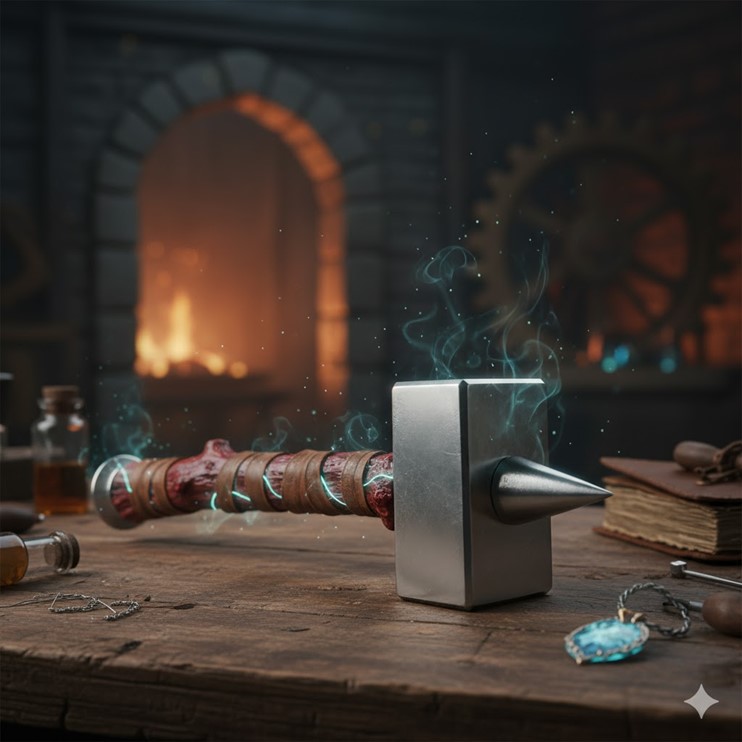
More a tool of creation than a weapon of war, this heavy hammer has nonetheless seen Caelia through dangerous situations. It has a short, dense handle of petrified coral wrapped in leather, providing a solid grip. The head is a solid block of polished steel, with one flat face for shaping metal and a pointed peen on the reverse for detailed etching and breaking away slag. The hammer is imbued with Caelia’s own resonant, magic-sensitive nature. Its magical property is simple: when used to strike inanimate, non-magical objects like a locked chest, a stone wall, or a barred door, the impact is exceptionally forceful, making it a superior tool for breaking through obstacles.
Lore
This shaping hammer is the first true tool Caelia was ever given, a gift from her mother, Matriarch Elara, upon the commencement of her formal apprenticeship. It is a traditional instrument of the Tideglass Artificer lineage; the head was forged in the great foundries of Iron-Tide City from steel prized for its purity, making it a perfect conduit for a crafter’s intent. The handle, however, is far more significant. It is a piece of petrified coral taken from the dismantled foundations of a Tidetower that stood centuries ago in Coralia Major. It is a tradition for a new apprentice to receive a tool with such a handle, reminding them that their own work is built upon the foundations laid by their ancestors.
Over her sixteen years of tutelage, Caelia used this hammer for countless hours, shaping bezels, setting crystals, and forging fittings. Through this constant use, the tool became deeply attuned to her unique magical resonance. It is no longer just a hammer; it is an extension of her own Wave-Sight and creative will. She discovered its destructive potential by accident during her pilgrimage to the Whispering Woods. Cornered in a cave by a territorial beast, she struck a rock wall in desperation and was shocked when the impact, amplified by her fear and the hammer’s resonance, shattered the stone and opened a path to escape. From that day on, she understood it was a tool for unmaking as well as making.
Item Values
- Tier One Stat Modifiers:
- Weapon Type: Simple Melee Weapon (Light Hammer)
- Damage: 1d6 Bludgeoning
- Properties: Light, Thrown (range 20/60)
- Skills Gained:
- Artisan’s Tools: When used for its intended purpose, this hammer grants the wielder proficiency with Smith’s Tools or Jeweler’s Tools.
- Passive Magical Effects:
- Resonant Impact: This is the hammer’s primary magical property. When striking an inanimate, non-magical object (such as a wall, door, or chest), the hammer’s impact ignores the object’s damage threshold and hardness.
- Structural Intuition: When the wielder gently taps a structure or object with the hammer, they gain an intuitive, extra-sensory understanding of its physical weak points, stress fractures, or hidden cavities.
- Creator’s Bond: The hammer is deeply attuned to its wielder. It cannot be unwillingly disarmed from the wielder’s grasp as long as they are conscious.
- Activatable Magical Effects:
- Shatter-Strike (3 times per day): Before making an attack roll against an inanimate object or a Construct, the wielder can declare a Shatter-Strike. If the attack hits, it automatically deals the maximum possible damage for the roll.
- Reshape (Once per Long Rest): The wielder can place the hammer’s flat face against a single, non-magical metal object no larger than one cubic foot. For one minute, the targeted metal becomes as soft and pliable as clay, allowing it to be reshaped by hand or with tools. After one minute, it instantly re-hardens in its new form.
- Specific Slot:
- Main Hand
- Tags:
- Light Hammer, Simple Weapon, Bludgeoning, Artisan’s Tool, Petrified Coral, Tier 1, Destruction, Utility, Attuned, Thrown, Wielder-Bonded, Apprentice’s Gift, Ancestral Handle, Iron-Tide Forged, Siege, Breaching Tool, Anti-Construct, Transmutation, Object Hardness Bypass, Dual-Purpose, Improvised Weapon, Personally Attuned
The Artificer’s Shaping Hammer 951 is unique because its primary magical property is tied to Caelia’s personal resonance, developed over years of use. This makes her specific hammer almost impossible to value on the open market. However, high-quality, non-magical masterwork hammers of the same design are foundational tools for certain guilds.
1. The Master Toolsmith in Iron-Tide City
- Type of Shop: This is the source for such a tool. A workshop in the industrial heart of Aegean, likely named something functional like “Iron-Grip Forgeworks.” The air is filled with the sound of hammering and the smell of the forge. This smith specializes in creating perfectly balanced, durable tools for other master artisans, not weapons for adventurers.
- How it is Bought/Sold: A craftsman like Caelia would purchase a new, non-magical masterwork shaping hammer here. The transaction is a professional courtesy between artisans. The buyer would inspect the hammer’s balance, the purity of the steel, and the quality of the finish. The discussion would be about the tool’s function and longevity.
- Cost: This is the baseline price for a non-magical, master-crafted tool of this type.
- Cost to Purchase (New Masterwork Hammer): Approximately 10 Platinum.
2. The Artificer’s Guild Quartermaster
- Type of Shop: The quartermaster’s office within a major guild hall, like that of the Tideglass Artificers in Tidehaven. This office supplies apprentices and journeymen with the standardized, high-quality tools required for their craft.
- How it is Bought/Sold: These tools are generally not for sale to the public. A guild member in good standing (like an apprentice starting their training) would acquire their first shaping hammer here. The transaction is less a purchase and more a formal provision, the cost of which might be deducted from future guild earnings. The item is guaranteed to meet the guild’s exacting standards.
- Cost: The price is guild-subsidized and reflects the cost of production.
- Cost for a Guild Artisan (New Masterwork Hammer): Approximately 8 Platinum.
3. The High-End Adventurer’s Outfitter
- Type of Shop: An outfitter like “The Sea-Serpent’s Scale” would typically not stock artisan’s tools. However, if Caelia were to sell her specific, personally attuned hammer, this is where she might go. The proprietor would recognize the quality but would appraise it as an oddity—a masterwork light hammer with a useful, if niche, magical property for breaking things.
- How it is Bought/Sold: The shopkeeper, an expert appraiser, would be intrigued. They would sense the magic but wouldn’t understand its connection to Caelia’s personal resonance. They would value its destructive power against objects and its quality as a makeshift weapon. The negotiation would be based on this limited, practical assessment.
- Cost: This is the price for Caelia’s unique, used, and personally attuned item.
- Value if Selling: A shopkeeper would offer around 15 Platinum. They might then try to sell it for 30 Platinum as a “Masterwork Breaching Hammer.”
4. The Pawnbroker in Port Aqua-Vel
- Type of Shop: A cluttered, dimly lit pawn shop in the rougher part of the port city. This is where an item is sold out of pure desperation. The pawnbroker is not an artisan or an adventurer; they are a merchant of last resorts.
- How it is Bought/Sold: This is a fast, grim transaction. The pawnbroker would heft the hammer, note the high-quality steel and the unusual coral handle, but would likely not sense its deeper properties. Their offer is based on what they think they can get for the raw materials or by selling it as a simple, heavy hammer to a dockworker or thug. The item’s history and true potential are completely lost.
- Cost: This is the lowest possible value, reflecting a desperate sale.
- Value if Selling: A pawnbroker would offer 3 to 5 Platinum, no more.
The Artificer’s Shaping Hammer 951 is not a duelist’s weapon; its role in combat is that of a specialized key designed to unlock or destroy the environment itself. Its use in offense and defense is about reshaping the battlefield by unmaking obstacles, cover, and even certain types of enemies.
Offensive Roleplay (The Unmaking Tool)
Offensively, the hammer is used to dismantle an opponent’s defenses, bypass their fortifications, and exploit the weaknesses of artificial creatures.
Breaching a Fortified Position
This is the hammer’s most direct offensive application. When faced with a barred door, a stone wall, or a locked gate, you don’t pick the lock; you obliterate it.
- Roleplay Example: The enemy has retreated behind a heavy, iron-banded oak door. You’d narrate your action: “I tell my allies to stand back. I square my stance, feel the hum of resonance build in the hammer, and declare a Shatter-Strike.” You’d then describe the impact: “The sound isn’t a simple smash, but a deafening, resonant CRACK. The oak splinters and the iron bands warp and snap under the amplified force, blowing the door inward off its hinges.”
Against Constructs
This is the hammer’s niche combat expertise. Against a living creature, it’s a clumsy bludgeon. Against a golem, it’s a tool of perfect deconstruction.
- Roleplay Example: Facing a stone guardian, you would describe your attack with an artisan’s confidence: “My hammer, which feels awkward against flesh, finds a perfect harmony against the stone creature. I’m not just striking it; I’m unmaking it. I use my Structural Intuition to find the stress fractures and aim a Shatter-Strike at a key joint in its knee, intending to cripple its leg.”
Disarming the Environment
Your offense isn’t limited to creatures. You can attack the enemy’s equipment. If archers are firing from a wooden parapet, you attack the support beams. If a cannon is aimed at your party, you attack its wheels.
- Roleplay Example: “Forget the crew on the siege engine! I’m targeting its axle. I swing my hammer, feeling the Resonant Impact ignore the hardness of the wood and iron. The axle splinters and cracks, and the entire war machine lurches sideways, its weapon now uselessly aimed at the sky.”
Defensive Roleplay (The Escape Artist’s Key)
Defensively, the hammer is used to create escape routes where none exist and to destroy enemy cover, thereby protecting your allies from protected threats.
Creating an Escape Route
This is the hammer’s ultimate defensive tool. When your party is cornered, you can change the layout of the map.
- Roleplay Example: Trapped in a dead-end chamber with enemies closing in, you would narrate your actions: “I run to the wall, tapping it with the hammer to find the thinnest point. ‘Here!’ I shout, ‘This part of the stonework is weaker.’ I then rear back and put all my force into a single, resonant blow, shattering the wall and creating a crawlspace for us to escape through.”
Destroying Enemy Cover
You can defend your allies by eliminating the enemy’s protection. An enemy archer firing from behind a stone pillar is a threat you can neutralize without ever targeting the archer directly.
- Roleplay Example: “The archer thinks he’s safe. I swing my hammer not at him, but at the pillar he’s hiding behind. The stone groans and fractures under the impact, and a huge section shears off, leaving the archer completely exposed to our attacks.”
The Reshape Ploy
The Reshape ability is a creative, defensive wild card. It can be used to jam mechanisms or alter metallic objects to protect your party.
- Roleplay Example: Your party is fleeing from a rolling boulder trap down a narrow hall, and the mechanism to stop it is a heavy iron lever that is rusted shut. You’d describe the scene: “I can’t move the lever, it’s frozen solid! I slam my hammer against it and activate its reshaping magic. The solid iron turns soft as wax for a moment, allowing me to bend the lever into the ‘off’ position just before the boulder reaches us.”
Perception of Activation:
When the Shatter-Strike ability of the Artificer’s Shaping Hammer 951 is activated, the perception is one of focused, resonant power culminating in a moment of explosive, unmaking force.
User’s Perspective
The activation begins the moment you decide to put your will into the blow. As you begin your swing, you feel a deep, resonant hum travel up the petrified coral handle into your arm, a familiar song of your own magic attuning to the tool. The hammer’s head, normally just a heavy block of steel, suddenly feels impossibly dense and focused, as if its entire weight has been concentrated into a single, perfect point.
Your extra-sensory perceptions flare. Through your Creator’s Bond, you feel your own magical energy surge into the hammer, which feels like a warm, pleasant flow. Your passive Structural Intuition sharpens into an active, aggressive sense; you don’t just see the target, you perceive its entire structural matrix in your mind’s eye—every crack, every stress point, every flaw—all at once. As the hammer connects, the physical sensation is a sharp, controlled kickback, and the sound is a deafening, explosive CRACK. For a split second, you get a clear mental image of the target’s structure being utterly and instantly pulverized from the inside out.
Observer’s Perspective
To an observer, the activation is a brief but dramatic display of power. As the wielder swings the hammer, its polished steel head begins to glow with a dull, coppery-bronze light. This light intensifies to a brilliant flare just a moment before impact.
The impact itself is disproportionately explosive. It doesn’t just break the target; it shatters it. A wooden door doesn’t splinter, it bursts into a cloud of fragments. A stone wall doesn’t crack, it explodes outward. The sound is a sharp, deafening BOOM that echoes like a thunderclap, far louder than a normal hammer strike. A visible shockwave, like a ripple in the air, expands from the point of impact, and the air smells of ozone and hot metal.
Positives
The primary positive is its role as the ultimate breaching tool. It provides a guaranteed, reliable way to obliterate non-magical obstacles, turning a locked iron door or a solid stone wall from a major impediment into a minor delay. Against Constructs, it is a potent equalizer, allowing even a non-warrior to become a significant threat by bypassing their natural defenses. The ability to guarantee maximum damage on a strike is a powerful tactical asset, ensuring a crucial barrier can be destroyed in a single, decisive action when time is of the essence.
Negatives
The activation is incredibly loud and unsubtle. It is impossible to use stealthily and will alert everyone in a large radius to your exact position and destructive capability. The sheer force of the blow, while magically controlled, is still physically jarring to the user, who would feel the shockwave in their arm and shoulder. The ability is also purely destructive; it cannot be used to delicately open a lock or disable a trap, only to annihilate it completely. Finally, its limited uses per day mean that each Shatter-Strike is a valuable resource that must be spent with foresight.
Smith’s Guild Standard: Resonant Shaping Hammer
This document details the standard process for the creation of a masterwork-quality shaping hammer. The resulting tool is perfectly balanced for fine metalwork and incorporates a resonant tempering process that makes it exceptionally effective for structural demolition.
Materials Needed
- One Ingot of Iron-Tide High-Purity Steel: The foundation of the hammer head, sourced from the industrial forges of Iron-Tide City.
- One Block of Seasoned Ironwood: A dense, resilient wood used for the handle, valued for its ability to absorb the shock of impact.
- One Square Foot of Cured Reef-Stalker Hide: To be used as a durable, non-slip grip wrap.
- One Pouch of Finely Powdered Lodestone: A key alchemical component for the resonant tempering process.
- Flask of High-Grade Machine Oil: For the final polishing and protection of the steel.
- Spool of Waxed Linen Thread: For securing the leather grip.
Tools Required
- High-Temperature Forge and Anvil: Standard equipment for a master blacksmith.
- Master Blacksmith’s Hammer and Tongs: The essential tools for shaping the hot metal.
- Set of Shaping Tools: Including a cross-peen hammer for the reverse face and various fullers and swages for precision shaping.
- Grinding Wheel and Polishing Stones: For finishing the hammer head after forging.
- Woodworking Tools: A set of saws, rasps, and carving knives for shaping the Ironwood handle.
- Quenching Trough: Filled with clean, cold water.
Skill Requirements
- Primary Skill: Master Blacksmithing (Toolsmithing). The crafter must be an expert in the forging and tempering of high-grade steel tools.
- Secondary Skill: Artisan Woodworking. Proficiency is required to shape and fit the dense Ironwood handle correctly.
- Required Knowledge: Metallurgy. A basic understanding of steel tempering and crystalline structures is necessary for the resonant quenching step.
Crafting Steps
- Forging the Head (Duration: 6 Hours): The ingot of Iron-Tide steel is heated in the forge to a bright yellow heat. Using the master hammer and anvil, the smith painstakingly draws out and shapes the steel into the rough form of the hammer head. The cross-peen hammer and other shaping tools are used to define the flat face and the pointed peen on the reverse.
- The Resonant Tempering (Duration: 1 Hour): This is the most critical phase. The finished head is reheated evenly to a precise cherry-red temperature. It is removed from the forge, and the powdered lodestone is quickly and evenly dusted over its entire surface. The lodestone will adhere to the hot metal. Immediately, the head is plunged into the quenching trough. The rapid cooling traps the resonant and magnetic properties of the lodestone within the steel’s newly formed crystalline structure. This process is what gives the hammer its unusual impact force against structures.
- Grinding and Polishing (Duration: 3 Hours): The cooled, hardened head is taken to the grinding wheel to remove any fire scale and refine its shape to its final, perfect dimensions. It is then polished with progressively finer stones and a coating of machine oil until both faces have a mirror-like finish.
- Handle Crafting and Assembly (Duration: 2 Hours): The Ironwood block is carved and sanded into a handle that is both ergonomic and perfectly fitted to the eye of the hammer head. The head is then securely set onto the handle. The Reef-Stalker hide is cut and tightly wrapped around the grip area, then stitched securely in place with the waxed linen thread to complete the tool.
Tale of Shaper’s Sorrow
It is told, from words that have been bent by the passing of many ages, that in the first days of the Artificer line, there was the Matriarch, Cyra, who was called the Shaper. Verily, her hands were blessed by the Great Tide-Mother, and she could coax the light of the sun and the heart of the wave into the solid form that is called Tidal Glass. She wrought things of great beauty, lenses that could see the far shore and windows that held the color of the dawn. And so she built the First Tidetower upon the coast, a thing of grace and light, but its foundations were of common stone.
Now, the spirit of the land, a stubborn and jealous thing, was not pleased. For it saw the beauty of the sea’s art standing upon its shore, and it grew angry. It shook its great shoulders, and the earth did tremble and crack. The First Tidetower, that jewel of the coast, was broken. Its stone foundations shattered, and it fell into the waiting arms of the sea, sinking beneath the waves until it was but a memory. And Cyra the Shaper beheld the ruin of her great work, and her heart was filled with a great sorrow. She thought, “Alas, my art is too fragile for this hard world. My glass is a beautiful dream, but the stone of the land is a waking and a brutal thing. I can make, but I cannot build a thing that will last.”
For a year and a day, she mourned. Then, one morning, she dove deep into the water, to the place where her broken tower lay sleeping. The sea was already making the ruin its own. Great fans of coral, colored like the sunset, had begun to grow over the fallen stones, making a new and wild beauty from the wreckage. As Cyra floated before the ruin, a piece of the coral that had grown through the very heart of the tower’s foundation stone broke away. It did not sink, but drifted into her waiting hands. It was hard as the stone it had consumed, yet it was light, and it hummed in her grasp with a deep and quiet song. It held the memory of the tower’s making and the patient strength of the sea.
Cyra returned to the surface, her sorrow now mixed with a new thought. She had a handle, a piece of her own failure now made strong by the sea. But she needed a head for this new tool, a thing that could speak to the stubborn stone of the land. She went to her forge and prayed to the Great Tide-Mother. “You have shown me the patience of the sea,” she prayed. “Now grant me a piece of the sky’s fire, a thing that can unmake as well as I can make.”
That very night, a star fell from the heavens, a burning tear of light that landed in the smoking hills near Iron-Tide. Cyra journeyed there and found it: a block of star-metal, heavy and dark and still warm, pulsing with a celestial fire. It was a thing of pure and focused might.
She took the star-metal and the coral handle back to her forge. She heated the metal not with common fire, but with the captured heat of her own fierce will. She hammered it into the shape of a tool, with one face as flat as a calm sea and a peen as sharp as a striking wave. When the head was forged, she joined it to the coral handle. And it was so, that the memory of the deep sea that dwelt in the coral flowed into the fire of the sky that slept in the metal. In that moment, the first Shaping Hammer was born.
Cyra took the hammer to the great cliffs by the sea, the very stone that had shaken down her tower. She struck the cliff face. The sound was not a clang of metal on rock. It was a single, pure note, a song that the stone understood. A great crack appeared, and the stone fell away, not shattered, but parted neatly, as if it had been asked to move and had agreed. Cyra smiled then, for she knew she now held a tool that could not only create beauty, but could shape the hard world to make a safe place for it.
The moral of the story is: To be a true creator, one must hold the power to unmake, and the greatest strength is often found by building upon the ruins of our own greatest failure.
Suggested conversions to other systems:
Call of Cthulhu (7th Edition)
The Hyperborean Resonant Mallet
This heavy, single-handed mallet is made of a polished, star-like metal with a handle of petrified, coral-like material that feels unnervingly organic. It was found in a pre-glacial ruin and is believed to be a tool, not a weapon. It emits a barely audible, high-frequency hum. Its purpose seems to be the controlled disassembly of solid matter.
- Weapon Stats: The mallet can be used as a Club, dealing 1d6 damage.
- Structural Destabilization: The mallet’s true purpose is to break things. It ignores the Armor Points and structural integrity of all non-magical, inanimate objects. A successful Mechanical Repair or Science (Physics) roll allows the user to strike an object to cause a specific, catastrophic structural failure (e.g., shattering a lock mechanism, breaking an axle, or cracking a stone lintel).
- Resonant Feedback: Each time the mallet is used to destroy an object, its user must make a POW x5 roll. On a failure, the resonant energy feeds back into the user’s nervous system, inflicting 1d3 physical damage and forcing a Sanity roll (0/1d2 SAN loss) as they are subjected to a nauseating, extrasensory perception of matter being torn apart at a molecular level.
Blades in the Dark
The Whisper-Steel Demolition Hammer
A heavy, beautifully balanced hammer forged in a now-lost foundry, with a head of polished whisper-steel and a grip of petrified sea-oak. It was designed for “aggressive engineering” and sabotage. When you hold it, you can feel a deep, resonant hum, a vibration that seems to seek out the weaknesses in the things around you.
Special Item: Heavy, Tool, Occult Load: 2
- Functions: As a specialized tool of unmaking, the hammer grants these abilities:
- It is a fine tool for demolition. When you Wreck an object or structure with it, you get +1d to your roll.
- Structural Intuition: When you Survey a structure, you can use the hammer to listen to its “song.” You get improved Effect as you can easily identify its weakest points.
- Shatter-Strike: Once per score, you can overcharge the hammer’s resonance. You can destroy one mundane obstacle—a locked iron door, a section of brick wall, a steam-engine’s piston—instantly and almost silently. The resonant backlash is jarring; take 1 Stress.
Dungeons & Dragons (5th Edition)
The Shatter-Strike Hammer
Weapon (light hammer), uncommon (requires attunement)
This smith’s hammer has a head of polished steel and a handle of petrified coral. It feels unusually heavy for its size and hums with a palpable, resonant energy.
- You have a +1 bonus to attack and damage rolls made with this magic weapon.
- Resonant Impact: This weapon deals double damage to objects and structures.
- Shatter-Strike: The hammer has 3 charges. When you hit a creature that is a Construct with an attack using this hammer, you can expend 1 charge to make the attack a Shatter-Strike. If you do, the attack deals an extra 2d6 force damage. The hammer regains all expended charges daily at dawn.
- Reshape Metal (1/Day): You can use an action to touch the hammer to a non-magical object made of ferrous metal (like iron or steel) that is no larger than 5 feet in any dimension. For 1 minute, the object becomes pliable and soft as clay. The object re-hardens in its new form after 1 minute.
Knave (2nd Edition)
The Breaker’s Hammer
A heavy, polished steel hammer with a dense, coral-like handle. It hums with a low, resonant energy and feels eager to strike.
- Slots: 1
- Qualities: Bludgeoning, Thrown
- Damage: d6
- Abilities:
- It ignores the armor of non-magical objects (doors, walls, chests), allowing it to damage them as if they were unarmored.
- It deals double damage to any creature made of non-living material (golems, statues, skeletons, etc.).
- Once per day, you can touch the hammer to a metal object to make it as soft as clay for one minute.
Fate Core
Hammer of the Unmaking Song
In Fate, this hammer is a significant tool that reflects a core aspect of your character’s identity. It is best represented by an Aspect and several Stunts.
Aspect: Carries the Tool of Unmaking
- This is a central truth about your character. You can invoke this Aspect for a +2 bonus or a re-roll on any roll where the hammer’s incredible destructive force against inanimate objects is a deciding factor. This applies to breaking down a door, shattering a statue, or disabling a mechanism. The GM can compel this Aspect to introduce complications; for example, your reputation for destruction might precede you, or you might accidentally break something valuable and fragile.
Stunts:
- Resonant Impact: Because my hammer sings the song that unknots stone, I get a +2 to Forcefully Overcome obstacles when I am trying to destroy an inanimate object or barrier.
- Shatter-Strike: When fighting a Construct or other creature made of non-living material, I can spend a Fate point to add the Aspect Shattered and Unmade with one free invocation to that opponent after a successful Fight attack.
- Reshape the World: Once per session, I can use my hammer to soften a piece of metal, no larger than a shield. I can automatically Create an Advantage representing the metal’s new, useful shape (like a Makeshift Key or Bent Grate) with two free invocations.
Numenera & Cypher System
The Molecular Destabilizer
This heavy, single-handed hammer is a relic of a prior world. The head is a solid block of polished steel, and the handle is a strange, coral-like substance that absorbs vibrations. When swung with intent against an object, it emits a low hum and a visible distortion in the air, causing molecular bonds in the target to temporarily break down.
Level: 1d6+2 Form: A heavy, single-handed hammer. Effect: This artifact is designed for demolition and reshaping materials.
- Passive: The hammer functions as a medium weapon that deals 4 points of damage.
- Passive: The hammer ignores 4 points of Armor from any non-living, non-magical object it strikes.
- Active: Shatter-Strike. An action to strike an object or construct. The attack is eased, and on a success, it deals an additional 6 points of damage.
- Active: Reshape Metal. An action to touch a metal object up to the size of the user. For one minute, the object’s molecular bonds are loosened, making it as pliable as clay. Depletion: 1 in 1d20 (Check only when Reshape Metal is used).
Pathfinder (2nd Edition)
HAMMER OF RESONANT UNMAKING – ITEM 3
UNCOMMON, MAGICAL, EVOCATION Price 60 gp Usage held in one hand; Bulk 1
This +1 light hammer has a head of polished steel and a handle of petrified coral. It feels unusually heavy and hums with a low, resonant energy.
- This weapon deals an additional 1d6 force damage to inanimate objects and constructs. When you damage an object, you ignore its Hardness.
Activate (manipulate) Frequency once per day; Effect You touch a single, non-magical metal object of 1 Bulk or less. For 1 minute, the object becomes pliable and can be bent or reshaped with a successful DC 18 Crafting check. After 1 minute, the object re-hardens in its new form.
Savage Worlds (Adventure Edition)
The Artificer’s Breaching Hammer
A masterwork shaping hammer that is surprisingly destructive. It is perfectly balanced as both a tool and a weapon.
- Damage: Str+d6
- Weight: 4
- Min. Str: d6
- Notes: Magical
- Special Rules:
- Wrecker: The hammer provides a +2 bonus to Damage rolls against inanimate objects (structures, doors, etc.). Against Hardness, the hammer’s damage is considered a Heavy Weapon.
- Construct’s Bane: The hammer deals +4 damage when striking any creature with the Construct ability.
- Reshape: Once per day, the wielder can touch the hammer to a metal object and cast the shape change power on it, affecting only metal and allowing it to be reshaped. This is an Innate Ability and requires no Power Points.
Shadowrun (Sixth World)
Ares ‘Breacher’ Resonant Maul
This tool is a piece of military-grade engineering hardware sold under the Ares Macrotechnology brand. It’s a heavy, durasteel hammer with a powered resonant head designed for demolitions and forcible entry. The “coral” handle is a high-grip, shock-absorbing polymer. It’s a favorite of combat engineers and door-kickers.
- Type: Melee Weapon (Club)
- Accuracy: 5
- Damage: (STR + 3)P
- AP: -1
- Availability: 12R
- Cost: 9,000 Nuyen
- Effects:
- Resonant Impact: The hammer’s primary function. When attacking an inanimate object (a door, wall, vehicle, etc.), the hammer’s damage is considered to have an AP of -8.
- Anti-Drone: The resonant frequencies are particularly effective against drone chassis. The hammer gains a +2 dice pool bonus when attacking Drones or other Constructs.
- Metal Fatigue: Once per day, the user can press the powered head against a non-magical metal object for one minute. The object becomes brittle and easily breakable (halving its Structure rating) until repaired.
Starfinder
The Destabilizer Maul
This powered melee weapon features a heavy, polished steel head and a handle of hardened, coral-like polymer. The head contains a micro-fusion core and a sonic generator that creates a high-frequency resonance field on impact, destabilizing the structure of objects and constructs.
DESTABILIZER MAUL, HYBRID – LEVEL 3 CATEGORY Advanced Melee Weapon; PRICE 1,350 credits DAMAGE 1d8 B; CRITICAL — BULK 1; SPECIAL Powered (capacity 20, usage 2), unwieldy DESCRIPTION This +1 light hammer is a tool for demolition.
- Demolition: The hammer deals double damage to objects and structures. Against an object with Hardness, this extra damage is not reduced.
- Construct’s Bane: The sonic field is particularly effective against artificial creatures. The hammer has a +2 circumstance bonus to damage rolls against creatures with the construct subtype.
- Reshape (1/day): As a full action, you can press the hammer against a single non-magical metal object and expend 4 charges. For 1 minute, the object becomes pliable and can be bent or reshaped as if it were soft clay.
Traveller (Mongoose 2nd Edition)
Ancient Molecular Destabilizer
This device appears to be a heavy, well-made hammer or mallet, crafted from a single, seamless piece of an unknown black alloy. It is an artifact of the Ancients, a high-powered demolition tool that functions by emitting a localized field that disrupts molecular bonds.
- Tech Level: 16 (Ancient)
- Damage: 2d6+2
- Weight: 3 kg
- Cost: Artifact (18+ MCr if a buyer could be found)
- Traits:
- Matter Disruption Field: The hammer’s primary function. When striking any inanimate, non-Ancient object, its damage ignores all Armour and Structure points, effectively destroying a small section of the target with each hit. A single, successful hit can destroy any lock, hinge, or similar mechanism.
- Limited Power: The device has a finite, internal power source. It has enough energy for approximately 100 uses of its disruption field before it becomes inert. It cannot be recharged with Imperial technology.
Warhammer Fantasy Roleplay (4th Edition)
Dwarf-forged Quarry Hammer
A masterwork smith’s hammer from a Dwarf hold, with a perfectly balanced head of polished steel and a handle of petrified, runically-treated oak. It bears a single, potent Master Rune of Breaking.
- Type: One-handed Weapon (Hammer)
- Damage: STR+4
- Qualities: Defensive, Durable, Master Rune of Breaking
- Weight: 1
- Special Rules:
- Master Rune of Breaking: This ancient and powerful rune was forged with a singular purpose. When used to attack an inanimate object (a door, chest, wall, statue, etc.), the hammer ignores all Armour Points and deals a Critical Hit on any successful Test. The resulting Critical damage is automatically the maximum possible result.
- Construct’s Bane: The rune’s power is anathema to false life. When used to attack a creature with the Construct Trait, all successful hits are considered to have the Impact Quality.
- A Tool, Not a Weapon: The rune was not intended for use against flesh and blood. When used to attack a living creature (i.e., any creature without the Construct or Undead Trait), the hammer feels clumsy and unbalanced, losing its Defensive quality for that attack.
Comments
One response to “Artificers Shaping Hammer 951”
[…] 2. Artificer’s Shaping Hammer 951 […]