
From: Lineage 13 of the Veridian
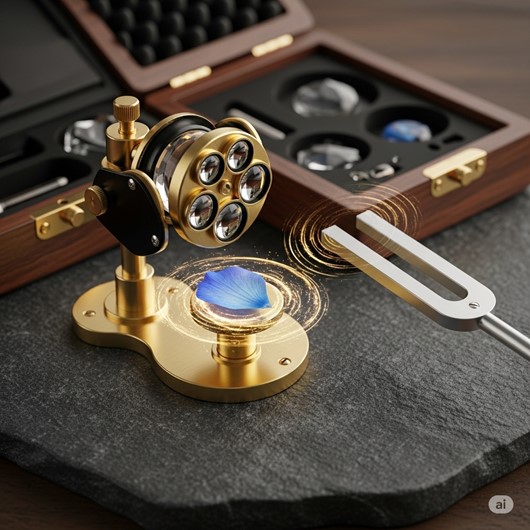
This is not a single tool, but a compact, multi-part analysis kit housed within a polished ironwood case no larger than a thick book. When unfolded, it reveals a small, articulated brass stand. Several attachments can be fitted to it:
- The Crystal Loupe: A series of rotating, high-magnification lenses that allow for the minute examination of plant matter, mineral purity, or the contents of a liquid.
- The Resonance Fork: A small, silver-tuned fork. When struck and touched to a substance, it hums at a specific frequency. Liatris can interpret this hum to identify latent magical energies, unstable alchemical bonds, or the tell-tale resonance of a poison.
Expounded Lore
This compact analysis kit is a masterwork of alchemical engineering, created by the legendary Veridian polymath Caelus the Perceptive. Caelus believed that all things—life, magic, poison, purity—were merely different frequencies in the great “Song of Saṃsāra,” and he dedicated his life to creating instruments that could perceive this unseen music. The Field Lens was his finest creation.
The “61” in its name refers to the 61 fundamental resonances—from the life-note of common moss to the death-screech of Black Lotus venom—that the kit’s primary tool, the Resonance Fork, is perfectly calibrated to detect. The polished ironwood case is not merely protective; it is insulated with a thin layer of rendered dream-spider silk to prevent outside vibrations from interfering with the delicate instruments within. The entire kit is a portable laboratory designed to allow a skilled user to read the world’s hidden grammar.
The components are each masterpieces in their own right:
- The Crystal Loupe: The lenses are not glass, but paper-thin, flawless slices of crystal from a geode that formed under immense magical pressure at the heart of a ley-line nexus. This unique origin allows them to magnify not only physical details but also the faint, structural patterns of magical auras.
- The Resonance Fork: Forged from silver mined from a meteor, this fork was “tuned” over a decade. Caelus would heat it in the heart of a volcano and cool it in the waters of a silent, subterranean spring, striking it and listening to its “note” until its own resonance was perfectly, utterly neutral. This allows it to vibrate in perfect sympathy with whatever it touches, accurately reflecting its target’s essential frequency without adding its own “sound.”
Item Values
- Tier 1 Stats: +1 Intelligence
- Skills Gained: Proficiency with Alchemist’s Supplies and the Poisoner’s Kit.
- Passive Magics:
- Detailed Analysis: When using this kit to examine an object or substance, you have Advantage on any Intelligence (Investigation) check made to determine its properties, origin, or function.
- Aural Sensitivity: The Resonance Fork hums softly, audible only to you, when you are within 10 feet of an active magical illusion or a source of psionic energy.
- Flawless Inspection: You can automatically determine if a potion, poison, or other alchemical substance is pure or has been diluted or contaminated, simply by observing a sample through the Crystal Loupe.
- Activatable Magics:
- Identify Substance (3/Day): As an action, you can use the kit’s various tools on a small sample of a substance. You learn all of its non-magical alchemical properties, its potential uses, and any toxic effects. This does not consume the sample.
- Reveal Magical Nature (1/Day): By spending 10 minutes setting up the kit and carefully analyzing a magical item, you can learn its properties and how to use them, as if you had cast the Identify spell.
- Trace Origin (1/Short Rest): By spending 1 minute examining a mundane crafted object (like a weapon, piece of armor, or clothing), you can analyze its material composition and craftsmanship. You learn one key detail about its origin, such as the specific region it was crafted in (e.g., “the steel is from the Dragon’s Tooth mines”) or the general type of creature it was made from (e.g., “this leather is from a large, winged, reptilian beast”).
- Specific Slot: This is an apparatus that takes up 1 inventory slot. Using its Activatable Magics requires it to be unfolded and set up on a stable surface.
- Tags: Tool Kit, Alchemical, Investigation, Divination, Utility, Masterwork, Artisan-Gear, Focus, Diagnostic, Analytical, Psionic, Sensory, Apparatus, Veridian, Detection, Scholarly
The Alchemical Field Lens 61 is an item of almost unparalleled utility, but only to a select few. It is not a weapon or a suit of armor, and its value is invisible to the ignorant. To a master alchemist, royal inquisitor, or archmage, however, it is a priceless key to understanding the hidden nature of the world. Its sale is a transaction of knowledge, whether for gold, secrets, or other artifacts.
1. The Scholarly Auction or Lyceum
- Type of Shop: This is a highly legitimate and prestigious venue, such as a university’s annual acquisitions auction or the private gallery of an arcane lyceum. This is where institutions of learning sell rare artifacts—often recovered from sponsored expeditions or donated by the estates of powerful wizards—to fund their continued research.
- How It Is Bought & Sold: The Field Lens would be the centerpiece of an auction focused on scientific and arcane instruments. Its history and functions would be meticulously researched and detailed in a catalog by the institution’s own sages. The bidding floor would be filled with representatives from mages’ guilds, alchemist’s leagues, royal investigators, and powerful individual collectors. The sale would be a formal, public (to the right people), and highly competitive event.
- Cost: The price would be exceptionally high, driven by a room full of experts who all understand exactly how powerful and unique the item is.
- Price: An expected final bid of 12,000 – 18,000 Gold Sovereigns. As part of the sale, the institution might also stipulate a clause granting their own researchers access to the device once per year for a collaborative project.
2. The Spymaster’s Information Broker
- Type of Shop: This is not a shop at all, but a clandestine meeting with an individual who trades in secrets and the tools used to acquire them. Known only by a title like “The Curator,” this broker values actionable intelligence far more than gold. Their “office” could be a private room in a library or a moving carriage, always discreet and secure.
- How It Is Bought & Sold: The Curator would have acquired the Field Lens through their network and would recognize its immense value for counter-espionage, poison detection, and magical analysis. They would not offer it for sale openly. Instead, they would let it be known to their exclusive clientele that a unique “analytical asset” is available for acquisition. The transaction is a trade, pure and simple.
- Cost: No amount of gold would be accepted. The Curator demands a secret of equal or greater value.
- Price: Examples of a valid trade would include: irrefutable proof of a high-ranking noble’s treason, the complete command structure and safe house locations of a rival spy network, or the true identity of an anonymous assassin who has been plaguing the city. The buyer must give up a world-changing secret to acquire a tool that can uncover them.
3. The Tinker’s Bazaar
- Type of Shop: A sprawling, chaotic marketplace filled with scavengers, mad inventors, and sellers of strange and often unidentifiable junk. This is the last place one would expect to find a masterwork artifact, which is precisely why it might be there.
- How It Is Bought & Sold: The seller is likely a down-on-their-luck prospector who found the kit in a ruin. They have no idea what it truly is. They see a beautiful, complex box of brass and glass lenses. They might advertise it as a “Gnomish Microscope” or a “Celestial Navigation Device.” It would be sitting on a dusty blanket next to a broken clockwork bird and a set of self-peeling potatoes. For a truly knowledgeable character, this is the find of a lifetime.
- Cost: The price is based on the seller’s complete ignorance of the item’s magical and alchemical functions. They are selling a beautiful, intricate “curio.”
- Price: The seller might hopefully ask for 2,000 Gold Sovereigns, thinking they’re being incredibly bold for a pretty box. A skilled haggler who doesn’t reveal their knowledge of the item’s true worth could likely talk them down to as little as 1,200 GS.
The Alchemical Field Lens 61 is an instrument of pure information. It has no direct combat function; it cannot block a blow or fire a projectile. Its use in “offense” and “defense” is entirely about preparation, analysis, and turning knowledge into a decisive tactical advantage.
1. In a Crime Scene or Intrigue-Filled Court
This environment is the Field Lens’s natural home, where minute details can unravel entire conspiracies.
Roleplaying Defense:
- Detecting a Poisonous Plot: You are at a grand feast. Before the king drinks from his goblet, you are asked to discreetly check it for poison.
- Roleplay: “I would never make a scene. I ask for a moment to ‘bless the vintage.’ I will set up my Field Lens nearby, appearing like a strange, scholarly wine enthusiast. I’ll take a single drop from the king’s goblet with a glass rod. Placing it on the purity slide, I’ll use the Crystal Loupe. ‘As I suspected,’ I’d whisper to the Royal Guard captain, ‘the wine itself is pure, but see this second, heavier liquid that has separated? A clear sign of contamination.’ A quick check with the Resonance Fork confirms it. ‘It hums with the frequency of Kings-Bane. The wine is poisoned. Swap the goblets, and watch to see who looks surprised when the king remains healthy.’”
- Identifying a Forgery: A peace treaty is presented to your party, but you suspect a trap.
- Roleplay: “Let me examine the document before we sign. It may look perfect, but the truth is in the details.’ I set up the Lens and use Trace Origin on the parchment and ink. After a minute, I would look up. ‘The parchment is from the Western Scribes’ Guild, as expected. But the ink… the Loupe shows its composition includes iron filings from the Northern mountains. This is military-grade ink, not diplomatic ink. And the Resonance Fork hums faintly; it contains a magical agent, likely to compel anyone who signs it. This treaty is a trap.’”
Roleplaying Offense:
- Tracking a Culprit: A poisoned dagger was left at a crime scene. You need to know where it came from to find the killer.
- Roleplay: “The dagger itself is mundane, but its history is not. I’ll spend a minute using Trace Origin. I analyze the specific way the leather of the hilt was cured. ‘This isn’t local work,’ I’d announce. ‘The tannins used in this leather are from the bitter-oak tree, which only grows in the Shadowfen Marsh—the same marsh the Assassin’s Guild uses as a training ground. This wasn’t a random murder. This was a professional hit.’”
- Discovering a Blackmailable Secret: You’ve acquired a noble’s “healing potion.” You suspect it’s something more illicit.
- Roleplay: “Lord Valerius seems a bit too energetic for a man his age. Let’s see what’s in his ‘tonic.’ I’ll use Identify Substance. I place a drop on the slide. The Loupe shows its base components, but the Resonance Fork is what tells the tale. It’s vibrating with a frequency I recognize… it’s a diluted, highly addictive stimulant, not a healing potion. We now have leverage. Lord Valerius’s secret addiction is a weapon we can use.”
2. In a Dungeon or Ancient Ruin
In an environment of unknown magic and strange materials, the Field Lens is an indispensable tool for survival and exploitation.
Roleplaying Defense:
- Identifying a Cursed Item: The party finds a beautiful golden crown on a pedestal.
- Roleplay: “Hold on. Let’s not be hasty. Give me ten minutes.’ I set up the Field Lens at a safe distance and use Reveal Magical Nature. The Resonance Fork begins to hum violently. ‘This is no simple treasure,’ I’ll warn the party. ‘The aura is thick with Necromantic magic. The Loupe reveals microscopic runes etched along the inside of the band. It’s a cursed item. Whoever wears it will be possessed by the spirit of the tomb’s original owner. Leave it be.’”
- Navigating a Hazardous Area: The air in a chamber shimmers, and the party is hesitant to enter.
- Roleplay: “I need a sample of the air itself. I’ll unstopper a vial and wave it through the shimmering space, then seal it. Back here, I’ll analyze the contents. Using Identify Substance, I can determine its nature. ‘It’s not a magical illusion,’ I’d report. ‘It’s a high concentration of spores from a rare, subterranean fungus. They aren’t poisonous, but they are powerful, fast-acting hallucinogens. We’ll need to hold our breath or risk battling our own nightmares.’”
Roleplaying Offense:
- Exploiting a Monster’s Weakness: The party is fighting a creature made of living crystal that is resistant to their weapons.
- Roleplay: “I need a piece of it! Fighter, try to chip off a shard!’ Once I have a sample, I’ll analyze it with the Field Lens. The Resonance Fork will be key. ‘The fork is vibrating at an incredibly high, pure frequency! Its crystalline structure is held together by sonic resonance. It’s like a giant tuning fork! Don’t use swords! Use sound! Yell, scream, cast a shatter spell! We can break it apart with the right frequency!’”
- Solving an Environmental Puzzle: A giant, magical door is sealed tight. There is a small bowl in front of it filled with a strange dust.
- Roleplay: “This isn’t a lock; it’s a recipe. I’ll use Identify Substance on the dust in the bowl. ‘It’s powdered silver and saltpeter, but it’s missing a binder.’ I’ll then use Trace Origin on the door itself. ‘The magical energy in the door… it resonates with the life-note of a specific type of giant slug that lives in these caverns.’ The answer is clear. ‘We need to find one of those slugs. Its slime must be the alchemical binder for the dust. Mix it together, and it will create a paste that dissolves the lock.’”
3. In an Enemy’s Lair or Before a Battle
In a tactical situation, the Field Lens provides the intelligence needed to form a perfect plan of attack.
Roleplaying Defense:
- Detecting Magical Traps: You are scouting an enemy fortress before your party’s assault.
- Roleplay: “I’ll move through the main hall, disguised as a servant. I don’t need to cast any overt spells. The Resonance Fork in its case on my belt will do the work. It will hum softly every time I pass a magical ward. I’ll take a mental note of each location—the glyph on the floor, the sigil over the doorway, the enchanted crossbow turret. When I return, I can provide my allies with a complete map of their magical defenses before we even begin the fight.”
Roleplaying Offense:
- Identifying the Perfect Poison: You have captured an enemy captain and want to use a poison against their leader, but you know their leader is a different species (e.g., an Orc or a Hobgoblin).
- Roleplay: “Before we plan the assassination, I need to be sure the poison will work. I’ll take a single drop of the captain’s blood and analyze it with the Field Lens. I’m checking his biology, his immunities. ‘Just as I thought,’ I’d say. ‘His species has a natural resistance to nightshade-based toxins. Our current poison would have failed. However, the Loupe shows a weakness in their liver to iron-based compounds. We need to formulate a new poison using rust-salts. It will be far more effective.’”
Perception of Activation:
User’s Perspective (The User)
By the Five Senses
- Sight: Looking through the Crystal Loupe, your peripheral vision fades to black. The sample under the lens is magnified with impossible clarity, revealing not just its physical structure but also a faint, superimposed layer of its energetic “true form.” A steady, golden light from the vibrating Resonance Fork illuminates the sample, making its aura visible to you.
- Hearing: This is the dominant sense, but it is entirely internal. The Resonance Fork produces a complex chord of sound directly inside your mind. A pure substance is a clean, single note. A poison is a sharp, dissonant chord that feels like grinding glass. A magical item is a shifting, intricate melody. You are not just hearing noise; you are listening to the “song” of the object’s existence.
- Touch: The polished ironwood of the kit feels cool and steady beneath your hands, a grounding sensation. The vibrating fork, if touched, thrums with a powerful but controlled energy that resonates deep in the bones of your arm.
- Smell: You perceive phantom scents directly related to the subject of your analysis. A flower may produce a fleeting scent of its bloom in your sinuses; a sample of dried blood might release the coppery tang of a fresh wound.
- Taste: A faint, sharp taste of ozone and metal on the tongue, a common side effect of intense magical or psionic concentration.
By Extra-Sensory Perception
- Intellectual/Psionic: This is the core of the activation. You are not simply observing; you are experiencing a direct, unfiltered flow of pure data. The “song” from the fork translates into concepts in your mind—alkaline, unstable bond, necrotic residue, origin: volcanic rock. It’s like a book’s entire contents being understood by hearing a single, complex chord.
- Aural (Magical): Through the loupe, you see the aura of the object under analysis with perfect clarity—its color, its density, its flaws, and the way it flows or stagnates. You can literally see if a potion’s magical energies are “cloudy” or “pure.”
Positives
- You gain an incredible feeling of insight and certainty, able to solve complex puzzles by directly perceiving their fundamental components.
- It allows you to make deductions and gain knowledge with a speed and accuracy that is impossible through normal means.
- The process grants immense intellectual confidence and a sense of mastery over the unseen world.
Negatives
- The process is mentally exhausting. Analyzing a complex or powerfully magical item can leave you with a severe headache and mental fatigue.
- You become completely absorbed in the analysis, making you utterly oblivious to your physical surroundings and extremely vulnerable to ambush.
- Analyzing a truly evil or chaotic object can be psychically harmful; its “song” can be a psychic scream that is painful to perceive.
Observer’s Perspective
By the Five Senses
- Sight: An observer sees the user hunched over the intricate brass and wood kit in a state of intense concentration. A small, silver tuning fork on the device vibrates so quickly it appears as a silver blur, emitting a soft, golden light onto a sample. Depending on the sample, a faint, multi-colored aura might become visible around it where the golden light touches it.
- Hearing: A continuous, pure, and high-pitched musical note emanates from the vibrating Resonance Fork. The note is unnervingly clean and may shift in pitch or develop strange harmonies as the analysis proceeds.
- Touch: None, though if one were to touch the workbench the kit is on, they might feel a faint, high-frequency vibration.
- Smell: A faint scent of ozone, like the air after a lightning strike, may be noticeable in the immediate vicinity of the kit.
- Taste: None.
By Extra-Sensory Perception
- Magical/Aural: A person with magical sight would see a complex interplay of energies. A faint tendril of light connects the user’s forehead to the device, representing their focus. The fork generates a “sonar” of diagnostic energy (the golden light), which washes over the sample. The sample then “replies” with its own aura, which the user observes through the loupe. It looks like a controlled, magical conversation.
- Intuitive/Subconscious: An observer gets a powerful sense of scholarly intensity and focus. The atmosphere around the user becomes still and charged, discouraging interruption. It feels less like dangerous magic and more like witnessing a master artisan or grandmaster chess player at a critical moment of their work.
Positives
- The process is non-threatening and clearly analytical, which is unlikely to cause panic in onlookers.
- For an ally, it is a clear and reassuring sign that critical information is being gathered by an expert.
Negatives
- The process takes time and renders the user completely stationary and defenseless, creating a major tactical liability in a hostile environment.
- The continuous, unusual humming sound and glowing lights could easily attract unwanted attention from patrols or wandering creatures.
- An intelligent magical foe might recognize the diagnostic energy and realize their nature or weaknesses are being analyzed, prompting them to attack immediately.
Artisan’s Schematic: The Resonance Analysis Kit
Materials Needed
- Casing and Frame: One flawless, aged block of Ironwood and three ingots of purified, lead-free Brass.
- Optical Component: A single, large, optically-perfect Scrying Crystal, at least the size of a human fist. (This will be sliced to create the lenses for the Crystal Loupe.)
- Resonance Component: One ingot of Meteoric Silver. (Note: This silver, having never touched the world’s core, has a unique celestial resonance. It must be forged without ever making contact with common iron, which would deaden its properties.)
- Analytical Reagents: Four magically-sealed vials, each containing a distilled, pure essence of one of the four cardinal elements (Gale-force Wind, Undisturbed Earth, Primal Flame, and Purified Seawater).
- Internal Fittings: A spool of fine silver wire and a small amount of quicksilver for creating conductive contacts.
Tools Required
- A Masterwork Jeweler’s Kit: Specifically, a diamond-edged cutting wheel is needed for the precise, dangerous work of slicing the scrying crystal.
- A Non-Ferrous Forge: A specialized forge with a stone hearth and bronze or stone tools. Required for forging the meteoric silver without contaminating its resonance.
- An Alchemical Distillation Apparatus: A full glass alembic, retort, and condenser setup is necessary to distill the raw elemental samples into their pure essences.
- Fine Mechanical Engraving and Assembly Tools: For crafting the intricate, articulated brass stand and the folding mechanisms of the ironwood case.
Skill Requirements
- Mastery in Jewelcrafting or Lapidary: The process of slicing a scrying crystal into a series of perfectly matched, flawless lenses is exceptionally difficult. A single miscalculation or unsteady hand will shatter the entire crystal.
- Mastery in Blacksmithing (Precious Metals): To forge the meteoric silver into a tuning fork and, most critically, to tune it. This requires an almost supernatural sense of hearing and precision, as micrograms of material are filed away to achieve a perfect, neutral tone.
- Expertise in Alchemy: To successfully distill raw elemental samples into their pure, stable essences without losing their potency.
- Expertise in Engineering (Fine Mechanics): To construct the folding case and articulated stand, where all parts must fit together with zero tolerance for error.
Crafting Steps
- Distillation of the Essences: This is a prerequisite stage. You must first acquire raw, powerful samples of the four elements and distill them into their pure forms using the alchemical apparatus. For example, capturing the wind from a mountaintop tornado or the flame from a magma vent. Each distillation is a complex alchemical challenge. The four sealed vials of pure essence are required before the main construction can begin.
- Forging the Resonance Fork: Using the non-ferrous forge, the meteoric silver is heated and carefully hammered into the shape of a precise tuning fork. This is followed by the most difficult part: the tuning. You must repeatedly strike the fork, listen to its resonant frequency, and use a specialized file to remove infinitesimal amounts of material. The goal is to achieve a tone of perfect, absolute neutrality—the “sound of pure potential,” which will serve as the baseline for all future analysis.
- Slicing the Lenses: This step requires absolute precision. The scrying crystal must be carefully mounted and then sliced into a series of thin, perfectly ground lenses using the diamond-edged tools. Each lens must be cut to a different, specific focal length. If any lens cracks or shows an imperfection, it is useless.
- Constructing the Case and Stand: This is the mechanical engineering phase. The ironwood block is hollowed out and carved into the shape of the protective, folding case. The brass ingots are milled and assembled into the articulated stand and fittings, ensuring every joint moves smoothly and locks into place with perfect rigidity.
- Final Assembly and Calibration: The lenses are carefully mounted into their rotating brass housing. The Resonance Fork is seated in its secure holder. The four vials of elemental essence are placed into their designated racks within the case. The final step is calibration. You must use the completed kit to analyze each of the four elemental essences you created. By adjusting microscopic screws on the loupe and fork, you must tune the device until the reading for each essence is a perfect, distinct, and pure baseline. This aligns the kit with the fundamental building blocks of the world, making it ready for use.
Listener and Song of Lies
Hear the telling of the Age of Doubt, when the world grew a sickness in its eyes. A thing called the Liar’s Fog came upon the lands. It was a strange plague. What was true looked false, and what was false looked true. A man would look upon his wife and see a stranger with a knife in her hand. A woman would offer a cup of pure water, and her friend would see a cup of poison and strike her down. A bridge would be strong, but men would see it as broken and would not cross. A bridge would be rotten, but men would see it as new stone and fall to their doom. The world was a bad dream, and no one could wake up. And the people were afraid.
The source of this was a spirit, a great and formless trickster called the Weaver of Mists. It ate fear and drank confusion, and as the world grew more doubtful, the Weaver grew fat and strong.
But there was a man of the Verdant People named Caelus, who was called the Perceptive One. He was a great listener. He did not listen to words, but to the nature of things. A great question he had in his heart: what is the world’s true shape, beneath the shape we see with our eye-orbs? He knew the Liar’s Fog was not changing the world. It was only changing the seeing of it. He said, “The world has a true song that it sings. The Liar’s Fog is a second, bad song played over it, to make men deaf to the truth. I must make an ear to hear only the first song.”
And so Caelus began his great work. A great knowing he wanted, a tool to read the world’s Unseen Grammar.
First, he needed a way to see truly. He journeyed to the Crystal Caves, where echoes cannot tell a lie but must repeat a sound with perfect truth. From a great geode in the heart of that cave, he took a flawless crystal and, with much labor, sliced it into perfect, clear lenses.
Second, he needed a way to hear the song of a thing. He took a stone that had fallen from the night sky, a piece of a star. He built a special forge, one that used no common iron, and from the star-stone he forged a single, silver tuning fork. The sky tells no lies, and so the fork, born of the sky, would have a pure voice.
Then he had to teach his new tool the True Notes. For many years he was a wanderer. He went to the First Mountain and held his fork to its oldest flame to learn the Song of Fire. He went to the deepest ocean trench to learn the Song of Water. He captured the great wind of the highest peak to learn the Song of Air. He listened to the sixty-one True Notes that made up the world, from the low hum of granite to the high vibration of a living leaf, and he calibrated his lenses and his fork to know each one. And his work was done.
He returned to his home, but the Liar’s Fog was thick there. His own people saw him and cried out, for to their eyes, he looked like a monster of twigs and shadow. The Weaver of Mists, feeling the power of the truth-tool Caelus carried, came to him directly. It was a horror. It showed him visions of his own grave. It made his workshop look as if it were burning to ash. It made his own hands look like the claws of a beast.
But Caelus the Listener did not look at the great lies. He looked at his kit. He ignored the phantoms and the fears, and he unfolded the polished case upon his workbench. From his own simple garden, he took one true thing: a single, green clover leaf. He placed the leaf upon the brass stand of his device. He struck the silver sky-fork.
A sound came forth.
It was not a loud sound. It was not a grand sound. It was a single, pure note. It was the True Note of “Leaf.” This one, small, perfect truth was a thing the Weaver of Mists could not fight, for the spirit was made entirely of falsehood. The True Note was a needle that popped the great balloon of the Lie. The fog in the room vanished. The illusions shrieked and turned to smoke. The Weaver of Mists, which was made of nothing, became nothing again and was gone. And all the people in the village saw with true eyes once more.
The Moral of the Story: A great lie can conquer the eyes of all men. But it cannot stand against a single, simple truth that is held, examined, and understood.
Suggested conversions to other systems:
Dungeons & Dragons (5th Edition)
Caelus’s Lens of Analysis Wondrous item, rare (requires attunement by a creature proficient with at least one artisan’s tool)
This device is housed within a polished ironwood case, which unfolds to reveal an intricate set of brass fittings, crystal lenses, and a silver tuning fork. It is a masterwork portable laboratory for identifying the hidden nature of things.
While attuned to this item, you have advantage on any Intelligence (Investigation) check made to analyze an object or substance.
The lens has 5 charges and regains 1d4 + 1 expended charges daily at dawn. You can expend charges to use the following properties:
- You can expend 1 charge to cast the Detect Magic spell.
- You can expend 1 charge to cast the Identify spell.
- You can expend 2 charges to cast the Locate Object spell.
Call of Cthulhu (7th Edition)
The Caelus Analytical Kit Specialized Investigative Equipment
A compact, exquisitely crafted field analysis kit from the late 19th century, far ahead of its time. The case contains a folding brass stand, a series of crystal magnification lenses, reagent vials, and a finely tuned silver fork. It allows for the precise analysis of physical substances, but may reveal more than the user bargained for.
- Scientific Analysis: Provides one Bonus Die on all Chemistry, Geology, and Pharmacy rolls when analyzing a known, terrestrial substance. It also provides a Bonus Die on any Spot Hidden roll when examining a small object for fine details.
- Identify Substance: When analyzing a non-Mythos chemical, poison, or unknown mundane substance, the user can spend one hour to automatically learn its precise composition and effects without needing a skill roll.
- Analyze the Unnatural: An Investigator can use the kit to analyze a substance of Mythos origin (e.g., a strange meteorite fragment, alien tissue). This takes one hour and requires a successful Cthulhu Mythos roll. Success reveals one crucial property of the substance (e.g., “It is biological, but silicon-based,” or “It reacts violently to salt water.”). Confronting the alien, non-terrestrial nature of the substance costs 1/1d4 SAN points, whether the roll is a success or failure.
Blades in the Dark
The Resonator Box Special Gear | Alchemical | Arcane
A strange, intricate device of brass and dark wood, filled with lenses and a silver tuning fork that hums in the presence of weird energies. It is a powerful tool for a Leech or Spider, allowing them to analyze substances and discover secrets that would otherwise remain hidden.
- Fine Alchemical Tools: When you use the Resonator Box, you are considered to have a Fine set of alchemical tools for any action.
- Gather Information: When you use the Resonator Box to Study a substance, a strange device, or a person’s afflictions, you may ask one extra question as if you had rolled a critical success.
- Downtime Project: When you work on a Long-Term Project involving alchemy, research, or invention using the box, you may mark an additional tick on the project clock.
- Find the Flaw (Costs 2 Stress): You can use the kit under pressure to analyze an obstacle (a new type of lock, an arcane ward, a tough opponent’s armor). The GM will tell you a specific weakness or flaw (e.g., “The lock has a pin that sticks,” “the ward doesn’t detect living things,” or “his breastplate has a hidden crack”). You and your crew get +1 effect on the next action that exploits this weakness.
Knave (2nd Edition)
Alchemical Field Lens Toolkit (2 slots)
A complex, multi-part kit of brass and wood, filled with delicate lenses and a silver tuning fork. It is a portable laboratory for a discerning alchemist or investigator. Due to its complexity and fragile nature, it takes up two inventory slots.
- Properties:
- If you spend 10 minutes carefully analyzing a potion, poison, or any other mundane substance, you learn exactly what it is and all of its properties.
- If you spend 1 hour analyzing a magical item while handling it, you learn all of its magical properties and how to use it.
- Once per day, you may analyze a single structure or object (like a wall, door, or chest) to ask the GM a single question about its physical nature (e.g., “Where is its weakest point?” “Is it trapped?” “What is it made of?”). The GM must answer truthfully.
- Drawback – Fragile: The kit is a collection of precisely calibrated instruments. If you ever suffer a serious fall or are hit by a critical attack, roll a d6. On a 1 or 2, a key component cracks, and the kit becomes useless until it can be repaired by a master artisan.
Fate Core System
The Resonant Truth-Seeker
In Fate, a tool this significant becomes a core part of the character’s identity, providing a new Aspect that can be invoked and compelled, and granting stunts that reflect its unique capabilities.
New Character Aspect: Sees the World’s Unseen Grammar This Aspect represents the user’s ability to look beyond the surface of things and analyze their true nature. It is a source of incredible insight but can lead to obsessive focus on details.
- Invoking this Aspect: A player can spend a Fate Point for a +2 bonus or a reroll on any Investigate or Lore roll where detailed analysis of an object or substance is involved.
- Compelling this Aspect: A GM can offer a Fate Point to compel this. For example: “You are so focused on analyzing the chemical composition of the mud on the suspect’s boots that you fail to notice the simple, non-analytical clue: the fresh bloodstain on his cuff. You’ve become Lost in the Details.”
Stunts Granted:
- Perfect Analysis: Because I use The Resonant Truth-Seeker, when I succeed on an Investigate action to analyze a substance or object, I gain an additional free invocation on any advantage I create, representing the depth of my understanding.
- Aural Divination: Because The Resonant Truth-Seeker translates magic into data, I can use my Investigate skill in place of Lore to identify magical auras, understand the function of magical items, or detect magical traps.
Numenera & Cypher System
Datasphere Resonance Scanner
This device is a compact, self-powered artifact from a prior world. It appears as a polished ironwood case that unfolds into an intricate stand of brass and crystal. It functions by emitting a unique resonance and analyzing the “echo” it receives, cross-referencing the data with information pulled from the datasphere.
- Level: 7
- Form: A compact, articulated analysis kit with lenses, a vibrating silver fork, and sample ports.
- Effect: Passively, the silver fork on the device hums softly, audible only to the user, when within immediate range of a powerful cypher or another artifact.
- Action: The user can spend one minute analyzing a single object, substance, or creature within immediate range. The user learns the target’s level and one specific, non-obvious property or weakness (e.g., “vulnerable to sonic attacks,” “the creature’s nervous system is external,” “this wall is made of a shape-memory polymer”).
- Action: Once every 28 hours, the user can use the scanner to analyze a complex phenomenon (such as a localized time distortion, a ghostly manifestation, or a piece of inscrutable nanotechnology). For the next hour, any task related to understanding or interacting with that specific phenomenon is eased.
- Depletion: 1 in 1d100 (Check each time a full analysis Action is used.)
Pathfinder (2nd Edition)
Alchemist’s Discerning Lens Item 9 Traits: Magical, Invested, Divination, Alchemical, Held Price: 700 gp Usage: Held in 1 hand; Bulk: L
This polished ironwood case unfolds into an intricate device of brass fittings and crystal lenses. It is a peerless tool for analysis, allowing a user to discern the hidden properties of objects and substances with incredible speed and accuracy.
While you have this item invested, you gain a +2 item bonus to Crafting checks to create alchemical items, and to any skill check made to Identify Alchemy or Recall Knowledge about alchemical subjects.
Activate [One-Action] to [Three-Actions] command, interact; Frequency once per 10 minutes; Requirements You are touching one object or a sample of one substance; Effect You analyze the target. The effect depends on the number of actions you spend.
- [One-Action] You learn if the target is magical, alchemical, or mundane.
- [Two-Actions] You learn all of the target’s non-magical properties, including any alchemical effects, if it is poisonous, its hardness, and its HP.
- [Three-Actions] If the target is magical, you learn all of its properties and how to use it, as if you had cast a 5th-level identify spell.
Savage Worlds (Adventure Edition)
The Investigator’s “Truth Box” Magical Gear
A beautiful, complex kit of brass and wood containing lenses, a tuning fork, and vials. To the uninitiated, it’s a strange curio. To a knowledgeable investigator, it’s the key to unlocking any mystery.
- Skill Bonus: A character using this kit gains a +2 bonus to all Academics, Notice, and Repair rolls that involve close examination of an object or substance.
- Detect Arcana: The user can spend an action to make a Notice roll. On a success, they can sense the presence and general location of any magic or psychic phenomena within a Large Blast Template centered on themselves. With a raise, they also learn the general power level (Novice, Seasoned, Veteran, or Legendary) of the strongest aura.
- Find the Flaw (Special Ability): Once per session, the user can spend 10 minutes meticulously analyzing a single object, person, or situation (such as a crime scene). After the analysis, the GM must provide them with one critical clue or piece of information they would not have been able to find otherwise, granting them a significant lead in their investigation.
Shadowrun, 6th Edition
Ares ‘Truth-Hound’ Analyzer Scientific Instrument
A piece of high-end corporate R&D equipment that has “fallen off a truck” and made its way into the shadows. Housed in a rugged, armored briefcase, the Truth-Hound is a portable laboratory, containing a gas chromatograph, a molecular resonance scanner, and a magically-attuned spectroscope. It is the final word in on-site forensic and alchemical analysis.
- Availability: 18R
- Cost: 55,000 nuyen
- Effects:
- Advanced Analysis: The kit provides a dice pool bonus of +4 on all tests using the Biotech, Chemistry, and Forensics skills.
- Identify Substance: When analyzing an unknown substance, a user can make a Logic + Chemistry (3, 1 minute) Extended test. For every net hit, they learn one key property of the substance (e.g., “it’s a neurotoxin,” “it’s water-soluble,” “its antidote base is potassium”).
- Magical Forensics: The kit’s sensors can detect magical residue. A user can use this kit to make an Assensing test to analyze an object or area, even if they are not Awakened.
Starfinder
Multispectrum Analysis Kit Technological Item Level: 9 Price: 14,000 credits Hands: 2 Bulk: 1
This advanced kit is housed in a durable polymer case that unfolds into a comprehensive analysis station. It contains a molecular analyzer, a bio-scanner, a radiation meter, and a magical resonance detector, allowing a user to get a complete picture of nearly any substance or object.
- Integrated Scanner: This kit can be used as any of the following items: tool kit (for disabling devices), medkit, or navigator’s tools.
- Skill Bonus: This kit grants a +4 item bonus to Life Science, Mysticism, and Physical Science checks made to identify creatures, substances, or magical phenomena.
- Deep Scan: Once per day, you can spend 10 minutes performing a deep scan on an object, creature, or small area. This functions as the spell identify. If used on a creature, you learn its type, subtype, and any immunities, resistances, or weaknesses it may have.
Traveller (Mongoose 2nd Edition)
Model 5 Universal Mass Spectrometer Advanced Laboratory Equipment, Tech Level 14
A sophisticated, briefcase-sized device used by advanced scientific survey teams and imperial forensics units. The UMS can analyze the chemical, biological, and energetic properties of any liquid, solid, or gas sample with incredible accuracy.
- Cost: Cr 1.2 Million
- Mass: 5 kg
- Effects:
- Skill Bonus: A character using the spectrometer gains two Boon dice on any Science (any sub-skill) or Medic check made to analyze a physical sample.
- Full Spectrum Analysis: After 10 minutes of analysis, the device provides a full chemical and biological breakdown of a sample, including identifying any poisons, diseases, genetic markers, or foreign contaminants.
- Technological Analysis: If used to analyze a piece of unknown technology, the UMS can identify its power source, primary function, and Tech Level after 1 hour of study.
- Power: The device is powered by a standard power pack, which is depleted after 12 hours of continuous use.
Warhammer Fantasy Roleplay (4th Edition)
The Cog-Work Orrery of Essence Magical Instrument
A marvel of engineering, rumored to be a collaboration between a Master Engineer from Altdorf and an Elven Loremaster. The device is a bewildering array of brass cogs, spinning crystal lenses, and humming silver tuning forks, all housed in a reinforced oak case. By placing a sample on its central plate, the device whirs to life, its many components moving to measure and define the fundamental essence of the subject.
- Qualities: Magical, Masterwork, Complex
- Passive Bonus: A character using this kit gains a +30 bonus on all Trade (Alchemist) and Lore (Science) Tests, as the device performs most of the complex calculations for them.
- Active Ability – The True Nature: Once per day, the user may spend one hour meticulously analyzing a single substance or object. At the end of this time, the GM must give the player a complete and truthful description of the object’s mundane and magical properties. This includes any alchemical recipes it could be used in, any curses or enchantments upon it, its general place of origin, and a hint about its creator.
- Drawback – Fragile Complexity: The Orrery is a web of impossibly intricate parts. If it is ever dropped or takes a direct hit in combat, its delicate mechanisms are knocked out of alignment. It becomes non-functional and requires an Extended Hard (–20) Trade (Engineer) Test requiring 1d10+5 hours to repair.