
From: Nimble Evasion Rune
Lore: The lore surrounding Rune-Bound Blades traces back to an ancient order of acrobatic warriors who sought to perfect the art of swift and agile combat. They developed a unique method of imbuing their blades with the power of the Rune of Nimble Evasion, carving the rune onto the surface of their dual blades. The runes were believed to be gifts from an elven deity of speed and grace, bestowed upon those warriors who demonstrated exceptional skill and dedication to their craft. The blades became legendary for their ability to enhance the speed and accuracy of their wielders, turning them into formidable opponents on the battlefield.
Use: Rune-Bound Blades are designed to grant the wielder unparalleled speed, precision, and agility in combat. When the blades are in the hands of an acrobatic fighter, the runes etched upon their surface resonate with the wielder’s movements, enhancing their natural agility and allowing for lightning-fast strikes with precision. The blades’ design facilitates swift, intricate maneuvers, enabling the wielder to strike swiftly and efficiently, overwhelming their opponents with a flurry of attacks.
Tier One Stats:
- Bonus to Attack Speed: +1 (providing a +1 bonus to attack speed rolls)
- Bonus to Accuracy: +2 (providing a +2 bonus to hit or precision rolls)
Skills gained: The Rune-Bound Blades enhance the following skills for the wielder:
- Acrobatics: The blades’ enchantment complements the wielder’s acrobatic abilities, allowing for fluid and agile movements during combat.
- Dual-Wielding: The blades’ enhanced speed and precision benefit those skilled in dual-wielding, enabling them to maximize the effectiveness of their attacks.
Preparation: To create Rune-Bound Blades, a skilled artisan must carefully carve the Rune of Nimble Evasion onto the surface of a pair of dual blades. The blades are typically made from high-quality materials such as enchanted steel or rare alloys, ensuring their durability and effectiveness in combat. The process requires a deep understanding of rune magic and exceptional craftsmanship to properly channel the enchantment onto the blades’ surface.
Cost: Rune-Bound Blades are highly sought after by acrobatic fighters and those who appreciate the advantages of speed and precision in combat. At level one, a pair of such blades might be priced at around 200 gold pieces, reflecting the intricate craftsmanship, the rarity of the runes, and the enhanced combat capabilities they provide.
Process Tags: Rune carving, Acrobatic combat, Dual-wielding, Speed and precision, Lightning-fast strikes, Agility, Enchanted steel, Ancient order, Legendary craftsmanship, Rune-etched, Bladed finesse, Precision strikes, Battle artistry, Elven craftsmanship, Agile duelist, Swift execution, Combat flow, Arcane infusion, Mystic resonance
The Rune-Bound Blades offer wielders at level one an advantage in terms of attack speed and accuracy. Their enchantment enhances the wielder’s natural agility and allows for lightning-fast strikes with precision. The blades are particularly effective for acrobatic fighters, providing them with the means to overwhelm opponents with swift and precise maneuvers. Possessing Rune-Bound Blades elevates the wielder’s combat prowess, making them a formidable force on the battlefield.
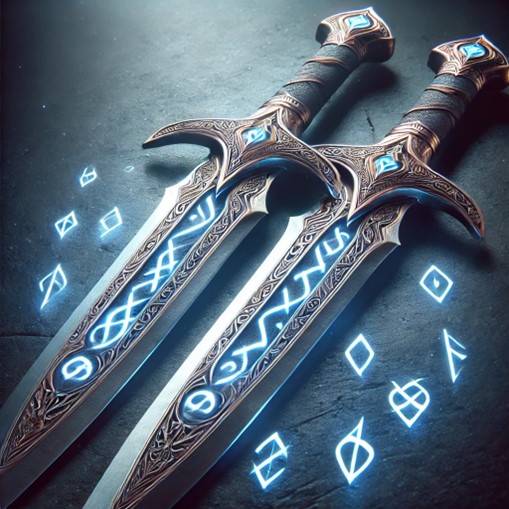
The recipe for Rune-Bound Blades is highly sought after by acrobatic fighters, dual-wielding specialists, and those who appreciate the art of swift and precise combat. Here are some details on where and how this recipe is sold, as well as how the end results are used:
- Weaponry Guilds: Established weapon guilds and martial training academies are often the primary sources for the recipe of Rune-Bound Blades. These guilds house skilled weapon smiths, rune crafters, and combat instructors who possess the knowledge and expertise to create such blades. Characters interested in acquiring the recipe may need to prove their worth through combat challenges, demonstrate their dedication to honing their skills, or contribute to the guild’s endeavors.
- Secretive Traders: In shady corners of black markets or hidden underground trading networks, elusive traders deal in forbidden or rare enchanted weapons. These individuals may have acquired the recipe through dubious means or through connections with renegade rune crafters. Characters seeking the recipe must navigate the shadows, establish trust with the traders, and potentially negotiate a high price or perform dangerous tasks in exchange for the coveted recipe.
- Forgotten Tomes and Ruins: The ancient secrets of crafting Rune-Bound Blades can also be discovered within forgotten tomes, scrolls, or inscriptions hidden deep within ancient ruins or sacred temples. Characters may embark on quests or archaeological expeditions to uncover these hidden knowledge repositories. The guardians of these ancient sites may require the characters to solve riddles, face trials, or offer protection in exchange for access to the recipe.
In terms of the environment and usage of Rune-Bound Blades:
- Combat Arenas and Dueling Pits: Characters who acquire the Rune-Bound Blades often put them to use in combat arenas or dueling pits. These specialized venues are ideal for showcasing the blades’ enhanced speed, precision, and agility. Acrobatic fighters and dual-wielding specialists engage in fast-paced, choreographed battles, utilizing the blades’ enchantment to perform intricate maneuvers, overwhelm opponents, and entertain the crowds.
- Skirmishes and Battlefields: The Rune-Bound Blades find their true purpose on the frontlines of skirmishes and battles. Agile warriors who possess these blades become formidable combatants, using their enhanced speed and accuracy to swiftly dispatch foes. The blades’ enchantment allows for seamless transitions between offensive and defensive maneuvers, enabling the wielder to strike with precision and evade incoming attacks with agility.
- Thieves’ Guilds and Espionage: In the world of intrigue and shadow, Rune-Bound Blades become valuable tools for thieves and assassins. The enhanced speed and precision offered by the blades aid in quick, decisive strikes, allowing thieves to incapacitate guards swiftly or assassins to dispatch targets silently. The agility bestowed by the blades assists in evading capture during heists or making daring escapes.
Rune-Bound Blades can be found in weapon guilds, secretive trading networks, or hidden within ancient tomes and ruins. Possessing these blades enhances the wielder’s speed, precision, and agility, making them a force to be reckoned with in combat arenas, battlefields, and stealthy operations. Acquiring the recipe may require navigating guild politics, delving into the underworld, or embarking on perilous quests, but those who master the art of the Rune-Bound Blades gain an edge in combat that sets them apart from their peers.
Song of the Dancing Steel
In the elder days, before the moon wept and the stars whispered of sorrow, there was a time when the wind itself bore no name and the rivers ran with silver light. In this time, among the high cliffs where the earth kissed the sky, dwelled the clan of the Swift Hand, known in tongues long crumbled into dust as those who moved swifter than the hawk’s shadow.
It was said they were touched by the favor of the Elven One, whose feet never broke a leaf and whose breath stirred not the dust. To this people, speed was the mother of wisdom, and grace the father of strength. But their world was not one of peace, for the Lords of Heavy Foot sought dominion over all lands where the winds danced free. These Lords, clad in iron thick as mountain stone, believed in the power of weight, of unyielding force, and the crushing of all that moved swifter than the turning of the sun.
Among the Swift Hand was born a warrior unlike any before, whose name—once bright as dawn—has since fallen into silence. Yet, some call him the Blade-Wind, others the Whispering Fang. He was one who needed no ground to stand upon, whose step was lighter than the breath of dawn, whose laughter could not be caught even by the storm. He saw the coming of the Lords of Heavy Foot and knew that their march would still the breath of the world. So he sought the counsel of the elders, whose wisdom had been shaped by the endless turning of wind and leaf.
They spoke in words of riddles, as was their way, saying, “That which cannot be held may never be broken. That which flows between the stones shall wear the mountain to dust.”
With this, the Blade-Wind journeyed beyond the edge of known sky, where the sun lingers but does not touch, where the night sings in voices older than sleep. There, in the forgotten hollow of the world, he found the last of the Rune-Singers, beings neither alive nor dead, who remembered the first etchings of meaning upon stone. He bowed low before them, for even the swiftest must pause before the weight of time.
The Rune-Singers beheld him and spoke as one:
“To carve the glyph of the Nimble Evasion, one must not seek to carve. To hold the blade, one must never grasp it. To cut the air, one must become the space between the edges.”
For seven days, the Blade-Wind listened, and for seven nights, he moved without step. On the eighth, the Rune-Singers placed before him two blades, their edges thin as thought, their metal neither warm nor cold. They bore no marks, and yet, when his hands neared them, they whispered of unseen etchings, runes so fine that the eye could not catch them, but the soul could feel their dance.
Taking the blades, he returned to his people. The Lords of Heavy Foot had already begun their march, their iron shattering the rivers, their shadows darkening the land. But when they reached the cliffs, the wind did not yield, for the Blade-Wind stood before them. With blades unseen, he wove the storm itself. Where their swords fell, they struck only air. Where their hammers swung, they met only their own echoes. He was the breath between heartbeats, the space where thought is born but not yet spoken.
For three days, the battle raged, yet not once did steel touch his flesh, nor did his blades know resistance. On the dawn of the fourth, the Lords of Heavy Foot, weary from striking shadows, sank to their knees. The wind, once still, laughed. The rivers, once broken, flowed anew. And the Blade-Wind, his task complete, cast his weapons into the sky, where they vanished into the breath of the world.
Yet, the Swift Hand did not forget. In secret, their artisans sought to capture the dance of the nameless warrior, carving the Rune of Nimble Evasion into blades meant for those who moved as whispers move. These weapons, though mere echoes of the original, carried a fragment of that long-lost wind, granting their wielders speed beyond sight, grace beyond reason.
The Moral of the Story: A hand that clings too tightly shall never grasp the wind. A mind that seeks to trap motion shall never know its freedom. That which cannot be caught can never be broken.
Suggested conversions to other systems:
Call of Cthulhu (7th Edition)
- Skill Requirement: Requires 50% or higher in Fighting (Melee) to properly wield.
- Damage: 1d6+1 (per blade), ignores 1 point of armor due to precision.
- Special Ability – Evasive Strikes: When attacking, the wielder may attempt a Dodge roll as a reaction with a bonus die. If successful, they suffer no damage from an incoming melee attack that round.
- Special Ability – Fleet-Footed: Gain a +10% bonus to Dodge rolls while wielding these blades.
- Mythos Influence: Prolonged use (several in-game months) may cause the wielder to experience unsettling visions of unseen forces guiding their movement, leading to bouts of paranoia (SAN loss: 1d3 per month).
Blades in the Dark
- Item Type: Fine Pair of Blades (Light Load, 2 slots)
- Quality: These rune-etched weapons count as Fine and provide potency when engaging in skirmishes or performing maneuvers requiring acrobatics.
- Special Ability – Whispering Steel: The blades enhance fluidity in motion, allowing the wielder to push themselves for free once per session when making an Athletics or Prowl roll.
- Special Ability – Nimble Edge: When engaged in a duel or combat situation where agility matters more than brute force, gain increased effect on skirmish rolls if the opponent is wearing heavy armor.
- Heritage Ties: The blades are rumored to be of elven or forgotten ancient origin. Possessing them may attract the attention of scholars, relic hunters, or rival assassins.
Dungeons & Dragons (5th Edition)
- Weapon Type: Magic, Finesse, Light, Dual-Wielding Weapons (Shortswords or Daggers)
- Rarity: Rare (requires attunement)
- Damage: 1d6+1 (piercing or slashing) per blade
- Special Property – Nimble Evasion: While wielding these blades, you gain a +1 bonus to AC and advantage on Dexterity (Acrobatics) checks.
- Special Attack – Bladed Wind (Recharge 5-6): As a bonus action, you may make an additional attack against a target within 5 feet after successfully hitting with both blades in the same turn.
- Special Ability – Untouchable Dancer: If you successfully hit a creature with both blades in a turn, you can use your reaction to move 10 feet without provoking opportunity attacks.
- Attunement Requirement: Must have proficiency in Dexterity-based melee weapons.
Knave
- Weapon Type: Paired Light Blades
- Base Damage: d6 per blade
- Special Property – Flowing Motion: The wielder may make one extra attack per round, provided the first attack hits.
- Special Ability – Elusive Step: When using the Evade action, roll with advantage.
- Weight: 1 slot
- Durability: If a fumble (natural 1) is rolled while using the blades, the runes briefly flicker, and their magic is suppressed for one round.
Fate Core
- Aspect: Blades of the Swift Hand – These finely-crafted rune-etched weapons enhance agility and speed in combat.
- Weapon Rating: +2 to Fight attacks when engaging in close combat.
- Stunts:
- Lightning Strikes Twice: Once per scene, when making a Fight attack, the wielder may spend a Fate Point to attack twice in rapid succession without penalty.
- Dancer’s Grace: Gain a +2 bonus to Athletics rolls when avoiding melee attacks or navigating difficult terrain.
- Untouchable Step: When the wielder succeeds with style on a defense roll using Athletics against a melee attack, they may immediately move up to one zone without provoking further attacks.
- Drawback: The blades are attuned to speed, requiring constant movement. If the wielder remains still for too long in combat, they suffer a -1 penalty to Fight rolls.
Numenera & Cypher System
- Weapon Type: Medium Weapon (Light if wielded by a character trained in acrobatics or finesse combat).
- Damage: 4 points per blade (ignores 1 point of Armor).
- Level: 5
- Special Abilities:
- Momentum Surge (Enabler): Once per encounter, if the wielder successfully hits with both blades in a single action, they may immediately perform a Speed-based action as a free action.
- Blurred Motion (Enabler): When attacking, the wielder may spend 2 Speed points to gain an asset on their next defense roll.
- Duelist’s Precision (Action): By spending 3 Speed points, the wielder can make an additional attack in the same round.
- Intrusion Possibility: Extended use of the blades may cause the wielder’s movements to become unnaturally fast, leading to unintended consequences like exhaustion or attracting unwanted attention.
Pathfinder 2e
- Weapon Type: Advanced Finesse, Agile, Twin Blades
- Rarity: Rare
- Damage: 1d6+1 (slashing or piercing) per blade
- Traits:
- Agile: Attacks with these weapons take a smaller multiple attack penalty (-4 instead of -5, -8 instead of -10 for further attacks).
- Finesse: Can use Dexterity for attack rolls.
- Twin: When wielding both blades, if an attack with one lands successfully, the next attack with the second blade gets a +1 circumstance bonus.
- Special Abilities:
- Runebound Reflexes (Reaction): If an enemy misses a melee attack against the wielder, the wielder may step 5 feet without provoking attacks of opportunity.
- Flurry of Blades (Two-Action Activity): The wielder may make two attacks with the Rune-Bound Blades as part of a single action, using the lower multiple attack penalty for both.
- Evasive Dance (Passive): While wielding these blades, the wielder gains a +1 circumstance bonus to Reflex saves and Acrobatics checks.
Savage Worlds (Adventure Edition)
- Weapon Type: Twin Light Blades
- Damage: Str+d6 (each)
- Traits:
- Finesse: Attacks ignore up to 2 points of Parry from heavier weapons.
- Balanced: The wielder may ignore the multi-action penalty for attacking with both weapons in a round.
- Special Abilities:
- Swift Strike: Once per turn, if the wielder lands a successful Fighting attack, they may immediately attempt another attack at no penalty.
- Dancer’s Reflexes: Gain +1 to Athletics and Acrobatics-based rolls.
- Blurred Step: When making an Agility roll to avoid an attack, the wielder may roll twice and take the better result.
- Drawback: The wielder must maintain constant motion in combat; remaining still for an entire round reduces their Parry by 1.
Shadowrun (6th Edition)
- Weapon Type: Melee (Blades)
- Damage: Str +2P
- Accuracy: 6
- AP: -2
- Reach: 1
- Special Abilities:
- Blurred Motion: Gain +1 to Gymnastics when using Full Defense.
- Evasive Reflexes: When an attack misses the wielder in melee combat, they may use their Reaction to move 2 meters without provoking another attack.
- Dual-Wield Efficiency: When wielding both blades, the wielder gains a +1 dice pool bonus on Melee Attacks and can reroll one die on a missed attack once per round.
- Availability: 10R
- Cost: 15,000¥
Starfinder
- Weapon Type: Advanced Melee Weapons
- Damage: 1d8 Slashing or Piercing
- Critical Effect: Bleed 1d4
- Level: 4
- Traits:
- Operative: Can be used with the Operative class’s trick attack.
- Quick: The wielder may draw or sheathe these blades as a swift action.
- Special Abilities:
- Evasive Dance (Reaction): If an attack misses the wielder, they can take a guarded step as a reaction.
- Flurry Strike (Full Action): When making a full attack with these weapons, the penalty to attack rolls is reduced by 1.
- Price: 5,000 credits
Traveller (Mongoose 2e)
- Weapon Type: Close Combat – Blades
- Damage: 2d6
- Traits:
- Lightweight: No penalty for using off-hand.
- Balanced: Allows the wielder to parry without taking an action.
- Special Abilities:
- Quick Reflexes: When wielding these blades, the wielder gains a +1 DM bonus to Athletics (Dexterity) checks.
- Duelist’s Grace: If the wielder successfully attacks and deals damage, they gain a +1 bonus to their next melee attack that round.
- Cost: 10,000 credits
Warhammer (Wrath & Glory, 40k RPG)
- Weapon Type: Melee – Twin Blades
- Damage: 5+ED (Each Blade)
- AP: -1
- Traits:
- Fast: Gain +1 to Initiative in melee combat.
- Rending (1): On a critical hit, the target suffers an additional Mortal Wound.
- Special Abilities:
- Blurred Strikes: If the wielder makes two successful attacks in the same turn with these blades, they may immediately make a third attack with no penalty.
- Elusive Form: Gain +1 Defense while wielding both blades.
- Wealth Cost: 4 (Rare)
Comments
One response to “Bound Blades”
[…] Merged• Bound Blades (Pair) — Tier-1 rune-etched weapons bearing the Rune of Nimble Evasion.• Item 947: Hollow Veil […]