
Lore: Crafted from a sliver of a Weeping Willow rumored to grow on the edge of a haunted graveyard, this small charm exudes an aura of quiet sadness. Legends speak of lost souls clinging to the willow, their mournful cries echoing in the wind.
Slot: Trinket
Skills:
- Notice +1: The character is more attuned to subtle shifts in the environment and energy flows.
- Resist (Fear Effects) +1: Provides some resilience against magics and situations that induce fear.
Passive Magics:
- Aura of Unease: Those within a short distance of the wearer might feel a prickle of unease or notice a slightly melancholic shift in the atmosphere. This has no direct gameplay effect but enhances roleplaying.
Active Magics:
- Echo of Lament (1 use per day): The charm emits a soft, mournful wail resembling a weeping sound. This can be used to distract simple creatures or those susceptible to auditory influences. It can also be used to enhance roleplaying moments of despair or sorrow.
Tags: Wood, Trinket, Common, Fear, Aura
Where the “Feng Shui 13 of the Weeping Willow” might be found and how the transaction would likely occur:
- Types of Shops
- Curio Shops: These eclectic shops specialize in odd trinkets, charms, and objects with minor magical or superstitious properties. They are often found in bustling marketplaces or tucked away in quiet side streets.
- Apothecaries: While primarily known for herbs and remedies, some apothecaries dabble in minor magical items, especially those associated with natural elements or folk traditions.
- Traveling Peddlers: These merchants move from town to town, their wares often including a mix of practical goods and intriguing trinkets. A peddler might have acquired this charm through unusual means and be eager to sell it for a story as much as for profit.
- The Buying Experience
- Haggling: In Saṃsāra, haggling is expected, especially in smaller shops. The initial price might be inflated, with room for friendly negotiation.
- Lore: The shopkeeper would likely have a tale about the charm’s origin, even if it’s a bit embellished. This adds to the item’s mystique and helps justify the price.
- Superstition: Shopkeepers might play upon the fears of customers, suggesting the charm offers protection against misfortune or restless spirits.
Cost — Since this is a Common Tier 1 item with limited but specific effects, it would be relatively affordable. Here’s a possible price range depending on the circumstances:
- Curio Shop or Apothecary: 10 – 20 silver pieces
- Traveling Peddler: 8 – 15 silver pieces (with a willingness to barter for interesting items or stories)
The Feng Shui 13 of the Weeping Willow offers subtle defensive and offensive options through roleplay, primarily influencing the emotions and perceptions of others. Here’s how you might use it in different situations:
- Defense:
- Subtle Deterrent: When entering a dangerous area or negotiating with hostile individuals, the character can clutch the charm inconspicuously. Roleplay the character focusing on the aura of quiet sadness emanating from the charm, hoping it instills a sense of unease or disarms potential aggressors.
- Feigning Distress: If cornered or outnumbered, the character can clasp the charm dramatically and wail, mimicking the mournful sound of the willow. This could be a desperate attempt to confuse or frighten attackers, creating a momentary opening for escape (though the effectiveness depends on the foe’s intelligence and susceptibility to fear).
- Haunted Ground: If the character finds themself in a haunted location or encounters restless spirits, they might clutch the charm and plead for protection, hoping it resonates with the lingering sorrow of the spirits and offers a sliver of defense.
- Offense:
- Intimidation: While not a direct weapon, the character can present the charm in a menacing way, weaving tales of the weeping willow and the spirits it harbors. This might be effective against foes who are superstitious or vulnerable to spooky lore.
- Emotional Manipulation: The character, while feigning remorse or projecting a melancholic aura with the charm’s help, could attempt to gain an advantage during negotiations or interrogations. This could be risky, however, as it relies on successful deception.
- Desperate Diversion: In a tense standoff, the character could smash the charm (treat this as a one-time use) to unleash a more potent burst of mournful wailing. This could disorient nearby enemies and create a brief window for escape or a surprise attack (though destroying the charm would negate its future benefits).
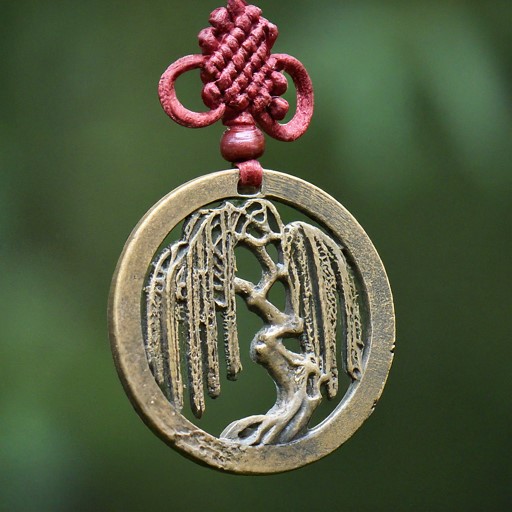
What might be perceived during the activation of the Feng Shui 13 of the Weeping Willow, considering both the standard senses and additional extrasensory perceptions:
- Sight
- Aura Intensification: The existing melancholic aura surrounding the charm glows slightly brighter, becoming more visible to those attuned to such energies.
- Positive: Helps visualize the area of effect of the charm’s passive abilities.
- Negative: Could draw attention from individuals sensitive to magical items.
- Visual Distortion (Slight): The air around the bearer might shimmer subtly, hinting at a disruption in the flow of energy, barely perceptible to regular sight.
- Positive: Might help notice other magical disturbances in the area.
- Negative: Could be distracting in low-light conditions.
- Aura Intensification: The existing melancholic aura surrounding the charm glows slightly brighter, becoming more visible to those attuned to such energies.
- Sound
- Echo of Lament: The charm emits its signature mournful wail, a soft weeping sound that grows slightly louder upon activation.
- Positive: Serves as the key auditory component of its active magic.
- Negative: Can draw unwanted attention, especially for stealth.
- Echo of Lament: The charm emits its signature mournful wail, a soft weeping sound that grows slightly louder upon activation.
- Smell
- Scent of Damp Earth: A faint smell, similar to a freshly turned grave, clings to the charm. It strengthens after activation.
- Positive: Adds an extra layer of atmosphere during roleplay.
- Negative: Might be unpleasant for those with sensitive noses.
- Scent of Damp Earth: A faint smell, similar to a freshly turned grave, clings to the charm. It strengthens after activation.
- Touch
- Coldness: The wood charm feels slightly colder to the touch, as if drawing negative energy into itself.
- Positive: Reinforces the melancholic feeling the charm embodies.
- Negative: Might be uncomfortable to hold for extended periods.
- Coldness: The wood charm feels slightly colder to the touch, as if drawing negative energy into itself.
- Taste — (This sense is typically not directly involved but could be flavored via magical perception)
- Metallic Bitterness: A faint metallic taste lingers in the air like a weeping rust.
- Positive: Adds a unique sensory element to roleplaying.
- Negative: Can be mildly unpleasant.
- Metallic Bitterness: A faint metallic taste lingers in the air like a weeping rust.
- Extrasensory Perceptions
- Empathic Resonance: Those with empathic abilities or a sensitivity to emotions may feel an intensifying wave of sadness, despair, and a sense of something lost.
- Positive: Could help detect concealed sorrow or hidden emotional burdens.
- Negative: Can be emotionally draining for the bearer and those around them.
- Spiritual Presence (Vague): Those attuned to the spirit world might feel a faint echo of restless energy. It is unclear if this is a real presence or merely a trace of the charm’s history.
- Positive: Could lead to uncovering ghostly mysteries.
- Negative: Might attract unwanted spectral attention.
- Empathic Resonance: Those with empathic abilities or a sensitivity to emotions may feel an intensifying wave of sadness, despair, and a sense of something lost.
- Important Notes:
- The intensity of these perceptions can vary depending on the user’s sensitivity and proximity to the charm.
- Even individuals without special abilities might experience a vague sense of unease or heightened sadness around the activated charm.
Crafting the Feng Shui 13 of the Weeping Willow
- Materials Needed:
- Weeping Willow Branch: A sliver of wood, roughly the size of a finger, taken from a weeping willow tree. Ideally, this should be sourced from a location with a reputation for melancholic or haunted energy.
- Grave Soil: A small quantity of earth taken from a fresh grave.
- Pure Silver: A thin wire of pure silver, used for wrapping and inlay.
- Tears of Grief: A single tear, freely shed in a moment of genuine sorrow or loss.
- Tools Required:
- Woodcarving Tools: A set of small, sharp chisels and knives for shaping the wood.
- Jeweler’s Tools: Fine pliers and tweezers for handling the silver wire.
- Mortar and Pestle: For grinding the grave soil into a fine powder.
- Skill Requirements:
- Woodcarving (Novice): Basic skill in shaping and detailing wood.
- Enchanting (Initiate): The ability to infuse objects with minor magical properties.
- Herbal Lore (Minor): Knowledge of the properties of weeping willows and their associations.
- Crafting Steps:
- Preparation:
- Under a waning moon, carefully harvest a sliver of wood from a weeping willow branch. Speak a brief prayer or apology to the spirit of the tree.
- Collect a small amount of earth from a fresh grave. Treat the site with respect and leave a small offering for the departed.
- Shaping the Charm:
- Using the woodcarving tools, carefully shape the wood into the likeness of a small, drooping willow branch. Focus on conveying a sense of melancholy and loss.
- Infusion of Sorrow:
- Grind the grave soil into a fine powder. Mix a small amount of the powder with the tear of grief to create a paste.
- During this process, meditate on the feelings of loss and despair associated with the materials.
- Silver Inlay:
- Using delicate jeweler’s tools, carefully inlay the silver wire into the wood carving. The design should suggest flowing tears or drooping branches.
- Enchantment:
- Under the light of a full moon, hold the charm and focus on its intended properties – channeling feelings of unease, sorrow, and subtle protection from fear.
- With a simple incantation and offering of personal energy, imbue the charm with its Feng Shui properties.
- Preparation:
Note: This process is emotionally draining and should not be undertaken lightly. Success is not guaranteed, and the emotional resonance of the ingredients greatly influences the charm’s potency.
Ballad of the Weeping Wood
From dusty scrolls, whispers of a bygone age, comes the tale of the Weeping Wood. Cuneiform etchings speak of a time when man and willow danced in harmony. A solitary willow, older than memory itself, wept tears of amber sap at the edge of the spirit realm. Legends claim its mournful sighs carried the pleas of restless souls, forever seeking solace.
One such soul, a nameless warrior, tasted the willow’s tears – a bitter draught of regret. Consumed by sorrow for a life unlived, the warrior clung to the ancient wood, his anguish echoing through the branches. The willow, touched by the warrior’s despair, gifted him a sliver of its bark, imbued with the essence of his grief.
The warrior, transformed by the Weeping Wood, became a wanderer, forever haunted by his past. The charm, a constant reminder of his loss, offered a strange solace. Its mournful aura both repelled and attracted – a shield against joy, a beacon to the sorrowful.
Many sought the Weeping Wood, each with their own burden. A grieving mother, a king wracked with guilt, all found a sliver of comfort in the charm’s mournful embrace. Yet, none could escape the clinging shadows of their past. The Weeping Wood, a paradoxical gift, offered solace at the cost of perpetual sorrow.
Moral: Beware the allure of lingering grief. While the Weeping Wood offers comfort, it binds one to the past, hindering the journey towards a brighter future.
Suggested conversions to other systems:
Call of Cthulhu
- Sanity Cost: Wearing the charm causes a gradual Sanity loss of 1/1D4 per week. This reflects the lingering melancholy that seeps into the investigator’s psyche.
- Spot Hidden: The charm grants a +10% bonus to Spot Hidden rolls made to perceive subtle shifts in the environment, spectral presences, or the emotional auras of others.
- Intimidate or Persuasion: When using the charm to manipulate others through melancholy displays, the investigator gains a +5% to Intimidate or Persuasion rolls, depending on the situation’s tone.
- Lore (Occult/Mythos): The charm may trigger Mythos-related knowledge checks with a slight bonus. This represents an intuitive understanding of the item’s connection to spirits and loss.
Blades in the Dark
- Action Roll: The charm primarily aids with Attune actions focused on sensing the supernatural or manipulating emotions. It might grant a +1d on a roll or provide a small narrative advantage.
- Resistance: The charm offers minor resistance against stress or trauma caused by encounters with ghosts, regrets from the past, or intense emotional manipulation.
- Downside: Prolonged use of the charm may lead to the “Haunted” or “Obsessed” condition, reflecting the player’s reliance on a melancholic crutch. This could increase the risk of downtime actions related to indulging in sadness or attracting spectral attention.
Dungeons & Dragons (5th Edition)
- Attunement: Requires attunement by a character with some emotional vulnerability or awareness (e.g., low Charisma, background with a focus on loss).
- Skills: +1 bonus to Perception and Insight checks focused on reading emotions or detecting subtle magical auras.
- Saving Throws: +1 bonus to Wisdom saving throws against effects that inflict the Frightened condition.
- Curse (Optional): The DM could introduce a lingering sadness effect. Perhaps the character starts each day with one level of exhaustion unless they actively roleplay overcoming their melancholy.
Knave
- Inventory Slot: Trinket.
- Defense: +1 Defense against Fear-based effects or creatures that feed on negative emotions.
- Usability: Once per day, use the charm to project an aura of sadness. This might distract simple beasts or make foes hesitate momentarily (use as a creative Knave ability with GM arbitration).
- Downside: Disadvantage on any roll requiring charisma or high spirits due to the charm’s negative aura.
Fate
- Aspect: Weeping Willow’s Burden. This Aspect highlights the item’s emotional impact and can be invoked or compelled for various effects.
- Invoke: To enhance rolls related to noticing subtle emotional states, resisting fear, or subtly influencing others through a melancholic demeanor.
- Compel: To make the character succumb to sadness, hinder attempts to spread joy, or to attract attention due to the charm’s negative aura.
- Stunt (Optional): Echo of Lament (1 Refresh): Once per session, unleash a mournful wail from the charm. This could distract those susceptible to auditory effects or temporarily intensify despair in an area, offering narrative benefits depending on the context.
Numenera & Cypher System
- Cypher: Weeping Willow’s Lament (Level 1).
- Effect: The user gains Asset on all Perception rolls to sense emotional auras or the presence of subtle energies. Additionally, they gain Asset on Intimidation or Deception attempts when playing on others’ sorrow.
- Depletion: 1 in 1d6 chance per use the user becomes momentarily overwhelmed by sadness (-1 to Intellect Pool for 1 hour).
Pathfinder (2nd Edition)
- Item Rarity: Common. Requires attunement.
- Traits: Magical, Evocation, Emotion, Mental
- Stats:
- +1 circumstance bonus to Perception checks to notice subtle shifts in emotions or auras.
- +1 circumstance bonus to saves against Fear effects.
- Aura of Melancholy: The charm projects a subtle aura of sadness. While this typically has no mechanical effect, it could impact social encounters or creatures sensitive to negative emotions (GM’s discretion).
Savage Worlds
- Setting Rule: Superstition. This setting rule increases the effectiveness of Fear-based powers against those who believe in them, making the charm a subtle weapon against the superstitious.
- Edge (Optional): Echo of Lament. This Edge allows the character, once per session, to unleash a mournful cry. It acts as a minor Test of Will with a success causing Shaken condition on a target.
Shadowrun
- Item Type: Focus (Mental/Emotional Manipulation)
- Rarity & Availability: Common, easily found in shops catering to magical practitioners or in the Barrens’ flea markets.
- Effects:
- Astral Perception: +1 dice pool for assensing auras and emotions.
- Social Rolls: +1 dice pool for Intimidation or Con checks when emphasizing a melancholic or sorrowful persona.
- Drain: Using the item may cause minor emotional drain (Narrative effect, similar to a mild addiction, GM’s discretion)
Starfinder
- Item Type: Hybrid Item (Level 1)
- Properties: Magical, Necrotic, Evocation
- Effects:
- +1 bonus to Mysticism checks to sense emotions and subtle necrotic energies.
- +1 bonus to Intimidate checks when roleplaying a mournful demeanor.
- Psychic Resonance: Prolonged use of the charm could cause a psychic imprint (GM’s discretion), potentially attracting beings attuned to negative emotions.
Traveller
- Tech Level: TL3-4 (Item itself is low-tech, but its creation relies on understanding of subtle psionic concepts)
- Focus: Psionic Focus (Minor)
- Effects:
- Grants a +1 DM to Psionic checks related to empathy, intuition, and sensing negative emotions.
- Can be roleplayed for a slight advantage during social interactions when appealing to others’ sadness or fears.
- Risk: Overreliance on the item might stunt emotional development in a character, representing their growing reliance on negativity (Referee’s discretion).
Warhammer (Fantasy or 40K)
- Item: Corrupted Trinket (Tzeentch or Nurgle)
- Lore: A relic possibly derived from interactions with the Warp or crafted by a Chaos cult. It exudes an aura of despair and corruption.
- Effects:
- Grants a minor bonus to channeling tests related to sensing the warp or resisting psychic intrusion.
- Might offer a slight edge in Intimidation attempts if the user embraces the item’s corrupting nature.
- Corruption Risk: Wearing the charm carries a considerable taint of Chaos. Using it could attract daemons or lead the character towards the path of despair.