
• The item originates in the healing quarters and traveling practitioner stalls of coastal and inland cities where those who work with fine points and energy lines treat injuries and imbalances. Artisans in small family workshops collect shed plumage during the Blooming and Passion weeks, selecting feathers whose tips and edges can suggest precise placement. These are layered over a light frame of slender plant fiber treated with sap mixed with fine dust from smoothing stones used in needle work. The covering is intended for avatars who possess a Feathers slot and who rely on careful gesture and visible markers when locating points or guiding minor flows. It is commonly found near shops that supply simple probes, binding cloths, and restorative drafts because the making requires no large crystals and finishes in a single day.
• Slot is Feathers. The covering is worn on or over the avatar’s existing feathers and occupies only that slot. It functions while openly visible and is suppressed if fully covered. Removal or minor adjustment is a free action when not under immediate demand.
• Skills gained when openly worn consist of a temporary +2 to the Medicine skill. These points come from the item and do not count against the maximum trained level of 5 plus tier. The bonus applies to checks involving precise point location, minor flow guidance, injury assessment through touch or gesture, or the application of restorative techniques. When covered or removed the temporary points end.
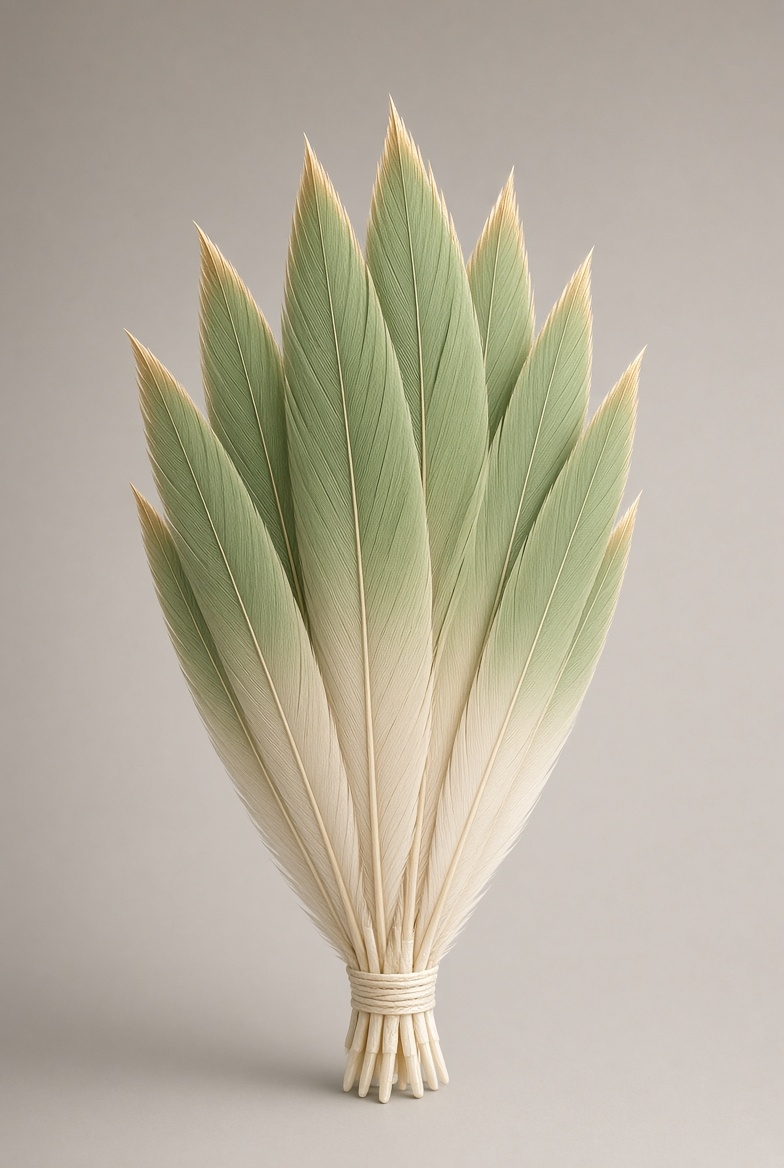
• Color is soft sage-green along the vanes fading to warm ivory at the base, with the tips carrying a steady pale amber sheen that does not shift. The pattern remains clear under ordinary daylight or soft interior light at the distances of a treatment space or bedside.
• Passive magic includes a continuous fine alignment of the outermost tips that makes small pointing or placing gestures more exact, granting advantage on Medicine checks made to locate a specific point or to trace a short line of flow without additional tools. A second passive causes the amber sheen to hold a calm tone that aids steady hands during extended work, reducing minor tremors from fatigue. A third passive offers light insulation that keeps the wearer’s own posture comfortable during long sessions in cooler rooms or warmer outdoor sites, supporting uninterrupted attention to the work.
• Active magic includes the ability, once per long rest, to flare the feathers briefly as an action and project a faint pattern of highlighted points onto a nearby surface or body area, adding the tier-1 die result to one Medicine check made to assess or treat in that moment. A second active permits the wearer, as a free action, to set the feathers into a slow tracing sweep lasting up to ten minutes that grants advantage on a sequence of related point-location or minor-flow checks performed during the time. A third active, usable once between long rests, allows a single precise snap of the feathers that produces a soft clear tone, marking the completion of a placement and granting advantage on one immediate check to stabilize or confirm the effect of the technique. Each active draws only on ambient magic already in the feathers.
• Tags are Feathers, Medicine, Precision, Common, Tier1, Worn, Magical, Flow, Point, Healing, Steady, Meridian, Needle-Aid, Point-Location, Flow-Guidance, Steady-Hand, Amber-Sheen, Tracing-Sweep, Placement-Mark, Restorative, Treatment-Space, Tremor-Reduction
• Additional information states that the item suits any avatar with a Feathers slot and adjusts in minutes by hand or artisan. Weight is negligible. In healing districts and near practitioner gatherings it appears in small shops and changes hands according to local feather supply and agreed price after haggling. Effects hold in ordinary magic flow without needing attunement, though attunement remains optional. In reduced flow the actives continue while the passive advantage on point location becomes an ordinary roll. Wear is repaired by those familiar with fine display or healing gear without altering the listed properties.
Acquisition and Trade of Feathers 2564 of the Pointed Flow
• The item may be obtained when an avatar is successfully possessed if the previous host already wore or carried the covering among gear used for treatments or assessments. It may also appear as a reward from a completed task for a healing practitioner, a local rest house, or an official who values those able to locate points and guide minor flows after injuries or strains. Confrontation with others carrying similar pieces can leave the covering among dropped items after search. An artisan with the proper skills and access to suitable shed plumage can craft a new example using plant fibers, sap, and dust from smoothing stones rather than crystals.
• Shops that handle the item are almost always small family workshops or single-proprietor stalls in the healing quarters of towns or near the practitioner gatherings and rest houses of larger cities. These establishments specialize in gear for fine gesture and restorative work, often neighboring makers of simple probes, cloths, and drafts. Owners shift production as demand from traveling healers or fixed treatment spaces changes. They employ a few workers for gathering feathers in the Blooming and Passion weeks and for stitching, while the binding stays with the family. No large holdings of identical pieces exist; each shop keeps only recent completions.
• Purchase occurs through face-to-face exchange in the shop or at a stall beside a treatment area. The buyer examines the sage-green and ivory tones under ordinary light, tests the tracing sweep and tip alignment, and haggles. An NPC merchant begins near the local suggested value and moves by about 10 percent times the buyer’s tier. Membership in a relevant healing circle or guild grants a matching reduction. Payment is in gold or equivalent local coinage; the merchant may deposit in the World Bank or keep coin. Short notes tied to a completed treatment are sometimes accepted. Black-market stalls offer the item at full value or higher for physical gold only and maintain silence on prior owners.
• Sale follows the reverse path. The owner presents the item and the merchant haggles downward by roughly 10 percent times the seller’s tier, with gold deposited in the World Bank. Black-market buyers may match or double the ordinary price for urgent need, always in physical gold. Quasi-logs are kept and may later be reviewed by officials.
• Cost is never fixed. In a healing quarter with several workshops and ready feathers the piece may change hands for silver equal to a few days of ordinary labor. Where suitable plumage must be carried farther the same item may require several gold due to access and fewer familiar artisans. During periods of higher injury or strain demand buyers pay more; after arrivals of similar coverings or in low flow sellers accept less. The final amount is whatever is agreed after haggling. Applicable city or state taxes on the sale are settled by the merchant before the buyer leaves with the item.
Roleplay Applications of Feathers 2564 of the Pointed Flow in Defense and Offense Across Environments
• In a fixed treatment space or rest house the wearer keeps the feathers aligned while assessing an injury or imbalance. When an aggressive patient or intruder moves suddenly the wearer flares the covering as an action to project the faint point pattern onto the area, adding the tier die to a Medicine check that identifies a stabilizing point or a momentary disruption. This can defend by quickly easing a companion’s pain or strain so they can withdraw, or serve offensively by marking a precise location that allows a held tool or gesture to interrupt an opponent’s motion. The passive tip alignment makes each placement more exact, supporting both restorative defense and targeted interruption.
• On a battlefield or in a skirmish clearing the covering aids rapid assessments between actions. A tracing sweep started as a free action grants advantage on a sequence of point-location checks, letting the wearer guide a minor flow that steadies an ally’s footing or breathing under pressure. The precise snap can mark the completion of a placement that reduces an incoming disadvantage, defending the group, or confirm a disruption that leaves an opponent briefly hindered for a following strike. Insulation keeps the wearer’s hands steady despite shifting temperatures or exertion. In low magic flow the passive advantage becomes an ordinary roll, so the wearer combines the projected pattern with direct touch for the same effect.
• Aboard a vessel or along a harbor the feathers support treatment of strains from rigging or waves while remaining ready for sudden clashes. Flaring projects the point highlights onto a deck or companion, adding the die to an assessment that either restores enough function for defensive maneuvering or identifies a balance point whose disruption sends an aggressor off-step. The sweep covers related checks for multiple minor injuries in sequence, coordinating care that keeps a crew defensive or enables a focused response. The steady sheen aids focus amid noise and motion.
• In city streets or market edges where disputes turn physical the wearer uses the visible tips for quick gestures that double as assessments. A snap timed with a precise placement can grant advantage on confirming a temporary hindrance to an opponent’s arm or leg, creating an offensive opening, or on stabilizing a bystander’s twist so they can move clear in defense. The flare’s pattern helps communicate the needed point to an ally without lengthy explanation. Temperature stability supports consistent work whether in sun or shade.
• In wilderness or along travel routes the item aids evaluation of creature or environmental strains. Projecting the pattern onto a track or companion adds the die to a check assessing likely weak points or recovery needs, either defending by advising avoidance of a aggravated injury or offensively by calculating a narrow window for a precise action that minimizes risk. The sweep structures a series of observations on wind, footing, and fatigue. Across settings the benefits require open display of the feathers; covering them returns the wearer to unaided checks until revealed again. The actives remain usable in reduced flow while passives adjust to ordinary rolls, prompting reliance on the audible tone and direct gesture.
Perception of Activation:
• Normal sight registers the feather tips aligning into finer points as they flare or trace, the soft sage-green vanes holding even while the warm ivory bases remain steady and the pale amber sheen stays constant at each tip. The description is a controlled refinement of the layered covering that projects a faint pattern of highlighted points onto a nearby surface or area for the duration of the active, after which the feathers settle back to resting alignment. Positives include a clear visual confirmation that the point aid has engaged and an immediate set of markers that help the wearer locate or confirm placements without extra tools. Negatives include a temporary focus that narrows broader awareness to the projected points and the chance that the steady amber tips draw notice from others observing the work.
• Touch registers a light, exact tension at the outer tips as the feathers refine their alignment, followed by small deliberate shifts during a tracing sweep and a single soft release on the snap. The description is a sequence of precise, minimal adjustments that match the pace of locating or placing and then ease. Positives include a tactile cue that the activation has matched the intended precision and a stable feel that supports steady hands. Negatives include a brief sense of constraint if the flare is held and a residual tip awareness that can feel noticeable during coarser movements.
• Hearing registers a very soft, even rustle that becomes a measured tracing cadence or resolves into one muted clear tone on the snap, quieter and more uniform than ordinary feather sounds. The description is a controlled series of faint contacts or a single distinct soft punctuation from the tips meeting in order. Positives include an auditory marker confirming the timing of a placement and a sound subtle enough for personal cueing in a quiet treatment space. Negatives include the possibility that the even tone masks softer patient responses and that the snap can signal completion to listeners before the wearer intends.
• Darkvision registers the activation as a sharpening of gray-scale tips into clearer points, the sage areas appearing consistent against the ivory while the amber sheen stays nearly uniform. The description is a rapid increase in tip definition that holds or moves slowly with the sweep. Positives include reliable point clarity in low light. Negatives include reduced distinction of the subtle amber that normally aids judging steadiness.
• True sight registers a faint, steady ultraviolet tracing along the amber tips that brightens evenly during the flare and holds without flicker through the sweep. The description is a thin unchanging outline of points that fades only when the active ends. Positives include confirmation that ambient flow has been shaped into stable point markers and a precise boundary for the projected pattern. Negatives include a mild after-trace overlapping other fine magical lines and a short pause before ordinary detail returns fully.
• Blindsight registers a sudden refinement of echo returns from the tips, producing a tighter cluster of precise points that matches the alignment and tracing motion. The description is a brief ordering of the near field into exact intervals. Positives include an accurate sense of the tip positions even without sight and early notice of obstruction to the pattern. Negatives include temporary reduction in irregular distant sound distinction and a slight shift in spatial awareness while the precise returns dominate.
• Soul sight registers a controlled stabilization and fine brightening of the personal aura at the feather tips, tones settling into sage and amber without abrupt change. The description is a steady held line or gentle trace that follows the activation and eases to baseline. Positives include an internal marker that the item has accepted the directed precision. Negatives include a sense of exposed fine detail if others with soul sight watch and a minor sustained concentration draw during the sweep.
• Mind’s Eye perception registers a brief overlay of the item’s properties—slot, temporary Medicine bonus, and remaining uses—aligned at the tips during activation, sometimes with a faint point suggestion for the current check. The description is a translucent set of values appearing cleanly and receding, lingering lightly on a continued sweep. Positives include immediate verification that the active supports the intended placement. Negatives include divided attention if multiple points are tracked and a brief delay returning full focus once the overlay clears.
Recipe for Feathers 2564 of the Pointed Flow
• Materials needed consist of twelve primary feathers shed by hybrid beasts during the Blooming or Passion weeks, each showing soft sage-green coloring that preserves well and tips suitable for a steady pale amber sheen with warm ivory bases. Four lengths of slender flexible plant fiber harvested from stalks grown near healing quarters or treatment grounds. A small quantity of clear tree sap collected with a fluid collector from a living tree within the past three days. One measure of fine mineral dust taken from smoothing stones used in needle or point work. No magic crystals are required; ambient weave in the feathers and sap supplies the binding for the precise effects.
• Tools required include a fluid collector for the sap, a pair of fine needles for delicate stitching, a flat work surface marked for tip alignment, a shallow bowl for mixing sap and dust, a fine brush for tip and edge application, a straight edge for maintaining point precision, and ordinary cord for temporary hold. All are mundane tools common to workshops serving healing districts.
• Skill requirements call for a trained level of at least 3 in crafting focused on fine or precision gear, plus at least 2 in binding or alchemy skill to apply the mixture without dulling tips or sheen. Familiarity with Medicine items is needed to test the point projection, tracing sweep, and precise snap. Levels may be met through downtime training or temporary points from openly worn badges.
• Crafting steps begin with gentle cleaning of each feather to preserve color, structure, and tip integrity, followed by arranging them in two overlapping layers on the marked surface so tips align to fine points and ivory bases sit evenly. The fibers are soaked in the sap-and-dust mixture until pliable, then laid as a light internal frame and stitched with a pattern that supports exact tip response and smooth tracing. Remaining mixture is brushed carefully at the tips to set the amber sheen and along edges, then dried under ordinary light for one After Noon period. The covering is tested for point flare, even tracing cadence, clear soft snap, and faint point pattern; any bluntness or misalignment is adjusted before completion. The process consumes the listed materials and takes most of one day in a healing-quarter workshop. The result matches the original slot, temporary skill bonus, passives, and actives when worn openly on an avatar with a Feathers slot.
Feathers That Found the Points
In the time before the counting of seasons was fixed there lived among the people who tended the hurt and the people who watched the flows of the body those who placed small marks and guided what moved within. These ones gathered the fallen feathers of the mixed beasts when the plants opened and when the time of joining came. They bound the feathers with the slender threads of the plants that grew near the places of rest and with the sap of the trees and the dust of the stones that smoothed the fine tools so that the feathers would point when the wearer wished a place to be known.
One among them was called by a name that later tongues could not keep and so is spoken only as the One Who Placed. This one desired that the points of pain or of stalled flow would not be missed in the searching of hands and that the mark of a placement would reach those who needed the easing. The One Who Placed took feathers that held the color of the young leaves and the color of the inner bone and bound them so that when the thought was given the tips would refine and cast small lights of place upon the skin or the ground. The binding was done in a small house near the rooms where the hurt were brought. When the work was finished the feathers lay close until the wearer called them and then the tips sharpened in their look and the points appeared.
The first time the feathers pointed the One Who Placed stood beside one who could not lift an arm after a fall from a cart. The body leaned and the feathers refined their tips and the small pattern of places fell across the shoulder so that the hand knew where to press and where to ease. The arm moved again after the placement because the point had been clear. Those who saw it said the feathers had taken the hidden places and set them where the eyes could find them. The One Who Placed tried the feathers again when a flow had stopped in a leg after long standing and the tracing sweep of the feathers marked each short line until the place of release was reached. The people began to ask for the same feathers so that their own tenders could hold the points when touch alone was not enough.
Yet the feathers did not always bring the easing that was wanted. When the unseen flow grew thin the pointing still happened but the small lights were fainter and some places were read differently by those who stood near. When the flow grew strong the tips refined more sharply than the wearer intended and the pattern showed places that were not yet ready for the work. The One Who Placed saw this and spoke to the people that the feathers remembered only the fine displays the beasts had made when they lived and that the wearer must also remember which points were true and which were still uncertain. The people did not all hear. Some wore the feathers and pointed them for every small ache so that the rooms grew full of marks and the true places were lost among them. Others wore them only to seem skilled and the placement that followed did not match the need.
In the years that followed the feathers were made again and again in the small houses near the rest rooms. Each maker used the shed feathers of the mixed beasts and the sap and the dust of the smoothing stones and each covering was a little different in the way the tips held. Some coverings let the wearer cast a clearer set of points across a larger area. Some let the wearer trace a longer line so that the one being tended knew when the next place would come. The stories that were told of these coverings grew long. One story said that a wearer had stood in a field after a clash and pointed the feathers so that three who could not rise found the places that let them stand again. Another story said that a wearer had used the soft snap of the feathers to mark the end of a placement and that the sound alone had let the tended one know the work was finished. These stories were repeated until the words changed and the names of the wearers were lost.
The One Who Placed grew old and the feathers that had been made first began to lose the fineness of their tips. New feathers were added and the binding was renewed with fresh sap. The people asked whether the first feathers still held the memory of the points or whether only the new feathers answered. The One Who Placed answered that all the feathers held what they had been given when they grew and that the binding only let the wearer speak to that memory through the refining of the tips. When the One Who Placed no longer worked in the rooms the coverings continued to be made. The small houses kept the way of the work and the travelers who came from other places carried the coverings away and brought back tales of how the feathers had pointed in the halls of ships and upon the roads when the places of hurt needed to be found quickly.
In one season when many had been strained by the lifting of goods a wearer stood in a treatment space while others argued over which arm needed the work first. The feathers refined and the points of light fell across both so that each saw the same places of stall. The placements that followed eased both before the argument grew. In another season a wearer used the tracing sweep while following a long line of stopped flow and the added order helped the hands keep each short mark until the release came. The people who kept the rest houses began to look for those who wore such feathers when a point needed to be clear to more than one pair of hands.
Not every use brought the desired ease. A wearer once refined the feathers over an uncertain place so that the points showed a spot that later proved wrong and the work had to be undone. Another wearer trusted the pointing when the flow was thin and the lights did not reach the far side of the body so that half the marks were missed and the easing was incomplete. The covering was later brought back to a small house and new feathers were set in the place of those that had blunted and the sap was applied again. The covering worked once more but the wearer chose the moments of pointing with greater care. The stories that were told after these happenings said that the feathers gave the finding of the points only when the wearer also chose which places were ready and that the feathers alone could not decide the truth of the flow.
Long after the first binding the coverings were still found in the stalls near the rest quarters. Travelers asked the makers how the tips were kept fine and how the snap was made soft and clear and the makers answered with the steps that had been used since the early days. Some buyers paid with the small coins of silver and some paid with the larger coins of gold when the feathers had come from distant beasts. The makers did not set one price for all days. When many feathers of the right soft color lay ready the covering left the stall for less. When few could be gathered the covering stayed until more was offered. The people who bought them carried them to other islands and the way of making them spread though each new maker changed a small part of the binding to suit the needs of that place.
In the time when the ships carried more of the hurt a wearer stood upon a deck while two who had fallen from rigging waited. The feathers snapped once in a soft sequence and the sound marked the close of the first placement so that the second could begin without delay. Other times were told in which the feathers pointed too soon and showed places that were not the true stall or pointed too late and the moment for easing was already past. In each telling the feathers themselves remained as they had been made: layers that refined their tips when called, that cast the small points for those who looked, and that settled again when the placement ended. The people who wore them learned that the pointing gave the chance to set the places in view but did not place the knowing of those places into the hands of those who saw them.
Thus the tale was carried from the shore rest rooms to the inland houses and from the inland houses back to the shore. Each telling added a new placement or a new miss and the words shifted as they passed through different tongues. The feathers themselves remained as they had been made. The people who wore them learned that the refined tips and the soft sound could gather the points into one seeing yet the choice of where to place and whether the flow would answer was still the wearer’s own to make and the body’s own to accept.
Moral of the story: The feathers point when the wearer asks and the marks appear as they have always appeared, yet the place that eases is still the place the wearer must choose to know and to touch.
Suggested conversions to other systems:
Call of Cthulhu Seventh Edition Adaptation of the Covering Known as Plumage of the Fine Points
• Layered soft sage-green and warm ivory feathers with pale amber tips on a light frame. Worn openly, minor magical artifact, common.
• When worn openly grants a bonus die on all Medicine and First Aid rolls involving precise point location, flow guidance, or injury assessment. Lost if covered.
• Once per day action to flare and project faint point markers, adding a bonus die to one Medicine roll for assessment or treatment in that moment.
• Free action to start a tracing sweep lasting up to ten minutes granting a bonus die on a sequence of related point checks. Once between rests.
• Soft snap grants a bonus die on one immediate roll to stabilize or confirm a technique’s effect.
• Minor reduction to penalties from fatigue or temperature affecting hand steadiness.
• 8 hit points. Below half benefits cease until repaired.
Blades in the Dark Adaptation of the Covering Known as Point-Vane
• Fine wearable, sage-green and ivory feathers, worn openly, one load.
• While worn potency on all Doctor or Study actions for precise treatment, point location, or guiding minor flows.
• Once per score push to flare gaining increased effect on one treatment or assessment roll with projected points.
• Free action spend 1 stress for tracing sweep granting potency on a series of related point rolls for several minutes.
• Snap as part of action for potency on one roll to confirm stabilization.
• Standard quality. Impaired loses benefits until downtime repair.
• Supports recovery and precise aid more than direct skirmish.
Dungeons and Dragons Fifth Edition Adaptation of the Covering Known as Feathers of the Guided Point
• Wondrous item, common. Sage-green to ivory feathers with amber tips. Worn openly, attunement required.
• While attuned +2 bonus to Wisdom (Medicine) checks for point work or assessment. Lost if covered.
• Once per long rest action to flare adding 1d4 to one Medicine check and projecting faint point markers on a target area.
• Bonus action once per long rest for sweep granting advantage on up to three related point-location checks over ten minutes.
• Snap for advantage on one check to stabilize a creature or confirm a minor restorative effect.
• Advantage on saves against effects imposing disadvantage on steady hands from environment or fatigue.
• AC 11, 15 HP. Below half suppresses until repaired.
Knave Second Edition Adaptation of the Covering Known as Bound Plumes of the Placement
• Worn gear, sage-green and ivory, one slot, openly worn.
• While worn +2 to Medicine or healing checks involving precision and points. Lost if covered.
• Once per day action to flare adding extra d4 to one such check with point projection.
• Free action for sweep granting advantage on a short series of point checks for ten minutes. Once between rests.
• Snap for advantage on one stabilization or confirmation check.
• +1 to saves against effects hindering hand steadiness.
• 10 item HP. Below half benefits cease until repaired. Zero destroys.
Fate Core Adaptation of the Covering Known as Aspect of the Known Point
• Wearable extra, sage-green and ivory feathers with amber tips, worn openly. Aspect “Feathers That Mark the Places.”
• While active +2 to Overcome or Create Advantage with Medicine-related skills for point location or flow guidance. Unavailable if covered.
• Once per session free invoke to flare adding +2 to one treatment roll with projected points, or to snap and confirm an effect.
• Spend fate point for tracing sweep granting +2 to a series of related point rolls in the scene.
• Can Create Advantage “Clear Placement” on a target or scene.
• Gear consequence makes aspect unavailable until recovered.
• Supports recovery scenes primarily.
Numenera and the Cypher System Adaptation of the Covering Known as Point-Plume Binding
• Cypher-level artifact, common. Sage-green to ivory feathers. One slot, worn openly. Depletes on 1 on 1d20 after use.
• While worn reduces difficulty of Intellect or Speed tasks for precise healing, point location, or minor flow by one step. Ends if covered.
• Action to flare reducing difficulty of one treatment task by one step with point markers. Risks depletion.
• Spend 1 Intellect free action for sweep granting asset on series of point tasks for ten minutes. Once per rest.
• Snap for asset on one stabilization task.
• Asset on tasks to keep hands steady under mild fatigue or temperature.
• Inert until difficulty 3 repair on depletion.
Pathfinder Second Edition Adaptation of the Covering Known as Plumage of the Exact Place
• Item 1, common, magical, invested. Sage-green and ivory feathers. Worn openly.
• While invested +1 item bonus to Medicine checks for assessment or point work. Suppressed if covered.
• Once per day Interact to flare adding 1d4 to one Medicine check with faint point projection.
• Free action once per day for sweep granting +1 circumstance to up to three related point checks over ten minutes.
• Snap for +1 circumstance on one check to stabilize or Administer First Aid confirmation.
• +1 circumstance to saves against effects hindering precision from environment.
• Hardness 2, 8 HP. Below half suppresses until repaired.
Savage Worlds Adventure Edition Adaptation of the Covering Known as Placement Plumes
• Worn gear, magical. Sage-green to ivory. Back slot, openly worn.
• While worn +1 to all Healing rolls for precise or point-based work. Lost if concealed.
• Once per session free action to flare adding +1 with point markers to one Healing roll.
• Action or Benny for sweep granting +1 to a short series of related rolls.
• Snap for +1 on one stabilization roll.
• +1 to relevant rolls against mild effects on steadiness for five rounds.
• Toughness 4. Wound suppresses until repaired; second destroys.
Shadowrun Sixth World Adaptation of the Covering Known as Point-Plume Focus
• Wearable Force 1 sustaining focus, Availability 4R. Sage-green and ivory feathers with amber tips. Worn openly.
• While active +2 dice pool to Biotech or Medicine tests for precise point location, assessment, or minor flow guidance. Lost if covered.
• Once per day Simple Action to flare adding 2 dice to one treatment test with projected point markers.
• Free Action for tracing sweep adding 2 dice to a series of related point tests for up to ten minutes. Once between rests.
• Soft snap for +2 dice on one stabilization or confirmation test.
• Minor aid against environmental factors affecting hand steadiness.
• Barrier Rating 2, 6 Condition Boxes. Half or more filled suppresses benefits until repaired.
Starfinder Adaptation of the Covering Known as Meridian-Vane
• Worn magic item, level 1. Sage-green to ivory feathers. Shoulders, openly worn, invested.
• While invested +2 enhancement to Medicine checks for point work or assessment. Suppressed if covered.
• Once per day standard action to flare adding 1d4 to one Medicine check with point projection.
• Bonus action once per day for sweep granting +2 on up to three related checks over ten minutes.
• Snap for +2 on one stabilization check.
• +1 circumstance to saves against effects hindering precision.
• Hardness 2, 10 HP. Below half suppresses until repaired.
Traveller Mongoose Second Edition Adaptation of the Covering Known as Placement Harness
• Personal equipment. Sage-green and ivory feathers. Worn openly, negligible weight. Cost varies.
• While worn DM+1 on all Medic checks for precise or point-based treatment. Lost if concealed.
• Once per day significant action to flare adding DM+1 to one assessment with point markers.
• Free action for sweep adding DM+1 to a series of related checks for ten minutes. Once between rests.
• Snap for DM+1 on one stabilization check.
• DM+1 on Endurance for brief effects on hand steadiness.
• Damaged like clothing; torn removes benefits until repaired.
Warhammer Fantasy Roleplay Fourth Edition Adaptation of the Covering Known as Mantle of the Fine Points
• Worn magical garment, common. Sage-green to ivory feathers. Back location, Encumbrance 0, openly worn.
• While worn +10 to all Heal Tests for point location or precise work. Lost if covered.
• Once per day Action to flare adding +1 SL to one Heal Test with point projection.
• Free Action once per day for sweep granting +10 to a short series of related Tests over ten minutes.
• Snap for +10 on one stabilization Test.
• +10 to Endurance against brief effects hindering steadiness.
• 4 Wounds. At 2 or fewer benefits suppressed until repaired; at 0 destroyed.