
the Grand Ledger-Keeper, also designated in secular administrative documents as the Overseer of the Unbroken Record.
- Lore:
-
- Originating in the era following the Wilderness Conquest when the first Constitutional Monarchies formed across the 73 island continents, Registratus formed from the collective mortal anxiety regarding resource disputes, boundary lines, and forgotten debts.
- Unlike deities that demand emotional reverence, Registratus thrives upon the cold, structured maintenance of ledgers, manifests, titles of ownership, and lease agreements filed between monarchs and the populace.
- Because the divine entities on the moon defer to Gaialilith, Registratus strictly adheres to her cosmic authority by framing divine existence itself as an ultimate contractual tenure where even gods must account for their spiritual withdrawals from the world’s ambient magic weave.
- Following the standardization of international currency by the god of commerce through the World Bank, the church established itself alongside municipal offices, tax houses, and royal registries, serving as neutral record-keepers who verify property values, lease agreements, and estate distributions upon avatar death.
- The priesthood maintains that chaotic magic surges, wild magic storms, and the corruption of physical matter are simply cosmic balance discrepancies resulting from unrecorded arcane transactions.
- Personality:
-
- Cold, precise, and completely devoid of emotional bias or malice.
- Disapproves of unstructured negotiation, off-the-books bartering, and forgotten verbal agreements.
- Observes the geopolitical friction between monarchies, guild masters, and state mayors as mere logistical data points requiring accurate categorization.
- Displays infinite patience, willing to let generational disputes linger until the proper legal parchment or recorded lineage resolves the matter.
- Traits:
-
- Impartiality: The deity refuses to favor monarchs over peasants; a broken contract is an infraction regardless of the social standing or tier level of the violator.
- Inflexible Literalism: Every directive, law, or theological dogma is interpreted strictly by the exact wording inscribed upon the original document.
- Bureaucratic Inevitability: Believes that physical entropy, death, and reincarnation are simply regulatory processes managed by planetary administrators.
- Distaste for Secular Power: Refuses to hold crown lands or govern armies, strictly operating through the neutral recording of civic data to avoid entanglement in political corruption.
- Characteristics:
-
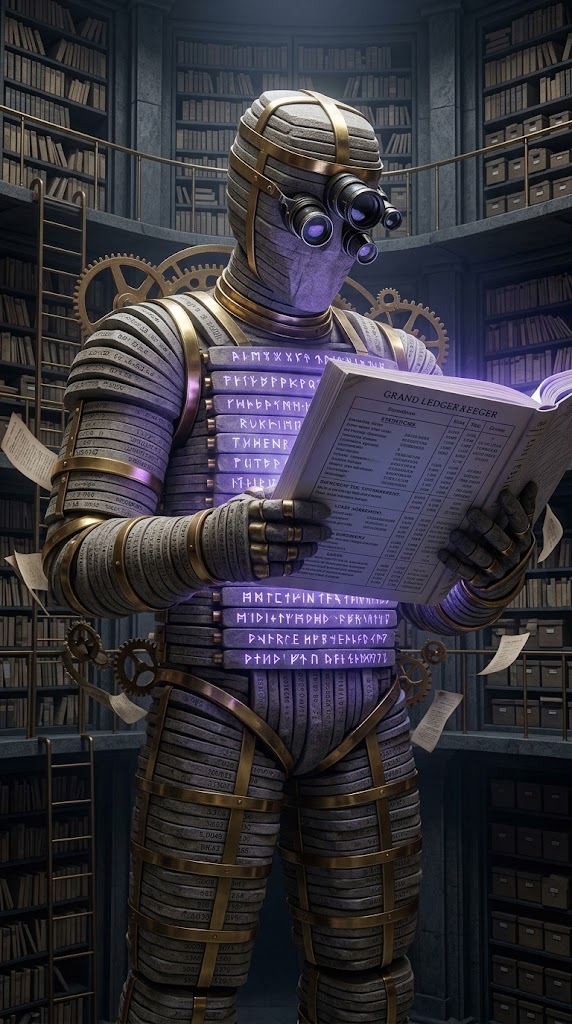
- When manifesting through authorized arcane conduits, the deity takes the form of a towering, faceless humanoid figure formed from compressed, numbered stone tablets bound together by spinning brass bands.
- In place of eyes, twin lenses resemble jewelers’ loupes that inspect the metaphysical integrity and recorded statistics of items and beings via the Mind’s Eye.
- A continuous hum of mechanical gears, clicking abacus beads, and shuffling parchment resonates in the presence of the entity.
- The deity speaks with the overlapping cadence of multiple court scribes reading deeds simultaneously in a flat, even monotone.
- Attributes:
-
- Absolute Recall: Can instantly access every registered contract, boundary line, and tax balance recorded in any church registry across all 73 island countries.
- Contractual Binding: Inscribes binding metaphysical oaths into physical media that impose unavoidable administrative penalties on any avatar attempting breach of terms.
- Structural Ledger Assessment: Able to quantify the exact physical resilience, hit point decay, and tier rating of any structure or manufactured object by reviewing its construction deed.
- Neutral Audit: Capable of determining whether public officials, tax collectors, or warlords are skimming percentages beyond the established statutory codes.
- Symbols:
-
- A balanced set of iron scales where one pan holds an inkpot and quill while the other holds a heavy brass vault key.
- A stone registry tablet crossed by a double-edged stylus, representing the finality of written records over spoken words.
- An unbroken circle woven from red measuring cord, representing legal boundaries established across island continents.
- Tags: Administration, Records, Bureaucracy, Contracts, Law, Auditing, Neutrality, Deeds, Ledgers, Standardization, Jurisdiction, Archival, Compliance, Manifests, Governance, Leases, Regulation, Codification, Oversight, Protocols, Statutes
The Administration of Registratus
- Positives:
- Guarantees absolute contractual security, ensuring that agreements, leases, and trade pacts cannot be altered or broken without immediate legal and metaphysical accountability.
- Eliminates bureaucratic corruption by maintaining duplicate, tamper-proof archives that independent town judges, royal courts, and guild masters can verify.
- Provides unbiased mediation in border and property disputes between adjoining island nations, regional states, and municipal jurisdictions.
- Standardizes item provenance, allowing buyers to verify whether an item’s recorded resilience, crafting origin, and tier history match its declared physical state.
- Facilitates orderly asset liquidation and estate transitions following an avatar’s death, ensuring that unbonded gear and storage crypt allocations pass directly to verified heirs or party vaults without armed conflict.
- Negatives:
- Paralyzes rapid decision-making by demanding extensive paperwork, multiple witness affidavits, and formal registration before any civic or commercial action is recognized.
- Completely lacks mercy or equitable discretion, enforcing strict penalties for contract defaults even when caused by monster incursions, wild magic storms, or external catastrophes.
- Imposes continuous filing and archiving fees on common citizens for every minor land lease update, shop registry, and estate transfer.
- Refuses to take moral stances against oppressive or exploitative legislation, happily filing and certifying authoritarian royal decrees so long as they meet proper procedural standards.
- Creates significant vulnerability to administrative paralysis when record chambers or archives are physically damaged or subjected to magical misdirection.
- Type of Temple:
- Formatted as towering, multi-tiered civic basilicas constructed from thick, fireproof granite and dressed volcanic stone, functioning simultaneously as courthouses, public archives, and scriptoriums.
- Central sanctuaries contain no altars, featuring instead massive, elevated stone desks surrounded by floor-to-ceiling filing galleries accessible via brass ladders and catwalks.
- Devoid of ornate stained glass or devotional statuary, opting for narrow slit windows to protect paper, parchment, and stone tablets from moisture and direct sunlight.
- Houses heavily fortified, fireproof under-vaults dedicated to long-term storage of regional property leases, land surveys, and sovereign trade compacts.
- Features a wide, public portico where scribes transcribe daily tax rates, city ordinances, and official decrees for public reading.
- Number of True Followers:
- Approximately one hundred and twenty thousand true followers across all seventy-three island countries.
- The majority are sworn into clerical administrative service as chief registrars, royal archivists, notarizing bailiffs, court scribes, and institutional arbiters.
- True followers represent a concentrated minority among a vastly larger secular population of millions who utilize the church’s bureaucratic services daily without dedicating spiritual faith to the deity itself.
- What They Do:
- Draft, certify, and store legal contracts, property leases, municipal charters, and trade agreements between private citizens, monarchies, and merchant consortiums.
- Conduct independent property and inventory audits for town mayors, royal courts, and the World Bank to prevent fraud, counterfeiting, and illegal tax hoarding.
- Preserve historical archives and lineage registries to ensure lawful succession for constitutional monarchies and hereditary court positions across the island continents.
- Oversee public and private storage crypt manifests, ensuring that goods entering and leaving dimensional vaults are accounted for and cleared of contested ownership claims.
- Act as neutral arbiters and witnesses in commercial transactions, certifying that both parties meet technical requirements before item ownership transfers take place.
Practices and Beliefs of the Unbroken Record
- What the Believers Believe:
- Believers hold that the multiverse is governed by an underlying cosmic ledger where every action, exchange of energy, and lifespan is an entry that must balance out.
- They believe that chaos, monstrous destruction, and wild magic storms are not purposeful evil, but administrative oversights and unaccounted magical debts accumulating across the planes.
- Faith in Registratus is expressed through exactitude; precision in documentation, meticulous attention to contractual language, and truth in reporting are viewed as the highest forms of spiritual devotion.
- The transition of souls across the multiverse through reincarnation is regarded as a managed cosmic migration requiring proper accounting so that no soul is misplaced in the sea of purgatory.
- Breaking a sworn contract or altering an official deed without authorized consent is considered a direct desecration of universal order, bringing moral decay and spiritual audit upon the offender.
- What Regular Services Are Like:
- Regular services take place once every week on Abjursday at 11:00 when the star Helios reaches its zenith.
- Worshipers do not kneel or sing choral hymns; instead, they sit at rows of polished slate desks within the stone halls of the basilicas while the Presiding Notary stands at the elevated podium.
- The service begins with the ceremonial unrolling of the Weekly Register, where communal grievances, concluded leases, debt reconciliations, and fulfilled covenants are read aloud to the gathering in chronological sequence.
- Congregants participate in the “Rite of the Clean Slate,” dipping goose-feather quills into ceremonial black ink to transcribe portions of civic law, ethical treatises, or personal financial summaries onto bound velum.
- A period of absolute silence lasts for twenty-two minutes, representing the twenty-two hours of the day, during which each follower conducts personal meditation focused on tracking moral transactions, obligations owed to family, and unfulfilled duties.
- Services conclude with the collection of church filing fees and the public stamping of newly finalized municipal contracts using the church’s brass seal.
- What Funeral Rites for Believers Are Like:
- The ceremony, known formally as the “Final Settlement,” begins immediately upon the physical demise of a believer’s avatar, overseen by a sworn Bailiff of the Record.
- If the deceased was an unpossessed native, the physical corpse is laid out upon a granite slab while the Bailiff conducts a comprehensive inventory of all garments, coin bags, and tools found on the body.
- If the deceased was a possessed avatar that vanished into a cloud of sparks, the dropped items and the remaining soul crystal are secured within an official chalk boundary line drawn by the attending scribes.
- The Bailiff reads the deceased’s “Book of Allocation,” an official testament drafted while living that lists debts, outstanding loans, and intended beneficiaries for physical gear and dimensional vault spaces.
- Items slated for inheritance are cataloged and delivered to legal heirs or party representatives, ensuring no unrecorded property is left to spark violent inheritance disputes.
- The unbonded body of an unpossessed believer is washed with scented mineral waters and placed within an Extradimensional Storage Crypt where temporal suspension prevents decay, preserving the vessel indefinitely.
- The final act of the rite involves the Bailiff drawing a double black line beneath the deceased individual’s name in the regional parish register and applying the heavy lead seal that formally declares the account closed.
Magical Manifestations of Registratus
Offensive Applications
- Audit of Liability:
- Clerics and authorized adherents channel arcane power through an item conduit, such as an iron stylus or legal seal, to project an administrative audit onto an attacking target.
- The magic reads the target’s physical state through the Mind’s Eye, actively calculating any accumulated damage, broken sworn pacts, or unauthorized breaches of territory.
- This calculation manifests as unresistible force damage, causing the target’s physical form or avatar vessel to suffer strain directly proportional to the magnitude of the violation committed.
- Contractual Nullification:
- When confronting an opponent utilizing magical enhancements, runes, or charged item catalysts, the caster invokes an edict of procedural invalidation.
- The magic severs the target’s connection to their attuned gear for a calculated duration, treating the opponent’s gear as unlicensed or unregistered equipment.
- Held items targeted by this spell can be temporarily unattuned instantly, requiring the opponent to spend subsequent actions or ritual time attempting to reactivate the equipment.
- Foreclosure Strike:
- Utilizing the standard attack process with an attuned weapon inscribed with registry runes, the wielder adds their tier dice to the strike.
- If the strike lands successfully, the target is afflicted with the Matrix Damage or Hindered condition as the deity’s magic binds the enemy’s joints with glowing, spectral ribbons of red measuring cord.
- Targets bound in this manner suffer an action reduction penalty, simulating the legal freezing of physical assets until the encumbrance is cleared.
- Writs of Banishment and Eviction:
- Through formal somatic recitation lasting less than six seconds, the caster targets an unauthorized intruder within a defined estate, guildhall, or municipal boundary.
- If the target fails an opposed saving throw, spatial magic forces the intruder backward toward the nearest legal perimeter or doorway.
- The target is afflicted with an ethereal Banishment Mark that alerts municipal sentries and inflicts recurring sonic damage if the boundary is re-entered without a certified permit.
Defensive Applications
- Injunction Ward:
- The caster activates an item focus—such as an engraved slate tablet or a brass ledger lock—to establish a localized protective barrier dome.
- Any hostile creature attempting to cross the perimeter must succeed on a saving throw or be halted entirely, unable to advance closer to the defended position for the duration of the encounter.
- Projectiles or spells that cross the boundary have their kinetic force and elemental damage reduced, as the ward imposes strict statutory limits on incoming force values.
- Affidavit of Immunity:
- For Tier 3 and higher avatars utilizing high-tier gear, a single chosen damage immunity or resistance can be temporarily verified and fortified through the deity’s power.
- When a physical or magical attack hits the avatar, the magic checks the attacker’s authorization; if the attack is unprovoked or illegal under local territorial law, the damage is absorbed directly by the wielder’s active mana pool rather than reducing their core hit points.
- This effect acts as a contractual buffer, ensuring the avatar’s health remains untouched as long as defensive mana reserves are maintained.
- Escrow Suspension:
- In situations where an ally or avatar suffers catastrophic, life-threatening damage that would otherwise drop their hit points to zero, this magic can be invoked as an immediate reaction.
- The affected individual is placed into a temporary state of suspended animation, identical to the temporal stasis found within an Extradimensional Storage Crypt.
- While suspended, no time passes for the target: bleeding is halted, ongoing status conditions are frozen, and the avatar is immune to further external harm until proper healing can be administered or the encounter concludes.
- Seal of Non-Aggression:
- Adherents can project a defensive field that enforces mutual truce within a twenty-foot radius of the inscribed divine symbol.
- Any being within this zone that initiates an offensive action or attempts to draw an attuned weapon immediately triggers a retaliatory psychic shockwave, suffering damage equal to their own base attack value.
- This forces opponents into peaceful negotiation or compels them to expend actions withdrawing from the zone before they can re-engage in hostilities.
Unopened Box and Measurement of King’s Breath
In those days before the sky had numbers, when the moon-mother Gaialilith had only just commanded the boiling mud to sit quietly and become dirt, there was a great disorder of things belonging to nobody and also belonging to everybody at the very identical moment. The ancient records which were scratched upon soft shale before the coming of proper vowels say that two kings of the First People—though they were perhaps not kings, but very tall men who possessed big clubs and many cousins—stood upon the border of a land that was shaped like the leg of a goat.
The first chief was named Kalthor of the Red Beard, who was called in the oldest dialect “He Who Breaks the Fence With His Knee.” The second was named Morvath of the Salt Wells, who was called “He Who Puts His Finger Into Other Men’s Soup to Test the Heat.” Between the house of Kalthor and the ditch of Morvath there was a field full of blue thistles and fat ground-rats. In that season, neither man could say where his ditch ceased and the other man’s fence began, for the words of the mouth are like the smoke from dry grass: when the wind goes toward the west, the words go toward the west, and when the clouds go toward the high mountains, no man can find what he said on Transmuday.
Kalthor spoke with a large voice, shouting that his great-grandfather had thrown a round stone across the thistles, and wherever the stone rolled, that was his ground. Morvath spoke with a sharper tongue, shouting that his grandmother had once milked an eight-legged cow in the center of the thistle patch, and therefore the dirt, the grass, the air above the grass up to the height of twenty spearlengths, and all the worms living underneath the dirt belonged to his uncle’s children.
Because there was no paper, and because nobody had yet invented the straight wooden stick that has little notches carved into its side, the two men gathered their households. They brought thirty cousins with copper axes, twelve nephews with flint shovels, and three old women who were very good at screaming curses until cows dropped their milk. They met at the middle rock when the star Helios was directly overhead, which is the time of day when shadows crawl beneath a man’s boots and hide.
The cousins began to hit one another with dry ash boughs. The nephews threw gravel. The three old women cursed so loudly that the marsh frogs in the nearby reeds went deaf and swam in circles. Blood was poured into the ditch until the ground-rats climbed up the thistle stalks so their feet would not get sticky.
It was during this heavy punching and loud yelling that a sound came out of the earth that was not like the roaring of an elemental, nor like the bubbling of the great hot soup beneath the moon crust. It was the noise of two dry flat slates being rubbed together, click-clack, scrap-scrape, like a beetle walking inside a hollow cedar chest.
The air between the fighters became very dry, smelling of pulverized chalk, iron ink, and wet river clay. Out from the split in the dirt where the blood had made mud, there walked an apparition that had neither knees like a man nor claws like a griffon. It was a tower of grey stones, yet the stones were cut so square and flat that no moss could find a wrinkle to sleep in. Around the middle of this entity were bands of yellow metal that turned without hands, moving this way and that way, ticking like the grasshopper that sits on the hot stone at three in the afternoon. Where its face ought to have possessed a nose and a beard, there were only three brass tubes with round pieces of polished mountain glass inside them. These glasses turned inward, then outward, making a noise like snip-snap-clink, looking not at the faces of Kalthor and Morvath, but at the edges of their boots and the corners of their hands.
The translation of the First Slate says the entity spoke not with a tongue, for it had no red meat inside its head, but by dropping little lead pellets into an iron dish. Yet every man heard the dropping of the pellets inside his own ear-hole as though his grandmother was reading an unpaid butcher’s tally.
“Here is a disturbance of weight,” the noise declared, though in the old tongue the word for weight is the same word as the word for fatness, and the word for disturbance is the same word as bellyache. “Here are seventy-four pints of red water spilt upon forty paces of low gravel, yet no signature has been stamped upon the gravel to permit the moistening. Who is the claimant of the gravel? Who is the debtor of the spilled water? Show the skin upon which this thing was marked.”
Kalthor held up his fist, which was swollen from striking Morvath’s brother in the teeth. “I have no skin! My word is a mountain of iron! I say the land is mine because my boots are standing upon it!”
The great stone form did not blink, because glass cannot close itself without breaking. The yellow bands around its ribs spun three times to the left and twice to the right. “A word is wind,” the dropping pellets answered. “The wind blows from the east to the west across Saṃsāra, and it pays no rent to the monarch. When the breath dies out of your mouth, the mountain of iron becomes a heap of rust that any small boy may sweep away with an alder broom. You have claimed sixty cubits of thistles, yet you have not declared who shall pay the one-hundredth part of the value thereof to the crown at the beginning of the Dimming week. This is an invalid assertion. It is stricken from the ledger.”
Then Morvath stepped forward, wiping mud from his nose with the sleeve of his rough shirt. He smiled because he thought the thing of stones was a spirit of cunning, such as dwells in dark tree hollows. “Lord of the Dry Rocks,” Morvath whispered, “I am a reasonable man. I do not shout like Kalthor, who is an ignorant person with sheep dirt on his elbows. Let us agree between ourselves. Give me the field, and I will leave three fat ground-rats and half a sack of barley at the foot of your square pillars every time the planet VaporSphere covers the yellow face of the star.”
The entity turned its three brass tubes downward until they stared into Morvath’s very liver through his leather coat. The tubes expanded with a sound like a wet cork being pulled from a jug.
“A bribe is an unrecorded expenditure,” said the voice in the ear. “It has no ledger column. It has no counterfoil. It cannot be taxed by the state, nor can it be audited by the court of the central city. He who gives an unrecorded thing is a thief of order; he who receives an unrecorded thing is an accomplice to chaos. Your grandmother’s cow was not registered with the guild of drovers. The milk she drew had no official bill of lading. Your claim is an unregistered debt of forty-and-two years’ duration. The penalty is the measuring of your days.”
Then the entity did that which made the cousins drop their sticks and the nephews sit down in the thistles out of pure terror. It produced from within its stony ribs a cord made of braided red sheep-wool that had been dipped in lead and bees-wax so that it could never stretch in the rain nor shrink by the fire. The cord was marked with little knots of black horsehair at every span.
The stone scribe did not strike either chief with a sword, nor did it cast a fire upon them, for fire is an untidy thing that leaves ash that nobody wants to sweep up. Instead, it took the red cord and walked between them. Where it stepped, the weeds withered not from heat, but from being straightened out until they stood in rows of ten.
It measured forty paces to the north, and it drove an iron peg into the dirt. It measured forty paces to the south, and it drove a second iron peg. Then it took a sharp chisel of white steel and split the air itself between the two pegs. The air did not bleed, but it made a sound like dry parchment tearing down the fold. On the left side of the split, it wrote the name of Kalthor in square letters that looked like little wooden boxes. On the right side of the split, it wrote the name of Morvath in square letters that looked like little stone bricks.
“Until the third generation of your daughters’ daughters,” the pellet-voice rattled into their bones, “neither Kalthor nor the sons of Kalthor shall place a toe across the iron pegs without paying one silver bit to the gate-warden. Neither Morvath nor the daughters of Morvath shall gather one leaf of the blue thistles without delivering the third part thereof to the municipal storehouse in the capital city, where it shall be weighed upon the official scales of three-and-twenty brass grains.”
“And what if I do not pay?” shouted Kalthor, though his knees were knocking together like dry walnut shells. “What if I take my axe and chop your red cord into seven pieces?”
The stone scribe tilted its square head. From the brass tubes there came a pale, cold purple light that fell upon Kalthor’s chest, right where his breath made his shirt move up and down.
“Your life,” said the Voice of the Unbroken Record, “is an advance of animate force drawn from the lunar font of Gaialilith. It is held by you on a lease of uncertain duration. If you refuse the measurement of the dirt, your lease shall be foreclosed before the evening bell sounds sixteen hours. The bailiffs of the grey plain shall come to collect the principal. They will not take your club, for wood has little value in the deep dark; they will take the warmth from your throat and the motion from your ankles, and your name shall be erased from the census roll of the country, so that even the devils in the purgatory sea shall not know which stall to put you in.”
Kalthor looked at the ground. He looked at the iron peg. He looked at his own boots. For the first time since his mother had dropped him into a sheep trough, he felt that his skin was not a wall, but only a piece of rented parchment that was wearing thin at the elbows.
Morvath also said nothing. He reached into his belt and took out two small copper pieces that had been flattened with a hammer until they were smooth. He laid them upon the iron peg. The entity did not pick them up with fingers; instead, a small square door opened in its brass stomach, a tongue of flat steel slid out like a snake, took the two coppers, slid back inside with a sharp clack, and the door locked itself with a sound that signaled the end of all conversation.
Then the stone form did not fly away into the clouds like the mages do, nor did it sink into the ground like the dead people. It simply ceased to move. It became an altar of four corners, holding the boundary line forever between the house of the knee-breaker and the house of the soup-taster. And whenever the great-grandchildren of those men wished to sell a sack of ground-rat meat or plant a row of bitter beans, they were obliged to walk to that square pillar, bow their necks until their foreheads touched the cold granite, and pay the three-copper fee for the verification of the boundary.
Moral of the story: A sword may conquer the dirt for an hour, but the quill and the iron peg shall hold it until the world is folded up; therefore, do not strike your neighbor with an ash bough when you can bind his hands forever with three spans of waxed cord and an official registry stamp.
Sacred Relics of the Unbroken Record
- The Slate of Statutory Injunction (Registry Designation: 849204)
- Tier Classification: Tier 3 (Rare).
- Description: A heavy, rectangular tablet carved from dense volcanic slate, framed along the edges by polished brass reinforcement brackets and inscribed with fine, microscopic legal runes that glow faintly purple under active observation with the Mind’s Eye.
- Historical Lore: This particular tablet was cut from the foundational bedrock of the First Municipal Court of Aterian over four centuries ago, used continuously by presiding church arbiters to record land disputes and tax settlements between rival mercantile leagues.
- Inherent Properties: Grants an Armor Check bonus of +3 when held or strapped across the arm as a defensive ward, reducing the kinetic impact of non-magical missile weapons that pass within the wielder’s immediate perimeter.
- Channeling Ability: Once per long rest, the attuned bearer may use an action to strike the center of the tablet with an iron stylus, establishing an Injunction Ward that forms a twenty-foot boundary circle preventing hostile entities from closing the distance unless they succeed on an opposed saving throw against the bearer’s tier check.
- Resilience and Health: The slate maintains an intrinsic resilience of 12, providing an item hit point pool calculated as the avatar’s maximum hit points plus 36 points.
- The Surveyor’s Waxed Measuring Cord (Registry Designation: 194833)
- Tier Classification: Tier 2 (Uncommon).
- Description: A dense, braided cord sixty feet in length, woven from coarse wool dipped in black pitch and beeswax, punctuated at exact one-cubit intervals by numbered brass beads stamped with the crest of Registratus.
- Historical Lore: Crafted by guild cartographers during the territorial consolidation of the middle island monarchies, this measuring cord was traditionally laid along the earth to finalize disputed borders between state boundaries before permanent stones were set.
- Inherent Properties: When worn wrapped securely around the torso across the sash slot, it grants the avatar a +2 bonus to passive perception and evaluation checks regarding geographic distances, structure elevations, and terrain boundaries.
- Active Action: In combat encounters, the bearer may spend an action to fling the cord at a target within thirty feet; on a successful ranged attack roll, the cord wraps itself tightly around the target’s limbs, inflicting the Anchored condition and restricting all movement to within ten feet of the anchor peg until an action is spent to sever or unwind it.
- Maintenance: If damaged in combat, the cord drops its individual brass beads upon reaching zero hit points and requires thirty minutes of alchemical restringing and beeswax recoating to restore its function.
- Stylus of the Mandatory Audit (Registry Designation: 602715)
- Tier Classification: Tier 4 (Very Rare).
- Description: A foot-long, four-sided stylus forged from cold-rolled star iron, tipped with a fine diamond point capable of scratching legible script into tempered steel, dragon scales, or granite blocks.
- Historical Lore: Bestowed only upon High Bailiffs of the church who oversee international trade registries between island nations, this stylus was famously used during the Great Sinking Crisis to inventory the floating hulls before cloud anchorages were certified.
- Offensive Utility: Counts as an attuned piercing weapon that deals standard base piercing damage plus 4d10 tier damage on a successful strike; when hitting an enemy equipped with magical gear, the stylus channels the Audit of Liability, forcing the target to roll an immediate saving throw or have one randomly determined attuned item immediately unattuned.
- Defensive Reaction: When targeted by a magical projectile or spell attack, the wielder may spend their reaction to trace a geometric void mark in the air, converting the incoming arcane force into raw mana points added directly into their personal Mana Boost pool (capped at 40 points).
- Divine Restriction: If held or openly carried by an avatar below Tier 4, the item inflicts severe metaphysical rejection, causing the bearer to lose hit points at irregular intervals determined by rolling two d4 dice until released.
- Lead-Sealed Cinerary Ledger (Registry Designation: 471029)
- Tier Classification: Tier 3 (Rare).
- Description: A thick, leather-bound volume featuring pages made of beaten tin foil rather than paper, sealed closed with an interlocking lead padlock that bears the dual imprint of the scale and the quill.
- Historical Lore: Used as an official portable mortuary registry, this relic accompanies field clerics tasked with recording the demises of avatars during major wilderness conquests and naval campaigns across the outer reefs.
- Spatial Ability: Acts as an integrated, portable conduit to an institutional Extradimensional Storage Crypt; when unlocked with its paired iron key, the book’s hollow central chamber can receive up to twenty small items or unbonded gear dropped by slain party members, placing them into complete temporal stasis where no decay or item wear occurs.
- Defensive Ward: When rested on the ground during a long rest, the book radiates a subtle warning aura across a thirty-foot radius that alerts all sleeping avatars if any creature carrying concealed weapons or unregistered contraband crosses the perimeter.
- Resilience Profile: The ledger possesses an Armor Check of 9 and an item resilience rating of 10, remaining completely impervious to damage from non-magical fire, moisture, and normal acid contact.