
Lore:
- Wrought by the geotechnical yamabushi of the High Crag Monasteries, this ringed staff was designed not for solitary wandering, but for the communal labor of stabilizing mountain passes, settling riverbank footings, and carving pilgrim stairs into sheer granite.
- The ascetic practitioners of the Earth-Listening Sect recognized that mudslides, sinkholes, and shifting bridge piers are symptoms of discordant earth spirits (kami) and chaotic geological stresses that can be pacified through disciplined resonance.
- Marked with the quartermaster tally “519” at the Copper-Spire Masonry Lodge, it was issued to itinerant builder-monks who surveyed cliff roads, anchored wooden bridges across deep ravines, and leveled terrace fields for alpine settlements.
- The six bronze jingling rings atop the staff are precisely weighted to sound specific acoustic frequencies that compact loose scree, detect hollow subterranean pockets, and bond lime-mortar into unyielding bedrock.
- Through daily recitation of earth-pacifying sutras and the strike of its iron heel, the staff serves as both a sacred surveyor’s rod and an indispensable civil engineering tool, harmonizing natural mountain geology with human construction.
Description:
- A five-foot-long staff fashioned from dense, oil-cured mountain oak, fire-hardened and capped at the base with a heavy, four-sided cold-forged iron heel shoe.
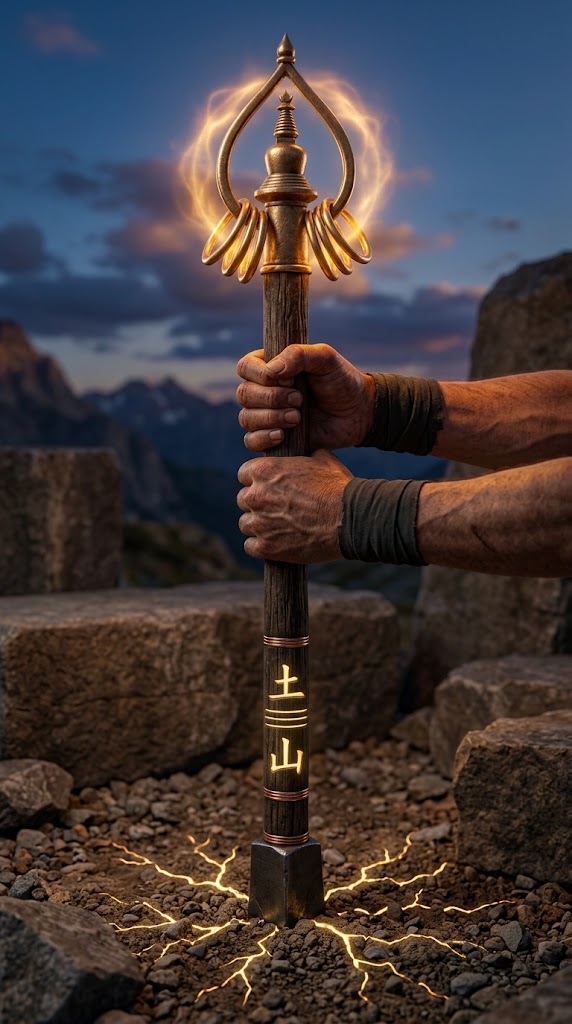
- The finial is cast from dull yellow bell-bronze in the shape of a sacred stupa surmounted by an open tear-drop frame.
- Suspended from loops along the outer curve of the bronze frame are six thick, loose bronze rings that produce a sharp, rhythmic clatter with every step or strike against the earth.
- Taoist geomantic balance lines and kanji for earth (Chi) and mountain (Gen) are deeply chiseled into the wood below the bronze collar, filled with powdered river-slate and sealed with clear pine resin.
- The shaft is marked at exact one-foot intervals with inlaid copper wire bands, allowing the bearer to use the staff directly as a calibrated surveying rod and leveling plumb.
Detailed Stats:
- Item Tier: Tier 1
- Rarity: Common
- Armor Check (AC) Contribution: +0 AC (Can be wielded in combat as an improvised quarterstaff dealing 1d6 bludgeoning damage)
- Item Health Points: Maximum Avatar Health Points plus 10 (Resilience 10 multiplied by Tier 1)
- Resilience: 10
- Weight: 4.0 pounds
- Bound Status: Unbound
- Required Attunement: Simple attunement (10 minutes of striking the iron heel into raw soil or unworked stone while chanting the Sutra of the Earth-Store Bodhisattva)
- Component Requirements: Consumes no fuel; draws upon the physical downward leverage of the user and ambient geological vibrations, though oiling the oak shaft with mountain cedar resin once per season preserves the wood’s tensile strength
Passive Magics:
- Geomantic Surveying Sense: While holding the staff upright with its iron heel resting on the ground, the bearer passively senses structural weaknesses, hidden sinkholes, hollow caverns, or loose soil layers within a 30-foot radius. The avatar gains a +2 bonus on all skill checks related to masonry, carpentry, architecture, surveying, and civil engineering.
- Unyielding Stance of the Pillar: When planted firmly with both hands into dirt, gravel, or stone, the staff roots the wielder’s center of gravity like a bridge pier. The avatar cannot be shoved, tripped, or knocked prone by non-magical physical impacts or sudden seismic tremors.
- Calibrated Gauge: The copper-inlaid shaft functions as an enchanted level and measure; the bearer can instantly determine the exact grade, slope angle, height, and load-bearing capacity of any natural or artificial structure within eyesight.
Activable Magics:
- Siphon Earth-Settling Thrum: As an action, the user strikes the iron heel firmly into loose terrain (such as deep mud, quicksand, fine gravel, or snow scree) and shakes the bronze rings. The staff emits a low-frequency hum that vibrates outward in a 15-foot radius. All loose, shifting, or difficult soil in that area immediately compacts and settles into solid, stable ground for 1 hour, removing difficult terrain penalties for anyone traversing it. This ability can be used three times per short or long rest.
- Mortar-Sealing Resonance: As an action, the user taps the bronze head of the staff against newly laid stone, brick, lime mortar, or wooden joints while reciting an architectural binding mantra. The acoustic vibration rapidly cures the bonding material within a 10-foot cube, causing wet mortar or loose timber joinery to cure and set with the strength of aged masonry in 1 minute rather than several days. Once used, this ability cannot be used again until finishing a short or long rest.
- Bedrock Anchor Strike: As an action, the user slams the iron heel into solid stone, a masonry road, or a foundation footing, uttering a grounding kiai shout. A visible shockwave of golden geomantic force radiates along the surface out to 20 feet. Up to two structures, retaining walls, bridge pilings, or cliff ledges within the area reinforce their structural integrity, doubling their durability against collapse, landslides, or siege damage for 10 minutes. Alternatively, in combat, the shockwave forces up to two adjacent hostile creatures standing on the same stone surface to make a DC 12 Dexterity saving throw or be knocked prone by the sudden pavement vibration. Once used, this ability cannot be used again until finishing a long rest.
Specific Slot:
- Weapon / Tool Slot (Carried and wielded in one or both hands, or strapped to an engineer’s walking pack)
Tags: Shugendo, Shakujo, Staff, Tier 1, Common, Tool Slot, Civil Engineering, Architecture, Masonry, Earth, Geomancy, Vibration, Attuned, Surveying, Infrastructure, Foundation, Compaction, Carpentry, Structural, Stupa, Khakkhara, Seismic, Resonance, Soil-Stabilization
Commerce and Acquisition of the Foundation-Sealing Shakujō in Saṃsāra
- High-Mountain Monastic Masonry Lodges and Earth-Listening Cloisters:
- Situated along cliffside pilgrim roads, mountain terrace aqueducts, and granite quarries, these workshops are run by monk-engineers and stonemason yamabushi.
- The staff is displayed resting across cedar pegs above a ceremonial sand garden, flanked by surveying plumb lines, stone-cutting chisels, and consecrated mortar troughs.
- Traveling builders, pilgrim guides, and visiting avatars buy the staff for an offering of 85 silver to 110 silver, while ordained yamabushi of the engineering sects, temple stonemasons, and licensed terrace-builders pay an initiate’s fee of 75 silver to 98 silver.
- Selling a well-maintained staff back to a masonry lodge earns 50 silver to 68 silver in certified World Bank credit chits, or fair barter in cold-forged wedges, heavy hemp rigging lines, and bags of hydraulic volcanic lime.
- Guild Engineering Guildhalls and Surveyor Supply Depots:
- Located in civic quarters, aqueduct hubs, and bridgeheads of expanding river settlements, these bureaucratic centers supply municipal architects, road-builders, and canal surveyors.
- The staff stands locked in a brass-fitted instrument rack alongside optical sighting tubes, brass drafting compasses, and parchment topographical charts, demonstrated by a surveyor who taps the iron heel to a loose gravel box to show rapid soil settling.
- Private contractors, foreign prospectors, and unaffiliated adventurers pay a standard commercial retail price of 100 silver to 135 silver, whereas guild-registered civil engineers, road wardens, and canal foremen receive a professional trade rate of 90 silver to 120 silver.
- Selling an uncracked shakujō to an engineering guild fetches 65 silver to 85 silver deposited into an official bank account, provided the copper surveying marks remain straight and the six bronze rings hold clear pitch.
- Frontier Road-Watch Posts and Mountain Pass Pioneer Stations:
- Stationed at landslide-prone mountain gaps, wooden trestle spans, and frontier palisades, these practical depots equip pioneer corps and maintenance garrisons tasked with keeping trade arteries clear.
- Quartermasters issue the staff to path-clearing crews to tamp down fresh road ballast, shore up timber retaining cribs, and identify subterranean cavern collapse zones before heavy ox-drawn freight trains pass.
- Because functional earth-compacting tools are vital for frontier survival, outright purchase costs run high at 115 silver to 145 silver, while contracted road-menders and military pioneers can requisition one for a bonded deposit of 102 silver to 130 silver.
- Selling a salvaged or retired staff to a frontier post brings 70 silver to 92 silver in local frontier scrip, dried travel rations, draft-beast harness gear, or World Bank coin.
- Under-Canal Reclamation Yards and Masonry Salvage Vaults:
- Found beneath wet dock basins, flooded canal gates, and subterranean drainage vaults, these damp emporiums deal in heavy construction tools, quarry surplus, and reclaimed estate foundation timber.
- Pawnbrokers sell the staff to tunnelers, canal smugglers, and underground foundation-jacks who prize an implement that can instantly spot hollow ceiling faults and solidify wet, collapsing mud walls during illegal excavations.
- Prices swing based on recent tunnel collapses or flash floods; a water-stained staff with scratched wood can be obtained for 75 silver during quiet dry seasons, but rises to 130 silver when sewer collapses or dam breaches threaten the lower districts.
- Reclamation brokers purchase intact staffs with few questions asked for 45 silver to 62 silver in loose silver coin, rough copper bars, or unrefined quarry ingots to bypass municipal World Bank oversight.
Roleplay Applications and Field Operations of the Foundation-Sealing Shakujō
- Unstable Scree Slopes, Mudslide Gullies, and Alpine Cliff Roads:
- Defensive Roleplay:
- When a sudden rockfall or mudslide threatens to sweep the party down a steep mountain incline, the avatar plants the iron heel deep into the slope, anchoring their stance via Unyielding Stance of the Pillar so companions can tether safety lines directly to their waist.
- Facing loose, shifting scree that causes allies to lose their footing or slide toward a precipice, the user activates Siphon Earth-Settling Thrum, driving the staff into the ground to instantly bind the sliding gravel into packed, navigable stone steps for an hour.
- If a hillside road begins to shear away beneath a wagon team, the user invokes Bedrock Anchor Strike, sending a golden shockwave into the retaining shelf to lock the fracturing rock in place long enough to haul the cargo to safety.
- Offensive Roleplay:
- When pursued across a hazardous shale slope by mountain skirmishers, the avatar leads enemies onto an unstable gravel shelf, waits for them to close, and slams the iron shoe down using Bedrock Anchor Strike; the seismic ripple knocks the pursuers prone, sending them skidding down the scree while the avatar remains rooted.
- Utilizing Calibrated Gauge, the user spots natural fault lines in the rock face hanging directly above a hostile encampment, then uses the staff’s heavy iron heel to tap a precise harmonic strike into the rock, triggering a controlled, localized rockslide that flattens barricades and cuts off enemy egress.
- Defensive Roleplay:
- Subterranean Mining Adits, Ancient Vaults, and Natural Caverns:
- Defensive Roleplay:
- Navigating old, creaking mineshafts, the avatar holds the staff upright, using Geomantic Surveying Sense to listen to the vibrations in the iron heel, quietly warning the group away from rotting cross-timbers, hollow floor pockets, or hidden sinkholes before anyone takes a false step.
- When a tunnel ceiling fractures during a cave-in, the avatar props the heavy oak staff against the failing lintel, bracing the load-bearing stone with Unyielding Stance of the Pillar to prevent the corridor from collapsing entirely on retreating allies.
- If an explosion or seismic tremor threatens to seal the party inside a chamber, the user strikes the door arch with Bedrock Anchor Strike, doubling the structural durability of the stone lintels and keeping the escape route open.
- Offensive Roleplay:
- In tight stone tunnels, the avatar uses the heavy four-sided iron heel as a hard-hitting bludgeon, leveraging the staff’s balance to parry brute swings and drive crushing strikes into the armored joints of subterranean constructs or burrowing beasts.
- Facing a phalanx of tunnel-dwellers holding a fortified stone choke point, the user strikes the bedrock with Bedrock Anchor Strike; the resulting shockwave travels straight through the granite floorboards, bowling the frontline defenders onto their backs and shattering their shield line.
- Defensive Roleplay:
- Flooded Riverbeds, Silt Basins, and Delta Quicksand:
- Defensive Roleplay:
- While fording swollen, muddy estuaries or treacherous delta marshes, the avatar probes the river bottom with the copper-banded shaft, using Calibrated Gauge to measure silt depth and locate firm subterranean clay bars for the party to walk on.
- If an ally steps into deceptive quicksand or deep river mud, the avatar strikes the adjacent silt with Siphon Earth-Settling Thrum; the low-frequency hum instantly compacts the waterlogged slurry into solid, dry ground, allowing the trapped companion to step out freely.
- When water surges undermine a riverbank or bridge footing where the party is taking shelter, the user sounds the staff’s bronze rings to deaden the hydraulic erosion, keeping the embankment from giving way under their boots.
- Offensive Roleplay:
- When ambushed by predatory amphibious beasts or swamp raiders wading through mud, the avatar uses Siphon Earth-Settling Thrum strategically: they allow the foes to wade into loose muck, then strike the heel down, rapidly compacting the slurry around the enemies’ lower legs to trap them waist-deep in hardened silt.
- Wielding the heavy oak pole with two hands, the avatar sweeps the iron-shod base across the water’s surface, striking muddy foes in the midsection and driving them down into the newly compacted, solid river floor.
- Defensive Roleplay:
- Frontier Timber Forts, Wooden Bridges, and Pallet Barricades:
- Defensive Roleplay:
- During a siege or raid on a frontier outpost, the avatar rushes to freshly damaged palisade walls or makeshift timber gates, tapping the bronze stupa head against the timber joints to trigger Mortar-Sealing Resonance, instantly bonding the joinery and timber pegs with the rigidity of centuries-old structural timber.
- If sappers or siege beasts strike the timber support posts of an elevated catwalk, the avatar anchors the footings using Bedrock Anchor Strike, ensuring the bridge or gantry does not collapse under the weight of defensive archers.
- Standing atop an arrow-riddled wooden parapet, the avatar remains anchored against concussive ballista bolts, letting the staff bleed kinetic force straight into the fort’s earthworks.
- Offensive Roleplay:
- During an assault on a hostile wooden stockade, the avatar uses Calibrated Gauge to instantly spot the single critical load-bearing timber holding up an enemy watchtower.
- The avatar sprints forward under cover, drives the iron shoe directly into the base of the key upright timber, and channels Bedrock Anchor Strike to fracture the joint with localized harmonic vibration, toppling the entire watchtower onto the courtyard defenders below.
- Defensive Roleplay:
- Urban Masonry Streets, Stone Bridges, and Aqueducts:
- Defensive Roleplay:
- When city enforcers or heavy war wagons charge the party across an arched stone bridge, the avatar plants the staff firmly between the paving stones, using Unyielding Stance of the Pillar to hold the bridge center like a monolith, physically turning aside horses and shield charges without being pushed back an inch.
- If an enemy demolition team or siege spell damages an aqueduct pillar near civilians, the user applies Mortar-Sealing Resonance to the cracked stone course, instantly setting the crumbling mortar to prevent catastrophic structural failure.
- When navigating paved city streets rigged with pit traps or subterranean sewer breaches, Geomantic Surveying Sense detects the hollow voids through the flagstones, allowing the user to guide allies safely around hidden traps.
- Offensive Roleplay:
- Cornered in an alley between tall brick tenements, the avatar slams the iron heel into the paved cobblestones with Bedrock Anchor Strike; the directional shockwave rattles the street, knocking pursuing mercenaries flat and sending loose masonry and decorative roof tiles raining down upon the attackers’ heads.
- The avatar hooks the bronze stupa finial around the ankles of an enemy commander, using the staff’s calibrated leverage to sweep their feet out from under them, then drives the four-sided iron heel into their breastplate to pin them firmly against the stone pavers.
- Defensive Roleplay:
Perception of Activation:
- Visual Perception:
- User’s Perspective:
- As both hands grip the oak shaft and the iron heel strikes the earth, a warm, golden halo of geomantic light ignites around the bronze stupa finial, curling along the teardrop frame in steady, radiant waves.
- The carved kanji for Earth (Chi) and Mountain (Gen) cut into the wood blaze with a crisp, molten-amber luminescence, casting sharp shadows across the wielder’s forearms.
- Golden fracture lines of pure vibrational energy radiate outward from the four-sided iron shoe through the soil, scree, or stone pavers, visibly knitting together fractures, settling loose gravel, and drawing structural fault lines into tight, interlocking geometries.
- The avatar sees glowing geometric grid lines and load-bearing stress paths shimmering across nearby masonry walls, cliff faces, and foundations, illuminating natural shear planes in bright gold.
- Observer’s Perspective:
- Bystanders see the heavy staff strike the ground with sudden authority, sending a circular crown of amber fire swirling through the six hanging bronze rings.
- Cracks in nearby mortar, brickwork, or loose shale appear to close and solidify as luminous golden veins race through the earth, locking loose debris into place as though cemented by molten rock.
- The user’s posture and lower body take on a monumental, immovable presence, with fine dust puffing outward in concentric rings around their planted boots.
- Positives:
- Clearly illuminates structural integrity, mortar faults, and foundation stress lines in dark tunnels or night-time construction sites.
- The golden ground-fractures give immediate visual confirmation of the boundary and reach of the compacted, reinforced terrain.
- Negatives:
- The bright amber flare from the stupa finial and ground lines instantly dispels stealth and draws attention across open quarries or mountain ridges.
- Staring directly down at the blazing kanji and ground fractures in pitch-black subterranean adits can cause temporary afterimage spots in the user’s vision.
- User’s Perspective:
- Auditory Perception:
- User’s Perspective:
- The six bronze rings clatter sharply against the central stupa, followed by an immediate transition into a sustained, deep bass resonance that hums directly through the wielder’s wrists, shoulders, and chest cavity.
- The jarring crunch of shifting scree or grinding stones instantly drops into dead silence as the ground locks together, replaced by a solid, dull thud like hitting an enormous block of granite.
- Subtle shifting noises within walls—such as hollow pockets, settling earth, or termite tunnels—manifest as distinct hollow echoes that contrast against the dense ring of solid stone.
- Observer’s Perspective:
- Observers hear a heavy, rhythmic chime of ancient temple bells combined with a low, earth-shaking rumble like a distant subterranean quarry blast.
- Loose stones and tumbling gravel in the vicinity stop their clatter immediately, settling with an abrupt, decisive snap into the earth.
- Positives:
- The resonant bell tone can serve as an audible surveying beacon or distress call for subterranean work crews separated by cave-ins.
- The deep harmonic deadens sudden high-pitched seismic shrieks, rockfall squeals, or deafening tunnel echoes.
- Negatives:
- The low-frequency chime carries through solid bedrock for hundreds of paces, alerting underground creatures and tunnel patrols to the user’s precise position.
- In tight, enclosed stone vaults, the sustained resonance can cause mild ringing in the user’s ears if continuously channeled.
- User’s Perspective:
- Olfactory Perception:
- User’s Perspective:
- The strike releases a rich, dry aroma of freshly cleaved granite, pulverized river-slate, and dry clay dust, backed by a warm hint of baked pine resin from the treated oak shaft.
- When sealing mortar, the user smells a sharp, alkaline scent of quick-curing hydraulic lime and volcanic ash heating up in the air.
- Observer’s Perspective:
- Those nearby catch the clean, grounding scent of sun-baked bedrock, dry soil, and cooling masonry, reminiscent of an ancient temple foundation after a summer thunderstorm.
- Positives:
- Masks the foul stench of sewer gasses, damp cave molds, or subterranean rot during engineering inspections.
- Negatives:
- The pungent scent of hot lime and crushed stone dust can provoke sneezing fits or dry nasal passages in dust-sensitive individuals.
- User’s Perspective:
- Gustatory Perception:
- User’s Perspective:
- The wielder experiences a clean, dry, mineral-rich taste on the tongue, comparable to licking a smooth mountain pebble or inhaling the dry mist off a newly carved whetstone.
- Saliva thickens slightly, leaving an earthy, alkaline chalkiness at the roof of the mouth.
- Observer’s Perspective:
- Observers standing within the golden shockwave occasionally lick their lips to taste a faint trace of fine mineral dust suspended in the dry air wash.
- Positives:
- Eliminates nauseating tastes caused by noxious swamp gasses, canal effluence, or putrid subterranean damp.
- Negatives:
- Leaves a persistent, dry mineral coating on the tongue that prompts a need to rinse the mouth with clean water afterward.
- User’s Perspective:
- Tactile Perception:
- User’s Perspective:
- The oak shaft pulses with a firm, rhythmic tremor that travels into the user’s palms, relieving wrist soreness and locking their center of gravity downward like a heavy plumb bob.
- The soles of the feet feel an immediate sense of ironclad stability; the ground beneath their boots shifts from unstable muck or slippery scree into unyielding, dense bedrock.
- A subtle warmth radiates through the oil-treated wood into the hands as the geomantic currents ground into the earth.
- Observer’s Perspective:
- Observers feel a sharp, clean jolt pass through the floor beneath their boots, followed by the sensation of walking across a flat granite slab rather than loose soil.
- If standing within the compaction radius, bystanders feel loose footing suddenly grip their boot soles with immense solidity.
- Positives:
- Grants absolute stability, eliminating vertigo on narrow cliff ledges and preventing slips on loose gravel.
- Absorbs all violent kickback, ensuring the strike does not jar the user’s shoulders or elbows.
- Negatives:
- The extreme downward rooting makes it difficult to pivot quickly into a sprint during the immediate heartbeat following the strike.
- Prolonged resonance through the hands can leave a mild, pins-and-needles numbness in the fingertips after extended engineering shifts.
- User’s Perspective:
- Extra-Sensory Perceptions:
- Mind’s Eye Perception:
- User’s Perspective: Looking inward through the Mind’s Eye, the terrain is mapped as a three-dimensional wireframe lattice of stress vectors and compression forces; weak joists, hollow voids, and unstable soil appear as flickering red fractures that instantly knit together into stable, solid blue arches.
- Observer’s Perspective: Observers viewing through psychic or meditative sight see the avatar take on the spiritual mass of an immense stone stupa, anchoring the surrounding room or hillside with thick, golden pillars of geometric force rooted to the planetary core.
- Positives: Allows instant, non-destructive diagnosis of hidden structural flaws, sinkholes, and load capacities without invasive excavation.
- Negatives: The sheer volume of architectural geometry and geological shear vectors can cause minor mental fatigue during prolonged architectural surveying.
- True Sight (Ultraviolet Spectrum):
- User’s Perspective: In the ultraviolet spectrum, the bronze finial emits a coronal discharge of deep amber and violet auroral threads, which spiral down the shaft and branch across the bedrock like an intricate root system anchoring an ancient oak.
- Observer’s Perspective: True Sight reveals a dense, rotating geomantic mandala hovering around the stupa crown, pinning stray earth spirits (kami) and chaotic kinetic vibrations into harmonious, immobile alignment.
- Positives: Clearly defines the exact boundary of the soil-stabilization field, ensuring the engineer knows which sections of ground have achieved complete compaction.
- Negatives: The intense ultraviolet radiance of the ground branches can momentarily obscure faint, low-intensity ethereal spirits or lingering apparitions nearby.
- Soul Sense / Spiritual Attunement:
- User’s Perspective: The soul aligns with the immovable resolve of the Earth-Store Bodhisattva (Jizō); the avatar experiences a tranquil, enduring patience, perceiving buildings, bridges, and mountain paths as sacred shelters for weary travelers rather than mere dead stone and timber.
- Observer’s Perspective: Sensitives nearby perceive an aura of profound calm, weight, and shelter radiating from the user—feeling the urge to steady themselves against the avatar as if resting against an ancient stone boundary marker.
- Positives: Provides total immunity to panic, vertigo, and fear induced by earthquakes, catastrophic bridge collapses, or crushing heights.
- Negatives: The profound mental anchoring can slightly slow spontaneous emotional expression and reduce agility when quick, flexible diplomacy is required.
- Mind’s Eye Perception:
Crafting Recipe: Shugendo 519 of the Foundation-Sealing Shakujō
Materials Needed:
- Cured Mountain Oak Heartwood (1 pole, 5 feet long, 1.25 inches in diameter) – Straight-grained, dried slowly over alpine cedar smoke to resist warping, moisture rot, and impact fractures.
- Bell Bronze Ingot (3.0 pounds) – High-copper casting bronze alloy formulated for clear acoustic pitch, durability, and resonance.
- Cold-Forged Bog Iron Block (1.5 pounds) – Low-impurity iron stock to forge the heavy four-sided protective heel shoe.
- Conductive Copper Wire (10 feet, 18-gauge) – High-purity wire drawn for inlaying measurement bands, leveling guides, and geomantic lines.
- Pulverized River-Slate Powder (2 ounces) – Fine slate silt mined from mountain gorges, used as an energetic mineral pigment for carved kanji inlays.
- Tier 1 Magic Crystals (2 units, coin-sized) – Earth-, stone-, or vibration-attuned crystals harvested from Tier 1 subterranean entities, serving as sacrificial catalytic anchors.
- Natural Clear Pine Resin Lacquer (2 fluid ounces) – Distilled pine sap used to waterproof the wood, seal carved runes, and bind mineral pigments.
- Mountain Linseed Oil (4 fluid ounces) – Deep-penetrating drying oil for curing and preserving the oak shaft against splitting.
Tools Required:
- Wood Lathe and Hand Drawknives – For turning, tapering, and finishing the cylindrical oak shaft to precise dimensional tolerances.
- Portable Charcoal Foundry, Crucible, and Tongs – For melting, alloying, and pouring the bronze stupa finial and loose rings.
- Jeweler’s Chisels, V-Groove Gouges, and Gravers – For cutting geomantic channels, one-foot increment marks, and kanji into wood and metal.
- Blacksmithing Anvil, Tongs, and Hand Sledge – For hot-forging, shaping, and seating the four-sided iron heel shoe.
- Agate Mortar and Pestle – For pulverizing catalytic crystals and river-slate into micro-fine setting powder.
- Leather-Lined Bench Vise – For securing the irregularly shaped bronze finial and shaft without marring the surfaces.
Skill Requirements:
- Woodworking / Joinery: Level 5 or higher – For turning the oak shaft, profiling the tenons, and cutting precision wire-inlay channels.
- Metal Casting and Blacksmithing: Level 6 or higher (Minimum level 5 required for metallurgical work, plus 1 additional level to achieve the Tier 1 item outcome) – For casting the hollow stupa finial, hot-forging the four-sided iron shoe, and making six identical acoustic bronze rings.
- Civil Engineering / Architecture (Surveying): Level 2 or higher – For accurately calibrating the one-foot increment bands and alignment marks along the staff.
- Geomantic Rites / Alchemical Ritual: Level 1 or higher – For preparing the mineral slurry, charging the iron heel with catalytic crystals, and performing the harmonic attunement.
Crafting Steps:
- Shaping, turning, and curing the oak shaft:
- Mount the cured mountain oak blank on the lathe, turning it to a uniform 1.25-inch diameter with a slight ergonomic taper toward the upper grip.
- Cut a sturdy cylindrical tenon at the top to receive the bronze finial collar, and shape a four-sided tapered tang at the base for the iron shoe.
- Hand-rub three coats of warm linseed oil into the wood grain, allowing each layer to dry completely over 24 hours to maximize impact resistance.
- Forging and mounting the four-sided iron heel shoe:
- Heat the bog iron block in the charcoal forge until glowing cherry red.
- Draw the iron out on the anvil into a heavy, four-sided pyramid-topped cap with a hollow socket matching the base of the oak staff.
- Quench the finished shoe in cold snowmelt water to harden the striking face, polish off scale, and heat-seat the shoe onto the staff’s bottom tang, pinning it through the wood with a transverse iron rivet.
- Casting and chasing the bronze stupa finial and rings:
- Carve a lost-wax investment mold for the central stupa finial, teardrop frame, and six integrated suspension eyelets.
- Melt the bell bronze in the crucible and pour the finial casting, along with six separate circular bronze rings.
- Break the mold, clean the castings with wire brushes, and chase the stupa surface with fine chisels to sharpen the architectural ridges.
- File the inner joints of the six bronze rings smooth and loop three rings onto each side of the teardrop frame, ensuring they swing freely and strike the frame with a crisp, bright acoustic chime.
- Seat the bronze finial onto the upper tenon of the oak shaft, securing it with natural resin and two hidden bronze dowels.
- Cutting calibration bands and geomantic kanji:
- Using an architect’s rule, scribe exact one-foot intervals from the base of the iron shoe to the top of the shaft.
- Cut shallow channels at each mark, hammer in the conductive copper wire, and burnish it flush with the surface of the wood.
- Chisel the Taoist geomantic alignment lines and the kanji for Earth (Chi) and Mountain (Gen) into the lower third of the staff above the iron shoe.
- Blend the pulverized river-slate powder with natural pine resin lacquer to create a dark mineral slurry, press it firmly into the carved runes, and let it cure to a durable, stone-like finish.
- Sacrificial crystal awakening and harmonic bedrock attunement:
- Crush one coin-sized Tier 1 magic crystal in the agate mortar into a fine, glowing flour.
- Blend the crushed crystal with hot pine resin and fill the internal cavity between the bottom iron shoe and the oak wood tang, permanently sealing the energetic conduit.
- Place the second intact Tier 1 crystal inside the hollow central chamber of the bronze stupa head.
- The artisan kneels upon exposed bedrock or unworked mountain stone, holding the staff upright with both hands and striking the iron heel rhythmically against the stone while chanting foundational earth-store mantras for one exploration turn (10 minutes).
- As the acoustic vibration reaches resonance with the surrounding rock, the crystal within the stupa head dissolves into warm golden light, permanently fusing with the bronze alloy.
- Verify completion by striking the staff firmly into loose gravel: confirm that the six bronze rings chime in sustained harmonic unison, the carved kanji ignite with amber luminescence, and loose scree within 15 feet instantly settles and compacts into dense, level ground.
Heavy Ringed Stick of Deep Root-Pillar Which Fastened Slipping Mountain 519
In the time before the water had dug the great ditch between the two red hills, the ground was very wet and loose like cold porridge in an old dog’s bowl. The stones did not know how to sit together upon their flat bellies; whenever the sky wept two bowls of water, the top of the big ridge would slide down into the cooking-pots of the ditch-people, and all their dried fat-meat was drowned in red mud.
The people of the low ditches were having much coughing and bitter lungs. They took long sticks of wild willow-wood and drove them into the wet dirt with heavy river-stones, saying: “We will build a high road upon eight wooden legs so our grandmothers may walk to the salt-hole without sinking their knees into the yellow grease.” But when six fat oxen walked across the sticks, the legs of the wood went sideways like a drunken duck, the middle split with a dry screaming noise, and forty sacks of white grain tumbled down into the boiling silt where the river-worms ate it all up.
Then the master of the mud-ditch, whose mark was Three Crooked Thumbs, took a pot of hot pig-fat to the foot of the High Granite Tooth and cried out with his beard shaking: “O you who sit upon the dry crag where no melon grows, why do you let the earth turn to soup under our sandals? We have no dry place to bake our brick-loaves, and our stone storehouse has broken its neck in the night!” But the mountain only threw down three small pebbles that struck him upon the bald crown of his head, because the stone does not listen to the squeaking of fat men.
Now there walked down from the cold cloud-pass an ascetic man whose knees were gray and calloused like the feet of an old mountain tortoise. His name in the ancient scratched cuts was The Man Who Sits Upon the Fault-Line. He had no woolen blanket, and his mouth ate only bitter pine-nuts and the gray dust scraped from the bellies of mountain rocks. For forty-and-nine snow-seasons he had stood with his heels pressed hard against the great crack where the east mountain pulls away from the west mountain, watching how the stone grows tired and slips down into the abyss.
He saw the ditch-people weeping over their broken timber-legs and their drowned grain-bags. The hermit shook the dried moss from his ears and spoke to a blind mole crawling through the gravel: “These digging men have heads made of dried squash. When the mountain shifts its shoulder, they strike it with little copper chisels and weep because the dirt does not turn into dry bread. If a wall is built with crooked thoughts and thin grease, the sky will push it flat with one finger. To hold the house, you must teach the scattered dust how to sleep like a single mountain.”
Then the old hermit went into the deep canyon where the mountain oak grows twisted by the north gale, so hard that the iron axe-head bounces back and bites the foot of the woodsman. He cut a branch five cubits long, thick like the wrist of a plow-driver, and held it over the smoke of alpine cedar-resin until the wood became black and oily like the skin of a smoked eel.
He walked down into the red ditch where the wild copper boils in the earth’s pot. With two tongs of crooked horn he pulled out three lumps of the yellow ringing metal and beat it between two hard stones until he made the hollow shape of the sacred stupa-spire, surmounted by an open tear-frame like the eye of an ox. Along the edges of the frame he hung six round rings of the same singing metal, loose and thick, so that when they shook together they made a sharp chatter like the noise of dry hail dancing upon an iron kettle.
Then he went into the black peat-bog where the cold earth-iron sleeps in the muck. He dug up a square block of the heavy bog-iron, heated it cherry-red in a fire of mountain charcoal, and hammered it upon an anvil-stone until it became a four-sided shoe with a sharp pyramid point. This he wedged upon the foot of the oak staff, driving an iron nail through its belly so that the wood and the iron might never be parted by water or stone.
Along the shaft he cut five notches at the distance of one human foot, and into the wood he beat ten cubits of red copper-wire so that the staff might know the straight measure of all things. Near the iron shoe he scratched with a sharp flint the two holy marks: the mark of the Deep Earth (Chi) and the mark of the Mountain Roof (Gen). Into the grooves he rubbed the gray flour of crushed river-slate mixed with sticky pine-juice, until the marks sat flush and hard like the shell of a beetle.
He took his stone hammer and scratched upon the wood the tally marks: five scratches, one scratch, and nine scratches, which was the number of times the high snow-peak had roared and dropped its white wool down the cliffs since the first builder was born.
Then the Great Builder of the Mud-Ditch, whose skin was rich with sheep-oil, came out with twenty men holding heavy ashwood mallets and long iron-shod poles.
“Look upon this old mountain-crow who brings a broomstick to an engineering task,” laughed the Builder with a mouth full of salt-pork. “We have driven forty cedar trunks into the river-bank, yet the mud swallows them like worms in a goose’s crop. What will this gray hermit do with six brass rings and a piece of burned firewood?”
The old hermit did not lift his chin to shout, nor did he ask for a bowl of roasted barley. He walked into the middle of the quaking bog where the water ran red through the yellow clay, where no horse dared set its hoof for fear of being sucked into the deep stomach of the earth.
The ground shook beneath his bare soles, and a great crack opened in the silt, spitting cold brown water three cubits into the air. The timber bridge that the ditch-people had built began to lean sideways; its wicker cords snapped with a noise like breaking bones, and the heavy granite footings began to roll down toward the black cataract.
The ditch-people threw their sheep-coats over their eyes, wailing: “The great gullet of the marsh is open! It will eat our village, it will swallow our hearth-stones, and our bones will rot with the river-leeches!”
The hermit stood upright upon the shaking crust. He raised the staff high with both hands, letting the six bronze rings clatter and ring out six times against the bronze stupa, filling the valley with a sound like a great temple bell struck beneath cold water. Then, pulling his navel hard against his spine, he brought the four-sided iron heel down with a terrible thud into the center of the trembling muck.
A golden circle of hot light leaped out from the bronze stupa head, wrapping around the tear-frame like a burning halo. The chiseled cuts of Chi and Gen upon the oak flared with the color of boiling honey.
From the iron point beneath his heels, a sound went forth into the earth—not a sharp crack, but a long, heavy thrum that made the teeth of the ditch-people vibrate inside their gums. Visible golden veins of lightning-like fire raced through the wet muck, branching outward like the roots of a giant cedar.
Where the golden veins touched the soup-like mud, the water did not boil; instead, it fell silent. The yellow grease stopped sliding. The loose sand, the slippery clay, and the wet river-pebbles were drawn together by the deep hum, snapping together with thousands of tiny dry clicks like the teeth of a hungry skull closing upon a nut.
In the space of twelve heart-beats, the quaking bog for thirty cubits around the hermit’s sandals turned gray, dry, and dense. The muck became as solid as the granite cliffs of the High Crag. The sinking cedar posts of the bridge stopped their slipping; the wet stone piers were gripped by the hardened ground as though held in a vice of old lime-mortar.
The Builder of the Mud-Ditch dropped his ashwood mallet into the dirt. His eyes became round like two white turnips, and his grease-fattened belly trembled beneath his tunic.
“The old crow has put an iron tooth into the world’s skull,” he whispered, holding his thumbs between his knees. “He has frozen the water-dirt into a stone road without building a single lime-kiln!”
The hermit stepped forward upon the ground that had been soup only a breath before. The earth did not yield under his bare toes; it rang dry and clear like an ancient pavement. He walked to the cracked pier of the great wooden bridge, where the stones had separated and were spilling their mortar like dry meal.
He took the bronze head of the staff and tapped it against the fractured joints three times, murmuring the secret words that teach the lime-dust how to cling to the river-pebble.
Where the bronze stupa touched the stone, the crumbling gray mortar began to smoke with a sweet smell of baked pine-gum and river-silt. The cracks closed. The wet mortar set hard and white in the blinking of an eye, turning the loose heap of river-stones into a single, seamless rib of bedrock that no winter flood could shake.
Then the old ascetic planted the iron heel firmly between two stones at the bridge-head, resting his calloused palms upon the bronze top. He looked down at the twenty builders who were kneeling in the dry dust with their mouths wide open.
“You dig into the mud like blind badgers,” the hermit spoke, his voice sounding like two dry boulders grinding together in an eddy. “You build high towers of soft wood upon foundations of water, and when the mountain shakes its back to cast off the winter ice, you curse the sky because your toothpick houses tumble down.
“The stone does not belong to the builder; the builder belongs to the stone. If you do not listen to the breath of the bedrock, your walls are merely graves waiting to fall upon your children. A bridge is not held by forty ropes of braided grass; it is held by the quiet bond between the deep root and the immovable rock. Put away your soft willow-pegs and your crooked measurements. Go down until your iron strikes the living bone of the world, and there build your road, or build nothing at all.”
When the sun dipped behind the western snow-wall, the people of the mud-holes ran to their storehouses and returned with three bronze pans of yellow honey-cakes and five jars of sweet mountain-wine to set before the holy engineer.
But when they reached the bridge-head, there was only the cold granite road, solid and unyielding beneath the rising moon. The hermit was gone. Only the five-foot mark was pressed into the stone where he had stood, and from far up the dark mountain pass, carried on the cold night wind, came the sharp, rhythmic clinking of six bronze rings striking against an iron path.
Moral of the Story: He who builds upon the shifting surface with haste and pride will see his labors drowned in the mud of the first storm, but he who seeks the quiet bedrock and anchors his work with disciplined measure will fashion a foundation that outlasts the mountain itself.
Suggested conversions to other systems:
Call of Cthulhu (7th Edition)
Staff of the Foundation-Sealer
- Item Classification: Arcane Artifact / Geomantic Instrument
- Weapon Skill: Fighting (Brawl)
- Damage: 1D6 + Damage Bonus
- Weight: 4.0 lbs
- Sanity Loss: 0 to carry or tap for surveying. Witnessing quicksand or fluid mud instantaneously solidify into dry, load-bearing granite bedrock under the strike of the iron heel costs 0/1 Sanity.
Game Mechanics:
- Geomantic Surveying Sense (Passive): Holding the staff upright with the iron heel resting on earth or stone grants a bonus die (+1D) to Geology, Archaeology, Navigate, and Art/Craft (Carpentry, Stonemasonry, or Civil Engineering) rolls made to evaluate terrain stability, structural flaws, mineshaft integrity, or concealed subterranean voids.
- Unyielding Stance (Passive): When planted firmly with both hands into dirt, gravel, or stone, the investigator gains a bonus die (+1D) to STR or DEX rolls made to resist being knocked down, shoved, or displaced by physical shockwaves, falls, or sudden seismic tremors.
- Siphon Earth-Settling Thrum (Active): The investigator spends 2 Magic Points and strikes the iron heel into loose terrain (quicksand, deep mud, loose scree, wet silt). All shifting or difficult terrain in a 5-yard radius settles and compacts into dense, solid ground for 1 hour. Any person trapped or bogged down in the area is instantly freed.
- Mortar-Sealing Resonance (Active): By tapping the bronze stupa head against cracked brickwork, lime mortar, or wooden joinery while expending 2 Magic Points, the acoustic chime causes the bonding materials within a 3-yard cube to cure immediately, restoring structural integrity and resetting compromised door lintels, cracked retaining walls, or tunnel timbers to full strength.
- Bedrock Anchor Strike (Active): Once per day, the user expends 3 Magic Points and slams the iron heel into stone with a grounding kiai. A golden shockwave travels through the bedrock out to 6 yards. Up to two structures, retaining walls, or bridge pilings in the area double their structural integrity against collapse or explosive demolition for 10 minutes. Alternatively, in combat, up to two hostile targets standing on the same stone floor within 6 yards must pass a Hard DEX roll or be knocked Prone by the sudden seismic pavement wave.
Blades in the Dark
The Foundation-Sealing Shakujō
- Classification: Arcane Implement / Geotechnical Tool
- Load: 2 Load (Heavy staff carried in two hands or strapped to an engineer’s walking rig)
- Quality: Tier I fine item
Item Features:
- Fine Craftsmanship: A fire-hardened mountain oak staff tipped with a four-sided bog-iron shoe, inlaid with copper measurement bands, and capped with a cast-bronze stupa holding six free-swinging bronze rings.
- Resonant Anchor: Vibrational magic grounds structural faults, detects hollow spaces, and forces loose sediments to lock into solid rock.
Game Mechanics:
- Structural Surveying (Passive): You gain Potency when using Study, Survey, or Tinker to inspect tunnel stability, map hollow sewer vaults, detect hidden cellar voids, or analyze the structural integrity of walls, docks, and bridges.
- Unyielding Stance (Passive): When you brace yourself with the staff planted into the ground, your position cannot be downgraded by physical force, shockwaves, or slippery footing (you cannot be knocked down or shoved).
- Soil Compaction & Mud-Freezing (Active): Spend 1 Stress and drive the iron shoe into unstable ground (quicksand, wet silt, collapsing mud, or loose gravel). The ground in your immediate area instantly compacts into solid stone for an hour. This clears obstacles of terrain and can trap waders by instantly hardening the silt around their legs.
- Rapid Structural Binding (Active): Spend 1 Stress and tap the bronze finial against fractured stone, damaged masonry, or sagging timber framing. You gain Potency on a Tinker action to shore up collapsing ruins, instantly seal breaches, or lock structural joints without needing dry mortar or replacement braces.
- Bedrock Shockwave (Active): Spend 2 Stress to slam the iron heel into a stone floor or road. You unleash a seismic pulse through the pavers: choose to either immediately destabilize a targeted architectural anchor (bringing down an enemy barricade, awning, or scaffold) or knock an advancing skirmish line off their feet, giving them the Staggered obstacle.
Dungeons & Dragons (5th Edition)
Foundation-Sealing Shakujō
- Weapon (quarterstaff), common (requires attunement)
- Category: Worn / Carried (1 or 2 hands)
- Weight: 4 lbs
- Damage: 1d6 bludgeoning (versatile 1d8)
Item Properties:
- Geomantic Surveying Sense: While holding the staff with its iron heel resting on the ground, you gain advantage on Intelligence (Investigation) and Wisdom (Perception) checks made to detect secret doors behind stone, concealed sinkholes, underground hollows, or architectural weaknesses. You add double your proficiency bonus to checks made using mason’s tools, carpenter’s tools, or cartographer’s tools.
- Unyielding Stance: While holding the staff planted in the ground, you cannot be knocked prone or moved against your will by non-magical forced movement or ground tremors.
- Calibrated Gauge: The copper-inlaid shaft functions as a magical level and plumb. You instantly discern the exact grade, slope, height, and load capacity of any structure within 60 feet.
Active Properties:
- Siphon Earth-Settling Thrum: As an action, you strike the iron heel into loose terrain (such as mud, quicksand, fine scree, or snow) and rattle the bronze rings. Non-magical difficult terrain within a 15-foot radius of you compacts into solid, level ground for 1 hour. Trapped creatures within the area are instantly freed. You can use this property three times, regaining all expended uses after a short or long rest.
- Mortar-Sealing Resonance: As an action, you tap the bronze stupa against stone, brick, lime mortar, or wood joinery. Newly applied or crumbling mortar and joints within a 10-foot cube instantly cure and set with the strength of centuries-old stonework. Once used, this property cannot be used again until you finish a short or long rest.
- Bedrock Anchor Strike: As an action, you slam the iron heel into solid stone or masonry. A golden shockwave travels through the surface in a 20-foot radius. You may choose up to two structures, bridge piers, or stone walls in that area; their damage threshold and hit points are doubled against siege or collapse damage for 10 minutes. Alternatively, in combat, choose up to two creatures standing on the same stone surface within 20 feet; each must succeed on a DC 12 Dexterity saving throw or take 1d6 bludgeoning damage and be knocked prone. Once used, this property cannot be used again until you finish a long rest.
Knave (Second Edition)
Ascetic’s Foundation Staff
- Item Slots: 2 Slots (Wielded as a staff / pole tool)
- Weapon Type: Staff (1d6 bludgeoning damage)
- Item Quality: 3/3 Durability
- Base Value: 120 copper coins
Item Mechanics:
- Structural Intuition (Passive): You gain a +2 bonus to Wisdom and Intelligence checks to identify unstable ceilings, hollow stone floors, pit traps, and load capacities in underground vaults and mines.
- Unyielding Center (Passive): While wielding the staff with both hands planted, you automatically pass saving throws against being knocked over, tripped, or shoved by physical force or collapsing rubble.
- Soil Compaction (Active): Once per day, you may strike the iron shoe into unstable ground (loose shale, wet river-mud, quicksand). The earth in a 15-foot circle around you instantly hardens into solid, dry stone pavement for 1 hour, negating difficult movement and anchoring sagging poles or wagon wheels.
- Quick-Cure Mortar (Active): Once per day, tapping the bronze stupa head against cracked or newly placed masonry instantly hardens wet lime mortar or timber joints within a 10-foot cube to maximum structural hardness.
- Bedrock Strike (Action): Once per day, slam the iron heel into solid stone or brick flooring. Up to two targets standing on the same surface within 20 feet must make a Dexterity save or take 1d6 damage and be knocked prone. If both targets fail their saves, make an Item Save for the staff (d20, target 11+); on a failure, one of the bronze rings cracks, reducing the staff’s Quality by 1.
Fate Core
Ascetic’s Shakujō of the Solid Bedrock
- Aspect: Mountain Oak and Bell-Bronze Surveying Staff
- Aspect: Immovable Root of the Earth-Listening Monk
- Aspect: Measured Bands of Grade and Plumb
Stunts:
- Civil Surveyor’s Ear: Because you carry the attuned geotechnical staff, you gain a +2 bonus to Crafts or Notice when overcoming obstacles or creating advantages related to evaluating structural weaknesses, finding hidden subterranean voids or pit traps, and inspecting foundations, bridges, or retaining walls.
- Unyielding Stance: When you plant the iron heel into dirt, gravel, or stone and brace with both hands, you gain a +2 bonus to Physique to defend against being moved, shoved, knocked down, or dislodged by physical force, shockwaves, or seismic disturbances.
- Earth-Settling Thrum: Once per scene, as an action, you may strike the iron shoe into shifting or hazardous ground (such as deep mud, quicksand, or loose scree) and spend a Fate Point. Instantly clear any environmental terrain aspects related to loose or difficult ground in your zone, replacing them with the situational aspect Compacted Bedrock with one free invoke.
- Bedrock Anchor Strike: Once per scene, you may slam the iron shoe into solid stone or paved ground as an action to create an advantage using Crafts or Physique with a +2 bonus against all active opponents in your zone standing on the same surface. On a success, you place the aspect Knocked Flat by Pavement Shock on up to two opponents with a free invoke.
Cypher System / Numenera (Discovery & Destiny)
Foundation-Sealing Shakujō
- Level: 2
- Form: A fire-hardened mountain oak staff capped with a heavy, four-sided iron shoe, calibrated with copper wire bands at 1-foot intervals, and topped with a bronze stupa holding six free-swinging bronze rings.
- Kind: Artifact (Depletion: 1 in 1d20, checked when triggering Earth-Settling Thrum, Mortar-Sealing Resonance, or Bedrock Anchor Strike)
Game Mechanics:
- Structural Intuition (Passive): While holding the staff with its iron shoe on the ground, all tasks involving civil engineering, architecture, stone-cutting, masonry, surveying, and detecting hidden subterranean hollows are eased by one step.
- Immovable Pillar (Passive): Might defense tasks to resist being knocked down, shoved, or displaced by physical shockwaves, falls, or sudden seismic tremors are eased by two steps when the user has both hands braced on the staff.
- Earth-Settling Thrum (Action): The bearer strikes the iron heel into loose terrain (such as deep mud, quicksand, fine scree, or wet silt) and rattles the bronze rings. Shifting ground within immediate distance solidifies into dense, stable earth for 1 hour, removing difficult terrain hindrances. Roll for Depletion.
- Mortar-Sealing Resonance (Action): Tapping the bronze stupa head against cracked brickwork, lime mortar, or wooden joinery while sounding an architectural mantra rapidly cures the bonding material within an immediate area, restoring full structural integrity to failing lintels, cracked retaining walls, or tunnel timbers in 1 minute. Roll for Depletion.
- Bedrock Anchor Strike (Action): Slams the iron shoe into stone or paved bedrock. A golden shockwave travels through the surface out to immediate distance. Up to two structures, retaining walls, or bridge pilings in the area double their structural durability against collapse or demolition for 10 minutes. Alternatively, in combat, up to two targets standing on the same stone floor must make a Speed defense roll or take 2 points of damage and be knocked prone. Roll for Depletion.
Pathfinder (Second Edition)
Foundation-Sealing Shakujō – Item 2
- Traits: Uncommon, Abjuration, Earth, Invested, Magical
- Price: 35 gp
- Usage: held in 1 or 2 hands; Bulk: 1
- Base Weapon: Staff (1d4 bludgeoning; two-hand 1d8)
Description:
- Crafted from cured mountain oak heartwood, this five-foot monastic staff is banded at exact 1-foot intervals with inlaid copper surveying wire. The lower end is capped with a heavy four-sided bog-iron shoe chiseled with the kanji for Earth (Chi) and Mountain (Gen), while the finial features a cast-bronze stupa holding six loose, chime-tuned bronze rings.
Passives:
- Civil Surveyor’s Rod: While invested, you gain a +1 item bonus to Crafting checks made to survey terrain, construct masonry or woodwork, and assess structural integrity, as well as to Perception checks to detect hidden cavities, sinkholes, or secret doors behind stone.
- Rooted Pillar: You gain a +2 item bonus to your Fortitude DC and Reflex DC against being Shoved, Tripped, or moved by physical or seismic effects.
Activate:
- Earth-Settling Thrum (Single Action – Concentrate, Manipulate): Frequency: Three times per day. Effect: You drive the iron heel into loose earth, gravel, quicksand, or mud. Non-magical difficult terrain resulting from loose or wet ground within a 15-foot emanation solidifies into packed, level stone-like earth for 1 hour. Any creature immobilized in the mud or quicksand is freed immediately.
- Mortar-Sealing Resonance (Two Actions – Concentrate, Manipulate): Frequency: Once per day. Effect: You tap the bronze stupa against stone, brick, lime mortar, or timber joints. Damaged, wet, or uncured mortar and framing within a 10-foot cube cures instantly, restoring up to 20 Hit Points to the affected structural sections.
- Bedrock Anchor Strike (Two Actions – Concentrate, Manipulate): Frequency: Once per day. Effect: You slam the iron heel into solid stone or paved ground. A golden geomantic wave pulses in a 20-foot emanation. Choose up to two stone walls, pillars, or bridge supports in the area; their Hardness increases by 2 and they gain resistance 5 to physical damage for 10 minutes. Alternatively, choose up to two creatures standing on the same stone floor within the emanation; each takes 2d6 bludgeoning damage and must attempt a DC 16 Reflex save.
- Critical Success: The creature is unaffected.
- Success: The creature takes half damage and is not knocked prone.
- Failure: The creature takes full damage and is knocked prone.
- Critical Failure: The creature takes double damage, is knocked prone, and is stunned 1.
Savage Worlds (Adventure Edition)
Foundation-Sealing Shakujō
- Type: Minor Arcane / Geotechnical Relic
- Damage: Str+d4 (Parry +1, Reach 1, Two Hands)
- Weight: 4.0 lbs
- Cost: $250 (treasured by civil architects, military pioneers, and mountain pathfinders)
Special Abilities:
- Geotechnical Insight: The staff’s copper bands and acoustic rings grant a +1 bonus on Common Knowledge, Notice, and Repair rolls made to inspect structural stability, survey slopes, navigate mineshafts, or detect hollow subterranean chambers.
- Unyielding Root: When bracing the staff with two hands into earth or stone, the wielder gains a +2 bonus to resist being knocked Prone, Pushed, or displaced by physical shockwaves, falls, or seismic tremors.
- Earth-Settling Thrum: Three times per encounter, the wielder may spend an Action to strike the iron heel into loose terrain (deep mud, quicksand, snow, or loose scree). A Medium Blast Template centered on the user instantly compacts the ground into solid, stable bedrock for 1 hour, removing all Difficult Ground penalties within the area.
- Mortar-Sealing Resonance: Once per encounter, spending an Action to tap the bronze finial against crumbling brickwork, cracked stone foundations, or wet lime mortar rapidly binds the material, immediately repairing minor structural breaches and doubling the Toughness of up to a 2-yard section of wall or pier for 10 minutes.
- Bedrock Anchor Strike: Once per encounter, the user may spend an Action to slam the iron heel into solid stone or paving pavers. All targets standing on the same stone surface within a Large Blast Template centered on the wielder must make an Agility roll at -2 or be knocked Prone and become Distracted by the seismic shockwave. Alternatively, this may be used to reinforce a bridge pier or retaining wall within the template, granting it +4 Toughness against collapse or siege impacts for 10 minutes.
Shadowrun (Sixth World Edition)
Yamabushi Foundation-Sealing Shakujō (Force 2 Qi / Geotechnical Focus)
- Item Classification: Enchanted Qi Focus / Geomantic Staff
- Force: 2
- Karma Cost to Bind: 6 Karma
- Weapon Stats: Reach 1, Damage 3P, Attack Rating 8/2/-/-/-
- Availability: 3 (L)
- Cost: 7,500 Nuyen
- Form: A fire-hardened mountain oak staff capped with a four-sided cold-forged iron shoe, calibrated along its length with copper measurement bands at 1-foot intervals, and topped with a cast-bronze stupa holding six loose bronze rings. Carried in one or two hands, or strapped to an engineer’s gear harness.
Game Mechanics:
- Structural Surveying (Passive): While attuned and held with its iron shoe touching stone or earth, the bearer gains a +2 dice pool bonus on Perception and Engineering Tests made to assess structural integrity, detect hidden subterranean voids or sinkholes, analyze load-bearing architecture, or inspect foundations and retaining walls.
- Immovable Pillar (Passive): When planted firmly with both hands into dirt, gravel, or stone, the wielder gains a +2 dice pool bonus on Body + Strength Tests made to resist being knocked down, shoved, or displaced by physical shockwaves, falls, or sudden seismic tremors.
- Earth-Settling Thrum (Active): The bearer spends a Minor Action and strikes the iron shoe into loose terrain (such as deep mud, quicksand, fine scree, or wet silt). Shifting or difficult terrain within Near range (up to 5 meters) solidifies into dense, stable earth for 1 hour, clearing movement penalties for anyone traversing it.
- Mortar-Sealing Resonance (Active): By spending a Major Action and tapping the bronze stupa head against cracked brickwork, lime mortar, or wooden joinery while reciting a binding mantra, the acoustic chime rapidly cures the bonding material within a 3-meter radius, restoring structural integrity to failing lintels, cracked retaining walls, or tunnel timbers in 1 minute.
- Bedrock Anchor Strike (Active): Once per day, the user spends a Major Action to slam the iron shoe into stone or paved bedrock. A golden shockwave travels through the surface out to Near range (up to 5 meters). Choose up to two structures, retaining walls, or bridge pilings in the area; their Armor Rating is increased by +4 against demolition or collapse damage for 10 minutes. Alternatively, in combat, up to two hostile targets standing on the same stone surface within 5 meters must pass an Agility + Athletics Test (Threshold 2) or gain the Prone and Off-Balance statuses from the sudden seismic pavement wave.
Starfinder (Second Edition)
Foundation-Sealing Shakujō – Item 2
- Traits: Tech, Magical, Abjuration, Earth
- Price: 75 credits
- Bulk: 1
- Hands: 1 or 2 (wielded as a staff, dealing 1d4 bludgeoning damage; two-hand 1d8)
- Form: A five-foot staff of cured mountain oak banded at exact 1-foot increments with copper wire. The base is shod in a four-sided iron shoe inscribed with earth and mountain kanji, and the head features a cast-bronze stupa holding six free-swinging tuned bronze rings.
Game Mechanics:
- Civil Surveyor’s Rod (Passive): While held, you gain a +1 item bonus to Perception checks to spot architectural flaws, hidden tunnels, or sinkholes, and a +1 item bonus to Crafting checks related to civil engineering, surveying, and structural repairs.
- Rooted Pillar (Passive): While holding the staff with both hands planted on the ground, you gain a +2 item bonus to your Fortitude DC and Reflex DC against being Shoved, Tripped, or moved by forced physical movement.
- Earth-Settling Thrum (Single Action – Concentrate, Manipulate): Frequency: Three times per day. Effect: You drive the iron heel into loose terrain, gravel, or mud. Non-magical difficult terrain resulting from loose or wet ground within a 15-foot emanation solidifies into packed, level earth for 1 hour. Any creature immobilized by mud or quicksand in the area is instantly freed.
- Mortar-Sealing Resonance (Two Actions – Concentrate, Manipulate): Frequency: Once per day. Effect: You tap the bronze stupa head against newly laid or crumbling stone, brick, lime mortar, or timber joints. The bonding materials within a 10-foot cube cure and set instantly, restoring up to 20 Hit Points to the damaged structural sections.
- Bedrock Anchor Strike (Two Actions – Concentrate, Manipulate): Frequency: Once per day. Effect: You slam the iron shoe into solid stone or paved ground. A golden seismic shockwave pulses in a 20-foot emanation. Up to two stone walls, pillars, or bridge supports in the area gain Hardness 5 and resistance 5 to physical damage for 10 minutes. Alternatively, up to two targets standing on the same stone floor within the emanation take 2d6 bludgeoning damage and must succeed on a DC 16 Reflex save or fall prone.
Traveller (Mongoose 2nd Edition)
Geotechnical Surveying Shakujō
- Tech Level: TL 4 (Primitive Bio-Acoustic Geological Stabilizer)
- Weapon Type: Melee (Staff, 2D bludgeoning damage)
- Weight: 2.0 kg
- Cost: Cr 400 (prized by alpine scouts, tunnel prospectors, and frontier bridge crews)
- Description: A heavy, dense mountain oak staff calibrated at 30-centimeter intervals with inlaid copper bands. It is fitted with a four-sided cold-forged iron heel shoe and a cast-bronze stupa head that holds six acoustic bronze rings.
Game Mechanics:
- Geological Surveying (Passive): Holding the staff with its iron heel on the ground grants DM+1 to all Electronics (Sensors), Engineer (Civil), and Survival checks made to detect subterranean voids, measure slopes and grade, or inspect structural integrity in tunnels and masonry bridges.
- Immovable Anchor (Passive): When braced with both hands against solid ground, the wielder gains DM+2 to STR or END checks made to resist being tripped, bowled over, or moved by physical shockwaves and tremors.
- Earth-Settling Thrum: Three times per day, the user may spend a minor action to strike the iron heel into shifting ground (quicksand, deep mud, scree). Terrain within 5 meters immediately compacts into solid, traversable stone-like ground for 1 hour, removing movement penalties.
- Mortar-Sealing Resonance: Once per day, tapping the bronze stupa against cracked stone, mortar, or wooden frames as a significant action accelerates the curing of binding agents within a 3-meter cube, immediately restoring minor breach damage and shoring up sagging timbers.
- Bedrock Strike: Once per day, the user may slam the iron shoe into solid stone or paving as a significant action. Up to two targets within 6 meters standing on the same surface must make an Athletics (DEX) check (Difficulty 8+) or suffer 1D damage and be knocked Prone.
Warhammer Fantasy Roleplay (Fourth Edition)
Shakujō of the Mason’s Foundation
- Item Category: Magical Artefact / Trappings
- Availability: Exotic (treasured by Cathayan stone-mystics, siege engineers, and dwarf tunnel-allies)
- Encumbrance: 2
- Weapon Type: Staff (Damage: +SB+4, Qualities: Defensive, Pummel)
- Cost: 5 GC (or traded for fine masonry tools, rare pigments, and architectural drafts)
Item Properties:
- Surveyor’s Eye: The copper-inlaid shaft and acoustic rings grant a +10% bonus to Trade (Mason, Carpenter, or Engineer) and Perception Tests made to evaluate wall integrity, spot subterranean hollows, or survey bridge spans and slopes.
- Immovable Pillar: When planted firmly with both hands into the earth, the wielder gains a +10% bonus to Athletics Tests to resist the Prone Condition or being moved by physical impacts and seismic tremors.
- Earth-Settling Thrum: Three times per day, the user may spend an Action to drive the iron heel into loose scree, mud, or quicksand. All terrain within a 4-yard radius instantly settles and compacts into dense, level stone for 1 hour, immediately removing difficult terrain penalties and freeing bogged companions.
- Mortar-Sealing Resonance: Once per day, tapping the bronze stupa head against cracked brick, lime mortar, or wooden joints as an Action causes the bonding material within a 2-yard cube to cure immediately, restoring structural integrity and repairing up to 4 Structural Damage to a fortified wall, gate, or bridge.
- Bedrock Anchor Strike: Once per day, the user spends an Action to strike the iron shoe into stone or paved bedrock. A golden shockwave pulses outward across the stone floor within 6 yards. Choose up to two stone pillars, retaining walls, or arches in the area; their Toughness increases by +2 for 10 minutes. Alternatively, in combat, up to two opponents standing on the same stone surface must pass an Athletics Test (+0) or suffer a hit with a Damage of +3 and gain the Prone Condition.