
Lore
- In the weaving halls of the northern settlements on Saṃsāra, the grand looms do not merely create cloth; they serve as metaphysical anchors connecting the physical world to the vibrational echoes of the earth. Elder weavers, trained in the trance-state divination of Seiðr, realized that the heavy stone weights used to provide tension on vertical looms absorb the ambient, deep-cycle harmonic signatures of seismic shifts within the planet. Often, these loom-weights are carved from bedrock directly above active fault lines during significant earthquakes. An apprentice weaver-mystic, seeking to honor a seismic event that reshaped her village, bound four of these resonant stones into a single frame, imbuing them with the dormant harmonic vibration of that quake. The result is the Tremoring Loom-Weights, a tool that allows a low-tier avatar to echo the planet’s deeper rumblings on a miniature scale. They are commonly used by geomancers-in-training to learn rock placement and by defenders to cause subtle, localized disruption without catastrophic collapse.
Description
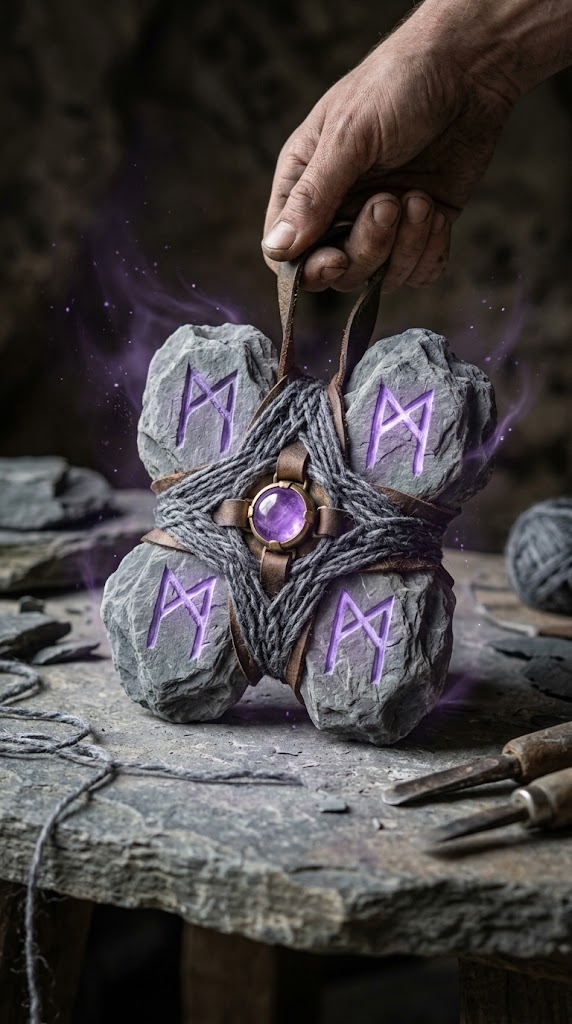
- The item is a matched set of four roughly shaped, gray slate stones, each approximately the size of a human fist, tightly bound together within a framework of braided, dark grey wool and oil-cured leather straps. The slate is unpolished, retaining the natural texture of the bedrock it was quarried from. Each stone is deeply incised with a single, repeating northern rune—ᛗ (Mannaz), representing humanity’s grounding upon the earth. Encasing the knot that binds all four stones is a small brass housing containing an amethyst-colored Tier 1 magic crystal, which functions as the stabilization anchor. When held or deployed, the stones emit a constant, low-frequency hum, and anyone grasping the leather binding feels a deep, oscillating vibration in their marrow, like the distant resonance of a mountain shifting in its sleep.
Detailed Stats
- Item Tier: Tier 1
- Item Rarity: Common
- Item Resilience: 15
- Item Health Points: Avatar maximum hit points plus 15
- Armor Check: N/A
- Damage: N/A
- Weight: 8 pounds total
- Operational Lifespan Check: When an activated magical ability is concluded, roll 1d20; on a roll of 1, the internal amethyst-colored crystal shatters, disabling all magical functions until replaced.
- Attunement Requirement: Held attunement (requires holding the object and focusing on the earth’s vibration for at least 1 minute)
- Commercial Valuation: Suggested trade benchmark is 18 silver coins.
Specific Slot
- Hand Slot (Held in one or two hands, or attached to a utility belt when inactive)
Passive Magic
- Anchor of the Bedrock: While actively holding the bound loom-weights, the avatar gains a +2 bonus to any check made to resist being knocked prone, pushed, or moved against their will by external forces. The stones anchor the avatar to the tectonic plates, making them feel as heavy and grounded as a small boulder.
- Seismic Harmony Detection: The user is constantly aware of any physical vibration or seismic movement within a 30-foot radius. This grants advantage on passive perception checks to detect tunneling creatures, approaching subterranean beasts, or the onset of larger, natural earthquakes.
Activable Magic
- Fault Line Resonance: The avatar spends one full action chanting a rhythmic cadence of grounding Seiðr verses while rhythmically tapping the central stabilization knot against a rock or hard surface. This triggers a shallow trance and causes the four loom-weights to vibrate violently. Over the course of 1 minute, the dawning quake in the stones aligns with the tectonic stress points beneath the terrain, preparing the earth to receive the upcoming earthquake charge.
- Localized Tremor Call: By expending one full action and visualizing the stored quake releasing from the slate, the user slam-strikes the ground with the loom-weights. A violent, deep-throated vibration emanates from the point of impact. Hostile entities in a 10-foot cone must make a Constitution saving throw (DC 13) or take 1d6 damage from intense bone-vibration and be knocked prone. This tremor instantly and harmlessly topples small unanchored objects within the radius, such as chairs or unsecured market stalls, creating immediate environmental disruption.
- Rippling Gravelwave: The avatar concentrates for one action, tapping the central amethyst knot three times against the bedrock while visualizing the earth as a calm pool of water. This releases a soft, pulsing seismic wave. Gravel, loose dirt, and small stones within a 15-foot radius on the surface begin to ripple and shift, automatically covering and concealing all recent tracks or trails (such as footprints, claw marks, or wheel ruts) within the area.
- Terrain Rupture Flash: As a reaction, when an opponent within 15 feet moves through or attempts to charge across a patch of loose gravel or unstable ground, the avatar unleashes a micro-seismic pulse. The ground beneath the target’s feet violently collapses and shifts into 10 square feet of difficult terrain, requiring the target to spend twice as much movement to cross. If the check on the next active ability fails and shatters the crystal, it does so immediately following this action.
Tags
- common, divination, earthquakes, ground, loom-weights, micro-seismic, paired-set, runes, seiðr, slate, tactical, vibrations, ancestry, anchor, disruption, environmental, geology, harmonic, localization, low-frequency, magical, resonance, stability
Commercial Outlets, Trade Venues, and Pricing for the Tremoring Loom-Weights
- Geomancers’ Guildhalls and Earth-Speaker Lodges:
- Located in mountain citadels, mining hubs, and city-states built on obsidian foundations, such as the subterranean vaults of Oakhaven.
- These guilds serve geomancers, miners, and elementalists who respect tectonic forces. They view the loom-weights as entry-level tools for training acolytes in harmonic resonance and bedrock stability.
- Buying Here: The items are displayed openly on slate pedestals. Masters ensure the amethyst stabilization crystal is attuned to the local fault line. Buying a set costs between 18 and 21 silver coins, as they are often bundled with instructions on local seismic patterns. Guild members in good standing may purchase them for 16 silver coins.
- Selling Here: Guild quartermasters readily purchase authentic tremor stones, particularly if they are sourced from remote or geologically significant regions. They examine the Mannaz runes for etching accuracy. A standard payout for an intact set is 13 to 14 silver coins, often as store credit for advanced divination focuses or reinforced miner’s gear.
- Coastal Weaving Enclaves and Seiðr Crones’ Cabals:
- Situated in traditional northern villages and seaside cliff settlements where the wind-loom is sacred.
- These are working weaving lodges, but also sites of spiritual instruction in Seiðr. They treat the item as a meditation focus that happens to double as a tactical disruptor.
- Buying Here: Avatars must often prove their intentions are respectful of the earth-mother. They are not sold as weapons. The cost is the benchmark 18 silver coins. The weavers are also open to barter, trading the set for rare crafting materials, such as raw amber, high-altitude wool, or unprocessed amethyst nodules.
- Selling Here: The crones accept returns or used sets, valuing the residual harmonic alignment left by prior use. They offer 11 to 13 silver coins, frequently paying in localized trade tokens, purified lamp oil, or dried herbal remedies.
- Municipal Quarries and Stone-Merchants’ Yards:
- Found near city gates, industrial zones, and major harbor fronts where construction stone is sold.
- These practical industrial dealers view the item primarily as tools for stabilizing small-scale quarrying operations or clearing loose shale.
- Buying Here: Sold in heavy oilcloth wraps, often stored alongside blasting powders and structural props. Due to low demand from general laborers, they might be on sale for 15 to 17 silver coins.
- Selling Here: Merchants buy them based on slate quality and crystal stability, offering 10 to 12 silver coins. If a set is damaged but the slate is high-grade, they might buy the components for 5 silver coins.
- Adventurer’s General Stores and Expedition Outfitters:
- Located in central markets, trade plazas, and supply stops near wilderness frontier gates.
- These shops sell varied, durable goods for explorers and rely on quick turnover. They market the loom-weights as essential survival items for detecting cave-ins or creating difficult terrain.
- Buying Here: Displayed on wooden shelves between climbing ropes and pickaxes. The price is standardized at 18 to 20 silver coins.
- Selling Here: Retailers accept common magical tools if the stabilization crystal is functional. They provide 10 to 11 silver coins in cash, directly transferred to the seller’s World Bank ledger.
- Salvage Dealers and Black Market Fences:
- hidden in dockside shanties, underworld dens, or the basements of shady pawnshops.
- These vendors trade in stolen goods, illicit salvage, or component parts. They prize the tremor stones as components for building makeshift seismic mines or for sale to eco-terrorist cells.
- Buying Here: Sold without guarantees of stability. Fences inflate the price because the source is unrecorded, charging 22 to 26 silver coins (or 2 gold coins) in physical coin.
- Selling Here: Fences buy eagerly, particularly if the crystal is broken, offering 7 to 9 silver coins in untraceable, hand-to-hand cash. They salvage the slate and amethyst for industrial use.
Tactical Applications and Environmental Roleplay of the Tremoring Loom-Weights
- Subterranean Tunnels and Mining Caverns:
- Environmental Context: Confined spaces, unstable shale ceilings, acoustic echo, potential for cave-ins, and blind corners where tunneling horrors lurk.
- Defensive Roleplay: While navigating a narrow, ancient mine shaft, the avatar constantly monitors Seismic Harmony Detection. Suddenly, they perceive the distinct, rapid micro-vibration of a Bulette burrowing through the rock wall 20 feet ahead. The avatar halts the party, anchors the loom-weights to the bedrock, and triggers Fault Line Resonance. By aligning the device’s hum with the existing geological stress points of the ceiling before the creature emerges, they prevent the impending structural collapse that the beast’s breach would have caused, securing the retreat path.
- Offensive Roleplay: Trapped by a squad of Drow vanguard in a chamber filled with unstable rock formations, the avatar executes Localized Tremor Call. They slam the four slate weights against a critical support pillar. The focused 10-foot cone of seismic energy does not strike the Drow directly; instead, it causes the base of the pillar to violently liquefy into gravel, bringing the unstable ceiling structure crashing down precisely in front of the enemy squad, blocking their path and separating their leader from the main force.
- Sandy Deserts and Loose Dune Seas:
- Environmental Context: shifting sands that swallow movement, blinding sun, lack of stable anchor points, and open terrain offering no cover.
- Defensive Roleplay: Pursued across open dunes by desert raiders on swift mounts, the avatar uses Rippling Gravelwave. They tap the central amethyst knot, and the seismic pulse spreads through the loose sand. Footprints, drag marks, and the distinct impressions of the avatar’s movement are instantly rippled and covered by the shifting grains, forcing the raiders to lose the trail in the featureless expanse.
- Offensive Roleplay: As the raiders catch up, charging full-tilt over a crest of sand, the avatar triggers Terrain Rupture Flash. They release a micro-seismic burst beneath the leading mount’s hooves. The stable dune face instantly collapses into a 10-foot square pit of treacherous, sliding sand. The lead horse plunges knee-deep into the sudden sinkhole, throwing its rider and causing the following mounts to collide and lose momentum, breaking the charge.
- Confined Urban Alleyways and Market Squares:
- Environmental Context: Cobblestone streets, narrow passages, stacked crates, unstable market stalls, and civilian crowds where large-scale magical destruction is prohibited.
- Defensive Roleplay: Backed into a dead-end alley by a street gang, the avatar holds the loom-weights, activating Anchor of the Bedrock. As the largest thug attempts to use a battering ram to smash through the avatar’s position, the device channels the physical impact directly into the tectonic plate. The avatar remains as immovable as a mountain, and the shockwave of the deflected blow travels back up the ram, shattering the attacker’s grip.
- Offensive Roleplay: To cause a non-lethal distraction or halt a fleeing thief, the avatar uses Localized Tremor Call in a crowded marketplace. They slam the stones against the pavement, targeting a row of unsecured produce stalls 10 feet away. The tremor causes the stalls to instantly harmlessly topple over, spilling barrels of apples and crates of chickens across the thoroughfare, creating immediate difficult terrain that prevents the thief from escaping while causing no lasting harm.
- Coastal Cliffs and High-Altitude Mountain Passes:
- Environmental Context: Precarious footholds, sheer drops, unstable scree slopes, strong winds, and narrow ledges where any imbalance is fatal.
- Defensive Roleplay: Navigating a treacherous mountain pass above the clouds, a sudden, natural earthquake tremor begins. While other party members stumble and risk falling over the edge, the avatar relies on Anchor of the Bedrock. They become a stable point, physically holding onto comrades and preventing them from sliding off the shaking slope, maintaining a perfect lock on the environment while the ground itself shifts.
- Offensive Roleplay: Threatened by an aggressive Yeti on a narrow ledge, the avatar waits until the creature attempts to charge. They use Terrain Rupture Flash to target the unstable scree directly beneath the beast. The micro-seismic pulse is the tipping point, causing the entire loose rock slope beneath the Yeti to violently shift and slide. The creature is unable to find purchase on the newly made difficult terrain and tumbles backward over the precipice.
- Ancient Ruins and Forgotten Temples:
- Environmental Context: Cracked stonework, hidden pressure plates, dust-choked halls, and ancient traps that rely on structural integrity.
- Defensive Roleplay: suspecting a pressure-sensitive floor trap in a dark corridor, the avatar uses Seismic Harmony Detection. By monitoring the deep-cycle vibrations, they intuitively perceive the hollow space beneath specific tiles and the subtle tension on invisible counterweights, allowing them to map a safe path across the floor without triggering the mechanisms.
- Offensive Roleplay: While being chased through a hall of cracked, massive statues, the avatar executes Loom-Cleave. They slam the stones, channeling a violent vibration into the floor directly beneath an ancient, precariously balanced statue. The seismic energy aligns with existing fractures, instantly shattering the statue’s base and causing the entire monument to collapse onto the pursuing constructs.
Perception of Activation:
User’s Perspective
- Sight: As activation peaks, the Mannaz runes carved into the slate glow with a localized, dull amethyst light that pulses in time with the deep-cycle frequency. The surrounding air momentarily shimmer with a colorless seismic distortion effect. Fine dust immediately rises in tiny, perfectly aligned crystalline spikes along the grain of the floor or ground directly beneath the stones.
- Hearing: The low-frequency drone escalates into a violent, guttural rumble that resonates up through the user’s skeleton, bypassing the outer ear and sounding inside the skull. This is accompanied by a loud, sudden crack like a lightning strike striking rock, signaling the discharge of seismic potential.
- Smell: A sudden, sharp scent of pulverized slate, ozone, and wet volcanic ash fills the air, suppressing all surrounding smells for several minutes.
- Taste: A dry, gritty texture of mineral dust and cold bedrock instantly coats the user’s tongue and teeth, accompanied by a sharp, metallic flavor of copper and wet slate on the palate.
- Touch: The user experiences a profound gravitational shift; as the tremor is called, their entire body feels momentarily grounded as though bound to a small mountain. The rocks themselves vibrate with such intensity that they feel slippery with kinetic energy, pushing against the leather bindings.
- Extra-Sensory Perceptions:
- Bedrock Attunement: The user’s consciousness expands downward 30 feet, intuitively perceiving the bedrock density, structural faults, water table shifts, and void spaces within the earth as a living map.
- Seismic Charge Awareness: A psychic pulse within the amethyst crystal signals the exact moment of harmonic alignment, allowing the user to release the tremor with perfect timing.
- Tectonic Anchor Sense: A soothing, grounding current flows into the user’s mind, banishing dizziness and providing an unshakable psychic stability against the called environmental chaos.
Observer’s Perspective
- Sight: The observer sees the user raise the unpolished slate cluster, which glows with a soft amethyst pulse along its carved runes. The air around the rocks appears to boil with subtle seismic distortions. When the rocks are struck against the ground, a small, circular shockwave of amethyst energy and dust ripples outward, toppling loose objects within the 10-foot radius.
- Hearing: Observers hear a sudden, painful sub-bass thump that is felt in the gut more than the ears, followed by the dry, explosive sound of a sudden pavement crack or building shift. This is instantly masked by the clatter of falling objects or breaking stone.
- Smell: Those nearby are struck by the smell of ancient dust, pulverized mountain rock, and fresh thunder-ozone.
- Taste: Bystanders close to the impact zone report a dry, dusty taste of slate and copper on their breath.
- Touch: The immediate vicinity experiences a sharp, bone-jarring tremor that travels through the soles of the feet, toppling anyone without a solid anchor or who is caught mid-stride, while small objects are violently harmlessly rearranged.
- Extra-Sensory Perceptions:
- Ground Shifting Instinct: Animals and sensitives near the observer instinctively perceive the called tremor not as a magical effect, but as a genuine, localized, miniature earthquake.
- Harmonic Disturbance: Mystics nearby perceive a momentary collapse of local ambient magical fields as they are violently displaced by the raw elemental force of the tectonic realignment.
Positives
- Reliable Disruption and Crowd Control: Instantly creates non-lethal, localized environmental chaos that topples unsecured opponents, breaks charges, and halts fleeing targets without catastrophic damage.
- Detection and Awareness: Seismic Harmony Detection provides constant, passive 360-degree awareness of approaching subterranean entities, tunneling traps, or natural earthquakes before they occur.
- Grounding and Stability: Anchor of the Bedrock renders the user exceptionally resistant to being moved or knocked prone, providing superior defensive stability against physical force and environmental shifting.
- Non-Violent Utility: Abilities like Rippling Gravelwave provide excellent survival utility by concealing tracks and trails without violence.
Negatives
- 5% Crystal Failure Risk: Every activation of an active ability carries a persistent, unmitigable 5% chance (rolling a 1 on a d20) that the central stabilization crystal shatters into useless shards, disabling the item entirely.
- Non-Discriminatory Area Effect: Localized Tremor Call is a non-targeted cone effect; it topples and damages all entities, including allies, and rearranges all small, unsecured objects (such as potion vials or market merchandise) within the radius without control.
- Inevitable Collateral Damage: Despite being considered “non-lethal,” the tremor violently collapses unstable terrain, shatters cracked masonry, and potentially buries enemies or allies beneath falling debris, which can have unpredictable lethal consequences in weak structural environments.
- Heavy and Obvious Signature: The 8-pound slate cluster is heavy and constantly emits a low hum, making it impossible to conceal, instantly identifying the wielder as an elemental threat to anyone familiar with seismic lore.
Crafting Recipe: Binding the Tremoring Loom-Weights
Materials Needed
- 4 fist-sized nodules of raw, gray slate (ideally quarried from bedrock actively shifting above a geologically unstable fault line)
- 6 feet of braided, unprocessed mountain goat wool cord (the wool must be spun by hand in a continuous length to maintain the vibrational circuit)
- 2 feet of oil-cured leather straps (tanned using rendered bear or boar fat for grip and flexibility under stress)
- 1 intact Tier 1 magic crystal (amethyst or similar deep purple hue, serving as the stabilization capacitor)
- 1 small brass housing (cast in a continuous loop to encase the stabilization knot and the crystal)
- 1 ounce of raw pine pitch or mountain amber mastic (for seating the crystal within the brass housing and waterproofing external leather joints)
- 1 sacrificial magical consumable: 1 mundane stone-shape elixir or minor geomancy draught (consumed during the binding process to anchor the seismic enchantment)
- 2 fluid ounces of distilled volcanic ash-water or elemental earth-warmed brine (harvested via a fluid collector)
Tools Required
- 1 set of fine bone or hardened bog-oak engraving chisels (for incising the ᛗ runes into the slate)
- 1 wire mandrel and jeweler’s pliers (for forming and securing the brass housing around the crystal and the central knot)
- 1 Fluid Collector (for drawing, measuring, and administering the distilled quenching and enchanting liquids)
- 1 small ceramic resin-melting pot and oil spirit lamp (for melting and refining the pine pitch mastic)
- 1 set of leather punches and heavy sewing awl (for shaping and securing the leather harness around the bound slate)
- 1 weaver’s threading needle and small comb (for manipulating the braided wool cord through tight leather loops)
Skill Requirements
- Geomancy / Earth Sciences: Level 3 or higher (required to identify proper seismic slate, interpret harmonic stress points, and attune the Tier 1 crystal to the local bedrock)
- Arcane Crafting / Runework: Level 2 or higher (necessary to correctly engrave the ᛗ runes and weave the continuous wool vibrational circuit through the leather straps)
- Leatherworking / Harness Making: Level 1 or higher (ensures the durable leather wrap can absorb violent vibrations without snapping under tension)
Crafting Steps
- Harvesting and Shaping the Resonant Slate: Travel to an area with known, active seismic activity (such as the base of a young mountain range or the edge of a volcanic caldera). Manually quarry four fist-sized nodules of gray slate. The stone must be split along natural fault lines and shaped primarily by hand, without using heavy magical force that might disrupt the stone’s dormant harmonic signature.
- Incising the Mannaz Runes: Using the bone engraving chisels, deeply incise a single ᛗ (Mannaz) rune into each of the four slate nodules. The runes must be identical and perfectly aligned with the natural bedding planes of the slate.
- Attuning the Stabilization Crystal: Take the amethyst Tier 1 crystal and the Fluid Collector. Place the sacrificial stone-shape elixir or geomancy draught into a small crucible and blend it with the distilled volcanic ash-water. Heat the mixture until it begins to vaporize. Using the Fluid Collector, draw the vaporized essence and inject it directly into the matrix of the crystal, focusing the psychic intent on stabilization and grounding.
- Forging the Brass Housing: Cast or form the brass housing in a continuous loop, ensuring it can accommodate the central stabilization knot and the Tier 1 crystal snugly without restricting the cord.
- Binding the Slate Nodes: Gather the four slate nodules into a tight cluster. Take the braided mountain goat wool cord and weave it around the nodules in a series of tightly interconnected figure-eight loops. The weave must be symmetrical and continuous, forming a single energetic circuit that passes through all four slate nodes and terminates at the central point where the brass housing will be attached.
- Securing the Stabilization Knot: Pull the final loops of the continuous wool cord tight into the center. Seating the Tier 1 crystal against the core wool bundle, encase the entire stabilization knot within the brass housing. Use the wire mandrel to lock the brass housing around the bundle.
- Sealing and Waterproofing: Melt the raw pine pitch mastic. Using a small brush, apply a durable seal of refined mastic around the crystal’s base where it enters the brass housing, and coat any external wool knots where they anchor to the leather harness.
- Fashioning the Leather Harness: Shape the oil-cured leather straps into a durable harness designed to wrap and compress the four slate nodules. Punch lacing holes through the edges of the straps. Lace the leather tightly around the slate, passing the final securement points through the loops of the wool cord at the central brass housing, permanently unifying the structure.
- Quenching and Balancing: Take the assembled loom-weights to an exposed patch of stable bedrock. Perform a minute of rhythmic, slow-paced tapping against the rock, allowing the stone and crystal to sync with the earth’s base frequency. Quench the external leather bindings by dipping the entire apparatus into the remaining distilled earth-warmed brine, locking the tension and attuning the finished item.
- Executing the Seiðr Activation Ritual: Unfold the finished item upon a flat stone surface. Spend at least ten uninterrupted minutes in a quiet, focused Seiðr trance, channeling the image of the earth as a calm, heavy sea. Chant the harmonic cadence of the mountain’s sleep. The ritual is complete as the engraved runes flare with a soft, pulsing amethyst light and the entire 8-pound apparatus begins to emit a faint, deep sub-bass hum, indicating the earth’s vibration has taken hold.
Heaviness Stone-Set and Shaking of Foundation-Dirt
Now this is the telling of the times of old, before the great water-climb, when the world-mountain Gaialilith did still hold her breath for twenty turns of the warm star Helios. In the villages of the north, where the cold-bite is sharp, the people did weave the sheep-hair upon great standing frames of wood. These frames did hold the wool-threads tight, that the women might make the blankets for the winter-sleeping. To hold the threads with stiffness, they did bind heavy rocks to the bottom, which they did name “Loom-Weights.”
In the settlement of the Crag, there lived a weaver-woman, of many winters and much inward-seeing, whose name was Astrid of the Twisted Finger. Astrid was not as the others, for she did possess the Seiðr breath, which is the looking into the unseen. When the other women did talk of goats and barley, Astrid did sit in the open air, listening to the deep-stomach noise of the ground-dirt. She did know that the bedrock beneath the feet is not sleeping, but is like a giant water-beast that groans and shifts its position in the dark mud.
There came a turn of the warm star, during the third hour of the daytime, when the ground-mother Gaialilith did become exceedingly restless. The air did turn soft and heavy, and the blue-vault did go grey like aged ash. The domestic goats did cease their eating and did make the sound of fear, and the wild birds did fly in panicked circles, though there was no hawk in the wind.
Astrid, sitting at her grand loom, did feel a great hum-noise begin deep within the earth-bones beneath her stool. She did close her outer-eyes and look with the inward-bone-eye. She did see that the great stone-plates that carry the soil were grinding one against the other, and the stress was climbing high, like a rope pulled until it must snap.
Suddenly, the great shaking did arrive. The ground did not merely move; it did wrestle. It did throw the huts of the Crag into the air like they were toys of woven grass. The grand loom of Astrid, which did stand higher than a man, did topple and smash upon the stones. All the village was in a screaming chaos, for the hills did slide, and the river did jump from its path.
When the warm star Helios did return to the top of the vault, after the hour of sixteen, the shaking did stop. The village of the Crag was no more, only broken wood and sorrowful people. Yet, in the middle of the brokenness, Astrid did crawl from the debris of her hut. Her grand loom was destroyed, but four of the heavy stone Loom-Weights, which were quarried from the bedrock directly above the grinding-line, were unbroken.
Astrid did gather these four slates. They were unpolished, grey, and shaped like the closed fist of a working-man. They did feel different in her hands, not dead like ordinary rocks, but alive with a continuing micro-hum, as though they had drunk the stomach-shaking of the earth and were now digesting it.
The old woman took the leather from her utility-belt and the braided wool of a black sheep, and she did bind the four stones together in a unified cluster. She did incise upon each stone the rune of ᛗ, which is Mannaz, the standing-man, that the stones might know they are to serve the upright human upon the ground, and not the underground worm. In the center, she did seat a small, purple rock-crystal, which she had found inside the craw of a mountain-crow, to act as the stabilization-eye.
The village chief, a man of large voice named Torvald the Bull-Necked, did come to her. “Weaver-woman,” he did bellow, “the mountain has eaten our homes, and the river has drowned the barley. Why do you play with rocks and sheep-hair?”
Astrid did look at him with her bone-eye. “Bull-Necked One,” she did say, and her voice was like the sound of dry leaves scraping over a cave floor. “You build with wood and rely on the height of your walls. But I am a weaver. I do know that the strongest cloth is not the thickest, but the one whose tension is harmonized. I have captured the shaking of the ground-mother inside this binding. We must learn to speak with the dirt, not fight it.”
Torvald did laugh, and the other people, who were digging for their pots and blankets, did also laugh. “If you have captured the earthquake,” said Torvald, “then show us. Cause the ground to open and swallow this goat.” And he did point to a small goat that was chewing upon a broken door.
Astrid did not wish to fight, but the inner Seiðr told her she must show the pattern. She took the fourfold stone-cluster in both hands and did enter the shallow trance, breathing the slow, rattling breath. She did hum the deep-stomach noise she had learned from the earth-bones.
She did slam the Loom-Weights against the broken pavement of the market square.
CRACK-BOOM!
The noise was not from the wood or the air; it was from the marrow. A sudden, violet light did pulse from the ᛗ runes. A 10-foot cone of violent, ground-shaking did emanate from the point of impact. The cobblestones did jump from their places. Torvald the Bull-Necked, who stood 8 feet away, was knocked prone upon his stomach, though he was heavy as a bulloc. The little goat was not swallowed, but it was harmlessly toppled over. The ground did shift and ripple, covering up all the muddy tracks of the village feet within a 15-foot radius, making the destroyed market appear untouched.
The laughter did stop instantly. Torvald did crawl backward on his elbows, staring at the old woman with round, white eyes. The people did make the gesture against the bad-spirit.
“This is not for making huts fall, but for understanding the rock,” said Astrid, as the amethyst light of the crystal did fade. “The ground-dirt is unstable, but now we may feel its coming mood before it strikes. We may anchor ourselves when it shifts. We may use its own anger to stop the charge of the great beasts that come from the tunnels.”
And so, it was that the Tremoring Loom-Weights did become the most known item of the north. From that day, whenever the villagers did rebuild, they did not just place wooden posts; they did have a Seiðr-walker tap the ground with the stones to ensure the bedrock was stable. When the wild cave-bears or the Drow skirmishers did attack, the defenders did not just stand; they did use the stones to make the ground beneath the enemy charge violently unstable, breaking their momentum and causing them to tumble.
Astrid did not stay in the village, for the Seiðr does not allow the inner-eye to rest in one place. She did wrap the eight-pound cluster in her wool cloak, strap it to her utility-belt, and depart into the high mountains, where she did use the stones to listen to the mountains shifting in their sleep, ever-seeking the deep, harmonious breath of the ground-mother.
The Moral of the Story: He who relies only upon the strength of his high walls and the sharpness of his spears is weak, for he may be broken by the grinding of the dirt beneath his feet. But he who understands the subtle vibrations of the world-mountain, and knows how to anchor himself to the bedrock and listen to the shaking before it becomes a catastrophe, is truly strong, for he may use the very instability of the earth to achieve stability for himself.
Suggested conversions to other systems:
Call of Cthulhu (7th Edition)
Name: The Tremoring Loom-Weights of the Seiðr-Walker
- Classification: Enchanted Artifact / Folk Magic Focus
- Appraisal Sanity Loss: 0 Sanity points
- Activation Sanity Cost: 0 (1 Sanity point if channeled against living, subterranean entities)
- Magic Point Cost: 1 Magic Point per 10 minutes of active operation; 3 Magic Points for the Localized Tremor burst
- Physical Description: A matched set of four fist-sized, unpolished grey slate stones, tightly bound within braided dark wool and oil-cured leather. Each stone features a deeply incised ᛗ (Mannaz) rune that hums with natural tectonic tension. An amethyst stabilization crystal is seated within a brass housing at the core of the central knot. While active, the cluster emits a sub-bass vibration felt through the bone marrow.
Artifact Mechanics and Operational Syntax:
- Anchor of the Bedrock (Passive): While the investigator holds the bound loom-weights, their physical gravity is amplified by a connection to the tectonic plate. The bearer gains a Bonus die on STR or DEX rolls made specifically to resist being knocked prone, pushed, or moved against their will.
- Seismic Harmony Detection (Passive): While attuned, the bearer is supernaturally aware of physical vibrations or seismic shifts within a 30-foot radius. This grants a Bonus die to Passive Perception checks made to detect tunneling creatures, hidden pitfalls, or the onset of natural earthquakes.
- Localized Tremor Call (Active): When the wielder spends 3 Magic Points and 1 Sanity point as a full attack action, they may slam the loom-weights against the ground to release a concussive burst of seismic energy. Targets within a 10-foot cone must succeed on a CON roll (DC 13) or take 1d6 points of damage and be knocked prone. This action automatically topples small, unsecured objects (e.g., market stalls, furniture) within the area, creating difficult terrain. Rolling a fumble shatters the amethyst crystal, rendering the magical traits inert.
Blades in the Dark
Name: Seismic Loom-Weights
- Item Load: 2 Load (Equipped as a matched pair and bound cluster)
- Quality Rating: Tier I Arcane / Field Utility Instrument
- Stress Cost: 0 Stress; 1 Stress for Rippling Gravelwave or Terrain Rupture
- Harm / Resistance Interaction: Can be spent to mitigate consequences related to being knocked prone, outbalanced, or outmaneuvered by fast-moving melee attackers.
System Mechanics and Operational Syntax:
- Anchor and Detection (Passive): While carrying the bound weights, your connection to the bedrock is amplified. You suffer no penalty to your Action Roll when resisting being shoved, pushed, or knocked prone in combat. When gathering information about hidden tunnels, impending cave-ins, or moving enemies in a complex or subterranean environment, you may count the item as Tier+1 Fine Equipment.
- Localized Tremor (Action): You can trigger a quick seismic burst as an action to disrupt a foe’s advance. Roll Wreck or Skirmish. On a regular success, you knock the adjacent target prone, leave them Distracted, or force them to fumble a critical action. A critical success causes structural damage or topples significant debris (e.g., bringing down a critical support, creating Difficult Terrain).
- Rippling Gravelwave / Terrain Rupture (1 Stress): You push your trance to unleash a controlled wave or a surgical tremor. When attempting to cover your tracks over loose earth or turn stable ground into a treacherous, collapsing mire, you may spend 1 Stress to gain +1 Effect to your Action Roll, instantly altering the surrounding landscape to your advantage.
Dungeons & Dragons (5th Edition, 2024 Revision)
Name: Tremoring Loom-Weights
- Item Type: Wondrous Item
- Item Rarity: Common
- Attunement: Requires Attunement
- Weight: 8 lbs.
Item Traits and Operational Mechanics:
- Anchor of the Bedrock: While you are on solid ground and holding this item, you cannot be knocked prone, pushed, or moved against your will by non-magical forced movement.
- Seismic Sense: While attuned, you have Tremorsense (30 feet).
- Localized Tremor Call (Recharge 5–6): As an action, you can slam the loom-weights against the ground. Each creature in a 10-foot cone emanating from you must make a Strength saving throw (DC 13). On a failed save, a creature takes 1d6 force damage and is knocked prone. Non-magical objects in the area that aren’t being worn or carried are toppled or harmlessly rearranged.
- Terrain Rupture (Reaction): When a creature within 15 feet of you makes an attack against you or attempt to charge across loose gravel or unstable ground, you can use your Reaction to trigger a micro-seismic pulse. A 10-square-foot patch of loose or fragile ground beneath the target violently collapses and becomes difficult terrain. Roll 1d20 after resolving this effect; on a roll of 1, the amethyst crystal shatters, and both the items become non-magical.
Knave (Second Edition)
Name: Tremor-Stones
- Item Slots: 2 Slots (Stored on a belt; carried and activated in both hands)
- Item Type: Paired Focus / Tool
- Durability: 3 / 3
- Hands: 2 (Requires both hands equipped to gain traits)
Item Traits and Operational Mechanics:
- Stability: While holding the Tremor-Stones, your Armor increases by +2 against non-magical attacks specifically designed to push, shove, or knock you prone.
- Seismic Sense: While carrying the stones, you may attempt a CON save as an investigation action to detect tunneling creatures, cave-ins, or hidden pitfalls within a 30-foot radius.
- Quake Burst: Once per explore turn during combat, you may spend an action and sacrifice 1 point of Durability from the stones to execute a concussive slam. All enemies within a 10-foot cone must make an STR save. On a failure, they take 1d6 damage and are knocked prone. Mundane objects (e.g., market stalls, furniture) in the area are harmlessly rearranged or toppled.
- Ground Collapse: You may spend an action to target a 10-square-foot patch of loose or fragile ground within 15 feet and trigger a micro-seismic collapse. The ground becomes difficult terrain. Roll for Durability immediately after resolving this action. If the Durability drops to 0, the amethyst crystal shatters and the brass whorls crack, rendering them mundane 1d4 bludgeoning weapons with no special properties.
Fate (Fate Condensed)
Name: Resonant Slate of the Loom-Quake
- Aspect: Bound Seismic Slates of the Bedrock Weave
- Item Type: Arcane Utility Focus (Extra / Stunt-Granting Device)
- Cost: 1 Refresh (as an Extra)
Stunts and Mechanical Rules:
- Bedrock Anchor (Passive): Because you wield the Resonant Slate of the Loom-Quake, you are mystically bound to the local tectonic plane. You gain a +2 bonus to your Physique defense rolls against being knocked prone, shoved, tackled, or forcibly moved by physical or kinetic means.
- Harmonic Ground-Sense (Passive): You can use Notice to sense physical vibrations through the ground up to two zones away, allowing you to detect subterranean creatures, hidden tunnels, or impending cave-ins without line of sight.
- Localized Tremor Call (Active): Once per scene, you may spend a Fate Point to strike the slate cluster against the earth, creating the scene aspect Ruptured and Quaking Ground with one free invoke. Opponents within your immediate zone must immediately roll Athletics against Fair (+2) opposition; on a failure, they are knocked prone and become Unbalanced.
- Track-Smoothing Weft (Active): By tapping the central amethyst node against the earth, you may spend an action using Crafts or Stealth to ripple the surrounding gravel and topsoil, instantly removing all footfalls and wagon ruts across your zone and creating the boost Concealed Passage.
Cypher System & Numenera (Cypher System Rulebook / Numenera Discovery)
Name: Tremor-Tuned Loom-Weights
- Level: 2 (Target Number: 6)
- Item Form: Artifact (Cluster of four rune-inscribed slate nodules bound with goat-wool cording, housing an amethyst capacitor)
- Depletion: 1 in 1d20 (Check upon triggering a seismic discharge)
Artifact Traits and Mechanical Rules:
- Anchor of the Bedrock (Passive): While holding or firmly carrying the weights, you gain an asset on all Might defense rolls made to resist being moved, tackled, or knocked off your feet.
- Sub-Bass Tremorsense (Passive): The low-frequency hum grants an asset to Perception tasks aimed at detecting burrowing creatures, underground structural faults, or hidden subterranean voids within a short distance (50 feet / 15 meters).
- Localized Quake Pulse (Active): By spending 1 point from your Might Pool as an action, you slam the cluster onto hard bedrock or soil to emit a localized shockwave. All hostile targets within an immediate radius (10 feet / 3 meters) take 2 points of ambient damage that ignores armor and must succeed on an Agility defense task or fall prone. Small, unsecured objects in the area are toppled, creating an area of difficult movement. Check for Depletion immediately after use.
- Terrain Rupture (Active): As a reaction to a creature moving through a short distance of loose stone or scree near you, you release a targeted harmonic pulse. The ground beneath the creature gives way, turning that section of path into difficult terrain. The target must pass a Speed defense task or halt their movement entirely for that turn.
Pathfinder (Pathfinder Second Edition, Remaster Core)
Name: Tremoring Loom-Weights of Seiðr
- Item Traits: Uncommon, Earth, Magical, Transmutation
- Item Level: 1
- Price: 18 gp
- Usage: Held in 1 or 2 hands; Bulk: 1
- Physical Profile: Four unpolished slate weights bound in braided wool cord and leather harness, fitted with a central brass housing and an amethyst-colored crystal.
Description: These balanced stones absorb the deep-frequency tremors of the earth. When activated, the runes inscribed on the slate glow with an amethyst light, and a dull, bone-deep hum shakes the ground directly beneath the bearer.
Activated Abilities:
- Bedrock Stance [one-action] (Concentrate); Effect: You brace yourself with the weights. Until the start of your next turn, you gain a +2 circumstance bonus to your Fortitude DC against attempts to Shove, Trip, or reposition you.
- Seismic Pulse Scan [one-action] (Concentrate); Effect: You focus on the ambient hum of the stones. You gain imprecise tremorsense out to a range of 30 feet until the end of your current turn.
- Localized Tremor Call [two-actions] (Earth, Manipulate); Frequency: Once per 10 minutes; Effect: You strike the stones against the earth. Ground-borne shockwaves erupt in a 10-foot cone. Each creature on the ground within the cone must attempt a DC 15 Reflex save.
- Critical Success: The creature is unaffected.
- Success: The creature takes 1d6 bludgeoning damage.
- Failure: The creature takes 1d6 bludgeoning damage and falls prone.
- Critical Failure: The creature takes 2d6 bludgeoning damage, falls prone, and is flat-footed until the start of its next turn.
- Failure Check: Immediately after the ability resolves, roll 1d20. On a result of 1, the amethyst crystal shatters, rendering the item an inert non-magical weight until repaired.
- Terrain Rupture Flash [reaction] (Earth, Manipulate); Trigger: A creature within 15 feet enters a space of natural earth, loose gravel, or scree; Effect: You discharge a micro-vibration into the earth. The target’s space collapses into difficult terrain, and the creature must succeed on an Acrobatics check (DC 15) or immediately end its movement.
Savage Worlds (Savage Worlds Adventure Edition – SWADE)
Name: Slate Loom-Weights of the Quake
- Item Type: Arcane Utility Artifact
- Weight: 8 lbs
- Minimum Arcane Rank: Novice
- Power Points: 5 (Recharges at a rate of 1 point per hour)
Device Mechanics and Trapping Rules:
- Arcane Trapping (Tectonic Resonance): Deep-cycle sub-bass vibrations rattle through bone and stone alike, releasing the scent of pulverized slate and ozone whenever power flows.
- Anchor of the Bedrock (Passive): While holding or tethering the bound slate cluster, the character gains a +2 bonus to resistance rolls against being Shoved, knocked Prone, or displaced by physical shockwaves.
- Seismic Harmony Detection (Passive): The wielder gains a +2 bonus on Notice checks made to detect subterranean predators, unstable flooring, or movement across earth and stone within 6 hexes (12 yards).
- Rippling Gravelwave (1 Power Point): As an action, the user taps the central knot to emit an oscillating pulse through loose soil or gravel within a Small Blast Template. All recent footprints, wheel ruts, and trail marks within the area are erased, imposing a -4 penalty on anyone attempting to track the party through that ground.
- Localized Tremor Call (2 Power Points): The user spends an action to slam the stones onto solid ground. Place a Cone Template extending from the character. All ground-bound targets within the template must succeed on an Agility roll at -2 or be knocked Prone and suffer 2d4 non-lethal crushing damage from the seismic jolt. Small unsecured structures, barrels, and market stalls in the area automatically topple.
- Terrain Rupture (1 Power Point): As a reaction when an enemy charges across natural soil or broken stone within 3 hexes, the user releases a micro-tremor. The target must make an immediate Agility check or fall Prone as the earth gives way beneath their stride, ending their turn immediately. After using any active power, roll 1d20; on a roll of 1, the amethyst crystal shatters, burning out the artifact’s magic until replaced.
Shadowrun (Sixth World)
Name: Seismic Loom-Anchor
- Item Type: Enchanted Sustaining / Utility Focus
- Force Rating: Force 1
- Karma Binding Cost: 2 Karma
- Item Availability: 2 (Legal)
- Cost: 2,000 nuyen
- Mass: 3.6 kg (Bound set of four slate stones with amethyst capacitor)
- Physical Description: A cluster of four unpolished slate weights laced with conductive dark wool cord and oil-treated leather bands. A small amethyst node sits inside a central brass setting, humming constantly with low-frequency tectonic resonance.
Game Mechanics and System Syntax:
- Bedrock Anchor (Passive): While holding or firmly carrying the cluster, the runner is grounded against kinetic displacement. Add a +2 dice pool modifier to Body + Willpower tests made to resist being knocked down, shoved, or forcefully repositioned by physical or blast attacks.
- Sub-Bass Tremorsense (Passive): The runner intuitively perceives structural and seismic shifts through the ground. Gain a +2 dice pool bonus on Perception + Intuition tests to detect subterranean movement, burrowing critters, unstable foundations, or underground access tunnels within 10 meters.
- Localized Quake Pulse (Major Action): The runner strikes the slate cluster against a solid surface to release a focused ground shockwave. Make a Sorcery + Magic or Athletics + Strength test against targets in an immediate 3-meter cone. Unsecured opponents within the area must make a Gymnastics + Agility test against your hits; failure causes them to fall prone and suffer 3S stun damage (unresisted). Loose terrain, furniture, and light market stalls in the area are toppled, creating difficult ground that costs +1 movement per meter.
- Terrain Rupture (Minor Action): As a reaction to a target charging or moving quickly through unpaved earth or loose rubble within 5 meters, the runner discharges a short pulse. The surface collapses beneath the target, forcing an immediate Gymnastics + Agility test. Failure immediately stops the runner’s movement and expends their current action. After resolving any active discharge, roll 1d20; on a result of 1, the amethyst capacitor burns out, neutralizing all magical traits until the stone is replaced.
Starfinder (Second Edition)
Name: Resonant Tectonic Loom-Weights
- Item Level: 1
- Price: 110 credits
- Bulk: 1
- Hands: 1 or 2 hands
- Item Traits: Earth, Environmental, Magical, Tech
- Description: A field set of four quarry-grade slate nodules bound in reinforced synthetic-wool harness cabling, anchored to an amethyst-tinted energy capacitor in a brass ring. When resting against bedrock or deck plating, it vibrates at a deep sub-audible frequency.
Activated Abilities:
- Tectonic Anchor [one-action] (Concentrate); Effect: You brace the weights against your footing. Until the start of your next turn, you gain a +2 circumstance bonus to your Fortitude DC against Trip, Shove, and Reposition maneuvers, provided you are standing on solid ground.
- Seismic Scan [one-action] (Concentrate); Effect: You attune your senses through the stones to monitor ground-borne pressure waves. You gain imprecise tremorsense out to a range of 30 feet until the conclusion of your turn.
- Localized Tremor Call [two-actions] (Earth, Evocation, Magical); Frequency: Once per 10 minutes; Effect: You slam the weights against solid terrain, unleashing a 10-foot cone of seismic shock. Creatures touching the ground within the cone must attempt a basic Reflex save (DC 15).
- Success: The target takes no damage.
- Failure: The target takes 1d6 bludgeoning damage and falls prone.
- Critical Failure: The target takes 2d6 bludgeoning damage, falls prone, and is immobilized until the start of its next turn. Unanchored mundane objects and loose fixtures in the area are overturned, creating difficult terrain.
- Depletion Check: Immediately roll 1d20 after resolving the effect. On a roll of 1, the amethyst capacitor cracks, rendering the item non-functional.
- Terrain Rupture Flash [reaction] (Earth, Manipulate); Trigger: A creature moves across unpaved ground or loose gravel within 15 feet of you; Effect: You release a localized shock pulse beneath the target. The ground collapses into difficult terrain, and the triggering creature must succeed on an Acrobatics check (DC 15) or immediately forfeit the remainder of its movement action.
Traveller (Mongoose Traveller 2nd Edition)
Name: Type-7 Sub-Surface Resonant Pack
- Tech Level: TL 11 (Specialized Survey / Field Utility Gear)
- Mass: 3.5 kg
- Power: Piezoelectric seismic induction cell (indefinite low-power standby; internal capacitor recharges in 1 hour)
- Cost: Cr 450
- Physical Description: Four dense, geologically stable mineral blocks linked by high-tensile braided synthetic cord and an electro-magnetic brass collar containing a purple resonance-regulating diode.
Item Rules and Technical Syntax:
- Inertial Ground Coupling: When held or deployed at the feet, the pack’s low-frequency pulses dynamically adjust footing along local gravity vectors. The traveler gains a +2 DM on all physical checks made to resist being knocked off balance, thrown down by shockwaves, or dislodged in high winds or sudden micro-tremors.
- Passive Acoustic Ground Radar: The device continuously maps micro-vibrations through solid surfaces. The operator receives a +1 DM on Electronics (Sensors) or Recon checks made to detect subterranean cavities, approaching motorized transports, or moving lifeforms within 15 meters through bedrock or composite bulkheads.
- Controlled Kinetic Discharge: Once per encounter, the operator can cycle the capacitor into a ground strike as a combat action. A concussive shockwave extends across a 3-meter cone along the deck or earth. Personnel in the path must pass an Athletics (Dexterity) check with a target number of 8+ or be thrown prone and sustain 1d6 stun damage. Unsecured crates, market stalls, and light barricades in the area are knocked over, converting the zone into hazardous or rough terrain.
- Fault Pulse Trap: When an adversary attempts to run through loose rock, scree, or fragile decking within 5 meters, the user can trigger a sudden micro-burst as a reaction. The surface fractures beneath the target, who must pass an Athletics (Dexterity) check at 8+ or suffer an immediate stumble, ending their movement for that round.
Warhammer 40,000 (Wrath & Glory)
Name: Sanctified Tectonic Loom-Weights
- Tier: 1
- Value: 3 (Uncommon / Field Focus)
- Keywords: IMPERIUM, ADEPTUS ASTARTES, ADEPTUS MECHANICUS, SEISMIC
- Rarity: Uncommon
- Range: Melee / 10-meter operational footprint
- Traits: Heavy (1), Special (Tectonic Anchor, Tremor Burst, Terrain Disruption)
- Weight: 3.5 kg
Item Traits and System Syntax:
- Tectonic Anchor: When the bearer stands on natural earth, stone, or reinforced deck plating while carrying the weights, their connection to the bedrock is metaphysically reinforced. The bearer adds +2 bonus dice to any Toughness or Strength test to resist being knocked Prone, Pushed, or moved by kinetic concussive force.
- Seismic Auspex Attunement: The continuous low-frequency hum vibrates through the bearer’s boots, granting a +1 bonus to Awareness tests to detect subterranean entities, burrowing xenos, or hidden structural weaknesses within 15 meters.
- Tremor Burst (Combat Action): The bearer expends a Combat Action and spends 1 point of Glory to slam the bound slate stones onto the ground. A localized seismic shockwave erupts in a 3-meter cone directly ahead. All targets within the area must make an Agility test (DN 3); on a failure, they are knocked Prone and suffer 4 + 1 ED damage from the violent bone-resonance. Unsecured light barricades, consoles, and furnishings in the area are toppled, making the zone Difficult Ground. Roll 1d20 after resolving this action; on a roll of 1, the amethyst capacitor fractures, permanently neutralizing the item’s special abilities until restored.
- Rupture Stumble: As a Reaction when an enemy moves across loose ground, scree, or crumbling masonry within 5 meters, the bearer channels a micro-shock into the earth. The target must succeed on an Agility test (DN 3) or immediately lose their footing, becoming Vulnerable and forfeiting any remaining movement for that turn.