
Lore
Carved in the smoke-scented feast halls and longhouse hearths of the northern clans of Saṃsāra, this rune-carved spoon was created for the matmóðir (food-mothers), hearth-wardens, and nutritional vitkar of the skaldic traditions. In Norse belief, health, endurance, and spiritual vigor (megin) are tied directly to the wholesome fuel provided to the mortal vessel. Hearth-dieticians carried these spoons not merely to portion out travel porridge and roasted meats, but to divine the hidden spoilage of provisions, purge blighted food of parasites, and magically enrich basic rations to sustain warriors through brutal blizzards and prolonged sieges.
Description
A broad, deep-bowled eating spoon six inches in length, hand-carved from the dense, polished horn of a highland mountain ram. The translucent horn shows hues of pale amber and honey when held up to a cookfire. Along the flat handle are carved Elder Futhark runes—principally Fehu (sustenance and cattle-wealth), Jera (bountiful harvest and nutrition), and Uruz (vital strength and bodily endurance)—each filled with powdered bone-ash and sealed with clear pine resin. The underside of the bowl features a blind-stamped bindrune of warding to detect poison and decay.
Slot
Held in 1 hand (or Belt Pouch / Culinary Kit Slot)
Detailed Stats
- Item Tier / Rarity: Tier 1 / Common
- Weight: 0.25 lbs
- Durability: 20/20
- Attunement: Requires 10 minutes of quiet meditation beside a roaring cookfire or hearth-stone, coating the bowl with animal fat or raw honey while carving the rune Jera into a piece of ash-wood kindling.
- Proficiency Required: Cooking / Herbalism / Runic Divination (Tier 1)
Passive Magic
- Gleaning of the Golden Marrow: Whenever the bearer consumes a meal, hot stew, or travel ration eaten with the horn spoon, the digestive tract efficiently absorbs every nutrient, conferring complete sustenance on half the normal food requirement and providing resistance against minor dietary ailments, indigestion, and gut chills.
- Sense the Bitter rot: While held over any bowl, trencher, or flagon of provisions, the amber horn clouds and turns chalk-white if the food contains toxic rot, parasites, bile, or added poisons, warming slightly against the fingers to warn the dietician before consumption.
Activable Magic
- Galdr of the Clean Trencher (Action): The user traces the rune Sowilo over a pot of spoiled, stale, or foul rations with the tip of the spoon and speaks a brief clearing chant.
- Effect: Up to 5 pounds of stale, sour, or stagnant food and water within touch range is purified of common mold, bacteria, parasites, and foul odors, making it safe, palatable, and nutritious to eat.
- Cost: At will (requires 1 minute of stirring and verbal incantation).
- Uruz Feast-Charge (Action): The user stirs a newly cooked pot of hot broth, grain mash, or stew while invoking the runes Uruz and Fehu, pressing the horn bowl against the center of the kettle.
- Effect: Infuses up to 6 individual meal portions with concentrated runic vitality. Any creature that eats a full portion within the next hour gains temporary vigor, removing the effects of mild physical exhaustion, gaining a surge of sustained stamina against cold weather for 8 hours, and recovering a small burst of vitality.
- Cooldown: 1 use per Long Rest.
Tags
- Tool, Utensil, Spoon, Dietician, Hearth, Norse, Runic, Fehu, Jera, Uruz, Nutrition, Sustenance, Purification, Level 1, Hearthcraft, Cooking, Vitality, Endure, Provisions, Blessing, Feast, Divination, Warding, Survival, Digestion
Acquisition and Trade of the Hearth-Warden’s Horn Spoon
- Longhouse Provisioners and Smokehouse Pantries: Tucked inside the communal gathering halls, smoke-cured meat houses, and timbered trading steadings of northern clan villages, these larders smell of curing juniper, salt pork, and dried lingonberries. Clan food-mothers evaluate the spoon by dipping its bowl into a trencher of sour milk or rendered lard; if the amber horn remains translucent and the ash-filled runes gleam faint silver without clouding, the utensil is deemed authentic. A wandering cook or clan scout selling a carved spoon receives an exchange credit of 9 silver pieces or equivalent trade goods (such as salted salmon and wool cloaks). Sworn hearth-keepers, clan outriders, and expedition cooks looking to buy an official longhouse spoon can purchase one for 12 silver pieces.
- Frontier Outfitters and Wilderness Caravanserais: Situated at high mountain trailheads, river-ferry crossings, and isolated wayposts where frost and scarcity claim careless travelers, these bustling depots cater to rangers, trappers, and mountain guides. The factor tests the spoon by holding it over a sulfur candle flame, ensuring the pine resin seal on the carved runes does not bubble and that the ram’s horn has no hidden fractures. An adventurer liquidating field gear receives a direct trade-in buyout of 8 silver pieces. Trappers preparing for long treks through game-barren tundra can purchase the horn spoon for a standard outfitter fee of 13 silver pieces.
- Herbalist Ateliers and Apothecary Cloisters: Found in the temple districts and apothecary rows of major stone cities, these quiet shops are filled with drying bundles of elderberry, mortar stones, and rows of clay extract jars. The apothecary verifies the rune Jera by stirring the spoon through a bitter decoction of wormwood and hemlock, observing whether the underside bindrune successfully clarifies the tincture’s surface. Selling a spoon here yields an immediate professional credit of 10 silver pieces in coin or medicinal salves. Urban dieticians, hospitaller healers, and nutritionists treating sickly noble wards can buy a calibrated horn spoon for 15 silver pieces.
- Curio Bazaars and Skaldic Relic Markets: Located along the busy port docks and crowded merchant arcades where sea-traders from the northern fjords offload northern novelties, these open stalls display carved scrimshaw, bone dice, and amber beads. Merchants often sell the item merely as an ornamental drinking horn utensil or exotic clan heirloom. An avatar offloading the item to a trinket dealer receives a fast pawn value of 7 silver pieces. Discerning antiquarians and culinary hobbyists browsing the stalls can purchase the unverified spoon for an off-the-rack price of 11 silver pieces.
- Siege Trenches and Smuggler Mess Pits: Operating within military encampments under prolonged siege, mercenary bivouacs, and subterranean cutthroat hideouts where rotten rations and maggot-ridden flour cause dysentery, a tool that purges mold and stretches meager grain supplies is worth more than steel weapons. Mess bosses authenticate the spoon by plunging it into spoiled salt horse broth to watch the rot disappear. A rogue forager or deserter selling an authentic hearth spoon to a quartermaster or mercenary fixer can command a black-market price of 18 silver pieces in pure coin. Any sellsword or squad leader desperate to keep their company fed and disease-free must pay a steep emergency cost of 22 silver pieces.
Environmental Applications of the Hearth-Warden’s Horn Spoon
- Frozen Tundra and High Mountain Passes: In sub-zero blizzards where hypothermia and calorie depletion kill faster than wolves, maintaining body heat and nutritional efficiency is a matter of life and death. Defensively, when a blizzard strands the party in a snow cave with freezing rations, the dietician uses Gleaning of the Golden Marrow to extract double the caloric energy from frozen pemmican, keeping companions insulated against the deadly gut-chill and frostbite. Offensively, facing an aggressive frost-troll or winter-wolf pack encroaching on the camp, the hearth-warden invokes the Uruz Feast-Charge over a melted kettle of fat and water. Imbuing allies with the raw, surging vitality of the wild ox, the dietician empowers the party’s frontline to withstand crushing physical blows, power through deep drifts, and repel the frozen beasts through sheer stamina.
- Besieged Keeps and Starving Outposts: Within a walled fortress cut off by enemy siege lines, food stocks quickly become contaminated with weevils, damp mold, and toxic rot. Defensively, when corrupt water supplies or mildewed grain threaten the garrison with debilitating dysentery, the dietician uses Galdr of the Clean Trencher. By stirring the tainted mash and chanting the runic formula, they eliminate parasites and rot, ensuring the defenders do not collapse from dehydration or bowel sickness behind their battlements. Offensively, as supplies dwindle to meager scraps, the dietician distributes an Uruz Feast-Charge broth to a chosen shock-troupe right before a sally out the postern gate, allowing the breakout team to shrug off fatigue and overpower the sluggish, overconfident besiegers in the trenches.
- Plague-Ridden Slums and Quarantine Lazarettos: In squalid city alleys where disease blooms and water wells are secretly poisoned by enemy saboteurs or rival cults, every meal carries the threat of assassination. Defensively, the dietician utilizes Sense the Bitter Rot at communal soup kitchens and triage stations, watching the amber horn bowl for the telltale chalk-white clouding that exposes contaminated grain, corpse-taint, or laced hemlock before a sick patient can swallow it. Offensively, when cornered in a clinic cellar by opportunistic grave-robbers or plague cultists seeking to destroy medical stores, the dietician channels the cleansing Sowilo rune through the horn tip to boil and scatter scalding, purified caustic broth directly into the assailants’ faces, driving them back with painful burns and runic warding.
- Sun-Scorched Wastes and Arid Badlands: Under a blistering desert sun where water skin supplies dwindle and dried rations bake into unpalatable, dry husks that cause throat swelling and heat exhaustion, conservation of moisture is crucial. Defensively, the dietician portions out half-rations under the protection of Gleaning of the Golden Marrow, halving metabolic water loss and preventing the dizziness of sunstroke from debilitating travelers on the march. Offensively, when rival raiders trail the party to ambush them when they drop from heat exhaustion, the dietician bolsters the caravan guards with an Uruz infusion, enabling them to counter-charge across loose dunes without losing their breath, turning the desert ambush into a rout.
- Sunken Swamps and Damp Crypts: Deep within damp barrows and stagnant marshes where miasma, fungal spores, and swamp water foul iron rations within hours, finding edible sustenance is nearly impossible. Defensively, the dietician plunges the horn bowl into stagnant bog water or scavenged, lichen-covered roots, executing Galdr of the Clean Trencher to neutralize poisonous marsh toxins and fungal spores, transforming noxious sludge into safe, life-giving soup. Offensively, when undead sentinels or swamp predators attempt to drag down the party in prolonged attrition, the hearth-warden leverages their heightened nutritional senses to identify the decaying fuel sources of necromantic constructs, directing allies to sever the unhallowed meat-engines and rot-cores keeping the monstrosities animated.
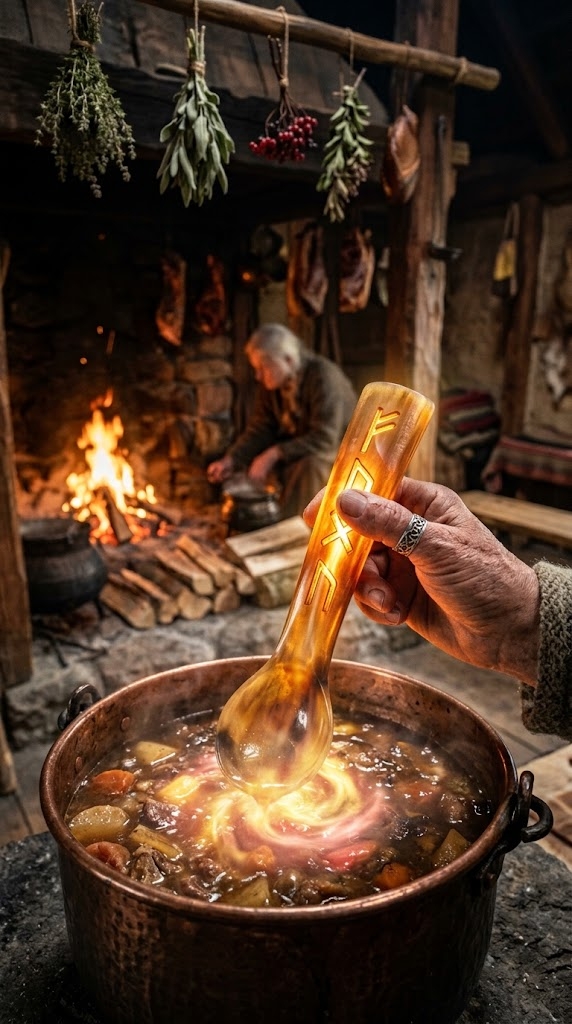
Perception of Activation:
- Sight:
- User’s Perspective: As the bowl touches the simmer, the translucent amber horn catches an internal fire, glowing like sunlit honey. The carved runes along the handle—Fehu, Jera, and Uruz—shift from chalky bone-ash into lines of liquid auric light that spiral lazily down into the broth, tracing luminous golden whorls across the simmering fats.
- Observer’s Perspective: Witnesses see the carved spoon brighten as if backlit by an ember, casting warm, golden-amber refractions against the cook’s face and surrounding cook-pot. When dipped, the broth briefly flares with a radiant, ring-shaped ripple of soft sunlight.
- Positives: The golden sheen provides steady, gentle illumination around the cook-pot, making it easy to inspect ingredients in dark tents or dim caves without holding a separate torch.
- Negatives: The distinctive, warm radiance cuts through pitch darkness, making it impossible to prepare an enriched meal without alerting nearby predators or enemy night scouts.
- Hearing:
- User’s Perspective: An immediate, gentle resonance hums along the horn handle—like the sustained acoustic vibration of an iron kettle coming to a gentle rolling boil, layered beneath a low, comforting murmur resembling clan throat-singing.
- Observer’s Perspective: Those sitting around the hearth hear the bubbling liquid settle into a rhythmic, harmonic simmer, punctuated by a faint, crisp sound like dry birch bark popping on a hot hearth.
- Positives: The rhythmic hum masks small whispers and subtle preparations around the campsite from sharp-eared eavesdroppers.
- Negatives: The acoustic frequency carries a low vibration through the ground, which burrowing beasts or tremorsense creatures can detect at short distances.
- Smell:
- User’s Perspective: The sharp, sour stench of spoiling tallow or stagnant travel-water vanishes instantly, replaced by a rich olfactory bouquet of roasted barley, cracked juniper berries, toasted bone marrow, and wild forest thyme.
- Observer’s Perspective: Anyone in the shelter is struck by an intoxicating, hearty aroma of a longhouse feast-day stew, triggering an involuntary pang of mouth-watering hunger.
- Positives: Clears out noxious cave damp, corpse-stench, and stagnant sewer odors, lifting the camp’s spirits immediately.
- Negatives: The potent aroma of rich, boiling marrow carries downwind, potentially drawing hungry wolves, beasts, or starved bandits straight toward camp.
- Taste:
- User’s Perspective: Sampling the broth leaves a lingering, rich taste of buttery fat, clean well-water, and wild salt, accompanied by a warm tingling along the tongue that completely cleanses the palate of bitter or stale aftertastes.
- Observer’s Perspective: Eating the prepared food causes a sudden warmth to spread behind the sternum; even dry grain mash tastes as wholesome as fresh milk and roasted ox shank.
- Positives: Masks the foul taste of field medicines, bitter herbs, or boiled wild roots mixed into the party’s meal.
- Negatives: The lingering richness deadens the sensitivity of the taste buds to subtle, trace minerals, making it harder to taste mild brackishness in downstream water sources for an hour afterward.
- Touch:
- User’s Perspective: The polished horn warms to a soothing, blood-temperature heat that eases aching finger joints and dispels the numbness of winter winds. As the food is enriched, a steady, rhythmic pulse thrums against the palm, feeling like the slow, strong heartbeat of a resting ox.
- Observer’s Perspective: Companions receiving a trencher feel radiant, deep-penetrating heat through the wood or iron bowl, instantly taking the chill out of frostbitten knuckles.
- Positives: Functions as a natural hand-warmer that prevents frostbite and keeps fingers nimble in freezing conditions without scorching bare skin.
- Negatives: The lingering vibrational hum can leave the cook’s hand feeling faintly pins-and-needles numb after prolonged stirring.
- Extra-Sensory Perceptions:
- Metabolic Bio-Tonic Sight:
- User’s Perspective: The dietician perceives the living party members not as bodies, but as hollow earthen vessels burning with varying qualities of hearth-fire. Starved companions appear as smoldering, ash-choked embers, while internal parasites, bile imbalances, and bowel sickness glow as dull, sick-green patches along the digestive tract.
- Observer’s Perspective: Highly perceptive allies feel an involuntary shudder of exposure, as though an experienced physician’s warm hand were gently palpating their internal organs without touching them.
- Positives: Pinpoints nutritional deficiencies, parasite infestations, and early stages of digestive rot across the party before physical symptoms erupt.
- Negatives: The constant visual overlay of metabolic decay and stomach bile can trigger mild nausea in sensitive or unaccustomed practitioners.
- Aura of the Hearth-Mother (Megin Resonator):
- User’s Perspective: An expansive, protective emotional wave rolls outward from the hearth, imbuing the space with an ancient, stubborn will to endure—the collective stubbornness of generations of northern clans surviving impossible winters.
- Observer’s Perspective: Weary, despairing adventurers feel their spiritual dread quiet down; cold dread is replaced by a stoic, iron-willed calm that urges them to sit, eat, and endure another dawn.
- Positives: Suppresses sudden panic, despair effects, and mental dread among allies within the circle of the cookfire.
- Negatives: Breeds a brief, complacent reluctance to pack up camp or move quickly while the hearth-warmth lingers.
- Metabolic Bio-Tonic Sight:
Fabrication Protocol 73: The Hearth-Warden’s Horn Spoon
- Materials Needed:
- One intact curved horn of a highland mountain ram or mature tundra ox (at least 8 inches long, free of deep fissures or insect borings).
- Two ounces of calcined bone-ash (derived from the marrow bones of a healthy draft beast).
- One dram of clarified amber pine resin (harvested from an evergreen struck by morning sun).
- Half-pint of rendered mutton tallow or clarified butter (for hot-oil tempering).
- One ounce of dried, crushed meadowsweet and juniper needles (for ceremonial cleansing).
- One square foot of dried sharkskin or fine horsetail rush (for abrasive smoothing).
- Tools Required:
- One curved horn-carver’s drawknife or straight-edge whittling blade.
- One shallow gouge chisel (for hollowing out the bowl).
- One diamond-tipped or hardened-steel scribe (for cutting rune lines).
- One copper heating pot or water basin for boiling and softening keratin.
- One wooden clamping jig or shaped horn-press.
- One small horn burnishing tool or smooth river agate.
- Skill Requirements:
- Horncarving / Scrimshaw Craft: Rank 2 or higher.
- Hearthcraft / Nutritional Herbalism: Rank 2 or higher.
- Runic Vitki / Galdr Inscription: Rank 1 or higher.
- Crafting Steps:
- Submerge the raw highland ram horn in a cauldron of boiling water infused with crushed juniper and meadowsweet for three hours to soften the interior marrow core and loosen the keratin layers.
- Extract the spongy bone core using an iron hook, then scrape the interior walls clean of residual tissue until only the translucent amber horn shell remains.
- Heat the softened horn over gentle steam and clamp it into the wooden jig, applying gradual pressure along the broad end to flatten the handle while preserving the deep curve needed for the bowl.
- Rough-shape the outline of the six-inch spoon using the drawknife, beveling the edges down to a thickness of an eighth of an inch along the shaft.
- Hollow the bowl using the shallow gouge chisel, working outward from the center along the natural grain of the horn until the bottom turns translucent when held before a fire.
- Smooth all cut facets and rough tool marks using wet horsetail rush and dried sharkskin, polishing the surface until it achieves an amber, honey-like sheen.
- Incise the runes Fehu, Jera, and Uruz along the flat face of the handle using the hardened-steel scribe, ensuring each stroke penetrates deep enough to hold inlay without splitting the horn grain.
- Blind-stamp the underside of the bowl with the protective warding bindrune using a warm, un-inked iron chisel point.
- Pack the carved rune channels with the calcined bone-ash, tamping it down firmly with the river agate until flush with the handle’s surface.
- Melt the clarified pine resin over a low flame and paint it across the rune channels, sealing the bone-ash beneath a waterproof, glass-hard protective layer.
- Submerge the finished spoon into warm rendered mutton tallow to quench the keratin against brittleness, chanting the Galdr of Sustenance while rubbing the bowl with a wool cloth until it hums with blood-warmth.
Winter-Belly Troubles and Honey-Horn Ladle of Good Digestion, Whereby Great Frost-Jarl Did Cease His Bitter Groaning in Ash-Pit
In the ancient turning of the wheel of Saṃsāra, when the white sky did sit upon the earth like a heavy tub of cold suet, and the pines did freeze until they cracked like dried bone-needles, there was a great winter upon the northern fjord of Hrafns-Fell. It was not a winter of three moons, nor of twelve, but a winter of seven snow-sheaves, wherein the sea-water turned to green glass and the ravens forgot their flying and did walk upon their shanks like grey beggar-men.
In the long-steading of stone and driftwood dwelt the mighty Earl, Jarl Torvald Ox-Knee. He was a man of five-and-twenty stone, having a chest like a brewer’s tun and arms like the split boles of mountain larch. He was a terror to the seal-hunters and a breaker of wooden shields, having taken forty iron ring-coats in his youth and slain eleven wild boar with only a short ash-hafted knife.
Yet, though Jarl Ox-Knee was feared by kings and dreaded by sea-wolves, he was brought down to weeping by the belly-curse.
For in the fifth year of the great cold, the dried lingonberries were gone, the salt herring had turned yellow like old grease, and the dried horse-flesh in the ceiling beams had grown a coat of blue whiskers. The slaves did boil leather shields in snow-water, and the warriors did chew old bow-strings until their teeth fell out into the soot. When the Jarl ate of the black tallow, his belly did puff up like a pig’s bladder blown by a smith’s apprentice. He lay upon a mound of elk-skins beside the smoke-hole, groaning like a stranded whale whose ribs are crushed upon the shingle.
His belly did rumble with the sound of nine mill-stones turning in an empty hopper. He spake to his house-carls: “My liver burneth like a coal dropped in a dry thatch; my guts are tied in forty fishermen’s knots! If any man among you hath an iron spear, let him thrust it into my flank, that the foul wind may blow forth and let me die like a bear upon the stones!”
Then the berserkers ran to fetch the iron-leeches and the witch-wives who dwell in the scree-caves.
First came the witch-wife Grima of the Crow-Stone. She took three dried toads, four pinches of copper-rust, and the sour gall of a wolf-fish, and boiled them in an iron kettle over dried bog-moss. She gave the black slop to the Jarl in a horn of walrus-tusk. But when Jarl Ox-Knee swallowed the brew, his eyes did bulge like boiled turnips, and he vomited forth both the toad-soup and his own spit, striking Grima across the floorboards until her cap of weasel-skin fell into the fire-pit.
Next came the blood-leech Hallbjorn of the Long Fjord. He brought forth nine sharp flint knives and four copper basins, saying: “The blood of the belly is full of hot salt and red worms; we must open the veins of the inner thighs and let three bowls of black grease run into the ash, that the heat may cool!” But when the knife touched the Jarl’s skin, the great man roared like a winter bull, seizing Hallbjorn by his leather breeches and hurling him out through the smoke-hole into the snow-drift, where he lay barking like a seal until the morning star.
Now upon the fourth night of the howling wind, there came to the gate-beam an old food-mother whose name was Mother Aslaug of the Birch-Hearth. She was not six spans high, and her knees were crooked like birch-roots that grow between split rocks, and she wore a cloak of unwashed sheep’s fleece bound with a strip of willow-rind. She carried neither copper kettle nor flint lancet, but only a six-inch eating scoop made of pale ram’s horn, yellow like late autumn honey, upon whose back three signs of the Elder Futhark were scratched and smeared with white bone-meal: the horn-wealth of Fehu, the fat furrow of Jera, and the wild bull of Uruz.
The berserkers mocked her at the door-post: “Look upon the grandmother! She cometh to fight the Great Wolf of the Belly with an old ram’s horn! The Jarl will chew her like an onion-stalk and throw her shanks to the sled-dogs!”
Mother Aslaug went past their iron axes as though they were only standing oats in an autumn rain. She approached the bench where the great Torvald Ox-Knee lay with his red beard fouled with vomit, his fingers clawing at his wool tunic, his belly hard like a basalt boulder.
She looked upon him not with fear, nor with sorrow, but with the cold, measuring eye of a farmer looking upon a sour dough-trough.
“Thou art a great fool of great bulk, Ox-Knee,” spake the food-mother. “Thou hast fed forty men with barley-beer, yet thou knowest less of thine own flesh-cauldron than a swamp-hog knoweth of the harp. Thou hast stuffed thine inner kettle with rancid suet and mold-eaten horse-gristle, and now the fire beneath thy ribs hath died to cold slag, and thy meal roteth within thee like a dead dog in a dry cistern.”
The Jarl opened his blood-shot eyes and hissed like an adder: “Woman of the dirt, give me an axe or hold thy tongue, for my liver is an oven of burning needles!”
Mother Aslaug took from beneath her fleece a handful of dry, withered oats that had been trampled in the straw, three shriveled juniper berries, and a cup of grey snow-water scraped from the threshold. She put them into an unwashed earthen crock.
The warriors spat upon the rushes: “She maketh swine-slop! The Earl cannot swallow clear water, yet she offereth him stable-dirt!”
Mother Aslaug held the pale horn spoon between her crooked palms. She breathed upon the horn until the amber skin of it did sweat with grease. She whispered into the bowl the ancient galdr of the Five Hearth-Stones, which is the song of the seed that sleepeth in the frost until the sun-bull turneth the clod.
Then did the signs of bone-ash wake!
The rune Fehu burned like a gold ring dropped in grease; the rune Jera did circle like a yellow bee; and the rune Uruz sent forth a thrum like the lowing of sixty wild kine in a spring pasture! The dry horn turned from cold bone to warm honey-flesh, glowing with an inner lantern-flame that made the dark timbers of the roof gleam like polished amber.
She dipped the horn spoon into the dirty crock.
Lo! Where the horn bowl touched the grey snow-sludge, the water did clarify like a mountain well! The sour oats did swell and turn white like pearl-barley; the shriveled berries plumped into red beads of clear juice; and an odor rose from the clay crock—not of stale straw, but of fresh milk drawn from the udder, toasted spelt-loaves fresh from the stone, and the golden fat that runneth from the marrow-bone of a yearling heifer!
The hounds under the bench sat upon their haunches and whined; the fierce carls swallowed their own spittle, for their tongues were dry with long famine.
Mother Aslaug brought the horn spoon to the Jarl’s blue lips. “Swallow, great ox,” she said. “Thou hast broken forty shields with thy fist, now let the runic horn break the stone in thy belly.”
Jarl Torvald took the warm scoop into his teeth.
As the broth passed his palate, a wonder was seen by all thirty men of the hearth! The black swelling beneath his ribs did soften like clay under the spring shower. The cold sweat upon his temples turned to sweet grease; his eyes, which were yellow like curdled whey, cleared until they were blue as fjord-ice under the noon sun. A sound went forth from his belly—not a screech of dying hawks, but a single, deep, percussive report like the breaking of river-ice in the fourth moon, followed by a long, whistling wind of release that smelled of cracked juniper and dry birch-bark.
The Jarl sat upright upon the bench!
He looked upon his own thumbs; he looked upon the empty clay crock; he looked upon the little old woman with the sheep’s fleece.
“Where is the oven?” he cried. “Where are the red worms that were gnawing upon my gall? I feel as though I had run three leagues across a sunny hill with a young heifer on my back!”
He leaped from the elk-skins with a shout that shook the dried dust from the ceiling beams. He would have loaded Mother Aslaug with six arm-rings of twisted gold and forty skins of dried beaver-pelt, but the old food-mother pushed his iron wrists aside with the flat of the horn scoop.
“Keep thy gold rings for the smiths, Torvald,” said Mother Aslaug. “Thy gold cannot buy one drop of marrow when the sky turneth white, nor can an iron axe cut away the poison of a rotten meal. Remember this when the forty carts of plunder roll into thy steading: the warrior who cannot balance the kettle beneath his ribs is weaker than the child who eats porridge from a clean dish.”
And she departed into the snow-drift with her pale ram’s horn tucked beneath her girdle; and the Jarl did decree that thenceforth, in all the seven steadings of the fjord, no meal should be cooked and no ox should be divided until the runic scoop had measured the trencher and blessed the marrow.
Moral of the Story: The sharpest sword and the thickest shield of iron are as nothing when the body’s hearth is fouled with bitter provender; for the strength of the arm is born only of the cleanliness of the pot, and he who mastereth the simple craft of wholesome sustenance and the balance of the belly shall outlive the conqueror who eateth pride upon an ash-heap.
Suggested conversions to other systems:
Call of Cthulhu (7th Edition)
The Hearth-Warden’s Horn Spoon
Runic Relic of Sustenance and Purity
- Description:A six-inch eating spoon carved from mountain ram horn, bearing the Elder Futhark runes Fehu, Jera, and Uruz inlaid with calcined bone-ash. Used by northern clan dieticians and occult herbalists to evaluate food quality, ward against toxins, and revitalize the physical frame during extreme hardship.
- Characteristics & Usage:
- Sanity Loss to Attune: 0 (Harmonious folk talisman).
- Magic Points to Activate: 1 MP per purification; 2 MP to infuse a feast.
- Skill Association: Survival, Medicine, Science (Pharmacy/Biology), or Occult.
- Mechanics:
- Gleaning of the Golden Marrow (Passive): When the owner consumes rations or meals eaten with this utensil, their body processes nutrition with supernatural efficiency. The investigator requires only half the normal daily ration of food to prevent starvation and receives a Bonus Die on CON rolls to resist food poisoning, waterborne parasites, or non-supernatural intestinal disease.
- Sense the Bitter Rot (Passive): When dipped into or held directly over any substance meant for consumption, the amber horn turns opaque, chalky white if the substance contains deadly toxins, spoiled bacterial growth, or unnatural taint. Grants an automatic success on detecting common non-supernatural poisons or spoilage without needing a roll.
- Galdr of the Clean Trencher (Active): By spending 1 Magic Point and taking 1 minute to stir a kettle or trencher containing up to 5 lbs of spoiled, sour, or dirty provisions while whispering runic galdr chants, the user purges common molds, parasites, and foul odors. The food becomes completely safe and nourishing to consume.
- Uruz Feast-Charge (Active): Once per day, by spending 2 Magic Points and stirring a warm pot of broth, mash, or stew, the user infuses up to six portions with runic vigor. Any investigator who finishes a portion recovers 1 additional Hit Point or ignores 1 penalty die caused by physical exhaustion, hypothermia, or heavy fatigue for the next 8 hours.
Blades in the Dark
The Hearth-Warden’s Horn Spoon
Arcane Implement / Practical Curio (0 Load if worn on belt or in cook kit)
- Description:A translucent horn eating ladle engraved with northern warding runes and filled with bone-ash. Treasured by Leech field-surgeons, survivalist Hounds, and mess cooks operating in the damp, blight-ridden slums and deathlands.
- Mechanics:
- Sense the Bitter Rot (Passive): You automatically spot tainted, spoiled, or poisoned provisions upon inspecting them with the spoon. Take +1 die to your Survey or Study roll when examining food, alchemical ingestibles, or the gut sickness of a crew member.
- Gleaning of the Golden Marrow (Passive): During downtime, when you indulge your vice (if food/drink-related) or recover from physical harm, your body extracts maximum sustenance. You gain potency on downtime recovery rolls involving physical recuperation, nourishment, or healing from wasting diseases.
- Galdr of the Clean Trencher (Active): You can spend 1 Stress during a score or downtime to instantly purify and render edible a cache of foul, rotting, or contaminated provisions for your crew, eliminating any threat of disease or sickness from starvation.
- Uruz Feast-Charge (Active): Once per downtime period (or score), spend 1 Stress while preparing a hot, shared meal for your crew or allies. Those who partake receive the temporary trait Uruz-Stoked, granting them +1d to resist cold, physical fatigue, or physical trauma on their next action involving raw physical stamina.
Dungeons & Dragons (2024 Edition)
Runic Spoon of the Hearth-Warden
Wondrous Item, Common (Requires Attunement by a creature proficient with Cook’s Utensils, Herbalism Kit, or Survival)
- Description:A six-inch curved eating spoon fashioned from translucent ram horn. Inscribed along the handle are the runes Fehu, Jera, and Uruz, filled with bone-ash and sealed in amber resin.
- Properties:
- Gleaning of the Golden Marrow (Passive): While attuned, you require only half the normal daily amount of food and water to sustain yourself. You have Advantage on saving throws against the Poisoned condition caused by ingested substances and against exhaustion caused by lack of food.
- Sense the Bitter Rot (Passive): While the spoon is held over or immersed in food or drink, the horn turns chalky white if the substance contains ingested poison, disease, or rot. This effect functions as a continuous Detect Poison and Disease spell, but detects only ingested hazards within 1 inch of the bowl.
- Galdr of the Clean Trencher (Action): You tap the spoon against a container of food or drink and speak an ancient runic word. Up to 5 pounds of nonmagical food or 1 gallon of drink within 5 feet of you is purified, neutralizing all nonmagical rot, spoiled bacteria, and foul odors as if by the Purify Food and Drink spell. Once used, this property can’t be used again until you finish a Short or Long Rest.
- Uruz Feast-Charge: Whenever you prepare food during a Short Rest using Cook’s Utensils, you can stir the kettle with this spoon to bless up to 6 servings. Any creature that eats a serving gains temporary hit points equal to your Proficiency Bonus + 1, and ignores the effects of extreme cold for the next 8 hours. Once used, this property can’t be used again until you finish a Long Rest.
Knave (Second Edition)
Hearth-Warden’s Horn Spoon
Item / Culinary Tool, 1 Slot, 3/3 Quality
- Description:A polished ram-horn spoon inscribed with northern runes. Essential equipment for traveling wilderness foragers, dungeon cooks, and field-triage dieticians.
- Item Properties:Occupies 1 inventory slot. Can be used in camp to prepare and stretch field rations.
- Sense Rot (Passive):When dipped into any liquid or mash, the horn bowl clouds into a chalky white color if the substance is spoiled, infected with parasites, or deliberately poisoned, alerting the bearer immediately without requiring a check.
- Gleaning of the Marrow (Passive):The bearer needs only 1 ration every 2 days to stave off starvation, provided meals are eaten using this spoon.
- Purify Provender:Once per exploration turn (10 minutes), the user may stir up to 1 inventory slot of spoiled, stale, or moldy dungeon rations while reciting a runic galdr. The food becomes clean, edible, and restores full sustenance.
- Uruz Feast-Charge:Once per day during a camp rest, the cook can stir a boiling pot of rations to feed the entire party. All who consume the runic meal gain Advantage on their next Constitution saving throw against cold, disease, or exhaustion, and immediately recover 1 lost point of Strength, Dexterity, or Constitution ability damage.
Fate (Fate Condensed / Core)
The Hearth-Warden’s Horn Spoon
Unique Extra / Practical Hearth-Magic Implement
- Aspects:
- Function Aspect: Bone-Ash Carved Spoon of the Longhouse Vitki
- Flaw Aspect: Demands Patient Preparation and Quiet Fuel
- Skills:
- Grants an effective rating of Fair (+2) to Notice or Lore exclusively when identifying dietary rot, poisonous ingredients, or nutritional deficiencies in living subjects.
- Stunts:
- Sense the Bitter Rot (Passive): You gain a +2 bonus to create an advantage using Notice or Lore when examining meals, draughts, or pantry stores for spoilage, venom, or sickness. When you succeed with style, you attach the aspect Pure and Calibrated Ration to the food with two free invokes instead of one.
- Gleaning of the Golden Marrow (Passive): When you or an ally eat provisions blessed or consumed with this spoon, gain a +2 bonus to overcome actions using Physique to resist hunger, cold exposure, or gut sickness.
- Uruz Feast-Charge: Once per session, when preparing a meal for your companions during a scene of respite or camp, spend a Fate Point to invoke the runes of vitality. You place the scene aspect Hearty Longhouse Vitality with one free invoke for each player character who partakes. Characters may invoke this aspect to absorb physical stress or push through severe physical exhaustion.
Numenera & Cypher System
Hearth-Warden’s Nutrient Horn
Level 2 Cypher / Artifact (Depletion: 1 in 1d20)
- Form: A six-inch curved eating spoon fashioned from translucent highland ram horn, inscribed with runic glyphs inlaid with calcined bone-ash and sealed under clear pine resin.
- Effect:
- Metabolic Gleaning (Passive): While carried, any meal or ration eaten by the user provides twice the normal nutritional value. Tasks related to resisting malnutrition, starvation, or mundane ingested parasites are eased by one step.
- Sense the Bitter Rot (Passive): Dipping or holding the horn bowl over food or drink immediately reveals the presence of biological contaminants, decay, or mundane poisons by clouding to chalk-white, easing all perception tasks to detect food toxicity by two steps.
- Galdr of the Clean Trencher (Action): The user stirs up to 5 pounds of moldering, spoiled, or stagnant food or water while tracing the cleansing rune. The material is instantly purged of harmful bacteria, foul smells, and parasites, rendering it safe and palatable.
- Uruz Feast-Charge (Action): The user expends 1 point from their Intellect Pool while stirring a hot broth or stew to empower up to six portions. Creatures that consume a full portion within the next hour restore 2 points to their Might Pool and gain an asset on all Might tasks made to resist environmental cold and fatigue for the next 28 hours.
Pathfinder (Second Edition / Remaster)
Hearth-Warden’s Horn Spoon
Item 1 | Uncommon, Divination, Magical, Primal
- Price: 15 gp
- Usage: held in 1 hand; Bulk: —
- Description: This six-inch curved eating scoop is carved from translucent, honey-hued ram horn and inscribed with bone-ash runic sigils of Fehu, Jera, and Uruz. It preserves the vital megin of prepared food, purges spoilage, and fortifies allies against harsh northern environments.
- Gleaning of the Golden Marrow (Passive): When you consume your daily rations with this spoon, your metabolic efficiency increases. You require only half the normal quantity of food to stave off starvation, and you gain a +1 item bonus to Fortitude saving throws against ingested poisons and diseases.
- Sense the Bitter Rot (Passive): When the horn bowl is dipped into food or drink, it turns a cloudy, chalky white if the substance is poisoned, spoiled, or infected with parasites. This grants a +2 circumstance bonus to Survival or Medicine checks made to detect ingested hazards.
- Galdr of the Clean Trencher [two-actions] (Concentrate, Manipulate, Primal); Frequency: Once per hour:
- Effect: You stir up to 1 Bulk of spoiled, foul, or stagnant food or drink with the tip of the spoon and utter a clearing chant. The target sustenance is purified of all non-magical rot, mold, toxins, and foul odors, making it safe and nourishing to consume.
- Uruz Feast-Charge [ten-minutes] (Concentrate, Exploration, Healing, Primal):
- Frequency: Once per day
- Effect: You stir a freshly cooked pot of food during an exploration rest, channeling the endurance of the wild ox into up to six portions. Creatures that eat a portion within 1 hour gain 2 temporary Hit Points for the next 8 hours and treat environmental cold as one step less severe for the duration.
Savage Worlds (Adventure Edition)
Horn Spoon of the Hearth-Warden
Minor Arcane Item (Novice)
- Description: A six-inch ram-horn eating utensil bearing the northern runes of sustenance, bounty, and physical endurance. Favored by tribal food-wardens, survivalists, and wilderness healers to stretch supplies and ward against cold and famine.
- Arcane Mechanics:
- Sense the Bitter Rot (Passive): When placed into contact with food or water, the spoon turns milk-white if the sustenance is poisoned, rotten, or carries parasites. The user receives a +2 bonus to Notice checks to spot dietary hazards or deliberate contamination.
- Gleaning of the Golden Marrow (Passive): The bearer consumes only half the standard daily rations without penalty and gains a +1 bonus to Vigor rolls made to resist hunger, thirst, or gut sickness.
- Galdr of the Clean Trencher: As an action, the user can stir up to 5 pounds of foul, rotten, or tainted rations. The food is instantly cleansed of mundane bacteria, parasites, and mold, making it wholesome and safe to eat.
- Uruz Feast-Charge: Once per day, by taking 10 minutes to prepare and bless a communal kettle of food over a campfire, the cook imbues up to six meals with runic vigor. Each ally who consumes a serving gains a +1 bonus to Vigor checks to resist Fatigue from cold weather or strenuous marches for the next 24 hours, and immediately eliminates one level of Fatigue caused by hunger or exposure.
Shadowrun (Sixth World)
Hearth-Warden’s Runic Horn Spoon
Hermetic/Shamanic Focus & Alchemical Utensil (Force 1 Sustenance Focus)
- Item Statistics:
- Concealability: +2 (Carried in a standard mess kit, jacket pocket, or belt pouch)
- Availability: 2 (Legal)
- Cost: 2,500 nuyen
- Type: Sustenance Focus / Culinary Qi-Focus
- Description: Carved from dense highland ram horn and inlaid with bone-ash Elder Futhark runes, this handheld eating spoon is free of fiber-optic wires, microtransceivers, or chemical micro-sensors. Carried by northern shamans, wilderness survivalists, and borderland smugglers, it taps into subtle ambient mana to purify rations, detect food tampering, and stretch vital calories in dead zones where reliable supply chains break down.
- Mechanics:
- Sense the Bitter Rot (Passive): When the bowl is dipped into any food, synthetic nutrient paste, or water source, it automatically turns milky white if non-magical biological toxins, bacteria, radiation traces, or ingested poisons are present. The wielder gains a +2 dice pool bonus to Perception tests made to detect ingestible toxins or spoiled food.
- Gleaning of the Golden Marrow (Passive): When bonded (Karma cost: 2), the wielder’s digestive tract processes nutrient blocks and natural meals with supernatural efficiency. The user requires only half the normal daily caloric intake to prevent starvation, and gains +1 die to Body tests to resist food poisoning, waterborne sickness, or gut parasites.
- Galdr of the Clean Trencher (Action): As a Major Action requiring 1 minute of stirring and verbal chanting over up to 2 kilograms of spoiled, moldy, or stale food or tainted water, the user purges organic rot, mold, and common street toxins. The provisions become safe, wholesome, and palatable.
- Uruz Feast-Charge: Once per 24-hour cycle, by spending 10 minutes preparing a hot meal for up to six people, the wielder infuses the food with runic vigor. Each person who finishes a portion immediately heals 1 box of Stun damage from physical fatigue or hunger, and gains a +1 dice pool bonus to Body tests to resist environmental cold and exhaustion for the next 8 hours.
Starfinder (Second Edition)
Runic Horn Spoon of the Hearth-Warden
Item 1 | Magical, Primal, Tool
- Price: 20 credits
- Usage: held in 1 hand; Bulk: L
- Description: A six-inch eating spoon crafted from translucent, honey-colored ram horn, inscribed with bone-ash runic formulas along its shaft and sealed in resilient resin. Popular among fringe-world colonist cooks, exploratory terraformers, and orbital survivalists, it transforms foul or dubious wilderness biomass into clean, fortifying nutrition.
- Sense the Bitter Rot (Passive): The bowl turns a distinct chalky white whenever it comes into contact with spoiled nutrients, biological parasites, or ingested chemical venoms. The user gains a +2 circumstance bonus to Survival or Medicine checks to identify spoiled rations, contaminated field hydro-stocks, or ingested toxins.
- Gleaning of the Golden Marrow (Passive): Consuming daily rations using this utensil maximizes nutrient extraction. You require only half your normal daily food intake to avoid starvation, and you receive a +1 item bonus to Fortitude saving throws against ingested poisons, tainted food, and waterborne pathogens.
- Galdr of the Clean Trencher [two-actions] (Concentrate, Manipulate, Primal); Frequency: Once per hour:
- Effect: You stir up to 1 Bulk of tainted, stale, or contaminated food or water with the horn tip while reciting a clearing chant. The target substance is instantly purified of all mundane non-magical pathogens, spoiled microbes, and foul odors, making it safe and nourishing.
- Uruz Feast-Charge [ten-minutes] (Concentrate, Exploration, Healing, Primal):
- Frequency: Once per day
- Effect: You stir a freshly cooked pot of rations or broth during an exploration rest, channeling ancient endurance runes into up to six portions. Each creature that consumes a portion gains 2 temporary Hit Points for 8 hours and treats environmental cold hazards as one category less severe for the duration.
Traveller (Mongoose Second Edition)
Archaic Runic Horn Spoon
TL 2 / Bio-Talisman Culinary Tool
- Item Specifications:
- Tech Level: 2 (Carved ram horn, bone-ash inlay, natural pine resin seal)
- Skill: Survival or Steward
- Mass: 0.1 kg
- Cost: Cr 120 (Fringe colony or agricultural outpost market)
- Description: A six-inch polished eating ladle carved from horn and engraved with symbolic Futhark incisions. Originally manufactured by superstitious frontier homesteaders and low-tech clan survivalists, its natural chemical properties and traditional preparation allow a cook to stretch meager field rations, identify tainted foodstuffs, and boost squad endurance without power cells or electronic analyzers.
- Mechanics:
- Sense the Bitter Rot (Passive): Dipping the bowl into suspect rations or stagnant water causes the horn surface to haze into an opaque white if organic decay, spoiled bacteria, or basic chemical poisons are present. Grants +1 DM to all Survival or Steward checks made to inspect food safety and identify tainted provisions.
- Gleaning of the Marrow (Passive): A traveler who eats their field rations exclusively with this spoon cuts their daily required food intake by 50% without suffering physical penalties, and receives +1 DM to END checks made to resist food poisoning or digestive parasites.
- Galdr of the Clean Trencher: With 10 minutes of active prep, stirring, and boiling, a character with Survival-0 or Steward-0 can purge up to 2 kg of sour, spoiled, or mold-contaminated rations of non-lethal rot, converting inedible field waste into safe, consumable food.
- Uruz Feast-Charge: Once per day, during a camp rest, the cook prepares a hot kettle of stew or grain mash for up to six crew members. Those who eat gain +1 DM on all END checks to resist fatigue from forced marches or freezing conditions for the next 12 hours, and immediately clear one level of fatigue caused by hunger or minor exposure.
Warhammer 40,000 Roleplay (Wrath & Glory)
Fenrisian Horn-Ladle of the Hearth
Imperial Gear (Common / Sanctified Archaic Curio)
- Item Profile:
- Keywords: Imperium, Fenris, Archaic, Sanctified
- Value: 2
- Rarity: Common
- Weight: 0.2 kg
- Description: Carved from the curved horn of a Fenrisian ice-ram and etched with protective elder runes filled with ground marrow-ash, this rustic eating spoon is carried by void-ship mess stewards, frontier scouts, and feral world survivalists. It wards against shipboard food-rot, strips toxic taint from grox-slurry, and ensures troops extract every ounce of strength from their imperial ration tins.
- Game Mechanics:
- Sense the Bitter Rot (Passive): The horn clouds to a chalky white when exposed to spoiled corpsestarch, stagnant sump-water, or chemical poisons. The bearer gains +1 bonus die to Awareness (Intellect) tests made to detect tainted food, poison, or spoiled stores.
- Gleaning of the Golden Marrow (Passive): The bearer can survive on half the normal daily corpse-ration intake without suffering starvation penalties, and receives +1 bonus die to Toughness tests made to resist food poisoning, gut rot, or parasitic infestation.
- Galdr of the Clean Trencher (Action): Taking a 1-minute action to stir and incant over a pot containing up to 2 kg of foul, moldy, or stale food purifies the substance, removing non-warp-spawned rot, bacteria, and foul stenches to render it edible.
- Uruz Feast-Charge (Action): Once per Regroup or Respite, the user can stir a boiling kettle of stew or grox-broth to bless up to six portions. Any ally who eats a portion immediately recovers 1 point of Shock and gains +1 bonus die on Toughness tests made to resist environmental cold or physical exhaustion until the next Respite.