
Lore:
- First forged in the mortuaries of a fallen desert kingdom, this specialized instrument was designed to read the physical and spiritual echoes left behind in flesh after death.
- Mystics who studied the divine emanations discovered that the human body is a microcosm of the universe, carrying secret numerical patterns inscribed into the organs, bone, and blood.
- By applying the principles of gematria and the ten Sephiroth to the deceased, a trained mortician can decipher the exact sequence of events that led to an avatar’s or creature’s demise.
- The scalpel was prized by guild coroners, city investigators, and grave-keepers who needed to determine causes of death without disturbing the sacred quiet of the departed soul.
- It is believed that the blade does not merely cut flesh, but parts the veil between physical remains and the historical memory stored within the corpse.
Description:
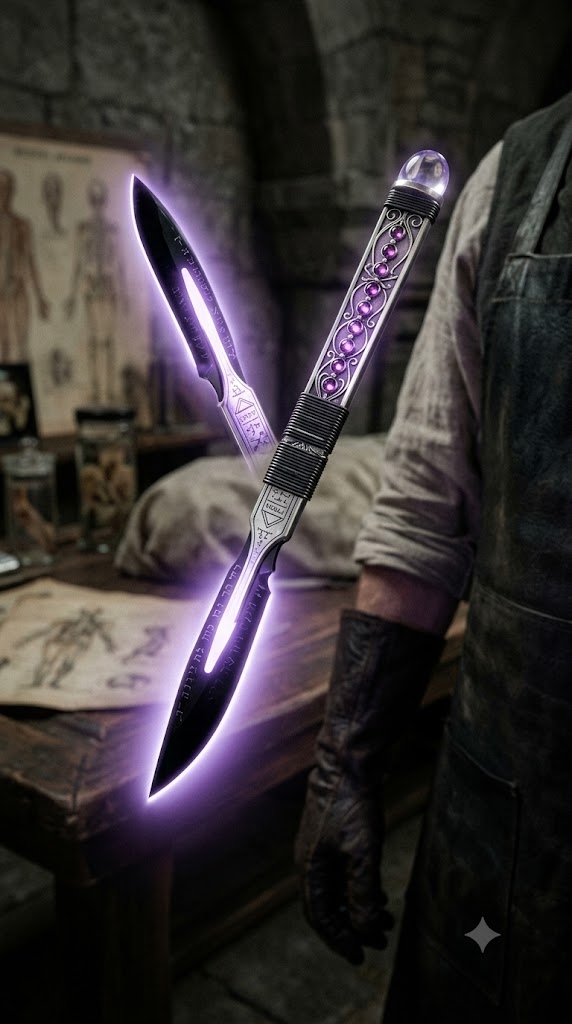
- The item appears as an obsidian-bladed scalpel bound to a polished silver handle etched with intricate Hebrew characters and sacred geometric lines.
- Ten micro-sized garnet gems are set along the silver spine of the handle, representing the ten divine nodes of the Tree of Life.
- The blade itself is razor-thin and dark as pitch, but casts a soft, pale violet glow when brought within inches of a deceased organism.
- The butt of the handle is shaped into a small, rounded quartz lens through which an examiner can peer to view microscopic fibers, fluid stains, or residual magical traces.
- When placed against dead flesh, the scalpel produces a faint, low-frequency hum that vibrates in harmony with the surrounding atmosphere.
Detailed Stats:
- Item Tier: Tier 1 (Common)
- Armor Check: +1
- Resilience: 10
- Item Health Points: Maximum avatar health points plus 10 (Resilience 10 multiplied by Tier 1)
- Weight: 1 pound
- Attunement Requirement: Instantaneous handheld attunement upon being held in an active hand
- Skill Requirement: Medicine or Forensic Investigation training
- Gear Slot: Hand Slot (Left or Right)
- Market Value: Variable based on local availability, demand, and regional merchant pricing
Multiple Passives Magic:
- Path of Binah: Grants the wielder a +1 bonus to all skill checks involving autopsies, post-mortem examinations, forensic analysis, and identifying cause of death on corpses.
- Echoes of the Departed: While holding the scalpel, the wielder passively sees the age, species, and exact time of death of any corpse examined through their Mind’s Eye as primary thought text.
- Preservation Grace: The scalpel naturally resists blood, rot, and decomposition fluids, remaining sterile and untarnished regardless of biological exposure.
Multiple Activable Magics:
- Post-Mortem Gematria (Active Action): The user spends one action making a precise incision on a corpse while concentrating on its internal structure. This reveals whether the target died from physical trauma, poison, disease, or magical damage, providing an advantage on the next medical check to identify specific substances or weapons used.
- Vitalis Tracing (Active Action): The user channels a minor pulse of arcane energy through the quartz handle lens while inspecting a corpse’s wound. This highlights residual blood trails, poison paths, or fluid tracks on or near the body in a glowing purple outline for 10 minutes.
- Chanted Incision of Yesod (Active Action – Normal Chanting): By reciting a brief formula of divine geometry for less than 6 seconds while using the scalpel on a corpse, the wielder temporarily stabilizes the remains, preventing further decay or environmental decomposition for up to 24 hours.
Tags: Kabbalah, Autopsy, Tier 1, Common, Scalpel, Forensics, Medicine, Sephiroth, Tool, Hand Slot, Investigation, Necrology, Gematria, Mortuary, Necropsy, Dissection, Microcosm, Binah, Anatomy, Pathology, Post-Mortem, Analysis, Silver Fire
Acquisition and Commerce of the Anatomist’s Scalpel
- Guild Coroners, Mortuary Supply Houses, and Medical Academies
- Location and Atmosphere: Situated within the civic districts of major island capitals, near city morgues, medical universities, or guildhalls. These shops smell strongly of preservation herbs, formaldehyde, and clean linen, featuring quiet display cases filled with surgical steel, embalming jars, and anatomical charts.
- Purchasing Conditions: Licensed guild coroners, city physicians, and certified medical apprentices may purchase the scalpel freely. Unlicensed buyers are scrutinized by shopkeepers to ensure the tool is not intended for illegal body harvesting or dark rituals.
- Selling Conditions: Merchants and guild apothecaries purchase these scalpels from estate liquidators, retiring surgeons, or adventurers who recover them from ancient medical vaults. Before buying, the merchant uses their Mind’s Eye to inspect the ten garnet nodes for fractures or biological contamination.
- Transaction Cost: Purchases typically cost between 90 and 140 Silver pieces (or equivalent in Electrum/Gold), depending on local demand and city medical regulations. Sales to these official establishments net the seller approximately 10% less per tier level of the character selling, deposited directly into their World Bank account. Registered guild members receive a 10% discount on purchases.
- Underground Black-Market Dens and Grave-Robber Exchanges
- Location and Atmosphere: Operating out of hidden cellars near city cemeteries, docks, or subterranean catacombs. These cramped venues are dimly lit by oil lanterns and trade in illicit alchemy ingredients, stolen anatomical specimens, and undocumented medical gear.
- Purchasing Conditions: Transactions are conducted strictly in physical gold or silver coin with no questions asked regarding identity, licensing, or intended use. Buyers pay premium prices for tools that do not log transactions with municipal watchmen.
- Selling Conditions: Fences and rogue alchemists buy these scalpels eagerly from grave-robbers or adventurers, as the item’s forensic abilities make it valuable for illicit autopsy work and poison identification.
- Transaction Cost: Purchases require physical gold coins paid upfront, often costing 15 to 22 Gold coins. Sales to a black-market fence yield roughly half the item’s market value in physical gold, bypassing World Bank records and avoiding official scrutiny.
- Wandering Medical Caravans and Port-Town Bazaars
- Location and Atmosphere: Temporary stalls and medical wagons set up near seaport gates, zeppelin landing docks, or coastal market squares where travelers and ship crews trade.
- Purchasing Conditions: Item availability is highly unpredictable and depends on recent ship arrivals or regional plague outbreaks. Merchants operate under a “buyer beware” philosophy, pricing items based on immediate local necessity rather than standard values.
- Selling Conditions: Traveling merchants buy surgical tools if they believe they can resell them at the next port of call for a higher profit margin. Haggling is expected, with prices fluctuating based on the seller’s tier and local health conditions.
- Transaction Cost: Prices vary widely based on regional health crises and distance from manufacturing hubs, ranging from 75 Silver in quiet port towns to over 250 Silver (25 Gold) in regions affected by disease or ongoing military conflict. Sales result in World Bank deposits minus standard transaction fees.
Combat Application and Tactical Roleplay
- Subterranean Catacombs and City Ossuaries
- Offensive Roleplay: In narrow, shadow-drenched burial chambers, the wielder targets undead entities, fleshy abominations, or hostiles utilizing dead flesh as cover. By activating Post-Mortem Gematria, the user strikes at a corpse or incoming undead beast, targeting historical anatomical weak points inscribed into its tissue. In roleplay, the wielder steps inside an opponent’s reach, making a swift, precise incision along a decaying tendon or skeletal joint, causing the target’s limb to buckle instantly as the obsidian blade sever the residual spiritual connections holding the dead flesh together.
- Defensive Roleplay: When cornered by swarm creatures or reanimated corpses, the wielder uses the scalpel to rapidly inspect defeated bodies lying on the stone floor. By chanting the Incision of Yesod, the user touches the scalpel to a fallen corpse, instantly stabilizing its physical decay and hardening its flesh and bone structure into a rigid, petrified mass. Roleplaying this involves describing the ten garnet gems on the handle flashing in a purple cascade as the user locks a corpse’s position, creating an impenetrable physical barricade against incoming strikes or narrow corridor pushes.
- Seaport Plague Docks and Quarantine Vessels
- Offensive Roleplay: On slick wooden decks or within disease-ridden ship holds, combat often involves toxic hazards, poisoned weapons, or bio-magical threats. The user targets a hostile combatant’s supply satchel, venom vials, or infected weapon blades using an action. By utilizing Vitalis Tracing, the wielder sweeps the quartz handle lens across an opponent’s gear or a wounded ally, visually highlighting the glowing purple pathways of venom or disease. The player roleplays this by identifying the exact entry vector of a chemical threat, allowing them to disarm a poisoned blade or cut away infected tissue before toxins enter the bloodstream.
- Defensive Roleplay: In damp, contaminated environments where rotting matter threatens to infect open wounds, the passive Preservation Grace property keeps the user’s weapon pristine and sterile. If targeted by biological attacks or acid splashes, the wielder roleplays using the scalpel’s razor edge to slice cleanly through contaminated cloaks or bandages, parrying biological projectiles off the dark obsidian blade while ensuring no rot or corruption clings to their personal gear.
- Metropolitan Guild Halls and High-Society Estates
- Offensive Roleplay: During urban investigations or social encounters that turn violent, the wielder uses the scalpel as a concealed, deadly defensive counter. Because the item appears as a small medical tool rather than an overt weapon, the user roleplays drawing the blade from an inner coat pocket without raising immediate alarm. In close-quarters combat, the wielder uses their forensic knowledge to target non-lethal nerve clusters or major arteries on humanoid attackers, disabling aggressive guards or assassins with surgical precision.
- Defensive Roleplay: When ambushed near a fresh murder scene or target of interest, the wielder uses the scalpel to protect critical forensic evidence from being destroyed by hostile forces or wild magic. By applying Chanted Incision of Yesod to a key body or evidence sample mid-combat, the wielder locks the corpse in a temporal-stasis field. Roleplaying this centers on the wielder shielding the body with their physical stance while the silver handle hums loudly, preserving the victim’s final memories and cause of death against fire, acid, or magical disruption.
Perception of Activation:
- User’s Perspective
- Sight: The ten garnet gems along the handle spine ignite with a deep, pulsing crimson light. The dark obsidian blade flares with an internal, pale violet luminescence that brightens and clarifies the edges of dead tissue being examined.
- Hearing: A low, rhythmic harmonic hum, resembling the distant ringing of fine crystal bells, echoes from the silver handle and resonates through the wielder’s hand. When chanting a spell, this resonance creates a subtle vocal echo.
- Touch: The polished silver handle remains cool to the touch, but the obsidian blade emits a subtle, warm magnetic vibration, pulling gently toward areas of significant physical trauma, poison deposits, or residual magical energy within a corpse.
- Smell: A sharp scent of clean ozone, sterile metal, and slightly acrid burning frankincense accompanies the magical activation.
- Taste: A faint, dry metallic copper taste coats the wielder’s palate during the peak moment of energy discharge.
- Extra-Sensory Perception: Through the Mind’s Eye, the wielder gains immediate post-mortem insight. Dead tissue reveals translucent pathways, historical wound channels, fluid trails, and residual magical echoes rendered as glowing violet patterns and primary thought text overlaid onto the physical remains.
- Observer’s Perspective
- Sight: Onlookers see the dark obsidian blade radiate a bright, pale violet light, casting intricate geometric shadow patterns onto the wielder’s hands and surrounding surfaces. The silver handle catches the ambient light as the ten garnet nodes illuminate in a rapid sequence.
- Hearing: Observers hear a distinct high-pitched metallic chime followed by a smooth, low-frequency thrumming sound that briefly suppresses ambient background noises, making wind or distant voices sound muffled.
- Touch: Individuals standing immediately adjacent feel a subtle drop in localized ambient temperature and a brief, focused pull of air toward the scalpel.
- Smell: Observers within a few feet detect an ionized metallic tang accompanied by a faint whiff of frankincense smoke.
- Taste: Observers do not perceive a direct taste, though highly sensitive individuals nearby may experience a mild dry sensation in their throat.
- Extra-Sensory Perception: Magic-sensitive observers or those using True Sight perceive a concentrated burst of ultraviolet magic surrounding the scalpel, radiating brightest from the ten garnet nodes. Those with heightened empathy may feel a brief emotional ripple or echo of pain in the immediate area during activation.
- Positives
- The strong tactile and visual feedback confirms that the magical alignment is active, reducing error during complex forensic examinations.
- The pale violet glow provides illumination for deep incisions, allowing for precise post-mortem analysis in dark environments.
- The extra-sensory vision provided by the Mind’s Eye allows the examiner to analyze wound channels and pathogens without requiring destructive exploratory surgery.
- Negatives
- The distinct violet glow and harmonic chime make stealth impossible during active use, instantly revealing the user’s position.
- The scent of ozone and the burst of ultraviolet light can be easily detected by hostile entities or creatures with specialized sensory abilities.
- Repeated active activations in a short timeframe cause a dull mental strain in the wielder’s Mind’s Eye, resulting in a mild tingle behind the eyes and a lingering metallic taste.
Crafting Recipe: The Anatomist’s Scalpel
- Materials Needed
- Tier 1 Magic Crystal: Quantity of 1 (approximate size and weight of a coin, serves as the primary mystical battery and magical catalyst).
- Dense Volcanic Obsidian: 1 pound of pure, unblemished black obsidian stock for knapping and grinding the main blade.
- High-Purity Silver Inlay Wire: 2 ounces of fine silver wire for forging the handle, setting the geometric Tree of Life engravings, and running the internal conduits.
- Flawless Garnet Gems: Quantity of 10 small, matched cabochon garnets (to be mounted at the Sephirotic nodes along the handle spine).
- Polished Quartz Crystal Lens: Quantity of 1 small, rounded quartz sphere (for mounting on the handle butt to act as a magnifying lens).
- Alchemical Preservative Flux: 1 vial of enchanted embalming flux (used to seal the obsidian to the silver handle and stabilize the magic crystal).
- Tools Required
- Diamond-Tipped Knapping Chisels: Specialized fine chisels for shaping and honing the razor-thin obsidian blade without creating structural micro-fractures.
- Jeweler’s Arcane Torch: A small, precise steam-and-fire torch used for soldering the silver handle matrix and setting the gemstone bezels.
- Engraving Chisels: Ultra-fine steel chisels for carving Hebrew characters and gematria glyphs into the silver handle.
- Fluid Collector: Used during material preparation to extract specific embalming saps or preservative fluids required for the alchemical flux.
- Item Focusing Workbench: A stabilized workstation equipped with magic flow conduits to isolate the crafting space from wild magic interference.
- Skill Requirements
- Alchemical Crafting Skill: Level 5 or higher (for flux synthesis and biological stabilization).
- Forensic or Medical Crafting Skill: Level 2 or higher (to correctly align the anatomical gematria pathways).
- Mind’s Eye Proficiency: Ability to actively view and adjust internal magic flow pathways during assembly.
- Crafting Steps
- Step 1 – Shaping the Obsidian Blade: Carefully knap and grind the volcanic obsidian into a razor-thin scalpel blade. Polish the surface until smooth and dark, ensuring the edge achieves a microscopic sharpness.
- Step 2 – Forging the Silver Handle: Melt and cast the pure silver into a sleek, ergonomic handle. File the spine to create ten inline gemstone sockets and cut a circular cavity at the butt end for the quartz lens.
- Step 3 – Carving the Sacred Geometry: Using the diamond-tipped engraving chisels, carve the ten Sephirotic pathways, thirty-two connecting lines, and sacred gematria characters along both sides of the silver handle.
- Step 4 – Gemstone and Lens Mounting: Place the ten matched garnets into their respective sockets along the handle spine, securing them with delicate silver bezels. Mount the polished quartz lens into the butt of the handle.
- Step 5 – Core Crystal Integration and Flux Application: Machine a small internal chamber at the junction where the blade meets the handle. Insert the Tier 1 Magic Crystal into this chamber, connecting its natural conduits to the silver engraving pathways. Apply the alchemical flux to lock the crystal in place.
- Step 6 – Blade Joining and Sealing: Fit the obsidian blade into the silver handle housing. Use the jeweler’s arcane torch to gently heat the assembly, fusing the obsidian, silver, and alchemical flux into a single seamless instrument.
- Step 7 – Calibration and Attunement Alignment: Place the completed scalpel onto the item focusing workbench. Activate your Mind’s Eye to observe the flow of magic from the core crystal to the ten garnets. Make micro-adjustments to the silver wire alignment until the garnets pulse in a fluid crimson sequence and the obsidian blade emits a steady, pale violet aura.
Dark Glass Knife and Ten Red Beads of Dead-House
In the days when the sky-monster VaporSphere was not yet given a name by the island kings, and the ground-moon Saṃsāra was still steaming from the old fires of the elemental battles, there lived a bone-cutter and body-watcher named Ya-Kov-the-Silent. Ya-Kov lived in a low stone hut near the sea-gates of a great walled city, where the water flows from east to west toward the cold poles. He was a man of quiet steps who did not speak loud words in the taverns, nor did he carry a great iron sword to cut down wild beasts in the thick jungle. He possessed only a small wooden mallet, three iron pins, and an eye that looked very deeply into the quiet faces of those whose breath had gone out.
During that time, a strange sickness of the blood fell upon the people of the coastal states. Men and women would sit down at their evening meal of boiled fish and bread, and before the sun Helios went down past the western waters, their skin would turn the color of wet mud, and their eyes would shut forever. The city judges and the grand councilors were filled with great fear, for they knew not if a bad wind had blown from the ocean or if an evil spirit had poured poison into the public water-wells.
The local warlord, who was also the leader of the city guild, went to the house of Ya-Kov. He brought with him four city guards carrying big copper shields and said: “O cutter of bones, thirty people have died in the lower street since the morning bell. If thou canst not tell us why their breath has ceased, the people will burn the dead-house and flee into the wild woods where the feral monsters wander.”
Ya-Kov looked upon the dead ones with his wooden sticks and his copper needles, but he could see nothing. The skin of the corpses was smooth like river stones, and their organs showed no cuts from a knife or marks from a serpent’s tooth. In his heart, Ya-Kov was heavy with sorrow, for he knew that without true knowledge, he was like a blind man walking on the edge of a high sky-dock in the cloud cities.
That night, during the week of Darkness in the month of Kelemus, Ya-Kov went to the quiet graveyard behind the city walls. He knelt upon the cold dirt and called out to the Earth-Mother Gaialilith, calling her by the secret title of the Great Root-Mother Who Remembers All Flesh. He held up his hands and spoke to the night air: “O Mother of the Deep Moon, my eyes are dark like two unlit lanterns. When I look upon the flesh of the fallen, I see only cold meat that tells no tales. Give unto me a small light that I may read the story written in the blood before the worm eats the page.”
The goddess Gaialilith, who feels the pain of every small insect and every human soul that enters the world of reincarnation, heard the prayer of the bone-cutter. She looked into the sea of purgatory across the many dimensions of time and pulled forth a small piece of dark volcanic glass that had been cooled in the deep ocean vents before people walked upon Saṃsāra.
She caused the dark glass to drop from the sky like a falling star. It crashed through the wooden roof of Ya-Kov’s dead-house and landed inside his clay basin of water.
When Ya-Kov ran inside, he found the clay basin broken in two pieces, and in the middle lay a long, thin sliver of black glass that burned with a faint, purple light. Beside it lay ten small red stones that looked like frozen drops of pomegranate juice. A voice came forth from the dark glass, sounding like a quiet whisper from an underground tomb: “Take the black glass of the fire-mountain. Bind it to a handle of pure silver wire. Carve upon the handle the thirty-two paths of the upper tree and set the ten red stones along its spine. When thou layest this blade against the flesh of the quiet ones, the hidden truth of their final hour shall shine like the morning sun.”
Ya-Kov worked for seven days without sleeping. He melted three silver coins that had been given to him by a dead prince’s family and drew the silver into fine threads. He wrapped the silver threads around the tail of the black glass knife, hammering them with his copper mallet until they formed a tight handle. He carved tiny marks into the silver, marks that looked like the legs of spiders and the branches of dry trees. Then he pressed the ten red garnets into the silver spine, one by one.
When the last red stone was pushed into its bed, the black blade gave forth a sharp chime, like the sound of an iron needle striking a brass bell.
On the next morning, the guards brought to the dead-house the body of a rich merchant who had fallen dead in the central market square. The city judge stood in the doorway, holding a cloth over his nose, and shouted: “Tell us quickly, bone-cutter! Was it the plague-wind, or did his heart stop from too much wine?”
Ya-Kov did not answer with words. He took the new instrument, which he named the Scalpel of Seventy-Two, and touched the razor-thin point of the black glass to the chest of the dead merchant.
Immediately, a great wonder occurred in the room. The ten red garnets along the handle lit up with a deep crimson fire, and the black blade emitted a bright, pale violet glow that illuminated the dark room. Through his Mind’s Eye, Ya-Kov did not see mere dead skin. He saw glowing lines of purple light running through the merchant’s body like the streams of a river map.
Following the purple lines with the tip of the knife, he saw a dark, black spot hidden inside the man’s throat. The glass knife guided his hand to make a single, bloodless cut. From the throat, Ya-Kov pulled forth a tiny, crushed leaf of a rare swamp-weed that grows only in the deep gardens of the city judge’s private estate. The man had not died of the plague; he had been poisoned by a secret cup of tea.
The city judge saw the glowing purple light and the green leaf upon the obsidian point. His face turned white like goat’s milk, and he turned to run out into the street. But the city guards, seeing the truth that had been revealed by the glowing blade, held up their spears and captured the judge before he could reach his carriage.
For many years after that day, Ya-Kov used the Scalpel of Seventy-Two to find the truth in the quiet city. He located hidden poisons, found the marks of invisible magic spells, and showed the city healers how to stop the spread of real sicknesses before they destroyed whole towns. He grew old and wise, but he never used the knife to harm a living man, nor did he sell the secret of its forging to the rich lords who offered him boxes of gold coins.
When his time came to leave his avatar, and his soul felt the 100% hunger to pass into the great ocean of memories, Ya-Kov walked out to the ancient catacombs beneath the central city. He lay down upon a stone slab beside the bones of the old kings, holding the black glass knife against his chest.
When his physical body vaporized into a cloud of purple sparks, leaving behind his soul crystal, the silver handle and the black obsidian blade did not vanish. The Scalpel of Seventy-Two remained lying upon the cold stone, its ten garnet nodes glowing softly in the dark, waiting for another seeker of truth to pick it up and read the silent stories of the dead.
Moral of the Story: No secret deed or hidden poison can remain buried in the darkness forever, for even when the mouth is closed in death, the physical body carries the unyielding truth of its history to those who know how to read it with precision and reverence.
Suggested conversions to other systems:
Call of Cthulhu (7th Edition)
Name: The Anatomist’s Scalpel of Yesod
- Item Type: Arcane Tool / Artifact
- Era & Setting: Gaslight / Modern / 1920s Adaptation (Originating from Saṃsāra)
- Equipment Slot / Carrying: Handheld (Occupies hand when in active use; carried in a leather surgical roll or velvet-lined case)
- Skill Requirements: Medicine (40% or higher) OR Forensic Pathology / Science (30% or higher)
- Physical Description: A razor-thin scalpel crafted from dark volcanic obsidian bound to a silver handle etched with Hebrew characters and geometric lines. Ten tiny garnet gems line the spine of the handle, and a small quartz lens is set into the butt end. The obsidian blade flares with a faint, pale violet glow when brought near a corpse.
- System Mechanics & Usage Syntax:
- Passive Benefit – Path of Binah: While holding the scalpel and performing a post-mortem examination, autopsy, or crime scene analysis on a corpse, the investigator receives One Bonus Die on all Medicine, Science (Forensics), or Spot Hidden checks targeting the deceased.
- Active Ability – Post-Mortem Gematria: The investigator spends 1 Action and burns 1 Sanity Point to make a precise incision on a corpse while concentrating on its internal structure. The user makes a Medicine or Science (Forensics) roll:
- Success: Reveals the exact cause of death (physical trauma, specific poison, disease, or magical damage) and highlights historical wound channels or toxic tracks in glowing purple outlines, granting an Extreme Success on subsequent checks to identify specific weapons or chemical compounds used.
- Extreme Success: The investigator instantly discerns the precise timeline of death, the exact weapon or poison involved, and any residual magical traces without requiring further checks.
- Fumble: The investigator suffers severe psychological feedback from the corpse’s final moments, suffering 1d4 Sanity Loss and becoming Shaken for 1 hour.
- Active Ability – Chanted Incision of Yesod (Cost: 2 Magic Points): The user recites a short geometric formula while making a symbolic cut over a corpse. The targeted remains are locked against physical decay, bacterial decomposition, and environmental rot for 24 hours.
Blades in the Dark
Name: The Anatomist’s Scalpel
- Item Type: Fine Forensic Tool / Arcane Artifact
- Load Value: 1 Load (Fine Quality)
- Associated Actions: Study, Doctor
- Quality Rating: Tier +1 when interacting with corpses, biological remains, forensic crime scenes, or surgical procedures.
- Physical Description: A sleek obsidian scalpel wrapped in silver wire with ten embedded micro-garnets. The blade emits a soft violet aura near dead tissue, while the quartz pommel lens allows microscopic examination of wound boundaries and chemical stains.
- System Mechanics & Usage Syntax:
- Fine Tool Quality: Counts as a Fine item when performing a Doctor or Study action to analyze corpses, determine causes of death, or extract biological samples, granting +1 Quality to the roll or improving overall Effect.
- Active Ability – Vitalis Tracing (Position & Effect Boost): When examining a victim or corpse under stressful or time-sensitive conditions (such as mid-heist or in a guarded morgue), the scoundrel may invoke the sacred geometry of the scalpel. This improves the Effect of a Study or Doctor check from Limited to Standard, or Standard to Great.
- Special Activation – Post-Mortem Insight (Cost: 1 Stress): The scoundrel spends 1 Stress to immediately discharge stored arcane power into a corpse’s wound. The scalpel highlights the precise entry vector, weapon type, or poison path, instantly clearing one clock segment related to an investigation or murder mystery without rolling.
- Special Activation – Preservative Stasis (Cost: 2 Stress): The user taps the scalpel against a fresh corpse while chanting a brief formula. The body is completely preserved against rot, decay, or spirit-severing degradation for 24 hours, preventing ghost emergence or physical corruption.
Dungeons & Dragons (5th Edition)
Name: Scalpel of the Anatomist
- Item Type: Wondrous Item
- Item Rarity: Common
- Attunement: Requires Attunement by a creature proficient with Medicine or Alchemist’s Supplies
- Equipment Slot: Held in one hand
- Physical Description: An obsidian-bladed scalpel fused to a silver handle inlaid with ten garnet gems and Hebrew characters. A rounded quartz lens is built into the pommel. The blade sheds pale violet dim light in a 5-foot radius when within 10 feet of a dead creature.
- System Mechanics & Usage Syntax:
- Forensic Precision (Passive): While holding this item, you gain a +1 bonus to Wisdom (Medicine) checks made to perform autopsies, determine causes of death, or stabilize dying creatures, as well as Intelligence (Investigation) checks made to examine corpses or biological crime scenes.
- Post-Mortem Gematria (Active Action – 1 Charge): As an Action, you press the scalpel’s obsidian tip to a corpse within 5 feet and expend 1 Charge. You instantly learn whether the creature died from physical trauma, poison, disease, or magical damage, as well as the exact time of death within the last 24 hours.
- Chanted Incision of Yesod (Active Action – 1 Charge): As an Action, you touch the scalpel to a corpse and chant a brief numerical formula. The corpse is targeted by the effects of the Gentle Repose spell for 24 hours (preventing decay and extending the time limit on resurrection spells).
- Charges & Recharge: The scalpel has 3 Charges. It regains 1d3 expended charges daily at dawn. If you expend the last charge, roll a d20. On a 1, the obsidian blade shatters into useless shards, turning the item into a non-magical decorative silver handle worth 10 gp.
Knave (2nd Edition)
Name: The Anatomist’s Scalpel
- Item Type: Utility Tool / Arcane Surgical Gear
- Slots Occupied: 1 Item Slot
- Quality / Durability: 3 / 3
- Associated Attribute: Wisdom / Intelligence
- Physical Description: A specialized obsidian-bladed incision knife bound in etched silver wire with ten tiny garnet beads. Its quartz pommel lens and dark edge glow with faint violet light near corpses or organic rot.
- System Mechanics & Usage Syntax:
- Anatomical Insight (Passive): Carrying this item in an active item slot grants Advantage on all Wisdom or Intelligence checks made to perform field surgery, analyze cause of death, identify poisons, or butcher monster remains for usable alchemy ingredients.
- Post-Mortem Examination (Active Usage – Quality Cost): You may spend 1 minute inspecting a corpse while utilizing the scalpel. Make a Wisdom or Intelligence check against the target’s Difficulty:
- Success: You identify the exact weapon, poison, or spell that caused death, as well as any physical weaknesses or natural armor flaws inherent to that creature’s species.
- Failure: The cause of death remains inconclusive.
- Preservative Stasis (Active Action – Spend 1 Quality): You press the obsidian tip against a corpse or harvested monster part and reduce the scalpel’s Quality by 1 point. The targeted biological material is completely preserved from rot, decay, and foul odors for 3 days.
- Refurbishing Quality: The scalpel’s Quality can be restored during downtime by spending 1 Tier 1 magic crystal or silver wire worth 20 gold pieces to re-align the gemstone conduits.
Fate Core System
Name: The Anatomist’s Scalpel
- Item Type: Extraordinary Gear / Aspect-Granting Stunt Focus
- Permissions: Requires an Aspect related to medicine, forensics, or biological study (e.g., Guild Coroner, Physician of the Shadow Docks).
- Invokable Aspect: Gematria Post-Mortem Insight
- Physical Description: A dark obsidian scalpel bound in silver wire etched with Hebrew characters. Ten small garnet gems along its handle pulse with a soft crimson glow, while the razor-thin blade radiates a pale violet aura near dead tissue.
- System Mechanics & Usage Syntax:
- Stunt – Forensic Precision: You gain a +2 bonus to Crafts or Lore checks when using the scalpel to perform autopsies, identify poisons, analyze cause of death, or examine biological crime scenes.
- Stunt – Post-Mortem Tracing: Once per scene, you may spend 1 Fate Point and use an action to analyze a corpse using Investigate or Crafts. Upon success, you create a free-invoke aspect on the scene or victim called Exposed Cause of Death with two free invocations instead of one.
- Stunt – Preservative Incision: Once per scenario, when a corpse or harvested biological sample would suffer environmental decay or degradation (such as rotting or losing magical potency), you can use an action to touch the scalpel to the remains. The target receives the positive aspect Preserved by Sacred Geometry, rendering it immune to rot and decay for 24 hours.
Numenera & Cypher System
Name: Scalpel of the Ten Garnets
- Item Type: Artifact
- Level: 1d6 + 1
- Form: A sleek obsidian surgical blade set in a silver frame with ten small garnet nodules and a quartz pommel lens.
- Depletion: 1 in 1d10 (check after using an active ability)
- Physical Description: A relic designed to extract historical memory from organic remains. Its obsidian edge cuts through dead tissue with zero resistance, emitting a low harmonic chime and a pale violet glow when brought close to a deceased organism.
- System Mechanics & Usage Syntax:
- Passive Benefit – Medical Analysis: While holding the artifact, the user gains an asset (lowers the difficulty by 1 step) on all Intellect-based tasks involving Healing, Medical Diagnosis, Forensic Pathology, or Harvesting biological components from dead creatures.
- Active Ability – Post-Mortem Gematria (Cost: 2 Intellect Points): The user spends one action touching the scalpel to a corpse or organic specimen. The difficulty of the next action to identify its cause of death, track poisons, locate internal flaws, or harvest usable components is reduced by 2 steps.
- Active Ability – Preservative Stasis (Cost: 3 Intellect Points): The user presses the obsidian tip against a corpse or biological sample of a Level equal to or less than the Artifact Level. The remains are locked in a temporal-stasis field, completely preventing decay, rot, and foul odors for 24 hours.
- Depletion Roll: Roll 1d10 when using Preservative Stasis. On a roll of 1, the garnet nodules shatter, reducing the artifact to a standard non-magical surgical blade.
Pathfinder (2nd Edition)
Name: Anatomist’s Scalpel
- Item Type: Item 2 (Magic, Necromancy, Transmutation)
- Price: 35 gp
- Usage: Held in 1 hand; Bulk: L
- Access Requirements: Trained in Medicine
- Physical Description: This fine obsidian scalpel features a silver handle inlaid with ten garnet gems and a small quartz lens at the pommel. When within 10 feet of a dead creature, the blade sheds pale violet dim light in a 5-foot radius.
- System Mechanics & Usage Syntax:
- Item Bonus (Passive): You gain a +1 item bonus to Medicine checks to Treat Wounds, Administer First Aid, or recall knowledge regarding anatomical structures and diseases, as well as Investigation checks to examine corpses.
- Post-Mortem Analysis [Single Action] (Concentrate, Exploration, Manipulation): You use the scalpel to inspect a corpse or biological sample within 5 feet. Make a Medicine check against the target’s DC (or standard level DC). On a success, you learn the exact cause of death (physical trauma, poison, disease, or magic) and the approximate time of death within the last 24 hours.
- Preservative Stasis [Single Action] (Frequency: Once per day) (Item, Necromancy): Effect: You touch the obsidian tip of the scalpel to a corpse. The corpse is targeted by the effects of gentle repose for 24 hours, preventing decay and preserving the body for resurrection or further forensic examination.
- Highlight Weakness [Two Actions] (Frequency: Once per day) (Item, Transmutation): Effect: You touch the scalpel to an undead creature or construct composed of flesh/bone. Make a Medicine check against its Fortitude DC. On a success, the target suffers a -1 item penalty to AC and saving throws for 1 minute as you expose its structural anatomical flaws.
Savage Worlds (Adventure Edition)
Name: Scalpel of the Anatomist
- Item Type: Weird Science Device / Magic Artifact
- Min Str: d4; Weight: 1 lb.
- Arcane Supply: 10 Power Points (Recharges 1 PP per hour)
- Physical Description: An obsidian surgical blade bound to a silver handle set with ten tiny garnet gems. The blade emits a soft violet aura and hums softly when held near corpses or biological samples.
- System Mechanics & Usage Syntax:
- Master Coroner (Passive): Holding the device grants a +1 bonus to Healing rolls and Notice rolls made to examine crime scenes, corpses, or biological materials.
- Post-Mortem Tracing (Active Action – Cost: 2 Power Points): As an action, the user touches the scalpel to a corpse, making a Healing roll at +2. On a success, the user determines the exact cause of death, weapon type, or poison path, instantly gaining a +2 bonus to any follow-up tracking or investigative rolls related to the victim.
- Preservative Stasis (Active Action – Cost: 3 Power Points): The user targets a fresh corpse or organic specimen, using an action to trace a sacred geometric line across its surface and rolling Healing against Medium difficulty.
- Success: The targeted biological material is completely protected against decay, rot, and environmental decomposition for 24 hours.
- Raise: The preservation lasts for 3 days and prevents any magical attempts to reanimate the body as undead during that time.
Shadowrun (6th World)
Name: The Anatomist’s Scalpel
- Item Type: Focus / Advanced Medical Tool
- Availability: 3 (R)
- Cost: 3,800 nuyen
- Wireless Bonus: The scalpel connects directly to your PAN via Matrix link, analyzing biological scans, toxin signatures, and tissue density in real-time. When performing forensic autopsies or cyberware extraction, you receive 1 bonus Edge point toward any Biotech check targeting that body.
- Physical Description: A precision scalpel featuring a razor-sharp volcanic obsidian blade mounted to a silver-bound handle etched with geometric node patterns. Capped with a quartz magnifying lens and ten inline garnet gems, the tool hums softly and sheds a pale violet aura when brought near organic remains.
- System Mechanics & Usage Syntax:
- Passive Benefit – Path of Binah: While holding the scalpel, the user receives a +1 dice pool bonus to Biotech (Forensics) and Biotech (First Aid) tests targeting organic targets or corpses.
- Active Ability – Post-Mortem Tracing (Minor Action): The user applies the obsidian tip to a corpse’s wound or incision site. The user spends a Minor Action to trace the tissue structure. The next Biotech (Forensics) test to determine the cause of death, weapon type, or poison signature receives +2 dice, and a success reveals the precise timeline of death.
- Active Ability – Preserve Remains (Major Action): The user spends a Major Action making a symbolic incision along a corpse while reciting a brief geometric formula. Roll Biotech + Logic vs. Device Rating / Essence x 2:
- Success: The targeted biological material or corpse is completely protected against decay, rot, and foul odors for 24 hours.
- Glitch: The scalpel’s magical alignment misfires, causing rapid cellular breakdown and rendering future forensic checks on the body 1 step harder in difficulty.
Starfinder (2nd Edition)
Name: Anatomist’s Scalpel
- Item Level: Level 2
- Price: 220 credits
- Hands: 1; Bulk: L
- Category: Tech / Arcane Hybrid Tool
- Physical Description: A dark obsidian scalpel blade fused to a silver handle set with ten garnet gems and a quartz pommel lens. Designed to read post-mortem energy patterns, its edge glows with a pale violet light when brought within 10 feet of a dead creature.
- System Mechanics & Usage Syntax:
- Tool Bonus (Passive): You gain a +1 item bonus to Medicine checks made to perform autopsies, diagnose diseases, or harvest biological samples from dead creatures, as well as Perception checks made to analyze crime scenes involving organic remains.
- Post-Mortem Analysis [Single Action] (Arcane, Tech): You press the scalpel’s obsidian tip to a corpse or biological sample within reach. You instantly learn whether the creature died from physical trauma, poison, disease, or magical damage, as well as the exact time of death within the last 24 hours.
- Preservative Stasis [Two Actions] (Arcane, Tech): You apply the scalpel to a corpse within 5 feet and recite a geometric formula. Make a Medicine check against the target’s level DC:
- Success: The corpse is targeted by the effects of Gentle Repose for 24 hours, preventing natural decay, rot, and environmental decomposition.
- Critical Failure: The ritual fails and corrupts the biological sample, making subsequent forensic checks on the body suffer a -2 circumstance penalty.
Traveller (Mongoose 2nd Edition)
Name: Anatomist’s Field Scalpel
- Tech Level: TL 12 (Special / Hybrid Origin)
- Weight: 0.2 kg
- Price: Cr1,800
- Skill Requirement: Medic 1
- Physical Description: A hand-held surgical blade forged from razor-thin volcanic obsidian mounted on a silver frame set with ten garnet gems. The pommel features a high-density quartz magnifying lens that highlights micro-fractures, chemical paths, and cellular trauma under ultraviolet light.
- System Mechanics & Usage Syntax:
- Passive Skill Augmentation: When held and used during post-mortem examinations, field surgery, or biological analysis, the medical examiner receives a +1 DM to all Medic, Investigate, or Science (biology) checks involving corpses or organic specimens.
- Active Diagnostic – Cause of Death Identification: The traveler spends 1 minute using the scalpel to inspect a corpse or biological sample. Make an Average (2D) Medic check (DM +1 from the item):
- Effect 0+: You determine the exact cause of death, weapon type, or chemical agent used, as well as the approximate time of death within 1 hour.
- Effect 6+: You identify non-obvious biological markers, such as hidden toxins, concealed sub-dermal implants, or residual exotic energy traces.
- Preservative Field (Exploration Action): A traveler can spend 5 minutes using the scalpel to trace a geometric pattern across a corpse or harvested biological sample. The target is preserved against decomposition, rotting, and foul odors for 3D6 days.
Warhammer (40,000 Roleplay – Rogue Trader / Dark Heresy / Wrath & Glory)
Name: The Anatomist’s Scalpel of Yesod
- Item Tier / Value: Tier 1 / Rare
- Keywords: IMPERIUM, ADEPTUS MECHANICUS, MEDICAE, ARTIFACT
- Physical Description: A dark obsidian chirurgeon’s blade bound in silver wire inlays and set with ten garnet gems. Kept as a sacred relic of ancient post-mortem geometry, its razor edge sheds a pale violet glow that pacifies the biological corruption of dead flesh and reveals hidden truths inscribed within mortal remains.
- System Mechanics & Usage Syntax:
- Passive Blessing – Forensic Precision: A character wielding the scalpel gains +1 bonus die (or +10% to Medicae Skill Checks in d100 systems) when performing tests using Medicae, Scholar / Forbidden Lore (Biology), or Investigation to analyze corpses, identify poisons, or perform autopsies.
- Post-Mortem Gematria (Combat / Investigation Action): The user touches the obsidian tip to a corpse or organic specimen and utters a brief binary canticle or geometric chant. Make a Medicae Test:
- Success: The user instantly discerns the primary cause of death, toxin type, or structural weakness inherent to that target’s biological species, granting a +1 bonus die on subsequent attacks or Medicae checks targeting that species for 1 hour.
- Stasis Incision (Out of Combat Action): The user traces a sacred geometric incision across a corpse or harvested biological organ. Make a Medicae Test:
- Success: The biological sample is locked in a stasis field, completely preventing physical decay, rot, and warp-taint degradation for 24 hours.
- Wrath / Critical Success: The preservation lasts for 7 days and prevents any dark rituals or warp entities from reanimating the corpse as undead.