
Lore
Among the wandering ritualists of Saṃsāra, there are tales of healers who never spoke a word yet calmed entire gatherings with nothing more than motion. Their hands carried rhythm, intent, and meaning older than language itself. Zar 219 was first formed in such a tradition, where gestures replaced incantations and motion replaced voice. The item was created for those who understood that the body speaks even when the mouth does not, and that careful movement can realign spirit, soothe pain, or redirect hostile intent.
It is said that the spirits bound to this Zar do not listen to words. They watch. They respond to motion, posture, and intention expressed through the body’s language. Over time, the Zar learned to echo those motions back into the world, subtly reinforcing meaning through rhythm and repetition.
Item Description
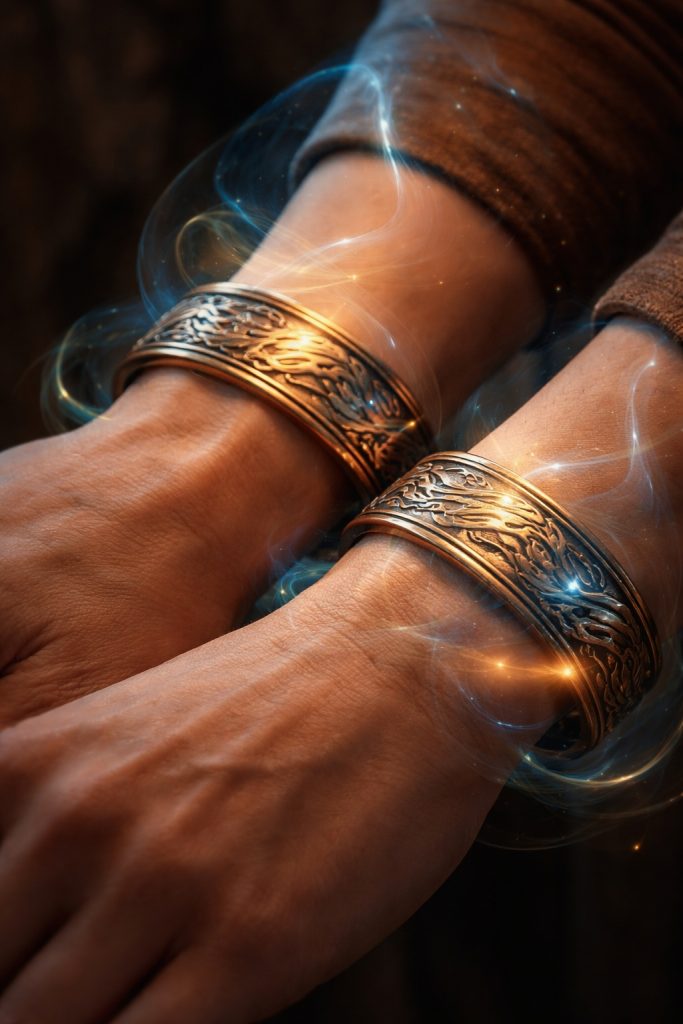
A pair of thin, interlinked bands worn around the wrists, etched with flowing, looping marks resembling stylized hands in motion. The metal is warm to the touch and faintly responsive, tightening or loosening with the wearer’s movements. When activated, the bands emit a soft kinetic hum, as if responding to invisible currents around the hands.
Rarity
Common
Tier
1
Item Type
Ritual Focus / Gesture Conduit
Slot
Both wrists (counts as one worn item)
Skills Gained While Openly Worn
• Gesture Interpretation: Improved ability to read body language, posture, and nonverbal intent
• Ritual Movement: Increased effectiveness when performing rhythmic or symbolic actions
• Silent Communication: Enhanced clarity when conveying intent without speech
Passive Magical Effects
• Motion Sensitivity: The wearer becomes more aware of subtle movement in their surroundings, gaining improved perception of shifting stances, tension, or intent.
• Gesture Amplification: Deliberate hand and arm movements carry emotional weight, making nonverbal communication clearer and more persuasive.
• Flow Alignment: Smooth, controlled motion reduces fatigue from repetitive or precise physical actions.
• Quiet Focus: The wearer finds it easier to concentrate while moving rhythmically or performing repetitive gestures.
Activatable Abilities
• Speaking Hands
Activation: Controlled hand movement or symbolic gesture
Effect: For a short time, the wearer’s gestures carry emotional meaning equivalent to spoken reassurance or warning. Nearby creatures instinctively understand intent, even across language barriers. This cannot convey complex ideas, only emotional or directional meaning.
Cooldown: Short rest
• Calming Pattern
Activation: Slow, repeated hand motions in a visible rhythm
Effect: Reduces agitation, panic, or emotional instability in those who can see the movements. Particularly effective on frightened, confused, or overstimulated individuals.
Cooldown: Short rest
• Guiding Motion
Activation: Deliberate directional gesture
Effect: Subtly influences movement and attention, making others more likely to follow, pause, or reposition as the wearer intends. This does not compel action, but strongly encourages it.
Cooldown: Long rest
Limitations
• The item requires visible movement to function.
• It cannot be used while restrained or immobilized.
• Effects weaken in darkness or when the wearer’s hands are obscured.
• Overuse can cause stiffness or tremors in the hands until rest is taken.
Roleplay Emphasis
Zar 219 is ideal for characters who lead without shouting, calm without commanding, and influence through presence rather than authority. It rewards deliberate movement, expressive roleplay, and creative nonverbal interaction. In social situations, it excels at defusing tension. In ritual or healing scenes, it reinforces harmony. In conflict, it subtly redirects aggression rather than confronting it.
Tags
gesture-magic, nonverbal, ritual-motion, calming-influence, body-language, subtle-control, flow-based, spirit-guided, kinetic-focus, empathetic, silent-ritual, hand-signs, motion-ritual, expressive-control, soft-command, kinetic-empathy, silent-invocation, bodily-focus, ritual-gesture, nonverbal-influence, flow-discipline, subtle-guidance
How the Zar 219 of the Speaking Hands Is Obtained
This item is rarely created through deliberate crafting alone. It most often comes into existence through prolonged ritual practice involving motion, repetition, and intentional silence. Zar 219 is born when a practitioner uses the same set of gestures—calming, guiding, or soothing—over a long period of time while tending to others. The gestures must be performed not as performance, but as instinctive communication. When this happens often enough, the object worn during those movements begins to hold the rhythm of intention.
In many cases, the item forms while assisting the distressed, guiding the injured, or mediating conflict without speech. The bracelets or bands that become Zar 219 are usually worn for weeks or months before they awaken. The awakening moment is subtle: the metal warms, the hands move more fluidly, and others begin responding to the wearer’s gestures as if meaning were being spoken aloud.
Some Zar practitioners deliberately cultivate this effect through long-form ritual dance or motion-based meditation. These individuals rarely sell the item immediately. Instead, they test it in real situations—crowds, arguments, healing rites—until the gestures consistently produce calm and clarity.
It is also possible for such an item to be inherited. In these cases, the gestures of the previous owner remain faintly imprinted, giving the item a slightly different “accent” of motion that must be learned rather than imposed.
Where It Is Bought and Sold
Zar 219 is not commonly found in standard magical shops or general markets. Its function is too subtle and its creation too personal for mass trade.
It is most often found in the following places:
In ritual enclaves or healing circles, where dancers, caretakers, and trance-guides operate. Here, the item is usually offered after observation. A practitioner may watch how a buyer moves, how they hold their hands, or how they react under stress before agreeing to part with it.
In cultural or spiritual districts of large cities, particularly those known for performance arts, healing traditions, or silent rituals. These shops are quiet spaces filled with motion-based artifacts, ceremonial cloths, and instruments meant to be felt rather than heard. The item is usually kept wrapped or worn by the shopkeeper until requested.
Through wandering Zar practitioners, who sometimes trade such items for shelter, food, or assistance rather than coin. These exchanges are often symbolic rather than commercial.
Rarely, it may be found in estates or forgotten shrines, left behind by a practitioner who no longer needed it or who passed on while in service to others.
Cost and Exchange in Saṃsāra
In terms of raw currency, Zar 219 is considered a low-tier item, but its value fluctuates wildly based on location and intent.
In rural or spiritual communities, it may cost little more than the equivalent of a few days’ wages or a meaningful favor. In such places, its worth is judged by who will use it, not how much they can pay.
In urban centers or trade hubs, its price is higher, equivalent to a well-crafted artisan tool or a modest magical focus. Even then, it is often sold with conditions, such as a brief demonstration of use or a promise of respectful handling.
Among ritualists, dancers, or healers, it is often traded rather than sold. Common exchanges include teaching a technique, assisting in a ceremony, or providing long-term care to someone in need.
Those who attempt to buy the item aggressively or treat it as a tool of control often find it unresponsive. In such cases, the Zar may feel cold, heavy, or inert until handled with patience and intention.
In practice, Zar 219 circulates slowly. It tends to remain with individuals who use it often and respectfully, passing hands only when its current bearer no longer needs its guidance.
Roleplay Use of Zar 219 of the Speaking Hands in Different Environments
Zar 219 is not a weapon of force. It is a tool of influence, rhythm, and presence. Its power manifests through how the wearer moves, pauses, and directs attention. In play, it shines brightest when used thoughtfully, where gesture can shape emotion more effectively than words or steel.
––––––––––––––––
Quiet or Social Environments (homes, councils, markets, temples)
Defense
In calm or semi-formal spaces, Zar 219 acts as a shield against escalation. The wearer uses slow, deliberate hand movements to lower tension before it becomes conflict. Open palms, steady motions, and rhythmic gestures signal safety and control.
Roleplay examples:
• Raising a hand slightly to calm an arguing crowd
• Slow, circular motions to steady a panicked individual
• Gentle gestures that encourage others to breathe or pause
The defense here is preventative. Violence, panic, or emotional collapse never fully forms because the environment is subtly guided toward calm.
Offense
Offensively, the item undermines agitation and dominance. A hostile speaker may find their intensity fading. An aggressor may hesitate or lose momentum. The wearer can redirect attention, interrupt emotional surges, or quietly assert control without confrontation.
This is not coercion—it is emotional redirection. The “attack” is making aggression feel unnecessary or exhausting.
––––––––––––––––
Crowded or Chaotic Environments (streets, festivals, refugee camps)
Defense
In chaos, Zar 219 acts as an anchor. The wearer becomes a point of visual stability. Their movements stand out as measured and intentional, giving others something to follow.
Roleplay expressions:
• Guiding people through danger with hand signals
• Slowing stampedes or panic reactions
• Calming children or frightened civilians without words
The item helps maintain order when sound and logic fail.
Offense
Here, offense takes the form of disruption. Hostile groups find their coordination faltering as attention drifts toward the wearer’s movements. Aggressive energy disperses rather than concentrates.
A gang might hesitate. A mob might lose cohesion. A hostile figure might stop advancing without realizing why.
––––––––––––––––
Wilderness or Travel Environments
Defense
In the wild, Zar 219 helps conserve energy and maintain rhythm. Gestures become cues for pacing, resting, or silent communication. It prevents fatigue-based mistakes and helps groups move as one.
Roleplay examples:
• Signaling safe movement without speech
• Calming nervous mounts or animals
• Maintaining morale during long or stressful travel
Offense
Against creatures sensitive to movement or body language, the item subtly discourages aggression. Predators may hesitate. Territorial beings may interpret the gestures as non-threatening dominance or warning displays.
It does not frighten—it unsettles intent.
––––––––––––––––
Combat or Crisis Situations
Defense
In combat, Zar 219 does not block blows. It stabilizes the wearer and those nearby.
Roleplay effects:
• Preventing panic when allies fall
• Keeping injured companions calm
• Maintaining formation through gesture alone
It allows characters to remain composed when chaos would otherwise take over.
Offense
Offensively, the item creates hesitation. Opponents misread timing. They pause at the wrong moment. Their aggression loses rhythm.
Used well, the wearer can:
• Interrupt an enemy’s charge
• Break the momentum of an attack
• Cause hesitation that allies exploit
The offense lies in disrupting flow, not dealing damage.
––––––––––––––––
Ritual or Spiritual Environments
Defense
In ritual settings, Zar 219 reinforces symbolic motion. Gestures gain weight and clarity. The wearer can stabilize rites, calm possession-like states, or ground participants experiencing overload.
Offense
Against hostile spiritual forces, the item interferes with rhythm and resonance. Many such entities rely on cadence or emotional build-up. The wearer’s movements subtly break that pattern, weakening influence without direct confrontation.
––––––––––––––––
Overall Roleplay Function
Zar 219 excels when the player thinks in terms of motion rather than action economy.
It is best used to:
• Control emotional tempo
• Guide rather than command
• Calm rather than overpower
• Influence without dominance
Defensively, it prevents escalation.
Offensively, it dissolves momentum.
It rewards characters who think in rhythm, posture, and intent—those who understand that sometimes the strongest statement is a raised hand, a slow breath, or a single, deliberate motion.
Perception of Activation:
User’s Perspective
When the Zar 219 of the Speaking Hands activates, the wearer first feels a subtle warmth bloom beneath the skin of their wrists. It is not heat in the burning sense, but a living warmth, like blood moving more deliberately through the veins. The bands tighten slightly, aligning with muscle and tendon, as if listening to the intent behind the hands rather than their motion.
The air around the fingers feels thicker, resistant in a gentle way, as though moving through slow water. Each gesture carries weight and clarity. The wearer becomes acutely aware of posture, breath, and the angle of every movement. Thoughts quiet, replaced by a sense of rhythmic certainty. Even without sound, the wearer feels as if they are “speaking” through motion.
Extra-sensory perception manifests as a faint awareness of emotional currents nearby. Anxiety feels sharp and jittery. Calm feels smooth and broad. Hostility appears as erratic pressure against the skin. The wearer does not hear voices or see visions, but perceives intent as shifting tension in the air.
Time seems to slow slightly, not literally, but in the sense that the wearer feels unhurried and precisely placed within the moment.
Observer’s Perspective
To those watching, the activation is subtle but unmistakable. The bands emit a low, almost imperceptible hum, felt more than heard. Faint ripples of light follow the wearer’s hands, like heat distortion or reflected waterlight. The movements appear unusually fluid and deliberate, as if choreographed by instinct rather than thought.
Observers often report an unconscious urge to mirror the wearer’s breathing or posture. Tension in the space visibly lessens. Arguments lose momentum. Movements slow. Even aggressive individuals hesitate, feeling as though interrupting would be improper or exhausting.
Animals become calmer. Crowds grow quieter. Individuals feel watched—not by eyes, but by intention.
Positive Effects
• Heightened bodily awareness and precision of movement
• Enhanced emotional perception without emotional overwhelm
• Improved nonverbal communication and influence
• Reduced stress and panic responses in nearby individuals
• Increased focus and steadiness during delicate or tense situations
• A sense of calm authority without aggression
Negative Effects
• Prolonged use causes stiffness or heaviness in the hands and wrists
• Emotional bleed-through may occur, causing the wearer to feel others’ stress or sorrow
• Overreliance can dull verbal communication, making speech feel awkward afterward
• In chaotic environments, the wearer may feel overstimulated by conflicting emotional signals
• The effect weakens if the wearer acts with deceptive or violent intent
The activation of Zar 219 is not dramatic or explosive. It is quiet, deliberate, and deeply personal. Its power lies not in force, but in presence.
Rite of the Speaking Hands
(Crafting the Zar 219 of the Speaking Hands)
Materials Needed
• Two narrow bands of soft, malleable metal (brass, bronze, or spirit-touched alloy preferred)
• Fine engraving powder or etching acid
• A length of natural fiber cord or silk thread
• Clean water drawn at dawn or dusk
• A shallow bowl of warm sand or ash
• A small quantity of natural oil (plant-based or resin-based)
• A quiet space where uninterrupted movement is possible
Tools Required
• Fine-point engraving tool or ritual stylus
• Polishing cloth
• Heat source capable of warming metal without warping it
• Smooth stone or anvil for shaping
• Timer or timekeeping method that does not rely on sound
• Open floor space for controlled movement
Skill Requirements
• Basic ritual awareness or familiarity with meditative practice
• Steady hand and controlled movement
• Ability to focus without verbalization
• Understanding of symbolic motion or body language
• Patience and emotional neutrality
Crafting Steps
- Preparing the Bands
Warm the metal bands until they are just pliable. Do not overheat. As they warm, hold them in both hands and slow your breathing until your heartbeat feels steady. The metal should be shaped to rest comfortably around the wrists without constricting. - Etching the Flow
Using the engraving tool, carve flowing, looping symbols along each band. These should resemble hands in motion or spirals that never fully close. Do not plan the pattern in advance. Let the movement of your hands guide the design. If you hesitate, pause until the motion feels natural again. - Binding the Pair
Wrap the cord or thread around both bands together once, then separate them and continue wrapping each individually. This symbolizes shared rhythm without dependence. Tie the cord with a single knot and seal it with a small amount of oil. - Infusion Through Motion
Place the bands in the bowl of warm sand or ash. Stand or kneel before them and perform slow, deliberate hand movements above the bowl for several minutes. No words should be spoken. The goal is consistency, not precision. - Awakening the Gesture
Lift the bands and place them around your wrists. Move your hands in simple, repetitive motions—opening, closing, turning the palms, tracing circles in the air. Maintain steady breathing. When the metal begins to feel warm or responsive, the binding has taken hold. - Sealing the Rite
Dip your fingers into clean water and lightly touch the bands once more. Remove them and let them rest overnight in a quiet place. Do not wear them again until the next day.
Completion Signs
• The bands feel slightly warm even at rest
• Movement feels smoother while worn
• A faint hum or pressure is felt when gesturing
• Emotional states subtly influence how the metal sits on the skin
Failure Conditions
• Rushing the process
• Speaking during the infusion step
• Forcing gestures instead of allowing natural motion
• Attempting to imbue the item with dominance or control
A properly crafted Zar 219 does not demand attention.
It responds only when movement carries intent,
and it grows stronger the more gently it is used.
Hands That Spoke Before Words
In the days before counting, before names were given to sounds, before breath was taught to shape meaning, there was a people who did not speak. Not because they were mute, but because they had not yet learned that sound could lie.
They lived beside a wide plain of shifting dust where the wind never stopped moving. There, children learned the world by watching how it bent, how it yielded, how it pushed back. They learned that motion carried truth more faithfully than noise.
Among them lived one called by many broken names in later ages. Some translations call them The Quiet One. Others name them The Listener of Motion. In the oldest fragments, the name is unpronounceable, written only as a spiral drawn with open fingers.
This one did not lead by command. They did not heal with herbs. They did not fight with weapons. They moved.
When grief came to the village, they stood near it and breathed. When anger rose, they turned their hands slowly until the fury lost its shape. When fear struck, they knelt and traced patterns in the dust that reminded hearts how to slow.
It is said the spirits noticed.
Not the loud spirits, nor the bright ones that feast on flame and praise. These were older things, watchers of motion and stillness, who had no mouths and no hunger. They watched how the Quiet One moved through the world without tearing it.
One night, as the moon hung low and the wind carried the smell of endings, the spirits descended. Not as light, not as shadow, but as a pressure in the air. They did not speak. They raised no sound. They waited.
The Quiet One lifted their hands.
They did not beg. They did not command. They simply moved as they always had—slowly, deliberately, with care for every joint and breath. The spirits watched the motion and, for the first time since time had shape, they understood intention without force.
So they gave a gift.
Not a weapon.
Not a word.
Not power.
They took the rhythm of the hands and folded it into metal, bending it as one bends water around stone. They shaped two bands and bound into them the echo of motion itself.
When the Quiet One wore them, the world listened more closely.
With a turn of the wrist, anger faltered.
With an open palm, fear loosened its grip.
With stillness, violence forgot why it had risen.
But the gift carried a rule.
It would never obey those who sought to command.
It would never move for those who rushed.
It would never answer hands raised in cruelty.
Only those who listened with their bodies would be heard.
When the Quiet One grew old, they removed the bands and placed them where travelers rested. They did not name them. They did not warn or explain. They simply left them to be found by those who already understood motion without instruction.
Over ages, the story fractured. Some said the bands were cursed. Some said they were holy. Some said they did nothing at all.
Yet whenever the world grew too loud, whenever anger moved faster than thought, the bands would surface again—on the wrists of a healer, a dancer, a mediator, or a wanderer who spoke little and moved carefully.
And always, the same thing would happen.
Noise would soften.
Hands would lower.
Breath would return.
And the world, for a moment, would remember how to listen.
Moral of the Story:
Power does not always speak.
Sometimes it moves quietly,
and the wise learn to follow its rhythm rather than command it.
Suggested conversions to other systems:
—
Call of Cthulhu (7th Edition)
Speaking Hands Zar-Bands 219
Item Type: Enchanted Talisman (Gesture Conduit / Calm Focus)
Slot: Worn on both wrists (counts as one openly worn item)
Rarity/Availability: Rare in ordinary trade, modest in effect (Keeper treats as a minor talisman)
Core Effects (while openly worn)
• Body-Language Reader: Gain +10% to Psychology when interpreting intent from posture, stance, and nonverbal cues (not detecting factual lies).
• Silent Direction: Gain +10% to Persuade when communicating calm, warning, or guidance without spoken words (crowd control, escorting, de-escalation).
• Motion Awareness: Gain +10% to Spot Hidden when the threat is telegraphed by movement (shifting weight, concealed draw, sudden stance change).
Passive Magical Perceptions
• Tension Sense: The wearer perceives agitation and hostile intent as subtle pressure against the wrists and fingers when within a few meters.
• Flow Alignment: Fine-motor tasks performed with the hands (binding, engraving, careful manipulation) gain a bonus die once per day at Keeper discretion.
Activated Abilities
• Speaking Hands (clear intent through gesture)
– Cost: 1 Magic Point
– Time: 1 round of deliberate motion
– Effect: For 1d10 minutes, simple emotional or directional meaning (stop, follow, calm, danger, wait, go) is understood by those who can see the wearer’s gestures, even across language barriers. Complexity remains limited.
– Use: Once per day.
• Calming Pattern (slow repeated gestures)
– Cost: 1 Magic Point
– Time: 1 round to begin
– Effect: One nearby target, or a small group close together, may attempt to reduce panic or agitation. The Keeper may allow an immediate roll to remove a penalty die caused by panic, restore enough control to speak, or prevent escalation. This does not heal HP.
– Use: Once per day.
Drawbacks / Risks
• Restraint Nullifies: If the wearer’s hands are bound, obscured, or immobilized, most benefits fail.
• Overuse: If both activations are used on the same day, make a CON roll. Failure causes wrist tremor and social flatness: penalty die on fine hand tasks and persuasion for 1d10 minutes.
—
Blades in the Dark
Speaking Hands Bands 219
Item: Arcane Implements (Load 1, worn)
Keywords: Nonverbal Command, Calm Influence, Crowd Guidance, Rhythm
Always-On (when worn openly)
• You have potency on Sway when de-escalating, calming, or guiding through gesture and presence rather than speech.
• You have potency on Study when reading a target’s intent through stance, micro-movements, and posture.
Special Uses (activate in the fiction)
• Speaking Hands
– Spend 0 stress to communicate simple intent across language barriers or through noise without rolling, if there’s time and visibility.
– Spend 1 stress to create an advantage “Understood Without Words” or “Follow My Hands,” with one free invocation, for a small group for the scene.
• Calming Pattern
– Spend 0 stress to gain improved position on one action to stop escalation, calm a panicked person, or prevent violence from sparking.
– Spend 1 stress to calm a small group and clear “Shaken” style narrative pressure from an ally for the remainder of the score, if they can see your hands.
Limits and Consequences
• In darkness, smoke, heavy rain, or tight crowding where hands can’t be seen, effects weaken or fail.
• Heavy use may start or tick a 4-segment clock: Hand Tremor. When filled, you take level 1 harm “Trembling Wrists” until you rest.
—
Dungeons & Dragons (5e compatible)
Zar 219, Bands of the Speaking Hands
Wondrous Item (common), requires attunement
Slot/Use: Worn on both wrists; must be worn openly and hands visible to function
Passive Benefits (while attuned and openly worn)
• Gesture Reader: You have advantage on Wisdom (Insight) checks to read intent from body language and posture in good visibility.
• Flow of Motion: You have advantage on Dexterity checks made for fine handwork (binding, engraving, careful manipulation) while you are calm and unhurried.
• Quiet Influence: You have advantage on Charisma (Persuasion) checks made to de-escalate hostility without threats.
Activated Features
• Speaking Hands (1/day)
– As an action, you perform deliberate gestures. For 10 minutes, creatures that can see your hands understand your simple intent and directions (stop, follow, wait, calm, danger, go) regardless of language. This does not convey complex plans or facts.
• Calming Pattern (1/day)
– As an action, choose one creature within 30 feet that can see you. It must succeed on a Wisdom saving throw (DC 12) or become calmed for 1 minute: it cannot take reactions and has disadvantage on the first attack roll it makes during the duration. The effect ends early if the creature takes damage. A willing creature may choose to fail.
Drawbacks
• If you activate both features before finishing a long rest, you must succeed on a DC 10 Constitution saving throw or suffer hand tremor for 1 minute (disadvantage on Sleight of Hand checks and on attacks with weapons that have the finesse property).
—
Knave (latest edition compatible)
Speaking Hands Zar 219
Type: Worn wrist-bands
Slots: 1 slot
While Worn (openly, hands visible)
• Gesture Reader: You have advantage on checks to read intent from posture and nonverbal cues.
• Flow Hands: You have advantage on checks involving delicate handwork and careful manipulation.
• Quiet Influence: You have advantage on checks to calm, de-escalate, or guide without threats.
Activations
• Speaking Hands (1/day)
– For one exploration turn, those who can see your hands understand simple intent and directions without needing shared language.
• Calming Pattern (1/day)
– One nearby target who can see you must save or lose aggressive momentum for one combat round: cannot take reactions and suffers disadvantage on their next attack. Ends early if they are harmed.
Costs / Risks
• If you use both activations in the same day, you suffer “Trembling Wrists” until a long rest: disadvantage on delicate handwork checks.
• If your hands are restrained or hidden, the item’s benefits are muted or unavailable.
—
Fate Core / Fate Condensed
Zar 219, Bands of the Speaking Hands
Item Type: Aspect-Bearing Ritual Focus
Scale: Personal
Slot: Worn (wrists)
Aspects
• “Motion Speaks Where Words Fail”
• “Calm Is a Kind of Authority”
Permissions
• You may use gesture, posture, and movement as justification for social or emotional actions normally requiring speech.
• You may interact with situations through motion even when silence or language barriers apply.
Passive Benefits
• +2 to Empathy or Rapport when calming, reassuring, or reading intent through body language.
• +2 to Notice when observing subtle movement, tension, or emotional shifts.
• You may defend against social or emotional attacks using Physique or Athletics if you describe calming or grounding motion.
Activated Stunts
Speaking Hands
Once per scene, spend 1 Fate point.
• Create an aspect such as “Understood Without Words,” “Calmed by Gesture,” or “Follow the Motion” on a target or small group, with one free invocation.
• This aspect can be used to reduce hostility, prevent escalation, or guide behavior without speech.
Calming Pattern
Once per session, spend 1 Fate point.
• Remove a mild emotional consequence or downgrade a moderate emotional consequence to mild, provided the target can see your gestures and is not actively resisting.
Compels
• You hesitate to act violently when calm would suffice.
• Emotional exhaustion may surface after prolonged mediation.
• You feel compelled to intervene when tension rises nearby.
—
Numenera / Cypher System
Zar 219, Gesture-Conduit Bands
Level: 3
Type: Subtle Artifact (Psychosomatic Interface)
Form: Worn (wrists)
Passive Effects
• Asset on Intellect tasks involving calming, persuasion, emotional insight, or nonverbal communication.
• Asset on Speed defense rolls against surprise or panic-based effects.
Activated Abilities
Speaking Hands
Cost: 1 Intellect
Action
Effect: For 10 minutes, creatures who can see your hands understand your emotional intent and basic direction. You gain an asset on all social or calming tasks during this time.
Calming Pattern
Cost: 2 Intellect
Action
Effect: One creature within immediate range may immediately reroll a failed Intellect defense roll against fear, confusion, or emotional manipulation, taking the better result.
Depletion
• 1 in 1d20 if both abilities are used within the same day.
GM Intrusion Suggestions
• Emotional feedback causes temporary numbness or hesitation.
• The wearer becomes overly sensitive to nearby emotional states.
—
Pathfinder Second Edition
Zar 219, Bands of the Speaking Hands
Item Level: 1
Item Type: Wondrous Item (Invested)
Usage: Worn (wrists)
Bulk: L
Passive Effects
• +1 item bonus to Diplomacy checks to Make an Impression or Request through calm or nonverbal means.
• +1 item bonus to Perception checks to Sense Motive or detect emotional tension.
Activated Abilities
Speaking Hands
Frequency: Once per day
Activation: 1 action (manipulate)
Effect: For 10 minutes, creatures that can see you understand your basic intent and emotional meaning even if you share no language. This does not convey complex information.
Calming Pattern
Frequency: Once per day
Activation: 2 actions
Effect: One creature within 30 feet gains a +2 circumstance bonus on saving throws against emotion or fear effects for 1 minute. If already affected, it may immediately attempt a new save.
Drawback
• If both abilities are used before daily preparation, you become fatigued for 10 minutes.
—
Savage Worlds Adventure Edition
Zar 219, Bands of the Speaking Hands
Item Type: Minor Relic
Slot: Worn
Rarity: Common
Passive Effects
• +1 to Persuasion and Notice when reading or influencing others through gesture.
• +1 to Spirit rolls to resist fear, panic, or emotional shock.
Activated Powers
Speaking Hands
Power Points: 1
Activation: Action
Effect: For 3 rounds, the wearer may communicate intent nonverbally and gains +2 to Persuasion and Support rolls involving calming or directing others.
Calming Pattern
Power Points: 2
Activation: Action
Effect: One target within sight may immediately recover from Shaken or gain +2 to Spirit rolls for the remainder of the round.
Limitations
• If both powers are used in the same encounter, the wearer must make a Vigor roll or suffer Fatigue from emotional strain.
• Has no effect on mindless or emotionless beings.
—
Shadowrun (Sixth Edition)
Zar 219 – Bands of the Speaking Hands
Item Type: Magical Focus (Gesture Resonance)
Focus Rating: 1
Bonding Cost: Standard for Rating 1 Focus
Slot: Worn (wrists)
Availability: Restricted
Passive Effects
• +1 die to Con, Influence, or Leadership tests when using body language, calming gestures, or silent coordination.
• +1 die to Perception tests to detect hostile intent through movement or posture.
• +1 die to resist Fear or Emotion-based effects.
Active Abilities
Speaking Hands
Activation: Minor Action
Drain: 1
Effect: For one minute, the wearer can communicate simple intent (halt, follow, calm, danger, wait) to any creature that can see them, regardless of language. Recipients instinctively understand the intent but not complex instructions.
Calming Pattern
Activation: Major Action
Drain: 2
Effect: One visible target may immediately reroll a failed Willpower test against panic, fear, or emotional stress and take the better result.
If used on a group, all targets gain +1 die to resist emotional effects for one combat round.
Limitations
• Requires free movement of hands.
• No effect on drones, AIs, or emotionless entities.
• Using both abilities in the same scene causes –1 die to all Social tests for 10 minutes due to emotional fatigue.
—
Starfinder
Zar 219, Gesture-Conduit Bands
Item Level: 1
Item Type: Hybrid (Magic / Techno-Resonant)
Usage: Worn
Bulk: L
Passive Effects
• +1 circumstance bonus to Diplomacy and Sense Motive checks involving emotional cues or body language.
• +1 circumstance bonus to Will saves against fear or emotion effects.
Activated Abilities
Speaking Hands
Activation: Standard Action
Frequency: 1/day
Effect: For 10 minutes, creatures that can see you understand your emotional intent and basic commands regardless of language. Grants +2 to Diplomacy checks made to calm or redirect.
Calming Pattern
Activation: Standard Action
Frequency: 1/day
Effect: One creature within 30 feet may immediately reroll a failed saving throw against fear, confusion, or emotion-based effects with a +2 bonus.
Drawbacks
• Using both abilities before resting imposes a –2 penalty to Initiative and Concentration checks for 10 minutes.
• Ineffective against mindless creatures.
—
Traveller (Mongoose 2e)
Zar 219, Bands of Quiet Gesture
Tech Level: Treated as TL–2 Ritual Artifact
Type: Psychosomatic Aid
Weight: Negligible
Passive Effects
• DM+1 to Persuade, Leadership, or Advocate checks when calming or guiding others.
• DM+1 to END or SOC checks to resist fear, panic, or shock.
Activated Functions
Speaking Hands
Time: 1D6 seconds
Effect: For 10 minutes, gestures convey intent clearly regardless of language. Gain DM+1 on social or coordination-based checks.
Calming Pattern
Time: 1 action
Effect: A visible target may reroll a failed check related to fear, confusion, or emotional distress.
Limitations
• Requires clear visibility of the hands.
• Repeated use causes mental strain, imposing DM–1 to INT-based checks for 1D6 minutes.
• Ineffective against non-sentient beings.
—
Warhammer Fantasy Roleplay (4th Edition)
Zar 219, Bands of the Speaking Hands
Item Type: Enchanted Trinket
Encumbrance: 0
Rarity: Rare
Availability: Restricted
Passive Effects
• +10 to Intuition or Charm Tests when calming, negotiating, or interpreting intent.
• +10 to Cool Tests made to resist fear or emotional stress.
Activated Powers
Speaking Hands
Activation: Action
Effect: For 10 rounds, creatures that can see the wearer instinctively understand simple nonverbal intent. Gain +10 to Charm or Leadership Tests during this time.
Calming Pattern
Activation: Full Action
Effect: One creature within sight may immediately remove the Frightened or Broken condition, or gain +10 to resist such effects for 1 minute.
Drawbacks
• Using both abilities before resting causes Fatigued condition for 1d10 minutes.
• No effect on Undead, Daemons, or creatures without emotional cognition.