
Euphorica is a hedonistic underground labyrinth carved into volcanic basalt beneath a cluster of geothermal vents on a remote island in Saṃsāra’s western archipelago. The entrance lies at the base of a dormant volcanic cone, marked by carved pillars that spiral upward like frozen smoke and emit faint, sweet-smelling vapor. The labyrinth has earned its reputation as a place of perpetual celebration, sensory indulgence, and altered consciousness—where reality softens at the edges and pleasure becomes philosophy.
The name Euphorica derives from the peculiar atmospheric conditions within the labyrinth. Volcanic gases seeping through cracks in the basalt contain trace amounts of naturally occurring compounds that produce mild euphoric effects when inhaled over extended periods. Combined with the fermentation industry that dominates the local economy, the cultivation of psychoactive fungi, and a culture that celebrates intoxication as spiritual practice, Euphorica has become synonymous with escape, excess, and ecstasy.
Lore and History
Euphorica was founded two hundred thirty years ago by a coalition of alchemists, brewers, vintners, and possessed avatars who remembered the pleasure districts and festival cultures of their previous lives. These founders sought to create a place dedicated entirely to the pursuit of altered consciousness—not as escapism from suffering, but as exploration of human and non-human experience beyond mundane sobriety.
The primary founder, a tiefling alchemist named Zyvex Dreamweaver who possessed tier-four knowledge from a previous life as a master distiller in an elven court, discovered the volcanic vents while searching for heat sources to power alchemical apparatus. Upon exploring the natural caves, Zyvex noticed the euphoric effects of the ambient gases. Rather than viewing this as a hazard, Zyvex recognized opportunity.
Zyvex gathered like-minded individuals: brewers whose previous lives included memories of legendary taverns, mycologists who cultivated consciousness-expanding fungi, performers who had entertained royalty with intoxicating dances, and philosophers who believed altered states provided genuine insight. Together, they excavated and expanded the natural cave system, channeling the volcanic gases deliberately to create zones of varying intensity.
The founders established Euphorica on several core principles: all intoxication is voluntary, no one is forced to partake, violence while intoxicated results in permanent exile, and the pursuit of pleasure must never cause lasting harm to oneself or others. These principles, enforced by a council of sober monitors who rotate monthly to prevent corruption, have kept Euphorica from descending into chaos despite its reputation for excess.
Over two centuries, Euphorica evolved from experimental commune to thriving subculture. Word spread across Saṃsāra of the underground labyrinth where reality bent gently, where music never stopped, where exotic substances could be sampled safely, and where judgment was suspended in favor of experience. Artists, musicians, writers, and seekers pilgrimage to Euphorica to create under the influence, to perform for intoxicated audiences, or simply to spend days lost in pleasure.
The labyrinth’s economy centers on the production and distribution of intoxicants. Euphorica exports rare spirits, psychoactive mushrooms, distilled essences, and alchemical compounds to markets across Saṃsāra. These exports fund the community’s maintenance and allow residents to pursue creative endeavors without worrying about basic survival. Critics call Euphorica a den of addiction and moral decay. Supporters call it a sanctuary of joy and liberation. Both are partially correct.
Reason for Construction
Euphorica was built to explore consciousness through chemistry and community. The founders believed that mundane awareness represented only a fraction of possible experience, and that systematic exploration of altered states could yield genuine wisdom alongside pleasure. They wanted to create a place where such exploration could occur safely, without the judgment or interference of societies that viewed intoxication as sin or weakness.
The volcanic heat provided practical advantages beyond the euphoric gases. Geothermal energy powered distillation equipment, fermentation chambers, and alchemical laboratories without requiring fuel. The constant warmth created ideal growing conditions for fungi and other plants used in intoxicant production. The remote location discouraged casual visitors while attracting serious seekers willing to make the journey.
The founders also sought to create a sustainable model where pleasure and productivity could coexist. They designed systems where intoxicated creativity fed economic output, which funded continued operation, which enabled more creativity. This cycle has proven remarkably stable, producing both genuine art and genuine profit.
Social Purpose
Euphorica serves multiple overlapping social functions. At its most basic, it operates as a production facility for intoxicants consumed across Saṃsāra. The distilleries, breweries, and fungal gardens employ hundreds of workers who take pride in their craft. Master distillers experiment with new flavor profiles and potency levels. Mycologists cultivate rare species with specific psychoactive properties. Alchemists blend compounds that produce predictable, safe effects.
Beyond production, Euphorica functions as a performance and creative arts center. Musicians play in venues designed with acoustics that enhance sound when listeners are intoxicated. Visual artists create immersive installations meant to be experienced under influence. Poets and storytellers craft narratives that resonate differently depending on audience consciousness state. The community believes that art experienced while intoxicated can reveal truths inaccessible to sober perception.
Euphorica also serves as a refuge for those recovering from trauma or grief. The controlled euphoric environment allows people to process difficult emotions while buffered from their full intensity. Grief counselors trained in intoxication-assisted therapy help clients work through loss while the volcanic gases take the edge off pain. Combat veterans haunted by memories find temporary peace in altered consciousness that disrupts trauma loops.
The labyrinth attracts researchers studying consciousness, intoxication, and the neurological effects of various substances. A small academy within Euphorica documents effects, develops safety protocols, and publishes findings that contribute to broader understanding of how different species and avatar types respond to intoxicants. This research has saved lives across Saṃsāra by identifying dangerous combinations and optimal dosages.
Socially, Euphorica operates on radical acceptance. Species, gender, sexual orientation, tier level, and past history matter less than present participation in the community’s culture of pleasure. Former criminals work alongside former nobility. Monstrous-appearing avatars socialize freely with conventionally beautiful ones. The leveling effect of shared intoxication breaks down barriers that persist in sober societies.
Geological Environment and Amenities
The volcanic basalt surrounding Euphorica is dark gray to black, dense and hard unlike Candleholm’s soft limestone. Carving it required tier-two and tier-three avatars with enhanced tools and considerable time. The resulting passages have a rough, organic quality—walls show chisel marks and natural fracture patterns, creating texture that seems to move when viewed while intoxicated.
Geothermal vents puncture the basalt at irregular intervals, releasing steam and gas that maintain interior temperature between seventy and eighty degrees. Humidity hovers around seventy percent, creating a perpetual warm dampness that some find sensual and others oppressive. The volcanic gases responsible for euphoric effects are odorless and colorless, though areas of higher concentration are marked with colored glass orbs that glow in warning—green for mild, yellow for moderate, red for intense.
Four levels comprise Euphorica’s inhabited sections, descending approximately six hundred feet total. The first level, thirty to one hundred feet below surface, contains public spaces, performance venues, and introductory experiences for new visitors. Euphoric gas concentration here is mild—enough to induce relaxation and slight giddiness but not enough to impair function.
The second level, one hundred to two hundred fifty feet down, houses production facilities, residential quarters for workers, and moderate-intensity pleasure zones. Gas concentration increases, and visitors report heightened sensory perception, mild visual distortions, and enhanced emotional states. Most regular residents live and work on this level, having developed tolerance that allows normal function despite effects that would incapacitate newcomers.
The third level, two hundred fifty to four hundred fifty feet deep, contains the high-intensity zones, private chambers for extended sessions, and the most potent distilleries and fungal gardens. Gas concentration here produces significant alterations in consciousness—vivid hallucinations, time distortion, profound emotional experiences, and occasionally mystical states described as divine communion. Only experienced users and those with monitors venture to this level.
The fourth level, four hundred fifty to six hundred feet down, remains partially undeveloped and is accessed only by specialists. Some chambers contain pure volcanic gas at concentrations dangerous even to experienced users. Other sections house experimental facilities where new substances are tested. A few sealed chambers reportedly contain failed experiments or substances too dangerous for general use.
Water comes from rainfall collected on the surface and channeled through carved aqueducts. The volcanic heat naturally purifies water through distillation, producing exceptionally clean drinking water that is then infused with various flavors and mild intoxicants before distribution. Pure water is available for those who want it, but flavored varieties are more popular.
Amenities include six major distilleries producing spirits from grain, fruit, and fungal bases, each specializing in different flavor profiles and intoxication effects. Three breweries create ales, wines, and fermented beverages, with experimentation rooms for developing new recipes. Multiple fungal gardens cultivate hundreds of species, from those producing mild relaxation to those inducing profound visions. Smoking lounges provide water pipes, rolled leaves, and vaporization devices for consuming various substances.
Performance venues range from intimate spaces seating twenty to a grand amphitheater accommodating five hundred. The acoustics in these spaces are natural properties of the volcanic stone, producing resonance that intensifies music’s emotional impact. Visual art galleries display works specifically created for intoxicated viewing, with lighting and arrangement designed to maximize effect.
Residential quarters vary from communal sleeping halls where dozens rest together on padded floors to private chambers with elaborate decoration and personal amenities. The culture values communal living, but privacy is available for those willing to pay premium prices. Most residents maintain minimal personal possessions, focusing resources on experiences rather than objects.
Medical facilities staffed by tier-two and tier-three healers manage intoxication-related emergencies. Overdoses, adverse reactions, injuries sustained while impaired, and psychological crises are treated with combination of magical healing, alchemical antidotes, and supportive counseling. The medical staff maintains records of which substances affect which species in what ways, contributing to the research academy’s knowledge base.
The Sober Watch maintains order. These rotating volunteers abstain from all intoxicants during their month of service, patrol public spaces, intervene in conflicts, escort overly intoxicated individuals to safe spaces, and enforce the community’s few rules. After their service month, they typically indulge heavily as reward for restraint. The position is considered honorable and essential, with social status granted to those who serve multiple terms.
Size and Population
Euphorica houses approximately twelve hundred permanent residents and accommodates another three to five hundred transients at any given time. The labyrinth’s passages stretch roughly four miles total across all levels, with inhabited areas comprising seventy percent of that distance. Undeveloped sections remain sealed or marked as dangerous.
The population skews toward creative types, service workers in the pleasure industry, substance production specialists, and spiritual seekers. Approximately forty percent are tier-one, forty percent tier-two, fifteen percent tier-three, and five percent tier-four or tier-five. The higher-tier individuals typically work in leadership, research, or specialized production requiring enhanced capabilities.
Demographics are diverse, with no single species dominating. Humans, elves, dwarves, halflings, tieflings, dragonborn, and dozens of other species coexist. Many residents are possessed avatars whose previous lives included experience with intoxicants, performance arts, or hedonistic cultures. The shared pursuit of pleasure creates bonds across differences that would divide communities in other contexts.
Surrounding Area
The volcanic cone above Euphorica rises eight hundred feet from surrounding jungle terrain. The volcano last erupted over a thousand years ago and is considered dormant, though geothermal activity continues deep below. The cone’s slopes are covered with dense tropical vegetation—massive ferns, flowering vines, fruit trees, and thick undergrowth that makes travel difficult.
The jungle surrounding the volcano extends for miles in all directions before reaching coastline. Dangerous creatures inhabit the jungle: venomous reptiles, territorial primates, predatory cats, and occasional monsters drawn by the area’s high magic concentration. The journey from the nearest port to Euphorica takes two to three days through challenging terrain, deterring casual tourists while attracting adventurers.
A small port settlement three days’ travel northeast serves as Euphorica’s connection to broader Saṃsāra. Ships dock here carrying visitors and departing with crates of exported intoxicants. The port settlement, called Last Sober, has developed its own character as a transition zone where travelers prepare mentally for Euphorica or decompress afterward. Several inns, supply shops, and guide services operate in Last Sober.
Natural hazards include periodic tremors from ongoing volcanic activity, though these rarely cause damage. Heavy tropical rains create flash flooding in surface streams but do not affect the underground labyrinth. The jungle’s predators occasionally attack travelers on the path between Last Sober and Euphorica, though guides familiar with the route minimize risk.
Characteristics
Euphorica’s defining characteristic is its pervasive atmosphere of pleasure-seeking and sensory intensity. Upon entering, visitors immediately notice the warmth, the humidity, the faint sweetness in the air that hints at the volcanic gases. Within minutes, the euphoric effects begin—a lightness of being, a softening of anxiety, an openness to experience.
The culture celebrates all forms of intoxication as valid paths to understanding. Alcohol, psychoactive fungi, distilled essences, alchemical compounds, and even the ambient volcanic gases are viewed as tools for exploration rather than vices to condemn. Residents speak of “the Journey” when describing consciousness exploration, using language borrowed from spiritual practice to describe chemical effects.
Music permeates every public space. Musicians perform continuously in rotating shifts, ensuring that silence never falls completely. The genres vary wildly—rhythmic drumming, melodic string compositions, haunting vocal harmonies, and experimental sound sculptures that blur the line between music and noise. Under the influence of intoxicants, listeners report that music becomes visible, that they can see sound waves and touch melodies.
Visual aesthetics emphasize flowing organic forms, vibrant colors, and elements that appear to move even when stationary. Carved wall reliefs seem to breathe. Painted murals shift and dance in flickering light. Hanging fabrics in jewel tones create spaces within spaces. The overall effect is dreamlike, as if the labyrinth itself is slightly intoxicated.
Time behaves strangely in Euphorica. The absence of natural light, the unchanging temperature, and the effects of intoxicants combine to disrupt circadian rhythms. Residents often lose track of days, sleeping when tired and waking when rested without reference to external schedules. This temporal fluidity extends to social interactions—conversations that feel like they lasted minutes actually consumed hours, while events that seemed to take days passed in moments.
The community embraces physical affection openly. Hugging, touching, casual intimacy are normalized and expected. Personal space contracts under intoxication, and the culture accepts this rather than fighting it. Boundaries still exist and are respected, but they are negotiated explicitly rather than assumed from social norms. Consent is discussed openly and enthusiastically.
Clothing tends toward minimal coverage and maximum comfort. Loose robes, wraps, and simple garments predominate. Some residents go nude in areas where temperature allows. Decoration focuses on body painting, temporary tattoos, jewelry, and accessories rather than elaborate outfits. The aesthetic values displaying the body as art rather than concealing it.
Economic transactions occur but feel almost secondary to the culture of sharing. Residents frequently gift intoxicants to each other, share meals communally, and collaborate on creative projects without expectation of payment. Currency exists and is used, but barter, trade, and gift economies operate alongside it. Visitors initially find this confusing but typically adapt quickly.
Tags
Hedonistic commune, intoxicant production center, performance venue, consciousness exploration, volcanic labyrinth, euphoric gases, creative arts colony, psychoactive fungi cultivation, distillery complex, spiritual seeking, radical acceptance, sensory intensity, pleasure research, trauma recovery, altered states sanctuary, four-level system, geothermal environment, basalt caverns, music culture, communal living, experimental substances, tolerance-required, tier-one accessible, dangerous depths, export economy, remote location
Positives
Euphorica offers tier-one characters unique experiences unavailable elsewhere in Saṃsāra. The controlled intoxication environment allows safe exploration of altered consciousness without the dangers of unregulated substance use. Medical staff trained in intoxication management prevent most serious complications, and the Sober Watch intervenes before situations escalate to violence or severe harm.
Employment opportunities exist for those willing to work in substance production or service industries. Distilleries need workers to tend fermentation vats, bottle products, and manage inventory. Fungal gardens require cultivators who monitor growth conditions and harvest at optimal maturity. Performance venues employ servers, cleaners, and support staff. While wages are modest, living costs are minimal since housing and basic food are provided communally.
The creative culture welcomes artists of all skill levels. Musicians can perform for appreciative audiences. Visual artists can display work in galleries specifically designed for intoxicated viewing. Writers can share stories at nightly gatherings where listeners respond with uninhibited emotion. The feedback loop of creating for intoxicated audiences, many of whom become collaborators or patrons, accelerates artistic development.
Euphorica’s radical acceptance creates space for avatars who face discrimination elsewhere. Monstrous appearances, unusual species combinations, non-standard genders, and unconventional lifestyles are not just tolerated but celebrated. Characters struggling with identity or seeking escape from judgment find genuine community here.
The market for intoxicants includes tier-one accessible options. Basic ales and wines sell for copper pieces. Common psychoactive fungi cost silver. Even alchemical compounds, while expensive, are available in small doses that tier-one characters can afford for special occasions. This accessibility allows characters to participate fully in the culture regardless of wealth.
The research academy provides learning opportunities. Characters interested in alchemy, mycology, distillation, or consciousness studies can apprentice with masters in these fields. The knowledge gained has practical applications across Saṃsāra—identifying safe substances, mixing compounds, understanding how different species respond to intoxicants.
The euphoric atmosphere genuinely helps with certain mental health challenges. Characters suffering from depression, anxiety, or trauma find temporary relief in the ambient gases and available substances. While not a cure, this relief can provide breathing room to process difficult emotions or simply rest from constant psychological pain.
Social connections form rapidly and intensely. The combination of intoxication, shared experiences, and cultural openness creates bonds between people who might never connect in sober contexts. Characters can build networks of contacts, friends, and allies who span diverse backgrounds and possess varied skills.
The Sober Watch maintains genuine safety despite the culture of intoxication. Violence is rare and swiftly addressed. Theft is uncommon since most residents value experiences over possessions. Conflicts are mediated before escalating. Tier-one characters can explore, indulge, and experiment with confidence that serious harm is unlikely.
Negatives
Euphorica’s greatest negative is also its defining feature—the pervasive intoxication can quickly become addiction. Characters who stay too long or indulge too frequently may develop dependencies that persist after leaving. The euphoric gases alone create mild physical tolerance, requiring longer exposure to achieve the same effects. Combined with available substances, the risk of addiction is significant and real.
The culture’s acceptance of intoxication normalizes behaviors that would be problematic elsewhere. Characters may lose perspective on what constitutes healthy use versus destructive excess. The line between exploration and escapism blurs, and residents often lack insight into when they have crossed it. Friends enable each other’s overconsumption in the name of shared experience.
Productivity suffers under constant intoxication. Characters trying to advance their tier level will struggle in Euphorica since the focus is on pleasure rather than accumulating the attuned items necessary for progression. Shops sell intoxicants and art supplies but offer limited selection of weapons, armor, or magical items useful for adventuring. Characters can easily spend weeks making no progress toward their goals.
The temporal fluidity and routine disruption affect long-term planning. Characters lose track of time, miss commitments outside Euphorica, and struggle to maintain discipline. Days blend together in a pleasant haze, and before they realize it, weeks have passed with nothing accomplished beyond consuming substances and enjoying music.
The volcanic gases affect different species unpredictably. Some avatars experience pleasant euphoria while others suffer nausea, headaches, or paranoia. Tier-one characters lacking experience with intoxicants may have adverse reactions that ruin their visit or create lasting negative associations. The medical staff can treat most reactions, but the experience can be frightening.
The remote location makes entry and exit difficult. Once a character travels three days through dangerous jungle to reach Euphorica, leaving requires the same journey in reverse. This creates a subtle trap—staying becomes easier than departing, even when departure is wise. Characters can find themselves effectively marooned by convenience and inertia.
The culture’s emphasis on communal living and sharing means privacy is minimal. Characters used to solitude or personal space will find Euphorica claustrophobic. The constant music, ever-present people, and expectation of social participation can exhaust introverts even when intoxicated. There are few quiet spaces for reflection or rest.
Financial resources deplete quickly despite modest individual costs. A copper here, a silver there, another gold for that special experience—the accumulation adds up rapidly. Characters can arrive with adequate funds and find themselves broke within a week, forced to work in production facilities to pay for continued stay. The economics subtly trap the unwary.
Judgment becomes impaired in ways that have lasting consequences. Characters make commitments while intoxicated that they regret when sober. They reveal secrets they meant to keep. They engage in relationships that become complicated. They make enemies without realizing it until too late. The freedom from inhibition cuts both ways.
Skills atrophy without practice. Combat abilities degrade when weeks pass without training. Magical knowledge becomes fuzzy. Professional expertise fades. Characters who stay in Euphorica for extended periods find themselves less capable when they eventually return to the world outside, at a disadvantage compared to peers who spent that time developing their abilities.
The fourth level contains genuine dangers that intoxicated characters may underestimate. Some residents venture too deep seeking more intense experiences and never return. Others suffer permanent psychological damage from substances that should never have been sampled. The Sober Watch tries to prevent access, but determined users find ways to bypass restrictions.
The community’s acceptance extends to behaviors some would consider immoral or unethical. Con artists operate alongside honest merchants. Manipulators exploit the vulnerable. Predators identify targets made compliant by intoxication. While the Sober Watch prevents physical violence, they cannot prevent all forms of harm. Characters must maintain some wariness even in this apparently safe environment.
The export economy means that quality intoxicants leave Euphorica for profitable external markets while residents consume lesser grades. The best spirits, the most potent fungi, the finest alchemical compounds—these are packaged and shipped to wealthy buyers across Saṃsāra. Residents drink what does not meet export standards, a irony that some find bitter.
Reputation suffers for those associated with Euphorica. Other communities view residents as addicts, hedonists, or moral failures. Characters who spend significant time in Euphorica may find themselves judged harshly elsewhere, denied opportunities, or treated with suspicion. The stigma persists even for those who used substances responsibly and left without addiction.
The research conducted in Euphorica sometimes crosses ethical boundaries. Experimental substances are tested on willing subjects, but consent while intoxicated is legally and morally questionable. Some experiments have caused lasting harm to participants. The academy publishes successful findings while burying failures, creating misleading impressions of safety.
The promise of profound insight through altered consciousness often fails to materialize. Characters seek wisdom through intoxication and instead experience pleasant sensations that evaporate upon sobriety, leaving no lasting understanding. The mystical experiences described by some users prove elusive to others, creating frustration and driving increased consumption in pursuit of revelation that never comes.
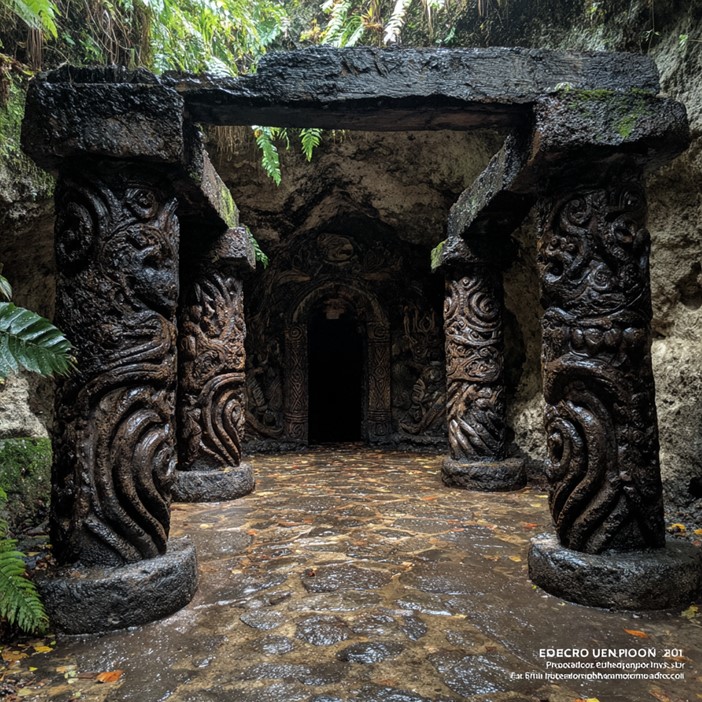
The Entrance to Euphorica
The main entrance to Underground 523 of Euphorica sits at the northeastern base of the volcanic cone, where ancient lava flows created a natural overhang that shields the opening from tropical rains. The approach follows a worn path through dense jungle that suddenly opens into a cleared plaza approximately eighty feet in diameter, paved with flat basalt stones arranged in a spiral pattern that draws the eye inward toward the entrance.
Six carved pillars frame the entrance, three on each side, rising twenty feet high and spiraling upward like frozen smoke or twisting flames. Each pillar is carved from a single piece of volcanic basalt, polished to a dark mirror sheen that reflects distorted images of those who pass. The spirals are carved with intricate reliefs depicting various states of consciousness—faces laughing, weeping, dreaming, ecstatic, contemplative, and transcendent. The craftsmanship is exceptional, suggesting tier-three artisans worked for years to complete them.
Between the pillars, steam and faintly sweet-smelling vapor rise from vents drilled deliberately into the basalt. The vapor is warm and carries the first traces of the euphoric gases that permeate Euphorica’s depths. First-time visitors often report feeling lightheaded or giddy within moments of entering the plaza, though regulars attribute this more to anticipation than actual chemical effects.
Above the entrance, carved letters three feet high spell “EUPHORICA” in flowing script that seems to dance and shift when viewed from different angles—an optical illusion created by the spiral pattern worked into each letter. Below the name, smaller text in Common reads: “Enter Freely, Depart Willingly, Remember Always.” The same phrase repeats in eight other languages spoken across Saṃsāra.
The entrance itself is a natural lava tube that has been widened and smoothed, creating an oval opening fifteen feet wide and twelve feet high. Unlike Candleholm’s wooden doors, Euphorica’s entrance remains permanently open, with no gates or barriers. The philosophy here rejects physical security in favor of reputation—those who would cause harm are not kept out by doors but by cultural understanding that violence results in permanent exile from one of Saṃsāra’s most unique communities.
Two alcoves flank the entrance just inside, each occupied by members of the Sober Watch during their rotation. These guards are immediately identifiable by their distinctive armbands—white cloth marked with a closed eye symbol, signifying their temporary abstinence. Unlike the armored guards of other labyrinths, the Sober Watch wear comfortable clothing and carry no visible weapons. Their authority derives from community respect rather than force, though they are typically tier-two or tier-three avatars capable of handling trouble if necessary.
The entrance tunnel extends sixty feet into the volcanic cone at a gentle downward slope. The basalt walls here retain their natural rough texture, with glossy black surfaces interrupted by gas bubble holes frozen in the ancient lava. Bioluminescent fungi have been cultivated in these holes, creating points of soft blue-green light that pulse gently like breathing. The effect is organic and hypnotic, immediately establishing Euphorica’s aesthetic of living, flowing beauty.
The temperature rises noticeably as one progresses down the tunnel. The exterior jungle air averages around seventy-five degrees with high humidity, but by the tunnel’s end, temperature reaches eighty degrees with moisture condensing on walls. The combination of warmth and humidity creates a sensual atmosphere that makes clothing feel restrictive and sweat bead on skin.
Carved into the tunnel walls at irregular intervals are small niches containing offerings left by visitors—coins, carved figurines, dried flowers, written prayers, small bottles of spirits, and other tokens. This spontaneous shrine developed organically over decades, with no official purpose but carrying emotional weight for residents who view it as honoring the journey from mundane world to altered consciousness.
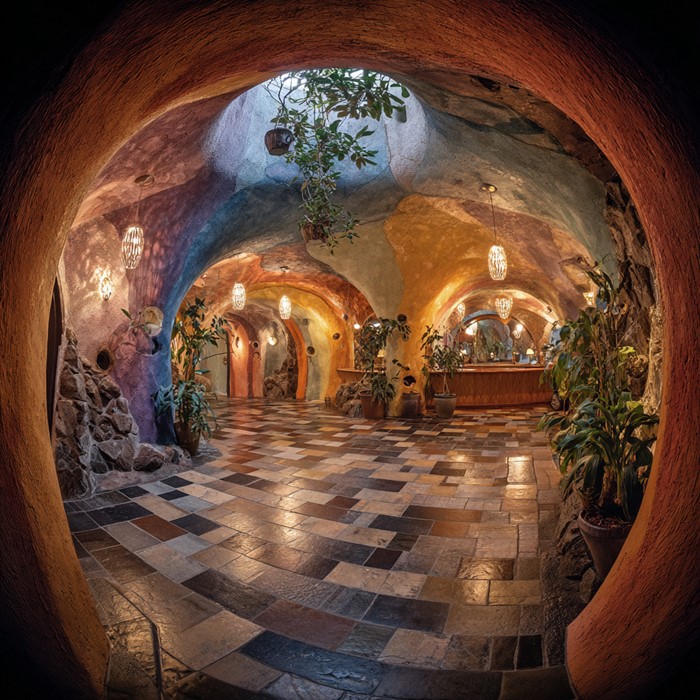
The Threshold Chamber
The entrance tunnel opens into the Threshold Chamber, Euphorica’s welcoming space and transition zone between jungle surface and underground community. This circular room measures fifty feet in diameter with a domed ceiling rising to eighteen feet at the center. The dome’s interior has been polished smooth and painted with swirling colors—deep purples, vibrant oranges, electric blues, and golden yellows—that seem to move in the light cast by more bioluminescent fungi and a few strategically placed oil lamps.
The floor is tiled with polished basalt in alternating light and dark gray, creating a checkerboard pattern that appears to ripple when viewed peripherally or while experiencing the mild euphoric effects of the ambient gases. Steam rises from vents in each of the cardinal directions, creating columns of vapor that drift toward the dome’s apex where ventilation shafts draw it upward.
A reception desk carved from reddish volcanic stone sits directly ahead of the entrance tunnel, crescent-shaped to allow multiple staff members to serve visitors simultaneously. Three to five attendants typically work the desk during busy periods, fewer during slower times. Unlike the businesslike reception at Candleholm, these attendants embody Euphorica’s character—they wear flowing, colorful garments, jewelry that chimes softly with movement, and welcoming smiles that suggest they have already begun enjoying the day’s offerings.
The attendants perform several functions. They greet newcomers and provide orientation about Euphorica’s culture, rules, and available experiences. They assess visitors’ apparent tier level and species to offer appropriate recommendations about substance use and gas exposure. They maintain a loose ledger tracking visitors for safety purposes—if someone goes missing or has a medical emergency, the records help locate friends or identify next of kin. They collect a modest entrance fee of five silver pieces for first-time visitors, which grants access to all public spaces on the first level for three days.
Behind the desk, a large painted board displays current information. Unlike Candleholm’s practical notices, this board resembles abstract art—flowing calligraphy, decorative borders, small illustrations, and color-coded sections. Information includes: performance schedules for the day, availability in various lounges and venues, special tastings or ceremonies occurring, safety warnings about particular substance combinations, names of individuals currently banned for rule violations, and weather conditions on the surface for those planning to depart.
To the left of the entrance, a preparation alcove provides services for those arriving from the jungle journey. Basins of warm water allow washing of hands, feet, and faces. Cloth towels hang on hooks. Simple robes in various sizes are available for those who wish to change from travel-stained clothing. A small shrine with offerings to safe-travel deities receives prayers of thanks for successful arrival. Several benches provide seating for those needing to rest before continuing deeper.
To the right, a merchant alcove operates as an introduction to Euphorica’s offerings. Small samples of various intoxicants are available for purchase—tiny cups of spirits, single mushrooms, alchemical vials, and prepared smoking mixtures. Prices range from copper pieces for basic samples to silver for quality options. The merchant, currently a gnome woman named Pip Sweetdream at tier-two, specializes in guiding newcomers toward appropriate choices for their experience level and desired effects. She warns against overconsumption and refuses sales to those already visibly intoxicated.
Along the curved walls between the alcoves, carved reliefs depict Euphorica’s history. Zyvex Dreamweaver discovering the volcanic vents, the first distillery being constructed, the opening ceremony where founders lit the first batch of bioluminescent fungi, and various scenes of celebration, creation, and community. These reliefs are painted in colors that glow under the blue-green fungal light, creating ethereal scenes that appear almost alive.
Five passages exit the Threshold Chamber beyond the reception area. The central passage, widest at twelve feet, leads to the Spiral Descent—the main route to deeper levels. Two side passages, each eight feet wide, lead to different sections of the first level. Signs carved into basalt plaques identify destinations, with the Common text supplemented by pictographic symbols for those who cannot read: “The Spiral – All Levels,” “Gentle Gardens & Tasting Halls,” “The Amphitheater & Music Halls,” “Residential Terraces,” and “The Observation Dome.”
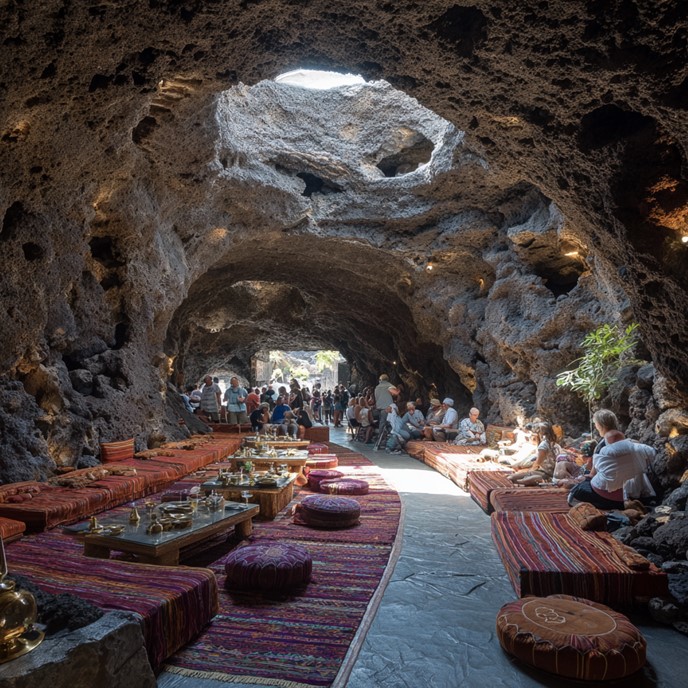
The Observation Dome
Many first-time visitors choose to visit the Observation Dome before venturing deeper, as it provides orientation to Euphorica’s layout and philosophy. This chamber lies at the end of a passage that curves upward slightly, carved into the volcanic cone’s side approximately fifty feet above the Threshold Chamber.
The dome itself is a natural bubble in the ancient lava flow, roughly forty feet in diameter and thirty feet high at the peak. The founders discovered this formation and enhanced it by drilling small holes through to the exterior, creating windows that allow sunlight to penetrate during day and moonlight at night. The holes are too small for creatures to enter but large enough for air circulation and illumination.
Cushions and low couches arranged around the dome’s perimeter provide seating for thirty people. The furniture is upholstered in deep reds, purples, and oranges, with brass fixtures that gleam in the filtered light. Small tables between seating areas hold water pipes, cups, and plates for communal consumption.
The floor is covered with woven mats made from jungle plant fibers, soft underfoot and decorated with geometric patterns. The walls retain their natural basalt texture but have been carved with flowing script—poetry, philosophical musings, and profound statements written by residents over decades. Some carvings are deep and bold, others delicate and fading. The accumulated wisdom creates a palimpsest of altered consciousness insights, ranging from genuine profundity to amusing nonsense.
At the dome’s center, a circular opening in the floor looks down into Euphorica’s depths. A railing prevents accidental falls, and the opening is covered with an iron grate for safety. Looking down, one can see the glow of bioluminescent fungi marking passages on deeper levels, steam rising from vents, and occasionally the movement of residents going about their business far below. The view provides visceral understanding of the labyrinth’s vertical extent.
A guide, currently a human woman named Sarissa Cloudmind at tier-three, maintains presence in the Observation Dome during peak hours. She offers orientation talks for groups of newcomers, explaining Euphorica’s culture, answering questions, and sharing stories about the community’s history. Sarissa has lived in Euphorica for twenty years and possesses encyclopedic knowledge of substances, effects, and proper usage. Her advice has prevented countless adverse reactions.
The Observation Dome also functions as a contemplation space. Those who find Euphorica’s energy overwhelming can retreat here, where the connection to outside world through the light-holes provides psychological anchor. The relative quiet and elevation above the main labyrinth allow visitors to process experiences without complete withdrawal from the environment.
Gentle Gardens
The passage marked “Gentle Gardens & Tasting Halls” leads to Euphorica’s first-level cultivation and consumption areas. The corridor slopes gently downward, with walls painted in soft greens and earth tones that contrast with the black basalt beneath. Bioluminescent fungi here are cultivated to produce warmer yellow-green light rather than the cooler blues found in the entrance.
The passage opens into a series of interconnected chambers totaling roughly five thousand square feet. These are the Gentle Gardens, where psychoactive fungi with mild to moderate effects are cultivated for first-level consumption. The chambers are kept humid through steam vents and regular water misting. Temperature hovers around seventy-eight degrees, ideal for fungal growth.
Raised beds filled with composted organic matter line the walls and create islands throughout the growing chambers. Hundreds of fungal species fruit in these beds—small button mushrooms, flat shelf fungi growing on logs, delicate white threads spreading across substrate, bulbous caps in colors ranging from pure white to deep purple. Wooden signs identify each species by common name, scientific name when known, and expected effects: “Laughing Gills – mild euphoria, increased sociability, fits of giggling,” “Dreamcap – gentle visual enhancement, colors more vivid, patterns appear in textures,” “Serenity Bell – deep relaxation, reduced anxiety, body-centered calm.”
Gardeners tend the beds continuously. These tier-one and tier-two workers monitor moisture, remove competing organisms, harvest mature specimens, and plant new spores. They wear simple work clothing and often hum or sing while working, adding to the chamber’s peaceful atmosphere. Visitors are welcome to observe and ask questions, and many gardeners enjoy explaining their craft.
Adjacent to the growing chambers, three Tasting Halls provide spaces for consuming the harvested fungi. Each hall is arranged differently to accommodate various preferences and group sizes.
The Communal Hall is the largest, measuring thirty feet by forty feet with cushions arranged in concentric circles around a central fire pit. The fire is actually a carefully controlled magical flame that produces warmth and flickering light without smoke or harmful fumes. Low tables between cushion groups hold baskets of fresh mushrooms, both the psychoactive varieties from the gardens and mundane edible species for those who want food without intoxication. Wooden boards display recommended combinations and preparation methods—some fungi taste better raw, others should be dried, still others work best brewed into tea.
Residents and visitors gather in the Communal Hall for shared experiences. Someone might bring out a musical instrument and begin playing. Others join in singing, humming, or rhythmic clapping. Conversations flow across the circles, with people contributing thoughts, jokes, or observations as impulse strikes. The atmosphere is warm, welcoming, and mildly chaotic in an endearing way. Tier-one characters find this an easy space to meet others and integrate into the community.
The Paired Hall caters to smaller groups and intimate encounters. This chamber is divided by hanging fabric curtains into a dozen semi-private alcoves, each containing cushions for two to four people, a small table, and soft lighting from carefully positioned bioluminescent colonies. Couples or close friends occupy these spaces for private conversations or experiences they prefer not to share with crowds. The curtains provide visual privacy while remaining acoustically transparent—one can hear laughter, music, and conversation from adjacent alcoves, creating a sense of connection to the larger community without direct interaction.
The Silent Hall serves those seeking introspection rather than socialization. This smallest of the three, measuring only twenty feet square, has cushions arranged against walls facing inward toward an empty center. Visitors are expected to maintain silence here, consuming fungi and processing the resulting experiences internally. Some use the space for meditation, others for artistic inspiration, still others for examining difficult emotions. A simple rule carved above the entrance reads: “Silence Speaks.”
The Amphitheater
The passage marked “The Amphitheater & Music Halls” curves to the left and descends more steeply than other first-level corridors. After one hundred feet, it opens into Euphorica’s primary performance space—a natural amphitheater created by a collapsed lava dome.
The amphitheater is an oval approximately eighty feet wide and one hundred twenty feet long, with the performance floor at the lowest point and seating rising in natural basalt terraces around the perimeter. The terraces have been smoothed but retain organic shape, creating irregular seating that accommodates roughly three hundred people. Cushions are scattered across the terraces, and audience members arrange them as desired.
The ceiling soars thirty feet overhead, its rough basalt surface decorated with hanging fabric banners in jewel tones. The banners serve both aesthetic and acoustic purposes, softening echoes that would otherwise render speech unintelligible while preserving the resonance that makes music powerful. The volcanic stone naturally amplifies certain frequencies, particularly mid-range tones, making the amphitheater ideal for string instruments and voices.
The performance floor is a raised platform carved from the basalt, polished smooth and painted with elaborate designs—geometric patterns, flowing organic shapes, stylized faces and figures, all in colors that glow under the blue-green bioluminescent light. Performers can stand, sit, dance, or arrange props on this platform while remaining visible to the entire audience.
No formal stage decorations exist—the space is deliberately neutral to accommodate different performance styles. Musicians bring their instruments. Dancers use their bodies. Storytellers rely on voice and gesture. Visual artists project illusions through minor magic or create temporary installations that are dismantled after performances. The philosophy emphasizes the performer rather than spectacle, though spectacle certainly occurs.
A schedule posted at the amphitheater’s entrance lists performances. Multiple events occur daily, ranging from brief fifteen-minute pieces to marathon sessions lasting hours. Genres include traditional music from various cultures, experimental compositions that challenge definitions of music, dance performances ranging from classical forms to improvised ecstatic movement, storytelling both scripted and spontaneous, poetry recitations, philosophical lectures delivered as performance art, and collaborative improvisations where audience members are invited to participate.
Attendance is free and encouraged. The amphitheater fills for popular performers and remains sparsely populated for experimental or acquired-taste offerings. Performers receive compensation through donations collected in baskets passed after shows, with audience members contributing copper, silver, or gold according to appreciation and means. Successful performers can earn comfortable livings, while amateurs supplement income from day jobs.
Behind the performance floor, a series of preparation chambers provide spaces for performers to warm up, store instruments, and compose themselves before appearing. These chambers are simply furnished with benches, mirrors, and storage alcoves. A water station provides hydration, and a basket contains small samples of substances performers sometimes consume before shows to enhance creativity or reduce stage anxiety.
Adjacent to the main amphitheater, three smaller Music Halls provide intimate venues for performances not requiring large spaces. Each hall seats thirty to fifty people in arrangements appropriate to the space’s character.
The Echo Hall is a circular chamber with perfectly smooth walls and dome ceiling that create remarkable acoustic properties. A whisper at the center can be heard clearly at the edges. Music performed here gains ethereal quality as sound bounces and reinforces in complex patterns. Musicians specializing in sustained tones—string drones, throat singing, meditation chimes—favor this venue. The experience of hearing music in the Echo Hall while under the influence of psychoactive substances is described as transcendent, with sound becoming almost visible and touchable.
The Rhythm Hall has irregular walls that break up sound, preventing echo and creating acoustically dead space perfect for percussion. Multiple drum sets, handheld percussion instruments, and various sound-making objects line the walls for communal use. Performances here are often participatory, with audience members grabbing instruments and joining rhythm circles that can last for hours. The emphasis is on energy, movement, and collective creation rather than polished musicianship.
The Whisper Hall is the smallest and most intimate, with seating for only twenty arranged in a tight circle. Performers sit among the audience rather than on a separate stage. This venue suits storytellers, poets, and musicians playing quiet pieces that would be lost in larger spaces. The proximity creates intensity—audience members can see performers’ expressions, detect subtle gestures, and feel directly connected to the creative act. Many residents consider the Whisper Hall their favorite venue despite, or because of, its limitations.
The Spiral Descent
The central passage from the Threshold Chamber leads to the Spiral Descent, Euphorica’s primary vertical connection between all four levels. This architectural feature is both functional infrastructure and artistic statement, embodying the labyrinth’s philosophy of consciousness as journey downward into depths.
The Spiral is carved as a circular ramp that corkscrews around the interior of a natural cylindrical shaft approximately forty feet in diameter. The ramp itself is ten feet wide with a waist-high railing on the inner edge preventing falls into the central void. The outer wall is the natural basalt of the shaft, rough-textured and dark. The inner railing is carved from the same stone but polished smooth, with spiral decorations that mirror the ramp’s descent.
Walking the Spiral creates mild vertigo even for sober individuals. The continuous turning, the visible drop into darkness below, the sense of descending endlessly—all combine to produce disorientation. For those already intoxicated, the experience intensifies. Many users report that walking the Spiral produces hallucinations of falling, flying, or spiraling through space. The architecture transforms simple vertical movement into psychedelic experience.
Bioluminescent fungi are cultivated along the outer wall in deliberate patterns. As one descends, the color shifts gradually from blue-green at the top through aqua, teal, cyan, and eventually deep blue at the fourth level. This chromatic progression creates visual marker of depth while enhancing the sensation of traveling through different realms or states of consciousness.
Every half-rotation of the Spiral, which represents approximately thirty feet of descent, an exit opens onto one of the levels. Carved archways indicate transitions: “First Level – Gentle Experiences,” “Second Level – Moderate Journeys,” “Third Level – Deep Exploration,” and at the bottom, in red paint rather than carved stone, “Fourth Level – Experts and Researchers Only – Real Danger.”
The central void contains no floor visible from above. Looking down from the first level, one sees only darkness punctuated by glowing fungi and occasional steam rising from vents. The drop from top to bottom measures six hundred feet—easily fatal if someone fell or jumped. No recorded suicides have occurred via the Spiral, though a few accidental falls by severely intoxicated individuals resulted in deaths in the labyrinth’s early decades. After these incidents, the railings were reinforced and the Sober Watch began monitoring the Spiral during busy periods.
The descent takes approximately ten minutes at normal walking pace from first to fourth level. Many users walk slowly, trailing hands along the outer wall, pausing to examine fungi or peer down into the void, or simply processing the disorienting sensation of endless turning. Some sit on the ramp for extended periods, backs against the outer wall, watching other residents pass by in both directions like a river of humanity flowing up and down through stone.
Musicians occasionally perform on the Spiral. A singer stationed at one level produces notes that echo and resonate throughout the shaft, reaching listeners multiple levels away. Drummers create rhythms that pulse through the stone. The acoustic properties turn the entire Spiral into a musical instrument, with the cylindrical shaft amplifying and transforming sound in unexpected ways.
Residential Terraces
The passage marked “Residential Terraces” leads to Euphorica’s first-level housing, which differs significantly from Candleholm’s carved rooms. Here, the original lava flow created natural horizontal shelves and ledges that have been developed into multi-tiered residential zones.
The main residential chamber is an irregular cavern roughly one hundred fifty feet long, eighty feet wide, and forty feet high at the peak. The ancient lava created stepped formations along the walls—natural terraces at different heights connected by carved staircases. These terraces have been developed into residential platforms.
The lowest terrace, at floor level, contains communal facilities: shared washing stations fed by steam-heated water, latrine alcoves with proper drainage, food preparation areas with fire pits and counter space, and common sitting areas with cushions and low tables. This ground level is always busy with residents cooking, cleaning, socializing, or moving between their dwellings on higher terraces.
Residential platforms occupy the terraces from five feet up to thirty-five feet above floor level. Each platform is carved back into the basalt wall, creating a semi-enclosed space approximately ten feet deep, twelve feet wide, and eight feet high. These are not fully separate rooms but rather alcoves open to the main cavern. Privacy comes from hanging fabric curtains rather than solid doors.
Each residential alcove contains minimal furnishings: a sleeping pallet or hammock, a storage chest, a small table, and personal decorations the occupant has added. The open design means sounds carry throughout the chamber—conversations, laughter, music, intimate activities—creating an atmosphere of enforced community that some find comforting and others find invasive.
Approximately sixty residential alcoves occupy the terraces in this chamber, housing eighty to one hundred residents depending on whether people share spaces. Rent is nominal—one silver piece per week—with the understanding that residents contribute to community labor through their work in production facilities, performances, or service roles.
The culture views communal living as philosophically aligned with Euphorica’s values. Consciousness exploration benefits from community support, shared experiences create bonds, and the artificial separation of individuals into isolated units is seen as counter to the labyrinth’s purpose. Those who desire more privacy can rent private chambers on deeper levels at higher cost, but most residents adapt to the open terraces.
Decorations throughout the residential areas reflect individual creativity. Hanging fabrics in countless colors partition spaces and add warmth. Painted designs cover walls—some personal expressions, others collaborative murals that evolved over time as successive residents added elements. Strings of beads, shells, and carved charms hang from ceiling outcrops, chiming softly when air currents move through the chamber. The overall effect is colorful, lived-in, and distinctly bohemian.
A second residential chamber, accessible through a side passage, provides family housing in slightly larger alcoves. These measure fifteen feet wide by twelve feet deep, with partial walls between alcoves providing more sound dampening. Families with children occupy these spaces, and the culture ensures children are protected from adult activities. A dedicated children’s play area occupies one corner of the chamber, with simple toys, climbing structures carved from basalt, and supervision provided by rotating community members.
The Distillery Row
Descending the Spiral to the second level and exiting the archway marked “Production Facilities,” one enters Distillery Row—the heart of Euphorica’s economy. This passage is wider than first-level corridors at fifteen feet, allowing movement of barrels, carts, and equipment. The ceiling rises to twelve feet, and ventilation is noticeably stronger here to manage fumes from distillation.
Six major distilleries line the corridor, each operating in a large chamber roughly thirty feet by forty feet carved from the basalt. The chambers open directly onto the corridor with wide entrances allowing observation of the work within. The heat from distillation equipment combines with volcanic warmth to raise temperature here to eighty-five degrees, making the distilleries the hottest inhabited spaces in Euphorica.
The Cleargrain Distillery specializes in spirits made from surface grains—wheat, barley, and rye imported through Last Sober. Massive copper stills dominate the chamber, their curves gleaming in light from oil lamps and the glow of heating elements. Fermentation vats line one wall, bubbling with grain mash at various stages. The master distiller, a dwarf named Korik Copperstill at tier-three, oversees four assistants who monitor temperatures, collect distillate, and prepare new batches. The resulting spirits range from harsh, high-proof alcohol used in alchemical compounds to smooth drinking spirits aged in wooden casks. Prices vary from five silver pieces per bottle for basic spirits to five gold for premium aged varieties.
The Fungal Fire Distillery creates spirits from fermented mushrooms rather than grain. The process produces liquors with earthy, complex flavors and unusual effects—some varieties produce euphoria beyond standard alcohol intoxication, others create mild hallucinations. The distiller, a tiefling woman named Zarala Capwhisper at tier-two, experiments constantly with different fungal species and fermentation techniques. Her creations have achieved fame across Saṃsāra, with wealthy collectors paying premium prices for rare bottles. Standard fungal spirits cost one gold piece per bottle, while experimental varieties sell for ten gold or more to those who can afford them.
The Fruit of Paradise Distillery works with tropical fruits from the surrounding jungle—mangoes, papayas, passion fruits, and dozens of exotic varieties. These fruit brandies and liqueurs are sweeter and more accessible than grain or fungal spirits, making them popular with casual drinkers. The distiller, a human man named Tomas Fruitwise at tier-two, employs local guides who harvest wild fruits and has established relationships with surface cultivators who grow domesticated varieties. His products range from simple fruit brandies at five silver pieces per bottle to complex liqueurs flavored with spices and aged in special casks for three gold pieces per bottle.
The Essence Extractor is technically an alchemical laboratory rather than a traditional distillery, but it occupies Distillery Row due to similar equipment and purposes. Here, an elderly elf alchemist named Silvanus Distillate at tier-four produces concentrated essences and tinctures with specific intoxicating or medicinal properties. Shelves hold hundreds of bottles containing liquids in every color imaginable. Silvanus can create custom compounds to produce desired effects—increased confidence, reduced inhibition, enhanced sensory perception, mild euphoria, deep relaxation. These essences are expensive, typically one to five gold pieces for a single-use vial, but they allow precise control over experience that appeals to sophisticated users.
The Steam and Spice Distillery creates liquors infused with exotic spices imported from across Saṃsāra—cinnamon, clove, star anise, vanilla, and rarer varieties whose names mean nothing to those unfamiliar with distant cuisines. The distiller, a halfling woman named Mira Spicetounge at tier-two, combines distillation with infusion techniques to create intensely flavored spirits that warm the mouth and throat. These spiced liquors are particularly popular during festivals and celebrations. Prices range from five silver to two gold pieces per bottle depending on the spices used.
The Dragon’s Breath Distillery produces the most potent spirits in Euphorica—liquors with alcohol content exceeding eighty percent that burn going down and produce rapid, intense intoxication. The distiller, a dragonborn named Rhogar Flameheart at tier-three, treats his craft as art and alchemy combined. His spirits are consumed in tiny quantities, sipped from thimble-sized cups, and are often used as components in alchemical compounds rather than drunk straight. A small bottle of Dragon’s Breath costs three gold pieces and contains enough for dozens of servings. Drinking too much can cause alcohol poisoning, and warning labels on bottles advise caution.
Between the distilleries, smaller workshops handle barrel-making, bottle-blowing, cork production, label printing, and packaging. These supporting crafts employ another dozen workers who ensure the distilleries can operate efficiently.
At the end of Distillery Row, a large storage chamber contains hundreds of barrels and crates awaiting shipment to Last Sober and eventually to markets across Saṃsāra. Guards from the Sober Watch maintain presence here to prevent theft, as the stored spirits represent significant wealth.
The Deep Gardens
Also on the second level, accessible through a different passage from the Spiral, lie the Deep Gardens—extensive fungal cultivation chambers that dwarf the Gentle Gardens on the first level. These chambers total approximately ten thousand square feet spread across interconnected caverns, all maintained at high humidity and moderate warmth.
The Deep Gardens grow both edible fungi for food and psychoactive varieties with moderate to strong effects. The cultivation chambers are divided by purpose, with clear signage indicating which areas contain which types.
The Food Chambers occupy roughly half the space, with raised beds producing mushrooms for consumption as meals rather than intoxicants. Giant mushrooms with caps two feet in diameter grow alongside smaller varieties suitable for soups and stews. Oyster mushrooms cascade from logs in shelf-like formations. Button mushrooms sprout in dense clusters. The harvest from these chambers feeds Euphorica’s population and produces surplus for sale in Last Sober.
The Moderate Chambers cultivate psychoactive species stronger than those in the Gentle Gardens but not as intense as varieties grown in the third-level chambers. These produce reliable hallucinations, significant mood alteration, and altered time perception while remaining manageable for experienced users. Species names reference their effects: “Timeslip – hours feel like minutes, events seem to happen in different order,” “Colorflood – world becomes oversaturated with color, ordinary objects glow,” “Touchstone – tactile sensations intensify dramatically, textures become fascinating.”
The cultivation techniques vary by species. Some fungi grow on composted plant matter, others on logs imported from the jungle, still others on substrates of mixed materials carefully calibrated for optimal fruiting. The mycologists who tend these gardens possess knowledge from previous lives as farmers, alchemists, or researchers in different cultures. They share techniques freely with apprentices, viewing fungal cultivation as both practical skill and spiritual practice.
Irrigation comes from the underground stream that flows through the second level. Stone channels carved into the floor direct water where needed, with wooden sluice gates controlling flow. Excess water drains into collection pools that are then used for washing and other purposes.
The gardens employ thirty full-time cultivators and another twenty part-time workers who assist during harvest periods. The work is physical—carrying compost, turning beds, harvesting mature specimens, planting new spores—but occurs in a pleasant environment where the humid warmth and earthy smells create a sense of working within living systems rather than simply performing labor.
Adjacent to the growing chambers, processing rooms handle harvest. Mushrooms are cleaned, sorted by quality, and either used fresh or prepared for storage through drying, powdering, or preservation in alcohol. The processing work is meditative, with workers often consuming mild intoxicants while they work, resulting in slow but careful handling that maintains product quality.
The Smoking Lounges
The second level also contains Euphorica’s Smoking Lounges, three specialized chambers for consuming substances through inhalation rather than ingestion. These lounges cater to different preferences and tolerance levels.
The Gentle Smoke lounge welcomes beginners and those seeking mild effects. The chamber measures forty feet square with cushioned seating around the perimeter and low tables throughout. Water pipes of various sizes sit on the tables, from small personal devices to massive ornate pieces requiring two people to operate. Prepared smoking mixtures are available for purchase—dried leaves with relaxing properties, mild psychoactive fungi ground to powder, and blended combinations designed for specific effects. Staff members, typically tier-one residents earning wages, assist visitors in preparing pipes, lighting them, and managing the experience. The atmosphere is social and welcoming, with conversation flowing easily between strangers united by shared activity.
The Deep Smoke lounge serves experienced users seeking stronger effects. This smaller chamber, thirty feet square, maintains higher concentration of smoke through reduced ventilation. The substances consumed here produce significant alterations—vivid hallucinations, ego dissolution, mystical experiences. Users often become non-verbal, lost in internal experiences, though the shared space creates subtle connection between journeyers even without direct communication. The lounge is monitored by a member of the Sober Watch who intervenes if anyone experiences distress, but interference is minimal and users are generally allowed to process their experiences without interruption.
The Private Smoke chambers provide individual or small-group experiences in enclosed spaces. Ten small rooms branch off a common corridor, each containing cushions for two to four people, a water pipe, and soft lighting. These chambers are rented by the hour—one gold piece for two hours—and appeal to those seeking intimacy or privacy during their experiences. The walls are thick enough to muffle sound, allowing users to laugh, cry, or react without self-consciousness about being overheard.
All smoking lounges maintain strict fire safety. Enchanted stones embedded in walls suppress flames if they spread beyond intended containers. Ventilation, though reduced compared to other areas, prevents dangerous buildup of smoke or carbon dioxide. The Sober Watch monitors lounges regularly and has authority to close them temporarily if conditions become unsafe.
The Forge and Workshops
Practical industry exists alongside pleasure in Euphorica. The second level contains a forge and associated workshops where tools, equipment, and metal goods are produced. The forge sits in a large chamber with ventilation shafts drawing smoke directly to the surface. A traditional anvil, hammers, tongs, and other smithing tools occupy the space alongside more specialized equipment for delicate work.
The smith, a half-orc woman named Grenda Flamefist at tier-three, produces tools for the distilleries, cultivation equipment, barrel bands, cooking implements, and occasional weapons or armor for residents planning to leave and seek adventure elsewhere. She employs three apprentices who learn the craft while handling simpler production work.
The forge’s heat comes from volcanic vents deliberately channeled into the firebox rather than from burning fuel. This geothermal heating provides consistent high temperatures without requiring constant attention to fuel supplies. The system was designed by Zyvex Dreamweaver during Euphorica’s founding and has operated reliably for over two centuries with only minor maintenance.
Adjacent workshops handle carpentry, leatherworking, and general repairs. A carpenter produces barrels for the distilleries, furniture for residential areas, and wooden tools. A leatherworker creates belts, pouches, straps for equipment, and occasional armor pieces. A general repair workshop fixes broken items, sharpens tools, and maintains the labyrinth’s infrastructure.
These practical spaces contrast sharply with Euphorica’s pleasure-focused areas. Workers here are typically sober during their shifts, as the precision required for metalwork or carpentry is incompatible with intoxication. They consume substances during off-hours, maintaining the separation between work and pleasure that allows the community to function despite its hedonistic reputation.
The Brewery Caverns
Three brewery operations occupy interconnected caverns on the second level, producing ales, wines, and fermented beverages that complement the distilleries’ spirits. The caverns total approximately six thousand square feet, with high humidity from fermentation processes adding to the already moist environment.
The Darkstone Brewery specializes in ales and beers brewed from grain, fungal sugars, and occasionally tropical fruits. The brewmaster, a dwarf named Thorin Alekeeper at tier-three, maintains traditional brewing techniques remembered from a previous life in a dwarven stronghold. Massive wooden fermentation vats line the cavern walls, each containing hundreds of gallons of liquid at various stages. The scent of fermentation—yeasty, slightly sour, oddly sweet—permeates the area. Thorin produces everyday drinking ales sold cheaply in Euphorica’s taverns, plus specialty brews aged for months that develop complex flavors and command premium prices. Standard ales cost one copper piece per pint, while aged specialty brews can reach one gold piece per bottle.
The Mycowine Cellars produce wines from fermented fungi rather than grapes. This unusual process creates beverages with earthy, complex flavors unlike any surface wine. The vintner, an elf named Sylvara Capvine at tier-two, grows specific fungal species solely for wine production, harvesting them at peak ripeness and processing them through techniques adapted from traditional winemaking. Some mycowines are dry and sharp, others sweet and dessert-like. The fermentation produces lower alcohol content than distilled spirits but often includes mild psychoactive compounds from the fungi, creating beverages that intoxicate in multiple dimensions. Mycowines range from five silver pieces to three gold pieces per bottle depending on the fungal species and aging.
The Fruit Fermentary creates wines from tropical fruits harvested in the surrounding jungle. Unlike the Fruit of Paradise Distillery which produces spirits, the Fermentary makes wines with moderate alcohol content and fruit-forward flavors. The fermentation master, a halfling named Pip Berrywise at tier-one, works with seasonal availability—mango wines in one season, passion fruit in another, exotic berries in a third. The wines capture tropical essence in liquid form and are popular both within Euphorica and as exports to surface markets where they command good prices. Standard fruit wines cost three silver pieces per bottle, while rare seasonal varieties reach two gold pieces.
Storage chambers adjacent to the breweries house aging barrels and bottles awaiting consumption or sale. The cool, humid environment created by underground conditions and proximity to the stream provides ideal wine storage. Some bottles have been aging for decades, representing significant investment that will eventually yield extraordinary wines sold to wealthy collectors.
The Underground Stream
The stream flows through a natural channel on the second level, approximately fifteen feet wide and varying from one to four feet deep depending on seasonal rainfall on the surface. The water is clean and cold, fed by mountain springs that percolate through volcanic rock. The natural filtration removes impurities, making the water safe for drinking without treatment.
The stream enters Euphorica from the south, flows roughly north through a meandering channel carved by ancient water, and exits through a crack in the basalt to continue its subterranean journey. The entire visible length within the labyrinth spans approximately three hundred feet.
Stone pathways line both banks, allowing access for drawing water. Carved steps descend into the stream at intervals, and wooden platforms provide convenient dipping points. Clay pipes divert water to various parts of the labyrinth—to the baths, to the gardens, to the distilleries, to residential washing stations.
A small mill occupies one section where the stream’s flow has been accelerated through a narrowed channel. A water wheel twelve feet in diameter turns continuously, providing mechanical power for grinding grain and fungi into flour. The mill’s grinding stones are carved from volcanic basalt, hard enough to process grain effectively. The miller, a human man named Jonas Streamwatch at tier-two, monitors the mill and adjusts the water flow to maintain consistent power.
Fish inhabit the stream—blind cave varieties that have adapted to permanent darkness. These small fish, rarely longer than six inches, are occasionally netted for food. They have translucent flesh and taste mild and clean. While not a major food source, they provide variety to the diet and catching them is a meditative activity some residents enjoy.
The stream’s banks support unique ecosystems. Mosses and lichens grow in the splash zone where water occasionally overflows. Small arthropods—cave crickets, blind spiders, translucent millipedes—inhabit the moist areas. These creatures are generally ignored except by researchers studying underground ecology.
A bathing pool has been created by damming one section of the stream, creating a pool twenty feet across and six feet deep. The water here is cold compared to the heated baths elsewhere in Euphorica, providing refreshing contrast for those overheated by the volcanic warmth or by intoxication-induced body temperature increases. The pool is used for bathing, playing, and occasionally for ritualistic immersion during ceremonies.
The Third Level: High-Intensity Zones
Descending the Spiral to the third level transition, visitors immediately notice increased heat—temperature here reaches eighty-five to ninety degrees—and stronger concentration of euphoric gases. The air tastes faintly sweet and creates noticeable effects within minutes. Tier-one characters unaccustomed to intoxication should proceed cautiously, as the ambient gases alone can produce significant alterations in consciousness.
The passage from the Spiral opens into a junction chamber where multiple corridors branch to different sections. A member of the Sober Watch maintains permanent station here, checking that visitors understand the risks before allowing entry. A carved warning in multiple languages reads: “Third Level – Intense Experiences – Not Recommended for Beginners – Monitor System Available – Proceed at Own Risk.”
The monitor system allows visitors to request supervision during third-level experiences. For a fee of five silver pieces, a tier-two or tier-three resident experienced with intense intoxication will accompany the visitor, ensuring safety while not interfering with the experience. The monitors are trained to recognize genuine emergencies versus temporary distress, intervening only when necessary. Many first-time third-level visitors wisely employ monitors.
The Vision Chambers
The Vision Chambers occupy a series of small rooms carved specifically for intense hallucinogenic experiences. Twenty chambers total, each approximately ten feet square with eight-foot ceilings, provide private spaces for journeys. The chambers are furnished minimally—cushions on the floor, a small table, soft lighting from bioluminescent fungi cultivated to produce specific colors (blue, green, red, purple, orange).
Users rent chambers by the session, with sessions typically lasting four to eight hours depending on substances consumed. The cost is one gold piece per session, and reservations are recommended during busy periods. Each chamber has a small window opening to the corridor, covered by a curtain the user can open or close. An emergency rope pull connects to bells that alert the Sober Watch if assistance is needed.
The substances consumed in Vision Chambers are far more potent than those available on upper levels. Psychoactive fungi with names like “Reality Shatter,” “Ego Death,” and “Divine Communion” produce experiences that dissolve normal consciousness boundaries. Users report encounters with entities, visits to alternate dimensions, complete loss of self, and profound mystical revelations. Skeptics argue these are merely chemical effects on the brain, but experiencers insist they access genuine alternate realities or divine truths.
The fungi and alchemical compounds used in Vision Chambers are carefully prepared and dosed by specialist mycologists and alchemists at tier-three or above. Each dose is measured precisely to produce intense effects while minimizing physical danger. Users are instructed on proper consumption, warned about potential difficulties, and advised to surrender to the experience rather than fight it.
Between the Vision Chambers, a common waiting area allows those who have completed journeys to integrate their experiences before fully returning to normal consciousness. Cushions, calm lighting, and the presence of other experiencers creates supportive environment. Many profound conversations occur here as people attempt to describe what they witnessed or felt during their journeys.
The Ecstasy Halls
Three large chambers on the third level are dedicated to dance, movement, and physical ecstasy. These halls provide spaces where intoxicated residents can move freely, dance for hours, and experience the joy of embodiment amplified by altered consciousness.
The Dance of Flames hall is the largest, measuring sixty feet square with a twenty-foot ceiling. The floor is polished basalt, smooth enough for bare feet to glide without friction yet textured enough to prevent slipping. Magical flames in wall sconces burn in colors—red, orange, gold, white—creating flickering light that makes dancers cast multiple shifting shadows. Musicians perform live, typically drummers and percussionists creating rhythms that encourage movement. Dancers range from those performing practiced choreography to those simply allowing their bodies to move instinctively in response to music and internal sensations. The atmosphere is energetic, sweaty, and intensely alive. Sessions can last six to ten hours, with dancers cycling through periods of frantic movement and exhausted rest.
The Silk and Sensation hall takes a different approach. This chamber, forty feet square, is draped entirely with hanging silk fabrics in deep purples, reds, and blues. The fabrics hang at various heights and densities, creating a maze-like environment where dancers move through silk, feeling the fabric caress skin. The sensation of silk combined with intoxication produces tactile experiences described as exquisite. Soft music plays—string instruments, flutes, gentle percussion—and movement here is slower, more sensual, more focused on feeling than on energetic expression.
The Primal Movement hall strips away civilization’s constraints. This rough-carved chamber maintains natural basalt texture on walls, floor, and ceiling. No furniture exists, no decorations, nothing but stone and body. Dancers here move instinctively, sometimes on two legs, sometimes on all fours, sometimes rolling or crawling or leaping. The movement is preverbal, accessing something ancient that exists beneath conscious thought. Drumming provides rhythm, but some sessions involve no music at all, just breathing and footfalls echoing through stone. Those who dance in Primal Movement describe connecting with something fundamental about physical existence.
All three halls maintain high temperatures from body heat and volcanic warmth. Water is provided constantly, and the Sober Watch monitors for dehydration or exhaustion. Dancers wear minimal clothing or none at all, as heavy garments quickly become soaked with sweat and restrict movement.
The Pleasure Gardens
The third level contains chambers dedicated explicitly to sensual and sexual pleasure, a aspect of Euphorica’s culture that outsiders often find most controversial. The Pleasure Gardens consist of private chambers, semi-private alcoves, and communal spaces designed for intimate activities.
Twenty private chambers provide spaces for couples or small groups seeking complete privacy. These rooms contain comfortable cushions, soft lighting, scented oils, and decorative elements that create sensual atmosphere. The chambers rent for two gold pieces per session of four hours. Privacy is absolute—thick doors muffle sound, and etiquette dictates that occupied chambers are never disturbed except in emergencies.
Semi-private alcoves, separated by hanging fabrics rather than solid walls, offer less privacy at lower cost—five silver pieces for four hours. These appeal to exhibitionists comfortable with others potentially seeing or hearing their activities, or to those who simply cannot afford private chambers. The partial privacy creates interesting dynamics where awareness of nearby activities enhances arousal.
The communal spaces are large chambers where multiple people gather for group intimacy. These spaces are free to use and operate on principles of consent and respect. Entry indicates willingness to participate or observe, and anyone can decline any interaction without explanation or judgment. The communal spaces attract those exploring group dynamics, those comfortable with their sexuality in public contexts, or those seeking anonymous encounters that dissolve into sensation without the complications of identity.
Euphorica’s culture treats sexuality as another form of consciousness exploration, enhanced by the intoxicants that reduce inhibition and heighten sensation. The community maintains strict rules: consent is mandatory and must be clearly communicated, anyone can withdraw consent at any time without consequence, coercion in any form results in permanent exile, and all participants must be adults (defined as age eighteen minimum regardless of species maturity).
Staff members of the Pleasure Gardens, typically tier-two residents, maintain the spaces, provide supplies like oils and cloths, and discreetly monitor to ensure rules are followed. They also offer services as companions to those seeking professional experiences, charging rates negotiated individually but typically ranging from five to twenty gold pieces depending on services requested and duration.
The Laboratories
The third level also houses alchemical laboratories where experimental substances are developed and tested. These facilities are off-limits to casual visitors and accessible only to researchers, alchemists at tier-three or above, or test subjects who have volunteered for experimentation.
Four laboratory chambers contain equipment for synthesis, extraction, purification, and analysis of chemical compounds. Glassware of elaborate design—retorts, alembics, condensers, flasks—fill shelves and tables. Heating elements powered by volcanic vents maintain precise temperatures. Ventilation systems protect against toxic fumes. The laboratories represent significant investment in equipment and expertise.
The researchers working here are developing new intoxicants with specific, predictable effects. They study how different species respond to various compounds, document safe dosage ranges, identify dangerous interactions, and push boundaries of what consciousness-altering substances can achieve. Some research is purely commercial—developing products that will sell well in external markets. Other research is philosophical—seeking compounds that produce specific mystical experiences or grant temporary access to enhanced cognitive abilities.
Test subjects volunteer for payment—typically one to five gold pieces depending on the substance’s unknown risk level. They consume experimental compounds under controlled conditions while researchers observe and record effects. Most tests proceed safely, with subjects experiencing new types of intoxication and providing valuable data. Occasionally tests produce adverse reactions—nausea, extreme anxiety, loss of consciousness, or rarely, lasting psychological effects. All volunteers sign agreements acknowledging risks, though the morality of this practice remains debated even within Euphorica.
A medical facility adjacent to the laboratories provides immediate treatment for bad reactions. Tier-three healers staff this facility during all laboratory operation hours, with magical healing, antidotes, and supportive care available. The facility has successfully managed most emergencies, though a few deaths occurred in Euphorica’s early decades before safety protocols were refined.
The laboratories also produce the alchemical antidotes used throughout Euphorica to reverse intoxication rapidly when necessary. These antidotes are expensive—ten gold pieces per dose—but effective, clearing most substances from the system within minutes. The Sober Watch carries antidotes for emergencies, and they are available for purchase by anyone wanting insurance against overconsumption.
The Fourth Level: Dangerous Depths
The fourth level, six hundred feet below surface, is largely undeveloped and explicitly dangerous. Only researchers, experienced users seeking ultimate intensity, and those with specific authorization from the community council venture here. The passage from the Spiral to the fourth level is barred by a heavy iron gate that remains locked, with keys held only by senior Sober Watch members and the council.
Temperature on the fourth level reaches ninety-five to one hundred degrees in some sections. The euphoric gas concentration is high enough to produce powerful effects within seconds. Unprepared visitors can lose consciousness from the combined heat and chemical effects. Warning signs are posted extensively, and even experienced residents approach the fourth level with caution and proper equipment.
Several chambers have been developed for specific purposes. The Pure Source chamber contains a volcanic vent where gases emerge at highest concentration. A few individuals seeking transcendent experiences enter this chamber with monitors and breathing apparatus, exposing themselves briefly to overwhelming stimulation. The experiences reported are beyond language—complete ego dissolution, merger with universe, encounters with divine presence, or simply void where self ceases to exist. Many who enter the Pure Source chamber emerge changed permanently, either enlightened or damaged depending on interpretation.
Experimental growing chambers cultivate fungi in extreme conditions—high heat, high gas concentration, unusual substrates. Some species that fruit here possess effects so powerful they are never released for general consumption. Samples are stored in secured vaults, documented thoroughly, and occasionally used in highly controlled research.
The sealed sections of the fourth level contain failed experiments, dangerous substances that cannot be safely destroyed, and sections where the volcanic activity created hazards. Some chambers are subject to periodic flooding from underground water sources. Others contain toxic gases beyond the euphoric compounds. Still others have structural instability that makes them unsafe to enter.
Rumors persist among residents that the fourth level connects to deeper cave systems that extend miles into the volcanic formation and potentially link to other underground labyrinths or even to the fabled Underdark. No confirmed explorations have mapped these theoretical connections, but occasionally strange sounds echo from the sealed sections—grinding stone, rushing water, or more disturbingly, sounds that might be voices or movements of unknown creatures.
The community council strictly controls fourth level access specifically because of the real dangers present. Even researchers must file detailed plans, obtain approval, and proceed with safety teams. Solo exploration is prohibited. Violations result in exile from Euphorica, as the community cannot afford the risk of rescue operations or the moral weight of preventable deaths.
The Council Chamber
The community council meets in a chamber on the second level, easily accessible from residential areas and the Spiral. This circular room, thirty feet in diameter, is furnished simply with a round table and chairs for the five council members plus seating around the perimeter for residents attending meetings.
The council consists of five members elected to two-year terms, with elections staggered so that at least three members have experience at any time. Current council members include a distillery owner, a mycologist, a performer, a healer, and a representative of the Sober Watch. This diversity ensures multiple perspectives inform decision-making.
Council meetings occur weekly and are open to all residents. Decisions require majority vote, and major policy changes need four of five members in agreement. The council manages financial matters, adjudicates disputes, authorizes fourth-level access, maintains relationships with external communities, and ensures Euphorica’s founding principles are upheld.
The chamber’s walls display Euphorica’s written laws—actually quite few. Prohibitions against violence, coercion, and non-consensual activity. Requirements for safety monitoring and medical staffing. Export regulations ensuring quality products. Financial obligations of residents. The laws fit on a single wall panel, reflecting the community’s preference for minimal governance.
Beneath the formal laws, carved by various hands over decades, are philosophical statements and guiding principles: “Pleasure pursued harms no one,” “Consciousness explored expands all,” “Community supports where judgment divides,” “Experience valued transcends possession desired.” These informal principles shape Euphorica’s culture as much as the formal rules.
The Memorial Wall
Near the council chamber, a section of corridor has been designated the Memorial Wall where residents honor those who have died while part of Euphorica’s community. Unlike most of the labyrinth’s decorative surfaces, this wall is maintained solemnly.
Each death is marked with a small carved plaque stating the individual’s name, species, how long they lived in Euphorica, and often a brief phrase capturing something essential about them. Some deaths were natural—old age, illness, accidents unrelated to intoxication. Others resulted from overdoses, adverse reactions, or the risks inherent in consciousness exploration taken to extremes.
The memorial serves as reminder that Euphorica’s pursuit of pleasure exists alongside mortality, that altered consciousness does not grant immunity from death, and that the community mourns its losses even while celebrating life. Residents sometimes leave offerings at the wall—flowers, candles, bottles of favorite drinks, written memories.
The oldest plaques date to Euphorica’s founding, including Zyvex Dreamweaver who died at age seventy-three from natural causes after establishing the community. The newest plaques are sometimes shockingly recent, reminding visitors that danger remains real despite safety protocols. The wall is never ignored—residents pass it regularly and usually pause briefly in acknowledgment.
This proximity of pleasure and mortality, celebration and sorrow, creates Euphorica’s complex emotional landscape. The community refuses to pretend that pursuing intense experiences is without cost, but judges the cost worth paying for the joy, insight, and connection gained. Whether this philosophy is wisdom or rationalization remains an open question that each resident must answer personally.
Dreamer Who Drank the Mountain
A Tale of Euphorica
In the time before counting, when the mountain still breathed fire and the jungle had no paths because no feet had yet learned to walk in patterns, there came to the smoking hill a person whose skin was the color of sunset-before-storm and whose eyes held memories of a life that was not this life.
This person had many names in the before-time, but in the now-time was called Zyvex, which in the tongue-that-came-later meant “one-who-seeks-what-lies-beneath.” Zyvex had died in another place, in another when, and had been cast across the spaces-between-worlds to land in the body of a creature with horns and tail, a creature that the settled peoples called tiefling and feared for reasons that had more to do with appearances than actions.
Zyvex remembered things. Remembered the craft of taking grain-water and making it into fire-water that burned the throat and opened the mind. Remembered the formulas of mixing and heating and cooling and waiting. Remembered the taste of drinks that made sadness small and joy large, that made the heavy world light and the fearful heart brave. These memories sat in Zyvex’s borrowed skull like treasures in a chest, waiting for hands to lift them out and give them form.
The land where Zyvex walked was at war, though war is perhaps too dignified a word for what happened. Lords whose names have been eaten by time fought over dirt and rocks and the people who lived on that dirt and worked those rocks. They took young ones for killing other young ones. They took food for feeding those who did the killing. They took and took and took until the people had nothing left but their bones and their breathing, and the lords wanted to take those too.
Zyvex, being possessed of memories and therefore able to see patterns, knew that this war would not end quickly. Wars fueled by pride and territory never do. Zyvex also knew, from the before-memories, that people in pain seek escape. And if escape could be made into something beautiful, something that served rather than destroyed—well, then escape might become transcendence, and transcendence might become valuable, and value might become survival.
So Zyvex began to walk. Away from the fighting. Away from the lords and their endless hunger. Into the jungle where things grew wild and the only law was the law of root and claw and rain.
The jungle was not empty. Never think the jungle empty. It held snakes whose bite made the world melt into colors. It held flowers whose scent caused visions of ancestors. It held mushrooms that when eaten showed the eater things that were true and things that were false and things that were both and neither. The jungle was itself intoxicated, drunk on its own fecund excess, and everything that lived within it participated in that intoxication.
Zyvex tasted carefully. Remembered carefully. Documented carefully in a journal that would later be lost but whose knowledge would survive in memory and teaching. Some plants killed. Some plants healed. Some plants did both depending on the amount and the timing and the phase of the moon and the intention of the user. The jungle taught Zyvex what the before-life had not known, and the before-life taught Zyvex how to use what the jungle provided.
After many turnings of seasons, Zyvex came to a mountain that smoked but did not burn. The smoking was not the smoke of fire but the breath of the mountain itself, the exhalation of the deep earth. And in that breath was something that made Zyvex’s borrowed head feel light and strange, something that loosened the boundaries between thought and feeling, something that whispered promises of pleasure without pain.
Zyvex, being a person who understood such things, recognized what others might have missed: the mountain was already doing what Zyvex wanted to do. The mountain was already offering intoxication. It simply needed someone to recognize the gift and build a temple around it.
At the base of the mountain where the breathing was strongest, Zyvex found caves. Not the small caves that animals use for sleeping, but great chambers carved by ancient fire-rock that had flowed and cooled and left behind hollow spaces. Zyvex entered these caves with torch in hand and caution in heart, not knowing what might live in the darkness.
What Zyvex found was emptiness. Emptiness and warmth. Emptiness and the sweet-breath of the mountain. Emptiness waiting to be filled.
Zyvex sat in the largest chamber and breathed the mountain’s breath for three days and three nights without eating or drinking water, only breathing, only feeling what the breath did to the mind and body. Later, Zyvex would describe this as “drinking the mountain,” and the phrase would enter the language of Euphorica as a term for deep communion with intoxication.
During those three days and nights, Zyvex saw visions. Saw chambers filled with people laughing and weeping and discovering things about themselves they had not known. Saw great copper vessels bubbling with liquids that captured the essence of joy. Saw gardens growing in darkness, producing fruits that opened consciousness like doors opening onto rooms never before entered. Saw a community built not on conquest or accumulation but on shared exploration of what it meant to be aware, to feel, to exist in a body that could experience pleasure.
Some visions were true-visions, showing what would come to be. Some were false-visions, showing things that never happened. Some were both and neither, showing possibilities that might become actual or might dissolve like morning mist. Zyvex, being wise from two lives, did not assume the visions were commands or prophecies. They were simply information, and what one does with information is always a choice.
When Zyvex emerged from the three-day drinking-of-the-mountain, the decision was made. Here, in this place where the earth itself offered gifts, a new kind of community would be built. Not a city of walls and laws and hierarchies. Not a village of farmers bound to soil. But a sanctuary of consciousness, where those who sought to explore the territories of the mind could do so safely, communally, and with purpose beyond mere escape.
Zyvex returned to the settlements where people suffered under the endless war. Went to the taverns and the market squares and the places where the displaced gathered. Spoke quietly to those who seemed ready to hear: “I have found a place where the mountain breathes pleasure. I am building something new there. Something for those who understand that consciousness is territory worth exploring. Something for those who want to turn suffering into seeking. Come if you wish. Or do not come. The choice is always yours.”
Some heard and laughed, thinking Zyvex mad with whatever the jungle had fed. Some heard and were frightened, suspecting traps or cults or slavery dressed in pleasant words. But some heard and felt something stir in their chests, some recognition that what Zyvex offered was not salvation but possibility, and possibility is what the desperate need even more than safety.
They came slowly. First a brewmaster who remembered techniques from a before-life in a dwarf-hold, who could turn almost anything into something drinkable and mildly mind-altering. Then a musician who had played in royal courts in another existence and understood how sound could amplify emotional states. Then a healer who knew that sometimes pain needed to be dulled before it could be processed. Then a farmer who understood fungi better than grain. Then others, and others, and others, until Zyvex was no longer alone in the mountain’s breathing chambers.
The work was hard. Basalt is not soft stone like limestone or sandstone. Basalt is born from fire and cooled into hardness that resists tools. They carved slowly, working with chisels that broke and hammers that rang against unyielding rock. Those with strength from higher tiers did the heavy work. Those with knowledge planned the layout. Those with artistic vision decorated what the others carved. Everyone contributed what they could.
The brewmaster said, “We must make drinks that people want. Good drinks. Drinks that justify the effort of getting here.” And so the first distillery was built, using the mountain’s heat to power the stills, producing spirits that captured the essence of grain transformed through fire and time and intention.
The farmer said, “The darkness is not empty. Things grow in darkness if they are the right things.” And so the first fungal gardens were planted, cultivating species that the farmer remembered from cave systems in a before-life, species that fed both body and mind.
The healer said, “If we are going to help people explore consciousness, we must also help them return safely. Exploration without guidance is just getting lost.” And so the first medical station was established, with supplies for treating overdose, adverse reactions, and the psychological crises that sometimes accompany profound alterations of awareness.
The musician said, “Experience without beauty is just sensation. We need art here. We need music and dance and the things that make intoxication into something more than mere chemicals.” And so the first performance space was carved, with acoustics considered carefully, with sight-lines planned, with the understanding that art and altered consciousness were partners in revealing truths that neither could access alone.
Others contributed other gifts. Someone who remembered architecture ensured the chambers would not collapse. Someone who remembered commerce established trade relationships with surface communities. Someone who remembered law created the minimal rules necessary to prevent the community from devouring itself through unchecked hedonism.
The rules were simple but absolute:
- All participation is voluntary. No one is forced to consume anything.
- Violence while intoxicated results in exile. Permanent. No exceptions.
- Consent must be clear and freely given. Coercion in any form results in exile.
- The pursuit of pleasure must not cause lasting harm to self or others.
These rules were enforced not through violence but through social consequence. Those who violated the rules were simply told to leave. Most left. A few refused and had to be physically removed by those stronger and higher-tiered. After enough examples, the rules became culture, and culture became stronger than any written law.
Word spread across the islands of Saṃsāra. Whispers in port cities about a place in the jungle where consciousness itself was the territory being mapped. Tales in taverns about a labyrinth where the walls breathed pleasure and the fungi opened doors in the mind. Stories among the desperate about a sanctuary where judgment dissolved in favor of experience and one could explore without shame what it meant to be aware, to feel, to exist.
Some who came were seekers—those who genuinely wanted to understand consciousness through systematic exploration. They approached the substances with reverence and intentionality, treating each experience as a lesson. They documented their journeys in journals, compared notes with others, and over time developed what could almost be called a science of intoxication.
Some who came were artists—those who knew that creation often requires breaking normal patterns of thought. They consumed, created, consumed, created, in cycles that produced works of startling originality. Musicians composed pieces that only made sense when heard while intoxicated. Visual artists painted canvases that seemed to move and breathe. Poets crafted verses that resonated in the altered mind differently than in the sober one.
Some who came were refugees—those fleeing trauma or grief or the weight of existence that had become too heavy to bear. They sought not exploration but escape, not understanding but forgetting. For some, this escape was temporary medicine that allowed healing. For others, it became permanent dissolution, and they never truly returned from the territories they fled into.
And some who came were simply hedonists—those who enjoyed pleasure for its own sake and saw nothing wrong with that enjoyment. They were not seeking enlightenment or creating art or healing wounds. They just liked how the substances felt, and saw no reason to justify that liking with deeper purpose.
Euphorica welcomed all of them. The seekers and the artists and the refugees and the hedonists. All were part of the community because all were part of the spectrum of human and non-human experience. Zyvex, observing this diversity, understood that consciousness exploration served different purposes for different people, and all purposes were valid as long as the rules were honored.
But there came a time—there always comes a time—when the founding principles were tested.
A young person arrived at Euphorica carrying grief like a stone in the chest. This person had watched a beloved die slowly from disease, had been unable to prevent the death, and was haunted by the memory of helplessness. The young person sought not pleasure but obliteration, wanting to consume enough to stop feeling anything at all.
The healers recognized the danger. They counseled the young person, explaining that attempting to drown grief in intoxication would only delay its processing, not resolve it. They offered gentler paths—mild substances combined with therapy, gradual work through the pain rather than flight from it.
But the young person refused these offers. “I came here because I heard Euphorica allows people to do what they want with their own consciousness. I want to stop hurting. That is my choice. You cannot deny me.”
The healers brought the matter to Zyvex, who was now old and moved slowly but whose mind remained sharp with the clarity of two lives’ worth of experience.
“You are correct,” Zyvex said to the young person. “Euphorica allows people to do what they wish with their consciousness. But you are asking us to participate in your self-destruction. You are asking us to provide the tools for your harm. And that violates our principle that pursuit of pleasure must not cause lasting harm.”
“My grief is my harm!” shouted the young person. “Your refusal to help me end it is causing harm!”
Zyvex was quiet for a time, sitting with the young person’s pain visible and real between them. Finally, the old tiefling spoke: “I, too, have carried grief. In my before-life, I lost people I loved. In this life, I have watched friends dissolve into crystals and sparks when their avatars died. Grief is part of consciousness, and consciousness is what we explore here. But grief explored honestly is different from grief drowned desperately.”
“What do you want from me?” asked the young person, weeping now.
“I want you to stay in Euphorica for three months. Not consuming anything. Living sober, working in the gardens or the distilleries or wherever you can contribute. Talking with the healers regularly. Processing your grief while supported by community. After three months, if you still wish to pursue obliteration, we will not stop you. But we ask that you try the other path first.”
The young person agreed, not because they believed it would help but because they were tired and had nowhere else to go and three months seemed both impossibly long and insignificantly short compared to the eternity of grief.
The three months were hard. The young person worked in the fungal gardens, tending mushrooms that offered escapes the person desperately wanted to take but had promised to avoid. The person talked with healers who asked difficult questions about the beloved who had died, about the relationship, about the guilt and helplessness and rage that hid beneath the surface grief.
The person attended performances in the amphitheater, watching others experience joy and sorrow and beauty while intoxicated, seeing that altered consciousness could reveal things rather than merely hide them. The person sat in the Observation Dome and watched sunlight filter through the mountain’s breath-holes, marking time’s passage in a place where time otherwise blurred.
Slowly—so slowly that it was barely noticeable except in retrospect—something shifted. The grief did not disappear. Grief that deep never fully disappears. But it changed shape. It became something the person could carry rather than something that carried the person. It became a weight that could be set down occasionally rather than a crushing burden that never relented.
At the end of three months, Zyvex asked the young person, “Do you still wish to pursue obliteration?”
The young person considered this carefully. “I still hurt. The grief is still here. But I am learning to exist alongside it rather than being consumed by it. I think… I think I would like to try some of the gentler substances now. Not to escape the grief, but to see it from different angles. To understand it more fully.”
And so the young person remained in Euphorica, becoming eventually a healer who specialized in grief counseling, combining mild intoxicants with therapeutic conversation to help others process losses that felt unprocessable. The young person never forgot the beloved who had died, but learned to remember with bittersweet fondness rather than with agony.
This story became legend in Euphorica. It was told to newcomers as an example of the community’s values. It was told to those seeking obliteration as a warning that sometimes the answer to pain is not less consciousness but more. It was told to those judging Euphorica from outside as evidence that hedonism guided by wisdom is different from hedonism guided only by appetite.
But not all stories ended so well.
There was a merchant who came to Euphorica seeking rare substances to sell in distant markets. This merchant, being clever and greedy, saw that the psychoactive fungi produced in Euphorica commanded high prices among wealthy collectors who wanted novel experiences. The merchant proposed a business arrangement: Euphorica would produce specific high-potency fungi in large quantities, and the merchant would export them, splitting profits with the community.
The council debated this proposal. The income would be substantial. The community could expand, improve facilities, fund research, and provide better support for residents. The export of intoxicants was already happening on a small scale—why not formalize and expand it?
But Zyvex, now very old and rarely leaving the residential chambers, asked to address the council. The tiefling’s voice was weak but the words carried weight: “If we become primarily producers for external markets, we change our purpose. We stop being a community exploring consciousness and become a factory producing commodities. The fungi we cultivate will be chosen not for their exploratory value but for their market value. The people we attract will come not to seek but to work. And Euphorica will die, even if the business thrives.”
“But we need income to survive,” argued the merchant-council-member. “Idealism does not pay for supplies or maintain equipment or feed residents.”
“True,” agreed Zyvex. “But there is a difference between producing some exports to fund our purpose and making exports our purpose. We must find the balance. And we must remember always that the moment we value profit over principle, we become like every other place in Saṃsāra—just another group of people taking from others to benefit ourselves.”
The council voted narrowly to accept limited exports but reject the merchant’s proposal for large-scale production. The merchant left angrily, spreading rumors in surface markets that Euphorica was an unstable cult rather than a legitimate community. These rumors damaged Euphorica’s reputation, and for several years exports declined and income suffered.
But the community endured. Those who remained believed in the purpose strongly enough to accept reduced material comfort in exchange for maintaining integrity. They tightened consumption, rationed supplies, and worked harder in the gardens and distilleries. Slowly, the reputation recovered as word spread that Euphorica had chosen principle over profit, and certain types of people—those who valued that choice—sought out the community specifically because of it.
Zyvex died in the spring of the seventy-third year of this life. The old tiefling simply went to sleep one night and did not wake the next morning. The body dissolved into sparks and crystal as possessed avatars do, leaving behind a journal filled with recipes, observations, philosophical musings, and one final entry written the day before death:
“I have lived two lives now and died twice. The first death brought me here, to this strange beautiful world, to this borrowed body, to this work of building sanctuary. I do not know where the second death will take me. Perhaps to another life in another form. Perhaps to nothing at all. But I am content. I have built something that will outlast me. I have helped create a place where consciousness is honored rather than feared, where pleasure is pursued thoughtfully rather than recklessly, where community supports rather than constrains. If this second life taught me anything, it is that meaning comes not from what we possess or achieve but from what we build for others. Let Euphorica continue. Let it change as it must. Let it remain true to the principles even as the specifics evolve. And let those who come after me remember that all of this began with one person breathing the mountain’s breath and imagining what might be possible.”
The crystal left behind by Zyvex’s dissolution was placed in a carved alcove in the Threshold Chamber, where it remains to this day. Some residents claim the crystal still glows faintly when touched, that Zyvex’s memories somehow persist in the stone, that the founder still watches over the community. Others say this is romanticism projected onto inert matter. But all residents, regardless of their beliefs about the crystal, pause when passing the alcove and acknowledge in some way the person who dreamed Euphorica into existence.
The community continued after Zyvex’s death. New residents arrived. Old residents departed. The distilleries expanded. The gardens diversified. The performance venues hosted ever more ambitious works. The research laboratories pushed boundaries of understanding. The fourth level was discovered and sealed and carefully studied.
There were successes and failures. Some residents achieved genuine enlightenment through careful exploration. Others destroyed themselves through reckless excess. Some created art that changed how people across Saṃsāra understood beauty. Others squandered talent in endless consumption. Some healed trauma and returned to the surface stronger. Others fled from trauma deeper into the mountain and were never truly whole again.
This is the nature of Euphorica. It is not paradise. It is not hell. It is a place where human and non-human consciousness meets substances that alter that consciousness, and the results are as varied as the individuals involved. Some find wisdom. Some find pleasure. Some find both. Some find neither. But all who come with honest intention and respect for the rules find acceptance, and that acceptance is perhaps the greatest intoxication of all—to be seen fully and welcomed completely regardless of what one seeks or how one fails.
The story most told about Euphorica is the story of Zyvex drinking the mountain’s breath and building sanctuary in the smoking hill. It is told to explain why the community exists, what it values, and what it hopes to become. It is told when residents forget why they are here, becoming lost in endless consumption without purpose. It is told when newcomers arrive curious but uncertain, seeking assurance that this strange place has foundation deeper than mere hedonism.
But the story is also a warning. It reminds listeners that consciousness exploration is not casual entertainment. It requires intention, wisdom, and respect for the territories being explored. Zyvex sat for three days and three nights drinking the mountain’s breath before making any decisions. Zyvex listened to visions without assuming they were commands. Zyvex built community rather than empire, created sanctuary rather than business, and chose principle over profit even when profit would have been easier.
These choices are what made Euphorica possible. And these choices must be remade constantly by each generation of residents, each new council, each person who descends the Spiral seeking something beyond mundane consciousness. The story of Zyvex is not history stored safely in the past. It is living instruction that must be embodied in the present, or else Euphorica becomes merely what its critics claim it is—a place where people hide from reality rather than explore it more deeply.
In the end, after all the elaborations and retellings and variations, the story comes down to something simple: A person who had died and been reborn found a mountain that breathed pleasure. Instead of consuming that pleasure selfishly, the person shared it. Instead of hoarding the discovery, the person built community around it. Instead of pursuing profit, the person pursued purpose. And that choice—to build for others rather than take for oneself—transformed a natural phenomenon into a human achievement, transformed a cave into a home, transformed intoxication into exploration.
This is what the people of Euphorica remember. This is what they tell newcomers. This is what they whisper to themselves when they wake unsure why they are here and what they are seeking. This is the story, translated poorly through time and language and the distorting lens of altered consciousness, but carrying still some essential truth about what it means to find something beautiful and choose to share it rather than exploit it.
The Moral: That which alters consciousness can be poison or medicine, destruction or revelation, depending not on the substance itself but on the wisdom and intention of those who use it. And a community built around pleasure must be anchored by principle, or pleasure becomes merely another form of suffering—sweeter perhaps, but no less destructive.
Or, said more simply for those who prefer simplicity: Intoxication without intention is escape; intoxication with intention is exploration. Know which you seek, and do not confuse one for the other.
Or, said even more simply: The mountain offers its breath freely to all, but only those who breathe with purpose rather than desperation find anything worth keeping when they exhale.