
From: Lineage 422 of the Kwe Sar
Tool Type: Portable Refining Crucible and Power Conduit
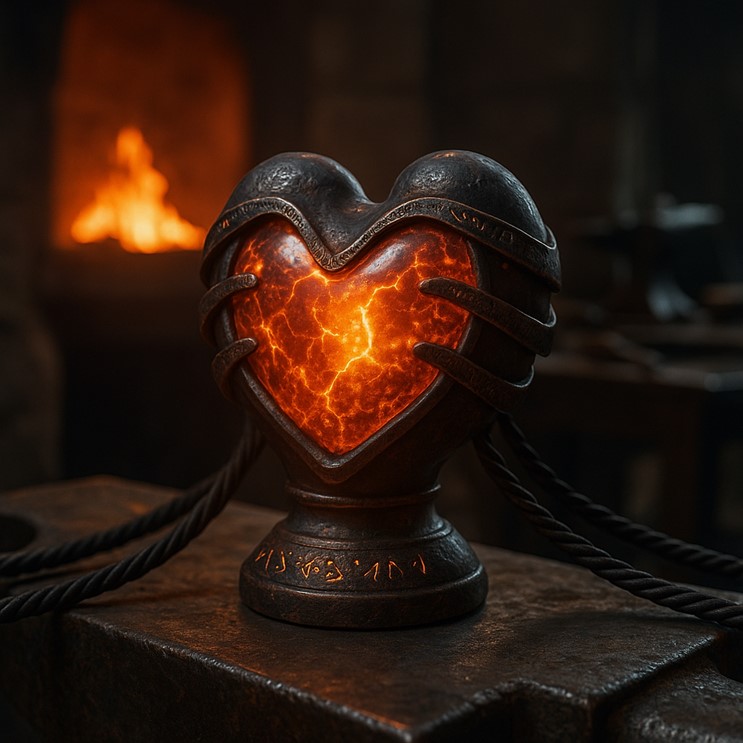
Origin: Designed by the priest-engineers of the Grand Emberforge in Sar-Kwe, this compact device serves as both a smelter and a portable power regulator. Shaped like a heart-sized core of blackened brass wrapped in obsidian ribs, it pulses faintly with a molten glow when active. When affixed to Tharion’s Core-Slot, it allows him to channel geothermal energy directly into machinery or enchantment work.
- Function and Effects:
- Refinement Core: Can melt and purify up to 25 lb of ore or scrap metal per hour using self-contained pyromantic flow.
- Power Conduit: When connected by rune-cables, provides continuous heat or kinetic energy to forges, engines, or automata for 6 hours.
- Overheat Mode (1/day): Releases a blast of excess thermal pressure in a 10-ft radius (1d6 fire damage, ignites flammable material).
- Utility Bonus: +3 to crafting, smelting, or engineering rolls when used to power or temper metalwork.
- Perception of Activation: A deep heartbeat-like thrum, red-gold light pulsing through the chest and along connected rune-cables; faint metallic scent of heated copper and ozone.
- Crafting Materials: obsidian ribs, volcanic brass, condensed magma crystal, heart-core essence, rune-etched conduits.
- Lore: The device’s prototype was created to stabilize the molten vents under the Grand Emberforge. Tharion’s model was custom-forged as a gift after he tempered a collapsing ley-channel with his bare hands.
Lore:
The Forgeheart Apparatus 221 of the Molten Vein stands as both a symbol and a relic of Acheulean ingenuity—a fusion of faith, science, and the living art of the forge. Within the Grand Emberforge of Sar-Kwe, where rivers of lava flow like blood beneath the stone, the priest-engineers of Korrath labored for centuries to create devices that could stabilize the volatile ley-channels crisscrossing the volcanic heart of the world. Most failed, burning out or collapsing under their own power, until the Forgeheart project achieved perfection—a design not built to dominate the fire, but to breathe with it.
This particular model, numbered 221, was gifted to Tharion the Tempered after he contained a fissure collapse in the Deep Ember Vaults without the aid of external tools. It was said he thrust his obsidian hands into a raw ley breach, guiding molten energy back into alignment through will alone. The engineers forged this Forgeheart to honor his act and bind it to his living stone-body. It does not merely serve as an external power source; it synchronizes with his Core-Slot, resonating with his lifeblood. Each pulse is a shared rhythm between man and machine, flesh and forge.
Legend holds that when the Forgeheart beats in harmony with its wielder, it reveals subtle resonances of the world’s deep magma-flows—songs of the earth’s creation still echoing from the first shaping. In battle, it glows like a second sun within Tharion’s chest, turning him into a walking forge. In creation, it is said to “hum the words of Korrath,” ensuring every hammer fall and weld bears divine precision.
Some whisper that each Forgeheart has a soul—an echo of a long-dead forge spirit bound willingly within brass and stone. When it cools, one might hear faint sighs like embers dimming, and those who listen claim the spirit murmurs of duty and balance—reminders that power without restraint leads only to ruin.
Tier One Stats (Base Values):
• Durability: 60/60
• Weight: 4 lb
• Energy Output: 6 hours continuous, 1/day Overheat pulse
• Slot: Core-Slot (integrated to the chest)
• Tier: 1 (Upgradeable through reforging or ley-bond enhancement)
Skills Gained:
• +3 Crafting (Metalwork or Smithing)
• +3 Engineering (Power Systems or Structural Design)
• +2 Arcana (Magitech Integration)
• +1 Endurance (while channeling heat or working under extreme temperature)
Passive Magics:
- Molten Synchrony: When attached, the Forgeheart synchronizes with the user’s heartbeat, granting resistance to fire and heat damage (–25% damage taken from fire sources).
- Ley Conduction Field: Any forge, device, or automaton linked by rune-cables gains 10% increased efficiency or output while powered by the Forgeheart.
- Living Crucible: While near molten rock, magma, or industrial heat sources, the Forgeheart self-recharges and restores 1 durability every 10 minutes.
- Harmonic Stabilization: Prevents power surges or magical backlash during complex crafting, reducing catastrophic failure chance by 30%.
Activatable Magics:
- Overheat Mode (1/day): Emits a 10-ft thermal pulse that deals 1d6 fire damage and ignites flammable materials. The user gains temporary immunity to fire for 1 round afterward.
- Forge Surge (2/day): Channel excess power through connected equipment, doubling crafting or smelting output for 10 minutes. If used in combat, melee strikes gain +1d4 fire damage for the duration.
- Magma Vein Resonance (1/week): When placed upon volcanic ground or a ley-node, the Forgeheart links to the earth’s pulse, restoring all power reserves and granting the user a heightened awareness of underground magma flows and structural faults within 100 ft (used by engineers to detect safe forging sites).
Specific Slot:
• Core-Slot (Chest):
A specialized indentation in the Kwe-Sar’s chest cavity lined with obsidian cartilage and rune-channels. The Forgeheart fits seamlessly, locking into the internal structure with magnetic pressure and heat-bond. When activated, runes across the torso glow faint orange-gold and faint veins of red light trace the circulatory pattern of molten essence.
Tags: Tool, Forge, Energy Source, Refinement, Pyromancy, Engineering, Conduit, Core Device, Industrial, Heat-Resistant, Power Generator, Rune-Bound, Ley-Linked, Magitech, Creation, Volcanic, Endurance, Utility, Artisan’s Aid, Forge-Spirit, Relic, Tool, Forge, Energy Source, Refinement, Pyromancy, Engineering, Conduit, Core Device, Industrial
The Forgeheart Apparatus 221 of the Molten Vein is a relic of Acheulean engineering and divine industry—far beyond a mere commercial tool. It sits at the crossroads of spiritual artifact and industrial necessity, making its trade highly restricted, ceremonial, and often secretive. Ownership of one requires skill, reputation, and either royal sanction or guild recognition. Prices vary dramatically depending on venue, accessibility, and legal standing within the world of Saṃsāra.
1. The Emberforges of Sar-Kwe (Religious Foundry Markets)
Environment:
These vast, temple-factories glow with molten rivers beneath the capital city’s volcanic heart. Only ordained Forge-Wardens or master smiths with written permission from the Ember Council may purchase or commission such items here. The Forgeheart Apparatus is seen as a divine tool of stewardship—part of the living faith of Korrath rather than a commodity.
Method of Sale:
Sales occur as ritual transactions rather than direct trade. The buyer must present a record of tempered deeds (a ledger of achievements demonstrating worth), offer a votive creation of their own forging, and participate in a three-hour resonance ceremony in the presence of priest-engineers. Payment is both monetary and spiritual—measured not in coins, but in service or future contribution to the Emberforge.
Typical Cost:
Equivalent of 4,500–5,000 gold (often paid through long-term service contracts or guild contributions).
Rarity: Extremely rare (one available every few decades).
Additional Notes: Such purchases are often accompanied by a binding rune of ownership; reselling without the church’s consent risks excommunication and confiscation.
2. The Brass Anvil Consortium (Industrial Guild Market of Korra-Shar)
Environment:
An immense tiered market built into the basalt cliffs of Korra-Shar. A cacophony of steam whistles, molten metal, and shouted haggles fills the air. These markets handle the trade of industrial relics and high-tier machinery.
Method of Sale:
Here, the Forgeheart Apparatus appears as a limited guild import—only available to accredited engineers or master artificers with proven safety certification. The purchase process involves a guild evaluation and demonstration of sufficient tier control to prevent accidental overload.
Typical Cost:
3,800–4,200 gold, or barter with equivalent-grade artifacts (runic tools, ley capacitors, or elemental cores).
Rarity: Rare, but obtainable through commission.
Additional Notes: The Consortium offers partial insurance and maintenance contracts for guild members, ensuring the Forgeheart’s regulation and safety testing every three years.
3. The Smoldering Exchange (Independent Market, Ashfall Reach)
Environment:
A grim, smoke-shrouded port city where the black glass of the ground crunches underfoot. This is where relics from old wars and buried forges resurface. Scavengers, scholars, and daring inventors barter through intermediaries in open plazas heated by underground vents.
Method of Sale:
The Forgeheart Apparatus here is often pre-owned or reclaimed—some still glowing faintly from prior use. Sales take place through private brokers under heavy guard. Buyers are expected to provide proof of identity and ability to maintain such a relic safely. There are no guarantees of authenticity; each transaction is a risk.
Typical Cost:
2,500–3,000 gold for a functioning model, 1,200–1,800 gold for damaged or unstable variants.
Rarity: Very rare; perhaps one changes hands every few years.
Additional Notes: Counterfeit versions exist, often replacing the molten crystal core with painted brass—dangerous when activated.
4. Black Markets and Smuggler Forges (Illegal Trade, Deepforge Cays and Outer Isles)
Environment:
Hidden beneath volcanic islands and within smuggler tunnels, these secret forges operate under the watch of outlawed engineers and rogue magitech salvagers. They harvest lost relics from abandoned Emberforges and sunken workshops, repurposing them for private collectors or mercenary guilds.
Method of Sale:
Deals are made through encrypted rune contracts or in-person exchanges aboard heat-shielded skiffs. Buyers usually arrive blindfolded or magically disguised. The sellers rarely disclose the relic’s true age or potential instability.
Typical Cost:
1,500–2,000 gold, depending on risk and condition.
Rarity: Unique—each sale is opportunistic.
Additional Notes: Black-market versions may contain “corrupted” Forgeheart cores—unstable, whispering with echoes of the forge spirits that once resided in them. Mishandling may lead to spontaneous combustion or ley feedback.
5. Scholarly and Noble Auctions (Academic & Aristocratic Circles)
Environment:
In Vara-Sul or Dreamtide, noble houses, scholars, and magitech collectors compete to acquire functioning relics as prestige symbols. The auctions are elaborate affairs, often accompanied by performances, rituals, and feasts. The device is rarely bought for use—most serve as displays of wealth and enlightenment.
Method of Sale:
Bidding wars through private patrons or proxy agents. Auctions often include historical context, showing the Forgeheart’s original serial inscriptions and lineage. Each item comes with a ceremonial appraisal certificate issued by the Guild of Preservation.
Typical Cost:
6,000–8,000 gold, depending on provenance and intact runes.
Rarity: Almost mythical.
Additional Notes: The aristocracy refers to them as “Hearts of the Earth,” and they are used as ceremonial centerpieces in royal marriages or diplomatic pacts between forge-nations.
The Forgeheart Apparatus is never merely bought—it is earned or claimed.
In the world of Saṃsāra, ownership of such an artifact marks one as both artisan and guardian of the living flame. Whether through divine approval, industrial contract, or outlawed daring, each Forgeheart found in a chest cavity or workshop tells a story of power tempered by discipline, echoing the unending heartbeat of Korrath’s forge.
Roleplay Functionality of the Forgeheart Apparatus 221 of the Molten Vein
(Defensive and Offensive Applications Across Varied Environments in the World of Saṃsāra)
1. Urban and Industrial Environments
Setting: Foundries, airship docks, factory-cities, or forge complexes in Sar-Kwe, Korra-Shar, or Vara-Sul.
Defensive Roleplay:
- The Forgeheart acts as a personal heat sink and barrier regulator. When a hostile spell, explosion, or gunpowder detonation occurs, the Kwe-Sar can instinctively vent energy through the apparatus. Steam bursts from their body in a protective cloud, reducing visibility and deflecting ranged attacks.
- The rhythmic thrum of the Forgeheart harmonizes with nearby machinery, stabilizing volatile pressure systems or preventing industrial sabotage. During infiltration or mechanical warfare scenarios, activating its pulse may prevent catastrophic chain reactions by absorbing excess heat.
- A skilled operator can use the Forgeheart to reroute energy attacks—such as lightning or plasma bursts—by channeling them through attached rune cables, diffusing destructive energy into nearby grounded metal or steam conduits.
Offensive Roleplay:
- The Overheat Mode can be triggered mid-combat to turn confined industrial corridors into furnaces. The thermal pulse incinerates loose materials and causes metal floors or weapons to glow red-hot, forcing enemies to withdraw.
- In close-quarters combat, the wielder may channel molten energy into their strikes or through attached weapons (like the Crucible Pike or Blade of the Seven Tempers), creating fire-infused attacks that scorch armor and ignite fabric.
- The Forgeheart’s energy output can also be diverted into siege devices or stationary steam-cannons, amplifying their power beyond safe limits for a brief but devastating volley.
Roleplay Expression:
NPCs and allies perceive a wielder with an active Forgeheart as a walking forge—a being of rhythmic light and deep, thunderous resonance. In urban areas, activation draws crowds or panic, as the sudden pulse of heat can crack glass, warp steel, and set alarms resonating across entire districts.
2. Volcanic, Subterranean, or Geothermal Regions
Setting: The caverns beneath Great Fire Mountain, lava deltas, Deepforge mining complexes, and ley-core excavation sites.
Defensive Roleplay:
- The Forgeheart’s Ley Conduction Field merges perfectly with volcanic energy flows, granting the user near-complete immunity to natural heat and molten exposure. They can walk across magma streams or stand against venting geysers while protecting allies within a radiant 10-foot aura.
- In collapsing tunnels or earthquakes, the Forgeheart senses tremors before they occur through harmonic vibration. The wielder may use its energy to stabilize loose rock or reinforce structural supports—literally shaping the molten stone with pulse rhythms of heat and resonance.
- When over-channeled, it can create shockwave bursts through the floor to deflect falling debris or destabilize charging underground beasts.
Offensive Roleplay:
- The user can convert geothermal pressure into directed flame jets, firing molten blasts along the ground to drive off subterranean predators or weaken crystalline armor.
- Against enemies made of stone, metal, or hardened shell, its heat resonance allows the wielder to fracture mineral structures—a method used by ancient forge guardians to shatter magma elementals and obsidian titans.
- When combined with chants in Kwe-Va, the Forgeheart becomes an instrument of divine wrath—turning the wielder’s body into a living conduit of Korrath’s flame, burning corruption or purifying tainted ley-flows.
Roleplay Expression:
In these deep places, light from the Forgeheart is sacred—a heartbeat in the dark. Allies rally to its glow, hearing the slow metallic thrum echoing through the tunnels like a divine metronome. To enemies born of the deep, it is terror incarnate: a light that cannot be extinguished.
3. Wilderness and Battlefield Environments
Setting: Open plains, mountain passes, siege zones, or magical frontlines during inter-nation conflict.
Defensive Roleplay:
- The Forgeheart serves as a reactive power regulator for enchanted armor or steam exoskeletons. When a companion’s defensive gear begins to overload, the Forgeheart can siphon power through connected rune cables to prevent meltdown.
- On the battlefield, the wielder may embed the Forgeheart’s output cables into the earth, creating a heat-based ward that scorches projectiles or incoming siege fire.
- When surrounded, activating Magma Vein Resonance causes the ground to tremble, briefly unbalancing opponents and granting allies cover through dust and steam.
Offensive Roleplay:
- The Forgeheart can superheat thrown weapons, ammunition, or siege bolts, adding fire damage and creating lingering burn zones upon impact.
- When charging through enemies, the wielder might unleash a ring of flame around themselves, simultaneously repelling melee attackers and branding the battlefield with molten cracks.
- Against magical adversaries, channeling the Overheat pulse directly into a ley-construct (like a summoned golem or arcane ward) can cause destabilization or collapse, functioning as an anti-magic countermeasure through thermal interference.
Roleplay Expression:
In battle, the wielder is a beacon—a literal heart of fire leading their allies through the haze. Flames rise and twist around them, synchronizing with the rhythm of their breath. Even in the chaos of war, the Forgeheart’s pulse beats steady, guiding others to regroup within its aura of heat and light.
4. Aquatic and Coastal Environments
Setting: Steamship decks, coral forges of Coralis Dominion, floating foundries, or tidal vents beneath island chains.
Defensive Roleplay:
- The Forgeheart’s heat dispersion field turns water into a defensive mist screen, obscuring visibility from snipers or aerial attackers.
- When submerged, the apparatus converts high-pressure water into steam bursts, pushing the wielder upward or outward to escape drowning or confinement.
- The thermal signature can deter aquatic predators sensitive to heat, forming a natural barrier of discomfort within several feet of the user.
Offensive Roleplay:
- In humid or aquatic conditions, Overheat Mode creates flash-boil shockwaves, scalding nearby foes and instantly vaporizing shallow water.
- In naval combat, the Forgeheart can channel energy through conductive harpoons or ship plating, turning the vessel into a temporary floating battery of geothermal wrath.
- A creative wielder might submerge the device in seawater to generate superheated steam clouds, obscuring approach or cloaking retreat during raids.
Roleplay Expression:
Observers see a divine contradiction—fire alive within the sea. Steam rolls across the waves as glowing light spills from the wielder’s chest, transforming the water around them into a living veil of flame and mist. Sailors whisper that such figures are the children of both volcano and storm.
5. Arctic or Frozen Environments
Setting: Glacial mines, frozen ruins, or expeditions to ley-frozen northlands where magic lies dormant under ice.
Defensive Roleplay:
- The Forgeheart prevents hypothermia by sustaining constant internal heat, granting perfect temperature regulation to the wielder and those linked via rune cables.
- It can melt through obstacles or collapsed glacial walls, acting as both heater and survival beacon.
- The warm aura protects against frostbite and nullifies cold-based magical damage, effectively turning the wielder into a mobile hearth for their companions.
Offensive Roleplay:
- Activating Overheat Mode in extreme cold causes explosive ice fracturing—shattering barriers and freezing adversaries due to rapid thermal expansion.
- Against frost creatures, it acts as a divine purifier, the heat from its pulse seen as sacred flame opposing elemental stillness.
- The wielder can press their palms into icy terrain to cause local melt floods or boiling slicks, destabilizing enemies or traps.
Roleplay Expression:
In snow and silence, the Forgeheart is the lone ember in the void—a heartbeat of civilization amid deathly cold. Steam rises from each step, melting footprints into glassy impressions. For locals, such a traveler is a mythic sight—the living warmth of the god-forge walking the frozen wastes.
Perception of Activation:
User’s Perspective:
When the Forgeheart Apparatus 221 of the Molten Vein ignites, the first sensation is a deep, resonant thrum inside the chest—like a second heartbeat syncing with the pulse of the earth itself. Each contraction radiates warmth through the body, not as surface heat, but as a dense, liquid vitality that floods every vein with molten strength. The scent of heated brass and ozone fills the lungs, metallic yet strangely invigorating. Vision wavers with subtle distortion, as though the air bends around the edges of perception. You feel connected to every vibration in the stone beneath your feet—the heartbeat of the forge, the hiss of lava flows, even the shifting rhythm of the ley-lines miles below.
Your Mind’s Eye perceives flowing streams of red-gold energy extending from the Forgeheart into the surrounding world, linking with dormant machines and glowing runes like veins of living magma. Every breath becomes a controlled exhalation of purpose and creation, your soul synchronizing with the steady cadence of the molten core within.
Observer’s Perspective:
To those nearby, the activation is both awe-inspiring and intimidating. A low-frequency hum fills the air, vibrating the ground and rattling tools on nearby tables. The user’s chest glows from within the obsidian ribs, red-gold light pulsing in time with their breathing. Faint tendrils of heat shimmer around them, distorting their silhouette like a mirage. Sparks flicker across connected rune cables, carrying rhythmic pulses of energy into nearby forges, machinery, or ley conduits. The ambient temperature rises noticeably, and those standing close feel their own hearts unconsciously aligning to the rhythmic pulse. When the Forgeheart enters overheat resonance, arcs of molten light crawl along the user’s skin like living veins of lava, both beautiful and terrifying.
Positives:
- Grants the user heightened focus and stamina—each action feels purposeful and reinforced by elemental will.
- The aura of warmth can bolster allies, offering morale and physical protection against cold or magical drain.
- In magical perception, the user radiates stability—an anchor of power that strengthens ritual casting or mechanical precision.
- The Forgeheart harmonizes with other pyromantic and geomantic systems, amplifying their function through resonance rather than conflict.
Negatives:
- The growing internal pressure causes subtle pain—each pulse feels heavier, more demanding, as though the forge within might burst free.
- Prolonged use leads to overheating: cracks of red light begin to spread across the user’s form, and internal temperature regulation becomes increasingly difficult.
- The rhythmic hum interferes with fine auditory perception and can cause vertigo in confined areas.
- The immense power attracts unwanted attention—spirits of fire, ley-hunters, or rival forges may sense its signature and seek to claim or extinguish it.
- Emotionally, the wielder risks forge-mania: a euphoric obsession with creation and destruction alike, driven by the intoxicating harmony between self and molten core.
At full activation, both user and observer witness the same truth—the boundary between living flesh and divine metal disappears. The wielder becomes a vessel of the world’s molten soul, radiant and dangerous, both a protector and potential cataclysm.
Recipe Title: Forging the Forgeheart Apparatus 221 of the Molten Vein
Materials Needed
- Obsidian Ribs (x6): Hand-carved from cooled volcanic glass taken from the slopes of Great Fire Mountain. Must be free of fractures or inclusions to ensure magical conduction.
- Volcanic Brass Shell (5 lb): Alloyed from copper, iron, and ash-gold, smelted within an active emberforge to absorb ley-heat properties.
- Condensed Magma Crystal (1): A crystallized core of liquid magma harvested under pressure; acts as the primary power focus.
- Heart-Core Essence (1 vial): A rare distillation of pyromantic life energy drawn from a living Kwe-Sar or elemental forge spirit.
- Rune-Etched Conduits (x4): Flexible brass or silver cables etched in Va-Shar script for safe energy transfer.
- Ash-Binder Resin (1 flask): Used to fuse and insulate the inner conduits; must be mixed under high pressure and moonlight to retain elasticity.
- Cooling Oil of the Deep Mines (1 pint): Slow-drip lubricant for stabilizing molten brass during shaping.
Tools Required
- Ley-Calibrated Crucible: Regulates magical pressure while refining molten elements.
- Forgehammer of Korrath’s Pattern: Required for tempering brass and obsidian together without cracking.
- Runesmith’s Chisel Set: Fine-edged tools for carving Va-Shar glyphs into metal without disturbing resonance lines.
- Pyromantic Tongs: Fireproof, enchanted grips that can manipulate heated metal safely.
- Aether Gauge: Measures internal energy buildup to prevent core detonation during calibration.
- Steam-Press Harness: Stabilizes the brass casing during bonding of outer ribs.
Skill Requirements
- Smithing (Expert): To handle both metallic and mineral components at high temperature.
- Runecrafting (Intermediate–Advanced): For precise inscription of Va-Shar channels; any deviation leads to unstable output.
- Pyromancy (Skilled Practitioner): To manage molten energy while sealing the Heart-Core Essence into the apparatus.
- Engineering or Geomancy (Intermediate): To align the internal energy flow with volcanic resonance frequencies.
- Alchemy (Journeyman): For preparing and applying the Ash-Binder Resin without contaminating the crystal core.
Crafting Steps
- Preparation of Core Vessel:
Heat the volcanic brass in the ley-calibrated crucible until it reaches a semi-liquid state (~1600°F). Pour into the pre-carved obsidian rib frame. The frame must be arranged in a six-pointed pattern resembling a ribcage. - Setting the Condensed Magma Crystal:
Carefully lower the crystal into the molten brass chamber using pyromantic tongs. The crystal should begin to pulse when properly aligned with the molten metal. Stabilize it with low-frequency Kwe-Va chants for exactly 300 heartbeats. - Fusion with Heart-Core Essence:
Inject the Heart-Core Essence directly into the magma crystal using a runic funnel while chanting the “Va’Korrath Nesh-Tha” binding phrase. The mixture will react violently—flames may surge outward. Maintain the crucible’s temperature to prevent explosive separation. - Inscription of Conduits:
Use the Runesmith’s Chisel Set to carve Va-Shar glyphs of heat regulation and ley harmony along the brass surface. Then, attach the Rune-Etched Conduits symmetrically around the ribs. Connect their ends to a central resonance node. - Application of Ash-Binder Resin:
Coat all seams and inner conduits with the resin while it remains viscous. Once hardened, it forms a perfect insulation layer between heat and energy channels. Any misalignment here may cause runaway overheat effects later. - Calibration and Cooling:
Submerge the entire apparatus in Cooling Oil of the Deep Mines for twelve hours. While submerged, run a gentle current of pyromantic energy through the device every hour to encourage proper crystallization of the inner veins. - Final Tempering Ritual:
Place the cooled Forgeheart into an active forge’s center for one final test. Activate it by reciting “Va-Kwe Thal-Vorran” while touching the ley node. The Forgeheart will glow red-gold and emit a steady heartbeat pulse if successful. If it flickers or shrieks, discard and begin anew—an unstable core risks detonation within the user’s chest slot.
Expected Outcome
When completed successfully, the recreated Forgeheart Apparatus 221 of the Molten Vein will hum with a resonant inner pulse. The molten veins will glow faintly in rhythm with the smith’s own heart, and the brass shell will remain warm even when dormant. The device can safely channel volcanic energy for hours and, when bound through attunement, functions as both a personal forge and heart of power—a union of life, heat, and creation.
Note: Improper inscription or impure magma crystal may result in a phenomenon known as “Heart-Flare Collapse,” wherein the apparatus ruptures and vents molten plasma outward. Only master forges in Acheulean’s Emberforges are qualified to attempt this crafting unaided.
Heart That Burned Beneath Mountain
There are old tellings, carved not in stone but in the brittle memory of ash. They speak of a device that beat like a heart yet was not born of flesh — the Forgeheart of the Molten Vein. The story, as told by the trembling tongues of those who claimed to remember it, is said to come from words older than the words of the Kwe-Sar, older even than Korrath’s own hammersong. The translations are poor, filled with gaps, but the meaning burns through the ruin of language.
It is said that before the Emberforges were whole, the mountain itself throbbed in pain. Rivers of fire bled from wounds in its side, and the people of stone — those who shaped but were not yet tempered — feared that the world’s heart was dying. The Great Forgemaster looked upon his children and wept not tears, but sparks. He said unto them — or perhaps he sang it — that the mountain’s heart could be healed only by a heart made in its image.
Thus came the craftsman Vael-Tharan, whose name has since been lost to the collapse of tongues. He was not the greatest smith, nor the bravest, but he was said to have listened better than any other — to the mountain, to the whisper of magma cooling into glass, to the deep pulse beneath the stone. Where others saw only molten ruin, he heard rhythm. Where others feared the lava’s hunger, he felt its sorrow.
For seven years, he dwelt alone in the hollow of the Great Fire Mountain. He shaped no weapon, nor armor, but a vessel — a cage of blackened brass and carved obsidian ribs. He fed it his warmth, his blood, his patience. When the last of his water was gone and his voice cracked from the heat, he spoke the final words he could remember from the old chants — words the mountain itself might have whispered into his dreams. Then, into the hollow heart of his creation, he poured his final breath and fell still.
The mountain did not forget.
On the seventh night after his death, the forge he built convulsed and roared as if in mourning. From its smoke rose a light not of flame but of purpose — a deep red that throbbed like a pulse. The Forgeheart was born. The ribs of obsidian closed around it like fingers gripping life itself, and the molten glow within began to beat, steady and slow.
The people came and beheld the thing that breathed though it was not alive. It hummed and sang, sending warmth through the caverns, calming the restless veins of magma. The mountain’s wounds sealed, and the fires burned not in rage, but in renewal. The Forgemaster’s disciples built the Emberforges around this light, and the first true Acheulean age began.
But the story does not end there.
Centuries passed, and the heart’s light began to fade. The forges cooled, the songs grew dim. None could reignite it, though many tried. Some struck it with hammers of star-metal; others prayed until their voices broke. It was Tharion — the young smith whose body would later become legend — who understood. He placed the heart within his own chest, binding it with his living essence. He did not ask it to burn brighter. He simply listened, as Vael-Tharan once had. The Forgeheart awoke once more, not as a tool, but as a companion to his own will.
It is said the mountain itself sighed when this happened, as though comforted after a long and lonely vigil. Tharion walked from the forge alive, though molten light now pulsed faintly behind his ribs. The heart’s rhythm had become his own. From that day forth, wherever Tharion walked, the forges burned hotter, the stone sang deeper, and the mountain knew peace.
But legends are imperfect things. Some say the heart still remembers Vael-Tharan, its first creator. When Tharion sleeps too long near the forges, the Forgeheart hums an older tune — a lament in a language even Korrath has forgotten.
And though its sound is warm, those who hear it too closely say that it carries a warning:
that no flame, however noble, remains tame forever.
Moral of the Story: To forge life from flame, one must first listen to the fire’s sorrow — for only by understanding its pain may its power be safely held.
Suggested conversions to other systems:
Call of Cthulhu (7th Edition)
Forgeheart Apparatus 221 of the Molten Vein
Artifact – Pyromantic Tool/Power Regulator
Description: A heart-sized core of blackened brass gripped by six obsidian “ribs,” threaded with etched rune-cables. It emits a low, steady thrum and a red-gold glow when active.
Game Statistics:
• Refinement Core: Can smelt/purify up to 25 lb. of ore or scrap per hour without external fuel; grants +20% to relevant Craft (Smithing/Metalwork) or Mechanical Repair rolls while the device powers the process.
• Power Conduit: When connected by rune-cables, continuously powers forges, engines, or automata for up to 6 hours. While powering heavy machinery, operators gain +10% to Operate Heavy Machinery and Engineering tests related to stability/safety.
• Overheat Mode (1/day): As a full round action the wielder vents excess pressure in a 3 m radius; 1D6 fire damage (targets may attempt DEX×5 to halve). Flammables ignite.
• Utility Bonus: While actively linked, the user gains +15% to Engineering (or appropriate Science/Technology) for calibration and magi-mechanical integration.
Costs/Risks:
• Fueling the Forge: Each hour of continuous operation costs 1 Magic Point (or equivalent power source); running at high output for more than 3 consecutive hours calls for a CON roll or 1 level of Fatigue.
• Sanity: 0/1D4 SAN loss the first time a keeper of the device witnesses the “living” heartbeat glow.
Value/Availability: Unique; temple-vault or guild reliquary piece (price at keeper’s discretion, typically 3,000–8,000 credits equivalent).
Blades in the Dark
Forgeheart 221 “Molten Vein”
Fine Arcane Tool (Temple-Engine Relic) — Tier +2 quality when used for forging, powering engines, or ritual heat
Load: 2 (worn at the chest or carried in a cradle)
Tags: Arcane, Heat, Power, Stabilizer, Ritual Focus
Use and Effects:
• Refinement Core: During a downtime long-term project to craft metal goods, you gain potency and +1d; clocks to smelt/refine advance +2 ticks per roll when the Forgeheart is present.
• Power Conduit: When you “rig” or “finesse” machinery/engines with the Forgeheart linked, gain potency and improved position on outcomes tied to heat/pressure systems.
• Overheat Vent (2 stress): Flash-vent in close range; inflict level 2 harm (burned) to foes in a small area and create heavy smoke/steam as a 2-tick environmental obstacle.
• Anchor the Flow (1 downtime action): Stabilize a volatile site (boilers, demon-blood engines, ghostly furnaces). Reduce a related danger clock by 2 ticks or grant +1d to the next teammate action interacting with that system.
Devil’s Bargain/Complication Seeds: Heat-signatures draw spirits of fire; prolonged use marks you with a faint heartbeat-glow that increases Heat or entangles you with a forge-cult faction.
Dungeons & Dragons (5th Edition)
Forgeheart Apparatus 221 of the Molten Vein
Wondrous Item (rare), requires attunement by a Kwe-Sar, artificer, or creature proficient with smith’s tools
While attuned, the device mounts in a specialized chest socket or is belt-cradled with rune-cables.
Refinement Core: Functions as a self-heating crucible. You smelt and purify up to 25 pounds of ore or scrap per hour without fuel. While using it, you have advantage on ability checks made with smith’s tools, and crafting time for metal items is halved.
Power Conduit: As an action, you connect the Forgeheart to a non-sentient device, forge, engine, or construct you can touch. For up to 6 hours (once per long rest), it supplies steady heat/kinetic energy. During this time, creatures friendly to you within 10 feet have resistance to cold damage and ignore nonmagical environmental cold.
Overheat Mode (1/day): As an action, you vent excess pressure. Each creature of your choice in a 10-foot radius must make a DC 14 Dexterity saving throw, taking 1d6 fire damage on a failed save (half on a success). Unattended flammable objects ignite.
Forge Sense: While attuned and the device is active, you can detect the presence of significant heat sources, molten rock, or pressurized boilers within 60 feet (no action), and you have advantage on ability checks to identify mechanical or magitech faults involving heat/pressure.
Drawback: If you end your turn having used Overheat Mode in medium or heavier armor, make a DC 12 Constitution saving throw or suffer disadvantage on Dexterity (Stealth) checks and gain vulnerability to cold damage until the end of your next turn (heat shock).
Attunement Notes: A creature not meeting the attunement prerequisite can still use Overheat Mode, but the device immediately de-attunes at the end of the effect.
Knave (latest)
Forgeheart 221 (Tool • Core Device • Rare)
Slots: 2 if worn; 1 if installed in a dedicated Core-Slot
Refinement Core: Smelt/refine up to 25 lbs/hour; crafting involving metal or engines completes in half the usual time. When the Forgeheart is actively powering your work, gain +2 on relevant checks.
Power Conduit: Once per day, power a forge/engine/automaton for up to 6 hours. While powering, allies within Near range ignore normal cold exposure and gain +1 Defense against environmental hazards related to cold or wind.
Overheat Vent (1/day): Emit a Close burst; all creatures must Save (DEX) or take 1d6 fire and catch fire (on a failure) until they spend a turn extinguishing. Success halves damage and prevents ignition.
Forge Sense: While active, you automatically notice significant heat/pressure anomalies within Near range and have advantage on checks to diagnose or stabilize overheating devices.
Risk: If you use Overheat Vent twice before a Long Rest (by any means), Save (CON) or the Forgeheart becomes Unstable; on a failure, it can’t be activated again until it cools during a Rest and you take 1d4 damage from backlash.
Fate (Core / Accelerated)
Forgeheart Apparatus 221 of the Molten Vein
Type: Unique Magical Device (Tool / Power Source)
Aspect: “The Heart that Burns Beneath the Mountain”
Description: A brass-and-obsidian core that beats with a deep, molten light, channeling volcanic essence to shape metal and power great engines.
Invokes: Precision Crafting, Raw Power, Elemental Stability
Compels: Overheating Pressure, Forge Spirit Hunger, Residual Heat Signature
Mechanical Effects:
• Refinement Core: Gain +2 to Create Advantage or Overcome actions related to forging, refining, or powering machinery when using the Forgeheart.
• Power Conduit: Once per session, power a location or machine for an entire scene; adds the temporary aspect Ley-Linked Forge Field with one free invoke.
• Overheat Mode (1/session): Make an Attack against all opponents in your Zone with fiery concussive force; Weapon:2. Compel may cause collateral damage.
• Drawback: Each prolonged use (scene or longer) places one situational Aspect on you: Scorched by Inner Heat until a rest or cooling ritual occurs.
Numenera & Cypher System
Forgeheart Apparatus 221 of the Molten Vein (Level 6 Artifact)
Form: Heart-sized brass and obsidian device with rune-cables and molten core.
Effect:
• Refinement Core: Automatically refines or smelts 25 pounds of metal per hour; grants an asset on crafting or machinery repair tasks involving heat or metal.
• Power Conduit: Provides energy equivalent to 50 standard power units for 6 hours; can operate machinery or charge numenera devices.
• Overheat Pulse (1/day): Emits a burst of thermal energy in immediate range, dealing 6 points of fire damage (Might defense for half).
• Utility: Users gain +2 to crafting and engineering tasks when attuned to the Forgeheart.
Depletion: 1 in 1d20 per day of use
Drawback: Each continuous activation beyond 6 hours requires an Intellect defense roll (difficulty 5) or the Forgeheart becomes unstable, venting heat uncontrollably.
Special: If installed in a creature’s body (Core-Slot), grants +1 Armor versus fire/heat and allows the user to power one numenera artifact without an external source.
Pathfinder (2nd Edition)
Forgeheart Apparatus 221 of the Molten Vein
Item Level 5 • Price 650 gp • Bulk 1 • Rarity Rare
Type: Magical Tool / Power Device (Fire, Magitech)
Usage: Held in two hands or installed in a Core-Slot (requires 1 hour)
Traits: Fire, Magical, Invested, Arcane, Artisan, Focus
Activate [one-action] command; [two-actions] interact (Concentrate, Manipulate)
Effects:
• Refinement Core: While active, you gain a +2 item bonus to Crafting checks related to smithing, metalwork, or engineering. Crafting progress per day doubles.
• Power Conduit: For up to 6 hours per day, the device produces intense heat and kinetic energy. Connected forges or engines gain +1 circumstance bonus to Performance and Stability checks.
• Overheat Mode (once per day): Emit a 10-foot burst of flame (2d6 fire damage, DC 18 basic Reflex save). Flammable materials ignite.
• Fire Sense (Passive): While invested, you automatically detect nearby (within 30 ft.) intense heat sources or pressure instability.
Drawback: After Overheat Mode, you become fatigued until the Forgeheart cools for 10 minutes.
Craft Requirements: Expert in Crafting and Arcana; Materials worth 325 gp, including obsidian ribs, volcanic brass, and condensed magma crystal.
Savage Worlds (Adventure Edition)
Forgeheart Apparatus 221 of the Molten Vein
Gear Type: Magical Tool / Energy Source (Rare Relic)
Cost: 1,500 credits or equivalent; Weight: 8 lb.
Requirements: Smarts d8+, Repair d6+, Arcane Background (Weird Science or Magic)
Statistics & Abilities:
• Refinement Core: Provides +2 to Repair or Craft rolls involving metallurgy, forging, or heat-based machinery. Doubles crafting speed for metal items.
• Power Conduit: Can provide a continuous energy supply for 6 hours, powering up to two Heavy Devices or Constructs. While active, grants +1 Toughness to any allied construct in a Medium Burst Template centered on the user.
• Overheat Burst (1/day): Action; Small Blast Template, 2d6 Fire Damage, Armor Piercing 2. If damage dice ace, the user must make a Vigor roll (–2) or take one level of Fatigue due to heat backlash.
• Tempered Core (Passive): Grants +2 bonus to resist environmental heat or fire-based attacks.
• Drawback: After three consecutive uses without downtime, roll 1d6; on a 1, the device destabilizes and vents molten plasma, dealing 2d4 damage in a Small Blast Template (ignores armor).
Notes: Common among Kwe-Sar forge-knights and smith-engineers. Those attuned through ritual can feel its heartbeat in sync with their own, granting a faint glow and rhythmic vibration when danger nears.
Shadowrun (6th Edition)
Forgeheart Apparatus 221 of the Molten Vein
Category: Cyberware / Power Unit (Restricted, Legal Rating 4R)
Essence Cost: 0.6
Capacity: 2 (torso slot)
Availability: 10R • Cost: ¥38,000
Description: A compact obsidian-brass power heart that channels geothermal-style energy through arcane runic conduction. The Forgeheart integrates with a user’s torso cyberlimb or body cavity, pulsing heat to power machinery, weapons, or armor systems.
Game Effects:
• Refinement Core: User gains +2 dice to any Engineering, Armorer, or Industrial Mechanic tests involving metalwork, smelting, or power calibration. When linked to a powered forge or device, reduce repair time by 50%.
• Power Conduit: May supply up to 10 units of Power for 6 hours to drones, weapons, or forge tools. While active, thermal signature rises by +3 on any Sensor Tests to detect the user.
• Overheat Vent (1/day): Free Action—release stored heat in a 2-meter radius, causing (Body ÷ 2)P Fire damage (AP –2) to nearby enemies; flammable objects ignite.
• Passive Effect: User gains +2 Armor vs. Fire/Heat Damage, and may ignore penalties from hot environments.
Drawback: Each activation beyond once per 12 hours inflicts 1 Stun damage due to internal overheating.
Notes: Common among Kwe-Sar engineers and pyro-smiths. Illegal outside sanctioned forge guilds.
Starfinder (Latest Edition)
Forgeheart Apparatus 221 of the Molten Vein
Level 6 Hybrid Item • Bulk 1 • Price 4,200 credits
Slot: Chest or Hybrid Tool Mount
Aura: Strong evocation and transmutation
Usage: 6 charges/day (automatically recharges at dawn)
Activation: Standard Action (command, 1 charge)
Effects:
• Refinement Core: When powered, grants a +2 circumstance bonus to Engineering and Physical Science (metallurgy) checks. Can refine or melt 25 bulk of ore or scrap per hour.
• Power Conduit: Spend 1 charge to power a forge, vehicle, or mechanical construct for 1 hour. While active, allies within 10 feet gain resistance 5 to fire damage.
• Overheat Pulse (1/day, 2 charges): Release thermal energy in a 15-ft cone dealing 4d6 fire damage (Reflex DC 15 half).
• Forge Harmony (Passive): You radiate a faint temperature field, granting a +1 bonus to saves against cold environments.
Destruction: If the Forgeheart loses all charges through external drain, it detonates in a 10-ft burst for 3d8 fire damage (Reflex DC 17 half).
Description: A core of volcanic brass and obsidian ribs housing a molten heart crystal, revered by Kwe-Sar artificers as a symbol of balanced industry and faith.
Traveller (Mongoose 2nd Edition)
Forgeheart Apparatus 221 of the Molten Vein
Tech Level: 14 • Weight: 8 kg • Cost: Cr45,000
Type: Industrial/Scientific Tool or Cybernetic Augmentation
Description: A portable geothermal conversion core, pulsing with molten plasma encased in obsidian ribs. Used to refine ores, power devices, or serve as a life-linked core implant for advanced forge-workers.
Statistics:
• Refinement Function: Doubles efficiency of any metal refining or manufacturing process; Engineering (Mechanic or Science) checks gain DM +2 when powered by the Forgeheart.
• Power Conduit: Generates up to 100 kW for 6 hours (enough for small machinery, workshop systems, or cybernetic research).
• Overheat Mode (once per day): Emits a defensive blast of plasma, inflicting 2D6 Heat Damage within 3 meters (Reflex DM +1 to avoid).
• Passive Effect: Grants the user Armor 4 vs. heat/fire hazards; provides vacuum-sealed heat retention when worn in suits.
• Drawback: On critical failure (Natural 2 on 2D6) during prolonged operation, the Forgeheart vents unstable plasma and deactivates for 1D6 hours, possibly inflicting 1D6 damage to the user.
Special: A Traveller with the Engineer or Mechanic background who bonds with it gains a permanent DM +1 on all repair or energy management checks.
Warhammer (Fantasy Roleplay 4e / 40k hybrid rules compatible)
Forgeheart Apparatus 221 of the Molten Vein
Type: Relic / Arcane Device (Rare, Unique)
Encumbrance: 1 • Value: 500+ Gold Crowns (forbidden to trade without Guild sanction)
Rarity: Very Rare • Craftsmanship: Master
Origin: Created by the priest-engineers of Sar-Kwe under the gaze of Korrath the Forgemaster. The Forgeheart is said to beat with the molten lifeblood of the mountain itself.
Game Effects:
• Refinement Core: The bearer gains +20 to any Trade (Smithing), Engineering, or Lore (Metallurgy) tests. All crafting or forging time is halved while it powers the process.
• Power Conduit: Can fuel one forge, construct, or arcane engine for 6 hours, providing constant fire intensity equivalent to 1,000° heat. Allies within 10 yards gain +1 AP against heat/fire damage.
• Overheat Blast (1/day): As a Full Action, unleash a burst of molten pressure; 6-yard radius, 3d10 damage, Pen 2, Ignores Armor from natural sources. Targets must make a Toughness Test (–20) or catch fire.
• Passive (Molten Vein): While carrying the Forgeheart, gain immunity to mundane fire and +10 bonus to resist magical flame or heat effects.
• Drawback: Each use of Overheat Blast forces a Toughness Test (–10) or suffer 1 Fatigue and gain the Unstable (Heat) condition.
• Misfire (GM Option): On a failed activation roll (01–05 on d100), the Forgeheart flares uncontrollably, inflicting 2d10 damage to the user and any adjacent character.
Flavor:
Legends say the Forgeheart hums in rhythm with the mountain’s pulse. The device’s heat can temper steel, fuel an army’s engines, or melt through fortress gates — but in careless hands, it is said to consume the bearer in a bloom of red-gold fire.
Comments
One response to “Forgeheart Apparatus 221 of the Molten Vein”
[…] Forgeheart Apparatus 221 of the Molten VeinTool Type: Portable Refining Crucible and Power ConduitOrigin: Designed by the priest-engineers of […]