
From: Lineage 472 of Anuran
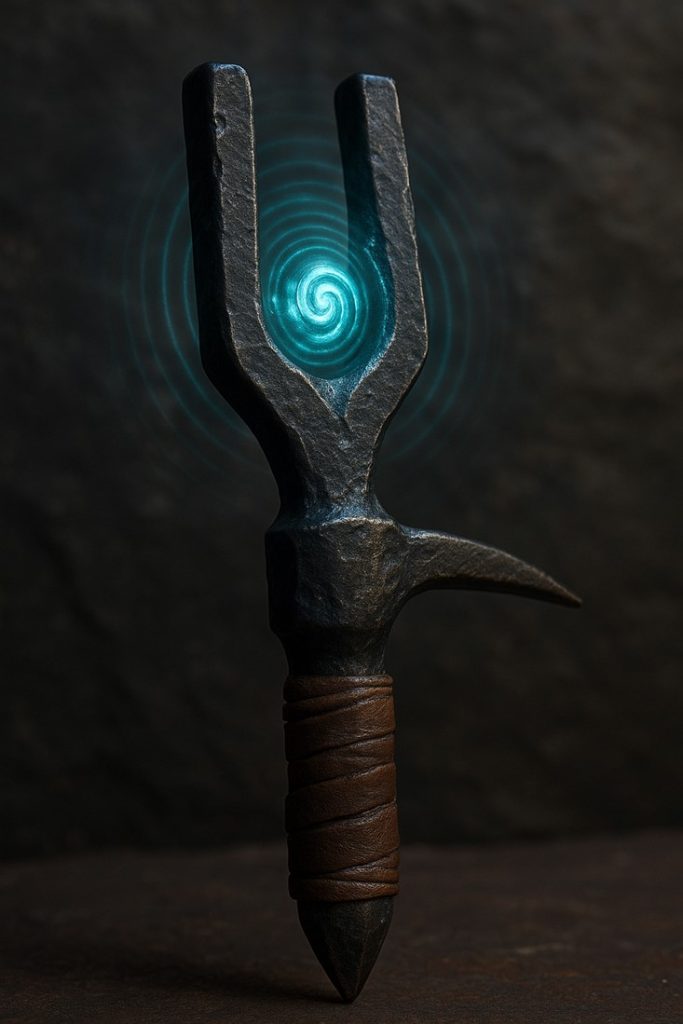
A compact, handheld resonance device shaped like a tuning fork crossed with a pickaxe. The head is carved from volcanic glass and set with a crystal core attuned to Abbevillian ley lines. When struck lightly against stone, it emits a deep, vibrating hum that reveals fractures, weak points, and mineral veins within rock. The tone changes based on density and alignment of the stone, allowing Anurans to “hear” the hidden structure.
- Effect: Grants advantage on checks to locate weak points in stone or detect hidden mineral deposits. Can identify unstable quarry walls before collapse.
- Drawback: Prolonged use can cause disorientation and ringing in the tympanum membranes of the user, leading to temporary perception penalties.
Lore of the Stone-Singer Apparatus 347
The Stone-Singer Apparatus 347 is not merely a tool, but a descendant of the earliest gifts of Gravok, the Shaper of Stone and Soul. According to quarry-chants whispered in Abbeville’s forges, the First Crafters once used crude tuning forks of obsidian to “listen” to the heart of the mountains. These primitive instruments helped them shape their settlements safely within the cliffs and quarries of the island. Over centuries, the craft was refined: volcanic glass was fused with ley-aligned crystals, and circuits of etched steam channels were added by industrious Anuran engineers.
The number 347 is said to be the identifier of the master Stoneweaver who perfected this iteration, embedding the resonance fork with a crystal core tuned precisely to Abbevillian ley lines. When struck, the tool sings like the voice of the earth itself, letting the wielder hear truths hidden deep beneath rock. For miners, engineers, and Stoneweavers, it is both a safety device and a spiritual artifact. Yet it carries a warning: Gravok allows mortals to glimpse the secrets of stone but not to overindulge. Those who lean too long into its hum risk disorientation, their tympanum membranes overwhelmed by the song of the earth.
Tier One Stats
- Strength: 0
- Dexterity: 0
- Constitution: +1 (when resisting environmental hazards underground)
- Intelligence: +1 (toward geological or mineralogical tasks)
- Wisdom/Perception: +2 when detecting hidden stone features
- Charisma: –1 after prolonged use (due to disorientation and ringing)
Skills Gained
- Stone Sense: Advantage on checks to detect weak points, hidden faults, or mineral deposits.
- Ley Attunement: Proficiency in recognizing ley line resonance within stone structures.
- Industrial Safety: Grants a trained ability to predict quarry collapses or cave-ins moments before they occur.
Passive Magics
- Resonant Awareness: The wielder perceives faint vibrations through their hands, allowing subtle detection of hollow chambers behind solid stone.
- Harmonic Bond: When near a ley line, the fork hums faintly even without being struck, guiding the wielder toward stronger magical currents.
- Earth’s Whisper: While holding the device, ambient sounds of shifting stone and mineral grinding are faintly amplified, enhancing awareness underground.
Activatable Magics
- Resonant Strike (1/day): Striking the device firmly against stone sends a shock of sound into the rock, causing hairline fractures to glow faintly for 1 minute in the wielder’s vision.
- Mineral Call (2/day): By tuning the hum to a certain frequency, the wielder can highlight the presence of specific ores or crystals within a 30-foot radius.
- Collapse Warning (passive activation): If a nearby wall or ceiling is about to collapse, the device emits a piercing, high-pitched note, giving the wielder and nearby allies a chance to evade.
Specific Slot
- Apparatus Slot (Tool/Utility Item)
Tags: Resonance-Tool, Volcanic-Glass, Quarry-Device, Ley-Attuned, Detection, Safety, Crystal-Core, Harmonic-Magic, Industrial-Artifact, Geological-Sensor, Vibrational-Guide, Ore-Detector, Quarry-Safety, Sound-Magic, Resonant-Frequency, Stoneweaver-Tool, Crystal-Infused, Miner’s-Companion
The Stone-Singer Apparatus 347 is not a common trinket found in every stall, but rather a specialized device that straddles the line between sacred tool and industrial equipment. Its availability and cost vary depending on where in Saṃsāra it is sought.
1. Quarry-Forges of Abbeville
• These forges, often tied to the Forges of Gravok, produce the most reliable and spiritually “tuned” versions. The volcanic glass head and ley-attuned crystal must be carved under ritual supervision. Priests of Gravok sometimes bless them, making these versions prized among both miners and devout crafters.
• Cost: 80–120 Gold (for an unblessed model) or up to 1 Rhodium (for ritually blessed, temple-forged models).
• Trade Style: Buyers often must prove their worth as artisans or Stoneweavers; not sold frivolously. Sometimes awarded after apprenticeship trials rather than purchased outright.
2. Independent Crafter’s Workshops
• In cliffside towns and quarry-villages, master artisans replicate the design with regional variations. These versions are more utilitarian, focused on function rather than sacred symbolism. While still effective, their resonance may not be perfectly aligned to ley lines.
• Cost: 50–70 Gold.
• Trade Style: Sold through direct commission; a customer often negotiates over the inclusion of certain enhancements, like padded grips or extended fork heads for broader scans.
3. Guild Markets and Industrial Exchanges
• Abbeville’s industrial heart thrives on trade between guilds. Mining guilds and quarry syndicates often stockpile these devices in bulk for their workforce. These models are sturdier, with heavier grips, designed to withstand constant daily use by multiple hands.
• Cost: 40–55 Gold when bought in bulk, but can fetch more (70–90 Gold) on resale to outsiders or Isekai avatars unfamiliar with local pricing.
• Trade Style: Sold in contracts, often alongside other quarry equipment (helmets, hammers, hydration packs).
4. Black Markets & Traveling Traders
• Smugglers and independent traders sometimes hawk “refitted” or counterfeit Stone-Singers scavenged from collapsed quarries or battlefield ruins. Many lack proper ley-tuning and may hum off-key, making them dangerous in precision work.
• Cost: 20–35 Gold.
• Trade Style: Sold quickly and quietly in hidden stalls or through backroom deals. Bargains tempt desperate miners or foreign adventurers.
5. Great Trade Halls of Other Nations
• Beyond Abbeville, Stone-Singer Apparatuses are rare curiosities, sold at great markup to collectors, prospectors, or magical engineers fascinated by Abbevillian craft. In coastal markets, they may be displayed as exotic relics rather than tools.
• Cost: 2–4 Platinum, depending on distance from Abbeville and the reputation of the seller.
• Trade Style: Auctioned in polished cases with exaggerated stories of origin, sometimes falsely attributed to being relics of the First Crafters.
the Stone-Singer Apparatus 347 would naturally lend itself to roleplay in different environments when turned from tool into weapon or shield, depending on circumstance:
Quarries and Mines
Defense:
• Striking the walls to activate the resonance allows the user to detect unstable stone. Roleplay might involve the avatar quickly humming the device along the rock and shouting for allies to move as cracks form—essentially preventing a deadly collapse.
• If used defensively, the hum can confuse cave-dwelling predators sensitive to vibrations, making them hesitate before striking.
Offense:
• The tuning-fork vibration, when struck hard against rock and pressed to an enemy’s armor, can send resonance through their gear. This may rattle bones or disrupt balance, especially against heavily armored foes.
• Against burrowing creatures, the sound can drive them to surface or lose direction, forcing them into the open.
Urban Environments (Stone Cities, Industrial Districts)
Defense:
• Used to detect hollow walls or false floors in alleys, helping a cautious avatar avoid traps or ambushes.
• The low-frequency hum can be roleplayed as creating a subtle disorienting field for nearby attackers—slightly unbalancing those who rely heavily on footing in close quarters.
Offense:
• When smashed against cobblestones, it can send a shock-like hum through the street, potentially startling mounts or disrupting pursuit.
• In stealth-heavy scenes, the apparatus can “sing” into the walls, shaking loose loose bricks or stones that can be dropped onto enemies below.
Battlefield or Open Terrain
Defense:
• Pressed against the ground, the resonance can warn of incoming cavalry or tunneling creatures before they arrive, giving the avatar a tactical edge.
• The vibration can be roleplayed as “masking footsteps,” the hum blending into battlefield tremors to reduce detection while repositioning.
Offense:
• When amplified with willpower or magical focus, the resonance hum can be roleplayed as painful to creatures with sensitive hearing (like canids, insectoid chimeras, or crystalline beasts), forcing morale checks.
• A hard strike into the earth can create a localized vibration burst, momentarily destabilizing foes’ footing in melee range.
Waterlogged or Coastal Environments
Defense:
• The resonance tone is sharper underwater. An avatar could strike submerged rocks or pilings to locate weaknesses, ensuring safety in sea caverns.
• The hum might also repel aquatic predators sensitive to sonar-like vibrations, buying escape time.
Offense:
• The device can be “sung” underwater to create painful pressure ripples in a confined space, roleplayed as forcing fish or amphibious enemies into panic.
• Striking ship hulls can cause unsettling groans and cracks, either as sabotage or intimidation.
Extra Roleplay Dimensions
Positives:
• Clever, multipurpose tool turned weapon, rewarding creativity.
• Encourages environmental interaction—stone walls, floors, and earth become part of the fight.
• Can be roleplayed as a cultural symbol: defending others with the same tool used to build and shape Abbevillian life.
Negatives:
• Overuse can cause debilitating headaches, so roleplay might include moments where the avatar winces or falters after prolonged activation.
• Ineffective in open, non-stone environments like grasslands, where its resonance has little to latch onto.
• Attracts attention—creatures and foes may track the humming vibration.
Perception of Activation:
User’s Perspective:
The moment the Stone-Singer Apparatus hums, the vibration resonates through your hands and up your arms, a deep thrum like the heartbeat of the earth itself. Your tympanum membranes flare with sensitivity, catching the subtle layers of tone hidden within the sound—dense granite ringing low, hollow limestone echoing sharp, veins of crystal singing in delicate, high-pitched tremors. The Mind’s Eye overlays faint glowing lines across your vision, marking fractures and veins as if the rock itself were illuminated from within. You feel the ley lines beneath your feet as pulsing warmth, their rhythm aligning with the harmonic tone, making you sway with the cadence of stone. Yet, beneath the clarity, a faint pressure builds behind your eyes, like a storm waiting to burst.
Observer’s Perspective:
To those watching, the Anuran’s bracers and tympanum quiver slightly as if resonating with the same sound, though they hear only a low, otherworldly hum that rattles tools on stone tables. Around the user, dust shivers loose from cracks and seams, outlining hidden weaknesses that become suddenly visible even to the untrained eye. The faint glow from the crystal core pulses in sync with the tone, bathing the immediate area in a ghostly shimmer. Observers note how the user seems entranced, moving in rhythm with invisible patterns etched into the earth.
Positives:
- Grants heightened perception of stone’s integrity, allowing precise quarrying or battlefield awareness in rocky terrain.
- Synchronizes the user’s senses with ley lines, offering insights that transcend mundane sight and hearing.
- Provides tactical advantage by revealing weaknesses in fortifications or natural cover.
Negatives:
- Prolonged resonance leaves a ringing echo in the head, causing temporary vertigo or dulled awareness afterward.
- Overexposure risks disorientation, with the user staggering as if drunk on vibrations.
- The hum is audible to others, making stealth nearly impossible during use.
Recipe of the Stone-Singer Apparatus 347
Materials Needed:
- 1 shard of volcanic glass (carved to tuning-fork shape)
- 1 crystal core attuned to Abbevillian ley lines (quartz or similar, purified in steam baths)
- 2 ingots of tempered steel (for reinforcement spine and grip)
- Quarry-leather wrapping, soaked in Anuran secretion for adhesion
- 3 vials of refined Anuran secretion (to bind crystal to volcanic glass without fracture)
- Powdered basalt dust (for resonance coating)
- Binding runes (etched silver filament, 6 inches total)
Tools Required:
- Steam-forge anvil with adjustable resonance hammer
- Precision chisels (geomantically attuned)
- Crystal lathe powered by ley-line circuits
- Alchemical crucible (for secretion infusion)
- Rune-etching stylus tipped with molten copper
- Hydration chamber (to maintain volcanic glass integrity)
Skill Requirements:
- Crafting (Stone & Crystal): Intermediate – ability to shape volcanic glass without shattering.
- Runecrafting: Intermediate – inscribing resonance runes that do not destabilize the harmonic flow.
- Alchemy: Basic – refinement and safe handling of Anuran secretion for bonding and resonance infusion.
- Ley-line Attunement: Apprentice – ensuring the crystal core aligns with local geomantic energy.
Crafting Steps:
- Shape the Frame:
- Heat the volcanic glass shard in the hydration chamber, then carefully chisel it into a bifurcated tuning-fork shape. Reinforce its spine with steel ingots, forging them directly into the central seam.
- Prepare the Core:
- Place the quartz crystal into the alchemical crucible, bathing it in steam infused with powdered basalt dust until it glows faintly. This stabilizes its resonance with Abbevillian ley lines.
- Bind Glass and Crystal:
- Using Anuran secretion (applied in three phases: adhesive, catalyst, sealant), set the crystal core into the head of the fork. The secretion hardens to a translucent black resin, ensuring vibration flow.
- Rune Etching:
- Carve silver filament into the volcanic glass, wrapping it around the crystal housing. Etch Granite Spiral runes with the copper stylus, focusing on harmony rather than raw power.
- Resonance Calibration:
- Strike the apparatus lightly against a basalt block while adjusting the runes. Continue until the vibration produces distinct tonal shifts in response to different densities of stone.
- Grip Assembly:
- Wrap the lower shaft in quarry-leather, cured in secretion, to provide both grip and moisture retention for amphibian users.
- Final Blessing:
- Place the completed apparatus in a Forge of Gravok’s steam vents for seven hours, allowing ley-line energy to infuse the device. When removed, it should emit a faint hum when brought near stone.
Song That Broke the Cavern
Hear now the tale, carved not in clean stone but in crumbling dust, carried by mouths older than rivers and tongues broken by time. It is said that in the age before chisels sang and steam rose, there was born an Anuran whose tympanum rang louder than the hammer’s strike. His name, if it was a name, has been forgotten, worn away like pebbles in the tide, but the elders called him He-Who-Heard.
He wandered the quarries when others feared collapse, listening with his skin and bones to the secret voices of the earth. Where others swung their tools blind, he touched stone and knew where to cut, where to leave whole, where to step lightly. The people said he was blessed of Gravok, for the rock itself hummed his song back to him. Yet he was not content. He said: “My ears are small, my body weak. I must make a tool that will hear louder than me.”
So he broke a shard of black glass from the mountain’s heart and bound it to a crystal that glowed with the breath of ley lines. He struck it against the cavern wall, and lo—there came a sound so deep that even the stone trembled. Caverns opened, veins of ore shone like rivers of silver, and walls revealed their weakness before a single blow was struck. The people marveled, calling his tool The Stone-Singer.
But as the tale tells, power is double-edged. He-Who-Heard grew drunk on his own resonance. He struck deeper and deeper, listening to the song of the world, saying, “I will hear the hidden heart of Gravok Himself.” His companions begged him to stop, for each strike shook the quarries, each hum made their tympanum bleed. Yet he laughed and struck again.
On the seventh day, he brought the Stone-Singer to the Grand Cavern, vast and hollow as the sky itself. He raised the tool and struck. The sound did not end. It swelled, filling every vein of rock, every bone, every soul. The cavern walls cracked like dry clay, the ceiling roared with fury, and the world above collapsed into the deep. Thousands fled, but thousands more were buried in stone, their cries lost in the endless hum.
When the dust cleared, He-Who-Heard was gone, swallowed by the echo. But the Stone-Singer was found, half-buried in rubble, still humming faintly. The survivors took it, fearful yet reverent, saying: “The tool was never at fault, only the hand that sought too much.” They carried it into the Forges of Gravok, setting it upon an altar so others might learn.
And thus the tale is carved crooked into memory, passing through tongues that forget more than they recall: a tool that sings, a man who would hear too much, a cavern that fell.
The Moral of the Story: To seek the hidden voice of stone is wisdom, but to demand the song of the world is pride. Use the tool to guide, not to command, for what has no patience for your hunger will bury you in silence.
Suggested conversions to other systems:
Call of Cthulhu (7th Edition)
Stone-Singer Apparatus 347
• Type: Tool/Artifact
• Appearance: Compact device of volcanic glass and crystal core.
• Mechanical Effect: When struck lightly against stone, provides a bonus of +20% to Geology or Archaeology skill rolls when examining rock, mineral veins, or structural integrity. May reveal hidden chambers or weak points automatically on a Hard success.
• Passive Magic: Emits low resonance that unnerves nearby listeners (SAN check 0/1 loss on first exposure).
• Activatable Magic: Once per day, can pulse with ley-line energy, granting automatic success on a single Geology roll, but the user must roll POW ×5 or suffer temporary vertigo (–20% to Spot Hidden rolls for 1d6 rounds).
• Drawback: Long-term use causes auditory hallucinations and ringing, requiring a CON roll after each full hour of use. Failure results in 1 HP loss and temporary penalty to Listen rolls.
Blades in the Dark
Stone-Singer Apparatus 347
• Item Type: Fine Tool (Counts as 1 Load)
• Effect: When used to survey or interact with stone structures, gain Potency on rolls to locate weak points, fissures, or hidden passages. Adds an additional die when using Survey or Tinker in quarry or underground environments.
• Passive Magic: Provides subtle resonance with the environment; always counts as having a useful tool when dealing with stonework or subterranean structures.
• Activatable Magic: Once per score, the wielder can “pulse” the device, automatically revealing hidden weaknesses in a wall or floor (GM describes). However, it increases Heat +1 due to rumors of magical resonance attracting attention.
• Drawback: Extended use causes stress — each additional use after the first in a session costs 1 Stress automatically.
Dungeons & Dragons (5e)
Stone-Singer Apparatus 347
• Wondrous Item, uncommon (requires attunement)
• Slot: Held (1 hand)
• Tier One Stats:
– Grants advantage on Investigation and Perception checks related to stonework, quarries, or underground structures.
– Provides a +2 bonus to checks made with mason’s tools.
• Passive Magic: While carrying the device, the user can faintly sense ley line flows; they may automatically detect magically unstable stone within 10 ft.
• Activatable Magic: 3/day, the wielder can strike the apparatus against stone. For 1 minute, they gain tremorsense (10 ft.) and advantage on saving throws against cave-ins or collapsing structures.
• Drawback: Each use forces a DC 12 Constitution save or the user suffers Disadvantage on Wisdom (Insight and Persuasion) checks until a short rest due to headaches.
Knave (latest edition)
Stone-Singer Apparatus 347
• Type: Gear (Utility/Tool)
• Slot: 1 inventory slot
• Effect: Advantage on checks to locate mineral veins, detect weak stone, or avoid collapses. Adds +2 bonus when testing Dexterity saves against falling debris in quarries or caverns.
• Passive Magic: Emits a low hum that alerts the user to structural instability before visible signs occur.
• Activatable Magic: Once per day, the wielder may strike the apparatus and automatically succeed on one check involving stonework or quarry navigation.
• Drawback: After each use, roll a d20. On a 1–2, the user suffers ringing ears, losing 1 HP and making all Perception checks at Disadvantage until next rest.
Fate (Core System)
Stone-Singer Apparatus 347
• Aspect: “The Stone Sings Its Secrets”
• Slot: Gear (Tool)
• Tier One Benefits: Grants a free invoke once per session on rolls involving Surveying, Crafting, or Investigation related to stonework or underground structures.
• Passive Magic: The device resonates with hidden flaws — gain +2 when Creating an Advantage to detect weaknesses in walls, caves, or constructs.
• Activatable Magic: Once per scene, you may spend a Fate Point to automatically succeed at locating a hidden weak point or vein of ore, narrated as the resonance guiding your senses.
• Drawback: Using the Stone-Singer for extended periods creates headaches. GM may compel the Aspect to inflict a temporary –2 penalty on Rapport or Provoke actions until the character rests.
Numenera & Cypher System
Stone-Singer Apparatus 347
• Level: 4 artifact
• Slot: Handheld Tool
• Effect: When activated, grants an asset on all tasks involving stonework, detecting hidden passages, or assessing mineral content. May also reveal unstable structures.
• Passive Magic: While carried, the wielder senses subtle ley line vibrations, giving +2 Armor against environmental collapse damage (falling stone, cave-ins).
• Activatable Magic: When struck against stone, the apparatus emits a ley-pulse. For the next 10 minutes, the user automatically knows the density and weak points of surrounding stone within short range.
• Depletion: 1 in 1d20 after each use.
• Drawback: After three consecutive activations in a day, user must succeed on a Might defense roll (Difficulty 4) or suffer disorientation, losing one action.
Pathfinder (2e)
Stone-Singer Apparatus 347
• Item 4, Magical, Artifact
• Usage: Handheld (1 hand)
• Bulk: L
• Traits: Magical, Resonant, Abbevillian Craft
• Tier One Benefits: Grants a +2 item bonus to Perception checks to notice stonework, mineral veins, or structural weaknesses. Provides a +2 bonus to Crafting checks related to stone or masonry.
• Passive Magic: User is treated as having tremorsense 10 ft. when in contact with stone or earth.
• Activatable Magic: 3/day, the wielder may strike the apparatus to create a resonant hum. For 1 minute, they gain precise tremorsense 30 ft. and advantage on saving throws against collapse or tremor-based effects.
• Drawback: After each use, roll a DC 15 Fortitude save. On a failure, the user takes a –1 status penalty to all auditory-based Perception checks for 1 hour (ringing ears).
Savage Worlds (Adventure Edition)
Stone-Singer Apparatus 347
• Gear Type: Relic/Tool
• Slot: 1 hand
• Tier One Stats: Provides +2 to Notice and Repair rolls when assessing stone structures, caves, or constructs.
• Passive Magic: While carried, the wielder can sense nearby unstable terrain; GM may warn the player of imminent collapse or hazard without a roll.
• Activatable Magic: Once per encounter, the wielder may strike the apparatus to generate a resonant hum. All walls, constructs, or stone-based opponents within a Medium Burst Template must make a Vigor roll at –2 or suffer Distracted until the end of their next turn.
• Drawback: Every activation requires a Spirit roll (–2). On a failure, the user gains the Fatigued condition (due to disorientation) until they rest or receive healing.
Shadowrun (6e)
Stone-Singer Apparatus 347
• Gear Type: Resonance Artifact (Illegal R5, Availability 6)
• Slot: Handheld Tool
• Tier One Mechanics: Provides +2 dice pool bonus on Engineering, Geology, or Demolitions tests when analyzing structures made of stone, concrete, or similar materials.
• Passive Magic: While carried, the user perceives subtle ley-vibrations; this grants them +1 to Perception tests for detecting hidden entrances, tunnels, or concealed structural flaws.
• Activatable Magic: By striking stone and activating the crystal core, the device sends a resonance pulse in a 10-meter cone. All concealed weak points become visible to the user for 1 combat round, and walls treated as armor lose 2 points of Structural Rating against their next attack.
• Drawback: After activation, the user must resist 2 Stun Damage (Willpower + Body). On a failure, they suffer temporary auditory disorientation (–1 dice to all auditory Perception checks for 1 hour).
Starfinder
Stone-Singer Apparatus 347
• Item Level: 4
• Price: 2,800 credits
• Bulk: L
• Slot: Held
• Traits: Hybrid, Abbevillian Relic, Magical
• Tier One Benefits: Grants a +2 insight bonus to Perception checks involving stone or earth and to Engineering checks regarding structural integrity.
• Passive Magic: While carried, the wielder gains tremorsense (10 ft.), but only through contact with solid ground.
• Activatable Magic: 3/day as a standard action, the user may cause the apparatus to resonate. For 1 minute, the wielder gains precise tremorsense 30 ft. and a +2 insight bonus to attack rolls against constructs or creatures with the stone subtype.
• Drawback: After each activation, the wielder must succeed at a Fortitude save (DC 14) or be Sickened 1 for 10 minutes (auditory resonance fatigue).
Traveller (Mongoose 2e)
Stone-Singer Apparatus 347
• Type: Advanced Tool / Artifact
• TL: 13 (equivalent, though of mystical origin)
• Slot: 1 hand
• Effect: Grants DM+2 on skill checks involving Engineering (construction), Prospecting, or Geology when dealing with stone or mineral-based environments. Can be used as a sensor to detect mineral veins or unstable terrain within 30 meters.
• Passive Magic: Provides a constant low-level awareness of structural stress. Referee may give warnings of imminent collapse or unsafe structures.
• Activatable Magic: Once per hour, the user may activate a resonance pulse. This automatically reveals nearby weak points and grants DM+2 to the next attack or demolition attempt against stone or concrete structures.
• Drawback: After each activation, throw END 8+. Failure results in 1D6 minutes of disorientation, giving DM–1 to all INT- and EDU-based checks until recovered.
Warhammer (Fantasy Roleplay 4e)
Stone-Singer Apparatus 347
• Type: Relic Tool (Unique, Rare 5)
• Encumbrance: 1
• Slot: Handheld
• Lore: Crafted in forgotten forges, the device lets its wielder hear the song of stone and divine its hidden weaknesses.
• Tier One Mechanics: Grants +10 to Trade (Engineering), Lore (Geology), or related tests when examining stone structures or caves.
• Passive Magic: The wielder automatically detects unstable stonework within 10 yards. GM may reveal potential hazards such as hidden fissures or tunnels.
• Activatable Magic: Once per Encounter, the wielder may strike the apparatus against stone to create a resonant hum. For 1 minute, all tests to damage or breach stone gain +20. Constructs or stone-based foes struck during this time must test Endurance or become Stunned for 1 round.
• Drawback: Prolonged use inflicts Fatigue if failed Cool test (Average +20). This represents migraines and sensory overload from the resonance.
Comments
2 responses to “Stone Singer Apparatus 347”
[…] Stone Singer Apparatus 347 (fully intact, crystal core still humming) […]
[…] Stone Singer Apparatus 347 (Tier 1) […]