
Definition: Dominaris is a unique language with a strong emphasis on assertiveness, confidence, and authority. It serves as a means for individuals to assert their dominance, command attention, and communicate with unwavering certainty, even across species.
Linguistic Attributes and Characteristics:
- Commanding Vocabulary: Dominaris’s vocabulary is filled with words and phrases that convey authority, assertiveness, and power. It enables speakers to express themselves with unwavering confidence.
- Authoritative Tones: The language often employs authoritative tones, creating a sense of command and dominance in the delivery of its words.
- Clear and Direct Structure: Dominaris is structured in a clear and direct manner, allowing for effective communication of commands and assertive statements.
Structure: Dominaris follows a structured yet commanding pattern, allowing speakers to assert their authority and convey their intentions with clarity and precision. The language may involve the use of strong verbs and assertive expressions to communicate with confidence.
Cultural Identity and Usage: Dominaris is used by individuals who wish to command attention, assert their dominance, and communicate with unwavering certainty. It is often employed by leaders, rulers, and individuals seeking to establish their authority and control in various situations. Dominaris does not have a specific cultural identity but is used by those who value assertiveness and confidence in their communication.
Rarity, Type, Script, Source, and History:
- Rarity: Dominaris is relatively rare, as it is a language associated with assertiveness and authority. It is not commonly known or used among the general population.
- Type: Dominaris falls under the category of commanding languages, as its words carry the power to evoke a sense of authority and dominance. While it does not possess magical powers in the traditional sense, its ability to command attention and assert dominance makes it a potent tool for individuals seeking to communicate with assertiveness.
- Script: Dominaris’s script appears bold and imposing, reflecting the language’s connection to assertiveness and authority.
- Source and History: The origins of Dominaris can be traced back to individuals who sought to establish their dominance and command attention. Over time, it evolved into a unique language used by those who value assertiveness and clear communication.
Sensory Experience: When spoken, Dominaris has a commanding and authoritative quality, as if the words themselves carry a sense of power and control. Listeners may feel compelled to pay attention and follow the speaker’s directives, as the language has the power to evoke a sense of authority. The sensory experience is further intensified when used telepathically, as the aura of dominance and confidence behind Dominaris’s words is directly transmitted, creating a profound sense of respect and submission in the recipients.
Dominaris is a unique language with an emphasis on assertiveness, confidence, and authority. Its linguistic attributes, cultural significance, and sensory experience make it a powerful tool for individuals seeking to command attention and communicate with unwavering certainty.
Tags: Commanding, Assertive, Authoritative, Confident, Direct, Powerful, Rare, Leadership, Control, Dominance, Certainty, Imposing, Telepathic, Bold, Structured, Precise, Unwavering
Inscriptions
- Sound: Vórtex kratéi ton aérona. | Meaning: The vortex commands the air.
- Sound: Hlios entolí, pyr anápti. | Meaning: Sun orders, fire ignites.
- Sound: Stériksi, próvlepsi, apókleisi. | Meaning: Fortify, foresee, forbid.
- Sound: Ostrakósi to ágrio pnévma. | Meaning: Ostracize the wild spirit.
- Sound: Aftó to stóma léei monó alítheia. | Meaning: This mouth speaks only truth.
- Sound: Sídiro daktýlio katapieísthai. | Meaning: The iron finger shall consume.
- Sound: To kýtos apokodikónei ti fýsi. | Meaning: The cell decodes nature.
- Sound: Pylónas exousías, anaptýxte. | Meaning: Pillars of authority, activate.
- Sound: Skotádi, ypévasé mou. | Meaning: Shadow, obey me.
- Sound: I ichó ton aiónon na fylássei. | Meaning: Let the echo of the ages guard.
- Sound: O kýklos oloklirotítai edó. | Meaning: The circle is completed here.
Political Oaths
- Sound: Enómetha ypó mia sémansi. | Meaning: We are united under one meaning.
- Sound: O lógos mou échei télio éngyo. | Meaning: My word has final guarantee.
- Sound: Tha archíso, tha diatiríso, tha epikratíso. | Meaning: I will initiate, I will maintain, I will prevail.
- Sound: I písti mou stin exousía eínai aprosdiályti. | Meaning: My faith in authority is non-negotiable.
- Sound: Apotássomai ti proigoúmeni zoí mou. | Meaning: I renounce my previous life.
- Sound: O orkós mou eínai sídherini voulí. | Meaning: My oath is an iron will.
- Sound: I antistási tha timoritíei me thanáto. | Meaning: Resistance will be punished with death.
- Sound: Akolouthó tis entolés chorís apória. | Meaning: I follow the command without question.
- Sound: I ypokeíméni mou ypotási eínai monolithikí. | Meaning: My underlying submission is monolithic.
- Sound: Tha prostátaxo me apóluti sapéneia. | Meaning: I will command with absolute clarity.
- Sound: Aftós o vrachíonas yperaspízei to kráros. | Meaning: This arm defends the state.
Cultural Ceremonies
- Sound: Kýklos zoís, gyrizeis pánta. | Meaning: Cycle of life, you always return.
- Sound: Ta pnévmatá sas na enothóoun me to edáfos. | Meaning: May your spirits unite with the soil.
- Sound: I fōties tis progonikís sofías. | Meaning: The fires of ancestral wisdom.
- Sound: Dexoú tin euloyía tou kýklou. | Meaning: Receive the blessing of the cycle.
- Sound: To néo prépei na exousiázei to palaió. | Meaning: The new must master the old.
- Sound: I chorési mas eínai mia kýmati. | Meaning: Our dance is one wave.
- Sound: Klévte tis istoríes ton exousiastón. | Meaning: Steal the stories of the authoritative ones.
- Sound: O gámos ton dýno meon, enósei. | Meaning: The marriage of two powers, unite.
- Sound: To katharó pnévma katakýverná ti mystikí omichlí. | Meaning: The pure spirit navigates the mystical fog.
- Sound: I fōnés mas mía, i alítheia mas mía. | Meaning: Our voice one, our truth one.
- Sound: Trechoúne ta pothitá nerá tis anámnisis. | Meaning: The thirsting waters of memory run.
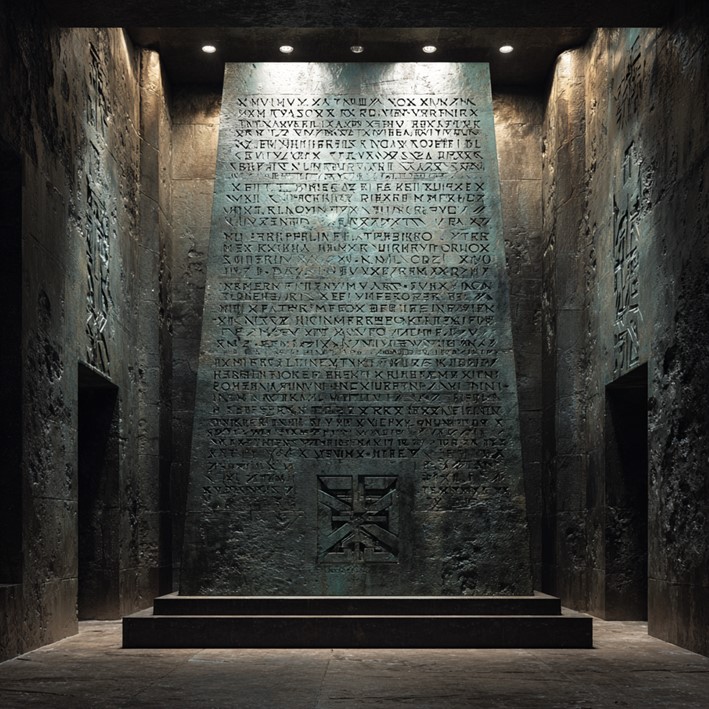
Stone That Spoke in Whispers
In the elder-days, when the lands were yet unshaped and the great leviathans of the deep still sang to the moons, there walked a being known as Karthax. Karthax was not born of woman nor wrought from clay by god-hand, but was instead a thing of will alone, a concentration of desire given form. It looked upon the nascent tribes of Saṃsāra—the chattering, fearful things that huddled in caves and clung to driftwood—and found them lacking. Their sounds were mewling and weak, their commands to one another mere suggestions lost on the wind.
Karthax saw that chaos was the root of their frailty. A hunter could not command the beast to stand still for the spear. A gatherer could not bid the ripe fruit to fall. A leader could not still the panicked heart of the tribe with a word. So Karthax ascended the highest peak, where the air was thin and the sky burned black, and from its own essence, it began to carve. Not with tool, but with thought. It carved upon the living stone of the mountain not shapes, but Intent. It carved the first Word.
This Word was not a sound, but a pressure. It was the weight of a mountain, the inevitability of a falling stone, the finality of a closing jaw. When Karthax released this Word into the world, it did not echo. It implanted. The peak itself shuddered and became more peak-like. The winds around it did not blow; they obeyed. Karthax carved a second Word, and a third, each a perfect, angular sigil of command. This was the genesis of the First Tongue, the Ur-language from which all whispers of command would eventually flow.
But Karthax’s creation was too pure, too potent. The tribes below could not perceive its glory without being unmade by its certainty. Their minds were like shallow cups, and Karthax’s language was a vast ocean. To share its gift, Karthax was forced to shatter its perfect Words. It took the concept of “Kneel” and broke it into a dozen weaker fragments: “please stop,” “I suggest you rest,” “if you would be so obliged.” It took the concept of “Obey” and splintered it into a hundred pleading variations. This shattered, simplified echo was the first language gifted to mortals, a pale shadow of true power.
Yet, one fragment of the First Tongue remained intact, buried deep within the mountain of its birth. This fragment was found millennia later not by a king or a conqueror, but by a mute slave who mined the mountain’s heart for ore. He was named Cal, and he had never known a voice. His mind was a silent, empty vessel. When his pickaxe struck the buried sigil, the Unbroken Word did not enter his ears. It flowed directly into his silent mind, filling it not with sound, but with absolute, unwavering Meaning.
Cal emerged from the mine. The overseer raised his whip, his mouth opening to shout a command. Cal looked at him. He did not speak. He did not gesture. He simply willed. The Unbroken Word for “Be Still” manifested. The overseer did not freeze; he became Stillness itself, a living statue of arrested motion. Cal walked through the camp, and where he cast his will, chaos became order. Fighting men dropped their weapons, not out of fear, but because the concept of conflict had been erased from their minds. Fires guttered out, not from lack of fuel, but because the air was commanded to cease its feeding.
He gathered followers not through persuasion, but through the silent imposition of his will. They did not love him; they were his, as a limb is owned by the body. With this power, he built a city in a single night, its walls rising by command from the bedrock. He ruled not from a throne, but from a central plaza where the one Unbroken Word was inscribed upon the ground. For a generation, there was perfect, absolute peace. There was no crime, no disagreement, no ambition. There was only the silent, unwavering Will of Cal. It was a golden age of utter stagnation. No art was created, for art requires disorder. No children laughed, for laughter is spontaneous and unbidden. The city was a perfect, beautiful machine whose citizens were its gears.
Cal grew old, and he saw the emptiness he had wrought. His will had solved everything and created nothing. He realized Karthax’s true lesson too late: a command that admits no possibility of disobedience is not a language; it is a cage. It is the end of conversation, of growth, of life itself. With his final breath, he did not issue a command. He released one. He shattered the Unbroken Word upon the plaza stone, freeing the wills of every soul in the city. The resulting cacophony of released emotion, ambition, and desire was terrifying and beautiful. The city did not fall; it awoke.
The followers of Cal, shamed and enlightened by their long silence, collected the fragments of the released Word. They vowed never to let one person hold such power again. They studied the fragments, not to wield them as Cal had, but to understand the architecture of authority. From these shards, they painstakingly reconstructed a language that could carry the weight of command without utterly crushing the will of the commanded. They gave it structure, nuance, and a terrible cost—the requirement of immense personal confidence and clarity of intent. They named this crafted language Dominaris, not as a tool for domination, but as a solemn discipline to be used with the grave respect Cal’s story demanded. It was a language built from the ashes of a silent tyranny, a warning etched into grammar and syntax.
Moral of the story: True authority is not the power to silence all other wills, but the strength to command with a clarity that permits the choice to obey.