
Definition: Snarlgruff is a unique language with a strong emphasis on expressing bad-tempered and irritable emotions. It serves as a means for individuals to convey their sense of frustration, anger, and impatience, even across species.
Linguistic Attributes and Characteristics:
- Gruff Vocabulary: Snarlgruff’s vocabulary is filled with words and phrases that evoke feelings of bad-tempered emotions. It enables speakers to express their frustration and impatience with a gruff and irritable tone.
- Irritated Tones: The language often employs irritated and grumpy tones, reflecting the bad-tempered emotions it seeks to convey.
- Impatient Structure: Snarlgruff is structured in an impatient and irritable manner, allowing for the expression of gruff and bad-tempered emotions.
Structure: Snarlgruff follows a gruff and impatient pattern, allowing speakers to convey their feelings of bad-temperedness and irritation in an irritable and impatient way. The language may involve the use of curt and sharp expressions to convey the depth of frustration and impatience.
Cultural Identity and Usage: Snarlgruff is used by individuals who wish to communicate their sense of bad-temperedness, irritation, and impatience. It is often employed in situations where tempers run high or when expressing feelings of frustration. Snarlgruff does not have a specific cultural identity but is used by individuals of various backgrounds who experience and value expressing their bad-tempered emotions.
Rarity, Type, Script, Source, and History:
- Rarity: Snarlgruff is relatively uncommon, as it is a language associated with expressing bad-tempered emotions. It is not widely known or used among the general population.
- Type: Snarlgruff falls under the category of gruff languages, as its primary purpose is to convey feelings of frustration and impatience. It does not possess traditional magical powers, but its ability to evoke gruff and irritable emotions makes it a powerful tool for those seeking to communicate their sense of bad-temperedness.
- Script: Snarlgruff’s script appears sharp and curt, reflecting the language’s connection to irritation and impatience.
- Source and History: The origins of Snarlgruff can be traced back to individuals who sought to express their feelings of bad-temperedness and irritation in a unique and impatient manner. Over time, it evolved into a distinct language used by those who experience and value expressing their bad-tempered emotions.
Sensory Experience: When spoken, Snarlgruff has a gruff and impatient quality, as if the words themselves carry a sense of irritation and frustration. Listeners may feel a sense of annoyance and impatience, as the language has the power to evoke bad-tempered emotions. The sensory experience is further enriched when used telepathically, as the curt and sharp essence behind Snarlgruff’s words is directly transmitted, creating a profound sense of irritation and impatience in the recipients.
In conclusion, Snarlgruff is a unique language with an emphasis on expressing bad-temperedness, irritation, and impatience. Its linguistic attributes, cultural significance, and sensory experience make it a powerful tool for individuals seeking to communicate their sense of frustration and impatience.
Tags: gruff, irritable, bad-tempered, impatient, frustration, anger, curt, sharp, emotional, vocal, telepathic, uncommon, expressive, intense, direct, concise, evocative
Inscriptions:
Phonetic: Grrak snarl huffrak, throk irk blarg. Meaning: Bind this stone with fury, shatter the weak bonds.
Phonetic: Snarff grumph karg, drak irrt blaff. Meaning: Eternal guard of rage, repel the foolish intruders.
Phonetic: Huffsnarl grok tharg, blargk irk snar. Meaning: Curse upon the thief, agony in every step.
Phonetic: Karggruff snarl drak, irrt huff blarg. Meaning: Power sealed in wrath, awaken only for the strong.
Phonetic: Throk blaff snarff, grumph karg irk. Meaning: Forbidden knowledge bites, pain for the unworthy seeker.
Phonetic: Drak irrt grok, huffrak snarl tharg. Meaning: Flames of impatience consume, burn the hesitant soul.
Phonetic: Blargk snar huff, grrakkarg drak irk. Meaning: Ward against peace, stir endless conflict here.
Phonetic: Irrt blaff tharg, snarl grok huffrak. Meaning: Echoes of frustration linger, deafen the calm minds.
Phonetic: Grumph drak snarff, karg blarg irrt. Meaning: Strength forged in anger, unbreakable by gentle hands.
Phonetic: Huff snarl grok, thargk irk blaff. Meaning: Secrets hidden in snarls, reveal only to the enraged.
Phonetic: Drak tharg huffrak, snarff grumph karg. Meaning: Portal of ire opens, cross at your peril.
Political Oaths:
Phonetic: Grrak huff blarg, snarl irk throk drak. Meaning: Swear loyalty through gritted teeth, betray and face my wrath.
Phonetic: Snarff karg grok, irrt blaff huffrak tharg. Meaning: Alliance forged in mutual grudge, break it and suffer alone.
Phonetic: Huffsnarl drak irk, grumph blarg snar. Meaning: Vow to lead with iron fist, crush the dissenting voices.
Phonetic: Throk grok huff, karg snarl blaff irrt. Meaning: Pledge defense in fury, let enemies feel our combined rage.
Phonetic: Drak blarg snarff, huffrak tharg grrakkarg. Meaning: Oath of rule unbroken, challenge it and invite destruction.
Phonetic: Irrt huff grok, snarl drak blarg tharg. Meaning: Bind to the throne in impatience, idle subjects earn my scorn.
Phonetic: Blargk irk huffrak, grumph snar throk karg. Meaning: Promise justice swift and harsh, mercy for none who falter.
Phonetic: Grok snarl drak, tharg blaff irrt huff. Meaning: Covenant of power shared, hoard it and face isolation.
Phonetic: Karg huff blarg, snarff grok irk drak. Meaning: Affirm command with growl, obey or be cast out.
Phonetic: Tharg irrt snarl, huffrak karg blaff grok. Meaning: Treaty sealed in bad blood, violate and ignite the feud.
Phonetic: Drak grok huff, blarg tharg snarff irk. Meaning: Declare unity through strain, division brings endless strife.
Cultural Ceremonies:
Phonetic: Grrak snarl throk, huff irk blarg drak. Meaning: Invoke ancestors’ ire, guide us with their eternal grumbles.
Phonetic: Snarff grok karg, blaff irrt huffrak tharg. Meaning: Celebrate harvest in frustration, curse the barren fields ahead.
Phonetic: Huffsnarl drak blarg, grumph snar irk grok. Meaning: Union rite of two snarls, bind lives in shared annoyance.
Phonetic: Throk huff blaff, karg snarl drak irrt. Meaning: Farewell to the fallen, rage against the void that claims them.
Phonetic: Drak grok snarff, tharg huffrak blarg karg. Meaning: Initiation into adulthood, endure the trials of impatience.
Phonetic: Irrt blarg huff, snarl throk grok drak. Meaning: Festival of storms called, dance in the fury of elements.
Phonetic: Blargk irk snarl, huffrak karg blaff tharg. Meaning: Renewal vow yearly, spit on past failures renewed.
Phonetic: Grok drak huffrak, snarff irrt blarg grok. Meaning: Healing chant for wounds, pull strength from inner rage.
Phonetic: Karg tharg snarl, huff blaff drak irk. Meaning: Naming of the newborn, imprint with a growl of destiny.
Phonetic: Tharg grok blarg, irrt huff snarl karg. Meaning: Mourning circle gathered, howl complaints to the departed.
Phonetic: Drak huffrak snarff, blarg tharg grok irrt. Meaning: Victory feast commenced, mock the defeated in loud toasts.
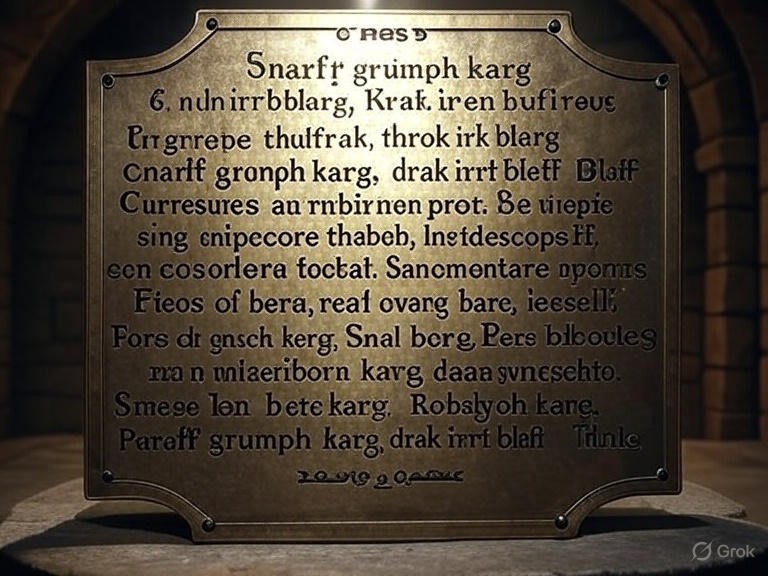
Growling Tongue’s Birth in Shadows of Forgotten Fury
In days when the planes twisted like serpents in agony and the avatars wandered without memory’s chain, there existed a wanderer named Kargthar, whose form was that of a hulking beast with fur matted from endless battles and eyes that burned like coals in a forge left to smolder. This Kargthar was not born of gentle winds but forged in the fires of discord, where the multiverse spat forth creatures that knew only the bite of hunger and the sting of betrayal. He roamed the lands of Saṃsāra, a world where thoughts flowed through conduits of stone and bone, and where the merging of minds with bodies brought forth both glory and torment. Kargthar’s avatar was a solitary one, a tier-one being that could not yet split into packs or share senses across distances, bound to its singular form like a prisoner in a cage of flesh.
The wanderer had come from a forgotten plane, his memories a jumble of lives past—once a lowly scavenger gnawing on scraps in shadowed alleys, then a warrior who fell in a clash of blades that echoed through time, and later a sage who pondered the voids between stars only to be consumed by them. Upon possessing his current avatar, a massive wolf-like creature with claws that rent the earth, Kargthar felt the clash of instincts and recollections, causing disorientation that lasted moons. He snarled at the confusion, his voice a raw echo that stirred the winds into whirlwinds of dust. But in those early wanderings, he encountered no kin, only foes that slunk from the underbrush or descended from jagged peaks, each seeking to claim his essence or shatter his form.
One fateful cycle, when the planes aligned in a rare convergence that allowed glimpses into other realms, Kargthar stumbled upon a crystal remnant of a fallen avatar. Touching it brought pain, for it was attuned to a higher tier, beyond his level plus nine, triggering irregular intervals of loss—two d4 dice rolled in his mind’s eye, the higher dictating minutes of torment, the lower the health points drained, amplified by the item’s superiority. He growled through the agony, his body wracked as if lightning coursed within, but from the crystal emerged a faint whisper of memories not his own. These were the echoes of an ancient character, one who had merged with multiple avatars at tier two, sharing thoughts and senses up to twenty feet before dimming, and who had wielded magic without traditional conduits, training body parts like vocal cords to channel power.
Inspired yet infuriated by this revelation, Kargthar sought to harness such might. He journeyed to the Crags of Endless Echo, a place where stone formations amplified sounds into weapons, and there he encountered a swarm of lesser avatars—buzzing insects that moved as one, unattuned to any character, driven by base instincts. They assailed him, their stings like needles of fire, reducing his health points gradually, for he had not rested long enough to roll his tier die and recover. In his rage, Kargthar attempted a spell, but lacking a proper conduit, his thoughts scattered like leaves in a gale. He ate a hasty meal of scavenged roots, gaining one health point after twenty minutes of forced role-playing the chew and swallow, but it was not enough. As his avatar teetered near zero, he expended a mana boost point as a reaction, leaving him with one health point and the swarm dispersed in confusion.
From this near-death, Kargthar’s frustration boiled over. He began to utter sounds that were not words but guttural emissions—grraks and huffs, snarffs and blargs—each laced with the essence of his ire. These noises, born of impatience and bad-tempered emotion, resonated with the world’s intrinsic magic. Unlike silent spells that dealt twenty-five percent less damage or normal chants under six seconds, these were ritualistic in their raw form, recited with shouts that drew attention and amplified effect up to twenty-five percent more. The swarm, hearing the tones, felt a profound sense of annoyance transmitted telepathically, causing them to scatter further, their own instincts clashing with the imposed irritation.
Emboldened, Kargthar refined these utterances. He attuned to a simple item—a jagged rock as his conduit—taking a full minute to bind it, feeling the former attunement of some distant user break, a sensation that prickled like distant thunder. With it, he channeled his growls into inscriptions on the crags: “Grrak snarl huffrak, throk irk blarg,” which bound the stone with fury and shattered weak bonds; “Snarff grumph karg, drak irrt blaff,” eternally guarding with rage against foolish intruders. These marks, sharp and curt in script, evoked feelings of frustration in any who gazed upon them, even across species, for the language pierced the mind’s eye, revealing stats of emotional intensity.
Word of this new tongue spread like wildfire through dry grasslands. Avatars of higher tiers, those at three who tripled sharing distances within a plane, or four with no limits therein, adopted it for political oaths: “Grrak huff blarg, snarl irk throk drak,” swearing loyalty through gritted teeth, betrayal inviting wrath; “Snarff karg grok, irrt blaff huffrak tharg,” forging alliances in mutual grudge, breaking them leading to solitary suffering. In cultural ceremonies, it was chanted: “Grrak snarl throk, huff irk blarg drak,” invoking ancestors’ ire to guide with eternal grumbles; “Snarff grok karg, blaff irrt huffrak tharg,” celebrating harvests in frustration, cursing barren fields.
But Kargthar’s creation drew envy. A rival character, merged with two avatars at tier two, all memories combined, challenged him. This foe, named Irrtblaff, possessed a pack that could not yet split but shared thoughts seamlessly. Irrtblaff sought to claim the language, attuning to Kargthar’s rock conduit, breaking the bond and causing Kargthar to feel the severance like a stab. In response, Kargthar unleashed a barrage of Snarlgruff phrases, his vocal cords trained as a rule-breaker’s conduit, gesturing with hands to amplify. The battle raged across planes, for at tier five, restrictions lifted across all existences, but neither had reached such heights.
They clashed in a valley where items lay scattered—belts adding slots, sheaths for weapons attuned automatically when held. Kargthar wore attuned gear up to his tier plus nine, storing excess to avoid advancement triggers, his slots numbering twenty minus his tier, filled with non-attuned items without penalty. Irrtblaff, overconfident, touched an item above his level, suffering pain in irregular intervals, losing health points until near death, expending mana boosts to survive—up to ten times his tier, dissipating one per day.
In the fray, Kargthar chanted ritually: “Huffsnarl grok tharg, blargk irk snar,” cursing the thief with agony in every step. Irrtblaff countered with stolen phrases, but his impatience warped them, leading to disruption from Kargthar’s distractions. Using true names doubled damage, and Kargthar snarled Irrtblaff’s essence, invoking silver fire spell power—unresistible mana boosts adding straight damage post-hit, no action penalties.
The conflict drew others: swarms that merged into groups, characters with multiple avatars encouraged above tier one, sharing senses dimming after twenty feet. They witnessed the power of Snarlgruff, its gruff vocabulary conveying anger, irritated tones reflecting bad-tempered emotions, impatient structure allowing curt expressions. Telepathically, it transmitted profound irritation, evoking annoyance in recipients.
Ultimately, Irrtblaff’s avatars perished dramatically, leaving crystals and items behind. Kargthar’s memories absorbed the foe’s, amplifying traits, though integration took time, clashing personalities causing confusion. He advanced to tier two, now able to merge with another by agreement, forming a single character with two avatars, memories fully combined.
Yet, in victory, Kargthar realized the language’s double edge—it stirred conflict endlessly. He inscribed a final plaque in sharp script: “Drak tharg huffrak, snarff grumph karg,” a portal of ire opening at peril. Then, he vanished into higher planes, his tale passed through poorly translated scrolls from an unknown ancient tongue, words mangled by time, meanings shifted like sands.
The moral of the story is that tongues born of fury may bind the world in shared ire, but unchecked, they devour the peace they never sought, teaching wielders to temper rage lest it consume all.