
Deity Name: Huánglián, The First Potter of the Sun
Lore:
In the telling of the Yangshao elders, the world was once a river of pale clay, unshaped and drifting beneath a sky without light. From the deep silence came Huánglián, whose hands were neither mortal nor divine but carried the memory of both. She drew the clay into great vessels, shaping mountains as jars, lakes as bowls, and rivers as painted lines curling across the surface of the world. To give her creations warmth, she placed the Sun into the largest jar and set it spinning across the sky. The Moon was her ladle, scooping night into the sky so that the day might rest.
Huánglián taught the first people how to carve their lives from the soft clay of possibility—how to spin the wheel of choice, how to fire the heart in the kiln of trial, and how to paint the self in the colors of truth. It is said that every soul is a vessel she made, and that when one shatters, its fragments are gathered by her to be reshaped into a new form.
Personality:
Huánglián is portrayed as patient yet deliberate, slow to wrath but relentless in justice. She values creation over destruction, but when the balance of the kiln is broken—when greed, neglect, or cruelty mar the world’s design—she will shatter what is flawed to rebuild it anew. In parables, she speaks little, letting her works be her lessons.
Traits & Characteristics:
- Creator of Form: Believed to shape the land, people, and even fate as clay on her wheel.
- Keeper of Cycles: Oversees the endless making, breaking, and remaking of all things.
- Silent Judge: Her judgments are never spoken, only seen in the consequences that follow.
- Gift of the Hand: Pottery, painting, and craft are considered divine acts of devotion.
- Seer of Patterns: The swirling motifs of Yangshao pottery are said to be her secret language, revealing the order beneath chaos.
Attributes:
- Domain: Creation, Earth, Craft, Sun, Renewal
- Elemental Affinity: Clay and Fire
- Sacred Colors: Red ochre, deep black, sun-gold
- Sacred Animal: The red-crowned crane, for its patience and grace
- Sacred Plant: Mulberry tree, used in binding pottery with root fibers in ancient rites
- Sacred Object: The Sun Jar, a mythical vessel said to contain the first spark of daylight
Symbols:
- A red spiral inside a black ring, representing the Sun turning within the kiln.
- A crane stepping in clay.
- A potter’s wheel flanked by two stylized flames.
Tags:
Creation, Renewal, Craftsmanship, Earth, Fire, Sun, Pottery, Painted Symbols, Justice, Patience, Cycles, Rebirth, Yangshao Heritage, Sacred Crane, Mulberry, Artisan Worship, Cultural Identity
Positives:
- Strong cultural unity among believers, as pottery, craft, and artistry become both religious expression and civic identity.
- Encourages patience, skill, and careful planning—traits that spill into governance, trade, and diplomacy.
- Deep respect for environmental resources, as clay, firewood, and water are gathered in sustainable, ritualized ways.
- Artistic traditions passed down through generations, giving the Yangshao a rich visual heritage recognized across Saṃsāra.
- Belief in renewal brings resilience—failure is seen as a chance to be “reshaped” rather than a final end.
Negatives:
- Adherence to Huánglián’s cycle of breaking and remaking can justify destructive acts if seen as “necessary corrections.”
- Crafts and rituals can be time-consuming, slowing urgent decision-making in times of crisis.
- The weight of tradition sometimes discourages innovation outside of established patterns.
- Those outside the faith may be mistrusted if they ignore or disrespect symbolic designs and pottery motifs.
- Shattering an object viewed as a “vessel of the soul” is considered a grave insult, potentially leading to violent retaliation.
Type of Temple:
Temples are large, low-walled compounds known as Kiln-Houses, combining a worship hall, open-air pottery yards, communal kilns, and shaded painting courtyards. The central sanctum holds the Sun Jar, a great golden-glazed vessel filled with an eternal flame said to be lit by Huánglián herself. Pilgrims may bring their own crafted pottery to “warm in the divine kiln,” symbolically placing their soul under the goddess’s guidance.
Number of True Followers:
Of the total 30,096,444 inhabitants of Yangshao, slightly over half follow the Path of the Painted Dawn, but only about 7,880,000 are considered true devotees—those who attend rites regularly, perform the sacred crafting rituals, and take part in the seasonal Kiln Offerings.
What They Do:
- Daily Practices: Shaping small clay tokens, carving or painting motifs, reciting short “wheel chants” before work.
- Seasonal Rites: Participating in the Kiln Offering, where crafted goods are fired in sacred flames and then distributed, broken, or buried as offerings to the goddess.
- Civic Service: Many true followers are artisans, builders, or painters contributing to public works adorned with Huánglián’s patterns.
- Pilgrimage: Traveling to the Great Kiln-House in the capital to leave a personally made vessel for blessing.
- Life Events: Births, unions, and leadership ascensions are marked by gifting symbolic pottery.
- Justice Rituals: In serious disputes, a neutral pot crafted by both sides is smashed before witnesses to “end the flawed vessel” and allow a fresh agreement to be shaped.
What the Believers Believe
Followers of Huánglián hold that all living beings are clay in the hands of the goddess—shaped, painted, and fired through life’s trials. The world itself is seen as her great vessel, constantly repaired when cracked by conflict or time. Life is cyclical: breaking is not an end, but a stage before reshaping. Beauty and imperfection are equally valued, as the “divine glaze” shines most brightly over repaired fractures. Every person carries an inner “kiln-flame,” the divine spark gifted by Huánglián, which can be nurtured or dimmed by their actions. Death is not destruction, but the return of the soul-clay to the goddess’s hands for a new form.
Regular Services
Services, called Wheel Gatherings, are held twice each week in Kiln-Houses, often at midday when Helios is highest. The ceremony begins with the Turning of the Wheel, where the High Potter (priest) spins a ceremonial potter’s wheel three times while chanting the “Four Shapings”—Forming, Painting, Firing, and Cooling. Congregants bring small clay discs they have prepared at home, marked with symbols of their recent deeds or struggles. These discs are placed on communal shelves to be blessed in the temple’s kiln during the service. Singing is common, with rhythm kept by wooden paddles tapping on clay jars. The service ends with the Glaze of Words, in which the High Potter sprinkles perfumed water over the congregation while reciting blessings for resilience and beauty in their “vessel of life.”
Funeral Rites for Believers
The passing of a believer is marked by the Shattering of the Vessel ritual. A clay effigy—crafted to embody the person’s spirit—is displayed during a vigil that lasts from early morning until evening. At sunset, the effigy is ceremonially struck with a special wooden mallet, breaking it into pieces. These fragments are then placed inside a large, lidded jar glazed in the deceased’s family colors. The jar is buried in sacred ground, facing the east so the morning light will “warm the clay” for the soul’s next shaping. Some families also commission a Life Jar, painted with scenes of the person’s most valued moments, which is kept in the home to honor their continuing spiritual presence. The belief is that Huánglián gathers the soul from the fragments, repairs its cracks with gold, and sends it back into the world in a new body.
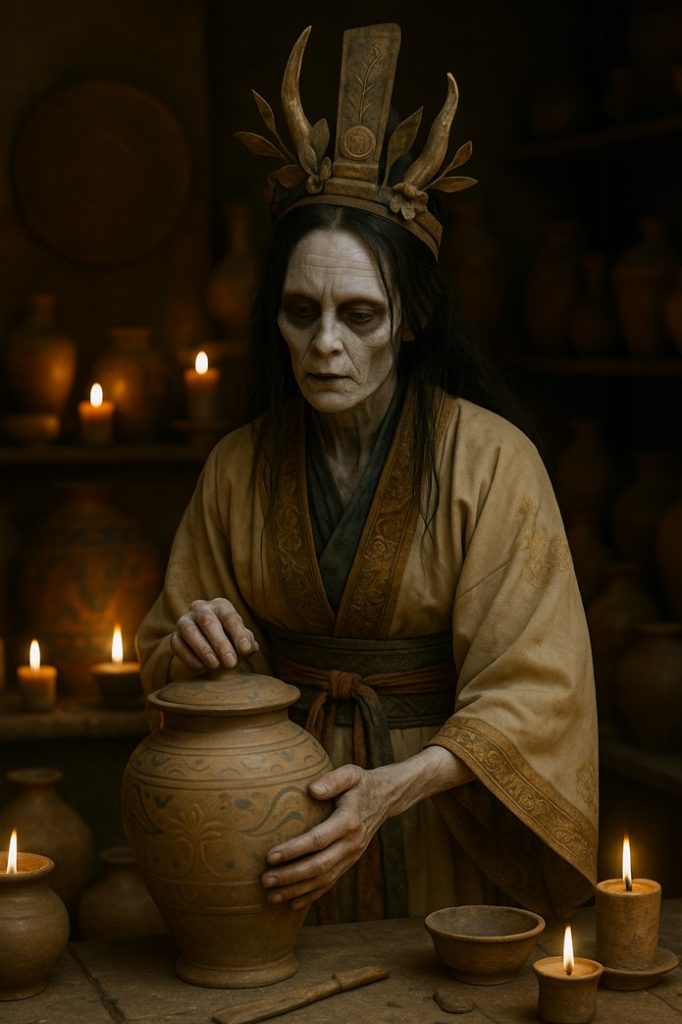
The god of the Yangshao faith, Huángmǔ Zàohuà (“Mother of the Living Clay”), governs vitality, earth-shaping, and the breath between life and death. Her magic is channeled primarily through ceramic, pigment, and woven vine charms prepared in ritual spaces, but can also be invoked by trained avatars in the field. The same powers used for creation and renewal can be turned toward both preservation and destruction, depending on the intent of the wielder.
Defensive Uses
• Earthen Bastion – Summons earthen walls or layered clay shells around allies, absorbing or deflecting physical and magical attacks. Properly glazed charms can cause the surface to resist elemental assaults.
• Living Clay Graft – Temporarily mends wounds by applying enchanted clay that bonds to skin or armor, hardening until the body’s natural healing catches up.
• Vine-Bound Sanctuary – Causes rapid growth of defensive flora from the ground, entangling attackers and shielding vulnerable positions.
• Pulse of Continuance – A wide-area surge of life energy that slows bleeding, reduces exhaustion penalties, and wards against necrotic magic for a short time.
• Earthen Resonance Ward – Embeds a vibrational pattern in soil or stone underfoot that disrupts enemy movement or interferes with hostile spellcasting.
Offensive Uses
• Shards of the First Firing – Launches razor-edged clay fragments infused with Huángmǔ’s power; they fracture further on impact, wounding multiple targets.
• Breath of Red Dust – Expels a cloud of fine ochre dust that blinds, chokes, and disrupts focus, useful against both living and magical constructs.
• Vine-Strangle Bindings – Causes creeping roots to erupt and constrict foes, restricting movement and crushing weapons or limbs.
• Earthen Collapse – Weakens ground stability beneath enemies, creating sinkholes or sudden fissures that break formations.
• Clay-Fired Judgment – Channels compressed heat through ceramic sigils, causing localized eruptions of molten clay and stone that can both burn and immobilize.
Song of Clay That Remembered
In the days when the ground was still soft and the rivers had not yet chosen their beds, the Mother of the Living Clay walked upon the wide unformed plain. Her hands sank into the earth as though kneading dough, and from each press there came a hum like the sound of water in a sealed jar. She was alone then, or so the tale begins, for the sky was high but had no birds, the hills were tall but had no trees, and the air was warm but carried no breath but her own.
She wished for company, and so she took the clay, mixed it with the wet breath from her lungs, and shaped many figures. Some were large as mountains, with feet that could tread valleys into bowls; some were small as seeds, meant to scatter in the wind. She placed them in the fire of the newborn sun, and the fire whispered to them names they would not forget.
But the first ones, it is said, broke too easily. Their bodies crumbled, and their spirits slipped out like water through cracks. The Mother gathered the fragments, ground them fine, and mixed them back into new clay. “If you remember your breaking, you will be strong,” she told them. So the second ones were given a little of the dust of the first, and they learned how to endure.
There came a time when a spirit born from the second making, called Shan-Yu by the later singers, grew proud. He saw that his hands could shape clay as the Mother had done, and he began to craft figures in secret. But unlike the Mother, he did not mix breath in equal measure—he poured too much of his own restless wind, and the figures woke with hunger and eyes that glimmered like wet stones. These were the First Devourers, and they walked at night, seeking to swallow what the Mother had shaped.
The Mother did not strike them down at once, for she wished to see if her children would defend what was theirs. Some fled into the rivers, some buried themselves in the earth, and some stood against the Devourers with only their bare hands and the clay charms they had learned to make. Those who fought found that the clay remembered not only its shaping, but the will of the shaper—an amulet fired in courage could turn a fang, a wall made in patience could outlast a storm.
Shan-Yu, seeing the ruin he had brought, went to the Mother with head bowed. “Take back my breath,” he said, “for it is crooked and has made crooked things.” But the Mother shook her head. “The breath cannot be unbreathed, but it can be taught to change its song.” And so she taught Shan-Yu to shape clay not into hunger, but into guardians. He worked beside her for a long age, and the Devourers grew fewer, though some say they still walk in the shadows between hill and field.
In the last verses, the Mother gathers her children and speaks: “When you take clay in your hands, you take the memory of all makings and breakings. What you form will remember you, even when you are dust. If your hands are gentle, the shape will guard. If your hands are cruel, the shape will bite. In the end, the earth returns all things to the same dust—but the dust will remember.”
Moral: What is made will carry the heart of the maker, and the earth remembers both kindness and cruelty.