
Original life forms referenced:
• Class Mammalia – Giant Pangolin
• Class Aves – Roseate Spoonbill
• Class Reptilia – Thorny Devil Lizard
• Class Malacostraca – Peacock Mantis Shrimp
Appearance:
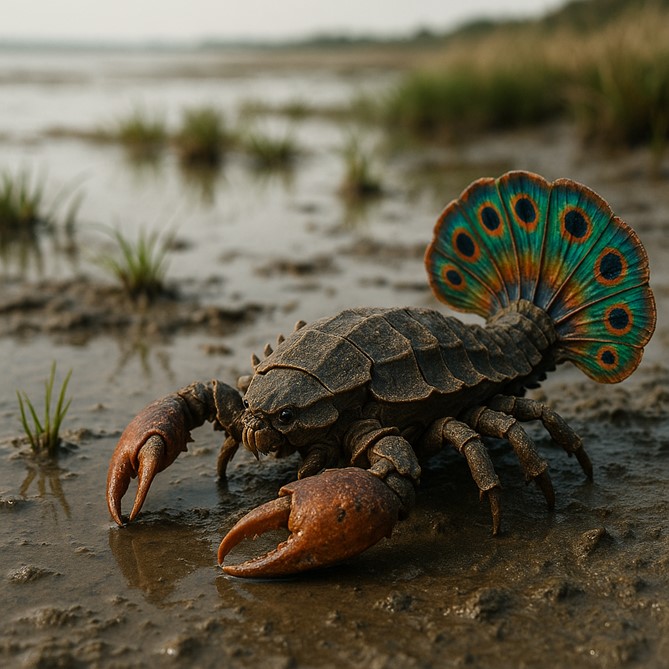
The Thrylliscorpa 842 bears a low, armored body covered in overlapping keratinous plates from its pangolin ancestry, each plate ridged with the spiny protrusions of a thorny devil, forming defensive ridges along the spine and flanks. Its forelimbs are muscular and end in mantis shrimp–derived raptorial claws, folded tightly against the chest until striking. The head is long-necked like a spoonbill’s, with a wide, flattened beak lined on the inner edges with fine, rasp-like denticles for filtering prey from silt or shredding softer organisms. Eyes are faceted and capable of polarized vision, with a metallic iridescence that shifts in greens, coppers, and blues. Its coloration ranges from pale desert pinks to vivid turquoise splashes, breaking up its outline near water. The tail is long and heavy, ending in a fan-shaped chitinous plate patterned like a peacock mantis shrimp’s threat display, used both for balance and intimidation.
Size:
Length 2.4 m from snout to tail, shoulder height 0.9 m, mass around 190 kg.
Speed:
Land – 35 ft per round (short bursts up to 60 ft when alarmed).
Water – 20 ft per round; not a fast swimmer, but can hold breath for 8 minutes.
Stat Modifiers:
• Strength +3
• Dexterity +2
• Constitution +4
• Intelligence −2
• Wisdom +1
• Charisma −1
Skills:
• Stealth +4 (camouflage from patterned armor)
• Perception +3 (polarized vision)
• Survival +3 (locating hidden water or burrow prey)
• Athletics +2 (burrowing and climbing)
Behavior:
Primarily solitary except during short mating seasons. Burrows into semi-soft banks near brackish inlets or marshes, creating hidden lairs with a submerged entrance. Highly territorial—will strike with raptorial claws if approached within 6 m. Uses tail-fan display to warn predators; if ignored, strikes come without hesitation. Prefers dawn and dusk activity, avoiding the hottest or coldest parts of the day.
Diet:
Omnivorous opportunist; filters small crustaceans, mollusks, and insects from mud or shallow water, but also eats hardy desert vegetation and fallen fruit. Will scavenge carcasses.
Emotions:
Generally cautious and suspicious; displays aggression only when defending territory or during courtship disputes. Shows curiosity toward glittering or bright-colored objects.
Environment Where Found:
Semi-arid coastal plains, brackish estuaries, mangrove edges, and tidal marshes where hardpan meets water access. Often in areas where tidal pools are interspersed with rocky or earthen burrows.
Tags:
Feral, Armored, Burrowing, Marsh-Dwelling, Desert-Edge, Filter-Feeder, Ambush-Predator, Territorial, Iridescent, Solitary, Threat-Display, Chitinous, Strike-Claws, Semi-Aquatic, Heavy-Tail, Cautious, Omnivore
Life Cycle:
Thrylliscorpa 842 begin life as soft-shelled, thumb-sized hatchlings that emerge from a shallow, burrowed nesting chamber dug into the sloped bank of a tidal inlet. Females lay between 6 and 9 leathery eggs, each about the size of a grapefruit. The eggs incubate for 40 to 45 Saṃsāra days, warmed by a mixture of solar heat and the mother’s body, who coils around them and blocks intruders with her plated back. Hatchlings are immediately mobile but remain under maternal supervision for 3–4 weeks, during which they learn to burrow and strike. Growth is rapid in the first year, with full carapace plating developing by their second year. They reach reproductive maturity at approximately 7 years and can live up to 45 years in optimal conditions.
Mating:
Courtship occurs during the Blooming Week of Passion Month when water levels in estuaries are at their warmest and food is abundant. Males approach females with slow tail-fan displays, alternating flashes of turquoise and amber across their plate patterns. The display is paired with a rhythmic drumming of their tail on the ground or shallow water, producing both vibration and sound. Males spar using their raptorial claws in short, explosive bouts to establish dominance. The victor gains the right to mate, engaging in a brief ritual where both participants filter-feed side-by-side before the act. Mating is quick and followed by the female driving the male away. Males play no part in raising offspring.
Tactics:
Thrylliscorpa 842 combines defensive armor with short-range, overwhelming offense. It uses stealth and terrain to avoid direct confrontation until necessary.
• Burrow Ambush: Conceals itself in sand or mud, tail-fan partially exposed like a shell or plant.
• Strike-and-Retreat: Delivers a single, crushing claw strike to incapacitate prey before pulling it into cover.
• Tail Bluff: Displays tail-fan to appear larger, often deterring predators without a fight.
• Mud Cloud Escape: In shallow water, it churns up sediment with its claws and tail to obscure itself before retreating.
Actions:
• Raptorial Claw Strike: Delivers a concussive blow capable of cracking shells or stunning medium-sized prey.
• Armor Roll: Tucks head and limbs to present only armored plates toward attackers, resisting piercing and slashing attempts.
• Tail Slam: Sweeps with its plated fan tail to knock back attackers or break fragile obstacles.
• Filter Sweep: Uses spoon-shaped beak to sift and consume small aquatic life from sediment.
Other Interesting Information:
• Color Memory: The patterns on its tail-fan can subtly shift depending on its past diet and recent territorial victories, making each mature Thrylliscorpa uniquely marked.
• Burrow Architecture: Burrows have dual exits—one to land, one to water—allowing escape in either direction. These are often reinforced with packed mud and lined with shells to prevent collapse.
• Sensory Edge: Its polarized vision allows it to detect changes in water surface tension, useful for spotting prey or predators just above the waterline.
• Role in Local Ecology: While feared for its claws, it plays a vital role as a sediment filterer, keeping estuarine waters clearer and reducing harmful algae blooms.
• Magical Curiosity: Some Urnfield mages prize shed Thrylliscorpa plates for creating iridescent armor charms that flicker in multiple spectra under magic light.
Adventurers in Saṃsāra might encounter or seek out the Cirrhostagryphon 912 for a combination of practical, magical, and cultural reasons that make it both a hazard and a target of interest.
1. Resource Harvesting
The Cirrhostagryphon’s chitinous-lobster armor plates are sought after for lightweight, high-resilience armor pieces, while its translucent lionfish fins yield shimmering membranes used in enchanted cloaks and spell-focusing screens. The avian talons it bears are naturally conductive to mana, allowing them to be carved into precision ritual tools. Even its internal organs—particularly the mana-rich gland sacs behind its eagle eyes—are valuable to alchemists and artificers for enhancing perception-based enchantments.
2. Magical Alchemy and Potion Components
Its venomous stinging tentacles carry a paralytic that, when diluted, becomes a potent numbing agent used in surgery and battlefield medicine. Undiluted, the venom is a dangerous reagent for traps, poisons, or complex potions requiring binding magic. The creature’s blood holds residual luminescence from its jellyfish ancestry, used to craft bioluminescent inks for runes or divine symbols.
3. Ecological Threat
In coastal or estuarine regions, Cirrhostagryphons are ambush predators that destabilize fishing communities by attacking nets, small boats, and even coastal dwellings. Adventurers might be contracted to clear them out after a spike in attacks, especially during their mating migrations when they become territorial.
4. Trials of Skill or Rite of Passage
Some Urnfield coastal clans and mage orders use the Cirrhostagryphon hunt as a coming-of-age or mastery trial, requiring proof of courage, teamwork, and resourcefulness. Surviving an encounter is a mark of status; returning with intact venom glands or the shimmering dorsal crest is a sign of exceptional skill.
5. Defensive or Offensive Application
The creature’s natural aggression and trainable ambush behavior have led certain militaristic factions to attempt capturing and relocating them to fortified coastal zones as living deterrents. Adventurers may be tasked with capturing one alive for such purposes—a dangerous job that requires precision and restraint.
6. Mystical and Folkloric Reasons
Legends claim that those who meet the gaze of a Cirrhostagryphon under moonlit tides will see visions of drowned empires or past incarnations. Certain seers and Mind’s Eye scholars seek these encounters deliberately, hoping to draw prophecy from the creature’s strange, alien awareness.
From a slain Cirrhostagryphon 912, skilled harvesters can recover a surprising range of materials, each prized for specific applications in Saṃsāra’s magical, alchemical, and artisanal trades.
1. Dorsal Crest Membrane
A thin, translucent membrane stretched between the dorsal spines, faintly iridescent.
• Use: Incorporated into high-grade scrying mirrors or portable mana screens, amplifying clarity and stability of visual magic. Some artificers layer it into spell-warding veils that refract hostile magical beams.
2. Photophores
Small, beadlike bioluminescent organs along the jellyfish-derived tentacles.
• Use: Ground into luminescent powders for magical inks, especially in underwater or low-light environments where written spells must remain visible. When intact, the organs can be mounted in lanterns that produce cold, steady light without heat or flame.
3. Chitinous Armor Plates
Segmented exoskeletal sections from its crustacean heritage.
• Use: Forged into lightweight, enchantment-friendly armor; can be boiled down into a resin-like paste used in binding runes to metallic surfaces. Preferred by stealth operatives for its sound-dampening properties when treated.
4. Venom Sacs
Located at the base of the stinging tentacles.
• Use: Diluted for medical anesthesia or precision surgical numbing agents. In concentrated form, used in paralytic weapon coatings or trap mechanisms. The venom is also a key reagent in high-tier transmutation brews that temporarily stiffen or soften organic matter.
5. Feathery Gill Fronds
Delicate, coral-like respiratory structures beneath its carapace.
• Use: When dried and powdered, grant temporary water-breathing when infused into tea or inhaled as vapor. Also serve as rare alchemical catalysts in potions that stabilize elemental water magic.
6. Eye Crystals
Calcified nodules in the back of its eagle-like eyes, infused with mana-conductive mineral deposits.
• Use: Set into precision targeting devices for siege weapons or ranged spell foci. Mind’s Eye researchers grind them into fine dust for lenses that sharpen perception during divination rituals.
7. Inner Beak Hooks
Hard, curved mouthparts of keratin-laced chitin, strong enough to crack shellfish.
• Use: Carved into ritual hooks or clasps for armor and magical gear; traditionally considered protective charms by Urnfield coastal families.
8. Stomach Stone Cluster
Smooth, mana-infused pebbles swallowed to aid digestion, polished by years of grinding.
• Use: When set in jewelry, these “tide stones” amplify elemental water spells and are believed to draw away ill fortune at sea.
9. Neural Thread Spool
A translucent braid of nerve fibers running the length of the tentacles, shimmering faintly in magic-rich areas.
• Use: Integrated into experimental magic circuits to improve mana flow efficiency, or braided into enchanted bowstrings that deliver spells alongside arrows.
10. Cartilage Core Rods
Flexible yet unbreakable rods of cartilage supporting the tentacle bases and fin spines.
• Use: Used in crafting collapsible staves or whip-like weapons that channel elemental water or lightning.
Song of Spines and Light
It is told — though the telling is cracked and worn like a shell dragged through a thousand tides — that in the elder days before the waves learned their own names, there came the creature with the body of the sea’s soldiers, the wings of the storm birds, the threads of the moon-jellies, and the hunger of the reef itself. It was called Cirrhostagryphon, though in the tongue of the sand it was “That-Which-Sings-When-Still.”
The old voices say it was born not from mother or egg, but from a quarrel between the Deep Blue and the White Horizon. The Deep Blue, jealous of the Horizon’s wide reach, cast a net woven from currents and night. In that net it trapped a piece of wind, a piece of light, and a piece of hunger, and bound them together with the spine of the coral mountain. From this binding the Cirrhostagryphon stirred, and the tides trembled.
It roamed the in-between places — the fog-bound shallows where the air is thick with the smell of rusted anchors and the sound of distant bells. Its eyes held two skies at once: one for prey, one for truth. Sailors who dared meet its gaze spoke later with voices like broken shells, telling how the creature’s sight peeled away the skin of lies, showing the marrow of things.
Once, in the season of Dimming, a fleet of seven ships went to the reef of black stone to find the shell that sings in storms. They found instead the Cirrhostagryphon, resting upon the spine of the reef, its tentacles like drifting weeds, its wings folded close. The captains, thinking it asleep, crept close with nets of bronze and hooks of bone. But the creature’s stillness was not slumber — it was the patience of the tide before it breaks.
When the bronze touched its carapace, it rose without sound. Its tentacles coiled like slow smoke, drawing the nets into its beak. The spines along its back flared, each casting a shard of blue light into the dark. The water churned not from wind or current, but from the creature’s song — a deep, slow hymn that turned the bones of the listeners heavy. One by one, the ships’ lanterns guttered. One by one, the crews leapt into the water, their minds filled with visions of vast trenches and cities of coral towers where words swam like fish.
Only one ship returned, and it drifted without crew, its sails stiff with salt. On the deck lay a single feather — if feather it was — black as tar but rimmed with tiny lights, like stars caught in frost. The old voices say those who hold such a feather hear the song of the Cirrhostagryphon in their dreams, and wake knowing the secret names of the tides.
In later ages, the creature was neither hunted nor worshiped, but awaited. Fishers, lost in fog, would tie offerings of shell and copper to their lines, letting them drift in the hope the Cirrhostagryphon would pass by and pull them toward shore. Warriors would paint its spined crest on shields, believing it would teach them patience before the strike. Scholars of the deep claimed it moved not by hunger or instinct, but by a long memory of a promise made to the Deep Blue — a promise that one day it would return to the coral mountain and unmake the net that birthed it.
But the oldest fragment of the tale — so worn that half the words are guesses — tells of a final meeting yet to come, when the White Horizon will bend low to the sea, and the Deep Blue will rise to meet it. Then the Cirrhostagryphon will open its wings to their widest, blotting out both sky and sun, and sing once more. In that song will be the ending of the old tides and the birth of the new waters.
Moral: Even in the stillness of the deep, there are songs waiting to break the silence — and when they do, they may carry both ending and beginning in the same note.
Suggested conversions to other systems:
CALL OF CTHULHU (7th Edition)
Name: Cirrhostagryphon, Tide-Singer of the Deep
STR 120 (6d6 × 5)
CON 100 (5d6 × 5)
SIZ 160 (8d6 × 5)
DEX 65 (3d6 + 3d6)
INT 65 (3d6 + 3d6)
POW 90 (4d6 + 4d6 × 5)
HP 26
Move 7 (land), 13 (swim), 12 (flight)
Build +3
Damage Bonus +1D6
Armor 8 (thick chitin, membrane)
Attacks:
• Tentacle Lash – 45%, 1D10 damage, may grapple; if grappled, victim is pulled 1D3 meters closer each round.
• Beak Bite – 35%, 2D8 damage, ignores 4 points of armor.
• Spine-Light Flare (POW vs. POW) – Victims who fail are dazed for 1D6 rounds, unable to act except defend.
Powers:
• Tide-Song: Once per day, the Cirrhostagryphon may emit a low, resonant hymn (Pow vs. Pow). Those who fail are afflicted by visions of abyssal cities, losing 1D10 SAN and suffering -20% to all skills for 1D6 minutes.
• Abyssal Vision: Can perceive hidden truths in a 30-meter radius, detecting lies, illusions, and invisible entities.
• Dream Feather Link: Possession of a shed feather allows nightly one-way dream contact (POW vs. POW each night).
Sanity Loss: 1D4/1D10 to see the creature in full glory.
BLADES IN THE DARK
Name: Cirrhostagryphon, Abyssal Relic of the Horizon Rift
Threat: 3
Type: Feral Leviathan-Spawn
Features:
• Massive chitin-armored body with storm-bird wings and drifting tentacles.
• Emits a hypnotic Tide-Song that clouds thought and draws minds into abyssal visions.
• Spine-Light Flare blinds and disorients.
Special Abilities:
• Tide-Song: When the Cirrhostagryphon sings, all PCs in its presence must make a Resolve resistance roll or be Lost in the Deep (temporary trance; vulnerable to harm).
• Crushing Tentacles: If the creature grapples, it can lift and fling targets into the sea or smash them against rocks.
• Dream Feather: Looting a feather grants an ongoing +1d to Attune with the sea’s supernatural elements, but draws the creature’s attention during downtime.
Drive: The creature appears during lunar conjunctions, drawn to offerings or disturbances in its feeding reef.
Clock to Defeat or Drive Away: 8 segments — physical harm, severing tentacles, or driving it off with ritual light and sound.
DUNGEONS & DRAGONS (5th Edition)
Name: Cirrhostagryphon, CR 12
Huge Monstrosity, Unaligned
Armor Class: 18 (natural armor)
Hit Points: 231 (22d12 + 88)
Speed: 30 ft., swim 60 ft., fly 50 ft.
STR 22 (+6)
DEX 15 (+2)
CON 18 (+4)
INT 12 (+1)
WIS 18 (+4)
CHA 16 (+3)
Saving Throws: Wis +8, Con +8, Str +10
Skills: Perception +8, Insight +8, Athletics +10
Damage Resistances: Cold, Lightning; Bludgeoning, Piercing, and Slashing from nonmagical attacks
Senses: Darkvision 120 ft., truesight 30 ft., passive Perception 18
Languages: Understands Aquan, Auran, and one local language; cannot speak
Challenge: 12 (8,400 XP)
Traits:
• Amphibious: Can breathe air and water.
• Tide-Song (Recharge 5–6): All creatures within 60 ft. that can hear must succeed on a DC 16 Wisdom saving throw or be charmed and incapacitated for 1 minute, seeing visions of the deep. They may repeat the save at the end of their turns.
• Spine-Light Flare (Recharge 4–6): Emits dazzling bioluminescent spines; creatures in a 30-ft. radius must make a DC 16 Constitution saving throw or be blinded for 1 minute.
• Tentacle Grapple: On a hit with a tentacle, the target is grappled (escape DC 16) and restrained until the grapple ends.
Actions:
• Multiattack: Two tentacle attacks and one beak bite.
• Tentacle: Melee Weapon Attack: +10 to hit, reach 20 ft., one target. Hit: 15 (2d8 + 6) bludgeoning damage.
• Beak: Melee Weapon Attack: +10 to hit, reach 5 ft., one target. Hit: 20 (3d10 + 6) piercing damage.
KNAVE (latest edition)
Name: Cirrhostagryphon, Abyssal Song-Beast
HD: 14
Armor: 4 [AC 16]
Attack: +8 (tentacle lash, beak bite)
Damage: 2d8 (tentacle) or 3d8 (beak)
Move: 60 ft. swim, 50 ft. fly, 30 ft. crawl
Morale: 10
Special:
• Tide-Song: Once per encounter, sings a hypnotic note — all within 60 ft. must Save vs. WIS or become entranced, taking no action for 1d6 rounds except to defend.
• Spine-Light Flare: As an action, blinds all in 30 ft. unless they Save vs. CON.
• Tentacle Grapple: On a hit, target is grappled; Escape Save vs. STR to break free.
• Amphibious, Darkvision 120 ft., immune to mundane cold damage.
Loot: 1d3 Dream Feathers (grant nightly visions; +1 to nautical navigation checks for 1 week), chitin plates worth 200 gp each, rare bioluminescent glands.
FATE CORE
Name: Cirrhostagryphon, Abyssal Song-Beast of the Deep Rift
High Concept: Titanic, winged, tentacled predator whose hypnotic hymn bends mortal minds
Trouble: Drawn inexorably to magical disturbances and lunar tides
Aspects:
• Dream Feathers whisper visions of drowned empires
• Spine-Light Flare blinds the unready
• Hungers for the pulse of living thought
Approaches:
Careful +1, Clever +2, Flashy +3, Forceful +4, Quick +2, Sneaky +1
Stunts:
• Tide-Song Hypnosis: Once per scene, spend a Fate point to force all nearby foes to make a Will defense; failure causes them to be Overcome by trance for one exchange.
• Tentacle Crush: Gain +2 when Forcefully Attacking a single target in melee to grapple or restrain.
• Abyssal Glare: Once per session, spend a Fate point to declare the environment shifts into an illusionary deep-sea nightmare, creating an Advantage “Visions of the Abyss” against all opponents in the zone.
Stress: 5 boxes
Consequences: Mild (2), Moderate (4), Severe (6)
NUMENERA / CYPHER SYSTEM
Name: Cirrhostagryphon, Level 7 (21) Creature
Motive: Defend feeding grounds, absorb psychic impressions of prey
Environment: Deep coastal trenches, storm-torn archipelagos, magical reef-lines
Health: 35
Damage Inflicted: 8 points
Armor: 3
Movement: Short on land, long in flight, long in water
Modifications: Perception as Level 8, Speed defense as Level 6, Intellect defense as Level 6 (Level 8 against mental intrusion)
Combat:
• Tentacle Lash (melee): Targets struck are automatically grabbed; escape is a Might task (Level 7).
• Beak Bite: Ignores 2 points of Armor.
• Tide-Song: As an action, all creatures in long range must make an Intellect defense roll (Level 7) or be entranced for 1 minute. Each new round allows another defense roll.
• Spine-Light Flare: Blinds all within immediate range unless they succeed on a Speed defense (Level 6); blinded targets are hindered in all tasks until they recover (1d6 rounds).
Interaction: Intelligent, may be bargained with via offerings of magical resonance or ancient songs.
Loot: 1–2 cyphers formed from bioluminescent glands, 1 artifact (Dream Feather), 200–600 shins worth of chitin plates.
PATHFINDER (2nd Edition)
Name: Cirrhostagryphon
Creature 12
NG Huge Aberration
Perception +22; darkvision, truesight 30 ft.
Languages Aquan, Auran, one regional language (understands only)
Skills Athletics +26, Acrobatics +20, Intimidation +21
Str +7, Dex +4, Con +6, Int +2, Wis +5, Cha +4
AC 30; Fort +24, Ref +20, Will +22
HP 245; Resistances cold 10, electricity 10, physical 10 (except magical)
Speed: 40 ft., fly 50 ft., swim 60 ft.
Melee: Tentacle +25 (reach 20 ft.), Damage 2d10+13 bludgeoning plus Grab
Melee: Beak +25 (reach 5 ft.), Damage 3d12+13 piercing
Ranged: Spine-Light Flare +22 (30 ft. cone, Recharge 1d4 rounds), Damage blinded (1 min, DC 30 Fort save negates)
Special Abilities:
• Tide-Song (auditory, enchantment, mental, incapacitation): Every 1d4 rounds, emits hypnotic song; creatures in 60 ft. must succeed at DC 30 Will save or become fascinated for 1 minute. They may attempt a new save at the end of each turn.
• Tentacle Crush: When the Cirrhostagryphon Grabs a creature, it can immediately deal 2d8+7 bludgeoning damage as a free action.
• Amphibious: Can breathe air and water.
Loot: Dream Feather (grants +2 circumstance bonus to Navigation and Sailing Lore for 1 week), chitin plates worth 300 gp each, rare alchemical glands.
SAVAGE WORLDS (Adventure Edition)
Name: Cirrhostagryphon
Attributes: Agility d8, Smarts d6(A), Spirit d8, Strength d12+2, Vigor d10
Skills: Athletics d10, Fighting d10, Intimidation d10, Notice d12, Swimming d12
Pace: 8; Parry: 7; Toughness: 14 (4)
Special Abilities:
• Tentacle Lash: Str+d8, Reach 3, can Grapple; grappled foes are automatically Shaken and must roll Strength vs. Strength to break free.
• Beak Bite: Str+d12 AP 4.
• Tide-Song: Smarts roll at –2 for all within a Large Burst Template; failure causes the target to be Distracted and Vulnerable for 1d6 rounds. A Critical Failure also Shakes the victim.
• Spine-Light Flare: Once per encounter, Large Cone; targets make Vigor roll or be blinded for 1d4 rounds.
• Aquatic: Pace 12 in water; ignores difficult water terrain.
• Flight: Pace 10, Climb 1.
Edges: Fearless, Improved Frenzy (tentacle attacks)
Hindrances: Habit (feeds on psychic impressions), Loyal (to deep reef spirits)
Treasure: 1d4 Dream Feathers (worth $500 each, +1 to Boating or Survival when at sea), bioluminescent organ for light source, heavy chitin usable as Armor (Armor +2, 40 lb).
SHADOWRUN (6th Edition)
Name: Cirrhostagryphon – Deep Rift Apex Predator
Attributes: BOD 12, AGI 5, REA 6, STR 14, WIL 6, LOG 2, INT 7, CHA 3
Initiative: 13 + 3D6
Condition Monitor: Physical 16, Stun 11
Armor: 9
Movement: Walk 10 m, Run 25 m, Swim 20 m, Fly 15 m
Skills: Unarmed Combat 10, Perception 9, Swimming 8, Intimidation 6, Tracking 7, Gymnastics 5
Powers:
• Enhanced Senses (Low-Light Vision, Thermographic Vision, Echolocation)
• Natural Weapon (Tentacle Lash): DV 8P, Reach 3, AP –2, can initiate Grapple
• Beak Bite: DV 12P, AP –4
• Abyssal Song (Resonance-like Power): Complex Action; targets in 20 m radius resist with Willpower + Logic (Threshold 4) or suffer Hypnotized (can’t attack for [Magic] Combat Turns, counts as Surprise against them)
• Spine-Light Flare: Simple Action; flashes bioluminescence. Targets within 10 m make Reaction + Intuition (Threshold 3) or are Blind for 1D3 Combat Turns
• Amphibious: No penalties in water, can breathe air and water
• Fear Power: Opposed Willpower + Logic vs. 12; failure imposes –4 dice pool penalty for 3 Combat Turns
Threat Level: Prime Runner-grade beast; treat as paracritter immune to mundane toxins
STARFINDER
Name: Cirrhostagryphon CR 12
XP 19,200
NG Huge Aberration (aquatic, air, magical)
Init: +6; Senses: blindsense (vibration) 60 ft., darkvision 120 ft., low-light vision; Perception +23
DEFENSE
HP 245; RP 4
EAC 28; KAC 30
Fort +17; Ref +14; Will +18
Resistances cold 15, electricity 15, physical 10 (except magical)
OFFENSE
Speed 40 ft., fly 60 ft. (average), swim 80 ft.
Melee tentacle +27 (3d10+18 B plus Grab)
Melee beak +27 (4d12+18 P)
Ranged spine-light flare +23 (cone 30 ft., blinded, Reflex DC 26 negates)
Special Abilities:
• Tide-Song (Su, mind-affecting, sense-dependent, auditory): Standard action; all within 60 ft. Will save DC 26 or confused for 1d4 rounds. Success negates for 24 hours.
• Crushing Embrace: Maintains Grapple without becoming grappled; deals automatic 4d8+18 B each round held.
• Amphibious: Breathes air and water.
STATISTICS
Str +8, Dex +4, Con +6, Int +1, Wis +5, Cha +3
Skills Acrobatics +21, Athletics +26, Intimidate +23, Survival +23
Feats Improved Combat Maneuver (Grapple), Lunge
Ecology: Solitary or mated pair; hunts by song-luring prey to reef ledges.
TRAVELLER (Mongoose 2nd Edition)
Name: Cirrhostagryphon – Feral Megafauna
STR 15 (+3)
DEX 10 (+0)
END 14 (+2)
INT 5 (–1)
EDU 3 (–3)
SOC 4 (–2)
Traits: Size (Huge), Amphibious, Flyer, Aquatic Hunter, Camouflage (skin chromatophores), Bioluminescent
Hits: 34
Armour: 10 (natural chitin)
Movement: 10 m fly, 15 m swim, 8 m land
Attacks:
• Tentacle Strike (Reach 3 m): 3D damage, may initiate Grapple; opposed STR roll to break free
• Beak Bite: 4D damage, AP 4
• Tide-Song: All within 20 m make INT DM–1 or be Stunned for 1D3 rounds; may attempt new check each round
• Spine-Light Flare: Dazzles all in 5 m radius; END check DM–2 or blinded for 1D3 rounds
Behaviour: Territorial solitary hunter; may be placated by psychic song or offering of bioluminescent prey.
Animal Encounter Reaction: 6+ (Friendly), 5– (Attack)
WARHAMMER FANTASY ROLEPLAY (4th Edition)
Name: Cirrhostagryphon – Monstrous Aberration of the Deep Reaches
M WS BS S T I Ag Dex Int WP Fel W
8 65 — 65 60 45 35 25 25 50 15 75
Traits: Amphibious, Armour 3 (Chitin), Bite, Enormous, Fear 3, Flight 80, Night Vision, Swallow, Weapon (Tentacle), Magical Creature, Painless
Skills: Perception 65, Intimidate 60, Swim 75, Athletics 55
Talents: Menacing, Hardy, Terrifying, Crushing Grip
Weapons:
• Tentacle Lash (Reach): SL+7 Damage, Entangle; successful hit allows opposed Strength test to Grapple; maintains without penalty
• Beak Bite: SL+10 Damage, Ignores Armour not magical
• Tide-Song (Magical, Channelling – Willpower): Targets within 24 yards must pass Average (+20) Cool Test or gain Stunned and Blinded for 1d5 Rounds
• Spine-Light Flare: Once per encounter, 12-yard cone; targets must succeed at Average (+20) Endurance Test or be Blinded (Rounds equal SL)
Special Rules: Counts as a Magical Creature; spells that target aquatic or avian beasts affect it.
Slain Beast Yields: Rare alchemical gland (worth 50 gc), 1d4 chitin plates (Armour +1, 20 Enc), Dream Feather (Luck Point bonus for 1 session).