
Species:
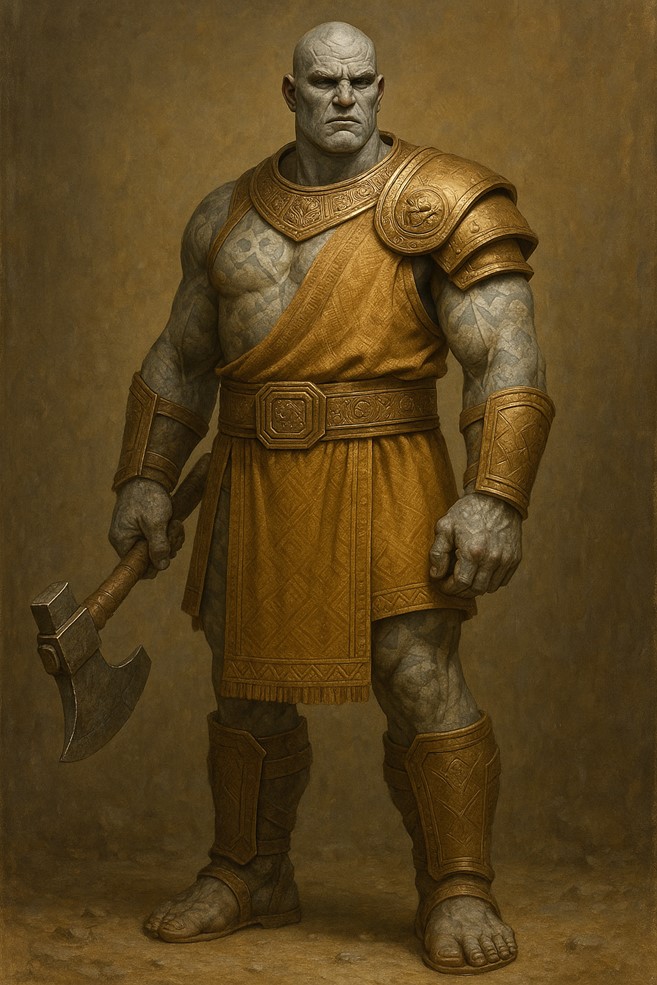
Drakurni 588 — A towering, broad-shouldered race of sentient avatars with physiques shaped by generations of stonework, bronze-forging, and ceremonial warfare. The Drakurni have become deeply woven into the political, cultural, and magical identity of Urnfield, both feared and respected as leaders, artisans, and defenders.
Physical Form & Sensory Traits:
The Drakurni stand between 2.3 and 2.7 meters tall, with mass ranging from 180 to over 280 kilograms, depending on diet and work. Their bodies are proportionally dense and muscular, with thick, mineral-infused dermal layers that harden slightly under stress. Skin tones range from granite-grey to earthen bronze, often marbled with striations resembling fired clay or etched metalwork. Eyes are typically pale amber, steel blue, or greenish slate, and have an unusually broad iris aperture, granting high clarity in low light. Their hearing is slightly diminished compared to smaller species, but compensated by exceptional bone-conduction sensitivity, allowing them to detect deep vibrations through ground, metal, or stone. Their sense of smell is acute for mineral, soil, and chemical changes—an adaptation from their centuries of mining, metallurgy, and ceramic craft.
General Size:
- Height: 2.3–2.7 m
- Weight: 180–280 kg
- Shoulder breadth: proportionally 15–25 % wider than most humanoid avatars
- Skeletal density: 1.5× standard humanoid, contributing to stability and resistance to impact
Body Pattern:
The Drakurni display unique “Urn-etch” dermal markings—natural pigmentation lines and marbling that echo Urnfield’s bronze age ceramic motifs. These markings often deepen in color during physical exertion or in high-magic weather. Hair is coarse, rarely growing beyond shoulder length, in shades of black, ash brown, or copper-red. Facial hair is thick and often styled in intricate braids bound with bronze or ceramic beads.
Life Cycle:
- Infancy (0–6 years): Slow development; skeletal plates remain slightly flexible to allow rapid growth spurts later.
- Juvenile (7–17 years): Height increases sharply; bones harden; skin striations begin to form distinct patterns.
- Prime (18–65 years): Full physical and sensory capabilities; peak endurance; ideal for leadership, warfare, or artisanal mastery.
- Elderhood (66–110 years): Strength diminishes only gradually; bones remain strong; markings fade slightly but retain symbolic value in Urnfield culture. Longevity is tied to diet rich in mineral-heavy grains and well-fired ceramic vessels.
Potential Positives from Physical Form:
- High resistance to blunt force, collapsing structures, and non-piercing projectiles.
- Exceptional load-bearing capacity; can carry significantly more gear than most humanoids without penalty.
- Low-light vision and vibration-sense make them highly capable underground, in siege defense, or in deep masonry environments.
- Bone-conduction hearing allows them to detect hidden tunnels, unstable foundations, or approaching siege engines.
Potential Negatives from Physical Form:
- Reduced agility and reaction speed compared to lighter-bodied avatars.
- Higher energy and food requirements; difficult to sustain in famine or long desert crossings.
- Poor buoyancy and swimming endurance due to mass and density.
- Vulnerable to fine, airborne toxins due to their reliance on mineral-based scent detection (lungs filter poorly against powders and vapors).
Tags: Urnkin, Giant-Blooded, Highland-Dweller, Stone-Markings, Ritual-Scarred, Mountain-Born, Bronze-Bearer, Ceremonial-Armor, Rune-Etched, Clan-Oathbound, Battle-Chant, Storm-Enduring, Hill-Fort, Ancestral-Lineage, Broad-Shouldered, Monarchy-Linked, Highland-Crafters
Specialized Item Slots Available:
In addition to standard avatar slots, the Drakurni possess:
- Shoulder Harness Slot: Designed for counterweighted war-standards, ritual pennants, or siege-tools.
- Browplate Slot: Fitted for ceremonial crests or engraved helm-plates that integrate Mind’s Eye enhancers.
- Bracer Plate Slot: Wider, reinforced forearms allow for larger attuned bracers with embedded tools or magical wards.
Environmental Adaptability:
The Drakurni thrive in temperate to highland environments, particularly where stone, clay, and metal resources are plentiful. They adapt well to mountainous terrain, fortress cities, and deep-underground chambers. Their physiology is less suited to swampy, high-humidity regions, as damp air slows the natural mineral hardening of their dermis. In magical eclipses or mana storms, their skin striations visibly pulse, making them more visible but also enhancing gear synergy.
Other Information Important to this Race:
- The ruling family of Urnfield is always Drakurni, with lineage marked not just by blood but by mastery in both metallurgy and civic oathcraft.
- Cultural prestige is tied to one’s dermal markings; the most symmetrical or intricate natural patterns are seen as omens of leadership.
- Their ceremonial duels, called “Clay Rings,” are fought in circular earthen arenas, testing strength, stability, and stamina, not just combat skill.
- Many Drakurni wear armor integrated into their cultural dress, even in peacetime, as a symbol of readiness and resilience.
Tharn of Urnkin and Stone That Sang
It is told, in the breaking voice of wind that crosses the high ridges of Urnfield, that long before the throne was of gold, it was of stone, and upon that stone sat Tharn, son of Karr, the First Broad-Shoulder. The old words are broken, bent from the mouths of many tellers, yet the bones of the tale still walk.
In the elder age, when the moon’s shadow danced wrong upon the fields and the clouds would not drink nor spill, the Urnkin tribes bickered for the little grain that rose. The hill-forts grew suspicious; each chieftain counted spears but not hands, counted grudges but not gifts. And in that time, a sound came from the high glacier of Karr-Veyr: a low hum that rolled down valleys like the memory of thunder.
Tharn was young but vast, his shoulders marked with the stone-lines of his people, each line carved by clan-elders with bronze that had tasted the hearth-fire. He was not yet crowned, yet he bore the burden of clan-oaths. He heard the glacier’s hum in his marrow and said, “This is the song that calls the true ruler.” Others heard only cold wind.
The elders warned him, “The glacier sings death to the boastful. Many who climb vanish into the white, their names unspoken so as not to call their frozen spirits home.” But Tharn said the sound was not death but longing, and longing was a thing he understood.
For seven days he walked, his feet crunching the old snow, the sky pressing close. His cloak was of woven bronze-thread and ox-hide, his boots lined with cliff-goat hair. Each night he dreamed the hum was nearer, and each morning he woke to find his breath turned silver in the air. On the eighth morning, the path vanished. He climbed on his hands, ice biting through callus, until he found a hollow in the glacier, shaped as if the hand of some forgotten god had pressed there.
Within the hollow lay a single stone, black as night-well water, warm though the air cut like knives. It pulsed with light, slow and sure, in time with the hum. Tharn placed his palm upon it and the hum became words—not words of Urnkin tongue, nor of any speech known—but the meaning was clear: “The one who would lead must be as stone, unmoving in oath yet shaping the water’s path.”
Tharn knelt there, and his knees froze into the ice. He stayed, listening to the stone’s song through a full turn of Helios. When he rose, he took the stone in both hands. It was heavy, yet not heavier than the duty he knew he would carry.
He returned to the lowlands to find the clans ready for war over barley stores. Without spear or shield, he walked into the circle of chieftains, placed the black stone upon the ground, and struck it with his fist. It rang out like a struck bell, and all the quarrel in men’s hearts drained into the air. They stood silent, for the hum had found them too.
From that day, Tharn was crowned upon the stone. His rule was said to bend no oath, to break no truth, yet to guide the flow of clan blood toward one river. And it is said that upon his death, he was set within the hollow of Karr-Veyr once more, to keep the song alive for the next who could hear.
Now, in the long halls of Urnfield, when a ruler falters, the people listen for the hum. And if it is heard, they say, “The stone calls again.”
Moral: A leader’s strength is not in the arm that strikes, but in the weight they are willing to bear, unmoved by storm yet shaping the course of many.