Magical Properties
Nahualté is a tonal and logographic language steeped in symbolic layering, with a unique magical resonance tied to its pictorial roots. While it is not a raw spellcasting tongue, trained speakers can shape its sound patterns and glyphs to subtly enhance memory recall, reinforce the will of the speaker, and imbue ceremonial objects with enduring symbolic significance. This makes it especially potent in rituals, architecture inscriptions, and ceremonial oratory. The language’s magical potency emerges from the interplay between spoken intonation and the semantic weight of its pictographs, allowing certain phrases to “anchor” intent into the physical world when inscribed or recited properly.
Linguistic Attributes & Structure
Nahualté is agglutinative and polysynthetic, meaning complex ideas can be expressed in single words built from root morphemes joined with affixes. It uses a triple aspect system for verbs (completed, ongoing, and eternal), a duality principle for conceptual balance (sun/moon, life/death, sea/land), and an honorific register for addressing deities, rulers, and ancestors. Tonal inflection changes both meaning and magical charge—rising tones imply growth or creation, falling tones imply decay or ending, and level tones imply stability or eternal truths.
Characteristics
- Syllable Shape: Primarily CV or CVC, with few consonant clusters.
- Phonetic Palette: Soft glottal stops, resonant nasals, and sharp alveolar consonants; vowels are rich and long, often paired to indicate sacred or intensified states.
- Symbolic Wordplay: Many words carry double or triple meanings depending on tone and context, a trait exploited in poetry and prophecy.
Script
Known as Tlachiglyph, the script is a hybrid of stylized pictographs, ideograms, and phonetic signs. Each glyph can represent a full concept or be combined with others to form elaborate visual sentences. Ceremonial and state inscriptions favor highly detailed pictorial glyphs in vertical columns, while everyday writing uses simplified line glyphs arranged horizontally.
Cultural Identity
Nahualté is more than a tool of communication—it is considered the lifeblood of Teotihuacán’s cultural unity. It is taught from early childhood, not only as a language but as a philosophy of seeing the world through dualities and cycles. Public rituals, market negotiations, and court proceedings all use Nahualté; to speak it fluently and tonally correct is to be recognized as part of the nation’s heart. The language is often intertwined with artistry—glyphs carved on temples, painted on pottery, and embroidered into ceremonial garments.
Speakers and Use
Approximately 148 million of the 155,168,000 residents speak Nahualté as a first language. The remainder, largely immigrant or minority communities, speak it as a second or trade language. It is the dominant administrative, religious, and cultural language, and is also recognized as a prestige tongue in several neighboring island nations.
Commonality, Type, Source, and History
- Commonality: National language, spoken in all regions of Teotihuacán.
- Type: Tonal agglutinative with symbolic layering; hybrid logographic and syllabic script.
- Source: Evolved from the trade pidgins of early city-builders, formalized into a ritual court language by temple scribes and royal decree over two millennia ago.
- History: Nahualté began as a combination of spoken ceremonial chants and carved trade glyphs, merging into a unified written and spoken system during the reign of the First Horizon King. It has absorbed vocabulary from coastal traders, highland farmers, and riverine fisherfolk while retaining its core tonal-magical structure.
Sensory Experience
Hearing Nahualté spoken is like listening to the rise and fall of waves against a hollow stone shore—tones shift with deliberate rhythm, punctuated by resonant stops and drawn vowels that seem to hang in the air. To the untrained ear, it feels like a chant even in casual conversation. Reading Tlachiglyph script is a visual journey: vibrant, interlinked symbols that invite the eye to wander and discover layered meanings. When spoken and read together in ritual, the experience can feel immersive, as if sound and symbol are weaving the world’s balance in real time.
Ceremonial Phrases and Glyph Examples in Nahualté
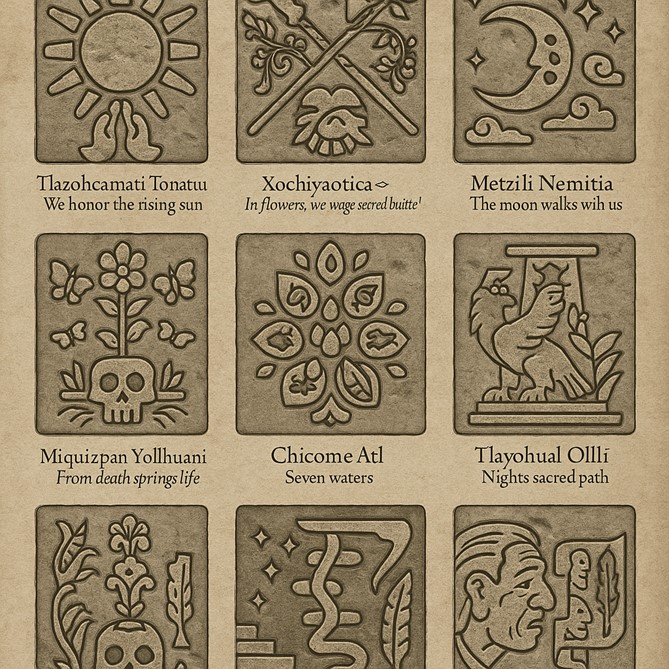
Below is a curated set of phrases used in state, religious, and cultural rites of Teotihuacán, accompanied by descriptions of their Tlachiglyph representations. Each glyph description includes the core symbolic elements, placement, and the intended magical or ceremonial resonance.
1. “Tlazohcamati Tonatiu – We honor the rising sun.”
- Usage: Spoken at dawn rituals, state openings, or military send-offs.
- Glyph: A stylized sun disc with eight radiating flame lines, overlaid with a single horizontal band representing the horizon. A small pair of clasped hands is carved below the disc to signify honor and offering.
- Magical Resonance: Invokes clarity, renewed vigor, and favor in new endeavors.
2. “Xochiyaotica – In flowers, we wage sacred battle.”
- Usage: Used in competitive ceremonies, war dances, and ritualized combat.
- Glyph: Crossed obsidian blades sprouting flowering vines, petals curling toward each point. The background is filled with small spiral clouds to indicate divine witness.
- Magical Resonance: Balances ferocity with beauty, aligning the warrior’s path with the sacred.
3. “Atl Tlamantli – All waters are one.”
- Usage: Spoken at maritime blessings, agricultural water rights negotiations, or peace treaties between river and coastal communities.
- Glyph: Three wave lines merging into a single larger wave, with an open-mouthed fish leaping through the crest. In the fish’s scales, tiny shell patterns represent different waters coming together.
- Magical Resonance: Unites disparate factions, eases negotiations, and blesses shared resources.
4. “Metztli Nemitia – The moon walks with us.”
- Usage: Night journeys, funerary rites, or blessings for travelers.
- Glyph: Crescent moon with embedded footprints curving along its inner edge, framed by stars arranged in a spiral.
- Magical Resonance: Offers guidance and protection through darkness or uncertainty.
5. “Cuauhpilli Yolotl – Heart of the Eagle Prince.”
- Usage: Coronations, declarations of war, or royal proclamations.
- Glyph: An eagle mid-dive with talons extended, clutching a glowing heart marked with dual flame and water symbols. Beneath it is a stepped pyramid to signify rulership.
- Magical Resonance: Channels courage, authority, and divine mandate into the leader’s actions.
6. “Miquizpan Yolihuani – From death springs life.”
- Usage: Agricultural planting festivals, funerals, or remembrance days.
- Glyph: A skull with a flowering stalk growing from its crown, flanked by two small butterflies (symbols of transformation). The earth beneath the skull is depicted as fertile, with roots reaching deep.
- Magical Resonance: Encourages cycles of renewal, inspires resilience in loss.
7. “Chicome Atl – Seven Waters.”
- Usage: Ceremonies for abundance, rain-calling rituals, or royal feasts.
- Glyph: Seven concentric droplets forming a flower-like shape, with each droplet containing a different water creature—fish, frog, crab, etc.—to represent diverse abundance.
- Magical Resonance: Calls forth prosperity, fruitful harvests, and favorable seasonal tides.
8. “Tlayohual Olli – Night’s Sacred Path.”
- Usage: Initiation ceremonies for priesthood or guilds; blessings before long voyages.
- Glyph: A stylized road curving upward into a starlit sky, bordered by obsidian blades and maize leaves, signifying both danger and sustenance along the way.
- Magical Resonance: Strengthens resolve and focus during trials or pilgrimages.
9. “Tonacayotl Ihuicatl – Our sustenance from the heavens.”
- Usage: Gratitude offerings for a bountiful harvest, or seasonal thanks to deities.
- Glyph: Maize stalk with kernels shaped like stars, roots entwined with clouds, and a central glyph of the rain god’s mask.
- Magical Resonance: Reinforces the bond between mortal effort and divine blessing for sustenance.
10. “Huehuetlatolli – The words of the elders.”
- Usage: Educational gatherings, law recitations, or moral guidance speeches.
- Glyph: An open mouth emitting a ribbon-like speech scroll, within which are drawn the faces of three elders. The scroll ends in a quetzal feather, signifying wisdom’s beauty.
- Magical Resonance: Imbues spoken counsel with weight, remembrance, and persuasive clarity.