
Deity Name: Ulun-Kai, the Shell that Holds the Horizon
Lore
The Tide of Ancestral Shells teaches that all living beings are shells in which the tide of existence pours, drains, and returns, just as the great coastal spirals are filled by the sea and emptied by the moon’s pull. Ulun-Kai is said to have formed the first shore from the discarded shells of ancient beings who had completed their cycles, laying them end to end until land rose from the waters. Those who walk upon the land are, in truth, still within a greater shell—one made by the deity’s own hands—and their lives are measured by the tides of fate.
Legends tell of Ulun-Kai’s twin faces: the Sheltering Tide, who nurtures the living within their shells and protects them from storm; and the Turning Wave, who strips the shell away when the tide calls it home. This duality governs not only life and death, but also cycles of power, leadership, and fortune. The people believe the deity’s breath rides upon sea winds, and their words can shape the currents of destiny if spoken in the right cadence at the water’s edge.
Personality
Ulun-Kai is neither entirely benevolent nor cruel. The deity is patient as the coral’s growth, yet implacable as the breaking wave. Ulun-Kai is deeply protective of the faithful when their shells are intact, but unhesitant to reclaim them when the tide demands. Compassion is expressed through shelter, guidance, and warning signs in the waves; judgment arrives in sudden storms and vanishing shores.
Traits and Characteristics
- Embodiment of cycles: life/death, growth/decay, calm/storm
- Speaks through ocean phenomena—wave patterns, shell shapes, tide pools
- Demands reverence for the sea and all its creatures, as they are fragments of past shells
- Honors patience, adaptability, and the ability to yield without breaking
- Believes all leaders must eventually relinquish power, just as tides retreat
Attributes
- Domain over water, wind, tidal forces, and the metaphysical “shell” of the soul
- Can grant blessings that harden one’s “shell” (body and spirit) against harm
- Can wash away corruption or memory, leaving the soul ready for its next cycle
- Holds mastery of ocean travel, granting safe passage to the worthy and leading the unworthy astray
- Associated with moon phases, which dictate the timing of major rites
Symbols
- Spiral shell (often conch or nautilus patterns)
- Moonlit tide line where wet and dry sand meet
- Interwoven wave and shell motif carved into driftwood
- Twin-tipped tide staff, representing the Sheltering Tide and Turning Wave
- String of three shells tied together: birth, life, and death
Tags
Waterbound, Tidal Faith, Cyclic Worship, Moon-Aligned, Shellcraft, Ocean-Born, Dual-Aspect Deity, Sangoan Ancestry, Coastal Rituals, Nautilus Sigil, Ancestral Currents, Shoreline Pilgrimage, Spiral Doctrine, Storm Omen, Saltwater Blessing, Driftwood Relic, Wave-Bound Oath, Moon-Shell Rite, Horizon Watch, Tide-Forged Law
Positives:
The faith reinforces community bonds through shared ceremonies, strengthens coastal defense with well-trained religious mariners, and fosters environmental stewardship over marine resources. It provides healing and protection rites linked to tides and weather, cultivates artistic expression through intricate carvings, shellwork, and song, and supports trade networks via temple-managed harbors.
Negatives:
Its leaders can wield excessive influence over maritime law, sometimes stifling innovation that conflicts with tradition. Strict adherence to seasonal rituals can delay critical decisions during emergencies. Non-adherents may be excluded from certain fishing grounds or trade routes controlled by the temple. The faith’s reliance on sea omens for governance can result in unpredictable political shifts.
Type of Temple:
Shoreline sanctuaries built on raised coral terraces, with open-air wave-halls allowing the tide to flow beneath parts of the structure. Tall shell-inlaid pillars and driftwood beams are lashed with rope and seaweed fibers, while tidal pools within the temple are used for blessings.
Number of True Followers:
Approximately 41,200,000 avatars across the nation, concentrated in coastal cities, fishing villages, and harbor fortresses.
What They Do:
True followers attend tide-mark festivals, maintain sacred harbor beacons, and participate in processions carrying carved driftwood idols to the water’s edge. Priests interpret tidal charts, wind patterns, and shell-cast lots for guidance, bless voyages with saltwater rites, and mediate disputes over fishing territories. During storms or naval threats, they coordinate ship-based defenses and call upon the deity’s favor through synchronized chants and drumbeats that echo over the waves.
Believers’ Beliefs:
Followers hold that the deity governs the eternal rhythm between land and sea, guiding the cycles of prosperity and hardship like the shifting tides. They believe the ocean is both a cradle of life and a testing ground for courage, and that each soul is weighed against the balance of giving and taking from the waters. Acts of generosity toward others, preservation of marine life, and respect for ancestral fishing grounds strengthen one’s spiritual “current,” carrying the soul safely to the afterlife’s sheltered harbor. Disrespect to the sea, greed, or wastefulness draws the soul into the “Deep Silence,” a realm of still, lightless waters.
Regular Services:
Held according to the lunar cycle, services take place at tide’s turn—dawn or dusk—when the water is in transition. Worshippers gather barefoot on the coral terrace of the temple, facing the sea. Priests open the ceremony by striking great shell-drums timed with incoming waves, then sprinkle salted water on the congregation as a symbolic cleansing. Chanted verses are accompanied by the rhythmic casting of polished shells into tidal pools, each representing a prayer or offering. Services often end with a “Catch of Honor,” where a communal meal of fresh fish or sea plants is shared, emphasizing unity and gratitude.
Funeral Rites:
For the passing of a believer, the body is wrapped in woven kelp mats, adorned with shell amulets and small driftwood carvings that depict key moments of the individual’s life. The funeral begins on land with a lament sung in rising and falling tones that mimic the tide’s pull. The body is placed upon a specially carved outrigger canoe, which is pushed to sea by family and temple attendants at high tide. The canoe is set adrift toward the horizon, guided by tidal currents, while a circle of swimmers trail behind to scatter white flower petals and crushed pearls on the waves. It is believed that the sea will either carry the soul to the sheltered harbor of the afterlife or return the body to shore if the spirit has unfinished duties.
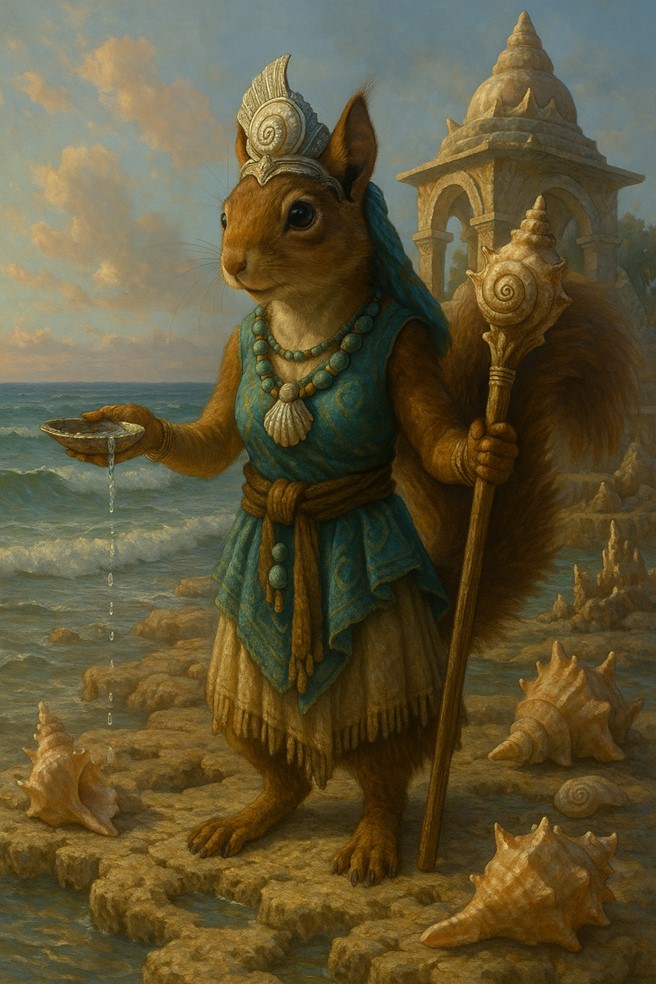
The deity of the Sangoan faith, revered as Tañaviri of the Twin Currents, grants powers drawn from the intertwined forces of still water and surging tide. These powers reflect both the tranquil preservation of life and the sudden, overwhelming force of the ocean.
Defensive Applications
• Currents of Shelter – Creates a shifting wall of shimmering water that blunts physical strikes and dampens projectiles, reducing their speed and force.
• Mist of Veiling – Summons a low-lying oceanic fog laced with divine essence, obscuring vision, muffling sound, and reducing enemy accuracy.
• Pearlskin Blessing – Hardens the skin of the faithful with a nacreous coating, deflecting blades and dispersing magical impacts.
• Undertow Pull – Reverses incoming magical or kinetic force by channeling it into a controlled, harmless dissipation into the ground or air.
• Flowbound Unity – Links allies in a divine current, sharing small amounts of damage between them to prevent a single member from being overwhelmed.
Offensive Applications
• Tidal Spear – Forms a condensed jet of high-pressure, god-infused seawater that can pierce armor or magical barriers.
• Surge of the Abyss – Calls forth a sudden wall of water to crash into enemies, knocking them prone and scattering formations.
• Saltwind Corrosion – Conjures a hot, saline wind that erodes metal, weakens bindings, and irritates exposed flesh and eyes.
• Razor Shoal – Summons a swarm of magically animated, razor-sharp shell fragments that orbit or are hurled at enemies.
• Maelstrom’s Grasp – Creates a localized spiral of water—whether from existing moisture or conjured mist—that draws enemies into a crushing vortex.
Song of Tañaviri and Twin Stones
It is told in the voice of elder-tongue, passed through mouths of wave-watchers and shell-keepers, that once in the gray time-before-time, when the shores of Sangoan were only half-shaped and the sea forgot where to end, the sky wept salt and the land drank deep. In that hollow place between land-breath and sea-breath, the One-Who-Walks-Between-Currents came from nowhere and everywhere, wearing the cloak of the moon’s shadow and the crown of coral-fire. This was Tañaviri, whose eyes were the still lagoon and whose hands were the storming tide.
In those days, the people had no anchor to hold the day, nor oar to push the night. The sea took without gift, and the land gave without care. The fish swam in the air, the trees grew in the waves, and no one knew the border between breath and drowning. The people built homes where foam kissed sand, but the tide would carry them away before the night could finish. And so they lived without tomorrow, for tomorrow was never promised.
One day—or it may have been a year, or a thousand tides—Tañaviri stepped into the water that was also the sky, and spoke to the First Fisherwoman and the First Netmaker. Words then were not as words are now, for they came like taste to the tongue or weight to the palm. The god placed before them two stones: one smooth as the lagoon’s belly, one jagged as the reef’s teeth.
“This stone,” said the god, pointing to the smooth, “is Still Water. It remembers. It keeps.”
“This stone,” said the god, pointing to the jagged, “is Surging Tide. It moves. It breaks.”
The First Fisherwoman, wishing for her nets never to be torn, took the smooth stone. The First Netmaker, longing for the sea to bring new fish, took the jagged. But the two quarreled, for one feared the stillness would starve them, and the other feared the surge would drown them. Their quarrel grew until the waves themselves listened, and the sky itself leaned low.
Seeing this, Tañaviri sighed the sigh that makes the deep groan, and took both stones back. The god struck them together, once, and from that strike came a ringing that the sea still sings on storm nights. The stones became a single form—half smooth, half jagged—and the god placed it in the hands of both, saying:
“To live is not to choose between stillness and motion, but to walk between them, as I do. One foot in the quiet lagoon, one foot in the storming surf.”
The First Fisherwoman and the First Netmaker, now bound by the stone’s weight and warmth, learned to weave nets strong enough to hold in calm and loose enough to give in storms. They taught others, and the villages began to last beyond a single tide.
It is said that Tañaviri walked the islands for many years after, unseen but felt—whenever a ship turned from storm to harbor, whenever a drought broke with gentle rain, whenever a quarrel cooled to quiet talk. In time, the god placed the Twin Stone deep in the coral caves under the island’s heart, guarded by currents that never meet.
Those who dive deep in dreams say they have seen it still—one half worn to glass, the other sharp enough to draw blood with a glance. They say the god’s reflection sits within it, waiting for the day when the people forget the lesson and need to hear the ringing once more.
Moral: In all things, balance the quiet that keeps with the change that moves, for life is the path between stillness and tide.