
Deity: Yllaqa, the Mirror of Ten-Thousand Horizons
Lore:
The Path of the Many Faces of Yllaqa speaks of a time when the Island of Recuay was not one land, but a scattering of shards adrift in a boiling sea. Yllaqa was said to walk upon each shard, taking on a different face for every shore they stepped upon—warrior, mother, hunter, healer, poet, storm-bringer—until the island knew itself as a single shape. The faithful believe that Yllaqa still wears these countless faces, shifting between them to guide or test the people. This constant change is not seen as deception but as truth: all forms, all moods, all states of being exist within one. The island’s survival is credited to Yllaqa’s mastery of adaptation, and the faith teaches that each believer must learn to embody many selves to meet the challenges of life.
Yllaqa’s myths often involve journeys to the Veil Between Faces, a shimmering horizon where identities blend and the boundary between self and world grows thin. There, the deity chooses which aspect will walk in the world next, often leaving subtle signs in weather patterns, bird calls, or the texture of light on stone to signal their current inclination.
Personality:
Yllaqa is unpredictable yet deeply protective, shifting from fierce wrath to serene gentleness without warning. They favor the clever and the adaptable, rewarding those who can change their approach as circumstances demand. While they love beauty and artistry, they are equally at home among warriors and traders, valuing the skill in each craft.
Traits and Characteristics:
- Shapeshifter of Form and Mood: Appears in multiple guises, each carrying different lessons.
- Voice in Many Tongues: Can speak as the wind, the surf, the crackle of fire, or the grinding of stone.
- Keeper of the Horizon: Symbolic master of the meeting place between opposites—sea and land, day and night, peace and war.
- Harbinger of Change: Periods of great upheaval in Recuay history are believed to mark Yllaqa’s shifting aspect.
Attributes:
- Domains: Change, Protection, Knowledge, Unity, Weather, Craft
- Preferred Offerings: Masks carved from obsidian or bone, textiles dyed in gradient patterns, vessels of mixed waters from different coasts of the island.
- Colors: Deep gold, horizon blue, volcanic black, white mist.
- Sacred Animals: Masked plover, giant river otter, serpent eagle.
- Sacred Places: Clifftop shrines facing sunrise and sunset; tide pools where freshwater springs meet the sea; volcanic ridges streaked with mineral veins.
Symbols:
- Primary: A divided mask, one half smiling, one half stern, over a horizon line where sun and moon meet.
- Secondary: A circle quartered by elemental motifs (wave, flame, gust, stone).
- Talismanic Shapes: Concentric spirals broken by sharp lines, signifying the interruption of habit by change.
Tags:
Religion, Recuay, Shapeshifter, Change, Horizon, Protection, Knowledge, Unity, Weather, Craft, Masks, Adaptation, Transformation, Sacred Animals, Tide Pools, Volcanic Shrines, Mixed Waters
Positives:
- Encourages adaptability, fostering creative problem-solving and resilience in both daily life and governance.
- Promotes unity through shared identity, even among diverse communities, by teaching that all faces belong to the same whole.
- Offers practical wisdom through Yllaqa’s shifting aspects—followers can seek guidance tailored to a specific challenge.
- Encourages artistic, craft, and trade skills, strengthening both culture and economy.
- Acts as a stabilizing spiritual anchor during periods of political or environmental upheaval.
Negatives:
- Constant change in teachings and guidance can cause confusion or factional disagreement over which “face” of Yllaqa is currently dominant.
- Opportunistic leaders may claim false revelations to justify erratic or self-serving policies.
- Some see the faith’s adaptability as moral inconsistency, especially in dealings with foreign powers.
- The shapeshifting nature of the deity can lead to mistrust from outsiders who prefer fixed doctrine.
- Ritual obligations to shift identity seasonally or during certain events can cause personal strain.
Type of Temple:
Temples of Yllaqa are Horizon Houses—open, multi-chambered structures without a single central altar. Each chamber is dedicated to a different “face” of Yllaqa, with the walls lined in masks, dyed cloth, and water basins reflecting light from open skylights. The outer courtyards are built on elevated terraces, offering a clear view of the horizon at both sunrise and sunset. Water channels run through the structure to symbolically unite the faces of the deity.
Number of True Followers:
Of Recuay’s 76,464,787 people, slightly over half (around 40,080,000) claim devotion to Yllaqa. Of these, roughly 7 million are considered true adherents—those who maintain seasonal rituals, participate in Horizon House activities, and adopt multiple ceremonial identities in honor of Yllaqa’s shifting nature.
What They Do:
- Seasonal Face Changes: Followers shift clothing, behavior, and social roles according to Yllaqa’s current aspect, announced at seasonal ceremonies.
- Ritual Maskcraft: Carving and painting masks that embody different identities; masks are worn in temple rites and destroyed or given to the sea after their purpose is complete.
- Mixed Water Offerings: Collecting waters from at least two different shores of Recuay and combining them in temple basins as a sign of unity.
- Guidance Seeking: Visiting Horizon Houses to meditate in the chamber matching Yllaqa’s current aspect for personal insight or to petition blessings.
- Horizon Watch: Groups of trained observers record unusual weather, celestial events, or animal behavior believed to indicate Yllaqa’s shifting mood.
- Public Works & Aid: Followers participate in community projects—bridge repairs, harbor expansion, relief for villages after storms—seeing such work as honoring Yllaqa’s protection aspect.
Beliefs
Followers of Yllaqa, the Many-Faced Horizon, hold that all reality is reflected in the deity’s countless aspects—each “face” showing a truth shaped by time, circumstance, and need. No single face is absolute; truth shifts like light over the sea. Yllaqa is believed to watch over Recuay’s people from the horizons, changing form to meet them in times of need—protector in storms, trader in times of bounty, warrior in defense, and quiet mourner in loss. Believers view personal adaptability as sacred, considering inflexibility a sign of spiritual blindness. The horizon itself is seen as a liminal boundary where change becomes possible, and it is honored as Yllaqa’s eternal dwelling.
Regular Services
Services occur in the Horizon Houses at dawn and dusk, marking the moments when Yllaqa’s faces are most likely to turn. Each service is led by a Facecaller, a priest who dons a mask representing the current dominant aspect. The service begins with the Chant of Shifting Waters, a slow, wave-like vocal pattern meant to mirror the tides. Worshippers move between chambers during the service, touching water basins, reciting short prayers, and presenting offerings relevant to the active aspect (woven goods for the artisan face, dried fish for the provider face, weapons or shields for the warrior face). Between seasons, the active chamber changes, and masks from the previous cycle are either ceremonially destroyed or placed into storage until the aspect returns.
Funeral Rites
When a follower dies, the body is first washed with waters collected from two different coastal points, symbolizing the meeting of life’s beginning and end. The deceased is dressed in garments of the current seasonal aspect and given a mask carved to represent Yllaqa’s Face Beyond Horizons, which is never used in life. The funeral procession moves from the home to the Horizon House, then to a chosen shore. There, the body is committed to the sea in one of two ways:
- Sea Interment: The body is wrapped in weighted sailcloth, lowered beneath the waves during the tide’s turning.
- Crest Release: The body is placed in a shallow vessel adorned with masks and lit lanterns, allowed to drift to the horizon before it sinks or burns away.
At both, the Final Horizon Chant is sung by the mourners—its verses deliberately slow and uneven, to represent Yllaqa’s unpredictable shifting. Survivors believe the soul travels beyond the visible horizon to join the deity in one of the unseen faces, awaiting its next cycle.
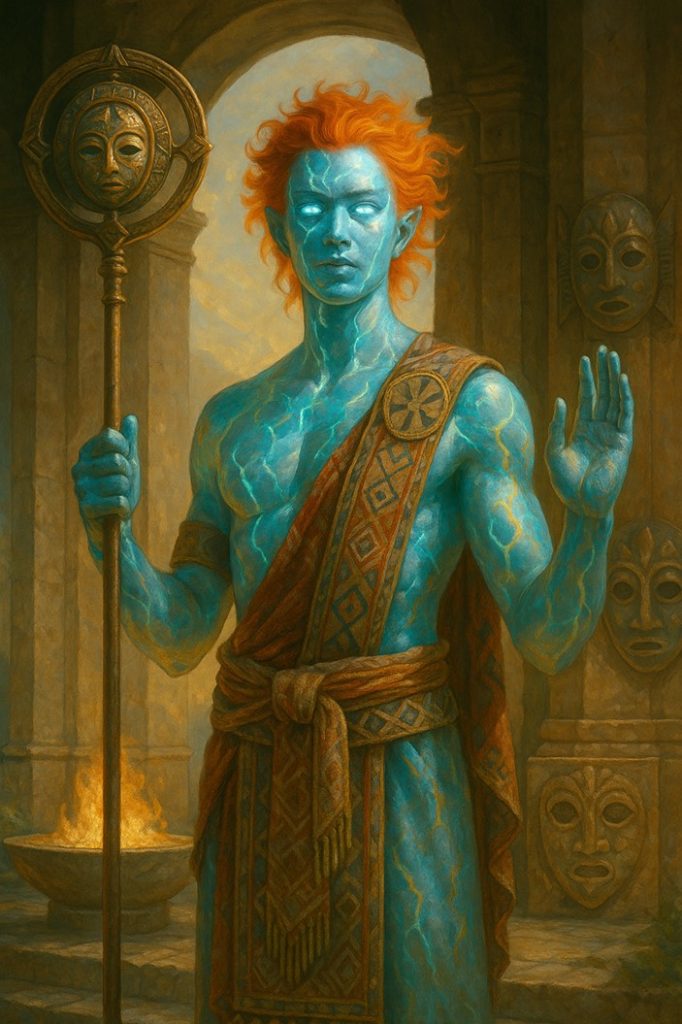
The deity of Recuay, Xalliq Illapa, embodies the confluence of mountain guardianship and tempestuous change, granting believers magic that channels stone’s endurance and storm’s ferocity. The god’s favor manifests through relics, ceremonial conduits, and devotional rites—never as innate gifts—so its power depends entirely on the items worn or carried by the avatar.
Defensive Uses
• Earthen Aegis: Gear infused with Xalliq’s essence can manifest momentary walls of living stone, shielding allies from missile fire or absorbing blunt force.
• Tempest Veil: In battle, sacred gear may call up wind-laden mist that blurs the sight and dampens sound around allies, disrupting ranged targeting and stealthing movement.
• Seismic Ward: Foot-bound relics can anchor the wearer to the ground against pushes, knockdowns, or magical displacement.
• Thunder’s Warning: Amulets may emit controlled, deafening thunderclaps to stagger enemies before they strike.
Offensive Uses
• Bolt of the Horizon: Gear blessed by the god can store a single, devastating arc of lightning, released when the wielder strikes or gestures at a foe.
• Avalanche Surge: Staffs, hammers, or other grounded conduits can send a shockwave through earth or stone, toppling unstable terrain or throwing opponents off balance.
• Cyclone Lash: Robes or cloaks empowered by ritual may conjure concentrated spirals of wind that buffet, disarm, or even lift enemies off their feet.
• Illapa’s Cry: Through horn or drum conduits, the god’s storm-voice can be unleashed to shatter brittle structures or rupture magical wards.
The balance of Xalliq Illapa’s gifts follows the god’s dual nature—protecting the faithful like the mountain’s roots, yet striking foes like a storm breaking on a high ridge.
Storm That Sat Upon the Mountain
In the days before the ridges learned the weight of snow, and before the rivers found their beds, the people of the high stone plains tell that the god Xalliq Illapa walked not in sky, but in shadow of valleys. The stones were young then, still warm from the world’s first fires, and the clouds feared to rest on peaks.
It is said the god took shape like man but bore a crown of rock faces, each with its own expression—joy, sorrow, anger, calm. His cloak was stitched from lightning, each thread humming with the voices of the storms yet to be. When he stepped, the earth sank, and when he breathed, the air tasted of copper rain.
The people then lived without roofs, trusting the openness of sky, for they believed no harm could come if they stayed in the god’s gaze. But a season arrived when the sky went black without thunder, and a whisper-cold wind came that carried no scent of rain. The elders called it the Silence Between Heartbeats, and they feared it meant the god’s eyes had closed.
One hunter, whose name is remembered differently in every telling—some say Qina, others Illav—climbed to the god’s resting cliff. There he found Xalliq Illapa seated upon a throne of unmoving cloud. The god’s many stone faces were still, and the lightning threads of his cloak hung dark. The hunter asked, “Why do the storms not walk, and why does the mountain not speak?”
The god answered in a voice like two stones grinding, “The rivers forget their course, the winds forget their names, and the people forget to listen. I will not walk until the ground remembers my tread.”
The hunter, hearing this, returned to the valleys and told the people to mark the earth with the god’s name. They carved spirals and lines in cliff and plain, each stroke done during breath-holding silence so as not to lose the god’s memory to idle words. But carving alone did not wake the storms.
So the hunter went again to the high cliff, bringing in his hands the first offerings: a bowl of river water taken where three streams meet, a handful of soil from where the mountain’s shadow ends at sunset, and a spark struck at midnight. He placed these at the god’s feet and said, “These are what remember you: water that seeks, earth that waits, and fire that arrives sudden.”
Xalliq Illapa took the bowl, the soil, and the spark, and pressed them into the folds of his lightning cloak. The threads began to glow, dim at first, then fierce as noon sun on ice. His stone faces shifted—joy on one, sorrow on another, wrath on the third, and calm on the last—and he rose.
When the god stood, his shadow stretched across all valleys at once, and his breath became the first storm of remembrance. Rain fell in sheets, wind bent the trees flat, and the mountains groaned like waking beasts. The people sheltered beneath rock ledges and in the hollows of carved walls, and for three days and nights the god walked the land, pressing his tread back into the earth’s memory.
When the storm ended, the rivers sang louder, the winds called their own names, and the mountain peaks wore crowns of white for the first time. The god returned to his cliff, but his eyes stayed open. He told the hunter, “Each year, when the shadows lengthen and the rivers slow, the people must bring water, earth, and spark to the high places, or again the storms will sleep.”
Since that time, the followers of Xalliq Illapa climb to the highest stones before the harvest’s end, bearing bowls, soil, and sparks hidden in lidded jars. They place them in the god’s image—carved into cliff or etched upon temple floor—so that the storms may remember to walk.
Moral: The world forgets those who do not remind it, and even the strongest mountain must be spoken to lest it think itself alone.