
The Alarians are a race of warm-blooded, avian humanoids. They are the marginally predominant race in the Major Island Country of Perigordian, constituting approximately 58% of the nation’s total population of 60,262,621 individuals. This means the Alarian population within the nation numbers around 35 million. They form the core of Perigordian society and its aristocracy, with the nation’s ruling family, House Vézac, being of pure Alarian lineage.
Physical Form and Sensory Traits
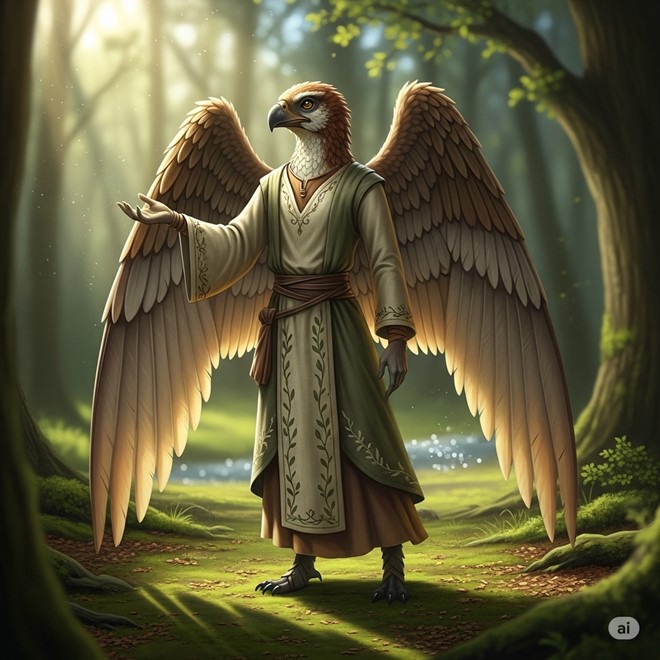
An Alarian possesses a slender, humanoid torso, arms, and legs, but their most defining feature is a pair of large, feathered wings that sprout from their shoulder blades. These wings are fully functional biological structures, not magical appendages, and grant the Alarian the power of natural flight. Their skeletal structure is composed of hollow, pneumatized bones, internally reinforced by a lightweight, crisscrossing strut matrix that provides exceptional strength relative to its low weight.
Their arms are distinct from their wings and end in fine-boned hands with three long fingers and an opposable thumb, granting them the dexterity needed for tool use, writing the intricate Pétric script, and manipulating the components of their gear. Their legs are muscular and end in digitigrade feet, equipped with sharp talons. While formidable, these feet are also adapted for walking and running on flat surfaces.
The head is distinctly avian, with sharp, elegant features, large eyes, and a hard, beak-like rostrum that replaces a conventional mouth and nose. This beak is strong yet surprisingly dextrous, allowing Alarians to articulate the melodic nuances of the Périgordian tongue and consume a varied omnivorous diet.
Their sensory capabilities are highly advanced. Vision is their most dominant sense; their eyes contain a higher density of photoreceptor cells and multiple foveae, granting them visual acuity far exceeding that of most other races. They can discern fine details from kilometers away and perceive a broader spectrum of light, including ultraviolet wavelengths. This allows them to see otherwise invisible patterns in the natural world, such as the trails left on flowers by nectar-feeding insects. Their hearing is similarly acute, especially in the higher frequency ranges, making them excellent at detecting subtle sounds like the rustling of hidden creatures.
General Size
Alarians are notable for their height and slender builds. An adult male typically stands between 1.8 and 2.1 meters tall, with females being slightly shorter, averaging 1.7 to 2.0 meters. Despite their height, their hollow bones make them remarkably light, with most adults weighing between 40 and 55 kilograms. Their wingspan is the most impressive measurement, generally extending 1.5 to 2 times their height, resulting in a span of 3.5 to 4.5 meters.
Body Pattern
The plumage of an Alarian is a primary expression of their lineage, individuality, and social standing. Feather coloration and patterns vary immensely across the population. Some families exhibit the muted, earthy tones of owls and falcons—creams, browns, and mottled grays that allow for camouflage in the rocky highlands of Perigordian. Others display the vibrant, iridescent jewel tones of hummingbirds or kingfishers, with feathers that shimmer with metallic blues, greens, and purples.
The ruling family, House Vézac, is distinguished by its regal plumage, which resembles that of a golden eagle: a body of rich, dark brown feathers with a mantle of brilliant gold feathers covering their head and neck. Patterns such as spots, bars, and stripes are common and are considered markers of beauty. Alarians are known to practice a form of personal art by meticulously grooming, and sometimes dyeing, their feathers for ceremonies and festivals, or embedding them with small, lightweight pieces of jewelry.
Life Cycle
Alarians are oviparous, hatching from large, hard-shelled eggs that are typically laid one or two at a time. Nests are complex structures, often built on high cliffs, in the spires of their cities, or in the boughs of massive trees. The incubation period lasts for approximately 60 days. An Alarian fledgling, known as an “aiglet,” hatches covered in a thick layer of soft downy feathers and is entirely dependent on its parents. Growth is rapid; they learn to stand and walk within a few weeks. The most significant milestone is the first flight, or “fledge,” which typically occurs around the age of 10. They are considered socially and physically mature by age 18 and have an average lifespan of 80 to 100 years.
Potential Positives and Negatives of Physical Form
Positives:
- Flight: Unpowered, natural flight is their greatest asset, granting them unmatched mobility, a crucial tactical advantage, and the ability to live and build in otherwise inaccessible vertical environments.
- Superior Vision: Their keen eyesight makes them exceptional scouts, lookouts, and hunters, able to perceive threats and opportunities long before other races.
- Agility: Their lightweight build translates to remarkable grace and agility, even when on the ground.
Negatives:
- Fragility: Their hollow bones are more susceptible to breaking from heavy, blunt-force impacts compared to the solid bones of other races.
- Spatial Constraints: Their large wings can be a significant hindrance in confined spaces. Navigating narrow dungeon corridors, dense forests, or crowded city streets can be awkward and difficult.
- Vulnerability to Weather: High winds, heavy rain, and magically generated storms pose a serious threat to an Alarian in flight, potentially leading to forced landings or injury.
Tags: Avian Humanoid, Feathered Wings, Natural Flight, Hollow Bones, Superior Vision, Beaked, Talons, Lightweight, Agile, Oviparous, Perigordian, High-Altitude Dweller, Vertical Society, Artistic Culture, Sophisticated, Ruling Class, Avatar
Specialized Item Slots Available
The unique anatomy of the Alarians allows them to utilize gear slots that are unavailable to other avatars.
- Talon Sheaths (Feet Slot): These are not boots but custom-fitted magical guards that cap their talons. These specialized items can be enchanted to harden the talons for combat, provide a magical grip on sheer surfaces, or discharge elemental energy upon a successful strike.
- Wing Braces (Back Slot): This slot is specifically designed for items that integrate directly with their wings. Standard cloaks and backpacks cannot be used with this gear. Wing Braces can include aerodynamic enhancements for increased flight speed, lightweight articulated armor plates to protect the wings, or resonant crystals that passively gather ambient magic as they fly.
Environmental Adaptability
Alarians are masters of high-altitude environments. Their physiology is perfectly suited for life in mountains, on cliffsides, and within the towering spires of their cities. They are most comfortable in temperate climates. Due to a lower percentage of body fat, they are poorly adapted to extreme cold and must rely on gear or their own thick down feathers for insulation. They are fundamentally uncomfortable and at a disadvantage in subterranean or aquatic environments, where their flight is rendered useless and their vision is less effective.
Other Information
Alarian culture is deeply shaped by the concept of flight, which informs their philosophy, art, and architecture. They value perspective, freedom, and a “higher view” of things, both literally and figuratively. Their cities are vertical marvels, featuring soaring towers connected by bridges, open-air roosts instead of enclosed rooms, and wide balconies for launching into the sky. Social status is often tied to altitude, with the most powerful and wealthy living at the highest points of a city. As their hands are free during flight, they have perfected combat styles that involve aerial archery and the use of gear that can be activated and aimed from above.
Grounded Wing and Soaring Eye
It is told, from the texts of the First Spoken Histories, that there was a time before the High Perch, a time before the Wind-Roads were known. In this age, the first of the Alarians dwelled within a great stone bowl, a valley whose sheer walls touched the underside of the World’s Ceiling. They were as they are now, with hands to shape and feet to walk, and great feathered cloaks upon their backs which were called wings. Yet they did not know them as such. These wings were a burden, cumbersome and heavy, and were for naught but to show the patterns of one’s lineage.
They were a people of the ground. Their eyes, though sharp, were taught to look down, to find roots and catch small crawling things upon the valley floor. The great open space above them, the Ceiling, was a thing of terror, a Void of featureless blue or impenetrable black. To look upon it for too long was to invite Void-madness, a sickness of the soul that made one forget the feel of solid stone beneath the talon. They were the Grounded, and the ground was their truth.
Among them was one whose feathers were the color of twilight, and she was called Alia. But her soul was not of the ground. Her eyes were not content with roots and stones; they were drawn upward to the Ceiling. She watched the mindless flying things, the beetles and the small birds, as they danced in the Void, and a question grew in her heart like a seed. Why was her body given this great feathered burden, so like the tools used by the small birds, if her place was the dirt? This question she spoke aloud, and the Elders chastised her. They said she had the beginnings of Void-madness, that her soul was becoming unmoored from the truth of the stone.
With her was Vez, whose feathers were the color of the steadfast rock. He was bound to Alia by the weaving of their lineages, and he feared for her. He would plead, saying, “The ground is our mother and our father. It gives us sustenance and holds us from falling into the terror. Why do you look away from it? The Ceiling has offered nothing but false light and the howling of wind.”
But Alia would not be swayed. She began her madness in truth. She would climb the low boulders at the edge of the valley, her great wings catching on thorns. From these low heights, she would leap, beating the air with her feathered burden in a clumsy panic. She would fall, always, tumbling into the dust and the scorn of her people. They called her the Wing-Broken, the Dancer for the Void.
Vez watched her folly with a heart split in two. He saw the foolishness and the danger, yet he also saw the fire in her eye that was brighter than any root or stone. Secretly, he would follow her, clearing the sharpest rocks from where she might fall, his own soul troubled by a question he dared not speak.
Alia, seeing that the low rocks were not enough, set her gaze upon the Great Tooth, the tallest spire of the valley wall, a needle of stone that was said to scrape the very Ceiling. It was a forbidden place, a place where the wind howled its madness without cease. She said to Vez, “The ground cannot teach me. I must ask the wind itself. I will climb the Great Tooth and leap into the heart of the Void. It will either take me, or it will answer me.”
Vez was seized by terror. “That is not a question,” he cried. “That is a final statement. The wind will dash you against the stones. The Void will swallow you whole.” But her twilight feathers were already gone, a speck moving up the ancient rock face.
Driven by a fear that overcame his fear of the heights, Vez followed. He climbed as his people had never climbed, his talons finding holds his eyes could barely see. The wind pushed at him, whispering the lies of the Void. And as he climbed, a storm, born of the world’s high magic, gathered about the peak. Rain fell. The rock became slick.
He reached the summit of the Great Tooth and saw Alia standing at the very edge, a silhouette against the churning gray Ceiling. The wind tore at her, whipping her great feathered cloak about her. Before he could speak her name, a fist of wind, a gale of immense power, struck the peak. It lifted Alia from her feet and threw her out into the open terror of the Void.
Vez cried out in despair. But she did not fall.
In that moment between the stone and the unforgiving air, Alia did not fight. She did not beat her wings in clumsy panic. She remembered the small birds, how they did not beat the wind but accepted it. She spread her arms, she spread her great wings, she made herself a vessel. And the wind, finding this new shape, caught her. It held her. Her plummet became a glide.
From his perch on the Great Tooth, Vez beheld a miracle. Alia was not falling into the Void; she was sailing upon it. And a strange thing happened. His eye was given the sight of her eye. Through her, he saw the world not as a wall of rock and a floor of dirt, but as a map. He saw the entire valley, the great stone bowl, laid out at once. He saw the river like a silver serpent, the forests like patches of moss. He saw the patterns he had never known, for his gaze had always been too low. He saw truth.
With a cry that was not of fear but of sudden, blinding understanding, Vez leaped from the peak. He did not have Alia’s practice, only her revelation. He spread his wings, clumsy but wide, and trusted the unseen road of the wind. The Void caught him. It held him. He fell, then drifted, then soared.
Together, they learned the wind’s language. They tilted their wings to climb the warm breaths of air rising from the valley floor. They saw that the Ceiling was not a ceiling at all, but a space without end. They flew beyond the Great Tooth, beyond the valley itself, and were the first to see the Endless Water that surrounded their land.
When they returned to the Grounded, they did not walk into the valley. They descended from the sky like twin gods, their shadows gliding over the people before their talons touched the stone. They brought not tales of terror and Void-madness, but a new truth. The wings were not a burden to be carried on the ground, but a gift to carry oneself through the sky. The sky was not a void to be feared, but a home to be explored.
Moral: For the eye that sees only the dirt at its feet is blind to the truth of the world, but the wing that trusts the unseen wind will grant sight of all things.