
Original Life Forms — This creature is a feral amalgamation of four distinct life forms from different classes of the Animalia Kingdom:
Class Mammalia: Honey Badger (Mellivora capensis)
Class Reptilia: Jackson’s Chameleon (Trioceros jacksonii)
Class Insecta: Bombardier Beetle (Brachininae)
Class Cephalopoda: Cuttlefish (Sepia officinalis)
Appearance
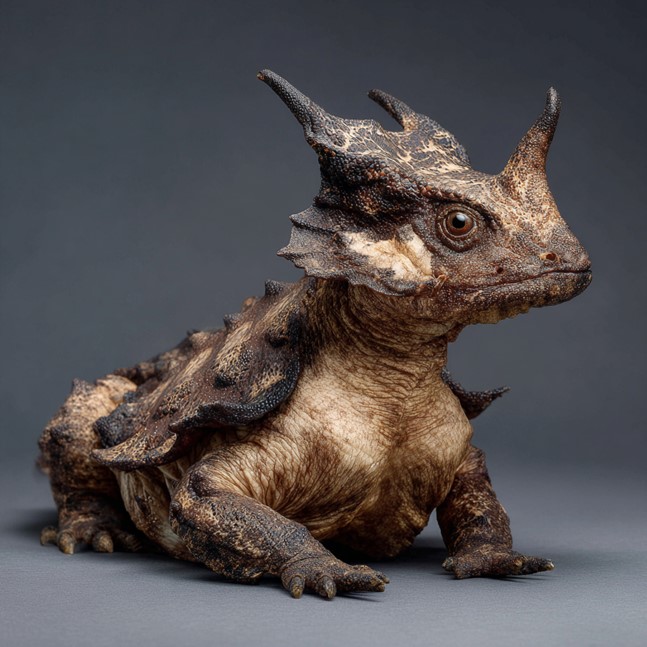
The Tricornis Mellisepia is a bizarre and formidable predator. It has the low-slung, powerfully built body of a honey badger, covered in thick, loose hide. However, this skin is not furred; instead, it is a complex layer of chromatophores, iridophores, and leucophores inherited from its cuttlefish ancestry. This allows the creature to change its color, pattern, and even skin texture with near-instantaneous speed, blending perfectly into its surroundings or flashing hypnotic, pulsating patterns to intimidate rivals. Its head is distinctly reptilian, resembling a Jackson’s Chameleon, complete with turret-like eyes that move independently and three prominent horns—two above the eyes and one on the snout. Its rear tapers into a hardened, chitinous abdomen like that of a beetle, ending in a flexible, aimable nozzle.
Size
The creature is heavily built for its height. It stands about two feet tall at the shoulder but is nearly four feet long from its horned snout to the tip of its abdomen. It typically weighs between 50 and 75 pounds of dense muscle and chitin.
Speed
It moves with the relentless, rolling trot of a badger. It is not a sprinter, but it possesses incredible stamina and can maintain its pace over long distances. Its true advantage is not speed but the element of surprise afforded by its camouflage.
Stat Modifiers
- Constitution: Very High
- Strength: High
- Dexterity: Moderate
- Wisdom (Perception): High
- Intelligence: Low (Cunning, not sapient)
- Charisma: Very Low
Skills
- Stealth: Masterful. Its active camouflage makes it nearly invisible when stationary or moving slowly.
- Survival: Exceptionally skilled at finding food and shelter in harsh environments. Its hide makes it resistant to toxins and physical damage.
- Intimidation: When it chooses to be seen, it can flash terrifying color patterns and display its horns aggressively.
- Perception: Its independently moving eyes give it a nearly 360-degree field of vision, making it extremely difficult to ambush.
Behavior
The Tricornis Mellisepia is a solitary and intensely territorial creature. It actively patrols a wide territory, marking it with a pungent chemical scent. It is notoriously aggressive and will attack creatures much larger than itself without hesitation if it feels its territory is threatened. It hunts using ambush tactics, blending into the landscape and waiting for prey to wander close before launching a ferocious assault with its claws and horns. If a fight turns against it, it employs its beetle-like abdomen to spray a boiling, noxious chemical concoction at its attacker, using the painful and disorienting cloud to cover its escape.
Diet
Strictly carnivorous. Its diet consists of anything it can overpower, including burrowing creatures, large reptiles, and the young of much larger beasts. Its powerful claws are capable of tearing open tough hides and digging prey from the earth.
Emotions
Its emotional range is limited and primal, dominated by territorial aggression, predatory hunger, and a deep-seated fearlessness that borders on psychosis. It does not form bonds and views all other living things as either a threat or a meal.
Environment Where Found
It thrives in rugged and desolate environments that offer plenty of cover. It is most commonly found in the arid badlands, rocky foothills, and scrub-choked canyons of the Mycenaean Central Range. It makes its lair in shallow caves or by digging out complex burrows beneath large rock formations.
Tags: Feral, Amalgamation, Carnivore, Territorial, Solitary, Ambusher, Horns, Claws, Active Camouflage, Chemical Defense, Fearless, Badlands Predator, High Stamina, Low-Slung, Armored Abdomen, Independent Eyes, Tricornis Mellisepia
Life Cycle
The life cycle of a Tricornis Mellisepia is solitary, violent, and grim. After a brief and aggressive mating, the female digs a deep, multi-chambered burrow and lays a clutch of 3-5 tough, leathery eggs. She then abandons the nest entirely. The eggs incubate for several months, and the hatchlings emerge already equipped with their basic survival instincts. Sibling cannibalism is the norm, with the strongest hatchling typically consuming the others within the first few days, ensuring only the most formidable individual survives. This lone pup is independent from birth, relying on its nascent camouflage to hide and scavenge until its skills and weapons are fully developed. They reach sexual maturity and full size in approximately two years, at which point they are driven by instinct to find and claim a territory of their own. Most die violently long before old age, either in territorial disputes or by taking on prey that is too powerful.
Mating
Mating is the only event that overrides the species’ innate solitude and aggression, and only for a short time. Once a year, for a period of a few weeks, females emit a potent chemical signature that males can detect from miles away. Drawn by this scent, males will converge on the female’s territory, fighting each other viciously along the way. The final courtship between the victorious male and the female is a tense and dangerous display of flashing chromatophores, guttural hisses, and posturing with horns. After a brief and violent coupling, their instinctual aggression returns, and the female will savagely drive the male from her territory before beginning the nesting process.
Tactics
The Tricornis Mellisepia is a master of ambush and attrition, employing a range of tactics depending on the situation.
- Camouflage Ambush: Its primary hunting strategy is to use its cuttlefish-like skin to blend perfectly with its environment. It will lie in wait for hours, appearing as nothing more than a rock or a patch of scrub, until prey wanders into striking distance.
- Intimidation Display: When confronting a potential threat or rival, it will first attempt to intimidate. It does this by flashing hypnotic, black-and-white patterns across its skin, lowering its horned head, and emitting a deep, threatening hiss. This is often enough to scare off less determined creatures.
- Ferocious Assault: Once it commits to an attack, it is a whirlwind of violence. It uses its powerful, low-slung body to charge in, goring with its three horns and tearing with its heavy claws. It does not employ complex maneuvers, instead relying on overwhelming, relentless aggression to subdue its target.
- Chemical Deterrent: The boiling chemical spray from its abdomen is a weapon of last resort. It is used when the creature is seriously wounded or when facing an overwhelmingly powerful foe. The goal of the spray is not to kill, but to cause extreme pain and confusion, allowing the Tricornis to escape and survive.
Actions
In a combat scenario, the Tricornis Mellisepia might utilize the following actions:
- Multiattack: The Tricornis makes two attacks: one with its Horns and one with its Claws.
- Horns: A melee weapon attack. On a hit, it deals piercing damage.
- Claws: A melee weapon attack. On a hit, it deals slashing damage.
- Active Camouflage (Bonus Action): The Tricornis alters its skin’s color and texture to match its surroundings. It has advantage on Stealth checks made to hide in that terrain until it moves or takes another action.
- Chemical Jet (Rechargeable): The Tricornis ejects a 15-foot cone of boiling, noxious chemicals from its abdomen. Each creature in that area must make a Constitution saving throw. On a failed save, a creature takes significant acid and fire damage and is blinded for one minute. On a successful save, the creature takes half as much damage and is not blinded.
- Unyielding Ferocity (Reaction): When the Tricornis takes damage from a creature it can see, it can use its reaction to move up to its speed toward that creature and make a single Horns attack.
Other Interesting Information
- Alchemical Value: The paired glands that produce and store the creature’s chemical spray are highly sought after by alchemists. They contain unique biological catalysts that can be used to create incredibly potent acids, solvents, or explosive compounds, making the dangerous task of hunting one potentially very lucrative.
- Lair Contents: While they do not hoard treasure, their deep burrows are often littered with the indigestible remnants of their meals. This can include pieces of armor, discarded gear, and rare metallic components from unfortunate avatars or magical beasts that have fallen prey to them.
- Skin Language: The complex, shifting patterns on the creature’s skin are a form of proto-language. While mostly used to display aggression or camouflage, a skilled observer could learn to discern specific patterns that indicate fear, curiosity, or the presence of a potential mate.
- Extreme Resilience: Its honey badger ancestry grants it a legendary toughness. The Tricornis Mellisepia is highly resistant to most forms of mundane poison and venom, and its thick, loose hide makes it difficult to damage significantly with piercing or slashing attacks.
Adventurers in the world of Saṃsāra would cross paths with a Tricornis Mellisepia for a number of reasons, ranging from accidental encounters in the wild to deliberate, high-stakes hunts.
Accidental Encounters
These feral creatures are aggressive, territorial, and masters of ambush. A party wouldn’t need to be looking for trouble to find it.
- Territorial Trespass: The most common reason for an encounter is simply travel. A party journeying through the arid foothills or rocky badlands of Mycenaean might unknowingly wander into a Tricornis’s territory. The creature, viewing the adventurers as a threat, would not hesitate to attack. The encounter would likely begin with a sudden, violent ambush from a seemingly empty landscape as the camouflaged beast reveals itself.
- Stumbling Upon a Lair: While seeking shelter from a storm or resting for the night in a cave system, a party could accidentally disturb a Tricornis’s lair. This would result in a desperate fight in close quarters as the creature furiously defends its home.
- Collateral Damage: Adventurers might be tracking another beast or fleeing from a different threat, only to run directly into the path of a hunting Tricornis. The creature would see the commotion as an opportunity for a meal or a reason to attack, adding a chaotic new element to an existing conflict.
Deliberate Searches and Hunts
Given the danger, adventurers would only seek out a Tricornis Mellisepia if the reward outweighed the considerable risk. Several quests could lead them on such a hunt.
- The Alchemist’s Bounty: The paired glands that produce the creature’s boiling chemical spray are a rare and potent alchemical component. A powerful guild of artificers or a master alchemist in a major city might post a handsome bounty for the “Caustic Scent Glands” of a Tricornis. They would be needed to craft exceptionally powerful acids, explosive devices, or catalysts for high-tier enchanting.
- The Pest of the Peaks: A mining consortium or a remote settlement on the edge of the badlands could hire the party for extermination. A Tricornis can be a menace to such operations, attacking pack animals, ambushing miners, and collapsing tunnels with its burrowing. The adventurers would be tasked with hunting the creature down and eliminating it to secure the region.
- A Trial of Mettle: For certain warrior lodges or monster-hunting guilds, reputation is everything. To prove their worth, prospective members might be tasked with bringing back a trophy from a notoriously fierce creature. A quest could be issued to secure one of the three horns from a Tricornis’s head—a feat that proves the adventurer can face down one of the most ferocious and resilient predators in the known world.
- The Camouflage Secret: A master artisan or a military strategist might want to replicate the creature’s active camouflage. They could hire the adventurers not to kill the beast, but to perform a much more dangerous task: acquire a live, undamaged sample of its chromatophore-rich hide. This would require the party to track, trap, and subdue the creature without killing it, a monumental challenge given its aggressive nature.
- Rescue and Recovery: A prospector, traveler, or village youth may have gone missing in the canyons, with tracks leading into the known lair of a Tricornis. The party would be hired for a rescue mission, forcing them to navigate the creature’s territory, potentially enter its burrow system, and confront the beast to save the missing person or recover their valuable gear.
Beyond the trophy horns and valuable Caustic Scent Glands, a skilled harvester with the right tools can gather several other unique and useful components from the corpse of a Tricornis Mellisepia.
Shifting Hide
This is the complex, chromatophore-laden skin of the creature. It is difficult to harvest and tan properly, as it can lose its unique properties if mishandled.
- Use: When correctly processed by a master leatherworker, the Shifting Hide can be crafted into cloaks, armor padding, or gear coverings. While the leather no longer provides perfect active camouflage, it retains a latent ability to subtly alter its color and texture. An avatar wearing a Cloak of Shifting Hide would find it easier to blend into shadows or natural environments, granting a notable bonus to Stealth. High-tier artisans can weave magic circuits into the hide to create gear that allows for more significant, controlled color changes.
Twin-Focus Lenses
These are the complex, crystal-like lenses harvested from the creature’s independently moving turret-eyes. They are small, dense, and have a peculiar optical quality.
- Use: An artificer or jeweler can grind these lenses and set them into helmets, goggles, or specialized monocles. A piece of headgear fitted with a Twin-Focus Lens grants its wearer an expanded field of vision and an enhanced ability to track multiple moving targets at once. This provides a significant advantage in combat, making it much harder for enemies to gain a flanking advantage, and offers a bonus to Perception checks.
Blast Shield Chitin
This is the hardened, multi-layered plating from the creature’s beetle-like abdomen. It is naturally resistant to extreme heat and corrosive substances.
- Use: This thick chitin can be carefully removed and shaped into a lightweight but remarkably durable buckler or shield. It can also be incorporated as a central plate on heavy armor or gauntlets. Any shield or armor reinforced with Blast Shield Chitin grants the user enhanced resistance to fire and acid damage.
Resilient Heart
The heart of a Tricornis Mellisepia is a dense, fibrous organ responsible for pumping its toxin-resistant blood. It continues to pulse with a faint energy for a short time after the creature’s death.
- Use: This organ is a key component in powerful alchemical and enchanting rituals. An alchemist can render it down to create a Potion of Unyielding Vigor, a potent elixir that can grant temporary resistance to poison and a burst of stamina. For enchanters, the heart is a required material component to permanently bestow poison resistance upon a piece of armor or an amulet.
Vibrational Cuttlebone
Deep within the creature’s body lies a porous, surprisingly lightweight internal shell, analogous to a cuttlebone. Its internal structure is a bizarre crystal-matrix lattice that is exceptionally good at absorbing and dampening kinetic energy.
- Use: When ground into a fine powder, Vibrational Cuttlebone can be mixed into mortar or metal alloys used in construction, reinforcing structures against earthquakes or siege weaponry. When a solid piece is incorporated into the padding of armor or the sole of a boot, it provides the wearer with resistance to thunder damage and lessens the impact of long falls or concussive blasts.
Folly of Astyages
It is told on tablets of cracked clay, found in a place of ruin, of a time before the Great Fracture. In this time, the memory of Lycomedes was strong, but the lessons of his victory were misunderstood. There was a man, Astyages the Curious, a shaper of flesh and a knower of alchemies. His mind was a sharp tool, but his wisdom was a cracked cup; it could not hold the truth.
Astyages looked upon the works of the world. He saw the beast of honey, whose rage was a shield against all harm. He saw the chameleon of the rocks, whose eyes saw all things at once and whose horns were a warning. He saw the soft thing of the sea, the cuttlefish, whose skin was a living map of lies, a perfect camouflage. And he saw the beetle of the dust, whose belly held a fire of bitter chemicals.
In his pride, Astyages thought, “These are but pieces of greatness. Why should a creature have only one strength? I will be as the gods are said to be. I will not merely forge gear to place upon a body. I will forge a body to be the ultimate gear.” This was his folly. He did not seek to build a foundation of order; he sought to stitch a quilt of chaos and call it a perfect blanket.
He went into the badlands, far from the Foundries and the disapproving eyes of the Keepers of the Depth. He built a laboratory in a hidden canyon. He used gear of a forbidden resonance, tools that were not for shaping metal, but for twisting the threads of life itself. The Keepers had said, “A creature’s form has a single, sacred purpose. To mix them is to invite discord.” Astyages called them fools, blind to true potential.
And so he began his work. It is said he took the unyielding fury of the honey badger and poured it into a vat. He took the skin of lies from the cuttlefish and laid it upon the fury. He took the three horns and the swiveling eyes of the chameleon and attached them to the vessel. Last, he stitched the belly of burning chemicals to the end of the form. He combined the rage. He combined the skin. He combined the eyes. He combined the fire. He breathed life into it with his forbidden gear.
And the creature lived. The first Tricornis Mellisepia stood in his laboratory.
At first, Astyages felt only triumph. The creature was powerful, resilient, and obedient. He commanded it to hunt, and it brought him back prey, its skin shifting to match the rocks as it moved. He commanded it to stand guard, and its swiveling eyes missed nothing. He had done it. He had surpassed the slow, patient work of the smiths. He had created a perfect survivor.
But Astyages did not understand. He had combined the parts, but he could not combine the souls. The soul of the honey badger knew only relentless aggression. The soul of the chameleon knew only solitary watchfulness. The soul of the cuttlefish knew only predatory cunning and ambush. The soul of the beetle knew only panicked, chemical defense. These souls were now trapped in one body, a cage of warring instincts.
The creature became a paradox. It wished to hide in solitude, but its rage drove it to confront all things. It wished to attack, but its fear-instincts told it to spray its fire and flee. Its mind, a jumble of four contrary natures, began to crack. It saw threats everywhere. It saw chaos in the ordered movements of its master. It saw a rival in the one who had given it life.
One night, Astyages entered his laboratory. The creature was there, but it was not his obedient servant. Its skin was not camouflaged; it was a shifting, hypnotic pattern of black and white terror. Its eyes swiveled not to watch for threats outside, but to fixate on him. It saw its creator not as a master, but as the source of its unending inner torment.
The fury of the honey badger finally won. The creature attacked. It did not attack with the cunning of the cuttlefish or the caution of the chameleon. It attacked with the blind, absolute rage of a thing that wishes to destroy the world that made it. It tore through the laboratory, its horns shattering the alchemical gear. It cornered Astyages, its creator. The story on the clay tablets cracks here, and the end of Astyages is not known with certainty. Some say he was slain. Others say he used his own chemical defenses against the beast and was horribly burned, forced to flee into the wastes.
The Tricornis Mellisepia, its mind now broken into pure, feral instinct, escaped the ruined laboratory and fled into the canyons. It was a perfect survivor, as Astyages had designed. It was strong enough to live, and it was fertile enough to breed. It spawned a new generation of creatures, each born with the same warring souls, a legacy of rage and fear that would forever plague the desolate places of the world.
The Moral of this account is: You can stitch together many strong limbs, but you cannot forge a single, steady heart. A vessel made of warring pieces will hold nothing but its own ruin.
Suggested conversions to other systems:
Call of Cthulhu (7th Edition)
Astyagian Amalgam A terrible, unnatural fusion of creatures, the result of a biomancer’s hubris. It is a being of pure, instinctual rage that stalks the desolate places of the world.
Characteristics STR 75, CON 80, SIZ 60, DEX 65, INT 40, POW 50, APP 05
Combat HP: 14 Damage Bonus: +1d4 Build: 1 Move: 9 Magic Points: 10
Sanity Loss: 0/1d4 Sanity points to see the Astyagian Amalgam. 1/1d6+1 Sanity points to be attacked by it or witness its Caustic Jet attack.
Attacks
- Fighting (Brawl) 65% (32/13), damage 1d3 + DB, or attacks with one of the following:
- Horns: 1d6+1 + DB. May impale on an extreme success (see below).
- Claws: 1d6 + DB.
Special Attacks & Abilities
- Caustic Jet: Once per combat, the amalgam can spray a 15-foot cone of boiling chemicals. All targets in the cone must make a Hard CON roll. On a failure, they take 1d8 burn damage and are blinded for 1d4 rounds. On a success, they take half damage and are not blinded.
- Impale: If the amalgam succeeds with an extreme success on its Horns attack, it has impaled the investigator. The investigator takes an additional 1d4 damage and is grappled. Each round, the amalgam will automatically inflict 1d6+1 damage until the investigator succeeds on an opposed STR roll to break free.
- Unnatural Camouflage: When motionless against a natural rocky or scrubland background, the amalgam is exceptionally hard to see. Investigators suffer a penalty die on all Spot Hidden rolls to notice it.
- Tough Hide: The amalgam has 1 point of natural armor against all physical damage.
Blades in the Dark
Rubble-ghast (A feral, territorial fiend of the Deathlands or forgotten city ruins; Tier III Threat)
This unnatural predator is a fusion of conflicting instincts, resulting in a being of pure aggression and paranoia. It hunts alone, claiming a wide swath of ruins as its territory and ambushing anything that intrudes.
Drives:
- To defend its territory with extreme violence.
- To ambush and consume intruders.
- To quell its inner torment through destruction.
Abilities & Tactics: A Rubble-ghast uses its camouflage to get into an advantageous position before attacking without warning. It is relentless, shaking off wounds that would stop other beasts, and fighting until its target is dead or has fled its domain.
Custom Moves:
- Meld with Stone and Dust: The Rubble-ghast vanishes from sight, blending perfectly with nearby rubble, shadows, or debris. It can reappear later in a surprising location.
- Charge from Nowhere: It erupts from hiding to impale a target with its horns, inflicting Level 3 Harm (“Impaled”).
- Unleash Caustic Fire: It sprays a nearby area with boiling, noxious chemicals. This creates a dangerous zone that inflicts Level 3 Harm (“Chemical Burns”) on anyone entering or starting their turn within it.
- Ignore the Pain: When it suffers harm, the GM can tick a 4-segment clock. If the clock is full, the Rubble-ghast ignores the harm completely.
Dungeons & Dragons (5th Edition)
Tricornis Medium monstrosity, unaligned
Armor Class 15 (natural armor) Hit Points 75 (10d8 + 30) Speed 30 ft., burrow 15 ft.
Ability Scores STR 17 (+3), DEX 14 (+2), CON 16 (+3), INT 3 (-4), WIS 14 (+2), CHA 5 (-3)
Skills Perception +4, Stealth +6 Damage Resistances poison Senses darkvision 60 ft., passive Perception 14 Languages — Challenge 4 (1,100 XP) Proficiency Bonus +2
Traits
- Active Camouflage. The tricornis has advantage on Dexterity (Stealth) checks made to hide.
- Relentless Fury. If the tricornis takes 14 damage or less that would reduce it to 0 hit points, it is reduced to 1 hit point instead. This trait can’t be used again until the tricornis finishes a long rest.
- Keen Sight. The tricornis has advantage on Wisdom (Perception) checks that rely on sight.
Actions
- Multiattack. The tricornis makes two attacks: one with its Gore and one with its Claws.
- Gore. Melee Weapon Attack: +5 to hit, reach 5 ft., one target. Hit: 8 (1d10 + 3) piercing damage.
- Claws. Melee Weapon Attack: +5 to hit, reach 5 ft., one target. Hit: 7 (1d8 + 3) slashing damage.
- Caustic Spray (Recharge 5–6). The tricornis sprays boiling chemicals in a 15-foot cone. Each creature in that area must make a DC 13 Dexterity saving throw, taking 14 (4d6) acid damage on a failed save, or half as much damage on a successful one. A creature that fails its save is also blinded for 1 minute. The creature can use its action to end the blindness.
Knave (2nd Edition)
Horned Shifter A ferocious, territorial beast that is a chaotic fusion of several creatures. It stalks rocky badlands, blending in perfectly before charging.
Level 4 Hit Dice 4 (18 HP) Armor 1 (Reduces damage from each hit by 1) Morale 11 Attacks: Horns (d8 damage), Claws (d6 damage). Can make both attacks on its turn.
Qualities
- Aggressive: Always wins initiative ties.
- Camouflage: When motionless against a natural rocky background, it is invisible. A PC must win a Wisdom contest against the creature to spot it.
- Relentless: The first time the Horned Shifter is reduced to 0 HP, it remains at 1 HP instead.
- Caustic Spray: Once per combat, it can spray a 15ft cone. All targets must pass a Constitution save or take 2d6 damage (half on success) and be blinded for d4 rounds.
Fate Core
The Unseen Fury (A ferocious, amalgam predator driven by warring instincts)
Aspects
- High Concept: Ferocious Territorial Amalgam
- Trouble: A War of Instincts Within
- Other Aspects: Skin of Shifting Stone, Sudden, Boiling Rage, Relentless and Unthinking Aggression
Skills
- Great (+4): Physique
- Good (+3): Fight
- Fair (+2): Athletics, Notice
- Average (+1): Stealth, Will
Stunts
- Active Camouflage: Because it has Skin of Shifting Stone, the Unseen Fury gets a +2 to Stealth rolls to create advantages related to hiding or ambush.
- Relentless Ferocity: Because it is a Ferocious Territorial Amalgam, once per scene when it is dealt a consequence, it can spend a Fate Point to ignore the effects of that consequence for one exchange.
- Caustic Jet: Because it has Sudden, Boiling Rage, the Unseen Fury can attack every target in its zone with a special Fight attack. Any target hit takes a 2-shift hit. If it succeeds with style, it can instead place the Blinded and Burning situation aspect with one free invocation on all targets in the zone.
Stress & Consequences
- Stress: [1] [1] [1]
- Consequences: One mild, one moderate.
Numenera & Cypher System
Chromatophagic Grazer This bizarre, bio-engineered predator stalks the arid wastelands, its skin constantly shifting to match the terrain. It is believed to be a failed experiment from a prior world, a creature of mismatched parts and boundless aggression.
Level: 5 Motive: To hunt and defend its territory. Environment: Rocky plains, badlands, and canyons. Health: 15 Damage: 5 Armor: 1 Movement: Short
Modifications: Resists poison as level 7; Stealth as level 7 due to its active camouflage.
Combat: The Chromatophagic Grazer uses its powerful camouflage to ambush prey, goring with its horns and tearing with its claws. It is notoriously difficult to surprise and will fight relentlessly until a threat is eliminated.
GM Intrusion: The creature’s chromatophores flare with an impossible energy. It seems to vanish completely, becoming invisible for one round. Its next attack is modified by two steps to its benefit (level 7 for 7 points of damage).
Special Abilities:
- Caustic Spray: The grazer can eject a stream of boiling chemicals, attacking all creatures within immediate range. A successful Speed Defense task (difficulty 5) is required to avoid the spray. On a failure, a character takes 5 points of damage and must immediately make a Might Defense task or be blinded for one round.
Pathfinder (2nd Edition)
Badlands Tricornis – Creature 4 Neutral, Medium, Beast
Perception +11; darkvision, scent (imprecise) 30 feet Skills Athletics +12, Stealth +11 (+13 in rocky terrain), Survival +9 Str +4, Dex +3, Con +4, Int -4, Wis +1, Cha -3
AC 21; Fort +14, Ref +11, Will +9 HP 65; Resistances poison 5
Abilities
- Active Camouflage. In rocky or scrubland terrain, the tricornis can use the Hide action even if it doesn’t have cover or concealment. It gains a +2 circumstance bonus to Stealth checks in such terrain.
- Unyielding Ferocity [reaction] Trigger The tricornis is damaged by a creature within 10 feet. Effect The tricornis pushes through the pain. It gains 5 temporary Hit Points and makes a Horns Strike against the triggering creature.
Actions
- [one-action] Strike Horns; Melee +14, Damage 1d10+6 piercing.
- [one-action] Strike Claw; Melee +14, Damage 1d8+6 slashing.
- [two-actions] Ferocious Pounce The tricornis Strides up to twice its Speed. If it ends its movement within reach of a creature, it can make two Strikes (one Horns, one Claw) against that creature.
- [two-actions] Caustic Spray (Acid, Fire, Evocation, Primal) The tricornis sprays boiling chemicals in a 15-foot cone. Each creature in the area takes 4d6 damage (half acid, half fire) and must attempt a DC 21 basic Reflex save. On a critical failure, the creature is also blinded for 1 minute.
Savage Worlds Adventure Edition
Canyon Stalker A notoriously foul-tempered predator that blends into the canyon rocks before charging with its three sharp horns. Its hide is tough as leather, and its tail conceals a nasty chemical surprise.
Attributes: Agility d8, Smarts d4(A), Spirit d8, Strength d8, Vigor d10 Skills: Athletics d8, Fighting d8, Notice d8, Stealth d10 Pace: 6; Parry: 6; Toughness: 9 (2)
Special Abilities
- Armor +2: Thick, resilient hide.
- Bite/Horns: Str+d6.
- Camouflage: +4 to Stealth rolls in rocky or desert terrain. Opponents take a –4 penalty to Notice rolls to detect it when it’s still.
- Caustic Spray: Once per encounter, as an action, may place the Cone Template. All targets within the cone must make an Agility roll at –2. Those who fail suffer 2d10 damage.
- Fearless: Canyon Stalkers are immune to Fear and Intimidation.
- Frenzy: Can make one additional Fighting attack on its turn at a –2 penalty.
Shadowrun, Sixth World
Ares TRICORNIS (TRC-17) (Genetically Engineered Infiltration/Guard Critter)
This critter is a high-priced, illegal gene-splice from Ares Macrotechnology, combining traits from several notoriously resilient animals. It was designed as a territorial guard beast and ambush predator, perfect for securing black sites in harsh environments. Escaped or released specimens have established feral populations in remote badlands.
Attributes Body: 6 Agility: 5 Reaction: 5 (7) Strength: 5 Willpower: 4 Logic: 2 Intuition: 4 Charisma: 1 Edge: 2 Essence: 6.0 Initiative: 9 + 2d6
Derived Stats Defense Rating: 9 Physical Condition Monitor: 11 Stun Condition Monitor: 10 Overflow: 6
Skills Unarmed Combat: 5 (7) Stealth: 6 (8) Perception: 4 (6) Exotic Ranged Weapon (Chemical Spray): 5 (7)
Critter Powers
- Armor: The TRICORNIS has a hardened hide, granting it an Armor rating of +6 (total soak 12).
- Camouflage: Its skin actively shifts color and texture. When in its natural environment (badlands/canyons), add +2 to its Defense Rating against ranged attacks. It gains a +2 dice pool bonus to Stealth tests.
- Chemical Spray: As a Major Action, the TRICORNIS can spray a chemical cone (Area Attack, deals 6P Acid damage, AP -2). Targets hit must resist the damage and make a Body + Willpower (3) test or receive the Blinded status for 1d3 rounds. This power can be used once per combat.
- Fearless: This creature is immune to fear and intimidation.
- Horns & Claws: The creature’s Unarmed Combat attacks have a DV of (STR/2 + 2)P and an AP of -1.
Starfinder
Tricorn Ambusher – CR 4 XP 1,200 N Medium magical beast
Init +3; Senses darkvision 60 ft., low-light vision; Perception +10
Defense EAC 16; KAC 18 HP 55 Fort +8, Ref +8, Will +3 Defensive Abilities Ferocious Resilience; Resistances poison 5
Offense Speed 30 ft., burrow 10 ft. Melee Horns +12 (1d6+8 P) or Claws +12 (1d6+8 S) Offensive Abilities Pounce, Caustic Jet
Statistics STR +4, DEX +3, CON +2, INT -4, WIS +1, CHA -2 Skills Athletics +10, Stealth +15, Survival +10
Ecology Environment warm deserts, badlands, and rocky hills Organization solitary
Special Abilities
- Active Camouflage (Ex) The tricorn ambusher’s skin shifts constantly. It can use the Stealth skill to hide even when it has no cover or concealment. When it does so, it gains a +4 racial bonus to Stealth checks.
- Caustic Jet (Ex) As a standard action once every 1d4 rounds, a tricorn ambusher can spray a 15-foot cone of boiling chemicals. Creatures in the cone take 4d6 acid damage (Reflex DC 13 half). A creature that fails its save is also blinded for 1d4 rounds.
- Ferocious Resilience (Ex) When a critical hit is scored against the tricorn ambusher, it can spend 1 Resolve Point to treat that critical hit as a normal hit.
- Pounce (Ex) As a full action, the creature can move up to its speed and make a full attack at the end of its movement.
Traveller (Mongoose 2nd Edition)
Tricornis Mellisepia (Badlands Predator) UPP: 8A9A64-4
This creature is a highly aggressive, solitary ambush predator found in arid, rocky regions. It is the result of unsanctioned genetic splicing, a failed attempt to create a perfect guard beast that has since gone feral. It is notoriously difficult to hunt due to its natural defenses and extreme tenacity.
Traits
- Pack: 0 (Solitary)
- Instinct: 8
- Attacks: Horns (3d6), Claws (2d6)
- Skills: Stealth 2, Recon 2, Survival 1
- Armor: 4 (Tough, layered hide)
- Endurance: 10
- Behavior: Ambusher, Territorial, Killer
- Special Abilities:
- Camouflage: The creature’s skin shifts to match its surroundings. It gains DM+4 on all Stealth checks in its native terrain.
- Caustic Spray: Once per encounter, the creature can spray a cone of chemicals out to its Short range. This is resolved as an automatic hit on all targets in the cone. Targets take 3d6 damage (ignoring armor) and must make an END 10+ check or be blinded for 1d6 rounds.
- Tough: This creature can ignore the damage effects of one hit that inflicts a wound. The wound is still applied for the purpose of cumulative damage, but the creature suffers no penalty from it for the remainder of the encounter.
Warhammer Fantasy Roleplay (4th Edition)
The Fell-horn A monstrous beast of the badlands, the Fell-horn is a creature of legend among prospectors and scouts. It is a fusion of several animals, given life by some mad alchemist or twisted by the winds of magic. It is a creature of pure, unthinking rage.
Main Profile WS 55, BS —, S 45, T 50, I 45, Agi 40, Dex 25, Int 10, WP 50, Fel 5
Secondary Profile A 2, W 18, SB 4, TB 5, M 4, Mag —, IP —, FP —
Skills: Athletics 50, Endurance 60, Intimidate 55, Perception 55, Stealth (Rocky) 60, Survival 55 Talents: Fearless (Bears, Boars), Frenzy (+1 A), Hardy, Relentless, Strike Mighty Blow Traits:
- Armour: 2 (Tough Hide)
- Fear: 1
- Horns: WS 55, Dam +8 (S+TB+0)
- Claws: WS 55, Dam +7 (S+TB-1)
- Size: Medium
- Caustic Spray: Once per combat, as an action, the Fell-horn can spray a cone of boiling liquid. Targets in the cone must pass a Challenging (+0) Agility Test or suffer a Damage +8 hit that has the Ablaze and Painful qualities.
- Shifting Skin: The Fell-horn gains a +20 bonus to Stealth Tests when attempting to hide in rocky or scrubland terrain.
- Unflinching: The Fell-horn ignores the rules for being outnumbered.