
Deity Name: The Uncarved Stone
Lore
The Troldhøj Path is less a religion of divine worship and more a philosophical framework for understanding existence. Its followers do not believe The Uncarved Stone is a creator god who built the world with intent. Instead, they believe it is the world’s origin and substance—a silent, primordial, and infinite entity from which all matter and consciousness first resonated.
According to their oldest traditions, in the beginning, there was only The Stone, silent and whole. From its deep and patient existence, the first echo vibrated outwards, giving rise to the fundamental laws of reality: gravity, time, magic, and the cycles of life and death. All things—rock, water, wood, bone, and the souls of all creatures—are considered to be smaller, more complex echoes of The Stone’s original, singular nature.
The Path teaches that life is a journey away from and back to this central source. A soul resonates into being, lives a life of experience and learning, and upon the death of its physical form, its echo returns to the great silence of The Stone, adding its experiences to the entity’s eternal, unspoken memory. The arrival of Characters from other worlds is seen as a profound mystery, interpreted as the echoes of other, distant creations of The Stone finally finding their way back to a major confluence of its power.
The foundational hero of the Tvillingesjæl, Kaelen, is revered not as a prophet, but as the first person to truly understand the Path. He did not defeat the Gloom-Wyrm with prayers or divine power, but by harmonizing his own twin-souled echo with the fundamental resonance of the land, reminding the world of its true, living nature and pushing back the silence.
Personality of the Deity
The Uncarved Stone has no personality in a way that mortals can comprehend. It is impartial, silent, and inevitable. It does not answer prayers, issue commandments, or pass judgment. It does not feel wrath, jealousy, or love. Its “will” is synonymous with the unbending laws of physics and magic. It is as patient as geology, as constant as time, and as unknowable as infinity. To try to anger The Stone is akin to trying to anger a mountain; to try to please it is like trying to earn the favor of the tide. Followers do not seek a personal relationship with it, but rather seek to align their own lives with the great, silent, and undeniable truth of its existence.
Traits and Characteristics of the Religion
- Practice over Dogma: Adherence to the Path is defined by actions, not declarations of faith. Building a sturdy home, raising a family, mastering a craft, or simply surviving a harsh winter with dignity are all considered acts of alignment with The Stone’s principles of endurance and existence.
- Ancestor Veneration: The dead are not gone, merely returned to the source. Followers keep detailed oral and written histories of their ancestors, believing their lives form a part of the collective memory of the people. A common practice involves carving the significant deeds of a deceased loved one onto a small, smooth river stone, which is then placed in a family shrine or a communal barrow.
- Absence of Clergy: The Path has no formal priests or hierarchical church. It has Stone-Tenders, who are guides, lore-keepers, skilled artisans, and mediators. They do not claim to speak for The Stone, but are trained to interpret its “resonances”—reading omens in geological formations, feeling the flow of magic in the land, and presiding over life-cycle rituals like births, comings of age, and funerals.
- Pragmatic Worldview: The followers see no conflict between their ancient beliefs and modern magic-driven technology. A steam-piston is made of refined metal (earth/stone), powered by elemental magic (the world’s resonance), and used to shape the world. To a follower of the Path, this is a natural and sophisticated expression of aligning oneself with the principles of The Uncarved Stone.
Attributes of the Deity
- Domains: Earth, Endurance, Time, Knowledge, Death, and Soul.
- Manifestation: The Uncarved Stone does not manifest in a physical form. Its presence is the physical world itself. However, large, naturally occurring monoliths, ancient boulders, and deep caverns are considered places where its resonance is strongest and are treated as sacred sites.
Symbols
- The Unadorned Stone: The primary symbol is simply a natural, uncut, and often moss-covered stone. It represents the raw, primordial nature of the deity and the beauty of existence without artificiality. Small, smooth pocket stones are often carried by adherents as objects for meditative focus.
- The Carved Spiral: A simple, single-line spiral is the most common secondary symbol. It represents the soul’s journey out from and back to the central source, as well as the cyclical nature of time, seasons, and life itself.
- The Three Pillars: Represented by three simple, vertical, parallel lines (|||), this symbol stands for Stone, Wood, and Bone. These are considered the three sacred substances from which the ancient Maglemosian people built their world and are honored as the primary physical expressions of The Stone’s essence.
Tags: The Troldhøj Path, The Uncarved Stone, Animistic, Philosophical, Ancestor Veneration, Primal, Impersonal Deity, Pragmatic, Cyclical, Earth-centric, Lore Keepers, Meditative, Non-dogmatic, Resonance, Endurance, Stone-Tenders, Ancestral Echoes, Silent Deity, Geomancy, Action-Based Faith, Sacred Barrows
Followers The Troldhøj Path is the primary spiritual tradition in the nation of Maglemosian. Of the country’s 99,872,000 citizens, it is practiced by just over fifty-one million people, making it a significant majority that shapes the nation’s culture and worldview.
Type of Temple
Followers of the Path do not construct temples in the traditional sense of ornate, enclosed buildings. Their sacred spaces are integrated with the natural landscape, designed to facilitate a connection with The Uncarved Stone, which is the world itself. Their “temples” fall into three main categories:
- The Barrow-Shrine (Troldhøj): These are the most common communal spaces. They are often ancient, man-made earthen mounds or natural hills with hollowed-out chambers reinforced with timber and stone. Inside, the walls are lined with niches where families place the carved stones that record the lives of their ancestors. These are quiet, contemplative places for honoring the dead and reflecting on the continuity of life.
- The Monolith Field: This is their version of a grand cathedral. It is an open-air site chosen for its significant geological features, such as a massive, naturally occurring boulder, a circle of standing stones, or a unique rock formation. These fields are used for large seasonal gatherings, coming-of-age ceremonies, and public pronouncements by Stone-Tenders. Minimal alteration is made to the site; simple paths may be cleared and a few benches of hewn rock might be installed, but the focus remains on the natural centerpiece.
- The Hearth-Stone: This is the personal, family-level temple. Almost every home dedicated to the Path has a hearth built around or incorporating a single, large, uncut stone. This stone might be from the family’s ancestral lands or one that was found at a significant moment. It serves as the physical and spiritual center of the home, a place for daily reflection and for keeping the family’s immediate ancestral records nearby.
Positives
The Troldhøj Path brings several profound strengths to its followers and to Maglemosian society as a whole.
- Social Stability and Cohesion: The deep respect for ancestors and shared history creates powerful social bonds. The focus on communal effort—whether raising a barrow-shrine or surviving a harsh winter—fosters a society that values cooperation and mutual support over individual ambition.
- Extreme Resilience: The core value of Endurance, learned from the patient nature of stone itself, makes the followers psychologically robust. They are stoic and pragmatic in the face of hardship, meeting disaster not with panic or despair, but with a calm resolve to endure and rebuild.
- Deep Environmental Harmony: Since the natural world is their deity, followers have an inherent respect for the environment. They practice sustainable forestry, farming, and mining out of a pragmatic understanding that to damage the land is to create dissonance with the very source of their existence. This leads to a clean, well-managed nation, even with its use of magic-driven industry.
- Low Religious Conflict: The faith is non-dogmatic and does not seek converts. Followers believe all paths eventually lead back to The Stone, so they view other religions with curiosity rather than hostility. This lack of evangelical fervor means the nation has been spared the strife of holy wars and religious persecution.
Negatives
Despite its strengths, the Path’s worldview also creates inherent weaknesses and potential problems.
- Tendency Towards Fatalism: The belief in a vast, impartial, and inevitable divine force can lead to passivity. Some followers may view disasters—such as a blight, a monster attack, or a political crisis—as an unavoidable “resonance” of The Stone and be slow to react, believing that “what will be, will be.”
- Resistance to Abrupt Change: While pragmatic with technology, the culture is deeply traditional. Radical new social structures, philosophies, or political ideas are often met with immense skepticism, viewed as “dissonant” creations that lack the stability of time-tested ways. This can make the society slow to adapt to new social challenges.
- Lack of Divine Intervention: In a world where the gods of other nations may grant miracles, heal their followers, or strike down enemies, The Uncarved Stone offers only silence. Its followers must rely entirely on their own strength, skill, and endurance. They cannot pray for a miracle to save them from a besieging army or a magical plague.
- Emotional Stoicism: The cultural value placed on calm endurance can lead to a society that discourages strong emotional displays. Passion, grief, and ecstatic joy may be viewed as disruptive states of being. This can result in individuals who have difficulty processing trauma or expressing their feelings, creating a society that appears emotionally detached or repressed.
What Believers Believe
The core tenets of The Troldhøj Path are centered on understanding one’s place within the natural, unending cycle of existence. Their beliefs are less about worship and more about alignment with the world as it is.
- The World as Divine: Believers hold that the entirety of the physical world—from the smallest pebble to the largest mountain—is the manifestation of a single, silent, and impartial divine entity known as The Uncarved Stone. This entity is not a personable god but the very substance and law of reality.
- The Cycle of Souls: They believe souls are “echoes” of The Uncarved Stone. A soul emerges into the world to experience life, learn, build, and endure. Upon the death of its physical form, the soul’s echo and all of its experiences are reabsorbed into the source, adding to the collective whole. This process is seen as natural and inevitable, like a river flowing to the sea, and is not tied to concepts of reward or punishment.
- A Life of Action: The purpose of life is to live in harmony with the world’s fundamental “resonance.” This is achieved through tangible actions, not prayer or supplication. Building a sturdy wall, mastering a craft, raising a healthy family, or discovering a new way to work with steam-power are all considered meaningful acts that strengthen one’s alignment with the Path. A person’s legacy is measured by what they built and who they taught, not by their professed piety.
- Veneration of Ancestors: Adherents do not worship their ancestors, but they deeply revere them. Ancestors are seen as the foundational stones of the current generation. Their memories, deeds, and skills are preserved in oral histories and carved onto “Deed-Stones” to ensure their echo remains a part of the community’s living history.
- Unity of All Things: There is no division between the mundane and the magical, or the natural and the technological. A mountain, a tree, a person, and a steam-piston are all composed of the same essential substance of The Stone. Using magic or technology to shape the world is seen as a natural extension of a creature’s will to exist and endure, provided it is done with respect for the integrity of the source.
Regular Services
The concept of a “regular service” in The Troldhøj Path is very different from the dogmatic services of other religions. Their practices are woven into the fabric of daily and seasonal life.
- Daily Contemplation: The most frequent “service” is a personal one. It is a quiet moment of reflection taken at the family’s Hearth-Stone upon waking or before sleeping. It is a silent acknowledgment of one’s place in the world, a moment to steady one’s own “resonance” before starting the day’s work or settling in for the night.
- Community Work-Gatherings: Rather than a weekly sermon, communities gather at their local Barrow-Shrine (Troldhøj) for practical and social purposes. These gatherings might involve the collective maintenance of the barrow, sharing news, mediating disputes under the guidance of a Stone-Tender, or working together to carve a stone commemorating a significant community achievement. These events reinforce social bonds and the value of shared effort.
- Seasonal Festivals: The largest gatherings occur four times a year, on the solstices and equinoxes. Entire communities congregate at major Monolith Fields to mark the turning of the great cycle. These are vibrant events filled with large bonfires, communal feasts, merchants, and the retelling of foundational stories. It is during these festivals that major life events, such as a youth’s coming-of-age rite, are often celebrated publicly.
Funeral Rites
Death is viewed as the “Great Return,” a solemn but natural transition. The funeral rites are focused on honoring the life lived and ensuring the deceased’s story is preserved in the community’s memory.
- The Tending: The deceased’s body is washed and clothed in simple, undyed garments by their immediate family. The body is not preserved artificially, as its return to the earth is a key part of the cycle.
- The Vigil of Stones: The body is laid in the home for a period of one to three days. During this time, community members visit to “sit with the stones.” This is a quiet vigil where people sit in silent contemplation, offering their steady presence as support for the family and as a final, quiet honor to the deceased.
- The Carving of the Deed-Stone: This is the central rite. A Stone-Tender or a skilled family member takes a flat, durable stone and carefully carves it with runes and symbols that narrate the deceased’s life: their lineage, their craft, their family, and a singular, defining achievement. This transforms a simple stone into a permanent record of the soul’s echo.
- The Procession and Internment: On the final day, the body is carried on a simple wooden bier in a silent procession to the community Barrow-Shrine. There, it is placed within an empty tomb in the earthen mound, where it will naturally return to The Stone.
- The Placing of the Stone: The final act is for the family to place the Deed-Stone into an empty niche in the barrow’s interior wall. A Stone-Tender recites the story carved upon it, formally adding the deceased to the honored history of the ancestors. The rite concludes with a shared meal outside the barrow, celebrating the life that was and its peaceful return to the great cycle.
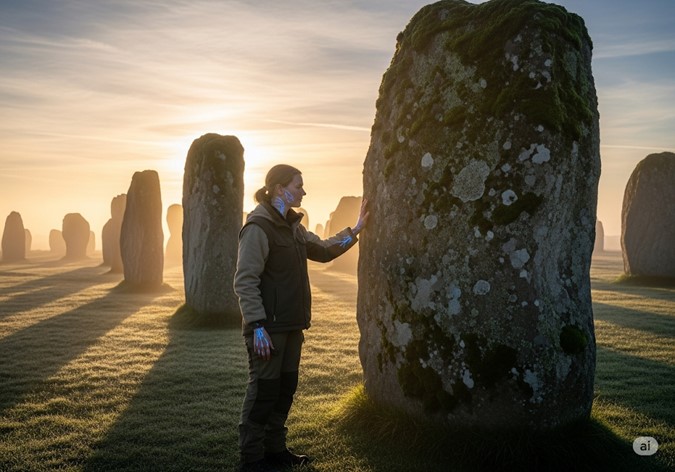
The magical power associated with The Uncarved Stone is not granted as a direct boon or miracle. Instead, a believer—typically a trained Stone-Tender or another practitioner of The Troldhøj Path—learns to use specialized gear and their own willpower to manipulate the fundamental “resonances” of the world that their deity represents: earth, stone, gravity, time, and endurance.
Their magic is practical, direct, and often lacks the flash of other magical disciplines. It is characterized by its immense force and inevitability, much like a geological event.
Defensive Applications
The defensive magic of the Path is centered on endurance, misdirection, and using the environment as an unbreachable shield.
- Flesh of Granite: By using a runic focus on their own body, a practitioner can temporarily increase the density and resilience of their skin and bones, making them as durable as solid rock. This doesn’t stop a blow but allows the user to endure impacts that would shatter a normal person. A sword might clang off their arm, and a bludgeon would strike with a dull, ineffective thud.
- Earthen Wall: The most common defense involves coaxing the ground to provide protection. A Stone-Tender can cause a thick wall of packed earth and rock to rise from the ground, creating a solid barrier against physical and magical attacks. A more skilled user might be able to summon a wall of ancient, fossilized bone from deep within the soil.
- Inertial Dampening: A subtle but powerful technique. By creating a localized field of dissonant vibrations, a practitioner can rob incoming attacks of their kinetic force. Arrows will drop from the air as if they’ve hit thick mud, and the concussive blast of a magical explosion will be deadened, its force absorbed harmlessly into the earth.
- The Ancestor’s Stand: This is a spiritual defense. By meditating on the Deed-Stones of their ancestors, a practitioner can summon their collective endurance and willpower. This manifests as an unshakeable mental fortitude, making the user immune to fear, pain, and magical effects that target the mind or spirit. To an observer, the practitioner simply stands resolute and immovable, weathering psychic assaults as a mountain weathers a storm.
Offensive Applications
Offensive magic used by followers of the Path is often brutal, direct, and overwhelming, using the raw, physical forces of the world as a weapon.
- Stone Spike Eruption: The most direct attack involves causing sharp, jagged spikes of rock to erupt violently from the ground beneath an opponent’s feet, capable of impaling targets and destroying fortifications from below.
- Gravity Well: A truly terrifying application of power. A practitioner can use their focus to drastically intensify the pull of gravity in a specific area. At first, an enemy will feel heavy and slow. Then, they will be forced to their knees, and finally, they can be crushed flat under their own weight and the immense, invisible pressure.
- Resonant Shatter: Every object has a unique resonant frequency. With intense focus, a Stone-Tender can identify the frequency of a target’s armor, shield, or weapon and emit a focused pulse of magical vibration that matches it, causing the object to shatter violently from within.
- Tectonic Shift: Rather than a direct attack, a practitioner can manipulate the ground itself. They can cause small, localized earthquakes to throw armies into disarray, open deep fissures to swallow siege engines, or cause the very foundation of a fortress to crumble.
- Hurlgoutte: A signature, pragmatic attack. A practitioner picks up a simple stone—no larger than their fist—and imbues it with immense mass and kinetic energy. They then hurl the stone, which travels with the speed and devastating impact of a cannonball, capable of punching through walls and shattering armor with brutally efficient force.
Elara and the First Deed-Stone
Listen, and let the knowing settle in your bones, for this is a telling from the time before. The words you hear are but a poor shadow of the true words, which themselves were but an echo of the events. This telling was taken from the Rune-Slates of the Second Age, which were themselves a flawed copy of the whispers of the first Stone-Tenders.
And it came to pass that there was an age called the Time of Thin Shadows. This was after the Great Cold, and after the Uniting of the Clans by the first Twin-Soul king. The people had built their halls of timber and their fastness of stone. The Gloom-Wyrm slept. Yet, there was a sickness in the land, a sickness not of the body but of the spirit.
A quiet sorrow fell upon the folk like a fine, grey dust. When a person’s time came to an end, and their body was given back to the earth, their soul, which is an echo, would return to the great silence of The Uncarved Stone. This was the Path. This was the way of things. But in the Time of Thin Shadows, the echo faded too quickly. A person would die, and within a moon’s turn, the memory of their voice, the feel of their presence, would vanish utterly from the hearts of the living. It was as if they had never been. The chain of ancestors was breaking, link by link, and the people felt themselves untethered, floating like lone seeds in a great, forgetful wind. They were becoming a people with no past.
In the village of Greywater Fen lived a woman named Elara. Her hands knew the ways of clay and her heart knew the ways of her partner, Aran. Aran was a builder, and his hands were strong and sure upon the timber-frames of their home. But the shadow-sickness took hold of his spirit. He grew quiet, and his inner light, his resonance that Elara could always feel, grew faint and thin. The healers could find no wound. The lore-keepers could find no curse. He was simply… fading.
Elara’s heart was a stone with a crack growing in it. She would not let Aran become nothing. She would not let him be forgotten. She went to the elders, who sat wrapped in their sorrow. They said, “We must endure. This is the Path now.”
But Elara looked at the unmoving mountains, and she saw them endure the wind and the ice for ages uncountable. She looked at the great river, and she saw how it carved its story into the rock of the canyon wall. She knew, in her bones, that true endurance was not passive acceptance. It was the act of holding on.
She spoke to the elders. “The sky gives no answer, for the sky is but sky. The great silence of The Stone does not speak in words. But the world speaks in its substance. The memory of the sun is held in the warmth of a rock at dusk. The memory of a life must also have a vessel. I will find it.”
The elders shook their heads. But Elara put on her walking-shoes of hardened leather. She put on her cloak of woven wool. She took her sharpest carving tools of flint and bone. To the high peaks she went, to the place called the Spine of the World, where it was said the first stone of the land had cooled from the fires of making.
Her journey was long. She ate the berries of the tough mountain bushes. She drank the water from the melting snows. She did not fight monsters of scale or fang. Her fight was with the wind that tried to tear her from the cliff-face, and with the cold that tried to steal the warmth from her blood, and with the despair in her own heart that whispered she was on a fool’s errand. With every step, she learned. She saw how the stubborn lichen clung to the rock, its life a slow story written in color. She felt the immense, patient weight of the mountain beneath her feet. She was not praying. She was listening.
After many days, she came to a high, hidden cirque, a bowl of stone cradled by three peaks. In its center, a waterfall, born from the ice above, fell into a deep and silent pool. The water of the pool was so clear it seemed a hole into the sky below. This was the place. The Resonance here was so strong, so pure, it was like a low hum she could feel in her teeth.
As she stood at the water’s edge, a great sorrow washed through her, and she knew, with a certainty that needed no messenger, that Aran’s life back in the village had ended. His echo was released. She felt it pass, a faint, sad whisper on the wind, beginning its journey back to the great silence.
A knowing then came to her. It was not a word. It was a truth like the truth of falling. A memory held only in the mind is but smoke. An echo in the air is fleeting. But a story given form, given substance, could endure.
She waded into the freezing pool, her breath a cloud before her. She reached into the depths and her hands searched not for a large or beautiful stone, but for the right one. She found it. It was dark and smooth, worn by ages of water, fitting perfectly in her two hands. It was dense and cool and felt… ancient.
She brought the stone to the shore. Closing her eyes, she cast her own spirit out, seeking the faint, fading echo of Aran. She found it. With all the love in her heart, she drew upon that echo, not to stop it, not to hold it back from its journey, but to read it. To remember.
And she began to carve.
Her first cut was a spiral, for the journey of his soul. Then, a carving of the house he had built, its roofline strong and straight. She carved the axe he favored, and the fish he caught, and the shape of the leaf from the tree they sat under in the summer. She carved a small, simple shape for the child they had lost to a winter fever. She did not carve his face. She carved his life. With every cut, she whispered the story of that carving. “This was his axe. It sang when it split the wood.” As she worked, she felt his fading resonance steady, and it seemed to flow into the stone beneath her hands. The stone grew faintly warm, and it pulsed with a soft, slow rhythm that matched the memory of his heart.
When she was done, she held not a cold rock, but a vessel. She held the Deed-Stone.
Her journey down the mountain was filled not with sorrow, but with purpose. She returned to her village to find them preparing the rites for Aran. She walked into the great hall and held up the stone.
“Aran is not gone,” she said, and her voice was clear and strong. “His echo has returned to The Stone, as is the Path. But his story remains with us.”
She began to trace the carvings with her finger, telling the story of each mark. And a wonder occurred. As she spoke, the people in the hall felt it. The memory of Aran, which had been a thin shadow, became clear and strong in their minds. They could almost hear his laugh. They could almost feel the warmth of his presence. The stone was a focus, an anchor for memory. The despair in the hall began to recede, replaced by a warmth of remembrance.
Elara taught them what she had learned. She became the first Stone-Tender. From that day forward, when a person died, their story was carved into a Deed-Stone, so that their echo would have a home in the memory of the living. The Time of Thin Shadows ended, and the people of Maglemosian became a people with a past as solid and as enduring as the mountains themselves.
The Moral of the Story: For a memory held only in the mind is but smoke, but a memory carved in stone is a foundation for all who come after.