
Original Life Forms Referenced
- Class Insecta: Bombardier Beetle (Brachinini)
- Class Asteroidea: Crown-of-Thorns Starfish (Acanthaster planci)
- Class Gastropoda: Cone Snail (Conus)
- Class Malacostraca: Mantis Shrimp (Stomatopoda)
Appearance The Conacanth is a walking fortress of natural weaponry. Its core body is a flattened, heavily calcified disc, similar in shape to a large starfish, from which six sturdy, insectoid legs emerge, allowing it to move on land. The center of its dorsal side is dominated by a beautiful, conical shell, marked with hypnotic, spiraling patterns reminiscent of a cone snail. The entire upper surface of its body, surrounding the central shell, bristles with hundreds of long, incredibly sharp spines which constantly drip a mild, paralytic venom.
From the front of its body disc, two thick, powerfully muscled arms extend, each ending in a hammer-like, clubbed appendage, the devastating “smasher” claws of a mantis shrimp. It has no discernible head, but two complex, independently moving eyes on stalks are located between the two striking arms, granting it exceptional vision. Its mouth is hidden on its underside. Extending from its rear is a segmented, articulated abdomen like that of a beetle, ending in a nozzle capable of spraying a noxious chemical deterrent.
Size The Conacanth is a low-profile but dense and heavy creature.
- Body Diameter: 2 to 3.5 feet.
- Height (to top of shell): Approximately 2 feet.
- Weight: 120 to 200 pounds.
Speed The creature is not fast, moving with a slow, deliberate, scuttling gait on its six legs. Its defensive and offensive actions, however, are blindingly swift. It is a slow-moving tank, not a sprinter. It can survive underwater for long periods but is not an efficient swimmer, preferring to crawl along the seabed.
Stat Modifiers This creature possesses immense power in its strikes and is exceptionally durable. Its strengths lie in its raw power, constitutional fortitude, and sensory perception. Its primary weaknesses are its slow movement speed and lack of overall agility, making it susceptible to being outmaneuvered by faster opponents.
Skills
- Hyper-Spectral Vision: Its complex, stalked eyes can perceive polarized light and a spectrum of colors and magical energies invisible to most other creatures. This allows it to spot weaknesses in armor, identify active enchantments, and see hidden objects with ease.
- Venomous Spines: The long spines covering its body are coated in a venom that causes escalating numbness and paralysis on contact.
- Caustic Jet: From its abdomen, it can spray a boiling, noxious chemical mixture in a short cone. This spray is a powerful deterrent that can cause severe chemical burns and temporary blindness.
- Smasher Strike: Its primary attack is a lightning-fast strike from its club-like arms. These blows are delivered with enough speed and force to shatter stone, punch through metal armor, and create cavitation bubbles in the water that release a secondary shockwave of energy.
- Venomous Harpoon: Hidden near its mouth on its underside is a proboscis that can fire a single, tiny, venom-laced radula tooth like a harpoon. This is a surprise attack used on prey that has been immobilized or on creatures attacking its soft underbelly. The venom is extremely potent and fast-acting.
Behavior The Conacanth is a highly aggressive and territorial scavenger and opportunistic predator. It does not actively hunt down fast-moving prey. Instead, it methodically patrols a small territory—usually a stretch of rocky coastline or a rich tide pool—and attacks anything that enters it. Its primary behavior is to pulverize its food source, using its powerful claws to smash open giant crabs, armored fish, and large shellfish to get at the soft insides. It is extremely belligerent and will attack creatures many times its size without hesitation, viewing everything as a potential threat to be neutralized.
Diet The Conacanth is a carnivore that specializes in consuming hard-shelled organisms. Its diet consists mainly of giant sea snails, armored crustaceans, and large bivalves. It is also an avid scavenger, using its powerful claws to crack open the bones of washed-up carcasses to get at the marrow. To consume soft carrion, it can evert its stomach out of its mouth and digest its meals externally.
Emotions This creature operates on a very limited set of primal instincts. Its dominant state is a form of aggressive vigilance. It shows no fear, curiosity, or social inclination. Its reactions to any stimulus are almost universally defensive and violent.
Environment Where Found It lives exclusively in the littoral zone of rocky coastlines and the shallow waters of vibrant coral reefs. It thrives in complex environments with many rocks, tide pools, and crevices where its food source is abundant and it can camouflage its shelled body among the terrain.
Tags: Feral Life Form, Amphibious, Carnivore, Territorial, Armored, Venomous, Poisonous, Caustic Spray, Smasher, Slow-Moving, Hyper-Vision, Regenerative, Conical Shell, Spined Body, Insectoid Legs, Stalked Eyes, Venomous Harpoon, Scavenger, Tide Pool Dweller, Aggressive
Life Cycle
The life cycle of a Conacanth is a slow, armored, and solitary progression from a vulnerable scavenger to a near-impregnable fortress.
- Egg Casings: The cycle begins when a female lays a small clutch of 5 to 10 eggs. These eggs are not soft but are encased in a thick, heavily calcified shell that makes them look almost identical to smooth, grey beach pebbles. She deposits them individually in hidden, hard-to-reach crevices within her territory’s tide pools.
- Larval Stage: Upon hatching, the larva is a small, soft-bodied creature resembling a slug, with only nascent claws and eye-stalks. Its first instinct is to find and inhabit a tiny, empty seashell for protection, much like a hermit crab. In this vulnerable stage, it scavenges for scraps and hides constantly.
- Growth and Shell Progression: As the young Conacanth grows, it abandons its shell for progressively larger ones. During this phase, which can last for several years, its own dorsal shell begins to grow and harden, and its venomous spines slowly emerge. Its smasher claws develop, allowing it to begin hunting its own small-shelled prey.
- Maturity and Lifespan: After 5 to 7 years, its own conical shell and spines are fully formed and incredibly hard. At this point, it abandons its final host shell and emerges as a true, adult Conacanth. Their heavily defended nature grants them a long potential lifespan, with some living for 40 to 50 years, their shells growing thicker and their territory more established with each passing decade.
Mating
Given their aggressive, solitary, and territorial nature, mating for a Conacanth is a rare and perilous affair driven by instinct and sound.
The process is triggered by seasonal changes in water temperature. A receptive female will begin to release a complex pheromone into the surrounding tide pools. Males in the area, detecting this scent, will be drawn toward her territory. However, they do not approach directly. Instead, a male will find a large, resonant slab of rock and begin “drumming”—striking the rock with its smasher claws in a deep, powerful, and rhythmic pattern. This drumming serves as both a declaration of presence and a demonstration of strength.
A female will listen to the drumming of competing males. She will only respond to the one whose rhythm is the most powerful and complex, indicating superior strength and maturity. Her response is a softer, slower drumming pattern tapped out on her own shell. This exchange of rhythmic sound is the only form of courtship. Once she responds, the chosen male will approach, and they engage in a tense, brief mating. The male deposits a spermatophore, a packet of genetic material, which the female takes into her body to fertilize her eggs internally. Immediately after the act is complete, their innate aggression returns, and the male is driven from her territory.
Tactics
The Conacanth does not employ stealth or subtlety. Its tactics are based on overwhelming defense and irresistible force.
- The Mobile Fortress: Its primary tactic is to simply exist within its territory as a near-invulnerable moving bastion. It slowly patrols its domain, relying on its formidable shell and venomous spines to deter almost any potential threat.
- Systematic Pulverization: When it identifies a food source, like a giant armored crab, it does not use finesse. It approaches, weathers any initial counter-attack on its heavy shell, and then delivers a series of catastrophic Smasher Strikes until its target’s defenses are utterly shattered.
- Active Deterrence: Against a larger or more agile foe it cannot easily smash, the Conacanth hunkers down, protecting its softer underside and presenting a formidable wall of venomous spines. If the attacker persists, it will use its Caustic Jet to create a zone of chemical hazard, forcing the enemy to retreat. The core of its strategy is to make any prolonged engagement with it a painful, costly, and ultimately fruitless endeavor.
- Hidden Threat: The Venomous Harpoon is a weapon of last resort. It is used only when an opponent has managed to bypass its claws and spines and is attacking its vulnerable underside. It is a single, potent, and unexpected strike meant to end a fight instantly.
Actions
- Smasher Strike: A lightning-fast, piston-like strike with one of its hammer-claws. The speed of this action is in jarring contrast to the creature’s slow movement. The blow is powerful enough to shatter rock and is followed by a secondary shockwave from the cavitation bubble it creates underwater.
- Caustic Jet: A short-range (15-foot cone) spray of boiling, acrid chemicals from its articulated abdomen. Creatures caught in the spray suffer chemical burns and must resist being blinded.
- Spine Impale: A defensive reaction. If an attacker’s melee strike misses the Conacanth by a narrow margin, or if a creature tries to grapple it, the Conacanth can reflexively angle its body to impale the foe on its venomous spines.
- Venomous Harpoon: A single, ranged attack from its hidden proboscis that can target an adjacent creature. The harpoon itself does little damage, but the injected venom is incredibly potent.
- Stomach Eversion: A non-combat action used for feeding on soft carrion, where it pushes its stomach out of its mouth to externally digest food.
Other Interesting Information
- Territorial Drumming: The rhythmic sounds used for mating also serve as a constant declaration of territory. Adventurers navigating a rocky coastline may hear a deep, powerful drumming echoing through the cliffs. Each Conacanth has a unique signature rhythm, and experienced coastal dwellers know how to identify the beats of the specific creatures in their area, and thus know which tide pools to avoid.
- The Living Anvil: In a practice that is both incredibly dangerous and highly revered, some master artisans of the Praakrit nation seek out the lairs of ancient Conacanths. They do not hunt the creature, but attempt to use its dormant, hardened shell as a “living anvil.” By placing a piece of red-hot, enchanted metal on its shell and striking it at the precise moment the creature is resting, they believe the echo of its pulverizing power is permanently forged into the weapon or armor. Most who attempt this are shattered by the creature’s instant, violent retaliation.
- Eye Harvesting: The complex, stalked eyes of the creature are prized by those who craft scrying devices and tools for magical analysis. However, the delicate crystalline structures within the eyes that grant its hyper-spectral vision decay into uselessness within moments of its death. Harvesting them requires immediate and complex alchemical preservation, making functional specimens exceedingly rare and valuable.
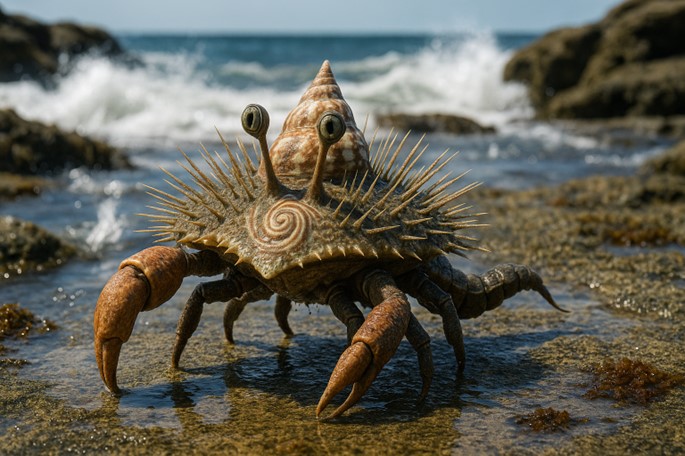
An adventuring party in the world of Saṃsāra might be compelled to seek out or simply have the misfortune of encountering a Conacanth Stomatini 47 for a number of high-stakes reasons, turning this slow-moving fortress into the objective of a quest or an unexpected, deadly obstacle.
Scenario 1: The Masterwork Commission (A Targeted Hunt)
The most direct reason for a party to hunt a Conacanth is for its exceptionally rare and powerful components. A master artisan from a major guild—perhaps a Praakrit engineer from Indus or a weaponsmith seeking to make a legendary piece of gear—posts a bounty that only a high-tier party could fulfill. The quest would specify the need for pristine, undamaged parts:
- The Smasher Clubs: The artisan requires the two powerful “smasher” claws to forge a pair of unparalleled warhammers or gauntlets. The quest would stipulate that the clubs must be harvested with extreme care, as any crack in their dense, calcified structure would ruin their potential for enchantment.
- The Hyper-Spectral Eyes: A master enchanter or a builder of scrying devices needs the creature’s complex eyes. As stated in its lore, these organs decay almost instantly upon death. The quest would require the party not only to kill the beast but to have an alchemist or a specialized magical container on hand to preserve the eyes within moments of its demise, adding a complex logistical challenge to the hunt.
- The Living Anvil Escort: In the most dangerous version of this quest, a renowned Praakrit artisan hires the party not to kill the creature, but to serve as their bodyguards. The artisan intends to perform the legendary ritual of using a dormant, ancient Conacanth’s shell as a “living anvil” to forge a unique magical item. The party’s job would be to defend the smith from the creature’s inevitable, violent retaliation the moment the first hammer blow falls on its shell.
Scenario 2: The Terror of the Tide Pools (A Threat Elimination)
A party might encounter the Conacanth as the monster at the heart of a local crisis. A prosperous coastal village, whose economy depends on harvesting rare pearls, giant clams, or iridescent coral from a specific set of resource-rich tide pools, suddenly finds its livelihood cut off. Divers are being attacked, their enchanted gear shattered by blows of impossible force. The shoreline is littered with the pulverized remains of the giant crustaceans they once harvested.
The village elders would hire the adventurers to investigate and eliminate the threat. The party would need to explore the treacherous, rocky coastline, likely at low tide. They would find evidence of the Conacanth’s destructive feeding habits—shattered shells and the lingering smell of its caustic spray. The climax would be a battle against the creature in its home territory, a complex arena of rocks and water-filled pools where the Conacanth has every advantage. The goal is simple: kill the beast so the village can survive.
Scenario 3: The Unforeseen Guardian (An Accidental Encounter)
Often, the most deadly encounters are the ones that are not sought. A party could be on an entirely unrelated quest, such as:
- Exploring a Ruin: They are searching for an ancient ruin or a hidden temple said to be located in a series of coastal sea caves. As they navigate the damp, dark caverns, they unknowingly enter the lair of a territorial Conacanth. The first sign of trouble might be a deep, rhythmic drumming echoing through the cave, or they might simply stumble upon the creature, perfectly camouflaged among the rocks, triggering a sudden and desperate fight for survival in a cramped, dangerous environment.
- Chasing Pirates: The party is tracking a group of pirates to their hidden cove. The pirates built their hideout in this specific location precisely because the presence of a Conacanth in the surrounding waters served as a perfect, non-sentient guard dog, making a direct naval assault on the cove impossible. The party would have to find a way to navigate the creature’s territory to get to the pirates, forcing them to either attempt an incredibly risky stealth mission or engage the beast directly.
Scenario 4: The Alchemist’s Desperate Need (A Component Quest)
This scenario focuses on the creature’s more esoteric parts. A powerful noble has been struck by a magical poison that resists all conventional healing and dispelling magic. The court’s master alchemist determines that the only known antidote requires a catalyst made from the Conacanth’s venomous harpoon—specifically, the potent venom from its proboscis, which has unique properties that can neutralize other toxins. The party would be hired under extreme time pressure to hunt a Conacanth, with the specific and difficult objective of extracting the tiny, fragile harpoon and its venom sac intact, a feat of both combat prowess and delicate surgical skill.
Harvestable Components of the Conacanth Stomatini 47
A skilled avatar with the proper training in skinning, alchemy, and creature anatomy can harvest several valuable and potent components from the corpse of a Conacanth. Success often requires specialized tools to deal with the creature’s heavily calcified shell and still-potent chemical agents.
1. The Resonant Cone Shell
- Description: This is the large, conical shell that dominates the creature’s back. It is not simple calcium but a complex, layered bioceramic material that is incredibly dense and possesses unique acoustic properties. Harvesting it requires powerful stone-cutting saws or sonic-based magical tools to separate it cleanly from the body disc without shattering it. The spiraling patterns on the shell are not just superficial; they are micro-grooves that channel vibrational energy.
- Use: When hollowed out and properly prepared, the shell acts as a powerful acoustic resonator. A large, intact shell can be used as the core component for a siege-weapon that generates powerful sonic blasts. Smaller sections are highly prized by artisans who craft gear for bards or sound-based mages, as incorporating the shell into an instrument or focus dramatically amplifies its sonic output. Powdered shell is a key ingredient in alchemical potions that grant resistance to sonic damage or magical effects based on sound or vibration.
2. Crown-of-Thorns Spine Clusters
- Description: These are the hundreds of sharp, needle-like spines covering the creature’s body. Each spine has a hollow channel connected to a small, underlying venom sac. A harvester must carefully extract the spines and their attached sacs to preserve the venom within. The venom itself is a mild paralytic that, while not lethal on its own, causes escalating numbness and motor-function failure.
- Use: The primary use is in alchemy. The venom can be refined into potent topical anesthetics used in field medicine. When treated with other reagents, it can be stabilized into a “Numbing Oil,” a gear coating that doesn’t damage a foe but, on a successful strike, seeps into their body to induce a temporary state of clumsiness and slowed reflexes. Individual spines are also used as darts or arrowheads for weapons designed to capture, rather than kill, a target.
3. Bombardier Gland and Reagents
- Description: Located at the rear of the creature is a complex, two-chambered gland responsible for its Caustic Jet. One chamber contains hydroquinones, the other hydrogen peroxide. These chemicals are inert on their own but become violently reactive when mixed. A skilled alchemist can drain these two chambers separately into magically stabilized glass containers.
- Use: These are highly sought-after alchemical components. Kept separate, they are stable. When combined, they can be used to create powerful, single-use explosives or acidic mixtures for breaching armored walls. In a more controlled application, small, separated doses can be installed into specialized gear, allowing an avatar to replicate the creature’s defensive spray on a much smaller scale, often as a surprise countermeasure built into a shield or gauntlet.
4. Crystalline Eye Lenses
- Description: The lenses of the Conacanth’s stalked eyes are not organic but are grown from a complex crystalline structure. This is what grants the creature its hyper-spectral vision. These lenses are incredibly fragile and their unique optical properties decay within an hour of the creature’s death unless submerged in a specific alchemical preservation fluid.
- Use: An intact, preserved eye lens is a priceless component for any gear related to seeing or scrying. When integrated into a helmet, monocle, or scope by a master enchanter, it grants the wearer the ability to perceive a broader spectrum of magical energies. This allows them to more easily spot active illusions, identify the elemental school of a magical ward, or see the faint auras left behind by powerful enchantments.
5. Mantis Striker “Knuckles”
- Description: This is the incredibly dense, calcified material that forms the hammer-like club on the creature’s primary arms. It is not the entire arm, but the specific impact surface. It is one of the hardest and most impact-resistant biological substances known. It must be carefully chiseled away from the rest of the arm.
- Use: The “knuckles” cannot be melted down, only shaped by grinding. Master armorers will grind this material into a fine powder and use it to create a ceramic-like coating for high-end shields and heavy armor, granting the gear an exceptional ability to withstand crushing blows. Alternatively, a whole, intact knuckle can be mounted onto the head of a warhammer or the fist of a magical golem, creating a weapon capable of shattering lesser arms and armor with ease.
Folly of Pirate Captain, Joric
It is known that a fortress of stone is a mighty thing. But a fortress that walks and feels anger is a thing for which there is no victory, only a lesson. This is the story of that lesson.
There was a pirate captain named Joric. He was a man of great reputation, whose ship was a black wolf on the waves and whose crew were all strong men with gear of high tier. His heart was large with pride, and had no room for caution. He had plundered the ships of the Guilds and fought the beasts of the deep water, and he believed no power in the world was greater than his own.
His ship, seeking a place to hide its treasure and mend its wounds, found a perfect cove. It was a place with high cliffs that hid it from the sea, and a deep channel for his ship. The land nearby was good. But the people of a small village nearby came to him and warned him. An old woman, the matriarch of the village, said to him, “That is the Cove of the Drum. You must not anchor there. It is the territory of the King of the Rocks, an ancient beast that has lived there since the first stones were wet. It suffers no trespassers.”
Joric laughed. “I have slain krakens and wrestled with serpents of the abyss. What is one beast of the rocks to me? Your fears are the fears of weak people.”
The old woman shook her head. “It is not a beast you can fight. It is the cove’s own anger given a shell and legs. It does not die. It only endures.”
Joric dismissed her and ordered his ship into the cove.
As the ship anchored, a deep, rhythmic drumming sound began to echo from the rocky shore. It was the sound of stone being struck by something of great power. On the rocks, the crew saw it: the Conacanth Stomatini, larger than any they had imagined. It was the size of a great boulder, and its shell shone with the colors of a foul bruise. It stood on its six legs and watched the ship with its strange, stalked eyes.
“It is only an animal,” Joric roared. “Show it the power of men!” He ordered his crew to fire the ship’s cannons, which were loaded with alchemical explosives. The cannons boomed, and the shots flew across the water. Several struck the creature’s conical shell. The creature’s shell wore the cannon-shots like rain. There was a great noise, but the shell was not even cracked.
The King of the Rocks became angry. It turned its segmented abdomen toward the ship and from it came a Caustic Jet of boiling, stinking liquid. The jet shot across the water and struck the side of the ship. The wood hissed and blackened, and the sailors who were hit screamed as their skin burned. The creature then slid into the water and vanished. Joric was full of rage.
The next day, Joric decided he would kill the beast on the land. He laid a trap. He had his men drag the carcass of a great sea turtle onto the beach as bait. He and his twenty strongest warriors, all in their finest battle gear, hid among the rocks, ready to ambush the beast when it came to feed.
They did not wait long. The Conacanth crawled from the sea. It ignored the bait completely. It moved with its slow, deliberate walk, not toward the turtle, but toward the place where the men were hiding. Its hyper-spectral vision saw them not as men, but as disruptions, as flaws in the pattern of its home.
Joric gave the order to attack. The pirates, screaming their battle-cries, rushed the creature from all sides. Their swords and axes, many of them enchanted, rang against its shell and glanced off its venomous spines. A few men who stumbled too close were pricked by the spines and fell to the ground, their limbs going numb.
The beast responded not with cunning, but with pure force. It swung one of its great hammer-arms in a blur of motion. The sound of its Smasher Strike was the sound of a tower falling. It struck a pirate’s enchanted shield, and the shield, the arm behind it, and the man’s chest all broke at once. It swung its other arm and shattered the legs of another. The pirates’ courage turned to terror. They were fighting not an animal, but a living piece of the mountain.
Soon, only Joric was left. His enchanted blade was shattered. His crew was broken and dying around him. He stood before the King of the Rocks, and for the first time, he felt the cold hand of fear. He saw in the creature’s strange eyes no rage, no hunger, only a kind of terrible, logical certainty. He had invaded its system, and the system was now removing him.
He turned to run. He took only two steps before one of the creature’s clubs swung and shattered his leg. He fell to the sand, his pride and his body broken. The great creature walked slowly toward him. It stood over him, and Joric looked up past the terrible mouthparts on its underside. He saw its stalked eyes looking down, and then one of the great hammer-claws began to rise.
A young boy, who had hidden on the cliffs, was the only one to survive. He told the story of how Joric’s great pride was shattered upon the shell of a beast who was merely protecting its home. The treasure of the pirates remains in the cove, but no one dares to seek it. For the drumming of the King of the Rocks can still be heard on a quiet night.
The Moral: A king’s authority ends at the shore, for the rocks and the tides have their own, older king.
Suggested conversions to other systems:
Call of Cthulhu (7th Edition)
The Resonant Shell-Beast An ancient, heavily-armored life form that patrols a single stretch of rocky coastline with implacable fury. It moves with a slow, deliberate gait, its stalked eyes scanning for any intrusion into its territory. Locals speak of a deep, rhythmic drumming that echoes from its cove, the sound of the beast pulverizing rocks and the bones of its prey with its terrifyingly swift claws. It is considered less a creature and more a sentient, mobile geological event.
STR: 90 CON: 95 SIZ: 85 DEX: 40 INT: 20 POW: 50 HP: 18 DB: +1d6 Build: 2 Move: 4 / 4 swimming Attack: 1 per round Fighting (Smasher): 70% (35/14), damage 1d6+1d4 + damage bonus (see Pulverizing Blow) Dodge: 20% (10/4) Armor: 8 points of calcified shell and hide. Sanity Loss: 1/1d8 SAN for witnessing the creature’s pulverizing attack.
Special Rules:
- Pulverizing Blow: A Smasher attack from the Shell-Beast is so powerful it can shatter equipment. If an investigator successfully uses a shield to block the attack, the shield is destroyed. If an investigator is hit and takes damage, any non-magical item they are holding (weapon, flashlight) may be destroyed on a Fumble on a Luck roll.
- Venomous Spines: If an investigator attacks the Shell-Beast with a melee weapon and misses their Fighting roll, they must make a DEX roll. On a failure, they have struck one of the creature’s spines. They must then succeed on a CON roll or become paralyzed, unable to move for 1d6 rounds.
- Caustic Jet: Once per encounter, instead of attacking, the creature can spray a 15-foot cone of boiling chemicals. All investigators in the cone must make a Dodge roll. Those who fail take 2d6 damage. A failed roll by more than half also means the investigator is blinded for 1d4 rounds.
- Immune to Impaling: The creature’s shell is too thick for it to be Impaled by attacks.
Blades in the Dark
The Canal Brute A hulking, armored horror that has claimed a section of the city’s ancient, forgotten waterways as its own. It moves slowly but strikes with the force of a steam-hammer, shattering brickwork, sinking skiffs, and pulverizing anyone who encroaches on its domain. The Bluecoats refuse to go near its territory after losing a patrol to it. Tier III Threat Instinct: To utterly destroy any perceived intrusion. Qualities: Heavily Armored, Brutal Force, Terrifying, Amphibious
Mechanics: The Canal Brute is a force of nature, a living siege engine. A direct confrontation is almost always a Desperate action. Its threat comes from its ability to destroy the environment and the crew’s equipment.
- Shattering Blow: When the Brute attacks, a possible GM action is to directly target a PC’s gear. The GM can start a 4-segment clock: Your Armor is Wreckage or Your Weapon is Shattered. A single powerful blow from the creature can fill this clock instantly.
- Environmental Destruction: The Brute’s main threat is its effect on the surroundings. The GM should create clocks representing the structural integrity of the area. For example: The Warehouse Floor Collapses (8-clock) or The Canal Wall Gives Way (10-clock). Every action the Brute takes ticks one of these clocks, creating a dynamic and collapsing battlefield.
- Caustic Spray: As a looming threat, the GM can start a 6-segment clock: The Brute Builds up Pressure. When this clock fills, it unleashes its Caustic Jet, inflicting Level 2 Harm: “Chemical Burns” on every character in its zone who cannot find cover.
- Weak Points: The creature’s armor is nearly impenetrable. The crew will have to take Setup Actions using Study or Finesse to create opportunities to strike at its joints or softer underbelly. Attacking without such an opportunity will always have Limited or Zero Effect.
Dungeons & Dragons (5th Edition)
Stomatopod Dreadnought Large monstrosity, unaligned
Armor Class: 18 (natural armor) Hit Points: 136 (13d10 + 65) Speed: 20 ft., swim 20 ft.
STR: 20 (+5) DEX: 8 (-1) CON: 20 (+5) INT: 2 (-4) WIS: 12 (+1) CHA: 5 (-3)
Damage Resistances: bludgeoning, piercing, and slashing from nonmagical attacks Damage Immunities: poison Condition Immunities: poisoned Senses: Darkvision 120 ft., passive Perception 11 Challenge: 8 (3,900 XP)
Siege Monster. The dreadnought deals double damage to objects and structures.
Venomous Spines. A creature that touches the dreadnought or hits it with a melee attack while within 5 feet of it takes 7 (2d6) poison damage.
Actions Multiattack. The dreadnought makes two Smasher attacks.
Smasher. Melee Weapon Attack: +9 to hit, reach 10 ft., one target. Hit: 21 (3d10 + 5) bludgeoning damage. If this attack targets a creature, the creature must succeed on a DC 17 Strength saving throw or be knocked prone. If the target is wearing nonmagical armor, the armor takes a permanent and cumulative -1 penalty to the AC it offers. The armor is destroyed if the penalty reduces its AC to 10.
Caustic Jet (Recharge 5-6). The dreadnought sprays boiling chemicals in a 30-foot cone. Each creature in that area must make a DC 17 Dexterity saving throw, taking 36 (8d8) acid damage on a failed save, or half as much damage on a successful one. A creature that fails the save is also blinded until the end of its next turn.
Bonus Actions Venomous Harpoon. The dreadnought can fire a venomous barb at one creature within 10 feet of it. The target must succeed on a DC 17 Constitution saving throw or be poisoned for 1 minute. While poisoned in this way, the creature is paralyzed. The creature can repeat the saving throw at the end of each of its turns, ending the effect on itself on a success.
Knave (2nd Edition)
Spined Smasher HD: 9 Armor: 17 Morale: 12 Attack: Smasher Claw (2d8) Qualities: Amphibious, Slow, Armored, Pulverizing Blow, Venomous Spines, Caustic Spray
Mechanics:
- Amphibious: Breathes air and water, moves freely in both.
- Slow: Pace is always considered halved. It cannot take the “Sprint” action.
- Armored: Its shell is as protective as plate armor.
- Pulverizing Blow: A Smasher attack automatically breaks non-magical shields if the attack hits, even if the damage is absorbed by HP. On a critical hit (natural 20 on the attack roll), the target’s worn non-magical armor is also destroyed.
- Venomous Spines: Any character who hits the Smasher with a melee attack must make an item saving throw for their weapon (if they care about it not getting chipped or stuck) and a CON save vs poison. On a failed CON save, the character is paralyzed for 1d4 rounds and cannot act.
- Caustic Spray: Once per combat, as its entire turn, the Smasher can spray a 30ft cone. All in the area take 4d6 damage (CON save for half).
Fate Core System
The Rock-Shattering Tyrant A living bastion of territorial fury, this creature claims a stretch of coastline as its kingdom and defends it with implacable, overwhelming force. It is less a predator and more a force of nature, pulverizing any who fail to respect its domain. It is best used as a major obstacle that cannot be overcome with simple violence, requiring the players to create advantages and exploit its slow, predictable nature.
High Concept: Immovable, Territorial Living Fortress Trouble: Slow and Predictably Violent Other Aspects: My Shell Deflects All But the Mightiest Blows, A Strike that Pulverizes, Caustic Chemical Defenses
Skills Superb (+5): Physique Great (+4): Fight Good (+3): Provoke (via intimidation) Fair (+2): Notice Average (+1): Will
Stunts
- Pulverizing Blow: When the Rock-Shattering Tyrant succeeds with style on a Fight attack, instead of the +2 shift bonus, it can choose to automatically attach the situational aspect Shattered Gear to the target’s armor or shield with one free invocation.
- Heavily Armored: The Tyrant’s natural shell is incredibly thick. It has Armor: 2 against physical attacks (it reduces the stress of any physical hit by 2).
- Caustic Jet: Once per scene, as an action, the Tyrant can attack every character in its zone. This is a Provoke attack representing a spray of boiling chemicals; characters must defend using Athletics by diving for cover. This attack can only inflict stress, not consequences.
- Venomous Spines: When an opponent fails a melee Fight attack against the Tyrant, the Tyrant can choose to inflict a 2-shift physical hit as the attacker blunders into its sharp, venomous spines.
Stress & Consequences Physical Stress: [1] [2] [3] [4] Consequences: One mild, one moderate, one severe, and one additional mild physical consequence.
Numenera & Cypher System
The Stomatapod Lithoclast This creature is a biological siege engine, a remnant of some ancient, alien ecosystem. It slowly patrols its territory, drumming on rocks with its powerful claws to demarcate its borders. It perceives nearly everything as a structural element to be tested and, if found wanting, pulverized. Its shell seems to absorb and dampen energy, while its claws strike with enough force to shatter stone.
Level: 6 Health: 30 Damage: 6 points Armor: 3 Movement: Short; Immediate swimming Modifications: Resists being moved or knocked down as level 8. Perception as level 7.
Combat: The Lithoclast is a direct and brutal combatant. It will typically move toward the most heavily armored or largest target and attempt to smash it.
- Pulverizing Strike: The Lithoclast’s claw attack inflicts 6 points of damage. In addition, the target must succeed on a Might defense task or one piece of their gear (GM’s choice, usually a shield or weapon) is damaged, increasing the difficulty of all tasks performed with it by one step until it is repaired. If this would be the second time the item is damaged, it is destroyed.
- Caustic Spray: As its action, the creature can spray a cloud of chemicals in an immediate area. All targets in the area suffer 4 points of ambient acid damage that ignores Armor.
- Venomous Spines: If an attack roll against the Lithoclast fails, the GM can use GM Intrusion to have the attacker strike the creature’s spines. The character must then make a Might defense task. On a failure, they are paralyzed and lose their next turn as their muscles seize up.
- Territorial Drumming: Before a fight, the Lithoclast will often drum on the ground, a terrifying display of power. Any character who witnesses this must succeed on an Intellect defense task or be hindered on their next action due to fear and awe.
Loot: Its bioceramic shell can be used to craft high-quality armor. Its glands contain potent alchemical reagents.
Pathfinder (2nd Edition)
Reef Smasher – Creature 7 Uncommon, Animal, Amphibious Perception +15; darkvision, wavesense (imprecise) 60 feet Skills Athletics +17, Intimidation +15 Str +6, Dex -2, Con +5, Int -4, Wis +2, Cha +0
AC 25; Fort +18, Ref +11, Will +15 HP 115; Hardness 5 (shell only); Immunities poison
Venomous Spines [reaction] Trigger A creature hits the Reef Smasher with a melee Strike; Effect The attacking creature is exposed to Spine Venom.
Actions Speed 20 feet, swim 20 feet Melee [one-action] Smasher Claw +18 (Reach 10 feet), Damage 2d12+9 bludgeoning Melee [one-action] Spine +18 (Agile), Damage 2d6+9 piercing plus Spine Venom
Pulverize [two-actions] The Reef Smasher makes a Smasher Claw Strike. This Strike deals an additional 2d6 damage. If the Strike is a critical hit, any non-magical shield or armor worn by the target is broken.
Caustic Jet [two-actions] (Acid, Evocation) The Reef Smasher unleashes a spray of boiling chemicals in a 30-foot cone. Each creature in the cone must make a DC 25 basic Reflex save, taking 8d6 acid damage. A creature that critically fails the save is also blinded for 1 round. The Reef Smasher can’t use Caustic Jet again for 1d4 rounds.
Spine Venom (Injury, Poison) Saving Throw DC 25 Fortitude; Maximum Duration 6 rounds; Stage 1 2d6 poison damage and slowed 1 (1 round); Stage 2 3d6 poison damage, clumsy 2, and slowed 2 (1 round); Stage 3 3d6 poison damage and paralyzed (1d4 rounds).
Savage Worlds Adventure Edition (SWADE)
Tide-Pool Mauler A walking tank of chitin and rage, the Tide-Pool Mauler is the undisputed king of its territory. It moves with a slow, grinding inevitability, its stalked eyes scanning for anything to smash. Its heavy, club-like claws can pulverize rock and steel, and its spined shell is a passive defense that cripples unwary attackers.
Attributes: Agility d6, Smarts d4(A), Spirit d8, Strength d12, Vigor d12 Skills: Athletics d8, Fighting d10, Intimidation d10, Notice d8 Pace: 4; Swim: 4; Parry: 7; Toughness: 12 (4) Edges: – Hindrances: Territorial (Major) Special Abilities:
- Armor +4: Heavily calcified shell.
- Aquatic: Pace 4 in water.
- Hardy: The creature does not suffer a Wound from being Shaken twice.
- Siege Monster: Its Smasher attacks deal Mega Damage to objects (see SWADE rules).
- Smasher: Str+d10, AP 3, Reach 1.
- Venomous Spines: When hit with a melee attack, the attacker must make an Agility roll. If the roll is failed, the attacker is exposed to its Venom.
- Caustic Jet: As an action, can spray a Cone Template. Characters in the cone must make an Agility roll or take 2d10 damage. This is considered a Heavy Weapon.
- Venom (-2): The creature’s spine venom is potent. On a failed Vigor roll at -2, the victim is Stunned and must make another Vigor roll at the start of their next turn. If that also fails, they are Paralyzed (cannot take actions or move, Parry is 2) for 1d4 rounds.
Shadowrun (6th Edition)
Tide-Pool Bruiser A heavily-armored paracritter found in the polluted coastal zones and overgrown, forgotten harbor districts. Believed to be an awakened mutation of several crustacean and insect species, the Bruiser is a walking tank of chitin and rage. Its slow, deliberate movements belie the lightning-fast, pulverizing strikes of its club-like arms, which have been known to shatter reinforced concrete and armored drones with equal ease. DocWagon reports indicate its spines carry a paralytic toxin, and its defensive chemical spray is highly corrosive.
Attributes Body: 9 Agility: 2 Reaction: 3 Strength: 8 Willpower: 4 Logic: 1 Intuition: 3 Charisma: 1 Edge: 1 Essence: 6 Magic: 6
Derived Stats Initiative: 6 (3 + 3) Physical Condition Monitor: 13 Stun Condition Monitor: 11 Defense Rating: 6 Armor: 14
Skills: Unarmed Combat 5, Perception 3, Exotic Ranged Weapon (Caustic Spray) 4
Critter Powers
- Armor: Rating 14
- Corrosive Spit: The Bruiser’s defensive spray is a chemical agent. This is a Ranged Exotic Weapon attack that uses the Cone template (p. 119, SR6). It has a DV of 8P, AP -4. Targets can use Reaction + Intuition to defend.
- Natural Weapon (Smasher Clubs): The Bruiser’s club-like arms are devastating. The attack has a DV of 10P, AP -3. On a successful attack that does physical damage, the target’s worn armor suffers 1 point of permanent damage (reduce its AR by 1).
- Venom: The creature’s spines are coated in a paralytic toxin. If a character makes an unarmed attack against the Bruiser, or is otherwise forced into contact with the spines, they are exposed.
- Toxin: Paralytic Venom
- Vector: Contact
- Speed: 1 Combat Round
- Penetration: 0
- Power: 8
- Effect: Stun damage, Paralysis
Starfinder
Carcinoid Pulverizer – CR 7 XP 3,200 N Large magical beast Init +0; Senses darkvision 60 ft., hyperspectral vision; Perception +14
Defense EAC 19; KAC 21 HP 105 Fort +11; Ref +9; Will +6 Resistances acid 10
Offense Speed 20 ft., swim 20 ft. Melee Smasher +18 (1d10+12 B & Shattering) Ranged Venomous Harpoon +15 (1d4+7 P & Paralytic Venom) Offensive Abilities Caustic Jet
Statistics STR +5; DEX +0; CON +3; INT -4; WIS +2; CHA -2 Skills Athletics +14, Intimidation +14
Ecology Environment Coastal rocks and shallow reefs on temperate worlds. Organization Solitary
Special Abilities
- Caustic Jet (Ex): As a standard action, the pulverizer can spray a 30-foot cone of boiling acid. Creatures in the area take 8d6 acid damage (Reflex DC 15 for half). The pulverizer cannot use this ability again for 1d4 rounds.
- Hyperspectral Vision (Ex): The pulverizer’s eyes can see in multiple spectra. It can see invisible creatures and automatically pinpoints the location of any creature within 60 feet. This functions as see invisibility.
- Paralytic Venom (Ex): A creature hit by the venomous harpoon must succeed at a DC 15 Fortitude save or be paralyzed for 1d4 rounds.
- Shattering (Ex): A creature struck by the pulverizer’s Smasher attack must succeed at a DC 15 Fortitude save or an item of worn armor they are using (shield or suit of armor) gains the broken condition.
- Venomous Spines (Ex): A creature that strikes the pulverizer with an unarmed strike or a natural weapon takes 1d6 poison damage.
Traveller (Mongoose 2nd Edition)
Armored Smasher Beast This creature is a heavily-armored, six-legged life form found in the littoral zones of frontier worlds with high oxygen content. It is an aggressive, territorial scavenger, notable for its two heavily-muscled forelimbs which terminate in dense, calcified clubs. It uses these to pulverize the shells of its prey and defend its territory with extreme prejudice. Survey teams are warned to keep their distance, as its clubs can breach the hulls of light vehicles and its defensive chemical spray is corrosive to most standard environment suits.
Str +4, Dex -1, End +4, Int – (Animal), Inst +2 Skills: Melee (natural) 2, Recon 1 Pace: 4m / 4m swimming Armor: 6 (Natural Shell) Weapons:
- Smasher Club (Melee): 3d6+4 damage, AP 3
- Spines (Melee): 1d6 damage, plus Toxin
Traits:
- Amphibious: Can breathe and move in water.
- Corrosive Spray: As an attack, can spray a 10m cone. Anyone in the cone takes 2d6 damage (ignores armor unless environmentally sealed). Can be used 3 times before needing an hour to regenerate.
- Toxin (Paralytic): A character hit by the spines must make an END (8+) check. On a failure, they suffer 1d6 DEX damage. If DEX is reduced to 0, they are paralyzed for 2d6 minutes.
- Territorial: Will attack any large creature that enters its territory (approx. 100m radius from its lair).
Warhammer Fantasy Roleplay (4th Edition)
Spine-Shell Mauler A monstrous crustacean that haunts the treacherous, rocky coastlines of Norsca and the Chaos Wastes. The Spine-Shell Mauler is a walking battering ram of shell and muscle, its back a fortress of venomous spines and its two great claws capable of shattering shields, armor, and bone. They are notoriously ill-tempered, attacking anything that casts a shadow in their tide pools, their strange, stalked eyes missing nothing.
Characteristic Profile WS: 55 BS: – S: 60 T: 65 I: 25 Ag: 15 Dex: – Int: 10 WP: 40 Fel: –
Skills: Athletics 35, Cool 55, Dodge 25, Intimidate 70, Melee (Brawling) 75, Perception 45 Traits:
- Amphibious: Can breathe and move in water without penalty.
- Armour: 4 (Shell)
- Big: Gains the Large Creature rules.
- Fear: 2
- Natural Weapons (Smasher Clubs): S+T Bonus+4 damage. Qualities: AP, Pulverize, Slow.
- Ranged Attack (Caustic Spray): Range 10, Damage T Bonus+2. Qualities: Cone, Corrosive, Dangerous.
- Size: Large
- Venom: Paralytic Venom. A character exposed must make a Challenging (+0) Endurance Test or become Paralyzed for 1d10-T Bonus rounds (minimum 1).
- Spiny Hide: If an opponent fails a Melee (any) Test to attack the Mauler, they must succeed on a Challenging (+0) Agility Test or hit one of the creature’s spines, immediately being exposed to its Venom.
- Weapon (Smasher Clubs): +13 Damage. Qualities: AP, Pulverize, Slow.