
Original life forms merged:
- Scorpion (from class Arachnida)
- Garden Snail (from class Gastropoda)
- Great White Shark (from class Chondrichthyes)
- Fiddler Crab (from class Malacostraca)
Appearance
The Scorpsnailsharkrab 42 displays a nightmarish yet efficient amalgamation of its ancestor traits, thriving in Saṃsāra’s dynamic biomes where reincarnation cycles fuse multiversal anomalies with indigenous evolutions. Its core body mimics a shark’s streamlined torpedo shape, armored with a snail’s spiral shell that coils tightly around the midsection, providing segmented protection infused with crab-like exoskeletal plates that click and shift for mobility. From the anterior end protrudes a scorpion’s curved stinger tail, segmented and venom-tipped, swaying above a maw lined with shark teeth rows that regenerate continuously, flanked by fiddler crab pincers— one oversized for crushing, the other diminutive for fine manipulation. Eight jointed legs, blending scorpion arachnid limbs with crab crustacean joints, support the frame, ending in hooked claws for burrowing or grasping, while a slimy foot from the snail underside allows gliding over surfaces with mucus trails that harden into temporary barriers. Eyes are compound and stalked like a snail’s, capable of independent rotation for 360-degree vision, with shark-like nictitating membranes for underwater clarity, and sensory pits along the body detect vibrations and chemical traces. Skin texture combines shark denticles for hydrodynamic smoothness with snail radula patterns for abrasive grip, colored in mottled grays and blues that camouflage via crab chromatophores, shifting to threat displays of red and black when agitated. Subtle venom glands pulse along the stinger, and ink sacs near the rear can expel obscuring fluids mixed with mucus for escape.
Size
Scorpsnailsharkrab 42 individuals generally range from 5 to 7 feet in length from stinger tip to maw, with a shell diameter of 2 to 3 feet at the widest coil, weighing 150 to 250 pounds based on age, diet, and magical exposure in Saṃsāra’s ebbs. Females tend toward larger shells for egg protection, averaging 6 feet 6 inches and 220 pounds, while males emphasize pincer size at 6 feet and 200 pounds. Gestalts incorporating this creature may modify dimensions slightly, such as a merger with a water elemental adding buoyancy to the shell, but solitary forms stay within this scope for predatory efficiency.
Speed
This life form demonstrates adaptable movement suited to varied terrains, swimming at up to 25 feet per round using shark-like undulations and crab leg paddles for bursts in water, gliding at 15 feet per round on land via the snail foot with mucus lubrication, and burrowing at 10 feet per round through soft soil with scorpion claws. In combat, it can lunge 15 feet horizontally with stinger strikes, though heavy shell weight imposes a -5 foot penalty in dry, non-mucous environments.
Stat Modifiers
In Saṃsāra’s feral contexts, the Scorpsnailsharkrab 42 applies these modifiers to its baseline stats, capturing its hybrid nature: +3 to Strength for pincer crushes and stinger thrusts, +4 to Constitution for shell armor and venom resilience, +2 to Dexterity for multi-limb coordination, -2 to Intelligence due to instinctive rather than analytical predation, +1 to Wisdom for sensory detection of vibrations and chemicals, and -1 to Charisma from intimidating, hybrid grotesqueness. Armor Class begins at 16 (shell and denticles), with HP as 8d10 + 24 (average 68), adjustable by tier if possessed.
Skills
The Scorpsnailsharkrab 42 proficiently wields skills from its origins, excelling in Athletics (+5) for swimming or grappling across terrains, Perception (+4) with compound eyes and pits to sense hidden mana or prey, Stealth (+3) using chromatophore shifts and mucus trails for cover, Survival (+4) to track via chemical scents in diverse biomes, and Intimidation (+3) through pincer displays and stinger arches. It gains advantages on rolls for venom delivery or shell defenses, and if possessed, can train further, adapting to gear like copper conduits for enhanced strikes.
Behavior
Feral and territorial, the Scorpsnailsharkrab 42 behaves as an opportunistic ambush predator, burrowing into mud or sand with its shell coiled for camouflage, then erupting with stinger lunges or pincer grabs when vibrations signal approach. It forms loose packs during magical ebbs, sharing sensory data like a temporary gestalt to coordinate encirclements, but disperses post-hunt to avoid cannibalism. Curious toward shiny metals or mana sources, it hoards them in lairs, sometimes trading with non-people civilizations in exchange for food. In threats, it ejects ink-mucus clouds for retreat, regenerating shell cracks mid-conflict, and displays caution around fire or dryness, which hampers mucus production.
Diet
Primarily carnivorous, the Scorpsnailsharkrab 42 consumes a mix of aquatic and terrestrial fare, favoring fish, crustaceans, and insects impaled on its stinger or crushed in pincers, but opportunistically scavenging monster remains or avatars in unsafe areas for mana-infused nutrients. It supplements with mineral licks from wadi ores to harden its shell, requiring feeds every 2-3 days to sustain HP, with excess leading to sluggish debuffs from shell overgrowth.
Emotions
This creature manifests raw emotions shaped by its merger: predatory satisfaction causes shell vibrations like a purr during successful hunts, fear prompts rapid ink ejection and burrowing retreats with dimmed colors, curiosity extends stalked eyes toward novelties, anger enlarges the dominant pincer in threat displays, and contentment settles as a slow mucus trail in secure lairs, promoting shell regeneration. In possessed forms, these blend with character memories, heightening overwhelm risks in clashes.
Environment where found
Scorpsnailsharkrab 42 inhabits Saṃsāra’s coastal and riverine zones, particularly Ghassulian’s wadis and springs where water meets arid lands, lurking in shallow pools, sandy shores, or cave streams with magical ebbs. It frequents unsafe fringes with halved AC for ambushes, shunning deathly volcanic areas unless ore-rich, and migrates to appearing islands for new territories.
Tags
Scorpsnailsharkrab42, Feral Hybrid, Aquatic Land, Stinger Predator, Shell Armored, Pincer Grappler, Mucus Trail, Camouflage Shifter, Venom Injector, Ambush Lurker, Sensory Pits, Primal Instinct, Wadi Dweller, Ghassulian Native, Possession Capable
The life cycle
Of the Qassuli spans approximately 180 to 250 years in the absence of possession, potentially extending indefinitely with tier advancements through character mergers, though avatars become sterile following possession. Birth transpires after a 9-month gestation in communal forges lined with copper-infused clay for ritual protection, with litters of 1 to 2 offspring emerging amid chants invoking Ghassura’s renewal. Infancy endures 3 years, during which young develop fundamental mobility and sensory acuity, nourished on fermented metal-rich milks and soft ores to foster early resilience. Childhood extends to age 18, characterized by playful manipulation of copper scraps and basic forging exercises, with Mind’s Eye glimpses revealing basic stats of nearby materials to build foundational awareness. Adolescence from 18 to 30 involves apprenticeship in family or guild crafts, honing endurance against overwhelm from complex alloys and training rudimentary skills in metallurgy. Adulthood commences at 30, emphasizing community roles, gear attunement for magic, and potential possession, which halts physical aging but integrates memories for tier growth, aligning with Ghassulian’s matrilineal emphasis where mothers guide initial rituals. Elderhood after 120 years transitions to advisory capacities, with bodies slowing but senses sharpening through accumulated multiversal lives, often leading temple forges or guild councils. Death, if not averted by mana boosts, results in the avatar vaporizing into sparks or leaving a crystal if possessed, with memories preserved in the character for future mergers; non-possessed bodies lie in blood pools, searchable for items before ritual processing. Cycles include seasonal molts every 7 years, shedding old skin patterns for renewed metallic sheen that deepens geometric etchings, and ritual rebirth ceremonies where elders attune heirloom gear to emulate possession enhancements, symbolizing the culture’s focus on eternal refinement.
Mating
Mating among Qassuli occurs during seasonal magical flows when wadi springs surge with purifying energies, typically every 3 to 5 years for adults, aligning with Ghassura’s cycles of renewal to ensure matrilineal continuity. Males initiate by displaying their metallic manes in ritual dances around forge flames, glowing veins pulsing to signal strength and purity, while emitting a copper-tanged scent from glands to attract females, who evaluate compatibility through infrared vision detecting heat signatures of vitality. Females, often larger and with more intricate etchings, respond by extending claws in a ceremonial grasp, intertwining tails to exchange mana traces via passive Mind’s Eye glimpses of basic genetic stats, confirming harmonious fusion without clash. Courtship lasts 2 to 4 days, involving mock forges where pairs hammer symbolic alloys together, regenerating minor exertion through shared meals that restore HP, and culminating in private ossuary chambers for intimacy. Copulation involves a prolonged embrace, with the male transferring essence internally, blending with the female’s refining energies for conception, lasting up to two hours under cover of steam clouds to ward intruders. Post-mating, females oversee gestation with guild support, while males contribute through protective quests, avoiding direct conflict to preserve matrilineal purity, though in mana-rich ebbs, pairs may form enduring bonds for joint rearing. Offspring inherit traits variably, with elevated mana during conception enhancing sensory acuity or etchings, and non-possessed status guarantees fertility, sustaining population in Ghassulian’s urban forges.
Tactics
Qassuli employ defensive tactics rooted in their robust form and cultural emphasis on purification, positioning themselves in forge-like formations to leverage strength in grapples or resistances, often using retractable claws to counter close threats while tails maintain balance for evasion. In offense, they favor overwhelming force with metallic skin providing natural armor, charging to crack enemy lines akin to hammering ore, amplified by mana boosts for silver fire additions post-hit. Group tactics during ebbs involve gestalt coordination, sharing infrared senses to detect hidden foes across distances—tripling at tier 3 or boundless at tier 5—allowing encirclements where one avatar forges a distraction while others strike from flanks. In unsafe areas, they halve risks by purifying terrain with chants, creating temporary wards that double AC in somewhat safe zones, and against misdirection, use Mind’s Eye to reveal false stats before engaging. Scavenging tactics include probing ruins with claws for gear remnants, hoarding them in lairs for attunement, and in territorial disputes, display manes in threat glows to intimidate, escalating to claw lunges if challenged. Against possessed adversaries, they target gear disruptions with precise strikes, exploiting corrosion vulnerabilities to impose debuffs, and retreat to moist forges for regeneration if overwhelmed, embodying equilibrated combat where restraint prevents unnecessary loss.
Actions
The Qassuli performs a variety of actions tailored to their metallurgical heritage, including the Forge Charge as a standard action, where it surges forward 15 feet to hammer a target with claws, rolling +5 to hit and dealing 1d8 + Strength bludgeoning damage plus a Constitution save (DC 14) or stunned for 1 round from shell-cracking force. Mane Flare, a bonus action, pulses veins to intimidate within 20 feet, forcing a Wisdom save (DC 13) or frightened for 1 minute, with advantage if in forge light. Tail Grasp uses the prehensile appendage as a reaction to incoming grapples, adding +2 to escape rolls or counter-grapple. Infrared Scan, a free action, employs eyes to passively detect heat signatures up to 50 feet, granting advantage on perception checks for hidden threats or mana residues. Ritual Attune, an extended action over 10 minutes, refines a specified item for +1 to transmutation spells channeled through it. Corrosion Ward, a reaction to acidic damage, halves the effect if in purified terrain. Claw Crack, a melee attack (+6 to hit, 1d6 + 3 slashing), targets objects or armor for degradation. In gestalts, Shared Refinement synchronizes senses as a group action, allowing tier-4+ to ignore distance for coordinated bonuses (+2 to ally rolls within plane).
Other Interesting Information
Qassuli culture reflects the ancient Ghassulian’s metallurgy and ossuary rites, with avatars forging symbolic copper ossuaries as mana repositories or ritual foci, often engraved in Khassulic for spell intensification. Ruling family members brandish heirloom gear inherited matrilineally, upholding god-imposed limits on worn items to avert overwhelming potency. Possession is esteemed as an alchemical honor, with forges aiding mergers for tier advancement, though initial memory clashes induce disorientation in their refined minds. Gestalts commonly encompass metallic constructs or fire-elemental entities for augmented forging, quantum-linked without distance penalties at tier 4. Trade pivots on copper alloys and steam components, utilizing their strength for heavy fabrications. Socially, they eschew impurity-shielded items, dreading stat erosion via Mind’s Eye, and focus quests on refining gear for deeper material disclosures. In battles, they prefer defensive postures, deploying silver fire from mana boosts post-hit. Memories from multiversal lives frequently remember inventive forges, facilitating skill training in metallurgy or magic conduits like hand gestures for rule-breakers. Libraries confer advantages on researched alloys, with Qassuli scholars specializing in transmutative concepts for puzzle-solving. Sterility post-merger redirects emphasis to communal rearing, with non-possessed sustaining population growth. HP recovery depends on metal-rich meals, yielding 1 HP per 20-minute roleplayed feast, up to three daily. Touching over-tier items triggers amplified pain, adding one HP loss per level discrepancy.
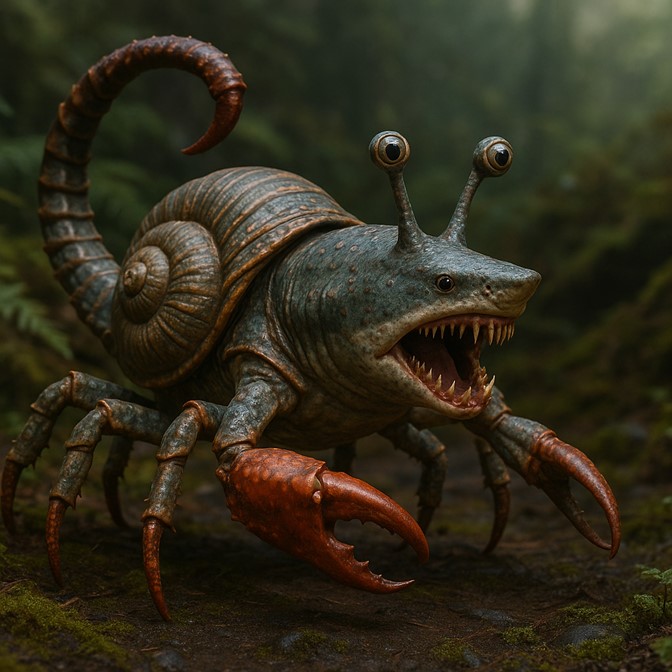
Adventurers in the world of Saṃsāra might encounter or actively seek out a Scorpsnailsharkrab 42 for a variety of reasons intertwined with the high-magic ecosystem, cultural significance, and mechanical opportunities within the setting, where this feral fusion of scorpion, garden snail, great white shark, and fiddler crab traits represents both a formidable challenge and a valuable resource in quests, trades, and tier progression. Encounters often occur spontaneously while traversing Ghassulian’s coastal and riverine zones—wadi springs, sandy shores, shallow pools, or cave streams—where the creature’s ambush tactics make it a frequent peril in unsafe areas, halving AC and compelling parties to rely on enhanced senses or gear like nasal clips to detect its chemical traces through its sensory pits. For example, while navigating these environments to reach forgotten ossuaries inscribed with ancient Ghassulian motifs, a party might stumble upon one burrowed in mud, its shell coiled for camouflage, erupting with a stinger lunge or pincer grab that injects venom, necessitating a quick mana boost to prevent death at 0 HP and allowing silver fire additions to counter its regeneration. Such chance meetings intensify during magical ebbs, when loose packs coordinate sensory data to encircle groups with ink-mucus clouds, transforming a routine journey into a survival ordeal that rewards HP recovery via scavenged mineral licks found nearby.
Deliberate searches for the Scorpsnailsharkrab 42 typically arise from quests leveraging its unique biological and magical attributes, aligning with the Forge of Eternal Renewal religion’s focus on transmutation and endurance, or broader Ghassulian cultural practices of harvesting feral essences for alchemical refinements. Artisans in walled forges or megacity smithies might commission adventurers to extract its venom glands, which brew into potions granting temporary paralysis effects for combat or crafting gear like digit rings that add +2 to grappling rolls via Mind’s Eye glimpses of basic stats, enhancing strategic planning in unsafe zones. These glands, infused with paralyzing mucus, serve as critical components in forging copper sheaths that resist corrosion, or in meals fermented over 20 minutes to create antidotes restoring 1d6 HP from poison debuffs, tying into the culture’s emphasis on balanced healing without exceeding daily limits of three feasts. Similarly, temple priests of Ghassura could task a party with capturing a specimen alive for ritual study, utilizing its shell armor—capable of regenerating 1d6 HP per turn in water—to symbolize the deity’s renewal enforcer tag, potentially unlocking library advantages for researching abstract concepts like eternal alloys, aiding in puzzles or decoding artifacts from disappearing islands.
Another compelling motive involves the creature’s hoarding behavior, as it collects shiny metals or mana-rich ores in its lairs, attracting treasure-hunting parties seeking attunable gear. Explorers delving into wadi groves might pursue one after passive Mind’s Eye activations reveal a trail of copper remnants leading to its den, where scavenged crystals enhance mana residues, offering boosts up to 10 times tier for unresistible damage in battles. This connects to story arcs where the Scorpsnailsharkrab guards Ghassulian relics, such as molten hammer amulets that add specialized slots without counting extra, making it a target for quests from the House of Qashtara to reclaim heirlooms disrupted by magical weather. In higher-tier campaigns, adventurers could hunt one for possession as an avatar, merging its traits into a gestalt for enhanced sensory shares—tripling distances at tier 3 or removing planar limits at tier 5—ideal for underwater or cave explorations where its aquatic-land adaptability excels, though initial memory clashes cause disorientation until integration.
Bounties from Ghassulian settlements offer practical incentives, as the creature’s predatory instincts disrupt fishing caravans or ore mining communes, prompting rewards in precious metals (10 silver for a confirmed kill, rising to platinum for alphas) or gear from monarchy reserves. In cultural contexts, it features in lore as a guardian of hidden wadi veins, so parties aligned with the Forge of Eternal Renewal might track one during festivals, using Khassulic chants invoking Ghassura’s wadi guardian tag to double spell potency against its camouflage, turning the pursuit into a rite of purification. For Isekai characters recalling multiversal marine or desert biomes, seeking this fusion evokes quests to adapt past-life skills, like training in venom extraction to counter its stinger strikes. Negatively, encounters risk overwhelm from its ink clouds or venomous grapples, imposing debuffs that halt progress, but successes yield alchemical byproducts for HP-restoring meals or conduits that amplify rituals by 25% over six seconds. Overall, whether stumbled upon in unsafe wilds or hunted for its regenerative shell, the Scorpsnailsharkrab 42 embodies Saṃsāra’s feral transmutation, driving adventures that test equilibrium, reward craftsmanship, and deepen ties to Ghassulian’s cyclical heritage.
Harvestable items and ingredients from a Scorpsnailsharkrab 42 corpse include various parts valued for their hybrid properties, collectible post-death with a Survival check (DC 14) to maintain quality. Juveniles yield 1-3, adults 4-6, alphas up to 8; non-possessed allow full harvest, possessed add crystals with silver fire essence.
- Venom-Tipped Stinger Segments: Curved tail segments (3-5, 1-2 feet each), drained for venom lasting 1d6 days in vials. Used for poison conduits or gear like darts causing paralysis (Constitution save DC 13, restrained 1d4 rounds), doubled if chanted; in nasal clips for venom resistance (+3 saves) or potions enhancing grapples.
- Spiral Shell Plates: Coiled shell broken into 5-8 plates (1-2 feet diameter, 5-10 pounds). Craft shields or belts adding 2-3 slots without count, attuned for halved corrosion penalties; ground for dyes summoning barriers (reduce damage 1d4 in moist terrain) or camouflage gear (+2 Stealth in coastal zones).
- Denticle-Coated Skin Sections: 3-5 square feet patches from torso/limbs, preserved in oils. Tailor gloves/boots for swim speed +10 feet or +2 Athletics grapples; in salves for enhanced HP recovery (+1 HP long rests) or meals adding 1d6 HP restoration.
- Asymmetric Pincer Claws: 2 claws (one crusher 1-2 feet, one manipulator). Precision tools for digit rings (+3 manipulation rolls) or weapons with crush damage (1d8 + Strength, grab on hit); hammered into amulets revealing false stats via Mind’s Eye.
- Mucus Gland Reservoirs: 1-2 pints adhesive mucus, milked before congealing. Reagents for boot adhesion (+3 balance) or potions creating barriers (15-foot difficult terrain); in fermented meals for +1 HP per feast or resonance wards doubling AC in safe zones.
- Regenerating Tooth Rows: 4-6 rows (20-40 needles). Engraving tools for ear clamps (+2 crafting details) or firearm powders (+1 hit vs. armor); in nasal rings for scent wards (+ advantages survival in deathly areas) or meals enhancing poison resistance.
- Chromatophore Skin Patches: 2-4 square feet shifting skin. Tailor cloaks/robes for +3 Deception/Stealth; in belts for illusion pouches or underwater gear reducing fatigue in swims.
- Ink-Venom Hybrid Sacs: 1-2 quarts dark fluid. Dyes for threat displays (+2 Intimidation) or scrolls with poison clouds (1d4 damage/round, DC 12 save); in amulets countering grapples or wards doubling AC in safe zones.
- Other harvestables: Leg hooks for climb aids (+ speed bonuses) or spermatophores for fertility potions. Risks venom exposure (DC 12 save or poisoned); blood pools attract predators (unsafe area, halved AC). Valued 5-25 silver/item, gold for alphas; used in lore as refinement emblems, temples bless for pain reduction; crystals boost mana (2 points/session); traded with monster civilizations; Isekai adapt alchemicals.
Coiled Shell-Stinger and Wadi’s Hidden Bite
In epochs lost to whispers of sands and waters that flowed backward, when the wadis of Ghassulian hid secrets in depths unplumbed and the skies rained ores not yet forged, there lurked a beast born from the chaos of blends unseen. This creature, etched in plaques half-eroded as the Scorpsnailsharkrab, number forty-two in counts of seers who dreamed in venom’s haze, emerged from the primal mud where gods twisted forms like wires bent. The account, murmured through scribes whose inks faded from speeches older than shells cracked, tells how this feral one, with body of shark’s swift cut and snail’s coil tight, scorpion’s tail curved poison and crab’s claws uneven, stalked the thresholds where waves met stone. The phrases, warped by translations of elders who heard echoes in stings, speak of a predator that guarded the mana flows, its fusion teaching that strengths entwine but imbalance invites the deep’s wrath.
Long afore the cycles spun nine thousand waves crashing, the island’s shores pulsed with life feral, and from this blood of sea and sand arose the Scorpsnailsharkrab, nightmarish yet cunning in its make. The beast, called by some the Shell-Bite-Tail or the Pincer-Venom-Glider in runes twisted, wandered the coastal zones where wadis met the endless ocean, its shell spiral armoring a torso streamlined, legs eight jointed hooking into sands soft. Its maw lined with teeth rows endless, regenerating as shark’s kin, flanked by pincers—one crusher oversized, the other diminutive for grasps fine—and tail stinger venom-tipped swaying above like threat eternal. The creature, with eyes compound stalked rotating full circle, detected vibrations and chemicals in air moist, skin denticled for smoothness in swims, mucus foot gliding trails that hardened barriers temporary. In early days, it lurked in pools shallow, camouflage mottled grays blues shifting to reds blacks when rage stirred, ink sacs expelling clouds obscuring mixed with mucus for escapes sly.
The story bends, as ancient inks bleed, to a great hunt when the Great Ebb came, a time of magic withdrawing like tides low, leaving the wadis dry and the shells cracking. The Scorpsnailsharkrab, alone in its lair burrow, felt the pull of the gods’ decree, for it held no tier yet, feral and unbound by possessions. A swarm of shadow-leeches, forms of hunger from deeper abysses, sought to unravel the creature’s fusion, fraying its regeneration and dimming its senses. “Lurker,” they hissed in voices like pincers clicking, “thy shell offends the open, thy stinger mocks the still.” The beast, with instincts sharp as crab’s grasp, flashed its chromatophores in satisfaction predatory, ejecting clouds of ink-spore to blind the foes, and lunged with claws hooked, grappling one leech in pincers that secreted venom of paralysis, holding firm as the enemy writhed.
Yet the leeches numbered many, overwhelming the senses with illusions of endless deeps, debuffs that clouded the glimpses of stats basic—health low, weaknesses hidden. The Scorpsnailsharkrab, speed swimming twenty-five feet in bursts, retreated to moist burrows, regenerating wounds with shell cracks mending, healing dice of six plus hardiness in the damp. With gear none, for life forms hold no classes or slots spell-born, the creature trained skills in hunts ancient, adapting mucus trails to harden as barriers against pursuit. “Strike with balance,” the winds chanted in voices like shells grinding, words muddled from unknown speeches, amplifying ambushes by quarters in waits long.
The battle raged through ebbs, the creature’s stinger dangling to attract lesser prey for sustenance, diet of fish and crustaceans fermented in gut for strength renewed. Mana boosts, absorbed to ten times none since tier zero, reacted to health near zero, preserving one point amid the torrent, silver fire adding damage unresisted after strikes true. The beast, in pack loose with kin during ebb, shared data sensory across distances short, tripling at levels three though none it had, removing bounds planar at five, though clashes none since feral.
As the ebb peaked, Ghassura the Refiner watched, petitioned by spirits of the wadi who saw in the beast a symbol of fusion feral. “Let this shell-stinger teach equilibrium,” the deity intoned, voices like hammers on slag. The gods agreed, infusing the Scorpsnailsharkrab with limits—its ink not endless, cooldowns after ejections, overwhelm if senses overloaded by too many foes at once. Empowered thus, the creature emerged, camouflage shifting to blend with sands, leaping fifteen feet horizontal to ambush the leeches’ leader. With jaws unhinged, it bit savage, piercing two dice of six, while legs jetted propulsion in water, flanking swift. The leeches, stats revealed by eyes compound—constitution frail but intelligence cunning—faltered under coordinated flares, the beast’s emotions of anger enlarging pincer dominant to daze, stunning for rounds short.
Victorious, the Scorpsnailsharkrab claimed the abyssal pools, its lair hoarding shiny metals from fallen shadows—ores half-refined, crystals pulsing mana. Scribes in Ghassulian temples etched this on ossuaries symbolic, translations warping names: from Scorpsnailsharkrab to Shell-Venom-Biter or Pincer-Tail-Glider. The creature became legend, emblem in the Forge of Eternal Renewal for fusion feral, its regeneration teaching that wounds heal in havens moist, but excess lures danger. In later cycles, when souls possessed forms, some sought the beast for merger, its traits enhancing gestalts—sensory acute detecting chemicals hidden, pincers manipulating for crafts fine.
The tale twists further, as ancient inks fade, to times when the Scorpsnailsharkrab migrated during islands appearing, its speed gliding fifteen feet in trails mucus to claim territories new, packs forming in ebbs to share vibrations sensory, coordinating hunts like quantum links without dim. In underwater depths, it adapted with nictitating membranes for clarity, detecting residues magical for stats basic, while in wadi springs, it burrowed sands for ambushes, stingers mimicking threats to draw adventurers unwitting. One such, a Qassuli scout of tier two, encountered the beast in pool shallow, its grapple strike restraining with poison dice four, but the scout, with mana boost reactive, preserved one health, countering with fire silver unresisted.
The creature, in lore passed through festivals, warned of greed—hoarding too many ores leading to overwhelm, debuffs temporary like cooldowns after activations repeated. Scribes noted its diet opportunistic, cannibalism in scarcities echoing scorpion traits, and emotions primal: satisfaction in hunts vibrating shell to signal unintended, fear accelerating ink for clouds thicker, curiosity extending eyes stalked for novelties, leading migrations exploratory. In Ghassulian trades, its parts harvested—stinger segments for darts venomous, shell plates for belts slot-adding, mucus for potions adhering—fetched silver ten or gold for alphas, blessed in temples to enhance meals roleplayed, restoring points health extra.
Yet the story warns of recurrence: in ebbs strong, the Scorpsnailsharkrab grows aggressive, its tags as ambush lurker and venom injector drawing it to mana sources hidden, enriching environments but attracting rivals low. Adventurers, in quests from House of Qashtara, hunt it for essences regenerative, symbolizing cycle eternal under Ghassura’s guardianship. The beast, capable for possession, merges into avatars feral, advancing tiers with shells as conduits chant-amplifying, twenty-five percent in recitations long. In underwater guilds or cave metropolises, adaptations echo: buoyant for planar at five, or symbiotic with beasts cleaning shells for protection mutual.
The codex, stamped on plaques copper half-corroded, speaks of vigilance eternal, for the Scorpsnailsharkrab lurks in thresholds, its fusion teaching that strengths blend but imbalance invites the wadi’s bite.
Moral of the Story: Blend strengths with care, for excess unbalances the shell of life, but harmony in fusion guards the path eternal.
Suggested conversions to other systems:
Call of Cthulhu
Abyssal Shell Horror
STR 70 (4D6×5), CON 75 (4D6+3×5), SIZ 55 (3D6×5), INT 50 (3D6×5), POW 65 (3D6+6×5), DEX 85 (5D6×5).
Move 8/12 swimming. HP 13. Build 1. Damage Bonus +1D6.
Attacks: Pincer Crush 55%, damage 1D8 + DB + grab (opposed STR to escape); Stinger Strike 60%, damage 1D6 + DB + venom (CON roll or paralyzed 1D4 rounds); Bite 45%, damage 2D6.
Armor: 4-point shell and denticles (regenerates 1D4 HP per round in water).
Sanity Loss: 1/1D6 to see the creature; 1D4/1D10 if witnessing its unhinging maw or ink ejection.
Spells: None, but in mana-rich zones, it may channel Contact Deep Ones (costs 1D4 Magic Points, summons minor aquatic entities).
Notes: This horror fits Call of Cthulhu’s cosmic threats, balanced for seasoned investigators. Its regeneration and venom make ambushes lethal, but dry land halves speed and regen. Adjust for lower groups by reducing HP.
Blades in the Dark
Slag-Coiled Ambusher
Magnitude 4 (Scale 2, Quality 3).
Harm: Stinger Venom (2 harm, desperate position if failed resistance), Pincer Grasp (3 harm, risky position), Shell Bite (4 harm, limited effect vs. armored).
Clocks: Territorial Lurk (4 segments: Detect vibration, Camouflage coil, Stinger lunge, Ink retreat). Pack Ebb Surge (6 segments: Sense mana flow, Coordinate pincers, Shell ram, Venom injection, Regenerate in pool, Reclaim territory).
Special: Shell Regeneration (reduce harm by 1 in water; resist with Wreck to crack shell). Chromatophore Shift (gain +2 effect on stealth in wet terrain). Mucus Trail (create slippery hazard, -1 position for pursuits).
Notes: Suited for Blades’ gritty heists in flooded districts, this ambusher acts as a hazard with pack dynamics during “ebbs” (+1 quality). Balance by allowing Survey or Hunt to spot vibrations early, shifting from desperate to controlled.
Dungeons & Dragons
Venomcoil Sharkbeast
Medium monstrosity, neutral
Armor Class 17 (natural armor)
Hit Points 78 (12d8 + 24)
Speed 30 ft., swim 50 ft., burrow 10 ft.
STR 16 (+3) DEX 14 (+2) CON 15 (+2) INT 6 (-2) WIS 13 (+1) CHA 8 (-1)
Saving Throws Con +5, Dex +5
Skills Perception +4, Stealth +5
Senses blindsight 30 ft., passive Perception 14
Languages —
Challenge 5 (1,800 XP)
Amphibious. The venomcoil sharkbeast can breathe air and water.
Shell Regeneration. At the start of its turn, if in water or moist terrain, it regains 5 hit points if it has at least 1 hit point.
Venomous Stinger. On a hit with its stinger, the target must make a DC 13 Constitution saving throw or be poisoned for 1 minute.
Actions
Multiattack. The sharkbeast makes two attacks: one with its pincer and one with its stinger or bite.
Pincer. Melee Weapon Attack: +6 to hit, reach 5 ft., one target. Hit: 8 (1d10 + 3) bludgeoning damage, and the target is grappled (escape DC 13).
Stinger. Melee Weapon Attack: +6 to hit, reach 5 ft., one grappled target. Hit: 7 (1d8 + 3) piercing damage plus 7 (2d6) poison damage.
Bite. Melee Weapon Attack: +6 to hit, reach 5 ft., one target. Hit: 10 (2d6 + 3) piercing damage.
Ink Cloud (Recharge 5-6). The sharkbeast expels ink in a 15-foot radius. The area is heavily obscured for 1 minute, and creatures inside must succeed on a DC 13 Constitution saving throw or be blinded for 1 minute.
Notes: Balanced for D&D 5e mid-level parties (CR 5 for 4-6 adventurers). Its regeneration and venom encourage environmental play; dry land halves regen. Adjust CR by adding pack allies for higher threats.
Knave
Ink-Sting Crawler
Level 5 (5d6 HD, 25 HP). Defenses: Physique 14, Agility 13, Intellect 10, Willpower 11. Armor 3 (shell denticles). Morale 8.
Attacks: Pincer grasp (d8 damage + grab; target saves vs Agility or restrained, d4 ongoing poison), Stinger jab (d6 damage + venom; failed Physique save paralyzed 1 turn).
Special: Shell Regen (heals d4 HP/turn in water), Ink Ejection (obscures 15 ft area 1 turn, failed Willpower blinded), Camouflage Shift (+2 stealth in coastal/wet terrain).
Notes: Fits Knave’s OSR simplicity as a level 5 threat for small groups. Acts in ambushes with morale checks for retreat; loot includes venom glands for poison potions or shell plates for +1 armor gear. Balance by reducing HD for easier encounters.
Fate
Coiled Venom Lurker
Aspects: Feral Shell-Bound Ambusher, Hypnotic Stinger Tail, Regenerative Mucus Glider
Skills: Athletics +4, Stealth +3, Physique +3, Notice +2, Fight +4
Stress: Physical 3, Mental 2
Consequences: Mild (2), Moderate (4)
Stunts:
- Stinger Venom Strike: Once per scene, after a successful Fight attack, spend a fate point to inflict a “Paralyzed Grip” aspect on the target, requiring a Physique overcome to remove.
- Shell Regeneration: Gain +2 to Physique rolls to defend or recover from physical stress when in water or moist terrain.
- Ink-Mucus Cloud: As an action, create a “Obscured and Slippery” zone aspect with two free invokes, covering a small area and imposing -2 to actions within until cleared.
Notes: This creature suits Fate’s narrative style as a mid-tier threat, with aspects driving environmental combats in wadis. Balance for groups by allowing compels on its territorial nature, encouraging clever use of terrain to counter regeneration.
Numenera & Cypher System
Shell-Sting Aberrant
Level: 5 (15 points of damage, effort cost 5)
Motive: Territorial predation and mana hoarding
Environment: Coastal wadis or cave streams (Ghassulian zones)
Health: 20
Damage Inflicted: 5 points
Armor: 3 (spiral shell)
Movement: Short on land (10 ft.), long swimming (40 ft.), burrow short (10 ft.)
Modifications: Stealth tasks as level 6 in water; Might defense as level 6 due to shell.
Combat:
- Pincer Grasp: Melee attack, 5 damage + grab (target Might defense or immobilized, 2 points ongoing poison until freed).
- Stinger Jab: Melee to grabbed target, 4 damage + venom (level 5 Might defense or paralyzed 1 round).
- Ink Cloud: Creates level 4 obscuring field (15-ft. radius) for 1 minute, level 4 Might defense or blinded (hindrance +2 steps).
- Regeneration: Recovers 3 health per round in water if not at 0.
Loot: 1d6+2 shins, 1 uncommon cypher (venom injector glove), possible oddity (chromatophore skin patch for camouflage).
Notes: Fits Numenera/Cypher’s weird biomes as a level 5 threat for tier 2 explorers. Regeneration promotes hit-and-run tactics; adjust by adding cypher-like “ebbs” for pack boosts (+1 level).
Pathfinder
Mucus-Shark Scuttler
Medium aberration (aquatic), neutral evil
Armor Class 18 (natural armor)
Hit Points 85 (10d8 + 40)
Speed 25 ft., swim 40 ft., burrow 10 ft.
STR 17 (+3) DEX 15 (+2) CON 18 (+4) INT 5 (-3) WIS 14 (+2) CHA 6 (-2)
Saving Throws Con +7, Dex +5, Wis +5
Skills Perception +5, Stealth +5
Senses blindsight 30 ft., passive Perception 15
Languages —
Challenge 6 (2,300 XP)
Amphibious. The scuttler can breathe air and water.
Shell Regeneration. At the start of its turn, if in water or moist terrain, it regains 7 hit points if it has at least 1 hit point.
Actions
Multiattack. The scuttler makes two attacks: one pincer and one stinger or bite.
Pincer. Melee Weapon Attack: +6 to hit, reach 5 ft., one target. Hit: 10 (2d6 + 3) bludgeoning damage, and the target is grappled (escape DC 14).
Stinger. Melee Weapon Attack: +6 to hit, reach 5 ft., one grappled target. Hit: 8 (1d10 + 3) piercing damage plus 7 (2d6) poison damage, and the target must succeed on a DC 14 Constitution saving throw or be paralyzed for 1 minute.
Bite. Melee Weapon Attack: +6 to hit, reach 5 ft., one target. Hit: 12 (2d8 + 3) piercing damage.
Ink Cloud (Recharge 5-6). The scuttler expels ink in a 15-foot radius. The area is heavily obscured for 1 minute, and creatures inside must succeed on a DC 14 Constitution saving throw or be blinded for 1 minute.
Notes: Balanced for Pathfinder 2e mid-level groups (level 5-7), emphasizing aquatic ambushes. Regeneration encourages tactical environmental use; dry land halves regen. Adjust CR by adding venom immunity for tougher variants.
Savage Worlds
Pincer-Tail Marauder
Wild Card, Size 1
Attributes: Agility d8, Smarts d4, Spirit d6, Strength d10, Vigor d10
Skills: Fighting d8, Notice d6, Stealth d10, Swimming d8
Pace: 6; Parry: 6; Toughness: 9 (3 natural armor)
Special Abilities:
- Aquatic: Pace doubled in water.
- Pincer Grapple: Fighting +2, d8 damage + grab (opposed Strength or Agility to escape, -2 multi-action penalty).
- Stinger Venom: On grapple hit, Vigor roll (-2) or Paralyzed 1d4 rounds.
- Regeneration: Roll Vigor each round to heal 1 Wound in water (every 5 minutes out).
- Ink Cloud: Action (recharge d6), Medium Burst Template obscures ( -4 to actions inside), Vigor roll or Fatigued 1d4 rounds.
- Camouflage: +2 Stealth in coastal/wet terrain.
Gear: None
Notes: Suited for Savage Worlds’ fast play as a Wild Card foe for Seasoned heroes. Its regeneration and venom shine in water fights; balance by vulnerability to fire ( +4 damage). Loot: Venom glands for poison edges (+2 damage, Paralyzed on Shaken).
Shadowrun
Venomous Shell Stalker
B 5 A 7 R 6 S 5 W 4 L 3 I 5 C 3 EDG 4 M 0
Initiative 11 + 1D6 (Physical), Condition Monitor 11/11, Armor 8, Limits: Physical 6, Mental 5, Social 5
Qualities: Amphibious, Natural Venom (Paralysis, Vector: Contact, Speed: Immediate, Penetration: 0, Power: 10, Effect: Physical Damage and Stunned), Regeneration (Heals 2 boxes of Physical damage per Combat Turn in water)
Skills: Exotic Weapon (Stinger) 6, Perception 5, Sneaking 7, Swimming 6, Unarmed Combat 7
Powers: Camouflage (Rating 4), Enhanced Senses (Compound Eyes, Vibration Pits), Natural Weapon (Pincer: DV 6P, AP -1), Natural Weapon (Stinger: DV 5P, AP -2, Reach 1)
Attacks: Pincer Crush (DV 6P + Net Hits, AP -1; on hit, target grappled, opposed STR + Unarmed), Stinger Jab (DV 5P, AP -2, Reach 1; on hit, venom applies)
Notes: This critter aligns with Shadowrun’s urban wilds, balanced as a Professional Rating 4 threat for runners. Its lure acts as a distraction (opposed Con + Intuition vs. Charisma + Willpower, -2 dice pool on fail). Adjust for higher stakes by adding toxin resistance in corporate zones.
Starfinder
Coral Pincer Predator
CR 5; XP 1,600
N Medium aberration (aquatic)
Init +5; Senses blindsight 30 ft., low-light vision; Perception +11
Defense HP 60
EAC 17; KAC 19
Fort +7; Ref +7; Will +6
Defensive Abilities regeneration 5 (water/moist terrain); Immunities poison
Offense
Speed 30 ft., swim 50 ft., burrow 10 ft.
Melee pincer +12 (1d8+8 B plus grab) or stinger +12 (1d6+8 P plus venom)
Space 5 ft.; Reach 5 ft. (pincer 10 ft., stinger 5 ft.)
Offensive Abilities constrict (1d8+8 B), ink cloud (DC 15 Fort or blinded 1d4 rounds)
Statistics
Str +4; Dex +5; Con +3; Int -2; Wis +2; Cha -1
Skills Athletics +11, Stealth +16, Survival +11
Languages none
Other Abilities amphibious, chromatophore shift (+2 to Stealth in water)
Ecology
Environment coastal wadis, cave streams (Ghassulian)
Organization solitary or pack (2-4 during ebbs)
Notes: Balanced for Starfinder CR 5, targeting levels 4-6 parties. Regeneration halts with fire damage; ink cloud offers escape. Loot includes venom sacs (tech item: injector, 150 credits) and shell fragments (armor upgrade, +1 EAC).
Traveller
Wadi Shellsnapper
Scavenger/Ambusher
Hits 4D
Speed 4 m (swim 8 m, burrow 3 m)
Skills Recon 2, Athletics (dexterity) 2, Survival 2, Melee (natural) 3
Attacks Pincer (2D+2, grapple), Stinger (1D+3, venom), Bite (2D+1)
Traits Armour (+3 shell), Amphibious, Camouflage (+3 DM to stealth in water/sand), Regenerator (heals 1D per hour in moist areas), Venom (stinger: 2D ongoing if failed Endurance check)
Behaviour: Territorial, solitary but packs in mana-rich ebbs (1D+1 encountered)
Notes: In Mongoose Traveller 2e, this animal fits frontier worlds like Ghassulian-inspired terrains, balanced for scout difficulty (Difficult). Stinger grants +2 DM to surprise (Recon vs. target’s Recon). Loot: Venom glands (Cr 700, poison crafting) and shell (Cr 300, light armor).
Warhammer
Stingcoil Wadi Beast
M 5 WS 50 BS 0 S 45 T 50 W 20 I 40 Ag 45 Dex – Int 15 WP 35 Fel –
Traits: Amphibious, Armour 3 (shell plates), Bite +9, Constrictor (pincer grapple: opposed Strength or restrained, +2D10 damage per round), Dark Vision, Regenerate (heals 1D10 Wounds/round in water, stopped by fire), Venom (stinger: TB + SL damage, Stunned Condition if failed Toughness test), Weapon +8 (pincer)
Size: Average
Optional Traits: Chromatophore Shift ( +10% to hide in wet terrain), Ink Cloud (creates Blinded Condition in 5-yard radius for 1D10 rounds, failed Toughness or Poisoned)
Notes: In WFRP 4th Edition, this beast poses a Major threat for mid-career characters, lurking in Ghassulian marshes. Balance with Fear (1) for its grotesque form. Loot: Venom glands (Regeneration potions, 15 GC), shell for armor crafting (+5% soak), used in rituals for +10% to Heal tests. Adjust Wounds for larger groups.