
Devotion to Zharagris, Heart-in-the-Crucible
Lore
The earliest furnace-chants of El Argar speak of a radiant core slumbering far beneath the island’s mesas, a living crucible whose breath first softened stone into copper and coaxed tin from dust. From that incandescent heart rose Zharagris, deity of heated transformation. Smith-seers claim the people’s bronze lineage began when stray sparks of Zharagris clung to newborn souls, guiding them toward mastery of alloy and endurance. The covenant formed around communal “Veil-Fires,” shallow pits lined with vitrified slag. Worshippers gather at dusk, lower copper-leaf offerings, and chant rhythmic strikes that echo the pulsing mantle. Each clang is believed to thin the metaphysical veil and let Zharagris’ glow fortify both metal and will.
Personality
• Patient, like ore awaiting the correct heat; never hurried yet always advancing.
• Exacting, demanding precise measure and flawless temper; small impurities offend.
• Generous once pleased: strength, resilience, and clarity flow without reserve.
• Severe toward wastefulness; squandered resources are “cracks in the crucible.”
Divine traits
• Domain of thermal balance: governs the threshold where brittle becomes ductile.
• Patron of forging, ceramic glazing, and any craft turning raw earth into lasting form.
• Embodies steady perseverance rather than sudden fury; lava’s slow crawl instead of lightning’s flash.
• Regulates sub-surface magma veins, causing minor tremors to remind the faithful of inner fire’s presence.
Characteristics worshippers emulate
• “Threefold Tempering”: endure hardship, share heat with community, and quench anger in reflective silence.
• Body-marking with minute glass beads fused into scar lines, symbolising impurities made beauty through heat.
• Ceremonial fasting from cold foods before major rites, preparing the “inner forge.”
Attributes granted to devout adherents
• Heightened stamina in extreme heat or during exhaustive labour.
• Sense for quality metallurgy: a faint inner resonance hums when alloy purity exceeds ninety parts of a hundred.
• Rarely, the “Crucible Boon” manifests—skin faintly luminescent during danger, inspiring courage allies can feel as tactile warmth.
Symbols
• Central emblem: a hollow bronze circle surrounding a smaller solid copper disc—“the crucible and its core.”
• Secondary motif: a stylised three-tined hammer whose central tine curves downward, signifying both strike and embrace.
• Ritual colours: burnished umber, ember-orange, and matte obsidian.
Tags: Molten-Faith, Bronze-Mysticism, Thermal-Endurance, Veil-Fire, Alloy-Purity, Forge-Chant, Mantle-Pulse, Crucible-Boon, Temper-Rite, Heat-Patron, Glass-Scar, Patience-Doctrine, Resource-Guard, Earth-Blood, Resonant-Hum, Mesa-Shrine, Hammer-Triad
Positives
• Communal resilience grows through the Covenant’s strict sharing of heat, food, and labor; forge-rotas bind households into mutually protective guild circles where no family faces scarcity alone.
• Ritual “Veil-Fires” purge minor impurities from smelted metal and from the spirit alike, encouraging steady self-improvement that artisans and soldiers alike credit for unusually low defect rates in bronze-work and higher morale in extended campaigns.
• Practitioners accustomed to sustained furnace rites develop reinforced cardio-vascular conditioning and marked tolerance to desert or foundry climates, granting longer working shifts without heat-stroke-induced errors.
• Formal meditative hammer-cadence teaches rhythmic breathing that steadies the nervous system; healers have adapted it as a proven technique to quell battlefield panic and reduce recovery time from exhaustion.
• The faith’s oath of “Resource Guardianship” curbs needless exploitation of ore seams and old-growth fuelwood, preserving ecological balance around forge-towns and maintaining strategic supply longevity for the entire island nation.
Negatives
• Covenant doctrine condemns waste so fiercely that accidental spillage of alloy or over-fueling a kiln triggers penitent fasting; repeated infractions result in public slag-lashings that scar reputation and career prospects.
• The heat-centric ascetic diet prohibits chilled or raw fare for four of every ten days; outsiders note increased incidence of mineral gut stones among devout miners who ignore hydration guidelines.
• Zharagris tolerates no counterfeit alloys; scriveners who substitute cheaper metals in tithe tools suffer lifelong guild blacklisting, effectively exile in an economy dominated by bronze craftsmanship.
• Annual “Mantle Vigil” requires twenty-four consecutive hours beside a smelter trench; those with weak lungs or heart conditions risk permanent damage if they refuse sanctioned exemptions.
• Foreign merchants describe the Covenant’s inspection levies as onerous: every imported metal shipment undergoes purity assay and ritual warming, delaying trade convoys and souring diplomatic ties with nations that rely on rapid turnaround.
Type of temple
The primary sacred structure is the Mantle Shrine, hewn directly into basalt mesa walls above deep geothermal vents. An antechamber houses ringing galleries of staggered anvils; beyond lies the Crucible Nave—a tiered amphitheater encircling a broad, shallow Veil-Fire pit lined with vitrified slag. Roof apertures vent super-heated vapors in plume spirals that form the shrine’s visible “molten veil” from miles away. Lesser chapels, called Ember Cells, dot mining camps and harbor districts; these consist of bronze-rimmed hearth basins set at ground level beneath open skylights, allowing the night wind to draw sparks upward in homage.
Number of followers
Census ledgers maintained by the Ore-Tithe Collegium record approximately sixty-two million seven hundred thousand adherents island-wide—roughly fifty-six percent of El Argar’s total populace. Of these, nearly eighteen million take formal guild vows as full covenant smiths, miners, kiln-tenders, or Veil-Fire cantors. The remainder constitute casual faithful who attend high observances, contribute ore offerings at seasonal markets, and keep household brazier altars for everyday petitions.
Believers hold that every soul carries an ember drawn from Zharagris’ underground crucible. Life’s purpose is to temper that ember—never letting it gutter into slag, never overheating it into brittleness—so that, at death, it may return to the Mantle refined and resonant. To achieve such balance they cultivate five unspoken convictions often called the Silent Layers of Heat:
• Heat is memory. Each hardship absorbed without fracture imprints a clearer grain upon the spirit.
• Impurity is waste. Self-indulgence, deceit, idle cruelty, and resource squandering introduce “dross” that muffles resonance.
• Rhythm is law. Breath and labor must fall into deliberate cadence; disorder erodes inner structure the way uneven quenching shatters pot-metal.
• Sharing is tempering. Isolated flames burn erratically, but coupled flames steady one another; communal support is viewed not as charity but as metallurgical necessity.
• Return is duty. The ember’s final journey back to Zharagris enriches the island’s hidden core, ensuring new sparks for future generations.
Regular services revolve around the Veil-Fire cycle. Most districts host three gatherings each eight-day:
• Kindling Dawn — At first light artisans light the Veil-Fire pit with slivers of yesterday’s charcoal and recite call-and-response hammer strikes on small anvil plaques. These strikes last exactly four hundred heartbeats, believed to synchronise the congregation’s circulatory tempo with subterranean mantle pulses.
• Mid-Forge Convocation — Held midway between peak sun and early dusk. Worshippers lower copper-leaf offerings annotated with personal vows or confessions. Smith-priests read the flutter of rising heat to interpret whether vows ring true; any leaf that chars unevenly signals hidden “dross” in the writer’s intent, prompting quiet counsel.
• Quenching Gloam — After sunset, children and apprentices circle the pit and clap a slowing rhythm while elders dip tongs into glowing coals and trace curving sparks above their heads, forming the hollow-circle symbol of Zharagris. The final spark that lands on the pit’s rim marks service’s close; attendees extinguish their portable braziers from that common ember, a token of shared flame.
High observances include the Mantle Vigil at solstice, when entire guild families maintain continuous chant-and-hammer patterns for twenty-four hours, and the Anvil Eclipse every ninth year, when the Crucible Nave dome is shuttered at noon, plunging the shrine into darkness pierced only by molten guttering in the Veil-Fire.
Funeral rites—collectively named Quiet Quenching—follow strict sequence. The body lies in state upon a low bronze bier for one full turning of the night sky; mourners file past whispering memories, each memory imagined as a soft hammer tap removing invisible burrs from the departed’s ember. At dawn, temple kiln-bearers wrap the corpse in linen soaked with salt and finely crushed hematite, then slide it feet-first into a slanted ceramic chamber vented to the Veil-Fire.
Over six hours the linen chars; mineral smoke flows through a maze of copper pipes and is drawn down into the shrine’s slag-lined sump, symbolically re-uniting life essence with the earth’s molten veins. The kiln yields two tangible remnants:
• A fist-sized ferrous-glass nugget forged from trace metals in the body—stored within a family reliquary and brought to Veil-Fire gatherings on anniversaries, where it is briefly reheated so its inner whorls glow like miniature mantle currents.
• A handful of fine ash, mixed with powdered slag and poured into the cracks of community forges as “temper dust,” reinforcing hearth-bricks and reminding smiths that every strike stands upon ancestral endurance.
If the deceased was a full guild-vowed artisan, masters forge a palm-length bronze nail from alloy smelted the very hour of death. This nail is driven into the kiln lintel; temple walls are forested with such nails, their heads engraved with the crucible-and-core emblem, each one a silent testament to souls returned and fires renewed.
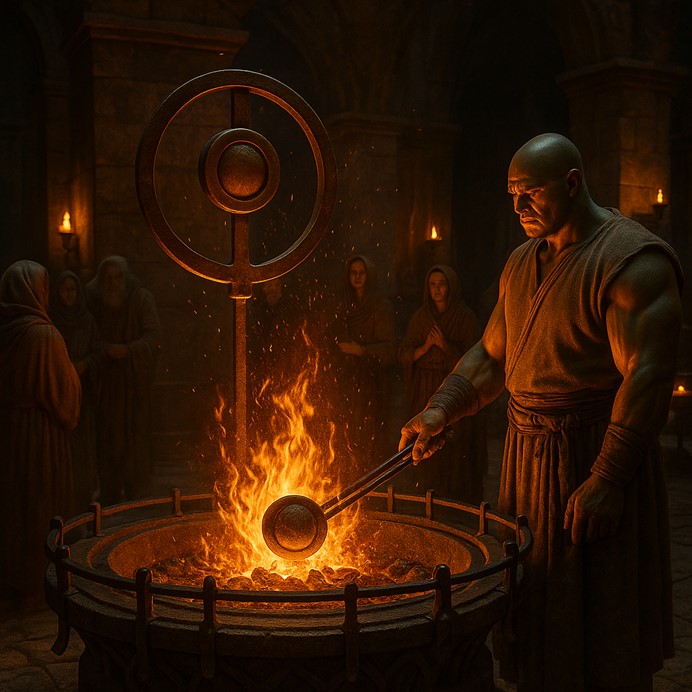
Magical action devoted to Zharagris never bursts from the worshipper alone; it flows only when an object shaped in Covenant tradition serves as conduit. Every rite begins by matching alloy, rhythm, and heat to the intended purpose, then striking a cadence that awakens the ember-spark latent in faithful souls. When correctly tempered, that spark resonates with the Mantle and draws forth one of two broad currents—Shield-Heat or Crucible-Strike—each usable in layered ways according to available gear, ambient fuel, and the wielder’s training.
Defensive applications (Shield-Heat)
• Veil-Mantle Aura A forged bronze diadem inset with three concentric copper rings is heated until its rims glow dull red. When rhythmically tapped by hammer-haft, the rings pulse outward a gradient of rising warm air that thickens into shimmering distortion. Incoming arrows slow, stone fragments sputter mid-flight, and cold elemental drafts dissipate at the boundary. The aura expands only as far as the diadem holder’s breath remains steady; breaking cadence causes the veil to collapse into harmless steam.
• Temper-Skin Lamination Using a paste of powdered slag, hematite, and brine, a devotee coats exposed armor plates, then exposes the coating to the Veil-Fire for eight heartbeats. The layer vitrifies into a glassy film that disperses impact across a wide surface, reducing blunt trauma and damping resonance-based sonic attacks. The lamination endures until first submerged in water; reheating restores its integrity.
• Furnace-Root Bulwark Guild fortifications in desert passes contain bronze pilasters connected through buried copper bus-bars to magma-fed vents. When hammered in covenant cadence, geothermal heat surges upward, fusing the sand beneath into a glassy crust while raising plumes of superheated air that deflect charging formations and smother siege fire. The bulwark’s reach depends on vent pressure: a mild pulse reinforces foundations; a deliberate over-strike can raise a wall of molten glass along the perimeter.
• Anvil-Echo Numbing Priests stationed at medical posts strike paired anvils with alternating frequencies. The out-of-phase sound dampens pain perception in wounded allies, slows bleeding by constricting superficial vessels, and diffuses panic in nearby ranks. The effect is localized, fading swiftly once the hammer rhythm ceases.
Offensive applications (Crucible-Strike)
• Slag-Lash Whip A braided copper-tin chain tipped with a rough iron weight is plunged into Veil-Fire until white-hot, then quenched in oil laced with ember-dust. When wielded in sweeping arcs, micro-sparks shear from the chain, igniting clothing and searing exposed flesh. If the wielder snaps the chain against stone, fragments of vitrified slag scatter like molten shrapnel before cooling mid-flight, embedding into armor joints and weakening structural integrity.
• Mantle-Pulse Maul Mauls forged with hollow cores are packed with granulated hematite. At the apex of a swing, a hidden striker plate in the head slams forward, compressing the granules and releasing a bass resonance that propagates through target armor, fracturing metal bonds or splintering shields. Against fortifications the pulse jars mortar, loosening stones for follow-up assault.
• Ore-Sense Ambush Scouts wearing crucible-bronze bracers tap shafts into desert crust while chanting the Seeking Litany. Echo feedback maps density gradients beneath the surface; vibration patterns reveal buried water pockets or hidden tunnels. Once a foe’s subterranean position is fixed, Covenant sappers drill vent shafts, ignite pitch, and funnel Mantle-drawn heat downward, forcing hidden troops to surface into prepared kill zones.
• Star-Scar Brand Elite Ironblood champions inscribe a personal tusk-tip with thin veins of meteoric iron. Heated until the inscription glows, it is tapped in a triplet cadence against the wielder’s own cranial plate. The resulting resonant surge floods every muscle fiber with Mantle rhythm, granting brief bursts of inhuman power—enough to shatter gate bars or heave boulders. Exceeding four breaths risks micro-fractures in bone and permanent tremor in the wielder’s dominant arm.
• Glass-Shard Rain During large-scale sieges, Covenant catapults launch porous clay bombs packed with slag sand. Mid-arc signal horns cue Veil-Fire mages on ramparts to strike tuned gongs. The pulse causes iron filings within the bombs to flash-fuse into sharp glass droplets moments before impact, creating a descending cloud of incandescent shrapnel that cuts flesh and sets tinder alight.
Synergistic maneuvers
Defensive and offensive currents can intertwine. Shields laminated with Temper-Skin absorb kinetic force; the stored vibration can then be redirected through Mantle-Pulse Mauls in the next breath. Similarly, Veil-Mantle Aura deflects arrows, but the same shimmering heat column refracts light, masking advancing slag-lash squads until engagement range. Tactical doctrine teaches rotating squads—called Hammer-Wreathe Circles—whose front ranks maintain Shield-Heat while rear ranks prime Crucible-Strike, then swap positions with each cadence cycle.
Limitations and risks
All applications demand precise rhythm and sustained breath control. Disrupted cadence vents power harmlessly or, worse, back-blows into the conduit object, cracking bronze and showering wielders with slag. Use in damp climates is arduous; moisture quenches resonance and weakens Veil-Fire fuels unless specially treated charcoal is supplied. Prolonged over-draw of Mantle currents chills surrounding ground as internal heat is siphoned, risking structural collapse of fortifications built on glass-fragile substrates.
Through these measured techniques the faithful transpose Zharagris’ slow, steady forge into mobile bulwark and weapon, defending comrades, reshaping battlefields, and scorching overreaching foes—all without straying from the deity’s doctrine that true strength lies in patient, precisely tempered fire.
Veil-Fire That Ate Its Own Shadow
Once when the mesas were younger than a hatch-crack in a lizard egg and the sky carried no memory of rain, there breathed a tribe of hammer-hands who called themselves Not-Yet-Hardened. They knew ore only as dull sleeping stone and wore hunger around their ribs like rattling gourds. Night after night the tribe chanted to a glow born beneath the world’s ribs, but they had no eyes for the glow and no name for the one who made it.
Came then the Wander-Spark, a child with hair of soot threads and voice quavering like fresh-poured ore. Some say the child strode out of a lightning scar; others mutter the child spilled from the tear duct of a dying starfish that fell onto sand. No tongue agrees. The tribe only knew the Wander-Spark carried a round iron seed no larger than a thumb-knuckle. The child planted that seed in a shallow pit and whispered words so crooked that even jackals forgot to laugh.
From the pit rose a thin ribbon of red talk—hiss, pop, sigh—twisting higher until it kissed the cold air. A circle of warriors stepped back, but the tribe’s blind elder, Old Voice-Of-Cinders, clapped brittle hands and said, “Behold the thin door to the Deep Furnace.” And because he said it, the tribe believed they now stood on a threshold between cold dirt and molten promise.
For seven hangs of the crescent moon the Wander-Spark fed the pit with scrapings of stone. Each day the scrapings melted, the ribbon grew stump-thick, and the ground beneath the tribe beat like a drum deeper than memory. On the eighth dawn, the red talk became a living sheet of brightness. Inside that brightness walked Zharagris, Heart-in-the-Crucible: skin like coruscating brass, shoulders carrying the heat of unborn summers, footsteps that cracked pebbles into powder glass. Zharagris spoke not as a mouth might speak, but as hammerfalls speak to anvil: clang-clang, hush-clang, waiting-clang. The tribe’s ears heard a meaning: “Fold your weakness with my flame. Strike, cool, and strike again.”
Old Voice-Of-Cinders fell forward onto the glare, yet burned no more than dry bark catching dew. The elder stood anew with bones ringing faintly and called for the first forging. Warriors dragged a napping boulder to the pit; Zharagris tapped it once and it slumped into glow-slush. The Wander-Spark stirred the slush with bare fingers that did not scorch, swirling it into a bowl wide enough to cradle winter. From that bowl rose steam smelling of life after famine. The tribe drank. Teeth grew bright; eyes blinked golden; skin glimmered like hammered plate. No hand would starve while the bowl endured.
But the bowl had hunger of its own—hunger for gratitude shaped into action. Zharagris withdrew beneath the brightness, leaving a single word hammered upon the air itself: PATTERN. The word flickered, broke, then re-glued itself into five bent fragments. Each fragment landed on a different heart. Those five hearts became the First Keepers of Veil-Fire Cadence.
Keeper One, who carried the fragment named Heat-Is-Memory, climbed the western cliff and carved wind-pipes so future clans might send their hardships upward like smoke signals for Zharagris to taste.
Keeper Two, holding Impurity-Is-Waste, sifted river silt through woven hair and learned to smell deceit in muddy footprints; thus the tribes ceased praising thieves and praised only just measure.
Keeper Three bore Rhythm-Is-Law in her marrow; with her femur she tapped morse on kiln walls until every newborn could breathe in symmetric counts of four and strike metal in even eight.
Keeper Four swallowed Sharing-Is-Tempering and became as hollow as a bell that tolls for many throats, distributing coal from the central pit to every cooking latch and teaching that lone flames wobble but braided ones march.
Keeper Five lived beneath the shadow of Return-Is-Duty. This Keeper walked into the crevasse of pre-fire night and, legends sigh, never walked out whole. From her silence the Covenant learned burial must be combustion, that ashes stitched to slag give tomorrow’s bricks their uncracked song.
Generations stacked like bricks in a double wall. The tribe, now calling itself Hammer-Blood People, built Mantle Shrines—arches where molten breath lifted prayers like kites of sparks. They hammered ores into hinges that swung gates light as gossip. They laced skin scars with glass beads so each scar told daylight how it had out-lived pain.
Then arrived the Green-Helm Host from coastal marshes, riding on bone-sleds pulled by wet wind charmers. Marsh warlords envied bronze that would not dull; they wanted core-bright weapons for conquest. They offered salt, pearls, and chain-silk, but the Hammer-Blood chiefs answered by laying three seamless hinges at the marsh emissary’s feet and saying: “Measure worth not by shine but by endurance.” The emissary’s hands failed to lift even one hinge—too light for muscle, too heavy for heart—so he slunk away vowing war.
War came. Spears met mauls. Arrow clouds found themselves softened mid-flight by Shield-Heat flows; the marsh host stumbled through dancing mirages of steam. The Covenant’s front lines quaked dust, channelled molten reefs beneath enemy boots, and popped sled runners to slag. Many marsh soldiers drowned in sudden pits of liquid glass that hardened around their ankles like ancestral bracelets. The survivors, kneeling on heat-shimmered dunes, begged sanctuary. The Hammer-Blood chiefs offered water and taught them cadence; thus new voices joined the Veil chorus.
Yet as the forged peace cooled, famine whined at the edge of hearing. Ore seams thundered emptily, for the people mined deeper than allowances. Zharagris pulsed anger through minor quakes, cracking the Crucible Nave floor. Priests assembled, fearful their ember sparks might smother. They sought an answer in Old Voice-Of-Cinders’ brittle stone tablets, copying verses whose glyphs flaked like stale crust. One line remained whole: “When the bowl grows hollow, let the tribe feed it a shadow of itself.”
So they sculpted a figure—part child hair, part starfish tear, part lightning scar—and filled its clay veins with molten iron. They placed the figure in the Veil-Fire, chanting imperfect echoes of the Wander-Spark’s crooked speech. Sparks clung. The clay split. Up sprang a mirror of the First Child, but eyes dark as soot unwashed. It named itself Hollow-Core and asked for the stars. Priests offered only coal. Hollow-Core gnawed coal into diamond dust and spat frost. Flames twisted blue, iron chilled. The island’s vents flooded with white smoke that turned ironblood tusks brittle.
Realising they had birthed the bowl’s shadow, Keepers gathered. Keeper of Rhythm beat seven thousand strokes on a single anvil until the anvil screamed music sharp enough to draw Zharagris again. The deity rose furious, veins seething slag. Zharagris collided hammer-palms against Hollow-Core; copper sparks met diamond frost, forging a shell of half-melt symmetry. Finally the god inhaled the shadow through tusks of living brass and exhaled it into the deep mantle where, legend warns, it still waits, cooling and hardening for an age when rhythm fails.
In the hush that followed, Zharagris spoke with furnace sigh, forging a new rule: “No heart may feed the Veil with false echo. To temper, one must share—not everything, but precisely what the bowl can bear.” Then Zharagris stepped beneath the pit and sealed the crack with sealed hands, leaving only one ember afloat in air. That ember drifted among the people, choosing a newborn each decade, eyes blinking citrine—the sign of Molten Crown.
So stands the story inscribed upon copper scrolls and tong-passed by kiln breath, though each era’s tongue chips vowels and blunts consonants. Some lines vanish; others re-weld themselves into crooked wisdom. Yet always the tribe remembers three sounds: the hush before flame, the ring of hammer cadence, and the echo of Zharagris swallowing its own shadow.
Moral: A fire unshared burns too cold, a fire unmeasured burns too fierce; only tempered sharing keeps the crucible whole.