
The Huo-Sar are the predominant race and ruling people of the volcanic island nation of Choukoutienian. Their physical form and culture are a direct reflection of their creation myth: they are the children of the First Flame, souls given substance and a voice by the fire in the heart of the world. They are a people of intense passion, profound resilience, and a unique power that resonates with the fiery, geological forces of their homeland. Their “look and feel” is one of dangerous grace, like that of polished obsidian or cooling magma.
Species, Physical Form, and Sensory Traits
- Species: Humanoid (Planar-Touched). The Huo-Sar are a humanoid species whose biology is fundamentally intertwined with elemental fire and resonant earth, a legacy of their origin as formless souls given shape by the First Flame.
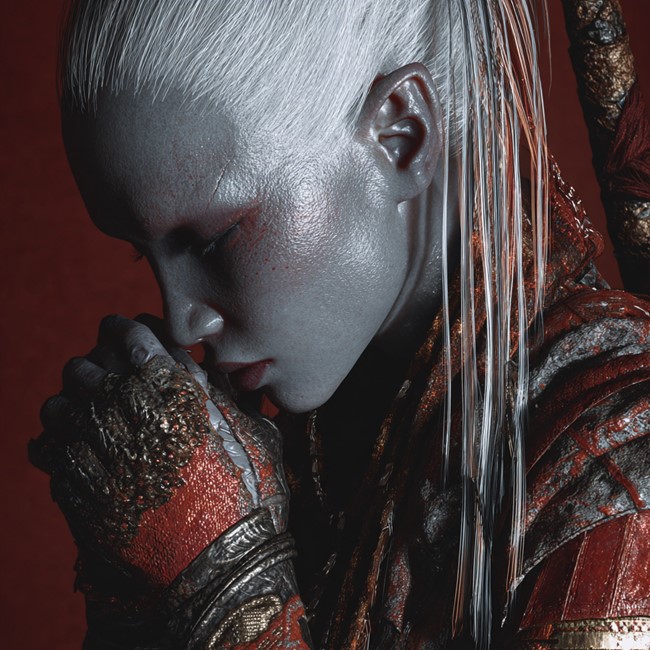
- Physical Form: Huo-Sar are known for their stark and dangerous beauty. They are typically tall and lithe, with a deceptive strength born from a life of labor in the great forges. Their skin is smooth, hairless, and naturally warm to the touch, with colors that mimic volcanic rock, ranging from deep charcoal grey and dusky red to the iridescent sheen of obsidian. Their hair is perhaps their most striking feature, often appearing as fine, flexible strands of spun volcanic glass (obsidian black, fiery orange, or coppery red) that can seem to shimmer with an internal heat. Their most unique biological trait is their vocal structure, which is capable of producing an incredible range of tones and frequencies far beyond that of other humanoids.
- Sensory Traits: Their senses are adapted to their subterranean, volcanic environment, with excellent low-light vision and a high tolerance for heat and toxic gases. Their hearing is exceptionally acute, extending into frequencies that allow them to perceive the deep, resonant hum of the earth. This leads to their unique sensory trait: Harmonic Resonance. This is not a magical power but an innate sensitivity to the vibrations and frequencies of their surroundings. A Huo-Sar can feel the structural integrity of a rock wall, “hear” a flaw in a cooling ingot of steel, or sense the pressure changes deep within a magma chamber before an eruption.

Sample photos of Male and Female Huo Sar
General Size
Huo-Sar are generally taller and more slender than the human average, with a graceful build.
- Average Height: 5’10” – 6’6″ (178–198 cm)
- Average Weight: 150–210 lbs (68–95 kg)
Body Pattern
In moments of intense emotion or when channeling magical energy through their gear, faint, glowing patterns like cracks in cooling lava will appear on a Huo-Sar’s skin. These patterns are unique to each individual, a visible manifestation of their “inner fire.” These patterns may become more complex and brighter as an individual gains experience and attunes to more powerful gear.
Life Cycle
Huo-Sar are born with a uniform dark grey skin and normal hair. Their unique fiery hair, stone-like skin tones, and powerful vocal abilities develop as they reach adulthood, which coincides with the awakening of their magical potential. Their entire education is focused on control and application, learning to harness their unique voice not for music, but as a precise tool for their chosen craft—be it smithing, architecture, or shamanism. They are long-lived, often reaching 160 to 180 years of age, their longevity suiting their patient and meticulous work as master artisans. Upon death, their culture’s “Return to the Shadow” rite sees their body committed to a burial chasm, returning it to the stone, while a ritual transfers their “spark” to the communal forge-fire.
Potential Positives and Negatives
- Positives: Their Harmonic Resonance gives them an unparalleled, innate advantage in any craft related to geology, mining, smithing, and architecture. Their natural resilience to heat and toxic environments is a significant survival trait. Their powerful and versatile voices, when focused through proper gear, are formidable tools.
- Negatives: They are poorly adapted to cold climates, suffering more acutely from low temperatures than other races. Their glowing skin patterns can betray their emotional state or make it impossible for them to hide in the dark. An untrained or undisciplined Huo-Sar whose vocal abilities manifest without control can be a danger to themselves and others, accidentally shattering stone or glass with an errant cry.
Tags: Huo-Sar, Humanoid, Planar-Touched, Fire-affinity, Obsidian-Skinned, Volcanic, Subterranean, Artisan, Smith, Shaman, Resonant Voice, Harmonic Resonance, Industrial, Communal, Heat-Resistant, Graceful, Forge-Dweller
Specialized Item Slots Available
The Huo-Sar’s unique vocal abilities are focused and amplified through a specialized piece of gear.
- Resonator Slot: A Huo-Sar can wear a piece of gear in a “Resonator Slot,” typically a gorget, choker, or a finely crafted amulet worn over the throat. This item, known as a Resonator, is not magical in itself but is a marvel of acoustic engineering, crafted from specific crystals, metals, or carved bone. It serves to focus, tune, and amplify the Huo-Sar’s vocal harmonics. The power comes from the Resonator, not the user’s innate biology. A smith’s Resonator might be tuned to the frequency of steel, allowing their “forge-song” to create flawless alloys. A warrior’s might be designed to focus their voice into a destructive, shattering shriek.
Environmental Adaptability
The Huo-Sar are masters of volcanic and subterranean environments. They can navigate treacherous lava tubes by sound and vibration alone and can work comfortably in the extreme heat of a great forge that would kill other humanoids. Their entire physiology is adapted to a world of fire, stone, and darkness.
Other Information
The Huo-Sar’s “song” is the sound of their civilization. It is not melodic music but a form of functional, resonant sound-craft. The song of a forge-city is a cacophony of thousands of voices humming in precise harmony to shape metal and stone. A warrior’s battle-cry is not just a shout but a focused, dissonant shriek designed to shatter shields or demoralize foes. The Forge-Matriarch, the ruler of the nation, is not just a political leader but the master vocalist, whose “First Song” sets the tone and prosperity for the entire nation. Their voice is not a lure for sailors, but a hammer that builds and a weapon that breaks.
Song that Woke the Obsidian Heart
It is told, from the heat-rippled glyphs on the oldest forge-walls, that in the dawn of the Huo-Sar people, their existence was a brittle and fragile thing. They were born of the First Flame, and they lived within the great mountain’s stony embrace, but the mountain was a restless and angry host. The obsidian they mined for their tools, which should have been their strength, was full of hidden cracks and flaws. An axe would shatter on its first strike. A spear-tip would break against the hide of a beast. The very earth they walked upon trembled with a deep, discordant rumbling, a sickness in the stone. The people were afraid, for their tools were weak and their home was unstable.
In this time of fear, there was a young artisan named Yan-li. She was not a chieftain or a great Fire-Tender. Her gift was not in the strength of her arm, but in the purity of her voice. When she spoke, the air seemed to hum, and when she sang her work-chants, the other smiths would fall silent to listen. She worked the flawed obsidian, and her frustration was great. One day, as she was polishing a blade that was riddled with tiny, spiderweb cracks, she let out a long, low note of sorrow. And a strange thing happened. As her resonant hum washed over the stone, the tiny cracks shimmered with a dull, red light and sealed themselves. The blade was made whole.
Yan-li was seized by a great wonder. She put down her polishing stone. She took another flawed piece of obsidian and held it before her. She sang to it. She sang a low, steady note, a note that felt like the deep, slow heat of the mountain’s heart. The obsidian grew warm in her hands and became strong, its flaws vanishing. Then, she sang a high, piercing note, a sound like a tiny crack appearing in hot glass. A new, clean fracture appeared in the stone, exactly where she had focused her will. She had found a new tool, one that was not held in the hand, but in the throat. She began to teach this to the other artisans, and they learned that their voices, in harmony, could shape the stone in ways no hammer could.
And so it was that the sickness of the mountain grew worse. The great volcano, the body of their world, began to shake with a final, terrible fever. The Forge-Matriarch and the Fire-Tenders prepared the rites for their people’s end. But Yan-li, whose ears now heard the song of the stone itself, knew the truth. “The mountain is not angry,” she told the Matriarch. “It is in pain. Its heart is fractured. It sings a song of breaking. We must sing it a song of mending.”
Taking with her only the most skilled of her fellow singers, Yan-li journeyed down, not up. She descended into the deepest lava tubes, into the very throat of the volcano, where the heat was a solid wall and the air was a chaotic roar of grinding stone and hissing steam. They came at last to a vast chamber, the heart-chamber of the mountain. Before them lay a sea of magma, and rising from it was a colossal, single formation of pure, black obsidian, as large as a chieftain’s hall. It was the Obsidian Heart of the world, and it was covered in a web of deep, glowing cracks. It vibrated with a terrible, discordant hum that was shaking the world apart.
Yan-li did not falter. She took a breath that was fire and ash, and she sang. She did not sing a melody of joy or sorrow. She sang a single, pure note of creation. It was the note that made stone whole. Her voice, alone, was a small thing in the great, roaring chamber. But then, one by one, the other artisans joined her, their voices finding the harmony, their Resonators glowing with focused power.
Their song, the First Great Forge-Song, rose to answer the mountain’s scream. It was the sound of a thousand perfect hammers striking a single, flawless anvil. It was the sound of order imposed on chaos. The discordant hum of the Obsidian Heart wavered. The song of the Huo-Sar grew stronger, a perfect, unbreaking wave of resonant power. The glowing cracks on the great Heart shimmered, and then, with a final, deep, and satisfying chime that was felt in the bones of every Huo-Sar on the island, the cracks sealed. The rumbling stopped. The chaotic roar of the chamber fell silent, replaced by the steady, peaceful, and powerful hum of a healthy, sleeping god.
When Yan-li and her followers returned to the surface, they found that their world was changed. The obsidian they mined was now perfect, flawless, and filled with a deep, inner strength. Their craft was no longer a struggle, but an art. And the Forge-Song became the most sacred of all their skills, the true foundation of their power and prosperity.
Moral: The strongest hammer can only break what is there. But the truest voice can create what is not. A people who learn to sing in harmony with the heart of their world can never be shattered.