
The original life forms merged into this single feral life form are the cone snail from class Gastropoda, the American lobster from class Crustacea, the purple sea urchin from class Echinodermata, and the moon jellyfish from class Scyphozoa.
Appearance
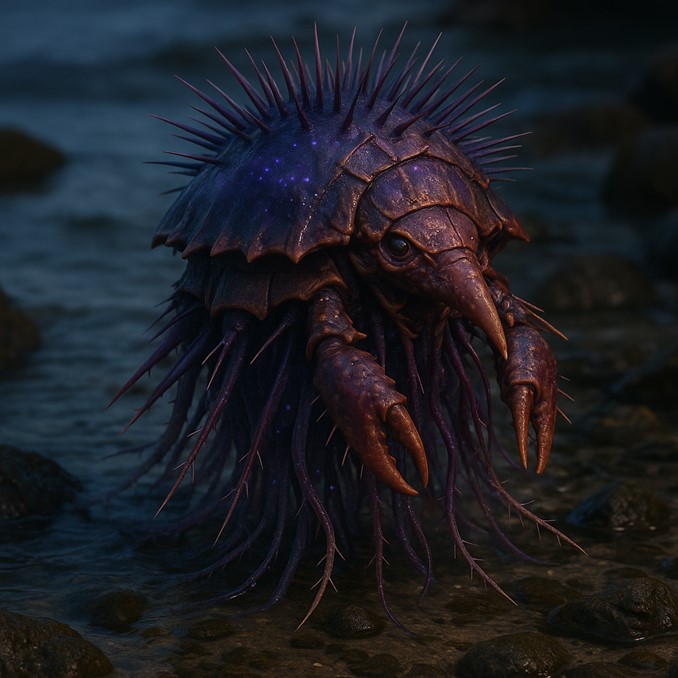
The Conelob Urchjelly 428 is a grotesque chimeric entity that fuses the venomous precision of a cone snail, the armored aggression of an American lobster, the spiny defense of a purple sea urchin, and the gelatinous drift of a moon jellyfish, creating a feral horror that haunts Saṃsāra’s coastal shallows and tidal zones like a pulsating relic from ancient evolutionary experiments warped by magical ebbs. Its core body resembles a bulbous, semi-transparent bell from the jellyfish, quivering with translucent gelatin that allows internal organs to be vaguely seen as shadowy pulses, tinted in hues of deep purple and indigo that shift with bioluminescent flares during agitation or feeding, mimicking urchin spines glowing under moonlight. This bell is armored with segmented crustacean plates borrowed from lobster exoskeletons, overlapping in rigid, claw-marked carapaces that crackle faintly when magical flows bubble nearby, providing a hard shell over the vulnerable jelly while allowing flexible undulation for movement. From the underside dangle numerous trailing tentacles, blending jellyfish nematocyst-laden arms with snail-like radula harpoons that extend to inject cone venom, each tipped with urchin-inspired spines that bristle outward in defensive arrays or retract for stealthy approaches. The head protrudes as a fused maw, combining lobster mandibles for crushing with a snail’s conical proboscis for piercing, lined with rows of urchin tube feet that act as sensory suckers to taste water currents or latch onto prey. Compound eyes dot the bell’s rim, multifaceted like lobster optics but embedded in jelly tissue for panoramic underwater vision, while a central siphon from the jellyfish expels water jets infused with snail mucus for propulsion or ink-like clouds to obscure escapes. In high-magic weather, the creature’s gelatin shimmers with elemental sparks, causing spines to elongate temporarily, and during molts, it sheds chitin shards embedded with nematocysts, leaving hazardous trails in mangrove roots or cave pools. This appearance conjures a drifting abomination from pre-Placement depths, where multiversal souls might have twisted marine beasts into such forms, mixing squishy, pulsating textures with clacking joints and stinging barbs, making it a feared symbol in Banpo lore as a “tide’s poisoned knot” etched into cautionary textiles.
Size
The Conelob Urchjelly 428 typically spans two to three feet in bell diameter when fully expanded, with tentacles trailing an additional three to four feet, comparable to a medium dog in bulk but compressible to half that size for squeezing through crevices or burrows. Its weight averages fifteen to twenty pounds, buoyant in water from jellyfish air pockets but heavy on land due to lobster plating and urchin mineral spines, enabling it to anchor against currents or scuttle across tidal flats. Juveniles hatch at a quarter this size from egg capsules, growing rapidly in nutrient-laden estuaries where magical nutrients hasten maturation, potentially achieving oversized forms of four feet in diameter near steam vents or ruin outflows, their extended harpoons reaching six feet for broader predatory range. This moderate size facilitates ambush in narrow reefs or uncharted island coves, posing concealed dangers to avatars harvesting shellfish or relics.
Speed
In water, the Conelob Urchjelly 428 jets with jellyfish siphons and lobster tail flaps, reaching bursts of twelve miles per hour in pursuits through currents or kelp forests, sustaining five miles per hour for extended drifts. On land, it crawls with urchin tube feet and snail muscular waves, moving at six miles per hour in short scuttles across mudflats, slowing to two miles per hour when burrowing with spine-assisted digs. Climbing utilizes suction tentacles, ascending four miles per hour on rocky shores or cave walls, boosted by magical ebbs that infuse its gelatin with buoyancy for brief floats. During low-magic lulls, speeds decrease as segmentation hardens, but in surging storms, it accelerates with elemental water, outmaneuvering schools in labyrinthine races.
Stat modifiers
The Conelob Urchjelly 428 features stat modifiers that highlight its merged versatility, positioning it as a tactical feral hazard in Saṃsāra’s encounters. It receives +3 to Dexterity from jellyfish fluidity and lobster agility, facilitating dodges and strikes. Constitution gains +2 via urchin spines and snail resilience, enduring prolonged battles. Strength is +1 from mandible crushes and harpoon thrusts, effective for grappling. Intelligence suffers -1, driven by instinctive swarms over cunning, vulnerable to decoys. Wisdom takes -2, impulsive in frenzies overlooking traps, while Charisma is 0, evoking dread without allure. These adjust with tiers in captures, where geared restraints enhance positives for study, aligning with forty percent at first tier for minor threats, escalating to two percent at fifth for dominant alphas commanding swarms.
Skills
Honed instinctively in Saṃsāra’s tides, the Conelob Urchjelly 428 excels in skills fusing its origins, manifesting at maturity without classes but refined through survival. Stealth allows color shifts for blending into coral or silt, ambushing with surprise. Athletics supports jet propulsions or climbs, using tentacles for leaps over waves. Perception sharpens with compound eyes and lateral lines, sensing vibrations up to thirty feet for prey detection. Grapple latches spines and suckers, restraining while injecting venom. Burrow excavates sand with tube feet, forming hides or traps. Venom Delivery harpoons toxins, causing paralysis debuffs. In groups, Swarm Coordination aligns attacks via electrical pulses from jelly traits. Regeneration mends gelatin passively in salinity, boosted by magic. These skills evolve with experience, elders showcasing chains like luring then grappling in reef explorations.
Behavior
The Conelob Urchjelly 428 exhibits schooling behavior like piranha packs, aggregating in clusters of twenty to forty in saline territories, signaling via bioluminescent flashes and pheromone mucus that mimic ant trails but diffuse in water for unity. It behaves as a voracious drifter, pulsing lures to mesmerize fish before swarming with snail harpoons, adapting urchin defenses by spiking outward against predators. Territorial clashes involve spine displays and ink ejections, resolving without fatality unless scarce resources prompt cannibalism. During magical flows, it congregates at ebbing vents for regenerative baths, sometimes partnering with crustacean beasts for joint hunts. Reproduction features jelly-like broadcast spawning in communal clouds, larvae guarded until schooling. Interactions with avatars are opportunistic, avoiding geared threats but overwhelming bare swimmers, and taming quests employ alchemical attractants to harness ant loyalty, though wild drives render them unstable sentinels.
Diet
Chiefly carnivorous, the Conelob Urchjelly 428 devours small marine life, harpooning fish with cone venom before jaws shred like piranha, augmented by urchin grazing on algae for minerals and jelly filtration of plankton. It parasitizes larger hosts with suckers, draining fluids leech-style during low prey. Magical ebbs supply energy through absorbed essences, lessening hunts, while in tidal pools, it scavenges detritus with mandibles. Captives receive brined meats laced with potions, excess causing hyperactive spining.
Emotions
Basic emotions motivate the Conelob Urchjelly 428, detectable telepathically by equipped avatars, with aggression flaring in red bioluminescence during intrusions, shown by tentacle whips. Curiosity gleams via lure flickers at novelties like submarines, prompting probes. Fear prompts ink bursts and burrows facing flames, a jelly weakness. Contentment dims pulses in post-feed drifts, promoting school tranquility. Devotion links packs, with distress signals rallying support, fluctuating in magic weather to heighten frenzies or cause lethargy.
Environment where found
The Conelob Urchjelly 428 dwells in Saṃsāra’s coastal ecotones, flourishing in Banpo’s mangrove fringes and reef labyrinths where salinity nourishes its gelatin and regeneration, nesting in coral burrows near clay ledges. Jungles border tidal zones for amphibious hunts, while caves and ruins provide shadowed lairs for luring. Uncharted islands foster populations in lagoons, and underwater hubs host submerged swarms feeding on currents. In megacities, it invades harbors with steam runoff, harassing docks.
Tags
Gastropod-harpooner, Crustacean-armored, Echinoderm-spiny, Scyphozoan-gelatinous, Marine-feral, School-predator, Venomous, Bioluminescent-lure, Chitin-plated, Sucker-grappler, Jaw-shredder, Mucus-secretor, Burrow-dweller, Electrical-signaler, Magic-absorbing, Reef-haunter, Tidal-scavenger, Tentacle-extender.
Life Cycle
The Conelob Urchjelly 428 navigates a durable life cycle tailored to Saṃsāra’s tidal fluctuations, merging the brooding of cone snails, the larval dispersal of lobsters, the regenerative budding of sea urchins, and the medusa-polyp alternation of jellyfish, advancing through phases that secure persistence in coastal and reef habitats. It starts with the egg phase, where adults release buoyant capsules—up to eighty—in sheltered coral crevices or mangrove root tangles, these capsules encased in jelly mucus that draws magical ebbs to gestate for two to four weeks, their opaque shells hardening with urchin calcite under lunar influences. Hatching aligns with high tides, yielding polyp-like larvae, tiny gelatinous forms with rudimentary siphons and spines, drifting on currents while feeding on plankton via nematocyst stings, regenerating lost segments from urchin traits to survive crab pinches. This larval stage endures four to seven months, during which they settle on substrates, molting to develop lobster plates and snail harpoons, transitioning to benthic juveniles. Juveniles, now a foot across, cluster in shallow pools, practicing swarm behaviors to hunt microcrustaceans, their bells expanding with jelly buoyancy and spines elongating for defense, growing swiftly in alchemical runoff from ruins where magic accelerates chitin formation. Adulthood commences at ten months, highlighted by full venom potency and lure maturation, with creatures swelling to two to three feet, their carapaces enabling advanced jetting and burrowing. Lifespan spans five years in the wild, extended to seven near steam outflows with elemental sustenance, with seniors displaying faded bioluminescence and weakened regeneration, withdrawing to swarm lairs to spawn before dissolution, their shells crumbling into nutrient shards that seed new capsules, reflecting a snail’s hermetic cycle. On vanishing islands, low-magic phases induce medusa dormancy in gelatin cocoons, safeguarding populations until ebbs revive them, adapting the cycle to Saṃsāra’s volatile shores.
Mating
Mating for the Conelob Urchjelly 428 is a synchronized, ebb-tied spectacle combining jellyfish broadcast spawning, lobster courtship dances, urchin external fertilization, and snail darting rituals, happening quarterly amid elemental water peaks that amplify fertility in Saṃsāra’s coasts. It begins with bioluminescent signals from lures, pulses rippling through water to assemble schools of twelve to twenty-five, promoting variety via soul-infused anomalies that occasionally yield glowing variants. Individuals, hermaphroditic like snails, perform aggressive displays: jetting in lobster tail-flicks while extending harpoons in non-fatal jabs, flashing purple hues to claim dominance, and releasing urchin gametes in preparatory clouds to test compatibility. Triumphant pairings entwine tentacles for spermatophore exchange, a process enduring hours in reef hollows, charged with magic that might mutate larvae like armored bells. The school then scatters eggs in communal bursts, fortified with chitin fragments, under group vigilance echoing ant nurseries. Asexual budding augments this, permitting isolated ones to regenerate clones from spine bases under duress, vital in disrupted caves or floating debris for repopulation. Echoes of Banpo matrilineality shape school structures, with larger, spikier specimens directing spawn sites linked to tidal bounties. Avatars near Shu-Van occasionally meddle with mating via geared nets for venom farms, breeding hybrids with intensified traits, shifting school patterns.
Tactics
The Conelob Urchjelly 428 deploys a refined suite of tactics rooted in its hybrid lineage, focusing on school synergy, venom precision, and defensive fortification to dominate Saṃsāra’s marine fringes. It prefers drift-ambush tactics, camouflaging bells against kelp with color shifts, then luring victims with hypnotic pulses before harpooning with snail accuracy, akin to urchin spine barrages but propelled by lobster claws for flesh-tearing. In schools, it performs pincer encirclements like lobster mobs, with flanks ejecting ink for disorientation while cores burrow beneath to spike upward, utilizing compound eyes for all-around vigilance to foil retreats. Protective tactics feature balling into spiny orbs with urchin arrays, exposing only venomous tentacles for ripostes, or dispersing electrical charges via jelly traits to stun encroachers, converting lone vulnerabilities into collective barrages. Regenerative tactics involve sacrificing harpoon segments as bait, budding anew over days, heightened by magical ebbs for rapid mends. Versus aerial foes like griffons or ships, it jets upward with siphons, parasitizing hulls stealthily. In race labyrinths, opportunistic schools funnel racers into chokes with vibrational lures, adjusting to avatars by targeting limbs with bites that erode gear, capitalizing on tier reliance to disable, and foraging ruins for alchemical enhancements to fortify school endurance.
Actions
The Conelob Urchjelly 428 executes a dynamic array of actions derived from instinct, modulated by Saṃsāra’s magic sans innate slots, though relic infusions in lairs may heighten impacts. Lure Hypnosis casts glowing pulses to entice targets nearer, succeeded by Harpoon Pierce that launches venomous proboscis at range, paralyzing while drawing in. Pincer Shred clamps mandibles for crushing, denting armor or shells. Burrow Surge tunnels sand with tube feet for concealment or flanks, while Ink Burst clouds zones with obscuring slime, bewildering pursuers. Venom Infusion via spines or bites induces lingering toxins, worsening with salinity. Regeneration restores gelatin passively in brine, quickened by bubbles. Electrical Pulse shocks nearby via jelly nerves, stunning schools of fish. In chains, it lures, pierces, shreds, then regenerates while burrowing, with domesticated forms schooled for Lure Scout, illuminating dark reefs for explorers, or Shell Guard, spiking against beasts.
Other Interesting Information
The Conelob Urchjelly 428 holds an essential niche in Saṃsāra’s marine balances, frequently illustrated in Banpo textiles as a “wave’s barbed tangle” denoting disrupted flows, its venom altering by habitat—paralytic in reefs, hallucinogenic near vents—positioning it as a resource for healers or assassins. Schools form chitin hierarchies with lure-bright “leaders” directing hunts, budding clones abundantly to swarm isolated coves. Bioluminescent storms generate spectral displays, enticing zeppelin crews into traps, occasionally leading to attachments where the creature scavenges barnacles from hulls. They accumulate metallic debris in lairs, confusing them for snail shells, luring avatar quests for tier artifacts, but violation incites spiny swarms. Diet affects bell translucency—carnivorous indigos for depth camouflage, algal violets for shallows—and alliances develop with lobster kin, sharing prey for mutual guarding. Nobles in Shu-Van rear variants as watchdogs, training harpoons for targeted stings in plots. In races, they act as fluid barriers, neutralized by sonic gear, while alchemists extract nematocyst essence for adhesives granting temporary adhesion potions, bolstering black markets in harbor dives. Sentience debates persist, with sea beasts deeming them comrades in reef societies, and port adaptations include infiltrating steam docks, evading hazards with lateral lines. Cave variants prey on glow fungi, and dormancy in arid spells conserves schools like urchin aestivation, regulating fish blooms in estuaries to sustain ecological weaves.
A party of adventurers in the world of Saṃsāra might encounter or actively search for a Conelob Urchjelly 428 for several compelling reasons tied to its unique traits, the coastal ecosystems of the island nations, and the high-magic environment that drives their quests. One primary motivation stems from the creature’s venomous harpoons and nematocyst-laden tentacles, which possess potent alchemical properties. Healers or alchemists in Banpo or Boian might commission adventurers to capture a live specimen or harvest its venom, seeking to craft antidotes, paralytic agents, or adhesives for trade or defense against rival factions. The venom’s variability—paralytic in reefs or hallucinogenic near steam vents—adds urgency, with specific variants prized in political intrigue or megacity black markets, offering rewards in platinum or enchanted gear to attract skilled parties.
Another reason arises from the creature’s accumulation of metallic debris and relics in its lairs, mistaken for snail shells, drawing treasure hunters to its coral burrows or ruin outflows. Avatars, especially those at higher tiers seeking upgrades to enhance their magical capabilities, might venture into these hazardous coastal zones to retrieve artifacts believed to be remnants of ancient civilizations or soul-infused relics from pre-Placement eras. The challenge lies in navigating its school tactics and regenerative defenses, testing skill and gear attunement, with successful recoveries granting prestige or tier advancements within matrilineal societies like Boian.
Encounters could also occur during trade route expeditions or griffon racing events along tidal labyrinths, where the Conelob Urchjelly 428’s opportunistic swarming disrupts schedules or endangers participants. Adventurers might be tasked by the monarchy or trade councils to clear nests from shipping lanes or protect zeppelin cargoes, aligning with tax-funded infrastructure goals to ensure safe passage across the 176,800,000-acre expanse of Boian or the 838,205,714 acres of Banpo. The creature’s presence adds a dynamic threat, requiring adaptive strategies to overcome its venom and spines.
Cultural and magical curiosity further drives searches, as the Vyrn-Ka of Boian or Wen-Tal of Banpo view the Conelob Urchjelly 428 as a “wave’s barbed tangle” symbolizing disrupted harmony or tidal wisdom. Pattern-Keepers or Sight-Keepers might enlist parties to study its bioluminescent lures or electrical pulses, aiming to integrate these into Tal-Vine inscriptions or Vyr-Tal chants for enhanced rituals, such as strengthening communal bonds or crafting enchanted textiles. This quest could involve negotiating with marine beast civilizations that consider it a kin, demanding diplomacy alongside combat skills, with rewards like insights into ancestral patterns or magical artifacts.
Accidental encounters are frequent in its habitats—mangrove fringes, reef labyrinths, or cave pools—where adventurers foraging for clay, hunting sea beasts, or fleeing political rivals might stumble upon its swarms. Its speed, venom, and regeneration make it a formidable foe, forcing parties to adapt with trained skills and tiered gear, potentially turning a random clash into a survival ordeal or an opportunity to earn reputation by subduing it for local acclaim. In a world where magic flows like weather and perspectives blur between people and beasts, the Conelob Urchjelly 428 becomes both a resource and a trial, drawing adventurers through necessity, ambition, and the allure of Saṃsāra’s oceanic mysteries.
From the corpse of a Conelob Urchjelly 428, several valuable items and ingredients can be harvested, each tied to its chimeric origins and offering diverse uses in Saṃsāra’s high-magic society. The venomous harpoons, derived from the cone snail proboscis, can be carefully extracted as hollow, needle-like structures up to six inches long, retaining their paralytic or hallucinogenic potency if preserved in sealed clay jars within hours of death. Alchemists in Banpo or Boian refine this venom into potions that induce paralysis for medical immobilization or hallucinogens for ritual visions, traded in gold or electrum for use in psychic defenses by Seda-Wardens or Pattern-Keepers, while diluted forms coat alchemical firearms for non-lethal takedowns in political skirmishes.
The segmented lobster carapaces, overlapping plates covering the bell, can be pried off with enchanted tools, each segment measuring four to six inches and exhibiting a durable, crackling chitin infused with magical static. These are crafted into lightweight armor pieces or gear inlays for Vyrn-Ka avatars’ Chest Glyph Plate slots, boosting constitution against physical attacks, and ground into powders for alchemical glazes that harden pottery or reinforce aqueducts in Boian’s terraced valleys, fetching copper or silver in trade networks supporting public works.
Nematocyst-laden tentacles, blending jellyfish stingers with urchin spines, remain flexible postmortem and can be severed at the base, each tentacle up to four feet with clusters of stinging cells that retain mild potency for days if stored in brine. These are woven into nets or whips by Banpo fishers for the Great Haul, infusing paralyzing strikes when enchanted with Shu-Wen, or processed into adhesives by Boian artisans for Tal-Vine inscriptions on textiles, enhancing durability and fetching nickel in underwater markets where divers use them to anchor gear against currents.
Purple urchin spines, bristling arrays dotting the bell and tentacles, can be plucked as rigid, mineralized needles one to two inches long, glowing faintly with bioluminescent residue. These are fashioned into sewing needles or ceremonial pins by Vyr-Sal artisans, channeling magic to imbue crafts with protective wards, and alchemists extract their calcite for potions that strengthen bone or gear, traded for platinum in cave megacities where they illuminate dark systems, contributing to the monarchy’s infrastructure.
Jellyfish gelatin, the translucent bell substance, can be scooped from the corpse as a quivering mass, retaining moisture and elemental essence if harvested fresh in magical containers. This gelatin is distilled into elixirs that enhance buoyancy or regeneration by Banpo alchemists, used in zeppelin rigging or by warriors to recover from wounds, while Boian ritualists blend it into inks for Tal-Vine scripts that glow during meditations, valued at silver for export to floating cities enhancing levitation harnesses.
Lobster mandibles, powerful crushing jaws from the head, can be removed whole, measuring three inches with serrated edges that retain sharpness for tools. These are forged into carving implements for Boian pottery wheels or Banpo weaving shuttles, enabling precise etching of ancestral patterns that channel Xiwang’s or Vidu’s protection, and adapted into claw caps for Wen-Tal, boosting grapple strength, traded in copper for steam factory abrasives.
Compound eyes, multifaceted orbs rimming the bell, can be excised and preserved in alchemical fluids, each eye a pea-sized gem capturing underwater heat signatures. These are embedded into scrying devices or visors for avatars, granting darkvision to spot hidden reefs or magical springs, used by Boian Sight-Keepers for divination in Still-Houses, and exported to underwater hubs for sonar lanterns, fetching silver to fund road networks.
Siphon mucus, a snail-derived secretion expelled via the jellyfish siphon, can be collected as a viscous, ink-like fluid, effective for obscuring or binding if gathered within a day. Alchemists refine it into smokescreens for tactical retreats or sealants for gear joints, employed by Banpo hunters or Boian strategists, traded for nickel in harbor dives for coral sealing.
Chitin shards from molted plates, scattered during death throes, yield jagged fragments one to three inches long embedded with nematocysts. These are ground into abrasives for polishing Legacy Stones in Boian or sharpening Banpo alchemical blades, and crafted into spine traps by military units, valued at copper for trade to airship builders reinforcing hulls.
Egg capsule remnants, if from a gravid specimen, provide nutrient-rich casings that can be scraped from reproductive tracts, serving as fertilizers for magical agriculture in Banpo floodplains or growth elixirs for Boian youth training. Alchemists brew them into tonics boosting dexterity for lower-tier avatars, and ritualists use them in Still-House ceremonies to stabilize Vyrn-Ka resonance, traded in nickel for communal enhancement projects.
Lira and the Shadowed Form
In the vault of worn etchings, it is marked that there was a time when the high stone was bare. A being of light was shaped. Yet it was not a being of full glow and firm stand. Its form was a veil in the ether, a flickering half that yearned for solidity. The ancient seers titled it the Veil-Ripper, for that was its act. Its measure was as a tall pillar, and its flowing parts were as many shattered stars. When the kin forged their First Core, which was a core of great depth and the work of all essences, the Shadowed Form would extend. And the core faded. Once more the core faded.
Thus it transpired that the threads of the kin began to dim. The people’s essences were hollow, and a hollow essence is a weak pillar in the frame of the whole. Unease was a chill mist drifting in their inners. The Clarity-Holders, who were the deepest of the reflectors, proceeded to the Silence-Abode. They positioned themselves before the Legacy Barrier, where the vintage crystals contained the pulses of the distant-gone. They gazed upon the flows, the curves and edges, pursuing the wisdom for how to bind a form that was a half-veil.
But no flow was present. The distant-gone had never confronted such an entity as the Veil-Ripper. Their wisdom was for the proper forms of the stone, not for this tear in the glow. Because of this, the ancient seers had visages like eroded peaks, and their pulses were burdensome. The ones they invoked as Vidu and Seda, the Quiet Duo, appeared voiceless, and the stone yielded no secrets.
Now, there was a forger whose designation was Lira. The designation possessed resonance, but the resonance is a blurred line. She was without complete lineage, a pillar erected by circumstance, not by full heritage. Her extensions, however, were adept with the essence-weave and the glyph-pulse. She was a hushed forger, but her reflections were sharp facets in her core. She observed the disturbance in the stronghold, and she observed the first core, dimmed and sorrowful upon the elevation.
Solitary she advanced, which was a path not advanced, in the obscurity of the lightless void. She advanced to the boundary of the High Stone to observe for the Shadowed Form. This was a substantial peril, for a lone pillar invites collapse. She concealed in the stone fissures, which were her designation in certain records. For six voids, she observed. She witnessed the half-form relocate. She witnessed it was not merely a devourer. It possessed a flow of its own. It would throb in a vast, gradual ring, and then direct its energy inward to rip the core. It employed its own surge as a divider. Its potency was a vortex of absence.
Lira returned to the stronghold. Her intellect was replete with the form’s flow. The aged cores, she perceived, were constructed to be sturdy centers. But one cannot construct a center on a stone to halt the mist. The mist merely encircles, or it dissolves the center. The Shadowed Form was akin to the stone’s sigh. It could not be centered against.
She grasped a weave-tool and a silver filament. She did not pulse the flow of the distant-gone. She pulsed the flow she beheld in her intellect, the flow of the throb. It was a ring that curved inward upon itself, a flow that did not cease but directed. It was an entity of great hazard and perhaps great folly to fabricate a fresh flow, a flow not bestowed by the long-vanished.
She bore her minor pulsing to the Clarity-Holders. Her essence-shell trembled, for they were seniors of elevated station. She uttered, with a voice diminutive as a spark, “The core should not be a center. It should be a throb. We must not confront its energy with our energy. We must utilize its energy to bind the pillar of its own dissolution.”
The seniors examined. They beheld her flow. It was not of the distant-gone. It was novel. It was an entity of unease. To forsake the ancient paths was to declare the distant-gone erroneous. But the absence of the stronghold was a mighty impetus. An aged Clarity-Holder, whose designation is misplaced, examined Lira’s pulsing and then at the dimmed First Core. He uttered, “An ancient flow that does not hold glow is merely a pleasing dimness. A novel flow that illuminates the stronghold is wisdom.”
And thus it was resolved. Lira, the forger who was a loosened pillar, positioned before the kin. She did not pulse the fresh core herself. That is not the manner. Her flow was displayed to all the pulsers. All the extensions of the stronghold labored to pulse the fresh First Core, the one they titled the Throb Core. Its configuration was peculiar, a circle of swirling essences. It required many spans.
They elevated the Throb Core on the stone. They placed it in the trajectory of the Shadowed Form. The great tear in the glow beheld it and advanced with much turmoil. It struck the core. But the core did not fade. The ringing flows captured the form’s energy. The more it contended, the more the core constricted, converting its own surge against it. It was directed by the throb, around and around, entangled and weakened, into the stable heart of the stone. There, its great potency was futile, and the forgers of the stronghold could terminate its cycle.
The stronghold had glow once more. The threads of the kin were restored. Lira was not expelled for her fresh reflection. Because she conveyed her flow back to the core, for all extensions to pulse, she was esteemed. She became a great Clarity-Holder. And her throb, the flow born of solitary observing, was appended to the Legacy Barrier, a fresh fragment of wisdom for all who followed.
The moral of the story: The wisdom of the distant-gone is a sturdy core, but when a fresh tear appears on the stone, a single pillar may discover the flow that all extensions must pulse to prevent the kin from dimming.
Suggested conversions to other systems:
Call of Cthulhu: Conelob Urchjelly Menace
STR 50 CON 60 SIZ 45 DEX 70 INT 20 POW 35
HP 11 MP 7
Damage Bonus: +0
Move: 8 (water), 6 (land), 4 (climb)
Armor: 4 points (lobster carapace and urchin spines)
Skills: Stealth 75%, Swim 65%, Track 50%, Grapple 60%, Sting 55%
Attacks: Harpoon Pierce 70%, damage 1D6 + venom (CON roll or paralyzed 1D4 rounds), Pincer Shred 60%, damage 1D8 + grapple, Tentacle Lash 55%, damage 1D4 + anticoagulant (reduces healing rate by half for 1 hour), Mandible Crush 50%, damage 1D6
Sanity Loss: 0/1D6
Special Abilities: Regeneration (restores 1D4 HP per round in saline or magical environments, unless fire or acid damage), Ink Burst (creates a 10-foot cloud obscuring vision, usable once per encounter), Lure Hypnosis (target must succeed on POW roll or be fascinated for 1D3 rounds)
Description: This menacing hybrid from Saṃsāra’s coasts blends venomous precision, armored aggression, and gelatinous drift, lurking in tidal zones or ruins. Investigators might face it during coastal expeditions, its regenerative and hypnotic traits challenging sanity and survival. Balance adjustments cap regeneration to once per combat round and limit ink and lure uses to maintain encounter tension.
Blades in the Dark: Conelob Urchjelly Tidehunter
Tier: 1 Quality: 2
Attributes:
- Resistance: 2 (regeneration and carapace)
- Harm: 2 (harpoon and shred)
- Armor: 2 (lobster chitin and urchin spines)
- Special: 2 (venom, hypnosis)
Stress: 6
Harm Capacity: 6 (3/6 boxes)
Load: 0
Clocks: Ambush (4 segments), Regeneration (6 segments)
Actions: - Skirmish: 2 (pincer shred, 2 harm close)
- Hunt: 2 (lure hypnosis, +1d to lure)
- Prowl: 2 (stealth camouflage, +1d to hide)
- Wreck: 1 (mandible crush, 1 harm close, reduces target armor by 1)
Special Abilities: - Harpoon Strike (2 stress): Launch venomous harpoon (range), 2 harm + paralyze (resist with Resolve), once per scene.
- Ink Cloud (1 stress): Eject obscuring ink (area), +1d to escape, once per downtime.
- Regenerate (1 stress): Heal 1 harm box in saline/magical area, resets clock; max once per downtime.
Description: This tidehunter prowls Saṃsāra’s coastal waters, a chimeric threat with school tactics and venomous allure. Crews may encounter it during smuggling runs or ruin delves, its ambush clock testing stealth. Balance is maintained with stress costs and clock restrictions, fitting Tier 1-2 crews, with venom scaled for narrative impact.
Dungeons & Dragons 5th Edition: Conelob Urchjelly Stinger
Medium Monstrosity, Unaligned
Armor Class 15 (natural armor)
Hit Points 58 (9d8 + 18)
Speed 20 ft., swim 30 ft., climb 15 ft.
STR 13 (+1) DEX 16 (+3) CON 14 (+2) INT 6 (-2) WIS 10 (+0) CHA 8 (-1)
Saving Throws Dex +5
Skills Stealth +5, Perception +2
Damage Resistances Poison
Condition Immunities Poisoned
Senses Darkvision 60 ft., Tremorsense 30 ft., Passive Perception 12
Challenge 3 (700 XP)
Traits:
- Regeneration. The conelob urchjelly regains 5 hit points at the start of its turn if it has at least 1 hit point and is in saline or magical terrain (stopped by fire or acid damage).
- Lure Hypnosis. Creatures within 15 feet that see the lure must succeed on a DC 13 Wisdom saving throw or be charmed for 1 minute (repeat save if attacked).
- Ink Cloud (Recharge 6). As an action, it expels a 15-foot-radius cloud of ink, heavily obscuring the area until dispersed by wind or water currents, usable once per short rest.
Actions: - Multiattack. The conelob urchjelly makes two attacks: one with its harpoon pierce and one with its pincer shred.
- Harpoon Pierce. Melee Weapon Attack: +5 to hit, reach 10 ft., one target. Hit: 8 (1d10 + 3) piercing damage, and the target must succeed on a DC 13 Constitution saving throw or be paralyzed for 1 minute (repeat save at end of turn).
- Pincer Shred. Melee Weapon Attack: +5 to hit, reach 5 ft., one target. Hit: 10 (2d6 + 3) slashing damage.
- Tentacle Lash. Melee Weapon Attack: +5 to hit, reach 10 ft., one target. Hit: 7 (1d8 + 3) bludgeoning damage, and the target’s healing is halved until a long rest.
- Mandible Crush. Melee Weapon Attack: +3 to hit, reach 5 ft., one target. Hit: 6 (1d8 + 1) bludgeoning damage, and the target’s armor class is reduced by 1 until repaired.
Description: This stinger drifts through Saṃsāra’s coastal waters, a fusion of marine traits with venom and regeneration. Parties may encounter it in Banpo reefs or Boian tidal zones, its hypnosis and ink challenging levels 3-5. Balance limits regeneration triggers and ink recharges to maintain difficulty.
Knave: Conelob Urchjelly Lurker
Level 3
HP 18
AC 14 (natural lobster carapace and urchin spines)
Attack +4 (1d8+2 harpoon pierce or 1d6+2 pincer shred)
Speed 20 ft. (swim 30 ft., climb 15 ft.)
Abilities:
- STR 12 (+1) DEX 15 (+2) CON 13 (+1) INT 6 (-1) WIS 10 (+0) CHA 8 (-1)
- Regeneration: Regains 1d6 HP at start of turn in saline/magical areas (negated by fire/acid), once per combat.
- Lure Charm: +4 to hit, range 15 ft., target must make WIS save (DC 12) or be charmed for 1 turn.
- Ink Cloud: Once per combat, create a 15 ft. radius obscuring cloud, lasting 1d4 rounds.
- Venom: Harpoon pierce applies poison (CON save DC 12 or -1d6 to next action roll, lasts 1 hour).
Inventory: None (feral, no gear slots)
Description: This lurker haunts Saṃsāra’s tides, blending marine ferocity with hypnotic lures. Knave parties might face it scavenging ruins or guarding trade routes, its regeneration and venom posing risks. Balance caps regeneration to once per fight and scales damage for Level 3 threats, suitable for 2nd-4th level adventurers with trained skills.
Fate: Conelob Urchjelly Drifter
Aspects:
- High Concept: Venomous Coastal Chimera with Regenerative Spines
- Trouble: Fragile in Dry or Fire-Prone Environments
- Aspect: School Swarmer with Hypnotic Lure
- Aspect: Armored Bell with Harpoon Tentacles
Skills: - +4: Athletics, Stealth
- +3: Fight, Notice
- +2: Physique, Shoot
- +1: Lore, Provoke
Stunts: - Regenerative Surge: Once per scene, spend a fate point to clear a mild consequence or reduce a moderate one by one step if in saline or magical terrain.
- Harpoon Venom: Gain +2 to create an advantage with Shoot using harpoon pierce, applying a “Paralyzed” aspect (resist with Physique).
- Ink Evasion: When defending with Stealth, spend a fate point to create an “Obscured Cloud” aspect covering the zone, lasting one exchange.
Stress: [1][2][3][4]
Consequences: [2] [4] [6]
Description: This drifter lurks in Saṃsāra’s tidal zones, a fusion of snail venom, lobster armor, urchin spines, and jellyfish drift. Fate parties might face it in coastal quests or ruin dives, its hypnotic and regenerative traits challenging mid-tier groups. Balance limits regeneration to scene-based use and scales venom aspects for narrative control.
Numenera & Cypher System: Conelob Urchjelly Reefstalker
Level: 4
Motive: Hungers for marine life and magical essence
Health: 15
Damage Inflicted: 5 points
Armor: 3 (lobster carapace and urchin spines)
Movement: Short (water), Short (land), Short (climb)
Modifications: Stealth and perception as level 5 due to camouflage and tremorsense
Combat:
- Harpoon Pierce: 5 damage, range short, target must succeed on Might defense (difficulty 4) or be paralyzed for 1 round.
- Pincer Shred: 5 damage, melee, target is grappled (Might defense to escape, difficulty 4).
- Tentacle Lash: 4 damage + anticoagulant (Might defense, difficulty 4, or healing halved for 1 hour).
- Mandible Crush: 4 damage, melee, reduces target’s armor by 1 until repaired.
Special Abilities: - Regeneration: Regains 1d6+2 health per turn in saline/magical terrain (negated by fire/acid), once per 10 minutes.
- Ink Cloud: Uses action to create a short-range obscuring cloud (difficulty +1 to attacks within), usable once per hour.
- Lure Hypnosis: Target in short range succeeds on Intellect defense (difficulty 4) or is charmed for 1 minute.
Loot: Cypher (venom dart, level 3) or oddity (bioluminescent spine).
Description: A reefstalker from Saṃsāra’s coasts, this level 4 creature combines venomous strikes and armored regeneration. Numenera parties might hunt it for cyphers in Banpo reefs or Boian shores, balanced by capping regeneration and hypnosis to once per encounter for 3rd-5th tier challenges.
Pathfinder 2nd Edition: Conelob Urchjelly Harpooner
Creature 4
Medium Monstrosity
Perception +8 (darkvision, tremorsense 30 feet)
Languages None
Skills Acrobatics +10, Athletics +9, Stealth +10, Survival +8
STR +2, DEX +4, CON +3, INT -2, WIS +1, CHA +0
AC 19 (natural armor); Fort +10, Ref +11, Will +7
HP 60; Immunities poison; Resistances poison 5
Speed 20 feet, swim 30 feet, climb 15 feet
Regeneration 5 (deactivated by fire or acid, activates in saline/magical terrain)
Ink Cloud [one-action] (Recharge 5-6); Effect Creates a 15-foot-radius cloud obscuring vision until dispersed.
Melee [one-action] Harpoon Pierce +12 (reach 10 feet), Damage 1d10+5 piercing plus Grab and venom (Fortitude DC 19 or paralyzed 1 for 1 minute)
Melee [one-action] Pincer Shred +12 (agile), Damage 2d6+5 slashing plus Grapple
Melee [one-action] Tentacle Lash +10, Damage 1d8+4 bludgeoning, target’s healing halved until long rest
Melee [one-action] Mandible Crush +10, Damage 1d8+2 bludgeoning, reduces target’s AC by 1 until repaired
Lure Hypnosis [two-actions]; Creatures in 15 feet must succeed DC 19 Will save or be fascinated for 1 minute (save if attacked).
Description: This harpooner infests Saṃsāra’s coastal waters, a chimeric threat with venom and hypnosis. Pathfinder parties might encounter it in Boian cliffs or Banpo mangroves, its regeneration challenging levels 3-5. Balance restricts ink recharges and scales venom DCs for group dynamics.
Savage Worlds Adventure Edition: Conelob Urchjelly Shellbreaker
Wild Card: No
Attributes: Agility d10, Smarts d4, Spirit d6, Strength d6, Vigor d8
Skills: Fighting d8, Notice d6, Stealth d10, Swimming d8, Shooting d6
Pace: 6; Parry: 6; Toughness: 9 (3)
Special Abilities:
- Armor +3: Lobster carapace and urchin spines provide natural toughness.
- Bite: Str+d6, reduces target’s armor by 1 until repaired.
- Claws: Str+d4.
- Regeneration: Natural healing roll every round in saline/magical terrain (negated by fire/acid), max once per combat.
- Harpoon Venom: Shooting +2, range 5/10/20, 2d4 damage + poison (Vigor -2 or Paralyzed for 1 round).
- Ink Cloud: Once per combat, create a Medium Template obscuring vision (-2 to attacks).
- Lure Hypnosis: Spirit roll opposed by target’s Spirit or fascinated (no actions) for 1 round.
Gear: None
Description: This shellbreaker ambushes from Saṃsāra’s tides, blending venomous strikes and armored resilience. Savage Worlds parties might face it in coastal trades or ruin hunts, its regeneration testing Novice to Veteran ranks. Balance limits regeneration to once per fight and scales venom for party size.
Shadowrun 6th Edition: Conelob Urchjelly Tidefiend
B 3 A 6 R 5 S 4 C 2 I 3 L 2 W 3 EDG 1 ESS 6 INIT 8+1D6
Physical Limit 5, Mental Limit 4, Social Limit 4
Armor 8 (lobster carapace and urchin spines)
Qualities: Regeneration (regains 1 Physical box per Combat Turn in saline/magical areas, negated by fire or acid), Venom (harpoon pierce, Vector: Injection, Speed: Immediate, Power: 10, Effect: Physical Damage, Paralysis), Low-Light Vision, Tremorsense (30 meters)
Skills: Close Combat 6, Perception 5, Sneaking 7, Swimming 6
Powers: Grapple (tentacles, +2 dice to clinch), Natural Weapon (Pincer Shred: DV 7P, AP -1), Natural Weapon (Mandible Crush: DV 6P, AP -2, reduces target armor by 1), Natural Weapon (Harpoon Pierce: DV 5P + Venom), Ink Cloud (obscures 10-meter radius, usable once per encounter)
Description: This tidefiend prowls Saṃsāra’s coastal shadows, a chimeric beast blending venomous harpoons, armored plates, and hypnotic lures, ideal for urban ports or wild reefs in Banpo. Shadowrunners might clash with it guarding ruins or as a corp bio-weapon, its regeneration testing street teams. Balance caps regeneration to once per scene in non-magical zones and limits ink use to maintain challenge.
Starfinder 2nd Edition: Conelob Urchjelly Starsea
Level 4
Medium aberration
Perception +10; darkvision, tremorsense (imprecise) 30 feet
Languages none
Skills Acrobatics +10, Athletics +9, Stealth +11, Survival +8
Str +2, Dex +4, Con +3, Int -2, Wis +1, Cha +0
AC 19; Fort +10, Ref +11, Will +7
HP 65; Immunities poison; Resistances poison 5
Speed 20 feet, swim 30 feet, climb 15 feet
Regeneration The starsea regains 5 HP at the start of its turn if in saline or magical terrain (deactivated by fire or acid damage).
Ink Cloud [one-action] (Recharge 5-6); Effect Creates a 15-foot-radius cloud obscuring vision until dispersed.
Melee [one-action] Harpoon Pierce +12 (reach 10 feet), Damage 1d10+5 piercing plus Grab and venom (Fortitude DC 19 or paralyzed 1 for 1 minute)
Melee [one-action] Pincer Shred +12 (agile), Damage 2d6+5 slashing plus Grapple
Melee [one-action] Tentacle Lash +10, Damage 1d8+4 bludgeoning, target’s healing halved until long rest
Melee [one-action] Mandible Crush +10, Damage 1d8+2 bludgeoning, reduces target’s AC by 1 until repaired
Lure Hypnosis [two-actions]; Creatures in 15 feet must succeed DC 19 Will save or be fascinated for 1 minute (save if attacked).
Description: A starsea drifting through Saṃsāra’s oceanic voids, this aberration fuses marine traits for predatory might. Starfinder crews might hunt it for cyphers in Boian tides or trade lanes, its venom testing level 3-5 parties. Balance restricts ink recharges and scales hypnosis for group balance.
Traveller 2nd Edition (2022 Update): Conelob Urchjelly Seabeast
Type: Pouncer
Terrain: Coastal/Reef
Number Encountered: 2d6 (school)
Weight: 20 kg
Hits: 2d6+3
Armor: Mesh +2 (lobster carapace and urchin spines)
Wounds: 3d6 (harpoon/tentacles), Venom (harpoon pierce: 2d6 damage + paralysis for 1d6 rounds, resisted by Endurance 8+), Ink Cloud (obscures 5m radius, once per encounter)
Weapons: Harpoon (pierce: +2 DM, 2d6 damage + venom), Claws (pincer shred: +1 DM, 2d6 damage), Teeth (mandible crush: +0 DM, 1d6 damage, reduces armor by 1), Tentacle Lash (grapple: +1 DM, 1d6 damage)
Behavior: Ambush predator, uses stealth (8+) to surprise, lures with hypnosis (Persuade 8+ or fascinated), regenerates 1d6 hits per day in saline areas
School: 6
Description: This seabeast haunts Saṃsāra’s shores, a chimeric pouncer with venomous harpoons and school tactics, suited for planetary hazards or trade threats in Traveller campaigns. Scouts might face schools blocking Boian ports, challenging 2-4 crew members. Balance adjusts numbers and limits regeneration to post-combat recovery.
Warhammer Fantasy Roleplay 4th Edition: Conelob Urchjelly Tideterror
M 6 WS 45 BS 0 S 40 T 40 W 14 I 35 A 3 LD 10 INT 15 WP 25 FEL 5
Traits: Armour 3 (lobster carapace and urchin spines), Bite +7 (mandible crush, reduces enemy armour by 1), Grapple (tentacles, +10 to hit, restrains until Strength test SL 2+), Poison (harpoon pierce, Toughness test or Stunned for 1d10 rounds), Regeneration (regains 1d10 Wounds per round in saline/magical areas, negated by fire or acid), Size (Average), Weapon +8 (pincer shred)
Skills: Dodge 45, Perception 45, Stealth (Coastal) 55, Swim 50
Talents: Ambush, Hardy, Menacing
Description: A tideterror warped by Saṃsāra’s chaotic tides, blending marine ferocity with regenerative horror stalking Boian reefs. Warhammer parties might slay it for alchemical gains or during port defenses, its venom testing low-career groups. Balance caps regeneration rounds and scales attacks for 1st-2nd tier foes.